Occupational Therapy for Adults With Cancer: Why It Matters
MACKENZIPERGOLOTTI,a,bGRANTR. WILLIAMS,bCLAUDINECAMPBELL,cLAUROA. MUNOZ,dHYMANB. MUSSb
a
Gillings School of Global Public Health, Department of Health Policy and Management, Cancer Care Quality Training Program and
b
Lineberger Comprehensive Cancer Center, Geriatric Oncology Program, University of North Carolina at Chapel Hill, Chapel Hill, North
Carolina, USA;cMemorial Sloan Kettering Cancer Center, Department of Occupational Therapy, New York, New York, USA;dMD Anderson
Cancer Center, Department of Occupational Therapy, Houston, Texas, USA
Disclosures of potential conflicts of interest may be found at the end of this article.
Key Words. Functional status x Occupational therapy x Activities of daily living x Quality of life
ABSTRACT
Adults with cancer may be at risk for limitations in functional status and quality of life (QOL). Occupational therapy is a supportive service with the specific mission to help people functionally engage in life as safely and independently as possible with the primary goal of improving QOL. Unfortunately, for people with cancer,
occupational therapy remains underused. The overall purpose of this review is to provide an understanding of what occupational therapy is and its relevance to patients with cancer, highlight the reasons to refer, and, last, provide general advice on how to access services. The Oncologist2016;21:314–319
Implications for Practice:Adults with cancer are at risk for functional decline, which can lead to increased hospitalization, poor tolerance of cancer treatment, and increased health-care costs. Occupational therapy is specifically designed to evaluate and treat functional deficits, yet it remains underused in cancer care. This article describes what occupational therapy is, how to identify those who may need it, and how to access services.
INTRODUCTION
Occupational therapy is a patient-centered service whose interventions focus on improving health, well-being, and functional capacity [1]. Among the many millions of adult cancer survivors, many report decrements in quality of life and limitations in basic activities of daily living (ADLs) and instrumental activities of daily living (IADLs). Such limitations in functional status may be due to the cancer itself, but many are actually a result of treatment-related side effects and age-related functional decline [2, 3]. Cancer-related disability arises from these limitations and puts adults with cancer at a higher risk for long-term disability, institutionalization, and overall increased mortality [4–7].
For adults with cancer, occupational therapy has the potential to limit and reverse cancer-related disability, yet it remains severely underused in adults with cancer [8]. Barriers to patients receiving occupational therapy are (a) the poor awareness of occupational therapy, (b) lack of knowledge of whom occupational therapy would benefit, and (c) practical accessibility to the service [9, 10]. The purpose of this review is to address these barriers to the use of occupational therapy for adults with cancer.
OCCUPATIONALTHERAPY
Occupational therapy uses a variety of techniques and tools to improve functional capacity. Goals are written in collaboration with the patient to identify the activities most important to their quality of life (QOL). Occupational therapy can increase functional status, decrease risk of falling, improve social participation, and improve overall QOL [11]. Occupational therapy interventions also improve life satisfaction and participation in one’s life roles, pain control, and overall mental health. Occupational therapy interventions can lead to improvements in short- and long-term outcomes and are cost effective [11–14].
Unfortunately, adults with cancer are at a higher risk for functional limitations, poorer QOL, and falling [2, 8, 15–18]. Poor QOL and functional limitations are associated with decreased ability to complete full treatment, increased risk of receiving a less intense treatment regimen, increased risk for chemotherapy toxicity, and, in turn, decreased survival [19]. Adults with cancer who have any level of comorbidity (mild to severe) have been shown to report a need for rehabilitation services [20, 21]. In patients with metastatic disease, one in five adults with cancer reported cognitive difficulties and 66%
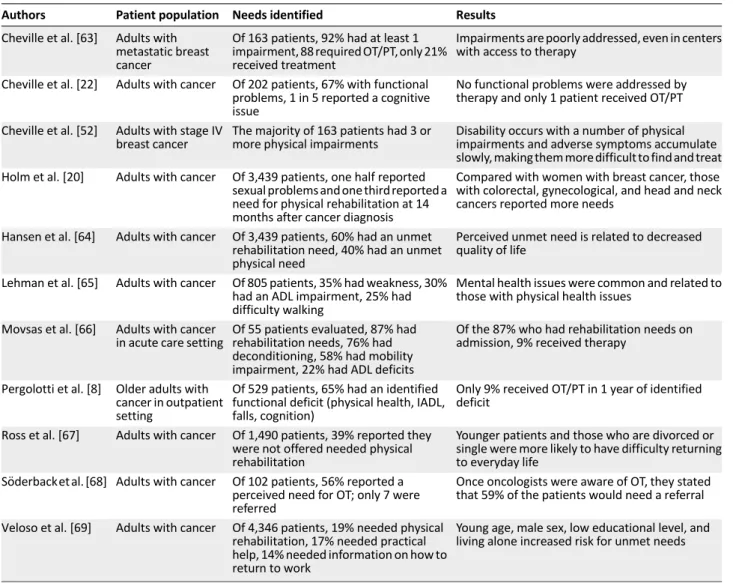
reported functional deficits [22]. Adults stated they had difficulty with bending, stooping, lifting, and getting out of bed and they needed help with ADLs, yet there was no documentation of impairment or any referral for occupational therapy to address their difficulties [22]. Table 1 describes several studies highlighting the need for occupational therapy in adults with cancer.
Specific Factors Amendable to Occupational Therapy Intervention
Many impairments related to cancer and its treatments are amendable to occupational therapy. In this section, we address specific cancer-related impairments and the potential occu-pational therapy interventions. This is not an exhaustive list, and it should be understood that these impairments do not occur in isolation but often in relation to one another. Table 2 provides a quick overview of occupational therapy needs and subsequent intervention strategies.
Falls
Older adults with cancer are at a higher risk for falls compared with those without cancer [23]. In one study, 44% of the patients who fell also reported a limitation in IADLs [24]. Yet, studies have consistently reported that oncology providers rarely report a fall or respond with appropriate and timely intervention [8, 24–26]. For fall prevention in community-dwelling older adults, the most effective interventions include home modifications and adaptations, which are most effective when completed by an occupational therapist [27–30]. In a randomized control trial of older adults, home occupational therapy decreased the risk of falling in those who had fallen before [28]. In a meta-analysis, in-home modifications by a skilled service, such as occupational therapy, reduced falls by 21% overall and 39% in high-risk groups [31]. Home-based modifications can include grab bars in the tub or shower to help getting in and out of the bath or near the toilet to assist with rising from a sitting to a standing position and toileting safely. Other modifications include stair handrails, removal of hazardous objects and clutter, and use of nonslip mats [30].
Cognitive Function Impairment
Cancer-related cognitive impairment (CRCI) presents as difficul-ties related to memory, attention, information-processing speed, and organization, and can affect all age groups [32]. For example, women with breast CRCI report mild cognitive decline impacting their ability to function, making previously easy activities more difficult and causing distressing loss of independence in family life roles [33]. For this issue, occupational therapy intervention will work toward adapting or remediating the functional impairment through different cognitive strategies.The occupational therapist will generally incorporate adaptive strategies so that the patient learns how to compensate for impaired memory or attention while performing particular tasks, or use restorative activities to improve cognition functions during the performance of specific tasks. For example, for a patient with memory and attention issues, an occupational therapist would help create individualized systems to set reminders for medications, schedule appoint-ments, and handle to-do type tasks for shopping, cooking, and money management. Another example of interventions for cognitive decline would be training or retraining on the use of
paper maps and/or global positioning system devices to enhance independence in community navigation.
Cancer-Related Fatigue
Cancer-related fatigue (CRF) is a commonly reported issue among cancer survivors that can disrupt daily routines and restrict participation in meaningful activity. Ninety-one percent of adults with cancer report fatigue as a symptom that has“prevented them from leading a‘normal’life”and 88% have to modify their daily routine [34]. Patients with CRF can benefit from energy conservation training taught in occupa-tional therapy. This translates into practical strategies to manage fatigue for resumption of roles and routines [35]. Structured activity modification and prioritization, as well as use of a daily activity log to monitor task-based activity and energy patterns, are a part of this training. Patients thus have personalized adjustments (e.g., placing frequently used objects in the refrigerator at easy-to-reach heights, timing showers at night) to conserve energy to enjoy the activities that contribute most to their QOL.
Upper-Extremity Impairments
In breast and other cancers, surgery has the potential to cause short- and long-term physical impairments that are potentially modifiable with occupational therapy. Restricted upper-extremity range of motion, arm swelling (lymphedema), pain, and numbness are all common impairments of the upper extremity in patients after surgery for breast cancer [36]. Disability related to arm range of motion was most often associated with ADL and IADL impairments such as putting on a sweater, making a bed, doing yard work, carrying groceries, and lifting anything weighing more than 10 pounds (i.e., children) [37]. Occupational therapy for patients with limitations in their upper extremities could include a combination of exercise, stretching, and modalities to improve range of motion and muscle strength, followed by training in the performance of functional tasks and adaptation of the activity or environment, as needed. Many tools commonly used and recommended by occupational therapists can improve independence (e.g., a rocker knife used to cut food using one hand) and limit the effect of upper-extremity limitations on QOL.
Lymphedema
Lymphedema causes decreased QOL, altered body image, decreased work/leisure participation, and impaired occupa-tional engagement [38]. Occupaoccupa-tional therapists can help patients identify meaningful activities and apply activity modifications for successful completion, use stress manage-ment and relaxation techniques to decrease anxiety, and address concerns related to changes in body image. Lymphe-dema education includes the identification of risk for exacerbation and activities that may worsen the swelling, appropriate activity modifications, energy conservation tech-niques, self-massage, and management of the swelling with complete decongestive therapy.
Chemotherapy-Induced Peripheral Neuropathy
numbness, tingling, and/or pain in their extremities that can lead to reduced QOL [40, 41]. Patients with chemotherapy-induced sensory neuropathy report high levels of functional disability [22]. Adults report difficulty with housekeeping,
distinguishing items in their hands (tactile agnosia), and an increase in overall dependence on others [40]. Occupational therapy interventions for peripheral neuropathy focus on adaptation and remediation through sensory and functional
Table 2. Qualifying conditions and potential interventions for occupational therapy
Qualifying conditions Types of interventions provided by an occupational therapist
ADL/IADL limitation ADL/IADL self-care, functional activity participation, therapeutic exercise, durable medical
equipment recommendations
Debility, fatigue, poor endurance Therapeutic exercise, ADL/IADL self-care, functional activity participation, durable medical
equipment recommendations, energy conservation
Neuropathy Neuromuscular re-education, ADL/IADL self-care, therapeutic activity, therapeutic exercise,
manual therapy, durable medical equipment recommendations
Lymphedema Manual therapy, ADL/IADL self-care, functional activity participation
Cognitive decline Cognitive therapy, ADL/IADL self-care, functional activity participation
Upper extremity impairment ADL/IADL self-care management, neuromuscular re-education, functional activity participation,
therapeutic exercise, manual therapy
Balance ADL/IADL self-care management, neuromuscular re-education, functional activity participation,
therapeutic exercise, durable medical equipment recommendations
Pain Functional activity participation, ADL/IADL self-care management, therapeutic exercise, durable
medical equipment recommendations
Abbreviations: ADL, activity of daily living; IADL, instrumental activity of daily living.
Table 1. Summary of relevant research evaluating the needs for occupational therapy
Authors Patient population Needs identified Results
Cheville et al. [63] Adults with metastatic breast cancer
Of 163 patients, 92% had at least 1 impairment, 88 required OT/PT, only 21% received treatment
Impairments are poorly addressed, even in centers with access to therapy
Cheville et al. [22] Adults with cancer Of 202 patients, 67% with functional
problems, 1 in 5 reported a cognitive issue
No functional problems were addressed by therapy and only 1 patient received OT/PT
Cheville et al. [52] Adults with stage IV breast cancer
The majority of 163 patients had 3 or more physical impairments
Disability occurs with a number of physical impairments and adverse symptoms accumulate slowly, making them more difficult to find and treat
Holm et al. [20] Adults with cancer Of 3,439 patients, one half reported
sexual problems and one third reported a need for physical rehabilitation at 14 months after cancer diagnosis
Compared with women with breast cancer, those with colorectal, gynecological, and head and neck cancers reported more needs
Hansen et al. [64] Adults with cancer Of 3,439 patients, 60% had an unmet
rehabilitation need, 40% had an unmet physical need
Perceived unmet need is related to decreased quality of life
Lehman et al. [65] Adults with cancer Of 805 patients, 35% had weakness, 30%
had an ADL impairment, 25% had difficulty walking
Mental health issues were common and related to those with physical health issues
Movsas et al. [66] Adults with cancer
in acute care setting
Of 55 patients evaluated, 87% had rehabilitation needs, 76% had deconditioning, 58% had mobility impairment, 22% had ADL deficits
Of the 87% who had rehabilitation needs on admission, 9% received therapy
Pergolotti et al. [8] Older adults with cancer in outpatient setting
Of 529 patients, 65% had an identified functional deficit (physical health, IADL, falls, cognition)
Only 9% received OT/PT in 1 year of identified deficit
Ross et al. [67] Adults with cancer Of 1,490 patients, 39% reported they
were not offered needed physical rehabilitation
Younger patients and those who are divorced or single were more likely to have difficulty returning to everyday life
S¨oderback et al. [68] Adults with cancer Of 102 patients, 56% reported a perceived need for OT; only 7 were referred
Once oncologists were aware of OT, they stated that 59% of the patients would need a referral
Veloso et al. [69] Adults with cancer Of 4,346 patients, 19% needed physical
rehabilitation, 17% needed practical help, 14% needed information on how to return to work
Young age, male sex, low educational level, and living alone increased risk for unmet needs
Abbreviations: ADL, activity of daily living; IADL, instrumental activity of daily living; OT, occupational therapy; PT, physical therapy.
activities (e.g., cooking) and adapting specific tools to maintain independence with ADLs and IADLs (e.g., a button hook to assist with fastening buttons when dressing).
Functional Impairments
For adults with cancer, occupational therapists also address how cancer-specific issues, such as fatigue, cognition, pain, and peripheral neuropathy, may affect changes in functional status and daily routines [42]. For adults who present with functional impairments, occupational therapy interventions would assist with skills ranging from dressing, bathing, and using the toilet, to the more complex IADL tasks of organizing one’s schedule for the day, balancing a checkbook, cooking, and being able to care for children or aging relatives. This type of intervention significantly reduced readmissions, overall disability, and improved functional outcomes in adults without cancer but with similar functional limitations [43–47]. Patients with primary and metastatic brain tumors made significant functional gains with inpatient and outpatient rehabilitation [48], and the presence of metastatic disease did not appear to influence gains [49]. In a novel, telemedicine-based occupational therapy intervention, women worked through their reported functional challenges [50]. The longitudinal findings demonstrated improved QOL, active coping and reframing of problems, and decreased self-blame [51].
How to Assess the Need for Occupational Therapy Referral
Cancer-related functional impairment is a slow process and can be difficult to recognize [52]. Obvious impairments and referrals to occupational therapy occur most often during an inpatient hospital stay where functional decline may be more apparent with issues of hemiplegia, hip fracture, or amputation [53]. When disablement is slowly developing and without a structured and consistent assessment of function, cognition, and falls, it can be difficult to determine quickly, in a busy outpatient oncology office visit, when to refer to occupational therapy [52]. Incorporating a few, brief patient-reported measures or questions that specifically relate to interventions, such as occupational therapy, could help with determining which patients will benefit from these services.The following are examples of validated screening tools: a brief geriatric assessment (GA), developed by Hurria and colleagues, that measures functional status, falls, physical health cognition, and other constructs [54]; the Patient-Reported Outcomes Mea-surement Information System (PROMIS), which was developed to assess QOL, functional status, and participation in social activites [55]; the Disabilities of Arm, Shoulder, and Hand (DASH) assessment developed to assess functional ability of the upper extremity [56]; and the Functional Independence Measure (FIM), a seven-item assessment of functional and mobility burden widely used in rehabilitation settings [57]. Quick screening questions can include the following:
x Has the patient had any falls in the last 6 months?
x Has the patient experienced difficulty with ADL or IADL tasks over the past several weeks?
x Are there new upper-extremity flexibility restrictions or pain limiting everyday activities?
x Has the patient experienced new limitations in leisure or social activities?
x Has the patient experienced changes in memory, attention, or focus that have impacted participation in routine daily activities?
These simple questions can easily identify patients who could benefit from a referral to occupational therapy. In addition, completing a comprehensive GA can provide a wealth of information regarding other supportive care needs, including nutrition, pharmacy, geriatrics, or psychiatry.
How to Obtain Occupational Therapy for Your Patient
Most medical centers have occupational therapy services, and if an institution does not have an occupational therapy department, a referral or prescription may be given to the patient to obtain occupational therapy services through a home-care agency or an outpatient clinic. A written referral by a physician, nurse practitioner, or physician’s assistant (depending on the state) is required. Once a referral is made, patients can contact any rehabilitation facility or hospital-based occupational therapy department to find outpatient offices in their area. Patients who are leaving the hospital and need additional therapy services may receive occupational therapy either in inpatient rehabilitation or in subacute rehabilitation centers often found in nursing homes. Table 3 describes different occupational therapy settings and levels of care.
A social worker or case/discharge manager can help facilitate a referral for either outpatient or home occupational therapy services when a patient is not able to access the community independently or is generally home bound. Patients, nurse navigators, social workers, and case managers may also call or check the patient’s supplemental insurance company’s website to find occupational therapists in the area who are covered under the patient’s insurance. For adults over the age of 65 years who have Medicare, outpatient occupational therapy is covered under Part B, and most patients also have supplemental insurance to help cover the cost of coinsurance for outpatient care. To best assist patients in getting optimal therapy, defining the reason for referral in terms of needs or specific concerns (e.g., ADL need, cognitive decline, lymphedema) should be included.
Cancer Rehabilitation Team
Occupational therapy is often obtained in combination with other rehabilitation services such as physical therapy and speech and language pathology. Physical therapy and speech and language pathology are vital parts of the rehabilitation team but differ from occupational therapy in their primary focus. Physical therapy has a strong emphasis on strength and endurance capacity, whereas speech and language pathology focuses on swallowing and speech production. In some ways, the occupational, physical, and speech therapy goals and techniques may overlap, but, as a team, they all work to improve each patient’s QOL and cognitive/functional performance.
Emerging Research
randomized controlled trial looking at the effectiveness of both occupational and physical therapies provided in the outpatient setting specifically designed for older adults with cancer [62]. There is also an ongoing study that is developing novel occupational therapy interventions for women after they have had ovarian cancer surgery. Another study is examining a problem-solving approach to changes in ADLs and IADLs to reduce disability of older adults with cancer. These and other emerging studies that are focused on adults of all ages will help further define the important role of occupational therapy in cancer care.
CONCLUSION
An analysis of the National Health Interview Survey confirmed that cancer survivors are significantly more likely to report being in fair or poor health, have three or more chronic
comorbid conditions, psychological problems, one or more limitations in ADLs or IADLs, and poorer functional status when compared with similar age adults without a cancer diagnosis [2]. One third of patients who reported having limitations with ADL or IADL believed that cancer caused their limitations [2]. Occupational therapy is designed to help people with these impairments and other needs improve their overall QOL by facilitating engagement in meaningful everyday activities. As more cancer rehabilitation programs are developed and the scope of occupational therapy becomes better understood by all consumers, accessing an occupational therapist will become more standard practice. Occupational therapists treat each patient holistically and use creative solutions to improve the overall cognitive and functional capacity of older adults with cancer, making the occupational therapist a critical member of the interprofessional cancer care team.
ACKNOWLEDGMENTS
This research was supported by National Cancer Institute (NCI) Grant R25CA116339. Grant R. Williams is supported by NCI Grant 5K12CA120780.
AUTHORCONTRIBUTIONS
Conception/Design:Mackenzi Pergolotti, Hyman B. Muss
Provision of study material or patients:Mackenzi Pergolotti
Collection and/or assembly of data:Mackenzi Pergolotti
Data analysis and interpretation:Mackenzi Pergolotti, Grant R. Williams, Claudine Campbell, Lauro A. Munoz, Hyman B. Muss
Manuscript writing:Mackenzi Pergolotti, Grant R.Williams, Claudine Campbell, Lauro A. Munoz, Hyman B. Muss
Final approval of manuscript:Mackenzi Pergolotti, Grant R. Williams, Claudine Campbell, Lauro A. Munoz, Hyman B. Muss
DISCLOSURES
Hyman B. Muss:Pfizer (C/A). The other authors indicated no financial relationships.
(C/A) Consulting/advisory relationship; (RF) Research funding; (E) Employment; (ET) Expert testimony; (H) Honoraria received; (OI) Ownership interests; (IP) Intellectual property rights/ inventor/patent holder; (SAB) Scientific advisory board
REFERENCES
1.American Occupational Therapy Association. Standards of practice for occupational therapy. Available at http://ajot.aota.org/article.aspx? articleid=2477354. Accessed December 15, 2015.
2.Hewitt M, Rowland JH, Yancik R. Cancer survivors in the United States: Age, health, and disability. J Gerontol A Biol Sci Med Sci 2003;58: 82–91.
3.Palmadottir G. The role of occupational partic-ipation and environment among Icelandic women with breast cancer: A qualitative study. Scand J Occup Ther 2010;17:299–307.
4.Reuben DB, Rubenstein LV, Hirsch SH et al.Value of functional status as a predictor of mortality: Results of a prospective study. Am J Med 1992;93: 663–669.
5.Ponzetto M, Maero B, Maina P et al. Risk factors for early and late mortality in hospitalized older patients: The continuing importance of functional status. J Gerontol A Biol Sci Med Sci 2003;58: 1049–1054.
6.Mor V, Wilcox V, Rakowski W et al. Functional transitions among the elderly: Patterns, predictors, and related hospital use. Am J Public Health 1994; 84:1274–1280.
7.Hurria A, Togawa K, Mohile SG et al. Predicting chemotherapy toxicity in older adults with cancer: A prospective multicenter study. J Clin Oncol 2011;29: 3457–3465.
8.Pergolotti M, Deal AM, Lavery J et al. The prevalence of potentially modifiable functional deficits and the subsequent use of occupational and physical therapy by older adults with cancer. J Geriatr Oncol 2015;6:194–201.
9.Halkett GK, Ciccarelli M, Keesing S et al. Occupational therapy in palliative care: Is it under-utilised in Western Australia? Aust Occup Ther J 2010;57:301–309.
10.Kealey P, McIntyre I. An evaluation of the domiciliary occupational therapy service in pallia-tive cancer care in a community trust: A patient and carers perspective. Eur J Cancer Care (Engl) 2005;14: 232–243.
11.Clark F, Azen SP, Zemke R et al. Occupational therapy for independent-living older adults. A randomized controlled trial. JAMA 1997;278: 1321–1326.
12.Clark F, Jackson J, Carlson M et al. Effectiveness of a lifestyle intervention in promoting the well-being of independently living older people: Results
of the Well Elderly 2 Randomised Controlled Trial. J Epidemiol Community Health 2012;66:782–790.
13.Hay J, LaBree L, Luo R et al. Cost-effectiveness of preventive occupational therapy for independent-living older adults. J Am Geriatr Soc 2002;50: 1381–1388.
14.Clark F, Azen SP, Carlson M et al. Embedding health-promoting changes into the daily lives of independent-living older adults: Long-term follow-up of occfollow-upational therapy intervention. J Gerontol B Psychol Sci Soc Sci 2001;56:P60–63.
15.Quach C, Sanoff HK,Williams GR et al. Impact of colorectal cancer diagnosis and treatment on health-related quality of life among older Americans: A population-based, case-control study. Cancer 2015; 121:943–950.
16.Holley S. A look at the problem of falls among people with cancer. Clin J Oncol Nurs 2002;6: 193–197.
17.Chen T-Y, Janke M. Predictors of falls among community-dwelling older adults with cancer: results from the health and retirement study. Supportive Care Cancer 2014;22:479–485.
18.Freedman VA, Martin LG, Schoeni RF. Recent trends in disability and functioning among older
Table 3. Settings and levels of rehabilitation
Settings Levels of rehabilitation provideda
Acute care 15 minutes to 1 hour, 1–5 days/week
Inpatient acute rehabilitation
At least 3 hours/day, 5 to 7 days/week
Transitional, long-term
acute care Less than 3 hours/day, 5–6 days perweek, length of stay$25 days General subacute
rehabilitation Less than 3 hours/day, 3–5 days/week
Long-term care 30–60 minutes/day, 1–3 days/week
Home therapy Varies based on insurance coverage
Outpatient therapy 30 minutes to 1 hour per treatment, 1–3
times per week, number of sessions allowed varies based on insurance coverageb
a
Levels of rehabilitation provided can include occupational, physical, and speech therapies.
bMedicare limits the amount of outpatient rehabilitation per year with
the“therapy cap”; Medicaid coverage, costs, and limits vary by state.
adults in the United States: A systematic review. JAMA 2002;288:3137–3146.
19.Maione P, Perrone F, Gallo C et al. Pre-treatment quality of life and functional status assessment significantly predict survival of elderly patients with advanced non-small-cell lung cancer receiving chemotherapy: A prognostic analysis of the multicenter Italian lung cancer in the elderly study. J Clin Oncol 2005;23:6865–6872.
20.Holm LV, Hansen DG, Johansen C et al. Participation in cancer rehabilitation and unmet needs: A population-based cohort study. Support Care Cancer 2012;20:2913–2924.
21.Holm LV, Hansen DG, Kragstrup J et al. Influ-ence of comorbidity on cancer patients’ rehabilita-tion needs, participarehabilita-tion in rehabilitarehabilita-tion activities and unmet needs: A population-based cohort study. Support Care Cancer 2014;22:2095–2105.
22.Cheville AL, Beck LA, Petersen TL et al. The detection and treatment of cancer-related func-tional problems in an outpatient setting. Support Care Cancer 2009;17:61–67.
23.Spoelstra SL, Given BA, Schutte DL et al. Do older adults with cancer fall more often? A comparative analysis of falls in those with and without cancer. Oncology Nurs Forum 2013;40:E69–78.
24.Guerard EJ, Deal AM, Williams GR et al. Falls in older adults with cancer: Evaluation by oncology providers. J Oncol Pract 2015;11:470–474.
25.Williams GR, Deal AM, Nyrop KA et al. Geriatric assessment as an aide to understanding falls in older adults with cancer. Support Care Cancer 2015;23: 2273–2280.
26.Puts MT, Monette J, Girre V et al.The fall rate of older community-dwelling cancer patients. Support Care Cancer 2013;21:775–783.
27.Gillespie LD, Robertson MC, Gillespie WJ et al. Interventions for preventing falls in older people living in the community. Cochrane Database Syst Rev 2012;9:CD007146.
28.Cumming RG, Thomas M, Szonyi G et al. Home visits by an occupational therapist for assessment and modification of environmental hazards: A randomized trial of falls prevention. J Am Geriatr Soc 1999;47:1397–1402.
29.Michael YL, Whitlock EP, Lin JS et al. Primary care-relevantinterventionstopreventfallinginolderadults: A systematic evidence review for the U.S. Preventive ServicesTask Force. Ann Intern Med 2010;153:815–825.
30.Harvey LA, Mitchell RJ, Lord SR et al. Determi-nants of uptake of home modifications and exercise to prevent falls in community-dwelling older people. Aust N Z J Public Health 2014;38:585–590.
31.Clemson L, Mackenzie L, Ballinger C et al. Environmental interventions to prevent falls in community-dwelling older people: A meta-analysis of randomized trials. J Aging Health 2008;20:954–971.
32.Hurria A, Somlo G, Ahles T. Renaming“ chemo-brain”. Cancer Invest 2007;25:373–377.
33.Player L, Mackenzie L, Willis K et al. Women’s experiences of cognitive changes or‘chemobrain’ following treatment for breast cancer: A role for occupational therapy? Aust Occup Ther J 2014;61: 230–240.
34.Curt GA, Breitbart W, Cella D et al. Impact of cancer-related fatigue on the lives of patients: New findings from the Fatigue Coalition.The Oncologist
2000;5:353–360.
35.Vockins H. Occupational therapy intervention with patients with breast cancer: A survey. Eur J Cancer Care (Engl) 2004;13:45–52.
36.Bosompra K, Ashikaga T, O’Brien PJ et al. Swelling, numbness, pain, and their relationship to arm function among breast cancer survivors: A disablement process model perspective. Breast J 2002;8:338–348.
37.Thomas-MacLean RL, Hack T, Kwan W et al. Arm morbidity and disability after breast cancer: New directions for care. Oncol Nurs Forum 2008;35: 65–71.
38.Shigaki CL, Madsen R, Wanchai A et al. Upper extremity lymphedema: Presence and effect on functioning five years after breast cancer treatment. Rehabil Psychol 2013;58:342–349.
39.Kuroi K, Shimozuma K. Neurotoxicity of taxanes: Symptoms and quality of life assessment. Breast Cancer 2004;11:92–99.
40.Beijers A, Mols F, Dercksen W et al. Chemotherapy-induced peripheral neuropathy and impact on quality of life 6 months after treatment with chemotherapy. J Community Sup-port Oncol 2014;12:401–406.
41.Mols F, Beijers T, Vreugdenhil G et al. Chemotherapy-induced peripheral neuropathy and its association with quality of life: A systematic review. Support Care Cancer 2014;22:2261–2269.
42.Stubblefield MD. Cancer rehabilitation. Paper presented at: Seminars in oncology 2011.
43.Walker MF, Gladman JRF, Lincoln NB et al. Occupational therapy for stroke patients not admitted to hospital: A randomised controlled trial. Lancet 1999;354:278–280.
44.Walker MF, Leonardi-Bee J, Bath P et al. Individual patient data meta-analysis of randomized controlled trials of community occupational therapy for stroke patients. Stroke 2004;35:2226–2232.
45.Corr S, Bayer A. Occupational therapy for stroke patients after hospital discharge—a random-ized controlled trial. Clin Rehabil 1995;9:291–296.
46.Gilbertson L, Langhorne P, Walker A et al. Domiciliary occupational therapy for patients with stroke discharged from hospital: Randomised con-trolled trial. BMJ 2000;320:603–606.
47.Legg LA, Drummond AE, Langhorne P. Occu-pational therapy for patients with problems in activities of daily living after stroke. Cochrane Database Syst Rev 2006;4CD003585.
48.Marciniak CM, Sliwa JA, Heinemann AW, Semik PE. Functional outcomes of persons with brain tumors after inpatient rehabilitation. Arch Phys Med Rehabil 2001;82:457–463.
49.Marciniak CM, Sliwa JA, Spill G et al. Functional outcome following rehabilitation of the cancer patient. Arch Phys Med Rehabil 1996;77:54–57.
50.Lyons KD, Erickson KS, Hegel MT. Problem-solving strategies of women undergoing chemotherapy for breast cancer. Can J Occup Ther 2012;79:33–40.
51.Lyons KD, Hull JG, Kaufman PA et al. Develop-ment and initial evaluation of a telephone-delivered, behavioral activation, and problem-solving treatment program to address functional goals of breast cancer survivors. J Psychosoc Oncol 2015;33:199–218.
52.Cheville AL, Kornblith AB, Basford JR. An examination of the causes for the underutilization of rehabilitation services among people with advanced cancer. Am J Phys Med Rehabil 2011;90 (suppl 1):S27–S37.
53.Silver JK, Gilchrist LS. Cancer rehabilitation with a focus on evidence-based outpatient physical and occupational therapy interventions. Am J Phys Med Rehabil 2011;90(Suppl 1):S5–S15.
54.Hurria A, Gupta S, Zauderer M et al. Developing a cancer-specific geriatric assessment: A feasibility study. Cancer 2005;104:1998–2005.
55.Hays RD, Bjorner J, Revicki RA et al. Develop-ment of physical and Develop-mental health summary scores from the Patient Reported Outcomes Measurement Information System (PROMIS) global items. Qual Life Res 2009;18:873–880.
56.Hudak PL, Amadio PC, Bombardier C. Devel-opment of an upper extremity outcome measure: The DASH (disabilities of the arm, shoulder and hand) [corrected]. The Upper Extremity Collabora-tive Group (UECG). Am J Ind Med 1996;29:602–608.
57.Hamilton BB, Laughlin JA, Fiedler RC et al. Interrater reliability of the 7-level functional in-dependence measure (FIM). Scand J Rehabil Med 1994;26:115–119.
58.Hindley M, Johnston S. Stress management for breast cancer patients: Service development. Int J Palliat Nurs 1999;5:135–141.
59.Hegel MT, Lyons KD, Hull JG et al. Feasibility study of a randomized controlled trial of a telephone-delivered problem-solving-occupational therapy in-tervention to reduce participation restrictions in rural breast cancer survivors undergoing chemotherapy. Psychooncology 2011;20:1092–1101.
60.Lyons KD, Hull JG, Root LD et al. A pilot study of activity engagement in the first six months after stem cell transplantation. Oncol Nurs Forum 2011;38:75–83.
61.Purcell A, Fleming J, Bennett S et al. Develop-ment of an educational intervention for cancer-related fatigue. Br J Occup Ther 2010;73:327–333.
62.Pergolotti M, Deal AM, Williams GR et al. A randomized controlled trial of outpatient CAncer REhabilitation for older adults: The CARE Program. Contemp Clin Trials 2015;44:89–94.
63.Cheville AL, Troxel AB, Basford JR et al. Prevalence and treatment patterns of physical impairments in patients with metastatic breast cancer. J Clin Oncol 2008;26:2621–2629.
64.Hansen DG, Larsen PV, Holm LV et al. Associ-ation between unmet needs and quality of life of cancer patients: A population-based study. Acta Oncol 2013;52:391–399.
65.Lehmann JF, DeLisa JA,Warren CG et al. Cancer rehabilitation: Assessment of need, development, and evaluation of a model of care. Arch Phys Med Rehabil 1978;59:410–419.
66.Movsas SB, Chang VT, Tunkel RS et al. Re-habilitation needs of an inpatient medical oncology unit. Arch Phys Med Rehabil 2003;84:1642–1646.
67.Ross L, Petersen MA, Johnsen AT et al. Are different groups of cancer patients offered re-habilitation to the same extent? A report from the population-based study “The Cancer Patient’s World”. Support Care Cancer 2012;20:1089–1100.
68.S¨oderback I, Paulsson EH. A needs assessment for referral to occupational therapy. Nurses’ judg-ment in acute cancer care. Cancer Nurs 1997;20: 267–273.