© The Author(s) 2018. Published by Oxford University Press on behalf of The Gerontological Society of America. All rights reserved. For permissions, please e-mail: [email protected].
S88
Review Article
Evidence-Based Nonpharmacological Practices to
Address Behavioral and Psychological Symptoms of
Dementia
Kezia Scales, PhD,
1Sheryl Zimmerman, PhD,
2,3,* and Stephanie J. Miller, MSW
31
PHI, Bronx, New York.
2School of Social Work and
3Cecil G. Sheps Center for Health Services Research, The University of
North Carolina at Chapel Hill.
*Address correspondence to: Sheryl Zimmerman, PhD, Cecil G. Sheps Center for Health Services Research, University of North Carolina at Chapel Hill, 725 Martin Luther King Jr. Blvd., Chapel Hill, NC 27599. E-mail: [email protected].
Received: March 15, 2017; Editorial Decision Date: September 15, 2017
Decision Editor: Beth A. Kallmyer, MSW
Abstract
Background and Objectives: To draw from systematic and other literature reviews to identify, describe, and critique non-pharmacological practices to address behavioral and psychological symptoms of dementia (BPSDs) and provide evidence-based recommendations for dementia care especially useful for potential adopters.
Research Design and Methods: A search of systematic and other literature reviews published from January 2010 through January 2017. Nonpharmacological practices were summarized to describe the overall conceptual basis related to effective-ness, the practice itself, and the size and main conclusions of the evidence base. Each practice was also critically reviewed to determine acceptability, harmful effects, elements of effectiveness, and level of investment required, based on time needed for training/implementation, specialized care provider requirements, and equipment/capital requirements.
Results: Nonpharmacological practices to address BPSDs include sensory practices (aromatherapy, massage, multi-sen-sory stimulation, bright light therapy), psychosocial practices (validation therapy, reminiscence therapy, music therapy, pet therapy, meaningful activities), and structured care protocols (bathing, mouth care). Most practices are acceptable, have no harmful effects, and require minimal to moderate investment.
Discussion and Implications: Nonpharmacological practices are person-centered, and their selection can be informed by considering the cause and meaning of the individual’s behavioral and psychological symptoms. Family caregivers and paid care providers can implement evidence-based practices in home or residential care settings, although some practices require the development of more specific protocols if they are to become widely used in an efficacious manner.
Keywords: Behavioral and psychological symptoms of dementia (BPSD), Nonpharmacological, Dementia care, Recommendations, Evidence, Review
Behavioral and psychological symptoms of demen-tia (BPSDs) are among the most distressing sequelae of Alzheimer’s disease and related dementias. They include agitation, aberrant motor behavior, anxiety, irritability, depression, apathy, disinhibition, delusions, hallucina-tions, and sleep or appetite changes (Cerejeira, Lagarto, &
Mukaetova-Ladinska, 2012). Up to 97% of persons living
with dementia experience at least one BPSD, the most com-mon being apathy, depression, irritability, agitation, and anxiety (Steinberg et al., 2008). BPSDs result from changes in the brain in relation to characteristics of the social and physical environment, as explained by three complemen-tary conceptual models described below. In the material that follows, the focus is on modifiable factors in the social
cite as: Gerontologist, 2018, Vol. 58, No. S1, S88–S102 doi:10.1093/geront/gnx167
and physical environment, which is not to minimize the important role of unmodifiable neurodegeneration associ-ated with dementia (Kales, Gitlin, & Lyketsos, 2015).
The competence-environmental press framework conceives of BPSDs as reflecting the interplay of cogni-tive capacity and external environmental stressors; sim-ply stated, environmental forces influence (“press” on) an individual’s psychological state and evoke a behavio-ral response (Lawton & Nahemow, 1973). For example, when confronted with bath water that is an uncomfortable temperature, a person living with dementia may strike out rather than convey discomfort through words. The progres-sively lowered stress threshold model expands the concept of press. It suggests that environmental antecedents pro-duce stress, which is met by a coping response that is com-promised by the progressive impact of dementia; BPSDs emerge as environmental demands exceed stress-tolerance or coping thresholds (Hall & Buckwalter, 1987). A behav-ioral example explained by this model is an individual who becomes agitated in response to an environment made noisy through overhead speakers and persistent talk.
The needs-driven dementia-compromised behavior model conceives of BPSDs as an attempt to communicate an unmet need; they reflect a response to antecedent environmental or social stimuli based on person-specific characteristics such as personality and cognitive and functional status (Algase
et al., 1996). Within this framework, BPSDs are considered
meaningful expressions, ranging from disengagement (e.g., apathy) to mild discomfort (e.g., pacing) to urgent need (e.g., physical aggression). As an example, a person living with dementia who “wanders” may be communicating the need to leave a situation that is causing mild anxiety. If the need is not addressed, symptoms will persist and may become more severe (Kovach, Noonan, Schlidt, & Wells, 2005), perhaps escalating from wandering to exit seeking.
Understanding the triggers of BPSDs has allowed for the development and testing of social and environmental practices (i.e., interventions or treatments) to reduce or eliminate those symptoms. Such practices are especially desirable given that antipsychotic and other psychotropic medications are generally contraindicated for the treatment of BPSDs; not only is there is limited evidence of benefit
(Sink, Holden, & Yaffe, 2005), but the use of antipsychotic
medications to treat this population is associated with higher risk of myocardial infarction (Pariente et al., 2012), stroke (Douglas & Smeeth, 2008), and mortality (Kales
et al., 2012). In fact, regulations state that antipsychotic
medications should be considered to treat BPSDs only in instances when the symptoms present a danger, and only after “medical, physical, functional, psychological, emo-tional, psychiatric, social and environmental causes have been identified and addressed” (CMS, 2013). Similarly, physical restraints are contraindicated to address BPSDs, as they can result in injury and negatively affect cognition, mood, and opportunities for social interaction (Scherder,
Bogen, Eggermont, Hamers, & Swaab, 2010).
It is recommended that practices to address BPSDs build from broader dementia care principles, which include sim-plifying tasks (breaking each task into simple steps, using verbal and/or tactile prompts); communicating clearly and calmly and allowing sufficient time for the individual’s response; aligning activities with the individual’s preference and capacity and providing support as needed; and engag-ing with the individual in a simplified environment that is free from clutter and distractions, using visual cues for ori-entation (Gitlin, Kales, & Lyketsos, 2012). Family caregiv-ers and formal care providcaregiv-ers of people living with dementia often need education/training about these principles, as well as how to recognize BPSDs, their triggers, and strategies to alleviate them (Spector, Orrell, & Goyder, 2013).
To date, a number of systematic and literature reviews have identified evidence-based nonpharmacological prac-tices to address BPSDs. Consistent with the conceptual approaches described above, these reviews have highlighted the utility of identifying characteristics of the social and physical environment that trigger or exacerbate BPSDs. However, not all reviews have focused specifically on out-comes related to BPSDs (e.g., one systematic review exam-ined “health outcomes” that included BPSDs; Zimmerman
et al., 2013) and others have been specific to settings of care
(e.g., a Cochrane review of dementia special care units; Lai,
Yeung, Mok, & Chi, 2009). Furthermore, few of the reviews
present and summarize the conceptual underpinnings of the individual practices, which is important information for considering when, why, and for whom a practice may be effective. Furthermore, there has been limited attention to the investment required for each practice, in terms of time requirements (such as for training and implementation), the need for specialized care providers, and equipment and capital resource requirements, all of which are important in the context of crafting recommendations for dementia care.
Therefore, the intent of this article is to serve as an applied review of the literature that summarizes evidence-based nonpharmacological practices to address BPSDs, describes the practices in some detail, critiques them in terms of their investment requirements, and derives related recommenda-tions for dementia care. Other reviews have not typically provided information to help potential users understand the conceptual basis underlying practices or the time investment necessary to implement them; consequently, this article is unique in its relevance for potential adopters.
Design and Methods
To identify evidence-based nonpharmacological practices to address BPSDs, a search of systematic and other literature reviews published in English from January 2010 through January 2017 was conducted. The 2010 start date focused this review on the most up-to-date assessments of a body of literature that has been growing for several decades; the majority of reviews have been published since 2010, but most cover evidence published since 1990 or earlier. Search
terms included “systematic (or literature) review,” “demen-tia (or Alzheimer’s disease),” “behavioral and psychological symptoms of dementia” (and synonyms), and “interventions” (and related terms). Search databases included PubMed, CINAHL, PsycINFO, AgeLine, and Cochrane. As needed, articles identified from the reference lists of the reviews were themselves reviewed for clarification or more information; additionally, so as to be inclusive, a small number of indi-vidual studies on BPSD practices that were identified during the search but not yet evaluated in systematic reviews were included in this review and synthesis. Review articles that addressed the experiences and outcomes of caregivers them-selves were not included, although we recognize the essential link to the experiences and outcomes of the person living with dementia (Gitlin, Marx, Stanley, & Hodgson, 2015). As a literature review and synthesis, this article presents evi-dence that has already been evaluated using a priori inclu-sion criteria and standards of rigor rather than replicating existing systematic review efforts. It does not evaluate the qualities of the reviews themselves, but it is important to note that they all met the standards of peer review.
The identified BPSD practices were summarized to describe the overall conceptual basis of each practice, the practice itself, and related evidence. Then, the evidence base for each practice was critically reviewed by the authors to determine apparent/likely acceptability to participants, reported/poten-tial harmful effects, potenreported/poten-tial elements of effectiveness, and investment required. As the included reviews used different criteria to search and evaluate the strength of the evidence, the intention in this article was to broadly summarize the findings across the reviews for potential adopters rather than specifically quantify the number of Level I, Level II, and Level III studies on each practice. Thus, the size of the evi-dence base for each practice was heuristically characterized as small (when the systematic reviews that were summarized in this review tended to identify fewer than five studies meet-ing inclusion criteria and supportmeet-ing the BPSD practice in question), moderate (5–10 studies), or large (more than 10 studies); to note, these categories served as a general guide for summarizing the extent of the evidence rather than precise
quantifications. The main conclusions from the evidence were characterized as positive (if positive effects were reported across the reviews), mixed (if negative effects were also iden-tified), or preliminary (if the evidence base was too small to evaluate). Investment was rated as low, moderate, or high, in relation to time needed for training and implementation, spe-cialized care provider requirements, and equipment or capital requirements, based on an adaptation of an existing frame-work. As shown in Table 1, low investment requires <2 hr of training and <15 min to implement, no specialized care pro-vider requirements, and material purchases <$100 with no environmental modification; high investment requires >4 hr of training and >60 min to implement, a specialized care provider, and material purchases >$500 with ongoing cost >$100/month and extensive environmental modification; and moderate involvement lies between the two extremes for all categories (Seitz et al., 2012). Overall, the literature itself did not quantify the investment required of each practice, so the authors used their judgment based on these criteria.
The Results section presents the practices, conceptual basis, evidence, and implementation; Tables 2–4 provide additional details regarding evidence.
Results
From the database search, 197 articles reporting evidence-based nonpharmacological practices to treat BPSDs were reviewed, and 14 single articles were also reviewed for their detail on particular practices. The practices that were identified have been classified here in three overarching cat-egories: sensory practices (aromatherapy, massage, multi-sensory stimulation, and bright light therapy), psychosocial practices (validation therapy, reminiscence therapy, music therapy, pet therapy, and meaningful activities), and struc-tured care protocols (bathing and mouth care).
Sensory Practices
Normal aging is associated with gradual decline across the five senses—visual, auditory, kinesthetic, olfactory, and
Table 1. Criteria to Rate Investment Required for Nonpharmacological Practices to Treat BPSDs
Low investment Moderate investment High investment
Time required for training and implementation
<1 hr of training 1–4 hr of training >4 hr of training <15 min to implement 15–60 min to implement >60 min to implement
Specialized care provider requirements
None Implemented by usual care provider but requires specialized knowledge
Not implemented by usual care provider
Equipment or capital resources Material purchase <$100 with no ongoing cost
Material purchase $100–$500 Ongoing cost <$100/month Some environmental modification
Material purchase >$500 Ongoing cost >$100/month Extensive environmental modification
No environmental modification
Note: BPSDs = behavioral and psychological symptoms of dementia.
gustatory—which can lead to loss of independence, social isolation, disorientation and confusion, safety risks, and other adverse outcomes (Raina, Wong, & Massfeller, 2004;
Schneider et al., 2011). Sensory change is also specifically
associated with cognitive impairment, although the nature and degree of this association is still under investigation
(Behrman, Chouliaras, & Ebmeier, 2014). Older persons
liv-ing with dementia are therefore particularly vulnerable to sen-sory deficits, which can reduce their capacity to interpret and manage the demands of their environment (consistent with the progressively lowered stress threshold model described in the Introduction). An individual who has trouble seeing, for example, may be easily startled and distressed by noises that are not clearly identifiable, leading to anxiety or agitation.
Sensory practices comprise a range of techniques for correcting sensory imbalances, increasing alertness, reduc-ing anxiety and agitation, and enhancreduc-ing quality of life
(Fitzsimmons, Barba, & Stump, 2014; Strøm, Ytrehus, &
Grov, 2016). Prominent among these tested techniques are
aromatherapy, massage, multisensory stimulation (MSS), and bright light therapy. It is recommended that sensory practices are supported by basic care practices that help minimize confusion and enhance orientation, such as ensuring that individuals have functional hearing aids and eyeglasses, and that the care environment is well-lit and easily navigable (Behrman et al., 2014); together, these practices can help individuals better tolerate the press from their environment.
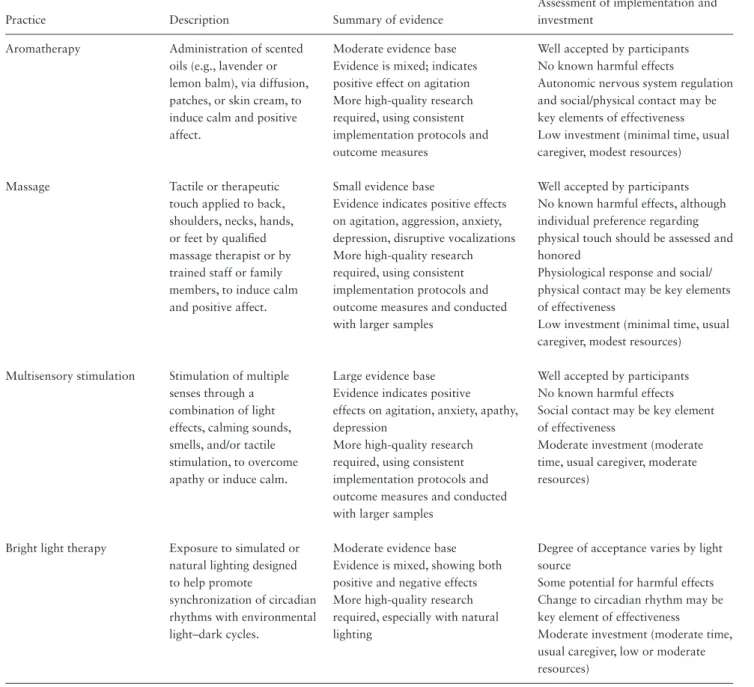
Table 2. Sensory Practices
Practice Description Summary of evidence
Assessment of implementation and investment
Aromatherapy Administration of scented oils (e.g., lavender or lemon balm), via diffusion, patches, or skin cream, to induce calm and positive affect.
Moderate evidence base Well accepted by participants Evidence is mixed; indicates
positive effect on agitation
No known harmful effects
Autonomic nervous system regulation and social/physical contact may be key elements of effectiveness Low investment (minimal time, usual caregiver, modest resources)
More high-quality research required, using consistent implementation protocols and outcome measures
Massage Tactile or therapeutic touch applied to back, shoulders, necks, hands, or feet by qualified massage therapist or by trained staff or family members, to induce calm and positive affect.
Small evidence base Well accepted by participants Evidence indicates positive effects
on agitation, aggression, anxiety, depression, disruptive vocalizations More high-quality research required, using consistent implementation protocols and outcome measures and conducted with larger samples
No known harmful effects, although individual preference regarding physical touch should be assessed and honored
Physiological response and social/ physical contact may be key elements of effectiveness
Low investment (minimal time, usual caregiver, modest resources)
Multisensory stimulation Stimulation of multiple senses through a combination of light effects, calming sounds, smells, and/or tactile stimulation, to overcome apathy or induce calm.
Large evidence base Well accepted by participants Evidence indicates positive
effects on agitation, anxiety, apathy, depression
No known harmful effects Social contact may be key element of effectiveness
Moderate investment (moderate time, usual caregiver, moderate resources)
More high-quality research required, using consistent implementation protocols and outcome measures and conducted with larger samples
Bright light therapy Exposure to simulated or natural lighting designed to help promote
synchronization of circadian rhythms with environmental light–dark cycles.
Moderate evidence base Degree of acceptance varies by light source
Some potential for harmful effects Evidence is mixed, showing both
positive and negative effects More high-quality research required, especially with natural lighting
Change to circadian rhythm may be key element of effectiveness
Moderate investment (moderate time, usual caregiver, low or moderate resources)
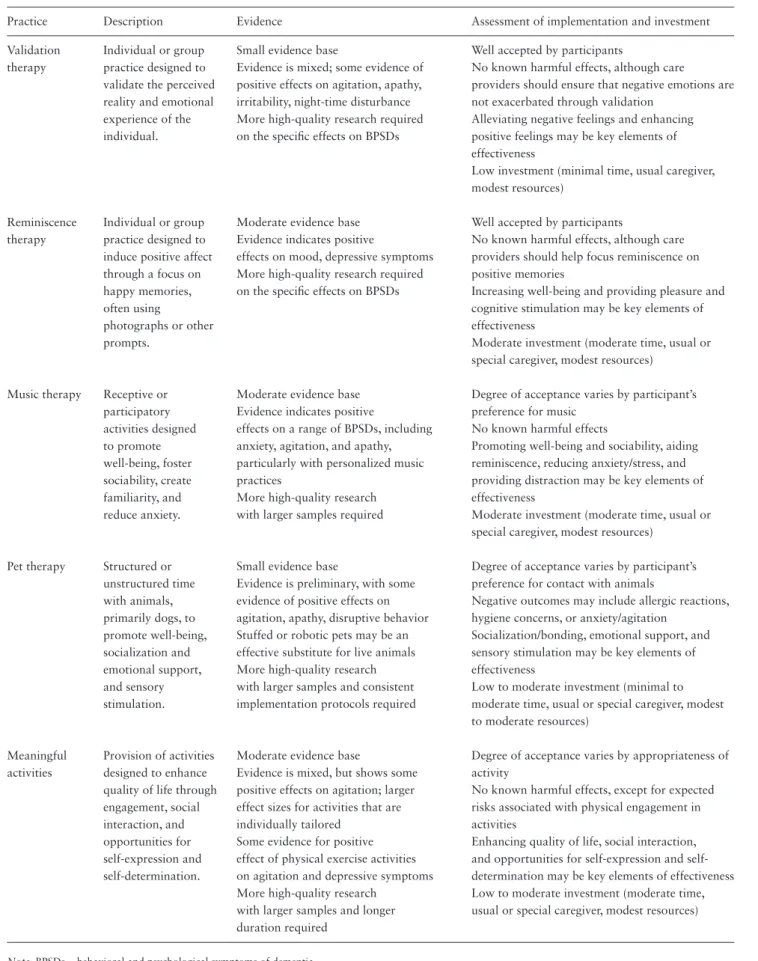
Table 3. Psychosocial Practices
Practice Description Evidence Assessment of implementation and investment
Validation therapy
Individual or group practice designed to validate the perceived reality and emotional experience of the individual.
Small evidence base Well accepted by participants Evidence is mixed; some evidence of
positive effects on agitation, apathy, irritability, night-time disturbance
No known harmful effects, although care providers should ensure that negative emotions are not exacerbated through validation
More high-quality research required on the specific effects on BPSDs
Alleviating negative feelings and enhancing positive feelings may be key elements of effectiveness
Low investment (minimal time, usual caregiver, modest resources)
Reminiscence therapy
Individual or group practice designed to induce positive affect through a focus on happy memories, often using photographs or other prompts.
Moderate evidence base Well accepted by participants Evidence indicates positive
effects on mood, depressive symptoms More high-quality research required on the specific effects on BPSDs
No known harmful effects, although care providers should help focus reminiscence on positive memories
Increasing well-being and providing pleasure and cognitive stimulation may be key elements of effectiveness
Moderate investment (moderate time, usual or special caregiver, modest resources)
Music therapy Receptive or participatory activities designed to promote well-being, foster sociability, create familiarity, and reduce anxiety.
Moderate evidence base Evidence indicates positive
effects on a range of BPSDs, including anxiety, agitation, and apathy, particularly with personalized music practices
Degree of acceptance varies by participant’s preference for music
No known harmful effects
Promoting well-being and sociability, aiding reminiscence, reducing anxiety/stress, and providing distraction may be key elements of effectiveness
Moderate investment (moderate time, usual or special caregiver, modest resources)
More high-quality research with larger samples required
Pet therapy Structured or unstructured time with animals, primarily dogs, to promote well-being, socialization and emotional support, and sensory stimulation.
Small evidence base
Evidence is preliminary, with some evidence of positive effects on agitation, apathy, disruptive behavior
Degree of acceptance varies by participant’s preference for contact with animals
Negative outcomes may include allergic reactions, hygiene concerns, or anxiety/agitation
Socialization/bonding, emotional support, and sensory stimulation may be key elements of effectiveness
Low to moderate investment (minimal to moderate time, usual or special caregiver, modest to moderate resources)
Stuffed or robotic pets may be an effective substitute for live animals More high-quality research with larger samples and consistent implementation protocols required
Meaningful activities
Provision of activities designed to enhance quality of life through engagement, social interaction, and opportunities for self-expression and self-determination.
Moderate evidence base
Evidence is mixed, but shows some positive effects on agitation; larger effect sizes for activities that are individually tailored
Degree of acceptance varies by appropriateness of activity
No known harmful effects, except for expected risks associated with physical engagement in activities
Enhancing quality of life, social interaction, and opportunities for expression and self-determination may be key elements of effectiveness Low to moderate investment (moderate time, usual or special caregiver, modest resources) Some evidence for positive
effect of physical exercise activities on agitation and depressive symptoms More high-quality research
with larger samples and longer duration required
Note: BPSDs = behavioral and psychological symptoms of dementia.
Aromatherapy
Aromatherapy is based on the long-standing practice of using scented oils, such as lavender or Melissa oil (lemon balm), to “regulate body activities by control and acti-vation of the autonomic nervous system and the neuro-endocrine system” (Press-Sandler, Freud, Volkov, Peleg, &
Press, 2016). Given the link between smell and memory,
the scent of essential oils (aromatic compounds found in seeds, bark, stems, roots, flowers, and other plant parts) can potentially improve an individual's mood if linked to positive memories; even as olfaction decreases, how-ever, essential oils may have a direct effect on the brain
(Behrman et al., 2014).
A number of studies have tested the efficacy of aroma-therapy for agitation and aggression in dementia. In these studies, the practice has been administered using room diffusion, sachets, a patch, or skin cream; and dosage has ranged from 3 min to 24 hr for a period of 2–360 days
(Strøm et al., 2016). Recent reviews of the moderate
evi-dence base for aromatherapy in dementia have found mixed results (Forrester et al., 2014; Livingston et al.,
2014; Press-Sandler et al., 2016; Strøm et al., 2016). For
example, one descriptive analysis of randomized controlled trials concluded that applying oil closer to the olfactory system was associated with positive outcomes, whereas the type of oil or duration of treatment made no explanatory difference (Press-Sandler et al., 2016). A different review of practices for agitation in nursing homes (Livingston et al., 2014) found that aromatherapy has not been effective when assessors are masked to the treatment.
Despite the need for more large-scale efficacy trials, cur-rent evidence indicates that aromatherapy is well accepted by participants with no harmful effects. Social and physical contact may be a key therapeutic element in aromatherapy practices, such as when scents are provided through the application of a hand cream (Ballard, O’Brien, Reichelt,
& Perry, 2002). Our review of aromatherapy suggests that
required investment is low, given minimal time needed for
learning and implementation, no need for a specialized care provider, and modest resource requirements.
Massage
As a nonverbal means of communication or connection, massage may help offset the social isolation that triggers negative affect and related behaviors (Behrman et al., 2014). Through tactile connection, a person living with dementia may feel comforted and cared about, especially in residen-tial care environments where touch tends to be instrumen-tal and task specific (Gleeson & Timmins, 2004); by the same token, massage may help familiarize the person with his/her care provider and thereby reduce resistance to per-sonal care (Fitzsimmons et al., 2014). Touch may also incur a physiological response, for example a sense of reassur-ance or calm mediated by the production of oxytocin, and meaningful sensory stimulation may help counteract cogni-tive decline (Hansen, Jorgensen, & Ortenblad, 2006).
Massage may be applied to different parts of the body, including back, shoulders, neck, hands, or lower legs and feet, using slow or large strokes, rubbing or kneading, non-contact therapeutic touch, or acupressure (Hansen et al., 2006). A small evidence base shows positive results for the effectiveness of massage in helping reduce agitation, aggres-sion, stress, anxiety, depresaggres-sion, and disruptive vocaliza-tions in the immediate or short term (Kales et al., 2015;
Moyle, Murfield, O’Dwyer, & Van Wyk, 2013; Randall
& Clissett, 2016; Staedtler & Nunez, 2015; Strøm et al.,
2016; Hansen, Jorgensen, & Ortenblad, 2006).
Massage appears to be well accepted by participants; it is recommended that individual preference be assessed, however, as the increased stimulation may increase agita-tion (O’Neil et al., 2011). Our review suggests that min-imal investment is required to implement massage practices (minimal time demands, no need for a specialized care pro-vider, and few capital resources). However, the diversity of massage techniques and outcomes suggests that develop-ment of specific protocols would be beneficial to enhance
Table 4. Structured Care Protocols
Practice Description Evidence
Assessment of implementation and investment
Mouth care Structured protocols for providing mouth care that include
person-centered communication and interaction strategies as well as technical skills.
Small evidence base Well accepted by participants Evidence is preliminary; one study
found positive effects on care-resistant behaviors
No known harmful effects
Reducing threat, anxiety, fear, and pain may be key elements of effectiveness Low investment (low time, usual caregiver, modest resources)
More high-quality research required
Bathing Structured protocols for providing bathing care that include person-centered communication and interaction strategies as well as technical skills.
Small evidence base Well accepted by participants No known harmful effects
Reducing fear and pain may be key ele-ments of effectiveness
Low investment (low time, usual caregiver, modest resources)
Evidence indicates positive effects on agitation, aggression, irritability, anxiety More high-quality research required, using consistent implementation protocols and outcome measures
the consistent application and effectiveness of touch-based practices (Moyle et al., 2013). Web-based training modules may be especially beneficial in this regard (Tuohy, Graham,
Johnson, Tuohy, & Burke, 2015).
Multisensory Stimulation
Originating in the learning disabilities field (Burns, Cox,
& Plant, 2000), MSS is designed to provide “a stress-free,
entertaining environment both to stimulate and to relax”
(Sánchez, Millán-Calenti, Lorenzo-López, & Maseda,
2013, p. 7), which does not require cognitive processing or short-term memory (Behrman et al., 2014). Because MSS environments are designed to be explored by the individ-ual in his/her own way, MSS is also intended to promote control and autonomy, which may otherwise be denied to persons living with dementia.
MSS involves the stimulation of multiple senses through a combination of light effects, calming sounds, smells, and/or tactile stimulation (Sánchez et al., 2013). Practices have ranged from three sessions (in total) to daily ses-sions over 15 months, averaging 30 min/session. A leading example of MSS is Snoezelen, a model that includes music, aroma, bubbles, fiberoptic sprays, and projected images
(O’Connor, Ames, Gardner, & King, 2009). Other MSS
approaches include sensory gardens (Goto, Kamal, Puzio,
Kobylarz, & Herrup, 2014) and the incorporation of
sen-sory stimulation into daily care routines (Van Weert, van
Dulmen, Spreeuwenberg, Ribbe, & Bensing, 2005; Whall
et al., 1997). From the large but diverse body of research on
MSS practices, there is positive evidence for the effects of MSS on reducing short-term anxiety, agitation, and apathy
(Baker et al., 2003; Millán-Calenti et al., 2016; Sánchez
et al., 2013). As with aromatherapy and massage, evidence
also suggests that part of the therapeutic benefit of indi-vidualized MSS practices may be the dyadic interaction involved (Maseda et al., 2014).
MSS appears to be well accepted, with no negative effects. Different from the other sensory practices, however, our review suggests that moderate investment in resources and time is required. Once resources are secured, care pro-vider time is the primary ongoing cost. As with massage, there is a need for more clearly defined protocols and care provider training to implement MSS (Bauer, Rayner, Koch,
& Chenco, 2012).
Bright Light Therapy
Normal aging is associated with changes in the circadian sleep-rest cycle that may result in fragmented nocturnal sleep, including multiple and prolonged awakenings, and increased daytime sleep (Forbes, Blake, Thiessen, Peacock,
& Hawranik, 2014). In persons living with dementia, these
sleep disturbances tend to be exacerbated by degenerative changes in the suprachiasmatic nuclei (SCN) of the hypo-thalamus, which generates the circadian rhythm, and can result in BPSDs such as agitation and sundowning. Bright light therapy is designed to promote the synchronization
of circadian rhythms with environmental light-dark cycles through stimulation of the SCN (Behrman et al., 2014). This practice may be particularly important for nursing home residents, who otherwise receive limited exposure to bright light (Sloane et al., 2007).
Light therapy can be delivered through a light box, a light visor, ceiling-mounted light fixtures, “naturalistic” lighting that simulates twilight transitions (Forbes et al., 2014), or exposure to natural bright light (Dowling et al., 2008). Practices have ranged from 2,500 to 10,000 lux exposure for 1–2 hr for 10 days to 2 months (Brasure et al., 2016). The evidence base for bright light therapy is moder-ate but shows mixed results. One recent review found insuf-ficient evidence to recommend light therapy for reducing sleep disturbance or other BPSDs, such as agitation (Forbes
et al., 2014); another review found low-strength evidence
showing that bright light therapy is similar to standard light in managing agitation and aggression (Brasure et al., 2016). Other reviews have found no efficacy for light ther-apy and that it may actually worsen agitation (Livingston
et al., 2014), although others have found positive effects
on agitation and sleep (Cabrera et al., 2015), and mixed results for depression (Hanford & Figueiro, 2013).
Overall, the evidence suggests that bright light therapy may have some therapeutic benefit for reducing agitation, depression, and/or sleep disturbance in some individuals living with dementia, although further research is required. Monitoring is critically important to ensure that bright light does not increase agitation. Our review suggests that bright light therapy requires moderate investment (as it can be administered by the usual care provider with add-itional time and with low to moderate capital investment). Acceptability may be increased and investment require-ments decreased by using natural light (opening windows, going outdoors) or ambient light rather than individual light boxes, which are more expensive and less usable with mobile individuals (Hickman et al., 2007).
Psychosocial Practices
As described in the Introduction, a number of conceptual models explain the emergence of BPSDs as an interaction between an individual’s neurological changes and their surrounding environment. Individuals living with demen-tia may experience anxiety, for example, because memory problems render their surroundings unrecognizable, espe-cially in residential care settings where daily interactions are not supported by long-term memories. Psychosocial practices are specific strategies intended to create a person-centered environment (see Fazio, Pace, Flinner, & Kallmyer, 2018) to help prevent or alleviate BPSDs and improve overall quality of life (Testad et al., 2014; Vernooij-Dassen,
Vasse, Zuidema, Cohen-Mansfield, & Moyle, 2010); in
this context, they are consistent with the person-centered focus of the needs-driven dementia-compromised behavior model. Prominent practices of this type include validation
therapy, reminiscence therapy, music therapy, pet therapy, and meaningful activities.
Validation Therapy
Rooted in Rogerian humanistic psychology (Livingston,
Johnston, Katona, Paton, & Lyketsos, 2005), validation
therapy focuses on accepting the reality of the person living with dementia. By focusing empathically on the emotional content of a person’s words or expressions, the aim of val-idation therapy is to alleviate negative feelings and enhance positive feelings.
Validation therapy is implemented through a number of communication techniques, including using nonthreatening words to establish understanding; rephrasing the person’s words; maintaining eye contact and a gentle tone of voice; responding in general terms when meanings are unclear; and using touch if appropriate (Mitchell & Agnelli, 2015). The evidence base for validation therapy is small and shows mixed findings. A recent review of personalized psy-chosocial practices for BPSDs (Testad et al., 2014) identi-fied two validation therapy studies: one study of validation therapy and sensorial reminiscence therapy conducted twice weekly for 12 weeks, with each session lasting 45–60 min, found significant improvements for behavioral dis-turbance compared to controls (Deponte & Missan, 2007); the other study, which included both individual (20 min, three times per week) and group sessions (45–60 min weekly), found decreased agitation, apathy, irritability, and night-time disturbance (Tondi, Ribani, Bottazzi, Viscomi,
& Vulcano, 2007). However, several other reviews found
insufficient evidence for the efficacy of validation therapy in reducing BPSDs (Livingston et al., 2005; O’Connor et
al., 2009; O’Neil et al., 2011).
Although the evidence base for validation therapy is underdeveloped, the concept of honoring the feelings of the person living with dementia has face validity as part of person-centered dementia care (Kitwood, 1997). Validation therapy is a low investment practice, as it can be integrated into care by usual care providers after modest investment in communication training. Negative effects appear minimal, although there may be risk that an individual’s feelings of distress could be exacerbated through validation therapy if care providers are not sufficiently prepared to both honor and alleviate those feelings.
Reminiscence Therapy
Reminiscence therapy involves discussion of past events and experiences with the aim of increasing well-being and providing pleasure and cognitive stimulation (Cabrera
et al., 2015). It relates to Erikson’s theory of psychosocial
development, in which the final “wisdom” stage (posited as age 65 years and older) is characterized by retrospection, or looking back over one’s life (Kasl-Godley & Gatz, 2000). The approach is also based on the concept that older mem-ories are more enduring than recent memmem-ories (Cammisuli,
Danti, Bosinelli, & Cipriani, 2016). Introduced in the
1980s, reminiscence therapy has been considered by some to be “one of the most popular psychosocial interventions in dementia care” (Cotelli, Manenti, & Zanetti, 2012).
Reminiscence therapy can be conducted with an indi-vidual or in a group, guided by either free recall (through conversation), specific stimuli (e.g., photographs, music), or a life-review method (often by creating a life-history book). Reminiscence therapy has been tested in 30- to 60-min sessions, one to two times per week for 3–8 weeks
(Testad et al., 2014). There is a moderate base of evidence
supporting its positive effects on mood, depression, and agitation or distress in the short term; however, the evi-dence is limited by sample size and heterogeneity, lack of blinded post-treatment assessment, and lack of information about adherence (Cabrera et al., 2015; Cammisuli et al.,
2016; Cotelli et al., 2012; Huang et al., 2015; Testad et al.,
2014). One review found strongest evidence for the benefit of reminiscence therapy in improving mood and depressive symptoms, with four studies reporting significant benefits compared to control (Testad et al., 2014).
As with validation therapy, reminiscence therapy fits well within a broader, person-centered approach that aims to recognize and honor the individual (Mitchell & Agnelli, 2015). In residential care settings, learning about each per-son’s personal history and meaningful events is considered important for combatting isolation and loneliness (Huang
et al., 2015). Validation therapy requires moderate
invest-ment in training and impleinvest-mentation time; an optional expenditure is the cost of audio-visual aids, such as film projectors or music players (Lazar, Thompson, & Demiris, 2014). There is no evidence of adverse effects of reminis-cence therapy (Woods, Spector, Jones, Orrell, & Davies, 2005), although the onus is on care providers to guide rem-iniscence toward positive memories, rather than negative memories that may cause distress.
Music Therapy
Music may help prevent or alleviate distressing symptoms of dementia in a number of ways. As a leisure activity, music is thought to promote well-being and fosters sociability in part by offsetting the isolation that can result from progressive loss of verbal ability (Cammisuli et al., 2016). Furthermore, because musical memory is generally retained longer than other memories, music can facilitate reminiscence and potentially reduce anxiety through general mind activation and specific memory triggers (Spiro, 2010). Consistent with the progressively lowered stress threshold model, music may reduce stress by creating a sense of familiarity and regularity in the environment (Behrman et al., 2014).
Broadly, musical activities can be classified as either receptive (listening to music) or participatory (mak-ing music; Mitchell & Agnelli, 2015). Practices include personalized music delivered through iPods or as part of daily care, or group sessions using prerecorded music or delivered by staff or music therapists (Chang et al., 2015). They have generally been implemented for up to
1 hr, two to three times per week, for an average of 10 weeks (Ueda, Suzukamo, Sato, & Izumi, 2013). A number of reviews have found a moderate evidence base support-ing the positive effects of music therapy on the short-term reduction of a range of BPSDs, including anxiety, agitation, and apathy (Cammisuli et al., 2016; Chang et al., 2015;
Gómez-Romero et al., 2017; Kales et al., 2015; Konno,
Kang, & Makimoto, 2014; Livingston et al., 2014;
Millán-Calenti et al., 2016; Strøm et al., 2016; Ueda et al., 2013).
A recent meta-analysis concluded that individual music therapy provided once a week and group music therapy provided several times a week are optimal for reducing dis-ruptive behaviors, anxiety, and depressive mood (Chang
et al., 2015). Another review of music therapy for
agita-tion found evidence for individualized music practices and interactive modalities (e.g., clapping, singing, and dancing;
Millán-Calenti et al., 2016). A number of other studies
have supported the efficacy of personalized or preferred music (Doody et al., 2001; Garland, Beer, Eppingstall, &
O’Connor, 2007; Sung, Chang, & Lee, 2010).
Music therapy appears to be an enjoyable and effect-ive approach to alleviate BPSDs and create well-being. Our review suggests that investment is moderate, as time and training are required to set up and sustain a music pro-gram; more resources are required over the long term for group sessions led by a music therapist than for individ-ualized recorded music sessions. Music therapy does not appear to have adverse effects although, and as with other BPSD practices, a personalized approach is recommended so that the practice aligns with the individual’s preference.
Pet Therapy
Pet therapy, also known as animal-assisted therapy, has been used for several decades to treat mental and physical health disorders, including in dementia, intending to pro-mote socialization and emotional support, sensory stimu-lation, and enhanced well-being (Bernabei et al., 2013). Physiologically, quiet interaction with an animal can help lower blood pressure and increase production of neuro-chemicals associated with relaxation and bonding, which may in turn reduce BPSDs (Filan & Llewellyn-Jones, 2006).
Pet therapy in dementia, most often involving dogs, has been tested daily or one to two times per week for 30–90 min for 1–12 weeks, in a structured or unstruc-tured format (Bernabei et al., 2013). In small studies, it has reduced agitation and disruptive behavior, increased social and verbal interactions, and decreased passivity (Bernabei
et al., 2013; Brodaty & Burns, 2012; Filan &
Llewellyn-Jones, 2006; Strøm et al., 2016). Preliminary studies using
a robotic dog or cat—which may be more feasible to imple-ment by reducing maintenance costs, but does require initial capital investment—have shown positive increases in mood and decreased agitation (Bernabei et al., 2013; Petersen,
Houston, Qin, Tague, & Studley, 2017). Overall, there is a
small and preliminary evidence base for pet therapy, with most studies using quasi-experimental or repeated measure
within-participant designs (Livingston et al., 2014; O’Neil
et al., 2011).
Although the evidence is too preliminary is too prelim-inary to permit specific recommendations, our review sug-gests that pet therapy is a practice that requires minimal to moderate investment, depending on the initial or ongoing costs of acquiring and/or caring for the animal. Specialized training and resource allocation may be required to care for and handle the animal or to contract with an outside agency, unless stuffed or robotic pets are used in place of live animals. Negative outcomes may include allergic reac-tions, hygiene concerns, or anxiety/agitation among some individuals, such as those who had negative experiences with animals in the past.
Meaningful Activities
The provision of individualized, meaningful activities is considered an important element of person-centered care and may help prevent or alleviate BPSDs by enhanc-ing overall quality of life through engagement, enhanced social interaction, and opportunities for self-expression and self-determination (Han, Radel, McDowd, & Sabata, 2016). By contrast, lack of meaningful activity is cited by persons living with dementia and family members as one of the most “persistent and critical” unmet needs (Trahan,
Kuo, Carlson, & Gitlin, 2014). The importance of
tailor-ing activities is noted as particularly important for ensurtailor-ing that individuals are able to fully participate and benefit, regardless of their cognitive capacity or functional abilities
(Trahan et al., 2014).
These practices comprise a range of leisure and social activities, also known as recreational activities, usually tailored to the individual’s preferences, cognitive and func-tional abilities, lifelong habits and roles, and memories and past experiences (Han et al., 2016). Overall, the evidence base for individualized activities is moderate, with mixed findings. A recent review found that nonindividualized meaningful activities reduced mean agitation levels in the short run, with mixed findings about the additional bene-fit of individualizing activities according to functional level and interest; there was a lack of evidence about longer-term effect (Livingston et al., 2014). Other reviews have found more support for individually tailored activities
(Brodaty & Burns, 2012; de Oliveira et al., 2015);
how-ever, evidence is still insufficient to draw conclusions about the comparative effectiveness of practices tailored to dif-ferent characteristics (Brasure et al., 2016). As a specific type of activity, there is some evidence for the effectiveness of exercise programs (including endurance, strength train-ing, and/or general physical activation; Fleiner, Leucht,
Förstl, Zijlstra, & Haussermann, 2017) on agitation and
depressive symptoms for individuals living with dementia, although effect sizes are small and the evidence is limited by heterogeneous designs, small samples, and short practices
(Barreto, Demougeot, Pillard, Lapeyre-Mestre, & Rolland,
2015; Brett, Traynor, & Stapley, 2016; Forbes, Forbes,
Blake, Thiessen, & Forbes, 2015; Potter, Ellard, Rees, &
Thorogood, 2011).
Like other nonpharmacological practices for BPSDs, the provision of meaningful activities is consistent with the broader aims of person-centered care. Investment required for implementation varies depending on the type of activ-ity, but in most cases will be low to moderate; meaningful activities take time, but can often be facilitated by regu-lar care providers or informal caregivers without extensive additional training.
Structured Care Protocols
Personal care routines can trigger a range of negative feel-ings and experiences for individuals, including pain or dis-comfort, fear, and embarrassment (O’Connor et al., 2009); the needs-driven dementia-compromised behavioral model suggests that BPSDs represent meaningful expressions of these feelings and experiences. Good mouth care, for example, is important for maintaining or improving qual-ity of life and reducing risk of morbidqual-ity and mortalqual-ity; however, practices such as tooth brushing are often resisted by persons living with dementia due to pain and/or the intimate and potentially intrusive nature of the practice
(Zimmerman, Sloane, Cohen, & Barrick, 2014). Similarly,
bathing can create embarrassment or anxiety as well as discomfort, including due to arthritic pain experienced during movement (Dunn, Thiru-Chelvam, & Beck, 2002). Structured care protocols, adapted to an individual’s needs and preferences, may help family caregivers and care pro-viders implement care in a person-centered and technically proficient way that avoids or minimizes pain and other behavioral triggers. Of course, in all instances, pain itself should be assessed—such as through facial cues, body move-ments, and/or vocalizations—and appropriately addressed, including with medication if indicated (Achterberg et al.,
2013; Husebo, Ballard, & Aarsland, 2011; Kovach et al.,
2006; Pieper et al., 2013).
Mouth Care
Anticipated resistance to daily mouth care (e.g., tooth brushing or mouth swabbing) is one of the reasons that oral hygiene tends to be neglected for people living with demen-tia, especially in residential care settings (Zimmerman
et al., 2013). Anxiety or agitation during mouth care may
be the manifestation of a limbic threat identification and fear response, a response that is progressively less medi-ated by cortical control in cognitive impairment (Jablonski,
Therrien, & Kolanowski, 2011). Using mouth care
proto-cols that include person-centered strategies for approach-ing, communicating with, and touching the individual, along with technical skills, may help reduce threat and thereby minimize resistive behaviors.
This review found that the evidence base for the effect of mouth care protocols on global or individual BPSDs is
small and preliminary. One review (Konno et al., 2014) found evidence from one pilot study that mouth care using an ability-focused, threat-reduction approach administered over a 2-week period significantly improved care-resistant behaviors (Jablonski et al., 2011). Findings from another evidence-based practice, ‘Mouth Care without a Battle’, suggest that care providers who have been trained to use a mouth care protocol feel more able to effectively address behavioral responses during care (Zimmerman et al., 2014).
From the limited evidence, our assessment is that little investment is required to implement structured protocols to prevent or minimize BPSDs during mouth care. Minimal capital expenditures include appropriate toothbrushes and other mouth-care supplies. However, training is required to ensure that family caregivers and other care providers are well prepared to implement the protocol appropriately, effectively, and consistently. No harmful effects have been identified.
Bathing
An intimate activity inscribed by cultural norms and indi-vidual preferences, bathing is the personal care task associ-ated with the highest frequency of behavioral expressions of distress for persons living with dementia (Gozalo, Prakash,
Qato, Sloane, & Mor, 2014). As with mouth care, distress
during bathing may signify a fear response that may poten-tially be alleviated by implementing person-centered strate-gies and skills.
A range of bathing protocols have been tested for a duration of 2–6 weeks, with a primary focus on providing person-centered showers or bed baths (depending on the individual’s preference) and enhancing the bathing environ-ment through preferred music or calming sounds. Results from this small evidence base suggests that bathing pro-tocols show positive results in reducing agitation, aggres-sion, irritability, and anxiety as well as physical discomfort
(Konno et al., 2014; O’Connor et al., 2009; Pieper et al.,
2013), but more high-quality studies are required (Kales
et al., 2015).
Our review suggests that implementing structured pro-tocols for bathing requires minimal investment, given that they can be incorporated into ongoing care by usual staff, with some training and support. No harmful effects have been identified.
Discussion
A large body of research indicates that a range of sensory practices, psychosocial practices, and structured care pro-tocols can be effective to some extent in addressing BPSDs, thus aligning with the causal mechanisms described in the competence-environmental press framework, the progres-sively lowered stress threshold model, and the needs-driven dementia-compromised model. Although the evidence base for virtually every practice requires further development, it was possible to identify a conceptual justification for the
potential effectiveness of each one (e.g., meaningful activi-ties conceptualized as addressing a critical unmet need for social engagement expressed through anxiety or apathy). Furthermore, all can be implemented with minimal to moderate investment of time and resources, and depend-ing on the investment required, most of the practices can be implemented by family caregivers in home-based set-tings as well as by paid care providers in other setset-tings, suggesting a good likelihood of “management continu-ity” (Haggerty et al., 2003) across care settings. Broadly speaking, enhanced continuity of care is associated with reduced health care use, cost, and complications (Hussey
et al., 2014). In dementia specifically, continuity of care
may also help promote the “continuation of self and nor-mality” that has been articulated by individuals and their families as the core of person-centered care (Edvardsson,
Fetherstonhaugh, & Nay, 2010).
Two caveats are noted regarding use of evidence-based practices to address BPSDs. First, conceptual models of BPSDs indicate that practices should reflect environmental press as experienced by the individual, his/her experience of stress and coping reaction(s), and his/her specific unmet need(s). Considered this way, practices should be respon-sive to the perspective of the person living with dementia, support his/her sense of self, promote individualization and relationship building, and structure an environment that promotes well-being (Fazio et al., 2018). In sum, nonphar-macological practices to treat BPSDs are recommended to be person-centered. For example, the potential for validation or reminiscence therapy to evoke distressing memories for a particular individual requires careful consideration, and pet therapy may only be acceptable to individuals who are comfortable around animals. However, little literature has specifically examined outcomes in relation to the extent to which practices have been individually chosen and tailored, which seems an area important for future study; in fact, it may be the lack of individualization that in some cases is responsible for inconclusive evidence. For this reason, it is important that systems be put in place to evaluate the effectiveness of practices and allow for change as needed. The process of selecting and monitoring practices to evalu-ate their individual effectiveness is usefully captured by the Describe, Investigate, Create, Evaluate (DICE) cycle for the person-centered management of BPSDs (Kales, Gitlin, &
Lyketsos, 2014).
Second, many practices for BPSDs lack readily access-ible evidence-based protocols for administration. The absence of such protocols means that family caregivers and other care providers do not have sufficient guidance to implement practices that are likely to be efficacious as part of their caregiving efforts. Given that many of the manuscripts reviewed for this article were derived from research that used standardized protocols, creating a tool-kit of evidence-based practices for BPSDs seems an easy next step to improve the quality of life of people living with dementia. Once such protocols are available, care providers
are advised to adhere to the protocols of administration to ensure that practices are used. That said, the protocols themselves may need to evolve over time, given the pro-gressive nature of dementia and the individualized nature of BPSDs.
An additional consideration relates to the investment required to enact the practices. The typology used in this article (Seitz et al., 2012) provides general categories of time investment (combining time for training and imple-mentation) and equipment or capital costs (combining initial and ongoing costs). It is conceivable, however, that more finite figures or a different classification would bet-ter describe “investment” for a given user. For example, a practice that requires >4 hr of training is considered to be a high investment, but if it may be implemented in <15 min, a user might then rate it as a moderate, or perhaps low, investment. Indeed, the developers suggest that if a prac-tice does not meet all criteria within a category, it may best be assigned to the next lowest category. Therefore, consid-eration and ratings of investment are best individualized, which is consistent with the overall person-centered focus of care provision.
Based on this synthesis of findings from previous sys-tematic reviews, and a critical consideration of implementa-tion and investment required to implement evidence-based practices to address BPSDs, the following five practice rec-ommendations are suggested:
1. Identify characteristics of the social and physical envir-onment that trigger or exacerbate behavioral and psy-chological symptoms for the person living with demen-tia.
BPSDs result from changes in the brain in relation to characteristics of the social and physical environment; this interplay elicits a response that conveys a reaction, stress, or an unmet need and affects the quality of life of the person living with dementia. The environmental triggers of BPSDs and responses to them differ for each person, meaning that assessment must be individualized and person-centered.
2. Implement nonpharmacological practices that are person centered, evidence based, and feasible in the care setting.
Antipsychotic and other psychotropic medications are generally not indicated to alleviate BPSDs, and so non-pharmacological practices should be the first-line ap-proach. Practices that have been developed in residential settings and which may also have applicability in com-munity settings include sensory practices, psychosocial practices, and structured care protocols.
3. Recognize that the investment required to implement nonpharmacological practices differs across care settings.
Different practices require a different amount of invest-ment in terms of training and impleinvest-mentation,
ized caregiver requirements, and equipment and capital resources. Depending on the investment required, some practices developed in residential settings may be feasible for implementation by caregivers in home-based settings.
4. Adhere to protocols of administration to ensure that practices are used when and as needed, and sustained in ongoing care.
Protocols of administration assure that there is a “guide-line” for care providers as they strive to alleviate BPSDs. These protocols may evolve over time, responsive to the particular components of the practice that are most ef-fective for the person living with dementia.
5. Develop systems for evaluating the effectiveness of prac-tices and make changes as needed.
The capacity and needs of persons living with dementia evolve over time, and so practices to alleviate BPSDs also may need to evolve over time. Therefore, it is necessary to routinely assess the effectiveness of the practice and, if neces-sary, adapt it or implement other evidence-based practices.
Funding
This work was supported by a grant from the National Institute on Aging (grant R01 AG0284690). Dr. Scales’s effort was addition-ally supported by a National Institutes of Health T32 Postdoctoral Fellowship through the Duke University Center for the Study of Aging and Human Development (5T32AG000029-40). This article was published as part of a supplement sponsored and funded by National Office of the Alzheimer’s Association.
Conflict of Interest
None reported.
References
Achterberg, W. P., Pieper, M. J., van Dalen-Kok, A. H., de Waal, M. W., Husebo, B. S., Lautenbacher, S., & Corbett, A. (2013). Pain management in patients with dementia. Clinical Interventions in Aging, 8, 1471–1482. doi:10.2147/CIA.S36739
Algase, D. L., Beck, C., Kolanowski, A., Whall, A., Berent, S., Richards, K., & Beattie, E. (1996). Need-driven dementia-compromised behavior: An alternative view of disruptive behavior. American Journal of Alzheimer’s Disease and Other Dementias, 11, 10–19. doi:10.1177/153331759601100603
Baker, R., Holloway, J., Holtkamp, C. C., Larsson, A., Hartman, L. C., Pearce, R., & Owens, M. (2003). Effects of multi-sensory stimulation for people with dementia. Journal of Advanced Nursing, 43, 465–477. doi:10.1046/j.1365-2648.2003.02744.x Ballard, C. G., O’Brien, J. T., Reichelt, K., & Perry, E. K. (2002).
Aromatherapy as a safe and effective treatment for the man-agement of agitation in severe dementia: The results of a double-blind, placebo-controlled trial with Melissa. The Journal of Clinical Psychiatry, 63, 553–558. doi:10.4088/ JCP.v63n0703
Barreto, P. d. e. S., Demougeot, L., Pillard, F., Lapeyre-Mestre, M., & Rolland, Y. (2015). Exercise training for managing behavioral
and psychological symptoms in people with dementia: A system-atic review and meta-analysis. Ageing Research Reviews, 24(Pt B), 274–285. doi:10.1016/j.arr.2015.09.001
Bauer, M., Rayner, J. A., Koch, S., & Chenco, C. (2012). The use of multi-sensory interventions to manage dementia-related behaviours in the residential aged care setting: A survey of one Australian state. Journal of Clinical Nursing, 21, 3061–3069. doi:10.1111/j.1365-2702.2012.04306.x
Behrman, S., Chouliaras, L., & Ebmeier, K. P. (2014). Considering the senses in the diagnosis and management of dementia. Maturitas,
77, 305–310. doi:10.1016/j.maturitas.2014.01.003
Bernabei, V., De Ronchi, D., La Ferla, T., Moretti, F., Tonelli, L., Ferrari, B., & Atti, A. R. (2013). Animal-assisted interventions for elderly patients affected by dementia or psychiatric disor-ders: A review. Journal of Psychiatric Research, 47, 762–773. doi:10.1016/j.jpsychires.2012.12.014
Brasure, M., Jutkowitz, E., Fuchs, E., Nelson, V. A., Kane, R. A., Shippee, T., & Kane, R. L. (2016). AHRQ Comparative Effectiveness Reviews: Nonpharmacologic interventions for agi-tation and aggression in dementia. Rockville, MD: Agency for Healthcare Research and Quality (US).
Brett, L., Traynor, V., & Stapley, P. (2016). Effects of physical exercise on health and well-being of individuals living with a dementia in nursing homes: A systematic review. Journal of the American Medical Directors Association, 17, 104–116. doi:10.1016/j. jamda.2015.08.016
Brodaty, H., & Burns, K. (2012). Nonpharmacological manage-ment of apathy in demanage-mentia: A systematic review. The American Journal of Geriatric Psychiatry, 20, 549–564. doi:10.1097/ JGP.0b013e31822be242
Burns, I., Cox, H., & Plant, H. (2000). Leisure or therapeu-tics? Snoezelen and the care of older persons with demen-tia. International Journal of Nursing Practice, 6, 118–126. doi:10.1046/j.1440-172x.2000.00196.x
Cabrera, E., Sutcliffe, C., Verbeek, H., Saks, K., Soto-Martin, M., & Meyer, G.; RightTimePlaceCare Consortium. (2015). Nonpharmacological interventions as a best practice strategy in people with dementia living in nursing homes: A systematic review. European Geriatric Medicine, 6, 134–150. doi:10.1016/j. eurger.2014.06.003
Cammisuli, D. M., Danti, S., Bosinelli, F., & Cipriani, G. (2016). Non-pharmacological interventions for people with Alzheimer’s disease: A critical review of the scientific literature from the last ten years. European Geriatric Medicine, 7, 57–64. doi:10.1016/j. eurger.2016.01.002
Centers for Medicare & Medicaid Services (CMS), Survey and Certification Group (SCG). (2013). Dementia care in nursing homes: Clarification to appendix p state operations manual (som) and appendix pp in the som for f309 – quality of care and f329 – unnecessary drugs (memorandum); ref: S&c: 13-35-nh. Baltimore, MD: CMS.
Cerejeira, J., Lagarto, L., & Mukaetova-Ladinska, E. B. (2012). Behavioral and psychological symptoms of dementia. Frontiers in Neurology, 3, 73. doi:10.3389/fneur.2012.00073
Chang, Y. S., Chu, H., Yang, C. Y., Tsai, J. C., Chung, M. H., Liao, Y. M., & Chou, K. R. (2015). The efficacy of music therapy for people with dementia: A meta-analysis of randomised controlled trials. Journal of Clinical Nursing, 24, 3425–3440. doi:10.1111/ jocn.12976
Cotelli, M., Manenti, R., & Zanetti, O. (2012). Reminiscence therapy in dementia: A review. Maturitas, 72, 203–205. doi:10.1016/j. maturitas.2012.04.008
de Oliveira, A. M., Radanovic, M., de Mello, P. C., Buchain, P. C., Vizzotto, A. D., Celestino, D. L., & Forlenza, O. V. (2015). Nonpharmacological interventions to reduce behavioral and psy-chological symptoms of dementia: A systematic review. BioMed Research International, 2015, 218980. doi:10.1155/2015/218980 Deponte, A., & Missan, R. (2007). Effectiveness of validation ther-apy (VT) in group: Preliminary results. Archives of Gerontology and Geriatrics, 44, 113–117. doi:10.1016/j.archger.2006.04.001 Doody, R. S., Stevens, J. C., Beck, C., Dubinsky, R. M., Kaye, J. A.,
Gwyther, L., & Cummings, J. L. (2001). Practice parameter: Management of dementia (an evidence-based review). Report of the Quality Standards Subcommittee of the American Academy of Neurology. Neurology, 56, 1154–1166. doi:10. 1212/ WNL. 56. 9. 1154
Douglas, I. J., & Smeeth, L. (2008). Exposure to antipsychotics and risk of stroke: Self controlled case series study. British Medical Journal, 337, a1227. doi:10.1136/bmj.a1227
Dowling, G. A., Burr, R. L., Van Someren, E. J., Hubbard, E. M., Luxenberg, J. S., Mastick, J., & Cooper, B. A. (2008). Melatonin and bright-light treatment for rest-activity disrup-tion in institudisrup-tionalized patients with Alzheimer’s disease.
Journal of the American Geriatrics Society, 56, 239–246. doi:10.1111/j.1532-5415.2007.01543.x
Dunn, J. C., Thiru-Chelvam, B., & Beck, C. H. (2002). Bathing. Pleasure or pain? Journal of Gerontological Nursing, 28, 6–13. Edvardsson, D., Fetherstonhaugh, D., & Nay, R. (2010). Promoting
a continuation of self and normality: Person-centred care as described by people with dementia, their family members and aged care staff. Journal of Clinical Nursing, 19, 2611–2618. doi:10.1111/j.1365-2702.2009.03143.x
Fazio, S., Pace, D., Flinner, J., & Kallmyer, B. (2018). The fundamen-tals of person-centered care for individuals with dementia. The Gerontologist.
Filan, S. L., & Llewellyn-Jones, R. H. (2006). Animal-assisted therapy for dementia: A review of the literature. International Psychogeriatrics, 18, 597–611. doi:10.1017/S1041610206003322 Fitzsimmons, S., Barba, B., & Stump, M. (2014). Sensory and nur-turing nonpharmacological interventions for behavioral and psychological symptoms of dementia. Journal of Gerontological Nursing, 40, 9–15. doi:10.3928/00989134-20140923-01 Fleiner, T., Leucht, S., Förstl, H., Zijlstra, W., & Haussermann, P.
(2017). Effects of short-term exercise interventions on behav-ioral and psychological symptoms in patients with dementia: A systematic review. Journal of Alzheimer’s Disease, 55, 1583– 1594. doi:10.3233/JAD-160683
Forbes, D., Blake, C. M., Thiessen, E. J., Peacock, S., & Hawranik, P. (2014). Light therapy for improving cognition, activities of daily living, sleep, challenging behaviour, and psychiatric disturbances in dementia. Cochrane Database of Systematic Reviews, 2, 1–64. doi:10.1002/14651858.CD003946.pub4
Forbes, D., Forbes, S. C., Blake, C. M., Thiessen, E. J., & Forbes, S. (2015). Exercise programs for people with demen-tia. Cochrane Database of Systematic Reviews, 12, 1–73. doi:10.1002/14651858.CD006489.pub4
Forrester, L. T., Maayan, N., Orrell, M., Spector, A. E., Buchan, L. D., & Soares-Weiser, K. (2014). Aromatherapy for
dementia. Cochrane Database of Systematic Reviews, 2, 1–60. doi:10.1002/14651858.CD003150.pub2
Garland, K., Beer, E., Eppingstall, B., & O’Connor, D. W. (2007). A comparison of two treatments of agitated behavior in nursing home residents with dementia: Simulated family presence and preferred music. The American Journal of Geriatric Psychiatry,
15, 514–521. doi:10.1097/01.JGP.0000249388.37080.b4 Gitlin, L. N., Kales, H. C., & Lyketsos, C. G. (2012).
Nonpharmacologic management of behavioral symptoms in dementia. Journal of the American Medical Association, 308, 2020–2029. doi:10.1001/jama.2012.36918
Gitlin, L. N., Marx, K., Stanley, I. H., & Hodgson, N. (2015). Translating evidence-based dementia caregiving interven-tions into practice: State-of-the-science and next steps. The Gerontologist, 55, 210–226. doi:10.1093/geront/gnu123 Gleeson, M., & Timmins, F. (2004). The use of touch to enhance
nursing care of older person in long-term mental health care facilities. Journal of Psychiatric and Mental Health Nursing, 11, 541–545. doi:10.1111/j.1365-2850.2004.00757.x
Gómez-Romero, M., Jiménez-Palomares, M., Rodríguez-Mansilla, J., Flores-Nieto, A., Garrido-Ardila, E. M., & González López-Arza, M. V. (2017). Benefits of music therapy on behaviour dis-orders in subjects diagnosed with dementia: A systematic review.
Neurologia, 32, 253–263. doi:10.1016/j.nrl.2014.11.001 Goto, S., Kamal, N., Puzio, H., Kobylarz, F., & Herrup, K. (2014).
Differential responses of individuals with late-stage dementia to two novel environments: A multimedia room and an interior gar-den. Journal of Alzheimer’s Disease, 42, 985–998. doi:10.3233/ JAD-131379
Gozalo, P., Prakash, S., Qato, D. M., Sloane, P. D., & Mor, V. (2014). Effect of the bathing without a battle training intervention on bathing-associated physical and verbal outcomes in nursing home residents with dementia: A randomized crossover diffu-sion study. Journal of the American Geriatrics Society, 62, 797– 804. doi:10.1111/jgs.12777
Haggerty, J. L., Reid, R. J., Freeman, G. K., Starfield, B. H., Adair, C. E., & McKendry, R. (2003). Continuity of care: A multi-disciplinary review. British Medical Journal, 327, 1219–1221. doi:10.1136/bmj.327.7425.1219
Hall, G. R., & Buckwalter, K. C. (1987). Progressively lowered stress threshold: A conceptual model for care of adults with Alzheimer’s disease. Archives of Psychiatric Nursing, 1, 399–406.
Han, A., Radel, J., McDowd, J. M., & Sabata, D. (2016). The benefits of individualized leisure and social activity interventions for peo-ple with dementia: A systematic review. Activities, Adaptation & Aging, 40, 219–265. doi:10.1080/01924788.2016.1199516 Hanford, N., & Figueiro, M. (2013). Light therapy and Alzheimer’s
disease and related dementia: Past, present, and future. Journal of Alzheimer’s Disease, 33, 913–922. doi:10.3233/JAD-2012-121645 Hansen, N. V., Jorgensen, T., & Ortenblad, L. (2006). Massage and
touch for dementia. Cochrane Database of Systematic Reviews,
4, 1–18. doi:10.1002/14651858.CD004989.pub2
Hickman, S. E., Barrick, A. L., Williams, C. S., Zimmerman, S., Connell, B. R., Preisser, J. S., & Sloane, P. D. (2007). The effect of ambient bright light therapy on depressive symptoms in persons with dementia. Journal of the American Geriatrics Society, 55, 1817–1824. doi:10.1111/j.1532-5415.2007.01428.x
Huang, H. C., Chen, Y. T., Chen, P. Y., Huey-Lan Hu, S., Liu, F., Kuo, Y. L., & Chiu, H. Y. (2015). Reminiscence therapy improves