University of Pennsylvania
ScholarlyCommons
Marketing Papers
Wharton Faculty Research
2015
Credit Scoring with Social Network Data
Yanhao Wei
University of Pennsylvania
Pinar Yildirim
University of Pennsylvania
Christophe Van den Bulte
University of Pennsylvania
Chrysanthos Dellarocas
Follow this and additional works at:
https://repository.upenn.edu/marketing_papers
Part of the
Applied Behavior Analysis Commons
,
Behavioral Economics Commons
,
Cognition
and Perception Commons
,
Entrepreneurial and Small Business Operations Commons
,
Marketing
Commons
,
Real Estate Commons
, and the
Social Psychology Commons
This paper is posted at ScholarlyCommons.https://repository.upenn.edu/marketing_papers/383 For more information, please [email protected].
Recommended Citation
Wei, Y., Yildirim, P., Van den Bulte, C., & Dellarocas, C. (2015). Credit Scoring with Social Network Data.Marketing Science, 35(2), 234-258.http://dx.doi.org/10.1287/mksc.2015.0949
Credit Scoring with Social Network Data
AbstractMotivated by the growing practice of using social network data in credit scoring, we analyze the impact of using network-based measures on customer score accuracy and on tie formation among customers. We develop a series of models to compare the accuracy of customer scores obtained with and without network data. We also investigate how the accuracy of social network-based scores changes when consumers can strategically construct their social networks to attain higher scores. We find that those who are motivated to improve their scores may form fewer ties and focus more on similar partners. The impact of such endogenous tie formation on the accuracy of consumer score is ambiguous. Scores can become more accurate as a result of modifications in social networks, but this accuracy improvement may come with greater network
fragmentation. The threat of social exclusion in such endogenously formed networks provides incentives to low-type members to exert effort that improves everyone's creditworthiness. We discuss implications for managers and public policy.
Keywords
social networks, credit score, customer scoring, social status, social discrimination, endogenous tie formation
Disciplines
Applied Behavior Analysis | Behavioral Economics | Business | Cognition and Perception | Entrepreneurial and Small Business Operations | Marketing | Real Estate | Social Psychology
Credit Scoring with Social Network Data
Yanhao Wei Pinar Yildirim Christophe Van den Bulte Chrysanthos Dellarocas∗
Abstract
Motivated by the growing practice of using social network data in credit scoring, this study analyzes the impact of using network based measures on customer score accuracy and on tie formation among customers. We develop a series of models to compare the accuracy of customer scores obtained with and without network data. We also investigate how the accuracy of social network based scores changes when individuals can strategically construct their social networks to attain higher credit scores. We find that, if individuals are motivated to improve their scores, they may form fewer ties and focus them on more similar partners. The impact of such endogenous tie formation on the accuracy of consumer credit scores is ambiguous. Scores can become more accurate as a result of modifications in social networks, but this accuracy improvement may come with greater network fragmentation. The threat of social exclusion in such endogenously formed networks provides incentives to low type members to exert effort that improves everyone’s creditworthiness. We discuss implications for both managers and public policy.
Keywords: social networks, credit score, customer scoring, social status, endogenous tie formation
∗
Wei: Doctoral Candidate, Department of Economics, University of Pennsylvania. Yildirim: Assistant Professor of Marketing, The Wharton School, University of Pennsylvania. Van den Bulte: Professor of Marketing, The Wharton School, University of Pennsylvania. Dellarocas: Professor of Information Systems, School of Management, Boston University. We thank Winnie Cheng for making us aware of network based credit scoring practices. We benefited from comments by Lisa George, Upender Subramanian, and audience members at the 2014 Columbia-NYU-Wharton-Yale Four School Marketing Conference, the 2014 Marketing Science Conference, and the 12th ZEW Conference on Information and Communication Technologies at the University of Mannheim. We gratefully acknowledge financial support from the Rodney L. White Center for Financial Research and the Social Impact Initiative of the Wharton School of the University of Pennsylvania.
Noscitur ex sociis.
Latin proverb You are known by the company you keep.
English proverb
1
Introduction
When a consumer applies for credit, attempts to re-finance a loan, or wants to rent a house, potential lenders often seek information about the applicant’s financial background in the form of a credit score provided by a credit bureau or other analysts. A consumer’s score can influence both the lender’s decision to extend credit and the terms of the credit. In general, consumers with high scores are more likely to obtain credit, and to obtain it with better terms, including the annual percentage rate (APR), the grace period, and other contractual obligations of a loan (Rusli, 2013). Given that people use credit for a range of undertakings that affect social and financial mobility, such as purchasing a house, starting a business, or obtaining higher education, credit scores have a considerable impact on the access to opportunities and hence on social inequality among citizens.
Until recently, assessing consumers’ creditworthiness relied solely on their financial history. The financial credit score popularized by Fair, Isaac and Corporation (FICO), for example, relies on three key data to determine access to credit: consumers’ debt level, length of credit history, and regular and on-time payments. Together, these elements account for about 80% of the FICO score. Within the past few years, however, the credit scoring industry has witnessed a dramatic change in data sources (Chui, 2013; Jenkins, 2014; Lohr, 2015). An increasing number of firms rely on network based data to assess consumer creditworthiness. One such company, Lenddo, is reported to assign credit scores based on information in users’ social networking profiles, such as education and employment history, how many followers they have, who they are friends with, and information about those friends (Rusli, 2013). Similar to Lenddo, a growing number of start-ups specialize in using data from social networks. Such firms claim that their social network based credit scoring and financing practices broaden opportunities for a larger portion of the population and may benefit low-income individuals who would otherwise find it hard to obtain credit.
Our study is motivated by the growing use of such practices and investigates whether a move to network based credit scoring affects financing inequality. In particular, we address the following questions. First, from the perspective of lenders, is there an advantage to using network based measures rather than measures based only on an individual’s data? Second, as the use of social
network data becomes common practice, how may consumers’ endogenous network formation influ-ence the accuracy of credit scores? Third, how does peer pressure operate in network based credit scoring? Finally, and most importantly for public policy, how do these scores influence inequality in access to financing?
1.1 Main insights
Access to financing is correlated with one’s credit score. Following Demirg¨u¸c-Kunt and Levine (2009), we assume that credit scores can influence access to financing at both the extensive and intensive margins, i.e., by increasing the number of individuals who are considered eligible for financing as well as by providing access to credit at better terms. Although network based scoring can affect access to financing at the extensive and intensive margin, the impact on each might be uneven for different segments of society.
We first develop a model with continuous risk types incorporating network based data (Sec-tion 2). Under the assump(Sec-tion of homophily, the no(Sec-tion that people are more likely to form social ties with others who are similar to them, we show that network data provide additional informa-tion about individuals and reduce the uncertainty about their creditworthiness. We find that the accuracy of network based scores is dependent mostly on information from the direct ties, i.e., the assessed consumers’ ego-network. This implies that credit-scoring firms can assess an individual’s creditworthiness efficiently using data from a subset of the overall network.
In Section 3, we extend our model to allow consumers in a network to form ties strategically in order to improve their credit scores. We find that they may then choose not to connect to people with lower scores. This can result in social fragmentation within a network: individuals with bet-ter access to financing opportunities choose to segregate themselves from individuals with worse financing opportunities. As a result, individuals self-select into highly homogeneous yet smaller sub-networks. The impact of such social fragmentation on credit scoring accuracy is ambiguous. On the one hand, scores may more accurately reflect borrowers’ risk as each agent will be located in a more homogeneous ego-network. On the other hand, scores may become less accurate be-cause smaller ego-networks provide fewer data points and hence less information on each person. How important financial scores are relative to social relationships determines whether strategic tie formation improves or harms credit score accuracy. When accuracy declines, network based scoring could put deserving individuals with low financing opportunities in further hardship. This result supports concerns about social credit scoring from consumer advocates and regulators like the Consumer Financial Protection Bureau and the Federal Trade Commission (Armour, 2014).
of their type, have similar needs for financing. We relax this assumption in Section 4 where we introduce a formulation with discrete risk types that may vary in their needs for financing. When studying this environment, we pay particular attention to the strategic formation of social ties. An important result is the emergence of social exclusion or discriminationamonglow type individuals. They avoid associating with one another, because such associations signal even more strongly to lending institutions that their type is low. Such within group discrimination is different from between-group discrimination studied commonly in the literature (e.g. Arrow, 1998; Becker, 1971; Phelps, 1972).
In Section 5, again within a discrete setting, we allow individuals to exert effort to improve their true creditworthiness or ‘type’. When social ties motivate effort, social credit scoring may benefit individuals with poor financial health in two ways: not only by letting them benefit from a positive signal from social ties with others having a stronger financial footing, but also by moti-vating them to invest more in their own financial health. We consider environments with explicit discrimination and with homophily. We find that when there are complementarities between the effort exerted by individuals, the between-group connections can motivate effort and thus lead to increased social mobility in both environments. The within-group connections also improve effort in a discriminatory environment. In contrast, when homophily is the only factor determining tie formation, a high number of low type friends who exert low effort will reduce an individual’s desire to exert effort. In Section 6, we analyze another way individuals can exert effort to improve their financial outcomes: actively networking to endogenously alter the probability of meeting people with high creditworthiness. Our analysis demonstrates that low types exert effort to meet others more aggressively than the high types only when they are in dire need of improving credit access. Otherwise, high types exert higher effort.
1.2 Related literature
Though motivated by and couched in terms of social credit scoring, the insights we develop go beyond that realm. Our models involve a relatively abstract notion of customer attractiveness or ‘type’ that has two properties: (1) social relationships are homophilic with respect to types and (2) a third party like a firm or society at large values higher types more and bestows some rewards (external to social relationships) that are monotonically increasing with one’s type. The notion of homophily in customer value, i.e., the notion that attractive prospects or customers are more likely to be connected to one another than to unattractive ones, and vice versa, underlies social customer scoring in predictive analytics (e.g., Benoit and Van den Poel, 2012; Goel and Goldstein, 2013; Haenlein, 2011). It also is the basis for targeting friends and other network connections of
valuable customers in new product launch (e.g., Haenlein and Libai, 2013; Hill et al., 2006), in targeted online advertising (Bagherjeiran et al., 2010; Bakshy et al., 2012; Liu and Tang, 2011), and in customer referral programs (e.g., Kornish and Li, 2010; Schmitt et al., 2011). The basic insights also apply to employment settings, where firms have long used employee referral programs to attract better applicants (e.g., Castilla, 2005) and many have started to use social network data to gain more information about applicants’ character and work ethic (e.g., Roth et al., 2013).
The model construct that we label ‘social credit score’ captures a customer’s attractiveness or type as perceived by a firm based on social network information, in which the firm bestows some benefits that are monotonically increasing with type. Hence, our insights about social credit scoring can also be interpreted as pertaining to consumers’ social status more broadly, i.e., their “position in a social structure based on esteem that is bestowed by others” (Hu and Van den Bulte, 2014, p. 510). As such, our analysis involving endogenous tie formation adds not only to research traditions in economics and sociology (e.g., Ball et al., 2001; Podolny, 2008) but also to the recent work in marketing on how status considerations affect consumers’ networking behavior (Lu et al., 2013; Toubia and Stephen, 2013), their acceptance of new products (Iyengar et al., 2015) and their appeal as customers (Hu and Van den Bulte, 2014).
Even when limited to the realm of financial credit scoring, our analysis relates to several streams of recent work. First is the large and growing amount of work on micro-finance and, more specifi-cally, how group lending helps improve access to capital by reducing the negative consequences of information asymmetries between creditor and debtor (e.g., Ambrus et al., 2014; Bramoull´e and Kranton, 2007a,b; Stiglitz, 1990; Townsend, 1994). Our analysis focuses on individual loans rather than group loans, and on a priori customer scoring rather than a posteriori compliance through group monitoring and social pressure. Hence, our result that social credit scoring can lead people to form their network ties differently and to exert more effort in improving their financial health is different from yet dovetails with the evidence by Feigenberg et al. (2010) that group lending tends to trigger changes in network structure that in turn reduce loan defaults. The two different kinds of “social financing” practices acting at two different stages of the loan (customer selection and terms definition vs. compliance) can both lead to improved outcomes mediated through endogenous changes in network structure.
Second, we provide new insights on the risk of discrimination and exclusion triggered by social financing (Ambrus et al., 2014; Armour, 2014). Our model allows for the possibility of discrimina-tion against less creditworthy individuals. There are two ways through which such discriminadiscrimina-tion can come about. The first is that individuals may be subject to discrimination based on type. In an endogenous network, borrowers will be more selective in forming relationships, and may
pre-fer to form relationships with higher-type individuals to protect their credit score. Formation of networks in order to attain a high credit score can be an indirect way of discrimination because some individuals are systematically excluded from others’ networks. The second is that individuals may observe each other’s effort to improve their score and may discriminate based on personal ef-fort. Any low-type individual who does not exert effort may face disengagement by fellow low-type contacts who do exert effort and who want to disassociate their own credit score from his.
Third, our work is also relevant to ongoing debates on the impact of new social technologies on social integration versus balkanization. Rosenblat and Mobius (2004) find that a reduction in communication costs decreases the separation between individuals but increases the separation between groups. Along similar lines, van Alstyne and Brynjolfsson (2005) find that the internet can lead to segregation among different types of individuals. In this study, we identify conditions under which network based credit scoring (and customer scoring in general) may foster or harm integration within vs. between groups.
Finally, our work will be of topical interest to the growing number of scholars seeking to better understand consumers’ financial behaviors, especially the role of homophily (Galak et al., 2011) and trust signaling (e.g., Herzenstein et al., 2011; Lin et al., 2013) in gaining access to credit. It will also be of interest to researchers focusing on the practices in emerging economies where consumer finance and access to credit are particularly important yet the traditional credit scoring apparatus is found lacking. Creditors in these markets often seek to enrich scores based on individual’s history with additional information (e.g., Guseva and Rona-Tas, 2001; Rona-Tas and Guseva, 2014; Sudhir et al., 2014).
The rest of the article develops as follows. In Section 2, we present a benchmark model of data collection from networks to assess one’s creditworthiness, and then provide justification for the emergence of this industry. In Section 3, we investigate the possibility of networks forming endogenously to the social credit scoring practice. We extend our model to allow individuals to vary in their financing needs in Section 4. We consider the possibility of social mobility through effort in Section 5. We extend the model in several directions in Section 6 and conclude with implications for public policy and marketing practice in Section 7.
2
Model with Exogenous Network
Consider a society with a large population S of individuals. Each individualiis represented with a type xi, and xi follows N(0, q−1) across individuals, with precision q >0. We assume that each
The process of forming friendships is specified as follows. Each pair of individuals meet with a very small independent probability ofν >0. Betweeniandj there is an independent match value mij ∼ χ2. A friendship between i and j creates utility mij − |xi −xj| for either individual. So,
our model features homophily based on preference rather than opportunity (Zeng and Xie, 2008): Individuals enjoy the company of others like them more than that of others unlike them. Personi accepts the formation of a friendship tie with j iff they have met and:
mij >|xi−xj|. (1)
Upon mutual consent of both parties, a friendship tie is created. The assumption of a χ2
distribution implies that the probabilityiand j become friends upon meeting is:
P r(mij >|xi−xj|) =e−|xi−xj| 2/2
. (2)
Let G denote the set of friendships (ties) in society and ni denote the number of friends of i, or,
thedegreeofiunderG. The expected number of friends foriisE(ni|xi) =Sν
q q
q+1e
−1+qqxi2/2.1 In
order to represent an environment with sufficient uncertainty about creditworthiness of individuals, we make three assumptions: (i) the society is large (S →+∞), (ii) the probability that any pair of individuals meet is very small (ν →0), and (iii) types are diffuse (q→ 0.) These three properties characterize a society with sufficient uncertainty about individuals. They also allows us to assume that the product termSνqq+1q holds a constant, which we denote byN. 2
Suppose that friendships in the society have been formed. The lender is interested in updating its information about the types of individuals using signals collected from the network. For any individual i, the lender may observe a noisy signal yi about his type:
yi =xi+εi (3)
whereεi∼N(0, c−1) and is independent across individuals. The firm observes the signals of a finite
set of individuals y, which we refer to as the vector of signals as well. For these individuals, the firm may observe the presence or absence of a tie. We use g≡(g1, g0) to denote such information. Specifically, g1 is the set of the dyads which the lender knows are friends, and g0 is the set of the dyads which the lender knows are not friends. Furthermore, for each person in y, we allow g0 to
1 E(ni|xi) =SR +∞ −∞νe −(t−xi)2/2pq 2πe −qt2/2 dt=Sνqq+1q e−1+qqxi2/2. 2
In a small society where everyone is likely to be friends with others, or in a society where each type is organized in perfectly homogeneous and mutually disconnected sub-graphs (“components”), there is little to no uncertainty about an individual’s type, implying that network based scores are less useful.
include all the dyads that involve him and someone outside y. 3
We first present some properties about the firm’s posterior on the types of individuals in a network. Together with the nodes iny, the ties ing1 define a sub-network involving only nodes on which a signal is observed. In this sub-network, let di be the degree of i, andr(i, j) be the length
of the shortest path (i.e., geodesic distance) between iand j.
Proposition 1. Let vector x indicate the types of individuals contained in vector y. Pr(x|g,y) is
a multivariate normal density with precision matrix Σ−1:
(Σ−1)ii = c+di
(Σ−1)ij = −1{ij∈g1}
and mean vector µ:
µ=cΣy. (4)
Proposition 1 states that the lender’s beliefs about the types of individuals in the network follow a multivariate normal distribution the parameters of which depend on the network structure. So, two individuals with identical individual signals (such as personal financial history) may obtain different network based scores because of social connections. These individuals would obtain similar financing opportunities if credit scores relied solely on individual history. In the new regime, despite identical individual financial histories, it is possible that they will have unequal access to financing because of the score gains and losses from the social network.
Equation (4) shows that the weight that a contact j’s signal receives depends on his location within the network. Proposition 2 states an upper bound on the weight of connection j’s signal on i’s posterior mean. When all else is equal, the upper bound on the weight of j decreases in the distance r(i, j). Ifiand j are not connected in the sub-network, the weight is zero.
Proposition 2. For all i6=j and r(i, j)<+∞, the weight matrix of Proposition 1 satisfies
cΣij < c c+di δr(i,j) 1−δ , where δ≡ maxk∈y{dk} c+ maxk∈y{dk} . 3
This type of information arises when the lender observes all ofi’s friends and their signals, which implies thati
To generate further insights about how the weight of a connection’s signal changes with distance, we follow with two examples.
Example 1. For a simple example, consider a star network g1 that is centered at 1.
1 2 3 4 With c= 1,cΣ equals: 0.4 0.2 0.2 0.2 0.2 0.6 0.1 0.1 0.2 0.1 0.6 0.1 0.2 0.1 0.1 0.6
By Proposition 1, this is a “weight” matrix, suggesting that to calculate the posterior mean of x1,
for example, the firm should weigh the signals (y1, y2, y3, y4) by (0.4,0.2,0.2,0.2). Note, further,
that direct neighbors (friends) for nodes 2, 3, and 4 receive more weight than indirect neighbors (friends of friends).
Example 2. Consider the following g1.
2
1 3
4
With c= 1, the weight matrix is: 0.62 0.24 0.10 0.05 0.24 0.48 0.19 0.10 0.10 0.19 0.48 0.24 0.05 0.10 0.24 0.62
Note that direct neighbors are weighed more heavily than indirect neighbors, and that direct neigh-bors need not receive equal weight. For instance, the updating of x2 weighs the signal from node 1
The above examples convey the intuition that distant signals on average receive lower weight in firm’s updating of the beliefs about a consumer’s type. In examples 1 and 2, the weight of the signal of an individual who is two links away is always lower than the weight of the individual who is only one link away. In the second example, although individual 2 is at equal distance to persons 1 and 3, their signals receive different weights: Individual 3’s signal is diluted as he is linked to individual 4.
Propositions 1 and 2 together imply that agents who have lower distances to high type indi-viduals can receive a more favorable posterior in credit score assessment. Conversely, proximity to individuals with low signals may hurt an individual’s assessment. Individuals cannot choose their distance as we have not yet considered active selection of friendship ties to attain such benefits (see Section 3).
In the remainder of the paper, we assume that when evaluating a particulari, the firm observes the complete ego-network ofi, i.e., all the ties ij ∈G, and receives a signal on each ofi’s friends. We collect the signals in the vectoryi, which we will refer to as the set of i’s friends as well. Note
that this imposes an additional assumption on the previous analysis: We now require thatg1 equals the complete set of i’s direct ties. The posterior belief of the firm about an individual’s type can then be stated as a special case of Proposition 1.
Corollary 1. For the evaluation of i, Pr(xi|yi) is normal with precision
ρi= c+ c c+ 1ni , (5) and mean µi = 1 ρi cyi+ c c+ 1 X ij∈G yj .
Corollary 1 states that when an individual has a higher number of connections, the posterior about his type will have higher precision. The assessment of an individual with a higher degree is likely to be closer to this true type, xi.4 More importantly, (5) implies that the precision of
lender’s beliefs is higher than the precision of the individual signal of i, even with data only from the direct relationships of i. The corollary thus states useful information about the efficiency of risk assessment based on network data. If gathering data on the whole network is impossible or costly, efficiency gains can still be attained by using data from the focal consumer’s immediate
4
Notice thatρi= 1/E((µi−xi)2|yi), which is the inverse of the conditional mean squared error. Since in (5)ρi
neighbors. Remember from Proposition 2 that first degree contacts of i receive a greater weight, and that data from longer paths in the network are expected to receive gradually lower weights in the beliefs about one’s credit-worthiness.
3
Endogenous Tie Formation
We next study individuals’ incentives to form network ties in order to improve their scores. This suggests that the probability that two agents will become friends depends on their type, xi, and
the expected utility from improving their credit score.
Facing network based scoring, an individual has an incentive not to form ties with low types in order to achieve a more favorable score. Such endogenous tie formation involves a trade-off between utility from friendship ties with people one likes and utility from a high score. To formally express this, we assume that the posterior mean µi enters the utility additively. The utility of individuali
is:
Ui= X
ij∈G
(mij− |xi−xj|) +αµi, (6)
where the first part of the utility, (mij− |xi−xj|), indicates a social utility taking into consideration
homophily; and the second part, αµi, indicates how much i enjoys having a high posterior mean.
Here,α calibrates the relative importance an individual places on receiving a high credit score vs. the utility from friendship ties with people he likes. All individuals gain utility from their posterior credit score at rate α.5 If α = 0, the individual cares only about forming friendships for social utility. If α→+∞, then the agent cares little about social utility but highly about improving his score.
Parameter α can also be interpreted as a measure of the desire for status. How much people care about how highly others evaluate them (i.e., generate a posterior about their type based on characteristics of their network) captures the importance people place on their position in a social structure based on esteem that is bestowed by others, i.e., their status. Let each individualiadopt a tie formation rule a priori (i.e., before meetingj) which states that he will accept friendship with 5To allow for the possibility that some agents may have no interest in improving their scores when they meet others with similar types, Section 4 presents a discrete formulation of our matching model and we provide a special case where the high types have zero utility from credit scores.
j iff mij > ηi|xi−xj| forxj ≥xi, mij > λi|xi−xj| forxj < xi.
The parametersλi and ηi represent the degree to whichiis willing to accept a lower and a higher
type individual as a friend. These parameters are not exogenous but will be chosen simultaneously6 and optimally by individuals. Although individualiwould prefer to be friends with others similar to him, which was expressed in (1), he may have additional utility from adding high type or removing low type friends due to the improvement in his credit assessment. This suggests that individuals will form relationships with others who have lower types only if the match valuemij yields sufficiently
high utility.
Comparing (6) with (1), a greater (lesser) desire to link to individuals with higher (lower) types would indicate that an agent should pickηi ≤1 andλi≥1. 7 Remember that forming a friendship
tie requires mutual consent: for iand j to become friends,ishould want to connect with j and j should want to connect with i. 8 Thus ηi becomes irrelevant and λi becomes the parameter that
sets the level of mixing with ‘others’. In the rest of the paper we omit any further references toηi.
Consider the symmetric case where λi=λfor all i. If everyone in the society applies the same
rule with commonλ, a friendship is established after meeting iffmij > λ|xi−xj|. With the common
rule in place, the probability of becoming friends after meeting becomes:
P r(|xi−xj|, λ) =e−λ|xi−xj| 2/2
.
Compared to the tie formation probability in an exogenous setting (given by Equation 2), indi-viduals will be more selective in linking to others. Fewer ties will be formed in the endogenous case.
6Note that in this model individuals form ties simultaneously. A model with sequential friendship formation would also need to consider, in addition to tie formation rules, rules about the order in which individuals form ties, and would need to assume that individual beliefs about firms’ financial assessment are consistent with equilibrium outcomes.
7
The benefits from network based scoring is measured by the difference between one’s expected posterior mean and one’s individual signal. This difference increases in λi (i.e., the rate at which the individual rejects ties with
low-type friends) and decreases inηi (i.e., the rate at which the individual adds high-type friends). Choosingηi>1
is worse thanηi= 1, because it decreases both the expected score benefit and the social utility of a tie. Similarly,
choosingλi<1 rather thanλi = 1 would decrease the utility from a higher credit score and the social utility of a
well-matching tie. Together, these two arguments imply that: (i) any symmetric equilibrium derived with restrictions is still an equilibrium even if we allowηi>1 orλi<1; and more importantly, (ii) there is no symmetric equilibria
whereη >1 orλ <1. 8
If we allowed individuals to form friendships without the consent of the other, then we would be in a trivial world where everyone can link to anyone to improve his own score. In such a world, the benefits of network based scoring are limited since a connection to a high-type is not informative of one’s type.
3.1 Credit Scoring with Endogenous Tie Formation
In this section we complete the analysis of endogenous relationship formation using an equilibrium concept. We use (λ, λi) to denote the common rule with the possible deviation ofi. The expected
utility of ibecomes: E(Ui|xi, λ, λi) =E X ij∈G mij− |xi−xj| xi, λ, λi +αE[µi(λ)|xi, λ, λi]. (7)
where µi(λ) =E(xi|yi, λ) is the lender’s posterior. Each individual calculates his expected utility
from being in a friendship network before the network is formed, implying that expected utility will depend on the friendship rule (λ, λi) adopted. The expectation E(·) is taken before meeting
others. We first display a version of Corollary 1 under a symmetric rule. In the following, whenλi
conforms with the common rule, we omitλi in the expectation conditionals.
Lemma 1. Under a common relationship formation rule λ, the posterior Pr(xi|yi, λ) is normal
with precision ρi(λ) = c+ cλ c+λni , (8) and mean µi(λ) = 1 ρi(λ) cyi+ λc c+λ X ij∈G yj .
Compared to Corollary 1, in Lemma 1, ρi and µi are scaled by the selection rule λ. When
borrowers are more selective in forming friendships with lower types (whenλis higher), a financial institution will put more weight on friends’ signals to update beliefs about the type of an individual (i.e., to calculate the posterior). In broad terms, this selectivity addresses our second main research question: When individuals begin reacting to an environment with network based scoring, are scores going to be less precise or even more precise? In other words, can assessments based on network data yield better assessment of individual data? Our answer to this question is a qualified yes. We explain the mechanism through which this improvement can be achieved via a lemma and then a proposition.
Lemma 2. The expected degree under a symmetric rule λsatisfies
E(ni|λ) =
N √
A lower rate of mixing between types (a higher λ) results in a smaller number of ties per person. Ties are formed only between individuals who are highly similar to each other in type. Such self-selection reduces the expected number of connections among consumers but increases the information value of any single link and the signal it conveys. The net effect on the formation of ties is not clear yet. We address it next.
Proposition 3 shows that, under the limits of S, ν and q, there is a symmetric equilibrium λ∗ where λi = λ∗ which maximizes (7) for any individual i, given that λ = λ∗ is the common rule
adopted by everyone else. In other words, there exists a common tie formation rule no individual wants to deviate from, with which the lender’s posterior is consistent.
Proposition 3. For0< α < N, there exists at least one symmetric equilibrium, and any symmetric
equilibrium λ∗ must satisfy
1< λ∗ < 1− α N −1 . (10)
Corollary 2. If c ≥ qNN−α, then E[ρi(λ∗)|λ∗] > E[ρi(1)|λ= 1], where ρi ≡ Prec(xi|yi, λ). On average, the network based score becomes more accurate when consumers are averse to connecting with lower type peers. Otherwise, if c ≤ 1, then E[ρi(λ∗)|λ∗] < E[ρi(1)|λ= 1]. On average, the network based scores are less accurate.
Social credit scoring changes the incentives of individuals to form relationships. There are two directions of change. Compared to the exogenous setting (λ= 1), in the endogenous setting with λ =λ∗ > 1, individual relationships are formed more selectively. This has several consequences. First, relationships are more strongly homophilous, that is, individuals form relationships with others who are closer to their own type. This first effect has a positive impact on network scores for lenders: The accuracy of their assessment will improve as a result of obtaining signals from closer types. Network based scores will prove to be even more precise due to data from others who are expected to be more similar in type.
Second, individuals will reject friendship ties with others who have lower types, implying that ego-networks will shrink in size (Lemma 2). This second effect has a negative impact on the accuracy of network scoring. The two forces, the homogenization and the shrinkage of ego-networks, work against each other. The net effect is ambiguous.
Corollary 2 identifies a further condition, which we interpret using the parameter α, to char-acterize situations in which the net effect is positive and network score accuracy improves with endogenous tie formation. For some sufficiently small α, lenders may benefit from using network
based credit scoring as it becomes even more precise with self-selection of individuals to form net-works to improve their credit scores. The improvement in precision is conditional on consumers placing sufficiently low weight on financial outcomes relative to the utility derived from social connections. Paradoxically, when individuals care greatly about their score or status, they may reduce the size of their social networks so much that network based scoring becomes less reliable in equilibrium.
Can societal tissue make network based scoring more effective in some societies than others? Corollary 2 states that the parameter range under which network based scores are more precise is larger when the average number of friends is higher. If everything else remains the same, the benefits of network based scoring may be greater in societies where people maintain a large number of connections, which are likely to be societies with collectivist cultures (Hofstede, 2001). Interestingly, several start-ups turning to social scoring have been growing in countries known to have collectivist cultures where the density of relationships is generally higher. Lenddo, for instance, operates in Mexico, Colombia, and the Philippines, and reports that Mexico is its fastest growing market.9
3.2 Lending Rates with Endogenous Network Formation
We now relate our scoring formulation to lending rates, i.e., access to finance at the intensive margin. The discussion in this section implies that network based scoring affects the rates at which individuals can borrow, even if these individuals would qualify to receive credit using the individual score system. For simplicity and concreteness of discussion, we specify the perceived probability of repayment of credit by individuali,Pi as
Pi=
1 1 +e−µi
which increases from 0 to 1 as the lender’s assessment of the borrower’s posterior mean,µi, increases
from−∞to +∞. Consider a risk-neutral lender who earns a rate ofrofrom a non- risky investment.
Letri be the lending rate to be charged to individualiwith typexi. The firm determines the rate
by solving:
Pi·(1 +ri) + (1−Pi)·0 = 1 +ro.
This formulation takes into account not only the expected creditworthiness of an individual, µi,
but also the outside options of the lender, ro. For ro = 0, the borrowing rate for iequals the log 9
odds of default vs. repayment:
ri =
1−Pi
Pi
=e−µi. (11)
As the consumer’s likelihood of a default increases, he faces a higher borrowing rate. Notice that the financial utility of consumers given in Equation (6) can be derived by assuming that the lending rate enters the utility through −αlog(ri). If lending rates can be interpreted within the context
of economic opportunities available to consumers, then an individual with a better network score will be likely to receive a loan on better terms. This links network based credit scores to financing access at the intensive margin.
4
Role of Signals from Social Contacts
In the preceding sections, we developed a model with continuous types and assumed that every individual had identical incentives to improve his credit score. In reality, there may be differences among individuals about how much utility they can gain from improving their credit score condi-tional on their type. In this section, we introduce a discrete version of the model to allow for this possibility. The discrete version allows us to analyze in greater detail how the firm utilizes signals of low vs. high type friends when assessing an individual’s creditworthiness. This enables us to disentangle and contrast the role of high and low type contact signals in the network.
4.1 Credit Scoring and Tie Formation with High and Low Types
Consider a society with two types of borrowers: high types (h) and low types (`) where the prior is uniform, with P r(xi = `) = P r(xi = h) = 12. Whereas high types have a low risk of credit
default, low types have a higher risk. With probability ν, any two individuals will meet. Upon meeting, they learn each other’s type and their match value mij >0, which is i.i.d. across pairs,
with positive distribution density f. Fori, the utility of becoming friends with j is
mij−1{xj6=xi}, (12)
where the disutility of becoming friends with a different type is normalized to 1. The utility of not becoming friends is 0. Given the specification, the probability that two same-type consumers will become friends conditional on meeting is 1, while the probability of two different types becoming friends is p≡Pr(mij >1)<1; hence the network features preference-based homophily. We retain
Figure 1: Pr(xi =h|yi) vs. Hi (ε= 0.4, p= 0.6, Li = 10, yi=−1) 10 20 30 40 50 Hi 0.4 0.6 0.8 PrHxi=hÈyiL
the assumptions S → +∞ and ν → 0 and set Sν = N for some positive number N. With the discrete formulation, the expected number of friends for any type is 12Sν(1 +p): increasing the degree of homophily (a lower p) reduces the expected number of friends.
Network based score. We assume that the lender may observe a signal yi which is -1 or 1,
indicating a low or high type. The signal is credible but incorrect with probability ε < 12. This implies, for example, that if the lender receives a signal from an `-type consumer, with probability 1−ε it observes yi = −1 and with the remaining probability it observes yi = 1. Let yi be
the collection of signals from i and the friends of i. We first explore how the firm perceives the probability of an agent being of h-type conditional on the structure of his social network.
Lemma 3. In evaluating i, the posterior for him to be high type is
Pr(xi =h|yi) = " 1 + ε 1−ε yi εp+ (1−ε) ε+ (1−ε)p Li ε+ (1−ε)p εp+ (1−ε) Hi#−1 (13)
where yi is the signal observed for agent i, Hi is the number of friends with high signal, Li is the number of friends with low signal.
Lemma 3 suggests that low and high type signals observed for an individual’s social connections affect the lender’s assessment of that individual’s creditworthiness in different directions. Notice that ε+(1−ε)p εp+(1−ε) <1 and εp+(1−ε) ε+(1−ε)p
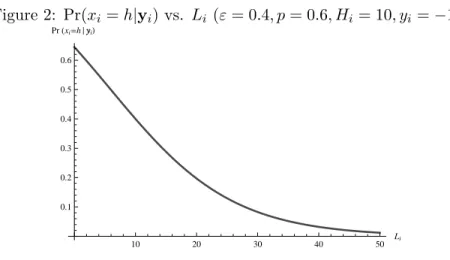
>1. Thus, high type signals increase the likelihood that an agent will be categorized as being of high type, whereas low type signals reduce this likelihood. Figures 1 and 2 illustrate how Pr(xi = h|yi) changes with Hi and Li. The firm would prefer to
Figure 2: Pr(xi =h|yi) vs. Li (ε= 0.4, p= 0.6, Hi = 10, yi=−1) 10 20 30 40 50 Li 0.1 0.2 0.3 0.4 0.5 0.6 PrHxi=hÈyiL
same. This suggests that in a given network where `-types are fairly segregated from theh-types due to homophily, `-types who are bridges between `-types and h-types may be favored by the lender (compared to `-types surrounded by the same-types). Put differently, in-group centrality of `-types will hurt their financing opportunities whereas between-group centrality will improve them.
Endogenous Network Formation. Eq. (13) applies only when tie formation is based only on
social utility and excludes the credit score (α = 0). We now consider the case where consumer utility includes credit score. We construct the utility of a borrower similar to Section 3.2. Pi is
the firm’s assessment of borroweri’s probability of repayment, which we may take as the posterior probability thatiis a high type. The lending rate for borroweriis again given byri= 1−PPii. Since
the lending rate enters the utility additively through−αxilog(ri), we have
Ui = X ij∈G mij −1{xi6=xj} +αxiRi (14) where Ri ≡ log Pi 1−Pi
. A higher Ri implies a lower risk of extending credit to an individual.
Further, the parameter αxi calibrates the importance of improving access to financing. Notice
that this formulation allows low and high types to have two different levels of financial need. When αh < α`, high types’ utility is less dependent on improving financing compared to the low
types. When αh =α`, both types have identical financial needs. The exposition here mirrors our
continuous-type model, except that different types may weigh financial concerns (represented by Ri) differently when forming ties.
Let individuals choose tie formation rules before the meeting process. Intuitively, given the network based score, individuals will be more selective towards low types and less selective towards high types. Due to the simplicity of the discrete-type model, friendship rules we allow are general
and flexible. More specifically, two high types will continue to form a tie with probability 1 after they meet. As to the friendship between low types, a low type iwill set a thresholdθi and accept
another low typej iff:
mij −θi>0.
Since friendships are formed based on mutual consent, a friendship between a high and low type can only be formed when the high type accepts friendship. A high typei will accept a low typej iff:
mij −βi >0.
As in the continuous case, social credit scoring makes individuals wary of forming ties with low types. In the discrete case low and high types are allowed to differ in their need for financing, and low types face discrimination or social rejection from both low and high types. This result is interesting since discrimination is often thought to take place between groups, or is believed to be exercised by one group on another. Interestingly, ‘within-group’ discrimination arises endogenously with the use of the network based scoring for the low types, in addition to the more common between-group discrimination. Within-group discrimination may make the surviving within-group ties more valuable, as we will see next in Lemma 4.
Let’s define a symmetric profile characterized by two thresholds (θ, β), whereθi =θfor all low
type i and βi =β for all high type i. Let (θ, β, θi) denote a symmetric profile except for possible
deviation of a low type i. Let E(Ui|`, θ, β, θi) represent the expected utility prior to the meeting
process for a low-type individual i:
E(Ui|`, θ, β, θi) =E X ij∈G mij−1{xi6=xj}|`, θ, β, θi +αxi=`E[Ri(θ, β)|`, θ, β, θi]
where the lender’s posterior assessment isPi(θ, β) = Pr(xi=h|yi, θ, β), consistent with the profile.
Similarly, E(Ui|h, θ, β, βi) is the corresponding expected utility of a high type. Using this utility
formulation, we first lay out the lender’s prior about individuals’ types in Lemma 4.
Lemma 4. Let (θ, β) be the symmetric criterion, pθ ≡Pr(mij > θ) the probability of two `-types
forming tie, and pβ ≡ Pr(mij > β) be the probability of a tie formation between h and ` types. Then the posterior probability ofi being high type is
Pr(xi=h|yi, θ, β) = " 1 + ε 1−ε yi εpβ+ (1−ε)pθ ε+ (1−ε)pβ Li εpθ+ (1−ε)pβ εpβ+ (1−ε) Hi e12N(1−pθ) #−1 (15)
where Hi is the number of friends with high signal, andLi is the number of friends with low signal.
Lemma 4 presents a slightly different result compared to Lemma 3 in decomposing the con-tributions of high and low signals. When individuals form ties endogenously, the probability of a favorable risk assessment, Pi(θ, β) (or the corresponding Ri(θ, β)), is increasing in the number of
high signals (i.e., Hi) for any level of pθ. In contrast, Ri(θ, β) increases in the number of friends
with low signals (i.e., Li) only if pθ is sufficiently small10, and decreases inLi otherwise. In other
words, when `-types are very selective in forming ties amongst themselves (pθ low), then in-group
ties help to achieve a more favorable assessment from the firm, as low types have fewer ties than the high types and a large friendship circle becomes a conspicuous signal, suggesting that one is more likely to be a h-type. That is the reason low-type signals can increase the high type perception, Pi(θ, β). But when low types are less selective towards other own types, the negative signal begins
to dominate the positive impact from size of social circle andPi decreases inLi.
We now turn to the impact of how selective low types are in forming ties amongst themselves, characterized by the selection rule θ. Ri(θ, β) is not always decreasing in Li. In particular, we
can define a valueθ(β) such that the expected effect of an additional low typefriendon Ri(θ, β) is
positive iffθ > θ(β). Formally,θ can be defined as
εp β+ (1−ε)pθ ε+ (1−ε)pβ 1−εεp θ+ (1−ε)pβ εpβ+ (1−ε) ε = 1
It can be easily shown that 0 < θ(β) < β. We detail how an individual’s odds of a favorable risk assessment vary with respect to the selectivity of`-types in Lemma 5.
Lemma 5. The expected log odds for a low type under a common tie formation criterion (θ, β),
E[Ri(θ, β)|`, θ, β], is strictly quasi-concave in θ and achieves its maximum at θ(β). Further, 0 <
θ(β)< β.
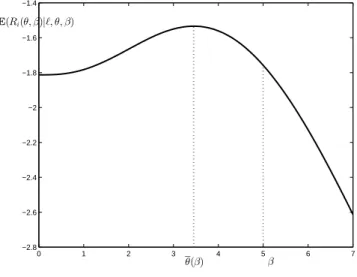
Figure 3 plots a numerical example for the expected log odds of repayment as a function of θ. Notice that very high or very low levels of within-group selectivity results in lower expected odds; whereas medium levels of selectivity among low types yield the most favorable risk assessment for them. The inverse U-curve relationship stems from two competing forces that shape low-type borrowers’ chances of receiving a loan. As the level of selectivity begins to increase from zero, the expected assessment improves at first. Consumers benefit from disassociating themselves from `-types, improving the appearance of being anh-type. As selectivity increases further, however, a
10Precisely, whenp
Figure 3: Expected Log Odds of Repayment vs. Selectivity θ.(ε= 0.2,f ∼Γ(3,2),β = 5). 0 1 2 3 4 5 6 7 −2.8 −2.6 −2.4 −2.2 −2 −1.8 −1.6 −1.4 θ(β) β E(Ri(θ,β)|ℓ,θ,β)
second and competing effect starts to dominate: Individuals’ ego-networks start to shrink exten-sively. Recall that the size of a borrower’s network becomes a conspicuous signal of his type when individuals can form ties endogenously. Extreme selectivity leads to a smaller number of ties and so reveals the true low type of a borrower, reducing his chances of a favorable credit assessment.
Lemma 6. The expected log odds for a low type is strictly decreasing in β for θ < β.
The lemma states that unlike the within-group exclusion which helps low types to some degree, between-type exclusion strictly reduces their chances of improving their financial outcomes. As high types exclude lower types from their networks, the latter’s chances of a favorable assessment from the firm goes down, resulting in further hardship for this segment.
We will seek for a symmetric equilibrium where no individuals have ex-ante incentive to deviate, and company’s posterior is consistent with their equilibrium behaviors. More precisely, (θ∗, β∗) is a symmetric equilibrium if for all i,E(Ui|`, θ∗, β∗, θi) (orE(Ui|h, θ∗, β∗, βi), depending oni’s type)
is maximized by θi=θ∗ (orβi =β∗). While ensuring that there will be no unilateral deviation, a
Nash equilibrium in social networks does not necessarily allow for mutual improvement in the utility of individuals. For example, a very high acceptance criteria such as θ∗ = ∞ can always be part of an equilibrium, because if no `-type accepts another `-type, an `-type would have no incentive from deviating from this threshold unilaterally. We remove “unintuitive” equilibria similar to the one described from consideration. Formally, we will not consider tie formation criteria (θ∗, β∗) an equilibrium if there is another profile (θ∗∗, β∗) such that (i) low types are better off, (ii) given that high types chooseβ∗ and every other low type choosesθ∗∗, a low type is willing to set his criterion
θ∗∗ as well. Similarly, we do not consider (θ∗, β∗) an equilibrium if there is a profile (θ∗, β∗∗) with unintuitive properties alike.
Notice that from Lemma 5, for any equilibrium, θ∗ < β∗ should hold. In words, when both low and high types need financing, regardless of how dire the needs of the low types are (i.e., independent of the value of α`), low types will face within and between group exclusion. More
importantly, since high types are more successful in tie formation, they afford to be selective in forming friendships. The low types, on the contrary, cannot be picky choosers: If they set the friendship threshold too high, they find themselves on the downhill side of the expected log odds curve (Figure 3). They would achieve a higher score and higher social utility by being less selective. As a result, the within-group discrimination against low types is always lower than the between-group discrimination against them. This result is formally stated in Proposition 4.
Proposition 4. Supposeαh, α` >0. In any symmetric equilibrium(θ∗, β∗), we have0< θ∗ < θ(β∗) and β∗ >1.
In summary, two forces influence the network-based score in equilibrium to be more or less diagnostic for detecting a low type. Compared to the scenario before people react, higher exclusion amongst low types make social network based scoring less powerful, by Lemma 5. In a similar vein, higher levels of exclusion on low types by high types increase the accuracy of the scores by Lemma 6.
4.2 Special Case: Lower Financing Needs for High Types
Up to now, we focused on an environment where the high types need financing. In reality, it is often the case that the need for financing (i.e., obtaining a credit or a loan) is markedly more severe for low types. To address this possibility, we provide the outcomes from the special case whenαh = 0.
Notice, by continuity, this implies that similar results would hold if αh is a very small positive
number. Note that when αh = 0, β is no longer material, and high types form a tie with low type
only when mij >1 (i.e., β= 1).
Proposition 5. When αh = 0, there exists a unique equilibrium among low types such that 0 <
θ∗ < θ(1).
Proposition 5 suggests that when high types put no or very little weight on access to financing, high types may reject many social ties with low types due to homophily. In addition, due to financial concerns,`-type individuals are systematically excluded even from the networks of others
similar to them. Put differently, existing financial inequality breeds within-group discrimination and social isolation among those of lower type and greater need.
4.3 Explicit Discrimination against Low Types
We have shown how strategic discrimination against low types may emerge endogenously even in the presence of non-strategic homophily among low types. To extend the discussion on discrimination, we analyze an environment with exogenous discrimination against `-types. To formally express such discrimination, we construct the utility for iof becoming friends with j in a manner similar to but different from the specification in Equation (12):
mij −1{xj=`}.
Keeping the discrete matching formulation with this slight modification, the probability that two h-type individuals will become friends conditional on meeting is 1 and the probability that any other type of pairs will become friends is p1 ≡ Pr(mij > 1) < 1. The social utility is penalized
whenever one becomes friends with an individual who is an `-type.
Parallel to Lemma 3, the following lemma gives the posterior before individuals strategically form their social ties to obtain better network based score. Notice that mathematically the Lemma is a special case of Lemma 4 wherepθ =pβ =p1.
Lemma 7. Let p1≡Pr(mij >1)be the probability of formation of a tie with at least one low type.
Then, Pr(xi =h|yi) = " 1 + ε 1−ε yi p1 ε+ (1−ε)p1 Li p1 εp1+ (1−ε) Hi e12N(1−p1) #−1 (16)
where Hi is the number of friends with high signal,Li is the number of friends with low signal.
The lemma says that having a friend with a low signal actually improves one’s score. When explicit discrimination is present, the expected number of friends varies for each type: For a high type, the expected degree is 12Sν(1 +p), whereas for a low type it isSνp. Similar to the endogenous rise of discrimination, a larger social network is a conspicuous signal. An individual with a larger network emits a stronger signal that he is a high type. Since in expectation low types have a smaller social circle, any tie becomes a signal of being high type.
Endogenous Network Formation. What happens when both exogenous discrimination and endogenous tie formation are at work? Lemma 7 implies that individuals will be less selective towards low types in an attempt to obtain better scores. Similar to the thresholds we defined for the homophily case, we let low types choose a criterionθi ≤1 towards their same type fellows, and
let high types choose βi ≤1 towards low types. High types continue to form ties with probability
one upon meeting, and a tie between two different types forms only when the high type accepts the low type. It is not difficult to see that Lemma 5 and 6 can be stated here without change. Further, a result can be derived that corresponds to Proposition 4.
Proposition 6. When low-types are exogenously discriminated against and α`, αh >0, in a
sym-metric equilibrium, θ(β∗)< θ∗ <1 and β∗ <1.
5
Effort to Become a High Type
Our results thus far relied on the assumption that individuals in society are endowed with ‘types’ that cannot be changed. In other words, we assumed that there is no social mobility. Although some indicators of type (e.g., family, race, birth place, country of origin) cannot be altered, other potential indicators, such as occupation or financial discipline, can be improved if low types exert effort (e.g., by investing in education). In this section, we extend our discussion to allow for this possibility. An array of factors may force `-type individuals to exert effort, but we will focus on factors endogenous to tie formation such as the reduction of borrowing costs and the threat of social exclusion.
We model the mechanism in the following fashion. Consider a friends network Gamong ` and h type individuals. Let G` denote the sub-network among the low types. Further, let Hi denote
the number ofh-type contacts of a low-typei, which collectively are represented with the vectorH
for all the low types. Similarly, let Li denote the number of `-type contacts of a low-type i. Each
low-type individual may then exert effort ei ≥ 0 such that with probability ei he will become a
high type. Notice, the effort therefore projects types of contacts one may have in the future. We assume that given the network and the parameters of our model, ei ≤ 1 for all low type i. High
type consumers exert zero effort and remain high types.
The utility that a low-type individualiderives from exerting effort ei consists of two parts:
Ui(e, G) = X ij∈G n mij−1{xj=`}(1−ej) o +ui (17)
where ui=aei−b ei 2 −φ Hi+ X ij∈G,xj=` ej ei (18)
The term in curly brackets in equation (17) captures individuali’s expected social utility under the assumption of explicit discrimination (Section 4.3) and exertion of own and friends’ effort. Given the effort of a friend ej, there is 1−ej probability thatj will remain a low type, in which casei’s
utility from forming ties with j will be discounted by a unit normalized to 1.
The term ui expresses the non-social benefits and costs of exerting effort. First, term aei
captures the expected intrinsic benefits of becoming a high type. Second, the cost of effort is captured with the marginal cost bei/2 that is increasing in effort. Third, under social
network-based scoring, a (potential) high-type friend j has a positive effect on i’s credit score and thus reduces i’s financing burden. We formally express this “network effect” by allowing the marginal cost of effort for i to decrease in the number of the high-type friends he has and in the efforts of his low-type friends to become high types, at rateφ >0. Alternatively,bφHi+
P
ij∈G,xj=`ej
ei
can be thought of as an interaction term, representing how the return to one’s own effort (ei)
is expected to be amplified by the number of friends one expects will be considered high-type. Some investors, for instance, may prefer if they have friends who are also invited to participate in exclusive investment opportunities (Bursztyn et al., 2014). In a very different setting, one is likely to gain admission to an exclusive bar or dance club if both oneself and the rest of one’s party is dressed attractively.
It is important to make two notes here. First, the derivation of the functional form of ui is
a“reduced-form” approach to motivate the complementarity between one’s effort and his friends’ efforts. It is possible to derive this form of complementarity based on the results provided in the earlier sections. (In the Web Appendix, we offer a more detailed description of how equation (18) can be derived from this channel.) As demonstrated in Section 4, under network-based credit scoring with non-zero financing needs for both types, low types will face both within-group and between-group discrimination. Under such pressure, `-type individuals would exert effort to increase their social and credit scoring utility from friendships. The benefits to exerting effort depend on the expected number of low and high type friends.
Second, notice that it is also possible to consider alternate specifications of social utility. For instance, we could also investigate an environment with pure homophily instead of discrimination, in which case Equation (17) would be replaced with:
Ui(e, G) = X ij∈G n mij −ei1{xj=`}(1−ej)−(1−ei) h 1{xj=h}+1{xj=`}ej io +ui. (19)
In an environment with homophily, individual i will become a high type with probability ei, in
which case there will be a disutility for a tie with individualj who, after exerting effortej, remains
a low type (which happens with probability 1−ej). With probability 1−ei, individualiwill remain
a low type, in which case he will face a disutility from ties with high types (including low types who become high types after exerting effortej).
Next, given the utility form in (18), we will first derive the optimal effort level in a given network.
Effort in an Exogenous Network. We are interested in the Nash equilibrium when people
si-multaneously choose their efforts when the network is exogenously given. Proposition 7 summarizes the optimal level of effort for an individual conditional on his social network, following Ballester et al. (2006).
Proposition 7. Let A` be sociomatrix (i.e., the adjacency matrix) of G`.
(i) Under a discriminating social utility, if the largest-magnitude eigenvalue of A` is smaller than
|φ|−1, then the equilibrium effort is
e∗ =(I−φA`)−1(ab−1+φH)
=(I+φA`+φ2A2` +...)(ab
−1+φH). (20)
(ii) Under a homophilic social utility, if the largest-magnitude eigenvalue of A` is smaller than
|2b−1+φ|−1, the equilibrium effort is:
e∗=I−(2b−1+φ)A` −1 (a+H−L)b−1+φH =I+ (2b−1+φ)A`+ (2b−1+φ)2A2`+... (a+H−L)b −1 +φH. (21)
Proposition 7 states that the effort exerted by individuals to improve their score relies on several factors. A discriminatory environment and an environment with homophily differ in the role of the low types in inducing effort. In both environments, an individual with higher number of high-type friends is likely to exert more effort, as his overall cost of borrowing is lower. In an environment with discrimination, if two`-type individuals are connected to the same number ofh-type friends, the one with higher number of `-type friends is incentivized to exert more effort. This is perhaps surprising, as sufficiently high within-group connectivity can be a stronger motivator of effort. In contrast, in homophily, increasing proportions of low type friends can reduce effort due to enhanced social utility when an individual with low-type friends remains low type with low effort.
and (21) are forms of Bonacich centrality. The effort exerted by an agent to improve his credit score is proportional to his centrality measure.
Further, the Nash effort in both environments is proportional to the Bonacich centrality measure, which is the ‘summed connections to others, weighted by their centralities of connections to others’ (Bonacich, 1987, p. 1172). With a discriminating social utility, an individual who is located at the center of a social network is likely to be exposed to higher positive network effects, therefore may exert greater effort. As a result, individuals who are more central in the network are more prone to social mobility when there are complementarities. In an environment with pure homophily, there will be two conflicting forces determining centrality and social mobility relationship. First, being central in a network of high types and low types who exert effort can increase an individual’s chances of social mobility. Second, if a low type individual is central among other low types who exert little effort, he will reduce his effort to ‘fit’ and be similar to his network to enhance his social utility. Therefore, in tie formation based on homophily, it is possible for central low types to exert low effort leading to ‘permanent’ low class membership and stagnant financial hardship.
Effort with Endogenous Network Formation among Low Types Under Discriminating
Utility. As we have specified in (17)–(19), the friendship utility of a friend ofidepends on the effort
that i will exert. Hence the effort of i plays an important role in his friends’ network formation. Moreover, in the last section we saw that i’s effort depends on his position in the network. This mutual dependence between the network position and effort suggests the possibility of multiple stable situations. With discriminating social utility, for example, in one society, people may exert low effort, and as a result, may become sparsely connected. This in turn gives little incentive for them to exert effort. Conversely, in another society, people may exert high effort and thus may become more densely connected, reinforcing their high-effort behavior.
To further explore how effort mitigates the likelihood of exclusion, we consider a two-stage game under the discrimination environment. In the first stage, individuals choose friends and friendships are formed bilaterally. In the second stage, individuals exert efforts. Let e∗(G) be the Nash effort for a given networkG, which is characterized in Proposition 7. The first-stage reduced form utility foridepends onGonly:
Ui(e∗(G), G).
We look for pairwise-stable networksGunderU. Gis pairwise stable if (i) for anyij ∈G, we have both Ui(G)> Ui(G−ij) and Uj(G)> Uj(G−ij); (ii) for anyij /∈G, either Ui(G)≥Ui(G+ij)
equilibrium.
Example 3. Consider a society with four low-type individuals featured with explicit discrimination,
and assume a= 1, b= 5, and mij = 12 for all i, j. Let φb= 15. It can be easily verified that both the empty network and the complete network are pair-wise stable. For the empty network, each individual exerts effort 15 and obtains utility of 101. For the complete network, each individual exerts effort 12 and has utility 58.
The example demonstrates that the empty network is pair-wise stable because everyone exerts very low effort, and a single link between a pair won’t generate a change sufficiently large. The disutility of friendship with a low type (which is normalized to 1) prevents any pair from becoming friends. Moreover, a complete network is pair-wise stable because everyone exerts reasonable effort. The effort reduces the disutility of friendship between low types, and the friendship utility between any pair is exactly zero. Breaking any one link increases the costs of effort for the pair, and they will decrease their efforts. This leads to higher costs for their friends and eventually the effort of everyone will decrease. As a result, everyone receives less utility from both the friendship and effort.
Overall, the example suggests that the network structure in different societies may facilitate social pressure to exert effort at different rates. In particular, in societies where network structure is sparse, it is expected to be less effective and social mobility may remain limited. In contrast, in denser societies, social pressure can be more effective, motivating higher levels of social mobility. The difference suggests that network based scoring practices are expected to reach different levels of success in different societies; and the performance is conditional on the network structure of society.
6
Extensions
6.1 Uncertainty about Friends’ Types
In our main model, the underlying assumption was that upon meeting, individuals learn about each others’ types with certainty. In reality, types may be observed with some noise. Let’s consider the case when individuals meet others but observe their types imperfectly. Let individual iobserve a signal of xj upon meeting with j, which is correct with probability 1−τ with 0 < τ < 12. This
implies that the added utility from homophily relies on how the uncertainty about the other’s type is resolved: expected social utility is mij −τ if the signal is the same as one’s own type, and