DOES ONLINE BANKING TECHNOLOGY AT LOW-INCOME CREDIT UNIONS PROMOTE FINANCIAL INCLUSION?
Lingmei Howell
A dissertation submitted to the faculty of the University of North Carolina at Chapel Hill in partial fulfillment of the requirements for the degree of Doctor of Philosophy in
the Department of City and Regional Planning
Chapel Hill 2019
Approved by:
William M. Rohe
Howard Aldrich
Mai Thi Nguyen
Roberto G. Quercia
ABSTRACT
LINGMEI HOWELL: Does Online Banking Technology at Low-Income Credit Unions Promote Financial Inclusion?
(Under the direction of William M. Rohe)
Ensuring access to safe and affordable financial products and services by
underserved members of society, such as low-income groups, is an encompassing goal
of financial inclusion. It has been claimed that online banking technology can be an
effective tool to foster financial access and promote financial inclusion. This study
investigates the relationship between the adoption of online banking technology by
low-income credit unions and the effectiveness of their financial inclusion efforts.
Using latent curve modeling, no significant effect was found for the number of
years low-income credit unions had offered online banking and expected membership
growth after accounting for credit union size in assets and annual changes in the
number of branches. Statistically significant effects were found, however, for assets size
on the number of years a low-income credit union had offered online banking, the
latent slope and the latent intercept, suggesting underlying differences between
low-income credit unions that offer online banking sooner and those that offer online
banking later or not at all.
Qualitative analysis of in-depth interviews with sixteen selected low-income
minimal impact on membership growth. Instead, online and mobile banking's
effectiveness is in preventing membership decline, especially with younger people who
demand online access to services. The reasons low-income credit unions adopt online
banking is to accommodate that demand and remain competitive. The one reason
low-income credit unions do not adopt online banking is cost. Tepid support was found for
the claim that online banking lowers the cost of provided services and that those
savings are passed on to the members via better interest rates and lower fees. Physical
branches were found to still play critical service roles, particularly with aiding members
uncomfortable with online banking technology and in providing financial guidance and
education to their members. Online banking’s appropriateness in fostering financial
inclusion is as an additional channel for accessing financial services, but not as a
ACKNOWLEDGMENTS
I cannot express enough gratitude for my dissertation committee’s support and
guidance throughout the years. Specifically, I would like to acknowledge the
tremendous support I have received from my advisor, Dr. William M. Rohe. Whether in
Manchester, Chile, China, or Chapel Hill, Dr. Rohe has tirelessly guided my studies. I’m
deeply grateful for his continuous support. In addition, I would like to thank Dr.
Catherine Zimmer, who has advised me on numerous analytical methods and
generously shared her consistent encouragement and interest in my study. I am most
grateful for her support. I also would like to thank my committee members, Dr.
Howard Aldrich, Dr. Mai Thi Nguyen, and Dr. Roberto G. Quercia, who have guided
and assisted me not only through this rigorous and rewarding process but also in the
classroom. I’m truly blessed to have had them on my committee and to learn from them
TABLE OF CONTENTS
Chapter 1 Introduction...1
Low-Income Credit Unions (LICUs)...4
Accessibility...5
Role of Technology in Financial Inclusion...5
Affordability...6
Adaptation and Appropriateness...6
Summary...7
Overview of Remaining Chapters...8
Chapter 2 Research Problem Background...10
Introduction...10
Overview...11
The Landscape of Evolving Online Banking Technology...14
Cost Reductions...15
Personnel Expenses...17
Real Estate Costs...18
Transaction Costs...20
Provision of Products and Services...21
Data Analytics and Customer Insights...24
Customers Opt for Online Banking...27
Convenience...29
Accessibility...31
There Are Still Non-Adopters...31
Lack of Resources...32
Technological Challenges...33
Regulatory Compliance...36
The Dodd-Frank Act...37
The Americans with Disabilities Act...40
Credit Unions and Low-Income Credit Unions (LICUs)...41
Defining Characteristics of Credit Unions...41
Cooperative Governance...44
Field of Membership...44
Low-Income Credit Unions (LICUs)...46
The Special Financial Needs...49
Trust Issues...51
Brick and Mortar...53
Chapter 3 Online Banking Revolution and Financial Inclusion...57
Introduction...57
Online Banking Evolution...60
Definition of Online Banking...60
Mobile Banking...62
Impacts of Online Banking Adoption...65
Transaction Cost-Savings...65
Institutional Size...70
Stability and Survival...72
Financial Inclusion...74
Financial Products and Services...74
Financial Access...75
Bank Accounts...76
The Banked and Unbanked...78
Digital Readiness...79
Summary...81
Chapter 4 Research Methodology...82
Introduction...82
Quantitative Study: Impact of Online Banking on Membership...83
The Conceptual Growth Model...87
Data for the Quantitative Study...89
Sample Selection...90
Variables and Measurement...93
Membership (Dependent Variable)...93
Online Banking (Independent Variable)...94
Control Variables...95
Endogeneity and Instrumental Variables...96
Qualitative Study: Meaning behind the Numbers...98
Rationale for Applying Qualitative Study...98
LICU Interview Candidate Selection...99
In-depth interviews...101
Qualitative Analysis...102
Chapter 5 Quantitative Results: Impact of Online Banking on Low-Income Credit Union Membership...104
Introduction...104
Summary Statistics of Select Variables...106
Latent Curve Analysis of Online Banking Technology Adoption and Membership...112
Modeling LICU Membership Growth...112
Competing Models and Parameter Estimations...115
Model 1: Technology Adoption Effect on Membership Size and Growth…...116
Model 2: Membership Size and Growth Controlling for Assets Size...118
Model 3: Branches as a Time-Varying Covariate...120
Model 4: Removal of Technology Adoption and Assets Size on Latent Slope...121
Model Fit Comparisons...122
Fit Anomaly and Model Respecification...125
Conclusion...129
Chapter 6 Qualitative Analyses: Factors Influencing the LICUs’ Decision to Adopt Online Banking Technology and Consequences of that Decision...130
Introduction...130
Methodology...131
Overview of the Topics...134
Reasons for Online Banking Technology Adoption Decision...135
Summary of Online Banking Adopters...139
Online Banking Non-Adopters...139
Summary of Online Banking Non-Adopters...143
Regulatory Compliance and Liability Costs...143
The Americans with Disability Act (ADA)...143
The Dodd-Frank Act...145
Online Banking Adopters...145
Online Banking Non-Adopters...150
Summary of Regulatory Compliance...154
Impact of Online Banking on Membership Growth...156
Impact of Decision to Adopt on Membership Growth...156
Impact of Decision Not to Adopt on Membership Growth...161
Summary of Online Banking on Membership...166
Impact on Member Services...166
Interest Rates and Fees...166
Caveats...170
Impact Summary...172
Summary...173
Chapter 7 Synthesis...177
Introduction...177
Overview of the Inquiry...180
Factors Influencing Online Banking Adoption...181
Efficiency and Expectation Drive Online Banking Adoption for
Larger Low-Income Credit Unions...183
Influencing Factors Summary...185
Online Banking and Membership Change...187
Summary...192
Chapter 8 Reflection and Conclusion...195
Introduction...195
Summary of Findings...196
Latent Curve Modeling...196
Content Analysis of Interviews...197
Reasons for Adopting Online Banking or Not...198
Impact of Online Banking on Membership Change...199
Online Banking Impact on Services...200
Synthesis...202
Implications...203
Limitations...205
Future Work...207
Conclusion...209
LIST OF TABLES
Table 4.1 LICU Interview Candidate Selection Cross-Classification...99
Table 5.1. Select Summary Statistics for Sample LICUs, 2012 and 2018...108
Table 5.2. Summary of Competing Model Parameter Estimates...122
Table 5.3. Summery of Model Fit Statistics...125
Table 5.4. Summary of Model Fit Statistics for Model 3 and Respecified Models...127
Table 6.1. Characteristics of 16 Interviewed Low-income Credit Unions...132
LIST OF FIGURES
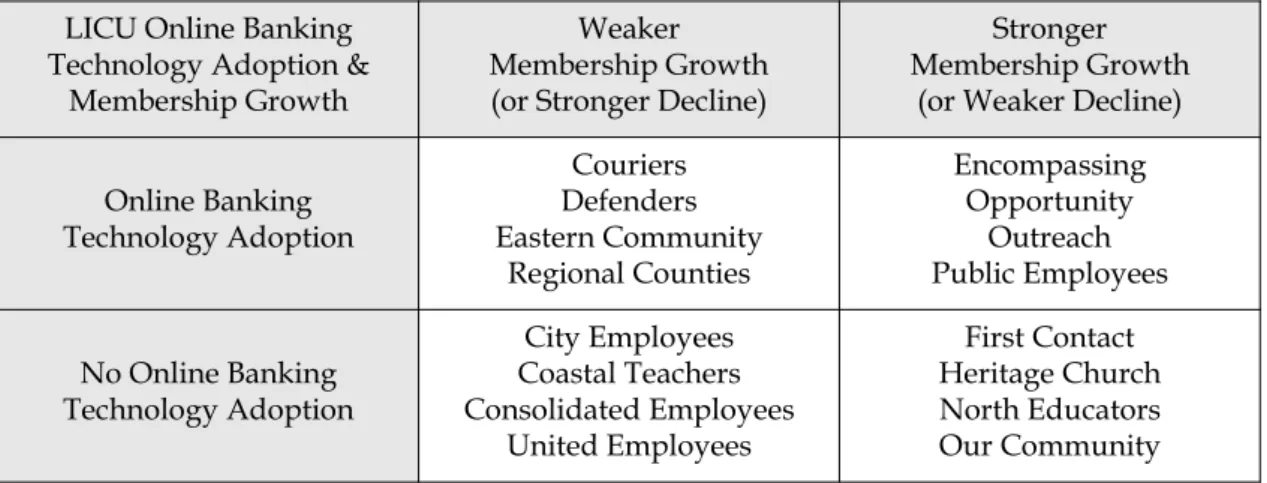
Figure 4.1. Conceptual Model of Online Banking Technology Adoption and LICUs’ Membership Growth...88 Figure 4.2. Average LICU Membership Size and Percent of Online Banking Adoption
by Year...92 Figure 5.1. Model of Online Banking Technology Adoption and LICU Membership
Change...112 Figure 5.2. Respecified Model of Online Banking Technology Adoption and LICU
LIST OF ABBREVIATIONS
ADA The Americans with Disabilities Act AIC Akaike Information Criterion
BIC Bayes Information Criterion
CAQDAS Computer Assisted Qualitative Data Analysis CDFI Community Development Financial Institution
CFI Comparative Fix Index
FAQ Frequently Asked Questions
FDIC Federal Deposit Insurance Corporation
FOM Field of Membership
HMDA Home Mortgage Disclosure Act
IV Instrumental Variables
LCA Latent Curve Analysis
LCM Latent Curve Model
LGM Latent Growth Model
LICU Low-Income Credit Union
LTM Latent Trajectories Models
NAFCU National Association of Federally-Insured Credit Unions NCUA National Credit Union Administration
RDC Remote Deposit Capture
RMSEA Root Mean Square Error of Approximation
ROA Return on Assets
SEG Select Employee Group
SEM Structural Equation Modeling
SMS Short Messages Service
CHAPTER 1 INTRODUCTION
Ensuring access to safe and affordable financial products and services by
underserved members of society, such as low-income groups, is an encompassing goal
of financial inclusion. Participation in the banking system can help protect against
discriminatory or predatory lending practices, as well as facilitate wealth building. In
spite of the clear benefits, many people, especially those of low- and moderate incomes,
lack access to mainstream financial and banking services. Several reasons have been
offered for this lack of access, such as geographic obstacles, product affordability,
low-income people's inability to meet eligibility criteria, or financial institutions' lack of
financial incentives in serving low-income individuals and households. Overall,
financial and economic inclusion is about bringing more underserved community
members into the banking system, “retain[ing] them in safe and sustainable account
relationships, and foster[ing] financial empowerment to deepen banking relationships
and fulfill [their] financial goals” (Burhouse et alia 2014, 2).
When the Community Development Financial Institution (CDFI) Fund was
created in the mid-1990s, it shone a light on the important role financial institutions are
low-income people (Pinsky 2014). The more than two decades since the formation of the
CDFI Fund have seen significant changes in banking and advances in communications
technology. In light of these changes, in particular those advancements that improve
access to banking services, as well as reduce the cost of providing many of those
services, financial institutions are empowered more than ever to lead community
financing and development efforts, particularly with respect to financial inclusion.
However, are credit unions especially those that serve low-income communities,
leveraging new banking technologies to that end?
Community development and revitalization occur in a local context and with a
physical presence (McDermott 2004). There are many indicators of a community's
well-being. This study focuses on economic well-being, particularly wealth creation and
financial inclusion. In this regard, one aspect of community development is to seek
ways to help their community members access financial services and opportunities that
can build wealth with a goal of community development and neighborhood
revitalization (Lichtenstein 2001, Ferguson and Dickens 1999, Vidal and Keating 2004).
Access to credit, capital, and financial services is seen as a critical element to economic
success for community members and the communities themselves. With accessible and
affordable financial resources, community members can accumulate savings, families
can begin to build wealth, businesses can develop, employment opportunities can be
created, and community prosperity can be enhanced. Vidal stated that ameliorating
“spatial gaps in credit and service availability” remains a key concern for community
community development and revitalization as being able to create assets (Vidal and
Keating 2004).
Yet, many communities lack access to safe and affordable financial services.
Wilson (1987) emphasized the role isolation plays in poverty. According to Wilson,
many communities have been neglected and underserved. Their residents do not have
access to the necessary institutions, resources, and opportunities critical for them to
improve their quality of life, as well as build wealth (Wilson 1987). Because of their
community focus, their access to grants and low-interest loans from the Community
Development Revolving Loan Fund, as well as favorable regulatory exceptions,
low-income credit unions (LICUs) are better positioned than most commercial banks to offer
affordable financial services and products, make smaller loans, provide technical
assistance and financial advice to community members, particularly low-income
members and small businesses. LICUs are often locally-based and
community-embedded and through the specialized financial services and instruments they make
available, LICUs can facilitate wealth creation, promote upward mobility, as well as
enhance the community’s overall economic health and prosperity, achieving
community revitalization objectives. Still, there are many low-income communities that
are not reached by LICUs and this study looks at how online banking technology can
Low-Income Credit Unions (LICUs)
The term “low-income credit union” (LICU) is often conflated with “community
development financial institution”(CDFI). A community development financial
institution can be any type of financial institution that receives certification from the
U.S. Department of Treasury's CDFI program. CDFIs can be credit unions, but they can
also be banks, loan funds, micro-loan enterprises, or even venture capital providers as
long as they meet eligibility requirements and share a common goal of expanding
economic opportunity in low-income communities. A low-income credit union can be a
CDFI, but many are not.
LICU, on the other hand, is a designation approved and granted by the National
Credit Union Administration to federal credit unions that meet certain criteria, primary
of which is that more than 50 percent of their membership be low-income (i.e., members
whose family income is 80 percent or below the median family income for the
metropolitan area where they reside). The Federal Credit Union Act was amended in
1970 and again in 2008 to define “low-income member” and establish criteria for
determining if a credit union qualifies for the “low-income” designation, as noted
above. Among the advantages of having the “low-income” designation, these credit
unions gain access to additional sources of funding and resources (NCUA 2015). This
Accessibility
Because their primary constituency is low-income individuals, low-income credit
unions (LICUs) can play a particularly vital role in financial inclusion, helping members
of their communities who historically have been excluded from the benefits of
participation in the mainstream financial system. Their effectiveness, however, is
limited by their ability to reach potential new members and bring them into financial
system.
There are various barriers to access, such as lack of conveniently located bank
branches, hours of operation, or even services offered in one's language. Lack of
conveniently located physical branches is an especially emblematic problem for
members of low-income communities. Yet, the economics of providing such services in
traditional brick-and-mortar facilities can be unprofitable and prohibitive.
Role of Technology in Financial Inclusion
However, technology innovation has profoundly altered the landscape of the
finance industry (Wheelock and Wilson 2013, 75), as well as how financial institutions
interact with their customers. The arrival of the Internet, enhanced computing power,
improved data processing capabilities, and advanced information and communications
technology have spurred the development of cheaper, better, and newer financial
products and services, as well as how they are accessed. As Internet access and
those barriers, permitting community members access to banking services from almost
any location, at any time, and often in multiple languages.
Affordability
Advanced technology can also enable LICUs to lower their operational costs and,
in turn, provide affordable financial products and services to attract more underserved
people to the financial system. For example, the cost difference between online and
traditional banking transactions is often in excess of one Dollar per transaction (Fuentes
et alia 2007, 5; DeYoung et alia 2018, 1035). Such operating cost savings can be passed
on in the form of fewer and lower banking fees on low-balance accounts, as well as
better interest rates for both savers and borrowers.
Many credit unions are increasingly devoting more resources to online banking
technologies to improve access and meet growing demands from the members for
online services. Even low-income credit unions (LICUs) are seeing increasing adoption
of contemporary online transactional technologies, which helps lower their operational
costs in the long run and, in turn, may allow them to offer more affordable financial
products and services to a wider membership base. Yet, not all credit unions have
adopted online transactional banking technology.
Adaptation and Appropriateness
Aldrich notes that “[a] thriving organization is adaptive to its environment”
(Aldrich 2008, 54). As technological advances drive change in the environment in which
technologies if they are to thrive and accomplish their financial inclusion objectives.
Stegman explains that online banking is about financial inclusion, bringing unbanked
people into the financial mainstream, facilitating savings by providing them with access
to bank accounts, and helping them build assets for their future (Steman 1999, 170–173).
However, Aldrich also cautions that “[a] particular technology is effective only insofar
as it is appropriate to the environment an organization faces” (Aldrich 2008, 18). While
advancements in banking technology often enhance convenience and affordability, is
the technology being widely adopted and utilized by low-income credit unions in a
manner that benefits members of the communities they serve? Does online banking
help low-income credit unions provide safe, conveniently accessible, and affordable
financial products and services to underserved members of society? What are the
downsides, if any?
Summary
Ensuring that all members of society have convenient access to safe and
affordable financial products and services is a goal of financial inclusion. This study
investigates the role contemporary communication technology and online banking are
playing in advancing financial inclusion. I also investigate the claim that low-income
credit unions (LICUs) that adopt online banking technology enhance their ability to
reach potential members in the communities they serve, providing them with
investigate potential factors and reasons low-income credit unions decide to adopt
online banking or not, as well as the impact on the services they provide.
To study these issues, I use a mixed-methods approach. First, I use latent curve
modeling (LCM) analysis to assess quantitatively the effect that offering online banking
has on a low-income credit union's ability to reach out and grow its membership. Next,
I follow up with a qualitative content analysis of interviews with sixteen selected
low-income credit unions, half that had adopted online banking and half that had not, to
examine the reasons some low-income credit unions decide to adopt online banking
technology while others do not. In addition, I seek their perspectives on the
effectiveness of online banking in reaching new members as well as its appropriateness
for the memberships they serve.
Overview of Remaining Chapters
Following this introduction, this dissertation consists of seven additional
chapters. Chapter two provides a detailed background of the research problem and
related issues. Chapter three provides a review of the literature pertinent to banking
technology evolution, impacts of using online banking, and financial inclusion. Chapter
four describes the research methodologies for both the quantitative and qualitative
portions of the study. Chapter five presents the quantitative latent curve modeling
analysis of online banking technology’s effect on membership growth, while Chapter
six presents the qualitative analyses of the interviews from sixteen selected LICUs.
Chapter eight summarizes the study and includes implications, limitations, potential
CHAPTER 2
RESEARCH PROBLEM BACKGROUND
Introduction
This study investigates the role online banking plays in helping low-income
credit unions reach more low-income unbanked and underbanked people of the
communities they serve and bring them into the financial mainstream, thus facilitating
savings, wealth accumulation, and promoting overall financial inclusion. In that regard,
this study examines the effectiveness of online banking in promoting membership
growth at low-income credit unions and factors shaping the decision of low-income
credit unions to adopt online banking technology or not, and the appropriateness online
banking services and products for lower-income members, as well as potential threats
reliance on online banking only can present to providing services that are in the best
interest of those members. In this chapter, I present a detailed review of background
issues and literature related credit unions, especially low-income credit unions, how
some are leveraging online banking to grow their memberships, and what makes
Overview
It has been claimed that online banking technology can be an effective tool to
foster financial services access and promote financial inclusion (Burhouse et alia 2014;
Gross et alia 2012). According to the World Bank, contemporary online banking
technology holds “an enormous opportunity for greater financial inclusion” (World
Bank 2014). Today, whether in the inner city or a remote rural area, historically
unserved and underserved low-income individuals not only can be reached and served,
but also can save and access basic financial services from their homes or their
businesses, without traversing outside of the premises (Ouma, Odongo, and Were,
2017, 34).
Modern telecommunications technology is improving accessibility by allowing
financial institutions to reach new members in remote, rural, or other locations where it
is often not profitable or financially sustainable to maintain a brick-and-mortar physical
branch. As McGarvey says, online banking technology enables people to have a virtual
branch bank in their pocket or in the palm of their hand (McGarvey 2014). Online
banking technology not only transcends geographic divides, it transcends the calendar
and the clock. It frees people to access financial services when it is convenient for them,
not just for the bank. For example, a working woman no longer has to take time off
from her job, and then a long bus ride across town and back to interact with her bank
because, frankly, that is what is convenient for her bank. With online banking, she can
interact with her bank in a way that is convenient for her. By practically eliminating
financial inclusion, allowing financial institutions to reach many more people,
especially those who have been excluded from access to the mainstream financial
system.
A handful of studies have claimed that financial institutions that adopt online
banking technology are those that tend to be the most successful, in terms of growing
customers and increasing assets (Ahamed and Mallick 2019, 405 and 423; Burhouse et
alia 2014; DeYoung, Lang, and Nolle 2007; Goddar, McKillop, and Wilson 2009; Isayev
2012, 126; Nath, Schrick, and Parzinger 2001, 21; Orem 2016; Ouma, Odongo, and Were
2017, 34; Ozili 2018, 330; Servon and Kaestner 2008, 271; Sullivan and Wang 2013, 1). A
recent FDIC report also claimed that online banking can promote financial inclusion
(Burhouse et alia 2014), although insufficiently. So, while the motivation might be
strategic, the result may be improved accessibility and cost-savings for low-income
individuals who have experienced restricted access to mainstream financial products
and services.
Key, albeit less altruistic, reasons financial institutions are adopting online
banking is that it enables them to reach new customers in remote areas and to directly
provide products and services to those customers without the need for establishing a
physical brick-and-mortar presence, thereby greatly reducing costs associated with
maintaining a physical branch or having branches in an otherwise unprofitable or
financially unsustainable location (United States Department of Treasury 2018). The
These associated costs can range from office occupancy expenditures, employee
salaries, and operating expenses.
Without incurring those major expenses, banks and credit unions are able to
convert the net cost savings into banking services that are more affordable; thus, not
only making the bank or credit union more attractive, but promoting wealth
accumulation for their customers or members. In addition, it is believed that the
mainstream financial banking system provides individuals with safer and more secured
financial services (Beverly et alia 2005, Burhouse et alia 2016). Beverly and associates
stated that money kept outside of formal financial institutions are less secure (Beverly et
alia 2005, 167). According to a recent FDIC report, when individuals keep their money
at formal financial institutions, such as federally insured depository institutions, they
“establish a mainstream banking relationship that provides them the opportunity to
deposit funds securely, conduct basic financial transactions, accumulate savings, and
access credit on fair and affordable terms” and are also ensured access to “safe, secure,
and affordable banking services” (Burhouse et alia 2016, 11).
Not everyone is convinced that online banking technology is effective in reaching
into previously unserved and underserved communities to bringing new members into
the mainstream financial system. Servon explained that there are other barriers to
motivating and attracting an individual to join mainstream banking; such as, trust,
relationships, affinity, and bank fees (Servon 2018). These barriers can have significant
impacts on an individual’s decision to engage with financial institutions, as well as to
individuals for the reasons that many low-income people have little or no trust in
mainstream financial institutions, the financial system, or contemporary online banking
technology. Additionally, many of low-income individuals have never had the banking
experiences before, not to mention owning a conventional bank account. (Servon 2018).
The Landscape of Evolving Online Banking Technology
Technological innovation has profoundly altered the landscape of the retail
finance industry (Wheelock and Wilson 2013, 75). Contemporary technological
advancements have changed how we manage our finances and also changed how we
interact with financial institutions. Conversely, financial institutions, too, have changed
how they interact and engage with customers. Stegman recognized this emerging
phenomenon years ago and noted that technological breakthroughs were changing the
way traditional banking is conducted (Stegman 1999, 38).
Innovations in online banking technology are allowing financial institutions to
provide new financial products and services, as well as new ways to provide them.
Financial institutions that embrace the new technologies are enabled to transcend
geographic boundaries to reach and serve more customers in remote and rural
communities where these individuals were previously not included in their service
areas. It has been reported that financial institutions are serving more low-income
individuals than ever before worldwide, bringing more people into the financial
mainstream (Ouma, Odongo, and Were 2017; Kamat 2017). DeYoung (2005)
do for financial institutions, including expanding service into new geographic areas.
Using examples of Internet-only banks, the author stated:
An especially elegant case has been made for the ‘‘Internet-only’’ business model in the banking industry. Overhead expenses can be reduced by jettisoning physical branch offices. Banks can use the resulting savings to reduce their loan interest rates or increase their deposit interest rates, attracting new customers without sacrificing earnings. The web-based distribution focus allows banks to enter new geographic markets without the costs of acquiring existing banks or starting up new branches, further increasing growth potential (DeYoung 2005, 893).
Most financial institutions, however, are not operating an Internet-only business
model. In fact, Internet-only financial institutions only account for a very small fraction
of the United States banking industry. According to Sullivan and Wang (2013), less than
0.5 percent of financial institutions were operating as Internet-only financial
institutions, even during the doc-com boom years (Sullivan and Wang 2013, 1). Yet,
DeYoung’s Internet-only example has illustrated the advantages for adopting and
utilizing online banking technology, at least on the provider side. I will elaborate some
of the main advantages the author indicated in the sections below, including (1) cost
reductions, (2) provision of newer financial products and services, and (3) obtaining
customer data and insights.
Cost Reductions
Reduction of costs plays a critical part in financial institutions’ decision to adopt
online banking technology or not. Servon and Kaestner (2008) noted that current online
banking technology adoption can help financial institutions save transactional costs and
institutions can perform many banking activities virtually without establishing a
physical presence, significantly lowering associated overhead costs (2008, 271). Sullivan
and Wang referred to contemporary online banking as a cost-saving technological
innovation, noting that a major driving force for adopting online banking is they
provide cost savings for financial institutions to conduct transactions (Sullivan and
Wang 2013, 1).
Typically, financial institutions incur two major expense items outside of interest
payments: personnel expenditures1 and real estate costs.2 In general, real estate costs
cover physical occupancy expenses, maintenance and repair fees, and operating costs.
To illustrate further the significance of cost-savings between online banking and
traditional brick-and-mortar branch banking, let us take a look at an actual low-income
credit union as an example. Self-Help Credit Union is a large credit union with branches
not only throughout the State of North Carolina but in a handful of other States as well.
According to Call Report submitted to National Credit Union Association in 2017,
Self-Help spent approximately $20.4 million on non-interest expenses that year. Within that,
Self-Help spent approximately $5.9 million on physical brick-and-mortar expenses
covering office occupancy and operating expenses (about twenty-eight percent of the
total non-interest expenses). Self-Help also spent more than $11.7 million on employee
1 The personnel expenses include employee salaries, compensations/benefits, pension plan costs,
employer’s taxes, etc. (Call Report, financial statement section; 2017 NCUA forms/instructions 31).
2The office expenses include two primary categories. (1) Office occupancy expenses, that is, expenses
compensation and benefits (about fifty-seven percent of the total non-interest expenses.3
These figures and percentages are not trivial and represented the two major overhead
cost items in Self-Help’s non-interest expenditure category. While such expenditures
will vary among different financial institutions, the personnel and real estate expenses
are typically the main overhead cost items for most of financial institutions. Returning
to DeYoung’s suggestion that “[o]verhead expenses can be reduced by jettisoning
physical branch offices,” it is evident that the resulting cost-savings for some credit
unions from utilizing online banking technology to reduce the number of physical
brick-and-mortar branches they need to maintain could be considerable.
PERSONNEL EXPENSES
Technology has been lauded for improving operation efficiency and decreasing
the cost of human resources expenses at workplace. Utilizing online banking
technology, financial institutions can substitute numerous manual banking activities
commonly performed by employees to reduce personnel costs. Many routine
transactions (e.g., check deposit and funds transfer) are increasingly being performed
by automation or telecommunication rather than being handled by financial institution
staff stationed on site at physical branches. Online banking technology not only enables
financial institutions to enhance their ability to handle more volume of transactions, but
the technology also has enabled financial institutions to complete these banking tasks in
a much shorter process turnaround time while reducing human errors. As such,
3 These expense items are included in Self-Help’s 2017 Call Report, on page 6; i.e., the financial statement
financial institutions are reevaluating the benefits and costs of staffing brick-and-mortar
branches.
Pressure from increasing minimum wages and demands for a livable wage are
also affecting staffing decisions at financial institutions. Several major commercial
financial institutions (e.g., J.P. Morgan and Bank of America) have announced that they
have raised their starting wage to $15 an hour, with many indicating their plans to
increase their starting wage to $20 an hour in a couple years (Prang 2019). As entry-level
wages increase, and the upward pressure that has on wages and salaries at all levels
increases staffing costs, the allure of cost-savings from replacing staff with technology
will likely drive more financial institutions to turn increasingly to online banking.
REAL ESTATE COSTS
Another key overhead expense item is real estate. Fuentes and associates
cautioned that the economics of providing financial services in traditional
brick-and-mortar facilities can be prohibitive, especially when compared with providing financial
products and services virtually (Fuentes, Hernández-Murillo, and Llobet 2007).
Reducing dependency on physical branches, thus reducing or eliminating the
associated property and related real estate costs, financial institutions can realize
significant cost savings. It is claimed that online banking technology has ushered in a
reduction of the need for traditional branch financial services (Stackhouse 2018). As
more virtual financial products and services, the number of physical brick-and-mortar
branches will be decreased (Stackhouse 2018).
Stackhouse also reported that the number of physical branches in the United
States has decreased each year since 2009 (Stackhouse 2018). Ensign and Jones also
noted that financial institutions have been eliminating their traditional physical
branches all together in order to save brick-and-mortar costs (Ensign and Jones 2017).
For instance, they reported that Bank of America had eliminated 1,597 physical
branches across the United States since the financial crisis in 2008. Yet, Bank of America
continues to grow its customer deposits with increasing profits. While there are other
reasons for the positive growth, Bank of America’s strong financial health may be
attributed in part to the cost-saving from renting facilities, leases, property taxes, and
operational costs, which have been significant for the bank (Ensign and Jones 2017).
Another example to illustrate the point is Citigroup, which is reported to have
decreased its retail brick-and-mortar branches in recent years (Demos 2019). Because
Citigroup’s consumer branch deposits in the United States have not been growing since
2015 and its branch outlets have not “translated into broad deposit growth” compared
with its rivals, in order to remain competitive, Citigroup has been eliminating its
physical branches. In contrast, Citigroup’s digital banking has been performing well.
What is more, its active mobile app users in the United States increased twelve percent
from 2018 to eleven millions mobile app users. As reported, it added approximately $1
billion in digital deposits in the first quarter, which was more than the entire year of
finally ready to leave the branch behind and fully embrace digital banking” (Demos
2019). As Citigroup perceives branches as burdensome, they are likely to continue
expanding their digital banking and abandoning its physical branches.
TRANSACTION COSTS
There has been much discussion about reduced transaction costs associated with
online banking, especially comparing cost differences between online banking and
traditional physical branch banking. Fuentes and associates noted that financial
institutions were rapidly embracing online banking technology and offering virtual
transactional services because of cost-savings (Fuentes, Hernández-Murillo, and Llobet
2007). As the expense of establishing an online transactional platform has decreased
substantially, the cost difference between online and traditional physical banking
transaction widening. Even back in 2007, the authors noted that the cost difference can
be well in excess of a Dollar per transaction (Fuentes, Hernández-Murillo, and Llobet
2007, 5).
Even earlier, when the expense of offering online banking services were
relatively higher, Cuevas noted the large cost difference in transaction costs and pointed
out that the average transaction in the late 1990s for banks over the Internet was one
cent, compared to $0.27 via ATM, $0.54 by telephone, and $1.07 at a full-service bank
branch (Cuevas 1998). DeYoung and associates also reported cost differentials, stating
an online transaction cost about $0.01 in the early 2000s as opposed to $1.30 for a
1035). Sullivan and Wang likewise found that there were significant cost savings
generated from conducting routine low-value-added (for example, bill payments,
balance inquiries, and account transfers) transactions through an online channel
(Sullivan and Wang 2013, 1). In addition to cost savings, the authors claimed that the
Internet permits much easier access for financial institutions to serve and reach their
customers (2013, 1).
Provision of Products and Services
Telecommunication and computing technological advancements have rapidly
spurred the development of newer, cheaper, faster, safer, and more sophisticated
financial products and services. As described above, the resulting cost-savings for
financial institutions are considerable. These cost savings, in turn, can be passed on to
benefit their customers, for example, in the form of higher saving interest rates, lower
lending interest rates, and charging lower banking fees (DeYoung 2005). Dow stated
that credit unions have been widely known for offering more affordable interest rates to
both of their savers and borrowers (Dow 2007) to the benefit of their members. Their
generally lower rates, combined with the ability to pass along cost savings to their
members, is particularly beneficial for smaller credit unions as it makes their financial
products and services more affordable and more attractive, and empowers them to
compete with larger institutions.
One newer online financial product being offered by many financial institutions
changed how financial institutions serve its customers and is popular with both
financial institutions and their customers. It allows the customer to simply scan or
photograph a check and deposit it remotely without the need to personally visit a
branch office, handing over the physical checks to the teller, and waiting for these
routine tasks to be completed. It also has allowed financial institutions to receive and
process the checks virtually, by the back-office computer programs and software, rather
than handled manually by staff members. Financial institutions can reduce staff needed
to station a teller desk to anticipate deposits and process the funds; instead computing
platforms efficiently complete these transactions. The RDC service has improved
financial institutions’ productivity and reduced costs. Sullivan and Wang (2013) noted
that banking innovation can provide financial institutions great potential for
productivity gains (Sullivan and Wang 2013). The remote deposit capture service is one
good example for productivity gains.
In addition to offering lower-cost products and newer online banking services,
many financial institutions, especially fintech startup firms,4 go even farther to provide
products and services that do not require long-term commitment contracts nor the risk
of incurring fees. Without the burden of being trapped in a long-term contract is highly
appealing to customers.
4Fintech startup firms are typically referred to financial technology startup firms. These hybrid tech firms
Bill payment service is another new, popular product that is being offered, not
just by banks and credit unions, but also by competing fintech startups and various
other auxiliary firms.5 Typically, financial products and services offered at these
third-party service vendors are competitively priced and accessible. These and similar
products and services have been very attractive to many customers, particularly the
underbanked. As reported, low-income individuals use such services frequently for the
reason that these third-party vendors are able to offer quicker turnaround (e.g., access
to funds) and greater control over costs and fees (Servon 2018; Ozili 2018, 332). While
Servon noted that many individuals have been drawn to alternative financial options
(Servon 2018, 7), others have cautioned that savings kept at alternative financial outlets
were less secure (Beverly, Moore, and Schreiner 2003) and many of the alternatives
operate without significant consumer protections (Stegman 99, 60-61). Servon agreed,
but countered that while these options are “not always ideal, people use them because
they are the only options available to them and can fill critical needs for them at the
moment” (Servon 2018, 129-130). Servon further stated that “people use whatever
resources are available to them to manage their finances. In fact, there are a large
number of people (many Millennials) use the alternative financial products, services, or
arrangements to meet their day-to-day financial needs” (Servon 2018, 118-119).
Nevertheless, online banking technology has enabled many different types of financial
5These auxiliary financial firms are also diverse. Similar to the alternative financial services, these firms
institutions and alternative financial firms to roll out newer products and services at
more affordable and attractive prices.
Data Analytics and Customer Insights
Contemporary banking technology has opened the door for financial institutions
to collect an array of customer information. Sophisticated computing power, analytical
software, social media tools, and interconnected/integrated networks have advanced
financial institutions’ ability to collect and analyze a wide variety of data from different
sources about their customers, as well as prospective customers. Data ranging from
demographic, geographic, financial, socioeconomic, medical, to even psychological are
being analyzed to understand and predict consumer financial behavior. Financial
institutions now can effortlessly obtain and analyze a large amount of data in an instant
and in a much more cost-effective and cost-efficient manner, allowing them delve
deeply into customers’ information and apply complex models and sophisticated
computer simulations to anticipate their customers’ financial needs and wants, provide
highly customized products and services, or recommendations, as well as to detect
potential financial issues.
Curran finds that as financial institutions become accustomed to contemporary
online banking technology and further utilize it, they are deliberately designing and
developing slick, niche products and services tailored to specific groups of customers
(Curran 2018). Financial institutions are also increasingly utilizing artificial intelligence
design customized products and services. Some are even catering services by wealth
and income of customers (Kaul 2018).
Many financial institutions, especially fintech startup firms, are embracing online
technology to closely track and analyze consumer usage data. In order to attract
younger, 'digital-native' customers, many financial institutions, especially fintech firms,
are launching sophisticated, individualized technology-driven “slicker offerings”; for
example, robo-investing (computer-generated recommendation) and robo-advising
services to attract their customers6 (Curran 2018). These fintech firms are emerging
rapidly and provide various technology-driven services. Curran reported that these
fintech firms are typically “digital first by their nature,” they are responding to the
industry trend (i.e., developing and designing niche products and services) to attract
and keep their customers (Curran 2018).
It is apparent that advancements in telecommunication and online banking
technologies have incentivized startup and spurred growth for many financial
institutions, including fintech firms and alternative financial service providers.
According to Kaul, fintech startup firms have “especially taken off and have ushered in
considerable changes in traditional products and services” (Kaul 2018) These newer
products and services include payment processing, e-documentation, credit
underwriting, and lending just to name a few (2018). Kaul states that technological
innovation and advancements have enabled financial institutions and firms to “create
value by offering ease of use, convenience, and efficiency to consumers” (Kaul 2018).
Financial institutions are not the only ones interested in what online banking
technology is capable of collecting and tracking in terms of customer data; customers
also have a great interest in this regard. There are an increasing number of customers,
especially younger customers, expressing a strong preference for having the capability
to monitor their own transactions. It is reported that 67 percent of Millennials desire
financial software that allows them to track and monitor their financial data in real-time
to better manage their finances, compared with only 30 percent of older customers (e.g.,
Gen X’ers and Baby Boomers) expressing such desires (Thompson and Blomquist 2017,
3). Financial institutions are capitalizing on voluminous customer data to meet younger
customers’ demands. They also are expanding their data gathering efforts to obtain
insightful financial information from their customers and prospective customers.
The ability for financial institutions to deepen their customer-behavior data
gathering has also indirectly benefited the financially underserved. That is because with
the enhanced capability of being able to accurately calculate the risks associated with
their customers, particularly with the subprime borrowers (e.g., individuals with
blemished credit scores), financial institutions are more willing to make loans
previously considered too uncertain. Benefiting from fine-grain customer analytics and
insights, financial institutions are in a better position to assess the risks and benefits of
serving these individuals. Previously unserved and underserved low-income customers
can now have a greater opportunity to access the basic financial products and services.
They no longer need be left without choices and have to incur extraordinary interest
underserved individuals can benefit from participating in the mainstream financial
system (The Economist 2012).
Servon and Kaestner (2008) noted that financial institutions have been exploring
the potential of technological banking tools to serve low-income customers and to
attract the underserved population (Servon and Kaestner 2008, 271 and 275). It appears
that more low-income individuals will have the prospect of being included in the
mainstream financial system and be able to access basic financial products and services.
Anguelov and associates (2004) seemed optimistic for the outlook and stated that
contemporary online banking technology has the great potential to bring in more new
customers (Anguelov, Hilgert, and Hogarth 2004).
Customers Opt for Online Banking
The availability of a wide range of affordable and attractive online banking
products and services has led to increasing adoption among consumers. Many
customers are embracing and using online banking services (Servon and Kaestner 2008,
271; Anguelov, Hilgert, and Hogarth 2004). Whether younger (e.g., the Millennials) or
older (e.g., Baby Boomers and Gen X’ers), an increasing number of customers are
attracted to online banking and use the virtual services. The primary reasons that online
banking technology is appealing to so many customers are (1) accessibility, (2)
convenience, and (3) frictionless experience. That is, the individuals can manage their
convenience and fewer or no barriers (i.e., reduced friction). Since frictionless
experience has become a common demand, I will begin with discussing this factor.
Reducing Access Friction
Contemporary online banking technology is attractive to many customers, not
only for the newer or sophisticated financial products and services, but especially for
the convenience of access. Due largely to the availability of Internet access and growing
penetration of smartphones and mobile devices, online banking technology has
substantially reduced and eliminated numerous access barriers, including distance,
time, and language barriers. For example, rather than traversing to a physical retail
branch office, or waiting in line to be served with a teller, customers can engage in
banking activities anytime they want and almost at any location. Individuals can
conduct their banking activities without encountering any (or little) friction (Ouma,
Odongo, and Were 2017, 34).
It is worth noting that the younger customers (e.g., Millennials) have a distinct
preference for communication style, particularly when they interact with financial
institutions. Millennials have no interest in encountering barriers or friction when
engaging with financial institutions. However, since they have existing perceptions of
how large organizations (such as mega financial institutions) operate, which are usually
bureaucratic, Millennials preconceive services provided by traditional investing firms,
wealth management institutions, and other mega financial companies as friction-laden
and multiple-layers of options (Thompson and Blomquist 2017). In a recent Accenture
survey, Millennial customers indicated that when they switched between different
delivery channels, they were frustrated with re-entering information or re-informing a
human representative. The younger customers considered such experience as “friction.”
They see financial institution’s omni-channel services as cumbersome and large
financial institutions do “not excel at communication” (Thompson and Blomquist 2017,
4). What these young customers prefer is a simple, straightforward, and smooth
interfacing experience where they can jump right in and pick right up whenever and
wherever as they engage with financial institutions. It is reported that experiences such
as filling out paper forms, or waiting in lines not only are irritating, but viewed as
unnecessary by younger customers today (Rymarz 2019). A more frictionless banking
experience (simple one-click-away approach) has drawn many customers to online
banking; at least many of the young customers.
Convenience
Convenience has been cited as a major force driving customers to use online
banking (Skowronski 2013). “Customers want convenience when it comes to financial
matters” (Rymarz 2019). In a recent consumer financial services survey from the Board
of Governors of the Federal Reserve System, it was reported that 39 percent of
consumers indicated that convenience was the primary reason they used online
banking (Board of Governors of the Federal Reserve System 2016, 12). Along these
convenience of online banking, especially the convenience of 'one-stop shopping' (Nath,
Schrick, and Parzinger 2001). The authors gave the example of real-time loan
applications being made available online, where customers were also able to make IRA
investments, or trade stocks while they were on the website (2001). Nath and associates
believed that such convenient one-stop shopping would lead to satisfied customers and
bring in more new customers to use online banking. The authors also believed that the
trend of convenient financial 'one-stop shopping' would likely to continue, shaping the
future of Internet banking (Nath, Schrick, and Parzinger 2001, 26). Stegman described a
conversation with a financial institution’s chief of executive officer who stated that
interest rates were important, “but from the middle-class on down customers want
convenience” (Stegman 1999, 82). Years have gone by, and financial matters have
become more complex, but the value of convenience remains a key priority for
customers.
The demand for convenience is not limited to only customers in the United
States. For example, in China, customers, too, want convenience, which was credited as
a main reason for driving the high volume of mobile pay usage (Cheng 2017).
According to their estimates, the volume of online transactions via mobile pay is
forecast to quadruple to 300 trillion yuan in a few years. In other parts of the world, for
example, the developing countries in Africa, individuals are embracing online banking.
Ozili (2018) noted that customers desired an easy-to-use, convenient online banking
platform to manage their finances; such as having the ability to pay bills and transfer
Accessibility
Accessibility is fundamental for customers to enjoy a convenient and frictionless
banking experience with financial institutions. Accessibility also has become a necessity
that customers expect financial institutions to provide. Orem pointed out that as
customers have grown inseparable from the Internet, smartphones, mobile devices, and
computers, they have come to expect instantaneous and ubiquitous accessibility.
Customers have come to expect the same when it comes to online banking services
(Orem 2016). The 2016 Board of Governors of the Federal Reserve System’s financial
services survey also reported that a growing number of customers have demanded full
accessibility to financial institutions’ services through Internet browsers, text messages,
or a mobile application on their device (Board of Governors of the Federal Reserve
System 2016, 7)
There Are Still Non-Adopters
As we have seen, adopting online banking technology allows financial
institutions to provide cheaper, faster, and more attractive financial services and
products to serve their customers, as well as provide those services almost anywhere at
any time. It also has become extremely popular with customers and, in fact, is
considered as the expected norm for customers to conduct their banking activities
(CUColabroate 2019). Yet, as some authors have pointed out, online banking technology
adoption has not been universal (Sullivan and Wang 2005; Dow 2007; Fuentes,
banking technology is neither a simple undertaking nor an inexpensive endeavor. Here
I will review and elaborate some of those factors that influence the decision to adopt
online banking technology.
Lack of Resources
In light of pressure to remain relevant with customers and be competitive, the
primary factor influencing a bank's or credit union's decision to adopt online banking or
not is the availability of resources to do so. That is, can they afford it? Most financial
institutions that do not offer online banking are smaller-scaled and often local. As much
as these financial institutions would like to adopt online banking technology in order to
provide convenient access to financial products and services, many of these financial
institutions simply do not have access to the necessary resources to consider online
banking technology adoption.
According to a recent report from the National Association of Federally-Insured
Credit Union, it was stated that credit unions have been confronted by growing
pressure to adopt new banking technology in order to compete and attract members. As
a result, credit unions are increasingly rolling out and providing new and varied online
banking services. Many financial institutions have reported that the issue of up-front
costs of online banking technology adoption is a major concern when deciding whether
to offer online banking. For the not-for-profit credit unions in particular, the cost of
other third party technology service providers has posed great challenges for credit
unions (National Association of Federally-Insured Credit Union 2018, 34–35).
Compounding matters, even if smaller-scaled financial institutions can find the
financial resources to adopt online banking, they might not have the staff to manage it.
Smaller banks and credit unions often have a bare-bones staff where the employees
have to take on several roles and functions. The technological expertise and attention
required to oversee the daily operation of offering online banking is typically beyond
that of a small, multi-tasking staff, and would require adding an additional IT person or
even a technology unit for handling all IT related activities. That is another cost many
smaller banks and credit unions do not have the resources to take on.
Technological Challenges
While many financial institutions are interested in using cutting-edge technology
systems to serve their customers, some financial institutions have no choice but to still
use older legacy systems. The primary reason is because of the technology conversion
expenses, which can be extremely costly. As Yurcan notes, while many financial
institutions would like to replace their old legacy systems, many remain “reluctant to
take the plunge to do so” owing to the huge financial burden (Yurcan 2018).
Simply adding online banking on top of an existing platform is often not easier.
Outdated legacy systems may still be able to perform existing banking activities, but
they must “coexist with the new system and continue to operate simultaneously with
the existing system is not as simple as replacing an outdated technology. At times, the
old system cannot be replaced” (Kamat 2017). Additionally, shifting from one system to
another requires a “major overhaul of retrofitting old legacy core systems.” Kamat said
that “the conversion process involved is more than merely building a new technology
infrastructure from scratch” (2017).
Moreover, the core systems conversion to develop a standalone online system
requires a wide range of expenses. The conversion costs can range from the cost of the
hardware and software, to the ancillary costs, such as hiring additional workers and
consultants during the transition (Yurcan 2018). Furthermore, “the core system
replacement procedure is time-consuming and it requires on-going technical expertise
to manage the process” (2018). Britt cautioned that banking technology is transforming
rapidly and a new technology can become outdated fast (Britt 2013). Britt stated that
“when you have an online presence, a system that is three to four years old seems more
like it’s twenty years old” (Britt 2013). Staying current with constant technology updates
can be an expensive challenge. As a result, several financial institutions are choosing not
to adopt online banking at all. Aldrich explained that failure to adopt technology may
be due, in part, to resource availability and the state of existing technology (Aldrich
2008, 217).
In addition, the broader economic levels of banking structural shifts may not
allow financial institutions to stand idly without suffering the consequences of being a
non-adopter. When revenues margins become narrower, there are fewer financial
to keep pace with the banking structural changes (Davis 2018). According to a recent
Wall Street Journal article, scale and efficiency matter; the smaller financial institutions
just simply can’t afford to adopt new banking technology (Davis 2018). For smaller
financial institutions in particular, pricey core systems conversions are especially
“intimidating.” Because many are not operating on a level playing field, the conversion
will require the smaller financial institutions to devote a sizable percentage of their
expenses to technology than larger institutions do (Yurcan 2018). Keeping up with
online banking technology is beyond the reach of many smaller-scaled financial
institutions.
Addressing cost concerns about adding online services, Montgomery explained
that there were third-party add-ons as alternatives to expensive ancillary products of
“all-in-one” or “one-stop-shop” core systems. He warned, however, that “if you decide
you prefer the third-party’s technology to their version of it, the legacy core will hit you
with exorbitant integration fees, or charge you for expensive middleware, or both.
Ultimately, one-stop-shop cores have a vested interest in making sure your experience
with third-party technology is as unpleasant or costly as possible” (Montgomery 2018).
In addition, affordable software may not meet a financial institution's needs,
especially data protection and cybersecurity needs. While there are affordable
off-the-shelf products, many financial institutions consider these cheaper, readily-available
products not as viable due to the fast rising liability risks confronting the financial
institutions and consumers, as well as growing constant financial data fraud and
financial institutions need IT expertise to help protect their customers, the costs for that
expertise and safety measures can be alarming. Security control systems and digital
management software suites have become extremely complex, which requires financial
institutions to have sophisticated technical expertise and additional designated IT staff.
All of these expenses can significantly influence a financial institution’s growth or
profitability. Ozili pointed out that the cost of securing customers’ data can have serious
implications for the efficiency, security, and profitability of financial institutions (Ozili
2018, 335).
Regulatory Compliance
Another key factor that deters financial institutions from adopting the newer
online banking technology is the high cost of regulatory compliance. Claessens and
associates (2002) stated that the finance industry is heavily regulated by various
governmental agencies for the reasons of “safety and soundness, competitiveness and
antiturst concerns, and consumer protection” (Claessens, Glaessner, and Klingebiel
2002, 42). The authors stated that consumer protection has become an extremely
important function of public policy on financial services (2002; 42 and 51). As a result,
there are growing regulations being put in place from numerous public agencies to
protect the customers and keep an eye on financial institutions’ activities (Claessens,
Glaessner, and Klingebiel 2002).
According to a recent trade journal article, financial institutions have been
institutions in particular are significantly burdened by the heavy cost of complying with
the regulations (McKissen 2018). The cost of complying with major regulations enacted
in the aftermath of the 2008 financial crisis has been especially salient (McKissen 2018).
For not-for-profit financial institutions, such as credit unions, the costs of
regulatory compliances have increased and disproportionately so. Goddard and
associates stated that local-based community banks and credit unions are rapidly
disappearing (Goddard et alia 2014). The authors noted that because of regulations,
smaller credit unions and community banks are a steadily shrinking population
(Goddard et alia 2014, 141 and 153-4). “Currently, IT compliance accounts for the single
largest compliance-related expense for credit unions, and it is likely that the cost of such
compliance will grow (National Association of Federally-Insured Credit Unions 2018,
37).
THE DODD-FRANK ACT
Responding to the 2008 global financial crisis, in the summer of 2010, President
Obama signed the Dodd-Frank Wall Street Reform and Consumer Protection Act (also
known as the Dodd-Frank Act) into law (Servon 2018). This reform legislation
“mandated the creation of the Consumer Financial Protection Bureau to make markets
for consumer financial products and services work for Americans” (Servon 2018, 39). As
Servon stated, “President Obama decreed that the Bureau would be a new and
powerful agency charged with ‘looking out for ordinary consumers’” (2018, 39).