Title: Precipitation drives global variation in natural selection
Authors: Adam M. Siepielski1*, Michael B. Morrissey2, Mathieu Buoro3, a, Stephanie M.
Carlson3, Christina M. Caruso4, Sonya M. Clegg5, Tim Coulson6, Joseph DiBattista7, Kiyoko M. Gotanda6, 8, Clinton D. Francis9, Joe Hereford10, Joel G. Kingsolver11,Kate E. Augustine11, Loeske E.B. Kruuk12, Ryan A. Martin13, Ben C. Sheldon5, Nina Sletvold14, Erik I. Svensson15, Michael J. Wade16, Andrew D.C. MacColl17
Affiliations: 1
Department of Biological Sciences, University of Arkansas, Fayetteville, AR, U.S.A. 2
School of Biology, University of St. Andrews, St. Andrews, U.K. 3
Department of Environmental Science, Policy & Management, University of California Berkeley, CA, U.S.A.
4
Department of Integrative Biology, University of Guelph, Guelph, Ontario, Canada 5
Edward Grey Institute, Department of Zoology, University of Oxford, U.K. 6
Department of Zoology, University of Oxford, Oxford, U.K. 7
Department of Environment and Agriculture, Curtin University, Perth, WA, Australia 8
Redpath Museum and Department of Biology, McGill University, Montreal, Quebec, Canada 9
Department of Biological Sciences, Cal Poly State University, San Luis Obispo, CA, U.S.A. 10
Department of Evolution and Ecology, University of California, Davis, CA, U.S.A. 11
Department of Biology, University of North Carolina, Chapel Hill, NC, U.S.A. 12
13
Department of Biology, Case Western Reserve University, Cleveland, OH, U.S.A. 14
Department of Ecology and Genetics, Uppsala University, Norbyvägen, Uppsala, Sweden 15
Department of Biology, Lund University, Lund, Sweden 16
Department of Biology, Indiana University, Bloomington, Indiana, U.S.A. 17
School of Life Sciences, University of Nottingham, Nottingham, U.K. *Correspondence to: [email protected] tel: 479-575-6357
Current or secondary addresses: a
INRA, Univ. Pau & Pays Adour, St Pée sur Nivelle, France.
One sentence summary: Global and local climate conditions predict variation in natural selection across diverse plant and animal populations.
Abstract:
Main text:
Climate affects organisms in ways that ultimately shape patterns of biodiversity (1). Consequently, the rapid changes in Earth’s recent climate impose challenges for many
organisms, often reducing population fitness (2-4). While some species may migrate and undergo range shifts to avoid climate-induced declines and potential extinction (5), an alternative
outcome is adaptive evolution in response to selection imposed by climate (6). However, we lack a general understanding of whether local and global climatic factors such as temperature,
precipitation, and water availability influence selection (2, 7). Understanding these effects is critical for predicting the consequences of increasing droughts, heat waves, and extreme precipitation events that are expected in many regions (8, 9).
To quantify how climate variation influences selection, we assembled a large database of standardized directional selection gradients and differentials from spatially (mean = 4.6 ± 5.4 [standard deviation, SD] populations, range = 2 - 59 populations) and temporally (mean = 5.2 ± 6.8 [SD] years, range = 2 - 45 years) replicated selection studies (N = 168) in plant and animal populations (Table 1, Database S1). We focused on directional selection (selection that can generate increases or decreases in trait values) because it is well-characterized and is likely to drive rapid evolution (10) in response to variation in climatic factors. However, selection acting on trait combinations and trait variance may also be affected by climate (7). Selection gradients estimate the strength and direction of selection acting directly on a trait, while differentials estimate ‘total selection’ on a trait via both direct and indirect selection because of trait correlations (11). These standardized selection coefficients describe selection in terms of the relationship between relative fitness and quantitative traits measured in standard deviations, thus facilitating cross-study comparisons (11, 12).
Geographically, the database contains many estimates of selection from temperate, mid-latitude regions centered at 40° N (Fig. 1A). The populations in this database span many
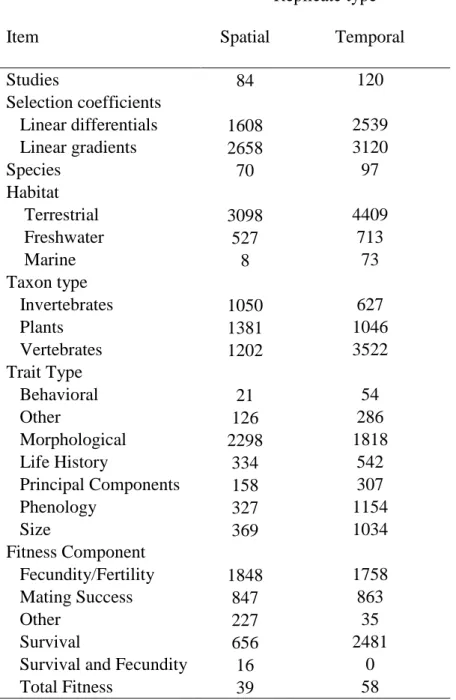
has rarely been quantified (Fig. 1B). This exception is concerning because tundra and tropical rainforests are likely to face severe effects of climate change (1, 13). Spatially and temporally replicated studies of selection in aquatic environments are also uncommon (Table 1), so our results pertain mainly to terrestrial systems. Additionally, the majority of studies are from vertebrate and plant populations, use fecundity or survival as a fitness measure, and use morphological traits (Table 1).
These data allowed us to determine whether directional selection covaries with changes in climatic factors among populations or across time within a given population. For each set of selection estimates, we geo-referenced the population and cross-referenced each population and time point with corresponding values of both local and global climatic factors (Database S2). We then used a random effects Bayesian Markov chain Monte Carlo meta-analysis to estimate the proportion of variation in selection within spatially and temporally replicated studies that was associated with climatic factors (14). This analysis is a hierarchical model, which separates the observation process (accounting for statistical noise in inference of individual selection
coefficients because of sampling error) from a process model (modelling variation in the
selection coefficients in relation to climate variables) (14). Under this analytical framework, we used a random regression mixed model component to model the distribution of within-study variation in the dependence of selection on climatic factors (14). As a measure of effect size, we present the mean and 95% credible intervals of the proportion of within-study variation in selection explained by a given climatic factor.
values of climatic factors influenced directional selection, as well as variation (the standard deviation [SD]), and the influence of extremes (minimum and maximum monthly values for a year) in these climatic factors because climate extremes frequently determine fitness and are expected to increase with climate change (15, 16).
When combining spatial and temporal studies, models that included temperature factors did not explain variation in selection (Fig. 2A, B). However, 20-40% of the variation in selection was associated with precipitation mean, maximum, and SD (Fig. 2C, D). Because precipitation factors are correlated (Table S1), our results collectively illustrate the potentially general
importance of local precipitation as a selective force. In addition, minimum PET explained more than 20% of the variation in selection across the dataset (Fig. 2E, F). When we ran the analyses separately for spatial and temporal selection, the results largely mirrored the patterns in the combined analysis (Figs. S1-S2). However, we found that for selection gradients, but less so for differentials, precipitation factors were more strongly associated with temporal rather than spatial variation in selection (Figs. S1-S2). A multivariate model that included means and SDs of both precipitation and temperature together (14) supports the finding that variation in selection is most closely associated with precipitation factors (Table S2). However, given the low levels of
replication typical of individual studies, we cannot unambiguously attribute a direct effect to any one of these four climate factors (Table S2).
We also explored whether within-study variation in selection associated with local climatic factors differed among subsets of major trait types, fitness components, and taxonomic groups (14). This analysis also indicated effects of precipitation and PET, although, there is substantial variation across the different subsets (Tables S3-S5). Among fitness components, no precipitation or PET climatic factors were consistently most associated with selection through mating success; however, selection through fecundity and survival were affected by
traits (Table S4). Precipitation also explained variation in selection on plants, whereas minimum PET consistently explained variation in selection among all major taxonomic groups (Table S5). While these findings are intriguing, it is important to note that the overall analysis revealed somewhat low precision in the estimates of the dependence of selection on climatic factors (Fig. 2, S1 and S2), and these subset analyses resulted in many estimates. With these important caveats in mind, we encourage a cautious interpretation of the above subset findings (14).
In addition to local climate variation, global climate cycles are known to be powerful agents of selection (17), but their capacity to operate as drivers of selection more broadly is unclear. To explore how annual global climate cycles may affect selection, we modeled the relationship between temporal variation in selection and the North Atlantic Oscillation (NAO) and the Oceanic Niño Index (ONI), which provide measures of inter-annual variability in atmospheric circulation for northern hemisphere and equatorial regions, respectively (14).
We found that the NAO explained between 10-30% of the variation in selection, whereas the ONI explained no appreciable variation (Fig. 3). The NAO was also most associated with selection through fecundity as a fitness component (Table S3), selection on morphological traits (Table S3), and on invertebrate and plant populations (Table S5). The overall stronger effect of the NAO (Fig. 3) relative to the ONI index is perhaps not unexpected because the ONI index would presumably be more important at equatorial latitudes (where studies of selection are rare), whereas the NAO index would be more important at northern latitudes (where selection is well documented; Fig. 1A). Indeed, although global in their reach, there are frequently correlations between large-scale climatic indices and local variation in climatic conditions that have subsequent effects on ecological and evolutionary processes (18, 19). Moreover, these global climate cycles are changing in response to climate change (20) and may therefore have cascading effects on selection at a global scale.
add a further nuance to these potential climate effects and suggest that variation in fitness associated with precipitation may also influence selection (Fig. 2, S1-2). Increases in strong precipitation events that are predicted for the near future (21) could therefore result in
considerable shifts in patterns of selection. Similarly, variation in selection was associated with variation in minimum PET—conditions when water deficits are low. While correlative, our findings do not support the idea that short-term moisture stress, as indicated by minimum
precipitation or maximum PET, is a major driver of selection. Conversely, the effects of changes in mean precipitation could result from sustained drought conditions or changes in resource abundance related to water availability (17).
Whether climate-selection coupling will lead to local adaptation and reduce the risk of extinction is difficult to predict (3, 6), because adaptive evolution also depends on genetic variation in the traits under selection (3, 11). Moreover, if selection is strong relative to existing genetic variation, and if the rate of climate change is rapid, selection might result in population extinction faster than adaptation and evolutionary rescue (3, 22). Phenotypic plasticity might also therefore have a key role in promoting population persistence due to climate change (6, 7).
Our analysis benefits from drawing on decades of accumulated inferences about natural selection. However, we acknowledge a potential limitation: annual measures of local climate factors may not always reflect the most relevant scale underpinning selection in a population (19). Although annual variation at even larger geographic scales such as the NAO (Fig. 3) often have considerable predictive power for explaining variation in demographic rates (18, 19), short-term climatic and extreme weather events, including winter storms and heat waves, can also generate strong selection (23). Our finding of no effect of temperature on selection, despite case studies showing an influence of temperature (24), suggests that such selection may be
the observed relationship between precipitation and selection at the annual scale makes sense because moisture availability is determined by precipitation over longer periods. Ultimately, to more fully understand and predict the consequence of climate variation on selection we also need replicated transplant experiments across broad climate gradients in diverse systems (6).
Transplant experiments would be especially beneficial because past selection may have eroded trait variation as populations locally adapted to a given climate regime, and such experiments would force populations to experience potentially stronger selective climate conditions, much like they could under climate change.
We have identified a signature of the effects of climate on selection in a phylogenetically diverse dataset across multiple environments. This provides evidence that local and global climate cycles are likely important drivers of selection in the wild. Thus, rather than selection being driven entirely by the local idiosyncrasies of each system, selection is partly predictable based on shared environmental features. Although ecologists and biogeographers have long recognized the importance of climate for explaining major ecological patterns, our analyses reveal a role for climate in explaining a key evolutionary process. In this era of unprecedented change to Earth’s climate (8, 9), and as future climatic conditions are expected to become increasingly more variable (15), natural populations will likely have to contend with greater climate variation than they have in the recent past. Such shifting climatic conditions, particularly changing precipitation patterns (2, 21), may present a challenge for many organisms (7, 16).
References and Notes:
1. O. E. Sala et al., Global biodiversity scenarios for the year 2100. Science 287, 1770-1774 (2000).
3. G. Bell, S. Collins, Adaptation, extinction and global change. Evolutionary Applications
1, 3-16 (2008).
4. M. C. Urban, Accelerating extinction risk from climate change. Science 348, 571-573 (2015).
5. I.-C. Chen, J. K. Hill, R. Ohlemüller, D. B. Roy, C. D. Thomas, Rapid range shifts of species associated with high levels of climate warming. Science 333, 1024-1026 (2011). 6. A. A. Hoffman, C. M. Sgrò, Climate change and evolutionary adaptation. Nature 470,
479-485 (2011).
7. L. M. Chevin, R. Lande, G. M. Mace, Adaptation, Plasticity, and Extinction in a Changing Environment: Towards a Predictive Theory. PLoS Biology 8, (2010).
8. M. Donat et al., Updated analyses of temperature and precipitation extreme indices since the beginning of the twentieth century: The HadEX2 dataset. Journal of Geophysical Research: Atmospheres 118, 2098-2118 (2013).
9. S. Rahmstorf, D. Coumou, Increase of extreme events in a warming world. Proceedings of the National Academy of Sciences 108, 17905-17909 (2011).
10. A. P. Hendry, M. T. Kinnison, Perspective: The pace of modern life: Measuring rates of contemporary microevolution. Evolution 53, 1637-1653 (1999).
11. R. Lande, S. J. Arnold, The measurement of selection on correlated characters. Evolution
37, 1210-1226 (1983).
12. J. G. Kingsolver et al., The strength of phenotypic selection in natural populations.
American Naturalist 157, 245-261 (2001).
13. M. E. Dillon, G. Wang, R. B. Huey, Global metabolic impacts of recent climate warming.
Nature 467, 704-706 (2010).
14. Materials and methods are available at Science Online.
15. D. R. Easterling et al., Climate extremes: observations, modeling, and impacts. science
16. D. P. Vázquez, E. Gianoli, W. F. Morris, F. Bozinovic, Ecological and evolutionary impacts of changing climatic variability. Biological Reviews, n/a-n/a (2015).
17. P. R. Grant, B. R. Grant, Unpredictable evolution in a 30-year study of Darwin's finches.
Science 296, 707-711 (2002).
18. N. C. Stenseth et al., Review article. Studying climate effects on ecology through the use of climate indices: the North Atlantic Oscillation, El Niño Southern Oscillation and beyond. Proceedings of the Royal Society of London B: Biological Sciences 270, 2087-2096 (2003).
19. T. Hallett et al., Why large-scale climate indices seem to predict ecological processes better than local weather. Nature 430, 71-75 (2004).
20. T. R. Karl, K. E. Trenberth, Modern Global Climate Change. Science 302, 1719-1723 (2003).
21. M. G. Donat, A. L. Lowry, L. V. Alexander, P. A. Ogorman, N. Maher, More extreme precipitation in the worlds dry and wet regions. Nature Clim. Change 6, 508-513 (2016). 22. R. Gomulkiewicz, R. D. Holt, When does evolution by natural selection prevent
extinction? Evolution 49, 201-207 (1995).
23. H. C. Bumpus, The elimination of the unfit as illustrated by the introduced sparrow, Passer domesticus. Biol Lectures, Marine Biol. Lab., Woods Hole., 209-226 (1899). 24. A. Husby, M. E. Visser, L. E. B. Kruuk, Speeding up microevolution: the effects of
increasing temperature on selection and genetic variance in a wild bird population. PLoS Biology 9, e1000585 (2011).
25. A. M. Siepielski et al., The spatial patterns of directional phenotypic selection. Ecology Letters 16, 1382-1392 (2013).
26. A. M. Siepielski, J. D. DiBattista, S. M. Carlson, It's about time: the temporal dynamics of phenotypic selection in the wild. Ecology Letters 12, 1261-1276 (2009).
28. R. A. Garcia, M. Cabeza, C. Rahbek, M. B. Araújo, Multiple dimensions of climate change and their implications for biodiversity. Science 344, 1247579 (2014).
29. P. A. Stephens et al., Consistent response of bird populations to climate change on two continents. Science 352, 84-87 (2016).
30. J. B. Fisher, R. J. Whittaker, Y. Malhi, ET come home: potential evapotranspiration in geographical ecology. Global Ecology and Biogeography 20, 1-18 (2011).
31. E.J. Pebesma, R.S. Bivand, Classes and methods for spatial data in R. R News 5: htpp://cran.r-project.org/doc/Rnews/ (2005).
32. G. Kunstler, BIOMEplot: Plot the Whittaker biomes. R package version 0.1 (2014). 33. R.E. Ricklefs, The economy of nature. W. H. Freeman and Company (2008).
34. M. B. Morrissey, J. Hadfield, Directional selection in temporally replicated studies in remarkably constant. Evolution 66, 435-442 (2011).
35. J. D. Hadfield, MCMC methods for multi-response generalized linear mixed models: the MCMCglmm R package. Journal of Statistical Software 33, 1-22 (2010).
36. A. Gelman, Prior distributions for variance parameters in hierarchical models (comment on article by Browne and Draper). Bayesian analysis 1, 515-534 (2006).
37. J. Hadfield, MCMCglmm course notes. Available at cran. us. r-project.
org/web/packages/MCMCglmm/vignettes/CourseNotes. pdf. Accessed October 13, 2014 (2015).
38. Open Science Collaboration. Estimating the reproducibility of psychological science. Science. 349, aac4716 (2015).
39. T. H. Parker et al., Transparency in ecology and evolution: real problems, real solutions.
Trends in Ecology & Evolution 31, 711-719 (2016).
41. N. P. Lemoine et al., Underappreciated problems of low replication in ecological field studies. Ecology 97, 2554-2561 (2016).
Acknowledgments: We thank the field biologists whose efforts allowed us to perform this analysis, and C. Benkman, A. Hendry, and M. McPeek for comments. This work originated from a NESCent working group (NSF grant EF-0905606). AMS acknowledges NSF (DEB1620046); BCS is a Wolfson Research Merit Award holder; RAM was supported by NSF (DBI-1300426); KMG was supported by NSERC; LEBK was supported by the Australian Research Council. The data reported in this paper are available at Datadryad.org and as Supporting Online Material. Supplementary Materials:
Materials and Methods Figs. S1 and S2
Table S1-S5
Databases S1 and S2 References (25-41)
Figure legends:
Fig. 2. Variation in selection is explained by local climate factors. Shown are mean and 95% credible intervals of the proportion of within-study variation in selection (combining temporal and spatial variation; see fig. S1 and S2 for temporal and spatial variation analyzed separately, respectively) explained by a given climatic factor. Little variation in selection gradients (A) and differentials (B) is accounted for by temperature, whereas considerable variation in gradients (C) and differentials (D) is accounted for by precipitation. Likewise, minimum PET also consistently explains variation in selection for both selection gradients (E) and differentials (F).
Table 1. Summary of records in the selection database. Numbers refer to the number of items in the database. Only those records with SE’s were used in analyses (14).
Replicate type
Item Spatial Temporal
Studies 84 120
Selection coefficients
Linear differentials 1608 2539
Linear gradients 2658 3120
Species 70 97
Habitat
Terrestrial 3098 4409
Freshwater 527 713
Marine 8 73
Taxon type
Invertebrates 1050 627
Plants 1381 1046
Vertebrates 1202 3522
Trait Type
Behavioral 21 54
Other 126 286
Morphological 2298 1818
Life History 334 542
Principal Components 158 307
Phenology 327 1154
Size 369 1034
Fitness Component
Fecundity/Fertility 1848 1758
Mating Success 847 863
Other 227 35
Survival 656 2481
Survival and Fecundity 16 0
A
● ● ● ● 0 0.25 0.5 0.75 temperature ● ● ● ● temperature ● ● ● ● 0 0.25 0.5
0.75 precipitation
● ● ● ● precipitation ● ● ● ● 0 0.25 0.5 0.75 PET ● ● ● ● PET Propor
tion of within−study v
ar
iance e
xplained
Gradients B Differentials
C A
F E
final.res[14, 8]
NAO ONI
0 0.25 0.5 0.75
Proportion of within-study varian
ce explained
Supplementary Materials for
Climate variation shapes natural selection in the wild
Adam Siepielski, Michael B. Morrissey, Mathieu Buoro, Stephanie M. Carlson, Christina M. Caruso, Sonya M. Clegg, Tim Coulson, Joseph DiBattista, Kiyoko M. Gotanda, Clinton D. Francis, Joe Hereford, Joel G. Kingsolver,Kate E. Augustine, Loeske E.B.
Kruuk, Ryan A. Martin, Ben C. Sheldon, Nina Sletvold, Erik I. Svensson, Michael J. Wade, Andrew D.C. MacColl.
correspondence to: [email protected]
This PDF file includes:
Materials and Methods Figs. S1 and S2
Tables S1- S5
Captions for database S1 and S2
Other Supplementary Materials for this manuscript includes the following:
Materials and Methods Selection database construction
We assembled a database of spatially (2 or more populations) and/or temporally (2 or more annual estimates from a given population) replicated studies of phenotypic selection on quantitative traits in the wild. By and large, the data sets were either spatially or temporally replicated; only 23 % of the selection estimates included both spatial and temporal replication in the same study. The database consists of standardized measures of selection coefficients: differentials and gradients. These standardized selection
coefficients reflect selection on traits in terms of the relationship between relative fitness and variation in a quantitative trait measured in standard deviation units, and are desirable because they allow for cross-study comparisons, irrespective of study organism, fitness measure, or trait studied (11, 12).
To begin, we combined earlier published databases that compiled studies on spatially (25) and temporally (26) replicated estimates of selection. Because the initial temporal database included studies published up until March 2008 and the spatial database studies up December 2011, we performed an additional literature search from March 2008 through December of 2012 to identify additional studies for inclusion. We reviewed the published literature for additional spatially and temporally replicated selection studies using the Web of Science indexing database system with the goal of identifying all studies estimating selection on multiple populations or multiple temporal replicates within populations. This search resulted in an additional 723 studies that we screened for inclusion in our final database. We also included two additional studies published shortly after December 2012 that we became aware of during our study.
Our inclusion requirements included criteria used in previous database compilations (12, 25, 26). Specifically, we only included studies that (i) focused on wild,
un-manipulated populations, (ii) estimated selection on quantitative traits that showed continuous variation, (iii) presented variance standardized selection differentials and/or gradients (11, 12) to facilitate comparisons across studies, and (iv) estimated selection in at least two populations or two annual temporal replicates within a population. When articles reported that selection had been measured on different populations, but data from multiple populations were combined for analyses, we contacted the authors to ask for population-specific selection coefficients. These later estimates were published in the appendix of (26). We relied on the author’s designations of populations being unique if the populations were either noted by the authors as geographically distinct, or were reported in the article to be genetically distinct. We suspect some level of dispersal might occur between some populations, but most studies lacked information (e.g., analysis of neutral genetic markers) to evaluate this possibility. Three studies estimated selection over multiple years, but presented their data averaged over the duration of their study, and so we contacted these authors directly to obtain year-specific selection coefficients. These later estimates were published in the appendix of (25). When data were presented in figure format, we contacted authors directly to obtain values of the selection
by a different author. The database is available from the Dryad Digital Repository and as Database S1.
In many studies, multiple datasets existed within studies. These within-study datasets represent selection estimated on different subsets of data defined by species, trait, fitness component, sex, age, etc. For clarity, we use the term “dataset” to refer to each unique combination of the above within studies.
Climate variables
We obtained local climate data at a resolution of 0.5 x 0.5 degree cells from the CRU-TS 3.1 Climate Database (27) spanning the years of data collected in the selection database. These climate data are one of the finest scale climate databases available at a global scale and are frequently used in large scale biological analyses such as ours (28, 29). Although the 0.5 degree cell size changes with latitude, our use of a 0.5 degree grid was simply the mechanism that rendered the opportunity to resolve the climate and selection databases. That is, with matched projections for coordinates and climate grids, the decrease in grid cell size with increasing latitude had little bearing on the fact that we simply extracted climate data from the 0.5 x 0.5 degree cell within which each population coordinate resides.
From these data, we generated grid files reflecting annual mean, annual standard deviation, and annual monthly minimum and maximum values for precipitation,
temperature, and potential evapotranspiration (PET) across the study period. PET is an informative climatic index because it integrates the effects of temperature, humidity, and radiation to quantify the overall potential moisture deficit for a location (30). To obtain appropriate temporal and spatial climatic information for each study location, we performed a spatial overlay of study site coordinates over each climatic grid using the function over in the R package sp (31). This procedure was performed to estimate climate values experienced at each study location during the year in which the data were
collected for a given population. This database is available from the Dryad Digital Repository and as Database S2.
We obtained annual global climate indices (ONI and NAO) from the National Weather Service at the National Oceanic and Atmospheric Administration. These indices relate variability in atmospheric forcing of climate change in northern and southern hemisphere mid-latitude regions. We used the Oceanic Niño Index (ONI) as a measure of the El Niño Southern Oscillation retrieved from
http://www.esrl.noaa.gov/psd/data/correlation/oni.data [Accessed February, 2014]. The North Atlantic Oscillation (NAO) index was retrieved from
http://www.cpc.ncep.noaa.gov/products/precip/CWlink/pna/nao.shtml [Accessed
September, 2013]. For each year of study in our database we used the mean value of the monthly reported ONI and NAO indices.
using annual mean cumulative precipitation and annual mean temperature that had been digitized from Ricklefs (33). To display the environments represented in our study samples through an overlay on Whittaker’s biome plot, we used the annual mean temperature and annual cumulative precipitation generated from the CRU dataset for each location to calculate annual mean temperature and annual mean cumulative precipitation for each study across the duration of the study. Additionally, for the timeframe of each study we also calculated the lowest and highest annual mean
temperature and annual mean cumulative precipitation to represent the climatic extremes experienced in each study.
Meta-analytical model and analysis
From earlier analyses, we know that there is non-trivial, detectable variation in selection in space and time (25, 26, 34), and progress has been made in developing meta-analytical methods to get at this variation accounting for the fact that variation in selection can be inflated by sampling error (25, 34). Thus, to control for sampling error we only used those records from the database that had associated standard errors with the selection coefficients (n = 2385 selection gradients and n = 946 selection differentials).
We used a random effects meta-analysis to determine the proportion of variation in selection across the entire database that could be accounted for by different climate variables after taking into account sampling error. This analysis can be most intuitively represented as a hierarchical model, separating the observation process (i.e., modelling statistical noise in inference of individual selection coefficients) and a process model (i.e., modelling variation in the underlying selection coefficients).
We model the observation process according to
(1) !",$ ∼ & !",$, '(",$) ,
where !",$ is the ith selection coefficient (linear gradient or differential) estimate for the jth trait/study combination (that is, a given combination of phenotypic traits and/or fitness components, etc. for a given study; hereafter “trait”). Each selection gradient estimate !",$is assumed to be drawn from a normal distribution with a mean corresponding to the true, unobserved (i.e., latent), corresponding selection gradient βi,j, and with a known variance defined by the square of the corresponding standard error SEi,j .
We model the distribution of (latent) selection gradients according to
(2) !",$ = &$+ ($×*",$ + +",$,
are interpretable as trait-specific mean selection gradients.Note that unlike most
applications of mixed models, the ei,j are not simply random noise, but are the variation in selection among replicates (i.e., within traits), and as such is a parameter of biological interest. We assume
(3) !",$ ∼ & 0, ()* ,
where !"# is the estimated residual variance. The random intercepts (aj) and random
slopes (bj) were modelled with a bivariate normal distribution with means !" and !" , and
standard deviations !"#and !
"#, respectively, and covariance !α,b
(4) !#"
" ∼ %
&'
&( ,
*'+ *',(
*',( *(+
,
where the mean intercept µα and slope µb, and their covariance matrix, are estimated parameters.
We implemented all analyses in a mixed model framework, using MCMCglmm (35). We used default diffuse normal priors on the fixed parameters (i.e., the overall intercept and average slope), parameter-expanded priors (36, 37) for the random
(co)variance components (i.e., of the random slopes and intercepts), and a diffuse inverse gamma prior for the residual variance. The analysis is thus similar to the meta-analytic models of selection gradients in (25) and (34) for estimating within-study variance in selection, but with the extension to a random regression component to model the
distribution of among-study variation in the dependence of selection on climate variables, via equation 4.
This model can be summarized in terms of the amount of variance in slopes (i.e.,
!"#), but a more intuitive summary is obtained by considering how much (within-study)
variance in selection coefficients is implied by the family of regressions between each climate factor (ei,j) and its corresponding selection estimate (βi,j) that is estimated by the random regression mixed model. Given that within-study environmental covariates are standardized to mean zero and unit variance, the variance among studies is σα2 (note that in a linear random regression model, the covariance of slopes and intercepts, σα,b does not enter into the among study variance). The variance within studies associated with
environmental variables is σb2, and the variance within studies that is not associated with the environment is the residual variance. The sum of these is the total variance in
selection.
estimates). Rather, the great majority report on variation in selection only in space or in time. It is for this reason that we can conduct analyses where we combine space and time, and then analyze space and time separately as we have done. Those few studies that report both spatial and temporal replication jointly typically have very low levels of replication in both, and will therefore not contribute sufficient information to separate these different, and potentially interesting, components of variation in selection. The residual variance, in the combined analysis, is thus simply interpretable as the total variance in selection, accounting for the climate variables, across both classes of replication.
Multivariate extension
Whether individual climate-selection associations are attributable to the climate variable in question, or whether they arise largely via associations with other climate variables, is of interest. However, with the generally low level of replication in individual studies (e.g., typically 2-5 data points for any given trait within any given study) it is infeasible to include many climate variables simultaneously in a multivariate model. Thus, to target the most relevant comparisons in a multivariate analysis, we developed a model that included the means and standard deviations of both temperature and precipitation in a single model by expanding equations 2 and 4 to accommodate four, rather than one, estimates of variance in slopes.
To manage the complexity of the model, we did not estimate covariances among the random slope terms, and we applied the analysis only to selection gradients, which is the measure of selection for which we have the most data (Table 1). The variance
explained by the random slopes in this model depends on the within-study correlations among variables, which varies among studies. Therefore, rather than presenting variance associated with each climate variable as a proportion of the within-study variance in selection, as done for the univariate models, we present the variances in direct effects for each climate covariate (Table S2).
Sub-set analysis of trait types, fitness components, and taxonomic groups
We also conducted analyses where we estimated how much variation in selection associated with local and global climatic factors varied among fitness components, trait types, and major taxonomic groups. These subsets are typical of meta-analyses such as ours (12, 25, 26). We conducted these analyses using selection gradients, and those fitness components, trait types, and taxonomic groups where we had the most substantial data (Table 1).
low precision of the resulting estimates of the dependence of selection on climate
variables (e.g., Figs. 2 and 3, S1 and S2) requires caution because such analyses result in many estimates, and their interpretation in isolation would likely be unreliable (38, 39). The causes of the low precision, despite large quantities of data (Table 1 and S1) is two-fold: the imprecision of individual selection estimates (34) and the somewhat limited extent of temporal and spatial replication of most studies (25, 26, 34). It is therefore important to note that apparently significant (i.e., non-overlapping 95% credible
intervals), large estimated effect sizes would be inevitable given the low precision noted above (e.g., type M errors, 38, 39, 41). These issues highlight the need for studies with larger sample sizes, and continued long-term and spatially replicated studies for tackling longstanding questions in ecology and evolution (40). Additionally, experimental
Fig. S1.
Temporal variation in selection explained by local climate factors. Shown are mean and 95% credible intervals of the proportion of within-study temporal variation in selection explained by a given climate variable ((A) and (B) temperature, (C) and (D) precipitation, and (E) and (F) PET) from a Bayesian meta-analytical model. Across all panels, the left column shows climate-selection associations with selection gradients and the right column selection differentials.
● ● ● ● 0 0.25 0.5 0.75 temperature ● ● ● ● temperature ● ● ● ● 0 0.25 0.5 0.75 precipitation ● ● ● ● precipitation ● ● ● ●
min max mean 0 0.25 0.5 0.75 PET ● ● ● ●
min max mean sd PET
sd
Propor
tion of within
Fig. S2.
Spatial variation in selection explained by local climate factors. Shown are mean and 95% credible intervals of the proportion of within-study spatial variation in selection explained by a given climate variable ((A) and (B) temperature, (C) and (D) precipitation, and (E) and (F) PET) from a Bayesian meta-analytical model. Across all panels, the left column shows climate-selection associations with selection gradients and the right column selection differentials.
● ● ● ● 0 0.25 0.5 0.75 temperature ● ● ● ● temperature ● ● ● ● 0 0.25 0.5
0.75 precipitation
● ● ● ● precipitation ● ● ● ●
min max mean 0 0.25 0.5 0.75 PET ● ● ● ●
min max mean sd PET
sd
Propor
tion of within
Table S1.
Correlation matrix of climate variables across studies. Min. = minimum, max. =
maximum, SD = standard deviation.
Mean temp.
Min. temp.
Max temp.
SD temp.
Mean precip.
Min. precip.
Max precip.
SD precip.
Mean PET
Min. PET
Max. PET
SD PET
Mean temp. 1.000
Min. temp. 0.868 1.000
Max temp. 0.666 0.280 1.000
SD temp. -0.575 -0.864 0.147 1.000
Mean precip. 0.020 0.236 -0.393 -0.403 1.000
Min. precip. -0.135 -0.006 -0.384 -0.125 0.738 1.000
Max precip. 0.107 0.305 -0.278 -0.451 0.890 0.530 1.000
SD precip. 0.177 0.365 -0.211 -0.498 0.826 0.368 0.968 1.000
Mean PET 0.701 0.395 0.878 -0.086 -0.322 -0.406 -0.157 -0.061 1.000
Min. PET 0.865 0.686 0.666 -0.464 -0.021 -0.164 0.085 0.163 0.834 1.000
Max. PET 0.317 0.038 0.776 0.234 -0.536 -0.575 -0.351 -0.255 0.818 0.421 1.000
Table S2.
Results from a multivariate model simultaneously estimating the variance of slopes of regressions of selection gradients on four key climate variables (mean and SD of temperature, and mean and SD of precipitation). Shown are intercepts and slopes with their 95% credible intervals (in parentheses) from a Bayesian meta-analytical model. The variances of slopes represent the variance in the partial effects (i.e., conditioning on the other climate variables) of each climate variable across study systems. Not
surprisingly, given the typically low levels of replication within studies, we cannot unambiguously attribute a direct effect to any one of the four modelled key climate variables (the slope variances of each climate factor have similarly very low lower bounds to their CIs). However, the results are consistent with patterns revealed in the univariate analyses of climate variables that variation in selection within studies tends to be most strongly associated with variation in precipitation (Fig. 1, Figs. S1 and S2). All covariates were standardized within studies to a variance of one, so fixed and random slopes are in units of changes in standardized selection gradients per standard deviation of the environmental variable.
Coefficient Fixed intercept or slope Random variance of intercepts or slopes Intercept 0.053 (0.026 - 0.080) 0.042 (0.035-0.051)
Table S3.
Variation in selection explained by local and global climate factors among different fitness components. We only considered those fitness components that were well-represented in the database (Table 1). Shown are mean and 95% credible intervals (in parentheses) of the proportion of within-study variation (combining both spatial and temporal replication; temporal replication only for NAO and ONI) explained by a given climatic factor from a Bayesian meta-analytical model.
Climatic factor Fitness component
Fecundity Mating Survival
Min. temp. 0.001 (0 - 0.277) 0.001 (0 - 0.239) 0.001 (0 - 0.113) Max. temp. 0.001 (0 - 0.16) 0 (0 - 0.121) 0.001 (0 - 0.253) Mean temp. 0.001 (0 - 0.143) 0.001 (0 - 0.174) 0.003 (0 - 0.417) SD temp. 0.419 (0.062 - 0.612) 0.001 (0 - 0.181) 0 (0 - 0.077)
Min. precip. 0.001 (0 - 0.209) 0.001 (0 - 0.16) 0.608 (0.069 - 0.789) Max. precip. 0.637 (0.395 - 0.78) 0.002 (0 - 0.284) 0.132 (0 - 0.44) Mean precip. 0.002 (0 - 0.354) 0.001 (0 - 0.271) 0.351 (0.032 - 0.652) SD precip. 0.579 (0.33 - 0.75) 0.001 (0 - 0.303) 0.059 (0 - 0.192) Min. PET 0.389 (0 - 0.544) 0.003 (0 - 0.578) 0.422 (0.083 - 0.645) Max. PET 0.001 (0 - 0.14) 0.001 (0 - 0.153) 0 (0 - 0.085)
Table S4.
Variation in selection explained by local and global climate factors among different trait types. We only considered those trait types that were well-represented in the database (Table 1). Shown are mean and 95% credible intervals (in parentheses) of the proportion of within-study variation (combining both spatial and temporal replication; temporal replication only for NAO and ONI) explained by a given climatic factor from a Bayesian meta-analytical model.
Climatic factor Trait type
Size Morphology Phenology
Table S5.
Variation in selection explained by local and global climate factors among different taxonomic groups. Shown are mean and 95% credible intervals (in parentheses) of the proportion of within-study variation (combining both spatial and temporal replication; temporal replication only for NAO and ONI) explained by a given climatic factor from a Bayesian meta-analytical model.
Climatic factor Taxonomic group
Invertebrates Plants Vertebrates
Min. temp. 0.869 (0.352 - 0.974) 0.003 (0 - 0.424) 0 (0 - 0.05) Max. temp. 0.005 (0 - 0.814) 0.001 (0 - 0.188) 0 (0 - 0.061) Mean temp. 0.958 (0.659 - 0.996) 0.002 (0 - 0.245) 0 (0 - 0.044) SD temp. 0.765 (0 - 0.927) 0.561 (0.208 - 0.712) 0 (0 - 0.061) Min. precip. 0.745 (0.243 - 0.966) 0.002 (0 - 0.402) 0 (0 - 0.061) Max. precip. 0.004 (0 - 0.719) 0.666 (0.503 - 0.829) 0.001 (0 - 0.188) Mean precip. 0.005 (0 - 0.715) 0.006 (0 - 0.466) 0.092 (0 - 0.384) SD precip. 0.003 (0 - 0.627) 0.708 (0.47 - 0.811) 0 (0 - 0.094)
Min. PET 0.959 (0.184 - 0.996) 0.462 (0.114 - 0.725) 0.229 (0.051 - 0.456) Max. PET 0.003 (0 - 0.618) 0.003 (0 - 0.396) 0 (0 - 0.048)
Database S1 (separate file)
Database of selection coefficients for spatially and temporally replicated studies of selection.
Database S2 (separate file)