“THAT’S WHAT THEY SEE ON TV, THAT’S HOW THEY VIEW OUR CULTURE.” EXPLORING THE RELATIONSHIP BETWEEN CULTURAL IDENTIFICATION AND MEDIA REPRESENTATIONS OF LATINA/OS AND LATINO STUDENTS EXPERIENCES,
IDENTITY DEVELOPMENT AND RELATIONSHIP WITH THE UNIVERSITY THEY ATTEND
Joseph Erba
A dissertation submitted to the faculty of the University of North Carolina at Chapel Hill in partial fulfillment of the requirements for the degree of Doctor of Philosophy in the
School of Journalism & Mass Communication.
Chapel Hill 2013
® 2013 Joseph Erba
ABSTRACT
JOSEPH ERBA: “That’s what they see on TV, that’s how they view our culture.”Exploring the relationship between cultural identification and media representations of Latina/os, and Latino
students’ experiences, identity development and relationship with the university they attend (Under the direction of Lucila Vargas)
This dissertation connects media’s racialization of Latinos and the educational challenges of Latino students in the U.S. by focusing on how undergraduate Latino students perceive the role media play in shaping their college experiences. It uses a symbolic interactionism framework to explore the influence that Latino students with different levels of cultural identification ascribe to media representations of their racial/ethnic group. The dissertation also addresses Latino
students’ identity development and the relationship they develop with the university they attend. Twelve Latino students (6 high-identifiers and 6 low-identifiers) attending a predominantly white public university took part in a series of in-depth interviews. High-identifying Latino students perceived media to negatively affect their experiences and interactions with other
ACKNOWLEDGEMENTS
I would like to thank my dissertation advisor, Dr. Lucila Vargas, for her guidance throughout this research during countless hours spent in her office and coffee shops discussing this project, from its conceptualization to the data analysis and writing. I have no words to articulate how much her feedback has taught me about qualitative research and writing.
I would also like to thank my committee members, Drs. Barbara Friedman, Charles Price, Xue Rong and Ruth Walden, without whom this study would have never been possible. They believed in its relevance and supported its idea. They were always be accessible and supportive.
Special thanks go to the 12 students who agreed to be interviewed and share their
experiences with me. One of the most rewarding aspects of this dissertation is that it allowed me to meet 12 very bright and highly motivated young men. Listening to their stories has been a very humbling experience and I can only wish I was as insightful and thoughtful when I was their age.
TABLE OF CONTENTS
LIST OF TABLES ... xiii
LIST OF FIGURES ... xiv
CHAPTER I: INTRODUCTION ... 1
A few media anecdotes ... 1
Latina/o students’ challenges in higher education ... 4
Present study and research questions ... 8
Why is there a need to keep talking about racial/ethnic diversity? ... 9
CHAPTER II: LITERATURE REVIEW ... 13
Symbolic interactionism: Interactions, symbols & words ... 13
Identity: development, performativity & lived subjectivity ... 16
Racial/Ethnic identity & ethnorace ... 27
Media construction of the “Other” ... 34
Latina/os in the media: From dirty Mexicans to Ugly Betty... 36
News. ... 37
Marketing... 42
Latina/o-produced shows. ... 44
Latina/os in North Carolinian newspapers: Illegal immigrants or helpless victims? ... 47
Media matter: Omnipresence, cultivation & effects ... 50
U.S. youth (stereotypical) media diet ... 50
Cultivation Theory ... 51
Media Effects & Audience Reception ... 54
University-Student relationship ... 56
CHAPTER III: METHODS ... 60
Grounded Theory ... 60
Interviewing ... 62
Phase One ... 65
Phase Two ... 71
Recruitment ... 75
Data collection ... 75
Data analysis ... 79
Reflexivity ... 82
Interview and analysis terms ... 85
“Media” ... 85
“Participants” ... 88
“HI” and “LI” ... 88
CHAPTER IV: THE PARTICIPANTS ... 90
“Just my skin color, like being tan, I mean year around.” ... 90
“What kind of company doesn’t want diversity?” ... 96
A few common characteristics ... 97
High-identifiers’ short biographies ... 101
Arturo (HI): ... 101
Eduardo (HI): ... 102
Federico (HI): ... 104
Hernando (HI): ... 105
Mauricio (HI): ... 106
Miguel (HI): ... 108
Low-identifiers’ short biographies ... 110
Alejandro (LI): ... 110
Cristian (LI): ... 111
Enrique (LI): ... 113
Javier (LI): ... 115
Leonardo (LI): ... 117
CHAPTER V: PERSONAL AND MEDIATED EXPERIENCES ... 121
“We have so much different flavors.” ... 121
“Poor, poor background, heavily, heavily culturally rich” ... 123
“Really isolated and really out of my comfort zone” ... 126
“We’re not exposed to people of other races, then we only know what we see in the television.” ... 129
“The gangsters in the movies” ... 131
“You see it in real life and it’s more reinforced when you see it in the media.” ... 136
“Seeing it in the media every single day for months, for years, for decades” ... 139
“The people committing those crimes are Hispanics on the news.” ... 141
“A lot of the Hispanics are illegal immigrants.” ... 143
“Americans see Latinos in the sense of low class, uneducated.” ... 145
“They’re all Mexican.” ... 146
“As of right now, we don’t have any role models […] we serve as the role models.” ... 149
Moving on to college... 153
CHAPTER VI: COLLEGE EXPERIENCES THROUGH THE MEDIA LENSES ... 155
“More Latinos in higher education” ... 155
“They tend to stick out more.” ... 156
“The cream of the crop” ... 159
“I fit in perfectly” versus “Being discriminated” ... 163
“I didn’t expect that ignorance.” ... 168
“I don’t wanna put myself in the situations where I think I could get, experience racism” ... 170
Sporting events versus Latina/o student organizations ... 173
“Latino Latinos” and “non-Latino Latinos” ... 177
“People expect me to dance it because that’s what they see on TV.” ... 179
“Nothing in the media really helps portray us in a positive light.” ... 184
“Probably because of media but I mean, I don’t think it’s had a large effect.” ... 186
“People do not come thinking that we’re somehow out of a movie, or out of like the news.” ... 190
“Racist conservative, really, really conservative people lack that education.” ... 193
“We’re in school together […] people might forget that like in social aspects.” ... 195
“My goals are gonna be what my goals are […] whatever the media is saying about Latinos.” ... 198
“There’s not a lot of portrayals of successful Latinos in the media.” ... 201
“I didn’t know a lot of Latinos, or as, as Latino, we, we had the power to, to do that […] so I was really impressed.” ... 206
“When they are portrayed, they’re the construction workers or the cleaning lady […] it kind of hurts.” ... 209
“Professors are happy for us ‘cause […] you see these portrayals of gang
members and bad poverty.” ... 213
CHAPTER VII: RACE-ETHNICITY AND MEDIA IMAGES DOMINATE CAMPUS INTERACTIONS ... 217
“I can definitely relate and talk to African Americans for days.” ... 218
“In the back of their head, the stereotypes are there for what Hispanics do, what black people do.” ... 220
“If I go to talk to a white person, I’m not gonna speak the way I speak with my black friends.” ... 222
“When you talk to other white students um, it’s probably like writing a paper.” ... 224
“I avoid that stereotypical stuff I see on the media.” ... 229
“I wouldn’t want to reinforce that stereotype that all Latinos dance.” ... 231
“I do think that experience would trump mostly anything.” ... 234
“Hopefully they’ll see me as a reflection of other Hispanic people.” ... 236
“Their only interaction with a Latino isn’t going to be what they see in Scarface.” ... 237
“You’ve grown up with it your whole life, you’re not gonna get rid of it in like a year or two.” ... 240
CHAPTER VIII: FROM IDENTITY STRUGGLES TO A NEW LATINA/O IDENTITY ... 245
“It made me realize how special and how specific my identity was […] being introduced to all these different cultures.” ... 246
“They act like they’re white basically.” ... 248
“Apart for like the skin tone, like there was really no connection.” ... 252
“I’d see those portrayals and then I kind of try to distance myself from that.” ... 259
“That’s what they see on TV, that’s how they view our culture.” ... 262
“In my pre-school I realized that my family looked a lot different than others.” ... 264
“This is our identity, the sense of losing our identity.” ... 267
“I’m what a modern day Latino professional is.” ... 273
CHAPTER IX: UNIVERSITY-STUDENT RELATIONSHIP ... 277
Satisfaction: “Everyone is like a family.” ... 279
Satisfaction: “If you’re not white and you want to come here, don’t worry about it.” ... 280
Satisfaction: “They just gave us a shitty, a shitty little, you know, space to work with.” ... 282
Trust: “[SEPU] is doing a disservice to Latino students by not trying to increase that number [of Latina/o students].” ... 285
Trust: “We need those resources now, and a lot of people don’t understand that.” ... 288
Trust: “Once they have those numbers, I feel like they’re not concerned.” ... 293
Commitment: “They’re not going to be the only ones here that are Latinos, there are other students just like them.” ... 296
CHAPTER X: CONCLUSION ... 301
Importance of cultural identification ... 302
Main differences between HIs and LIs ... 306
Main similarities between HIs and LIs ... 308
Limitations ... 313
Recommendations ... 314
A final word about media ... 317
APPENDICES ... 319
Appendix I: Interview Guide #1... 319
Appendix II: Interview Guide #2 ... 322
Appendix III: Interview Guide #3 ... 324
Appendix IV: Interview Guide #4 ... 326
LIST OF TABLES
Table 1: Participants’ repartition by age, birth and years in the U.S. ………...67
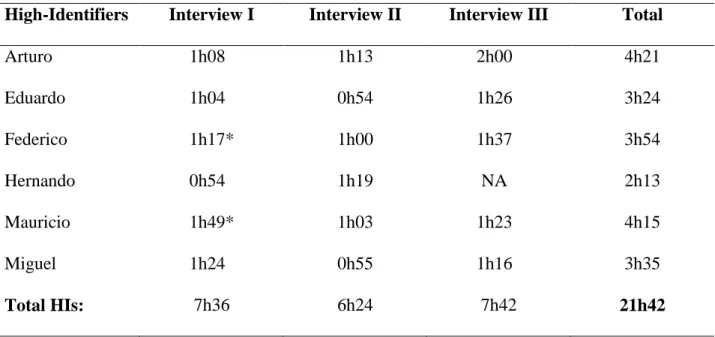
Table 2: Interview time for high-identifiers by participant and interview ………78
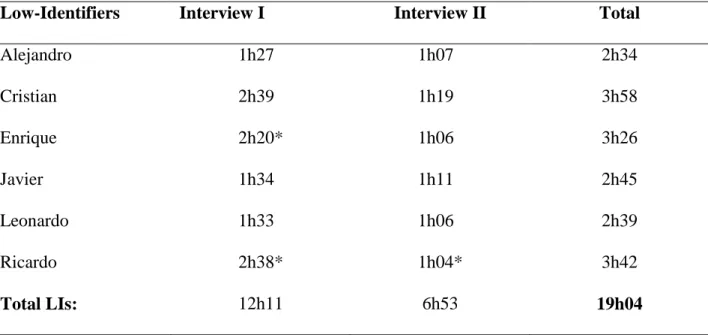
Table 3: Interview time for low-identifiers by participant and interview ……….79
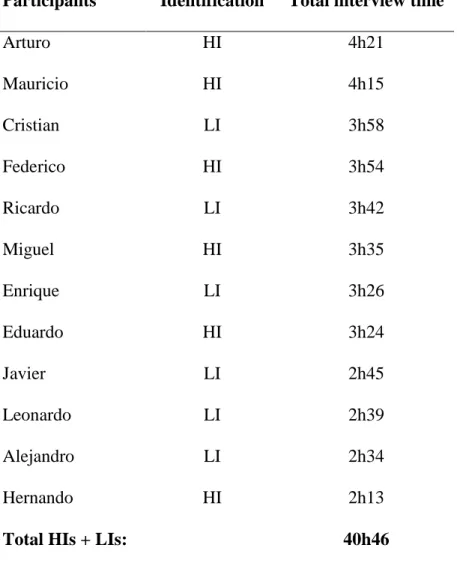
Table 4: Total interview time by participant and ethnic identification ……….80
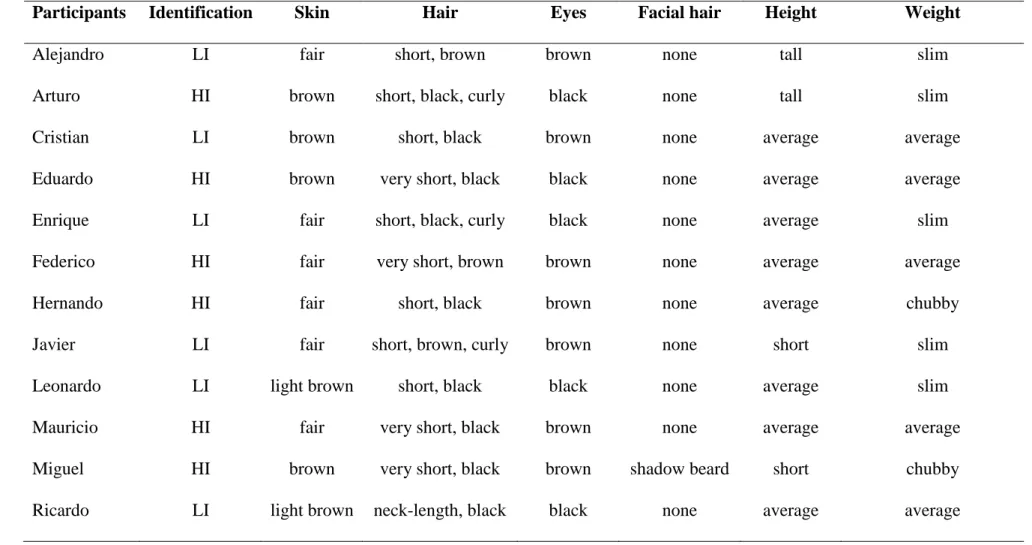
Table 5: Participants’ phenotypic features ………93
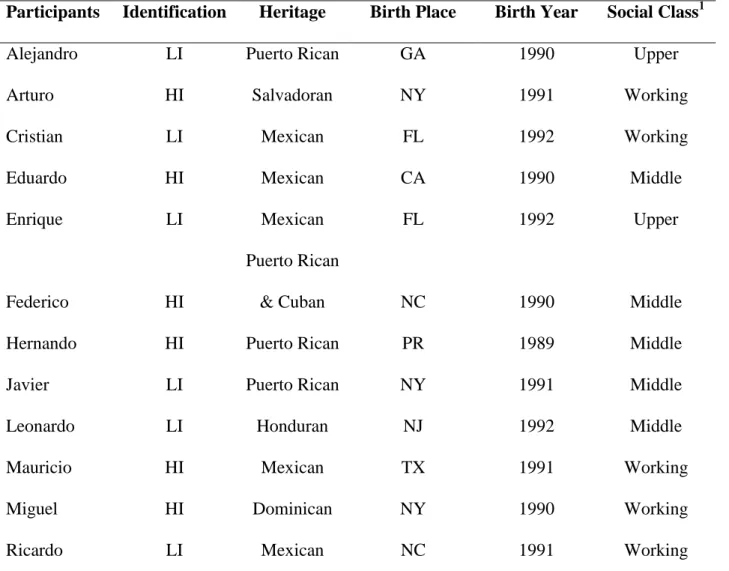
Table 6: Participants’ demographics .………...99
LIST OF FIGURES
CHAPTER I:INTRODUCTION
We used to rank number one in college graduates. Now we are in the middle of the pack. And since we are seeing more and more African American and Latino youth in our population, if we are leaving them behind we cannot achieve our goal, and America will fall further behind—and that is not a future that I accept (President Barack Obama, keynote speech for the 100th anniversary of the National Association for the
Advancement of Colored People, July 16, 2009).
A few media anecdotes
In May 2012, Vice-President Joe Biden announced his support of same-sex marriage stating that Will and Grace, the first prime-time television show to feature openly-gay lead characters, “probably did more to educate the American public than almost anything anybody’s ever done so far” (Stein, 2012, para. 7). Biden’s comment illustrates the influence media representations have on audiences’ perceptions of groups of people and societal matters. Media representations are thought to be so powerful that in December 2011, the conservative group Florida Family Association petitioned to cancel a television reality show portraying Muslims living in the U.S. The group claimed that the reality show, All-American Muslim, would show a
there are four in Florida that are venomous” (Stacy, 2011, para. 6). In other words, the group wanted to prevent media from representing U.S. Muslims as “normal” people.
These two brief examples cast light on how media affect not only our perceptions of others but also of ourselves and the groups we identify with. Many young viewers consider certain media figures, real or fictive, as role models. Unfortunately, media role models often fit the U.S. norm and are predominantly white, male and heterosexual. In January 2012, renowned producer George Lucas released the movie Red Tails, chronicling the true story of the Tuskegee soldiers, the first African-American air force pilots, who served during WWII in a then
segregated U.S. military. Lucas financed the entire movie, which took him more than 20 years to finish because no one in Hollywood was interested in investing in a predominantly black movie. In an interview with The Daily Show host Jon Stewart, Lucas said one of his main motivations in producing the movie was “to make it inspirational for teenage boys.” He “wanted to show that they [African-American boys] have heroes, they [Tuskegee soldiers] are real American heroes, they are patriots, they helped make the country what it is today” (The Daily Show, 2012). Lucas’ comments illustrate the dearth of positive role models in the media for young African
Americans.
Red Tails offers a portrayal of African Americans and other racial/ethnic minorities that
is counter to the mostly stereotypical media representations of these groups. Of all racial/ethnic groups in the U.S., African Americans and Latina/os are overwhelmingly depicted in media as perpetrators of crimes (Mastro, 2009; Mastro, Behm-Morawitz & Ortiz, 2007; Oliver, 1994). As I describe at length in this dissertation, U.S. media representations of Latina/os are also
and realistic images of Latina/os. This means that today’s college students grew up mostly exposed to stereotypical representations of African Americans and Latina/os in the U.S.
Media researchers have extensively studied the effects of stereotypical media
representations on white audiences’ perceptions of people belonging to these stereotyped groups. For this dissertation, I was particularly interested in the effects these same images have on college students belonging to racial/ethnic groups that are stereotyped in the media. I focused on Latino male students because they have the highest attrition rates of all college students and interviewed 12 Latino students at a large, four-year, predominantly white public university in North Carolina to explore how media representations of Latina/os have affected their college experiences.
Latina/o students’ challenges in higher education
U.S. Latina/os represent 16.3 % of the current U.S. population, a 43% increase from 10 years ago (U.S. Census Bureau, 2010a). While the country’s population is increasingly racially diverse, students in most U.S. universities are predominantly white (Worthington et al., 2008). Latina/o undergraduate college students represent 12% of all students enrolled in U.S.
institutions of higher education, with more Latina/o students enrolled in public two-year institutions (17%) than in public four-year institutions (10%) (U.S. Department of Education, 2011b). The North Carolina university where I conducted this research reflects the low enrollment of Latina/o students. Only 5.4% of the school’s undergraduate student body is Latina/o, the second lowest percentage of a non-white undergraduate student racial group after Native Americans. The university’s admissions policy, which favors in-state applicants,
represents an obstacle for Latina/o students’ enrollment. Indeed, the university limits the number of out-of-state students to 18% of every freshman class. In addition, the university’s website states that out-of-state “legacy applicants enjoy roughly twice the acceptance rate as those who do not have a parent who attended Carolina.” Latina/os represent only 8.4% of North Carolina’s population, and many Latina/o applicants, in- or out-of-state, are first generation college students (Fischer, 2007; U.S. Census Bureau, 2010b).
community college in North Carolina (NCGA, 2011). Three other Southern states, Alabama, Georgia and South Carolina, have already passed such laws (National Conference of State Legislatures, 2012).
While these laws concern only first-generation immigrants, as children of immigrants born in the U.S. are granted American citizenship, the path to higher education for U.S.-born Latina/os can nevertheless be just as complicated. Indeed, many Latina/o students face
“structural barriers” at all stages of their education (Campa, 2010, p.430). Latina/o students are often victims of racial discrimination from teachers who believe they simply cannot succeed in school (Núñez, 2009; Strayhorn, 2008). Some educators believe that Latina/os do not value education and do not encourage Latina/o students to do well in school (Auerbach, 2006; Cavazos et al., 2009).
Many Latina/os attending institutions of higher education are first-generation college students. Therefore, their families often lack the resources to help them apply for colleges and scholarships (Zalaquett, 2006). In addition, if they belong to a lower social class and are not fluent in English, many Latina/o families are reluctant to meet with their children’s teachers and find out more about educational opportunities (Strayhorn, 2008). Family pressures may also hinder Latina/os’ academic journey, as some of them are expected to assist with their families’ financial support. Indeed, pursuing education may delay this expected support, which may in turn create conflict, “especially for men from families of lower socioeconomic status (SES) who might be expected to contribute the most support to their families” (Flores Niemann et al., 2000, p.49).
materialized in the form of social interactions with professors and other students (Gordon, 2007; Hurtado & Ponjuan, 2005; Tinto, 2006). Latina/o students perceive that feeling of being
welcomed and belonging to a university is more important in their decision to stay in or drop out of college than their academic performance (Bordes & Arredondo, 2005). Indeed, obtaining good grades alone is not enough to ensure Latina/o students’ retention if they do not feel welcome on campus (McLaughlin González & Ting, 2008).
General perceptions of campus climate can affect Latina/o students’ experiences, specifically, how Latina/os perceive other students, faculty and staff as viewing them (Gloria et al., 2005; Schneider & Ward, 2003). In other words, do Latina/o students think they fit in or belong to a particular university culture? Gloria and Robinson Kurpius (1996) refer to this internal struggle as “culture incongruity,” which occurs when Latina/o students perceive that their culture and the university culture “are different in values, beliefs, and expectations for behaviors” (p.535). Latina/o students are much more likely to feel isolated from the university community if they feel they have to constantly question their ethnic identity and choose between their Latino culture and the U.S. mainstream culture (Gloria & Robinson Kurpius, 1996).
Other students’ actions can make Latina/o students feel disrespected and unwelcome on campus, thus increasing Latina/o students’ isolation. For instance, similar events at the
dressed as “janitors, gardeners, gangbangers and pregnant teens” (Associated Press, 2007, para. 1). In November 2006, white students had already organized a “Fresh off the Boat” themed party, for which attendees were encouraged to dress as Latina/o immigrants (Georgevich, 2007). Latina/o students condemned these actions for, among other things, reinforcing stereotypes about Latina/os (Georgevich, 2007).
As I discuss at length in the next chapter, entertainment and news media cast Latina/os in a predominantly unflattering light, but research on students’ college experiences has not
considered the role of media. Education researchers have explored many variables that contribute to Latina/o students’ retention and attrition rates in institutions of higher education, from
immigration generation (Dennis et al., 2010; Holleran, 2003; Hurtado-Ortiz & Gauvain, 2007), acculturation level (Gibson, 1995; Parra et al., 2004; Valentine & Mosley, 2000), ethnic identity (Flores et al., 2000; Roehling et al., 2010; Valentine, 2001), and racial discrimination (Núñez, 2009; Strayhorn, 2008; Zalaquett et al., 2007), to psychological condition (Gloria et al., 2005; Iturbide et al., 2009; Telzer & Vazquez Garcia, 2009), but I did not find any published research examining the media variable.
Some researchers comment on the stereotypes certain educators may have about Latina/os but do not mention the potential relationship between perceptions of Latina/os and media representations of Latina/os (Cavazos et al., 2010; Gloria et al., 2009; Holleran, 2003; Hurtado & Ponjuan, 2005). While a wealth of research has been published on media portrayals of Latina/os (Dixon & Linz, 2000; Larson, 2006; Mastro & Behm-Morawitz, 2005), how these portrayals might affect Latina/os’ identity (Mastro, 2009; Vargas, 2009) and audiences’
perceptions of Latina/os (Mastro, 2003; Mastro et al., 2007; Mastro et al., 2009;
between media representations and Latina/o students’ college experiences. Valdivia (2010) does argue that media representation of Latina/os, or the lack thereof, has had educational
consequences for Latina/o students, who were subjected to “particular forms of treatment in schools, as well as no inclusion of Latina/o history and issues in the curriculum” (p.71). However, this point does not address how Latina/o students understand the role media play in their academic experiences.
Present study and research questions
In this dissertation, I use a qualitative methodological approach to explore how Latino undergraduate students perceive the role that media portrayal of Latina/os plays in their
experiences at a predominantly white institution of higher education. I focus on Latino students because they currently have the lowest college graduation rates in the U.S. based on gender and race/ethnicity (U.S. Department of Education, 2011a, 2011c). I also explore how media
How do media representations of Latina/os influence Latino students’ college
experiences? I explore the relationship between media representations of Latina/os and Latino undergraduate students’ campus experiences at a predominantly white university. Specifically, I investigate (1) how Latino students subjectively understand their presence on campus and experience their social and academic interactions with students and professors, (2) how Latino students perceive and make sense of their identity in a society where the dominant
representations of Latina/os involve negative connotations, and (3) how Latino students perceive their relationship with the university they attend. I thus link two phenomena that have been extensively dealt with separately in previous research: media’s racialization of Latina/os and Latina/o students’ educational challenges in the U.S. To explore the third research question, I view Latino students as an internal public to the university they attend. Similarly, I view the university as an organization involved in maintaining a positive relationship with its publics. I thus focus on the university‒Latino undergraduate student relationship. More specifically, I explore how Latino students perceive their relationship with the university and how they perceive media representations of Latina/os as affecting that relationship.
Why is there a need to keep talking about racial/ethnic diversity?
U.S. universities have been increasing their efforts to recruit racial minority students and faculty. A cursory look at various university recruitment materials suggests that universities display images of racial minority students with the intent to paint a diverse and inclusive picture of their campuses. However, the racial composition of university brochures often does not match the actual student body diversity. Indeed, researchers have recently started to question the
promotional images that will appeal to a racially diverse applicant pool (Boyer, Brunner, Charles & Coleman, 2006; Harris, 2009; Hartley & Morphew, 2008; Sung & Yang, 2008).
Universities’ promotional images help them effectively brand themselves and begin to establish a relationship with important stakeholders (Harris, 2009). Portraying racial minority students in promotional imagery represents a way for institutions to “foster the ethnic
identification process of minority students” with a particular school or program (Boyer et al., 2006, p. 140). Most university promotional images depict a racially diverse student body where students appear to interact in a warm, inviting environment (Hartley & Morphew, 2008; Hite & Yearwood, 2001). Although numerous institutions use images of racial minority students to demonstrate a commitment to diversity, promotional materials usually fall short of clearly addressing diversity matters, such as by indicating resources available for minority students on campus as well as in the local community (Boyer et al., 2006; Hartley & Morphew, 2008).
While we can applaud universities’ efforts to increase minority student enrollment, it is also important to look at how minority students are received once they arrive on campus. Many studies looking at African-American and Latina/o students’ experiences at predominantly white institutions of higher education suggest that minority students often feel alienated and isolated (Frank, 2003; Washburn-Moses, 2007), believe they have to prove themselves intellectually worthy of attending college (Hurtado, 2005; Worthington et al., 2008) and perceive certain comments from their white peers and professors as condescending (Davis et al., 2004; Scheurich & Young, 2002; Wallace & Bell, 1999). These experiences sharply contrast with the image universities promote about their campus.
stereotypical views their white peers and professors have of people of their race (Davis et al., 2004; Frank, 2003; Washburn-Moses, 2007). These negative interracial interactions can heighten social identity differences, which in turn can lead to a greater feeling of isolation (Hurtado, 2005). On the other hand, minority students who experience positive interracial interactions are less likely to perceive themselves as different from other racial groups, more likely to express high levels of self-confidence and believe that conflict enhances democracy (Hurtado, 2005). The majority of studies focusing on minority students’ experiences in predominantly white universities deal with African-American students. Tanno (2003) denounced a significant lack of studies on Latino/a students in higher education and stated that more “research is required on the successes, failures, and worldviews of Latino/a students in higher education” (Tanno, 2003, p.43). While many studies have been published about Latina/os’ experiences in higher education, the field is still in its nascent stage as many education studies often overlook Latina/os (Santiago & Reindl, 2009).
From a strategic communication perspective, current minority students can directly or indirectly be part of a university’s communication strategy. Minority students discuss their experiences on campus with friends and family, who form an image of the university based on these accounts. If minority students have a positive experience and image of their university, they will likely share it with their friends and might encourage them to apply. Universities should therefore concentrate as much effort, if not more, on building positive relationships with
minority students as they do on promoting a diverse campus. While there is a wealth of research exploring relationships between organizations and their internal publics in corporate
The demographic changes of the U.S. Latina/o population, coupled with the low college graduation rates mentioned above, suggest that universities will have to build strong
relationships with potential and current Latina/o students to reverse the tide of low academic achievement. The literature reveals that positive relationships are the basis of well-being and productivity (for examples, see works in Grunig, 1992, and Ledingham & Bruning, 2000). Universities that actively recruit minority students could benefit from lessons learned from the public relations literature in terms of relationship building based on the organization
(university)‒public (Latino students) relationship model (DeSanto & Garner, 2001; Sung & Yang, 2009).
CHAPTER II:LITERATURE REVIEW
Media representations can influence how we perceive ourselves and make sense of everyday life, which in turn can influence our identity, experiences, and interactions (Ford, 1997; Grossberg et al., 2006; Mastro, 2009). I approach this dissertation from a symbolic
interactionism perspective in which Latino students are active participants in the university environment. Charon (2010) offers a concise explanation of the main premises of a symbolic interactionism perspective: “To understand human action, we must focus on social interaction, human thinking, definition of the situation, the present, and the active nature of the human being” (p.29). Two of the main tenets of symbolic interactionism are its focus on interaction as the basic unit of study and its use of symbols to communicate to others and to ourselves (Charon, 2010).
Symbolic interactionism: Interactions, symbols & words
central to what we do” (Charon, 2010, p.28, italics in original). As Goffman (1982) states, “every person lives in a world of social encounters, involving him [/her] either in face-to-face or
mediated contact with other participants” (p.5). Our interactions take place in social
environments that influence them (Goffman, 1982). From a symbolic interactionism approach, “the interactional mediation of symbolic resources of both verbal and nonverbal kinds”
represents the key to understanding social experiences (Smith, 1999, p.5). Symbolic
interactionism is thus a useful framework for this dissertation as it explores how Latino students’ interactions on campus shape their subjective experiences.
A symbolic interactionism perspective also sees the world as “overwhelmingly symbolic at its very core,” a perspective in which human beings rely on symbols to communicate with and understand each other (Charon, 2010, p.59). Symbols change over time; they are socially
established for the purpose of representation and are used in everyday interactions (Charon, 2010). People learn the meanings of symbols and use them to organize both their world and that of others (Holland et al., 1998). For instance, even if one has never interacted with members of other racial groups, one has nevertheless been exposed to images of these groups and is aware of the meanings attached to these images (Collins, 2008). As I further discuss in this chapter, media’s representations of racial minorities have provided audiences with specific symbols to associate with members of non-white racial groups. Both dominant and minority groups are aware of these symbols when interacting with each other.
racialized subjects. Therefore, they might also have taken the time to reflect on these experiences and how they have affected their sense of identity. From a symbolic interactionism perspective, I assume that these past experiences affect how Latino students’ define their present situation.
People construct each other through their social interactions, which are often the result of ritualized norms and self-control, both necessary elements for the continuation of society
(Goffman, 1982). Indeed, Goffman (1971, 1982) argues that social interactions not only create but also perpetuate society; therefore, human beings cannot be understood outside of their interactions. Charon (2010) explains that symbolic interactionism is a useful lens for viewing college experiences because the interactions that take place on campus and in classrooms change students’ world perspectives. Symbolic interactionism is also useful in exploring the experiences of racial minorities by focusing on how these groups understand their reality and interactions with the dominant society (Charon, 2010).
Symbolic interactionism has been used to look at organizations’ strategic communication efforts because of the importance organizations place on their interactions with society in general and with their different publics in particular (Gordon, 1997; Zhang, 2006). By creating and communicating messages to their various publics through different media channels,
attend, which will undoubtedly be based on Latino students’ interpretations of symbols they perceive as emanating from the institution.
Prior to discussing media representations of Latina/os, I describe the main concepts of this dissertation and how I use them to guide the research questions in the following sections. I start by explaining how I understand identity and racial identity as they apply to racial minorities in general and Latina/os in particular. I then introduce the concepts of ethnic identity and of ethnorace as an alternative to explore Latino students’ identity.
Identity: development, performativity & lived subjectivity
While some people think they have a clear image of who they are, others might still go back and forth between the person they would like to be, the person they think they are, and the person people perceive them to be. Still others continue to explore different personae and try to make sense of who they are, of what their identity is. Identity has been associated with “an individual’s sense of uniqueness” (Harris, 1995, p.1), “visible marks on the body” (Alcoff, 2006, p.86), “the relation to what is not” (Stephen, 2001, p.66), “life story” (Chaitin, 2004, p.11), “social histories” (Strauss, 1995, p.4) as well as a “quest” and a “search” (Erikson, 1968, p.19). Simply stated, identity refers to “knowing who one is, and who one is not” (Harris, 1995, p.1).
which he/she claims to identify (Dávila, 2008). Therefore, one person’s identity is also
dependent on others validating that identity. Identity thus illustrates the “dense interconnections between the intimate and public venues of social practice” (Holland et al., 1998, p.270). We meet “different significant others” in our life course who “both influence and are influenced by us,” and we develop our identity through our interactions with them (Chaitin, 2004, p.5).
Goffman (1963) claims that in our interactions with others, we are both performers and an audience for the performances of others. Goffman (1963) uses the metaphor of a performance to explain that people behave in public as actors would on a stage, performing for others.
Goffman (1982) explains that our social interactions, or performances, are best understood in terms of “line” and “face.” He defines line as “a pattern of verbal and nonverbal acts” and face as “an image of self-delineated in terms of approved social attributes” (Goffman, 1982, p.5).
While Erikson was developing his identity theory, William E. Cross Jr. was focusing his research on Black identity. Cross was the first scholar to formally conceptualize a theory of racial identity development. His 1971 “nigrescence theory is considered one of the seminal Black racial identity theories” (Vandiver, Cross, Worrell & Fhagen-Smith, 2002, p.71). Cross’ theory aims to explain the different stages, or “statuses,” one goes through to “become Black,” that is, the process in which race becomes a more salient aspect of one’s identity (Cross, 1971, 1991, 1994). He revised his original theory in the early 1990s and expanded it in the early 2000s to adapt it to changing socio-cultural factors, to better reflect the fluid aspect of identity, and to place more emphasis on the difference between individual and group identity (Davis, Aronson & Salinas, 2006; Vandiver et al., 2002).
Cross’ revised and expanded nigrescence theory includes four statuses, “Pre-Encounter,” “Encounter,” “Immersion-Emersion” and “Internalization” (Cross, 1991; Cross & Vandiver, 2001). The Pre-Encounter status is characterized by three identities, “assimilation,”
“miseducation” and “self-hatred.” People with an assimilation identity express pro-American sentiments and do not consider race salient. People with a miseducation identity perceive Blacks as a whole stereotypically, whereas people with a self-hatred identity focus on themselves and display self-loathing attitudes due to their race (Cross & Vandiver, 2001; Fhagen-Smith, Vandiver, Worrell & Cross, 2010).
People enter the Encounter status after a particular experience or series of events leads them to reconsider their perceptions about Blacks or about themselves (Cross, 1971, 1991, 1994; Cross & Vandiver, 2001). Taking action upon this racial “encounter” leads people to the
identities, stating that “Intense Black Involvement describes a Black person’s overromanticized immersion into the Black experience [while] individuals manifesting the Anti-White identity reject everything White, to the point of demonizing Whites and their culture” (p.72). In other words, “everything Black or Afrocentric is good” and “everything White or Eurocentric is evil” (Vandiver et al., 2001, p.177).
The last status of the nigrescence theory is “Internalization,” which emphasizes acceptance and pride of being Black. “Moving into the Internalization stage resulted in ‘self-healing’ (Cross, 1995, p.96), with feelings of inferiority and insecurity replaced by ‘Black pride’ and ‘self-love’ (Cross, 1991, p.159). However, Cross (1991, 1995) cautioned that while reaching the Internalization status may improve self-esteem, it does not automatically result in
psychological well-being. Similarly, some Blacks who do not reach the Internalization status may nevertheless display high levels of self-esteem. The Internalization status includes four identities: “Afrocentric,” “bicultural,” “multiculturalist-racial” and “multiculturalist-inclusive.” Fhagen-Smith, Vandiver, Worrell and Cross (2010) offer the following definitions of these four identities:
Afrocentric identity attitudes center on Black empowerment and the use of African-derived principles of living and interpretation of one’s environment. The bicultural racial identity highlights being both Black and an emphasis on being a member of some other cultural group(s) such as nationality, religion, or gender. A multiculturalist-racial identity is both pro-Black and respectful of other racial/ethnic groups including White people and European Americans. A multiculturalist-inclusive identity is pro-Black, respectful of other racial/ethnic groups, and puts an emphasis on building relationships with people from a multitude of cultural backgrounds including varying sexual orientations” (pp. 166-168).
move back and forth between statuses, and between identities within statuses, based on personal experiences and/or external factors (Cross & Vandiver, 2001). Cross’ nigrescence theory is useful to this dissertation as it could help us understand the differences in racial identity among Latinos. Indeed, the four statuses “Pre-Encounter,” “Encounter,” “Immersion-Emersion” and “Internalization” are conceptually broad enough to apply to any racial/ethnic group in the U.S. Vandiver, Cross and their colleagues (2002) explained that the four statuses emphasize the salience and valence people attribute to their race. They argue that people can view the role race plays in their lives as “(a) of no importance (low race salience) with neutral valence, (b) of singular importance (high race salience) with a positive valence, or (c) of singular importance (high race salience) with a negative valence” (p.72). Therefore, Latinos who do not consider their race/ethnicity to play an important role in lives would belong to category (a). On the contrary, Latinos who view their race/ethnicity as an important part of their lives could either belong to category (b) if they hold favorable views of Latina/os, or belong to category (c) if they hold unfavorable views of Latina/os.
At any stage of the identity development process, life experiences have a strong impact on how people perceive themselves. Ferdman and Gallegos (2001) contend that the “familial and cultural context one is born into sets the initial parameters for one’s identity,” which is then further influenced by school and new messages a person receives about the group he/she sees him/herself as part of (p.45). Identities are shared and shaped by people’s interactions with others (Strauss, 1995). For these reasons, Alcoff (2006) maintains that “identity comes into our
This “invocation” can come from media, which represent a powerful tool to construct categories of identity (Alcoff, 2006; Grossberg et al., 2006; Kellner, 2011) and “interpellate audiences who decide to take up, or not,” a particular identity (Grossberg et al., 2006, p.246). Indeed, media provide “the materials for constructing views of the world, behavior, and even identities” (Kellner, 2011, p.8). These categories of identity are contrasted to a norm, a dominant image within a culture, which is also the product of media and/or government entities (Alcoff, 2006; Grossberg et al., 2006). Ascribing to a particular identity is therefore to contrast the “codes” of that identity to the norm’s “cultural codes” (Grossberg et al., 2006, p.243).
To fully understand a person’s identity, we have to take into account historical, social and cultural contexts (Chaitin, 2004; Strauss, 1995). In this sense, identities are more than personal histories as they are interwoven with social histories: “Every social world produces its own histories, which may profoundly affect the lives and identities of its members—and possibly also of people pulled into argumentation or other contact with them” (Strauss, 1995, p.5). Identities change, “always forming and re-forming” based on personal and collective life experiences as well as the socio-historical context in which these experiences occur (Holland et al., 1998, p.284). Holland and her colleagues (1998) state that “one can never inhabit a world without at least the figural presence of others, of a social history in person” (p.282). In this sense, one’s identity is better understood as being “composed of multiple identities” (Chaitin, 2004, p.5).
experiences may represent a key turning point in one’s identity exploration when one is in the “moratorium status,” to use Erikson’s (1968) terminology, leading to one’s “achieved identity.” Chávez-Reyes (2010) illuminates this point for Latina/os in her interview study with the
Fuenteses, 18 third- and fourth-generation Mexican Americans who recount how they became aware of their racial identity during their teenage years. According to Cross’ (1991) identity theory, the Fuenteses’ experiences in high school represent an “encounter” with their race/ethnicity.
Chávez-Reyes (2010) explains how a combination of family socialization and middle and high school experiences affected the identity of all family members. She states that
later-generation parents instilled in their children egalitarian values but did not prepare them for the racism they might encounter outside of their home. Therefore, the Fuentes children never
considered themselves the offspring of immigrants or as being anything but Americans until they reached an “encounter” stage, that is, until they were placed in a situation to enter a “moratorium status.” Prior to that, racial differences were not made salient to them. Indeed, the Fuentes children said they first experienced racism in school, especially in middle and high school when they started thinking about dating and were ostracized due to their difference, which initiated a “moratorium on ethnic identity” (Chávez-Reyes, 2010, p.508).
perceived: “As an African American female academic, I can be and am sometimes positioned as conceptually White in relation to, perhaps, a Latino, Spanish-speaking gardener. In that instance, my class and social position override my racial identification and for that moment I become ‘White’” (Ladson-Billings, 1998, p.5). This is an excellent example of how one person’s identity can have multiple facets and how one’s identity can be performed differently based on the context in which social interactions take place (Butler, 1990, 1993; Charon, 2010).
Erikson’s (1968) and Cross’ (1991) theories of identity development are useful for this dissertation because Latino college students might have undergone or might be undergoing their own identity development in high school or in college. It would be interesting to see if Latino college students could isolate specific encounters that made them conscious of their identity development.
Butler (1993) associates performativity with society’s norms, which not only constrain the limits of one’s performativity but also make these constraints part of one’s performativity. In other words, Butler argues that “performativity cannot be understood outside of a process of iterability, a regularized and constrained repetition of norms” (p.95). She refutes the idea that identity is determined in advance, as might be suggested by the term “repetition.” She maintains that the production of one’s performativity might be a repetition of an existing norm because of the fear associated with performing outside of the norm (Butler, 1993). To re-emphasize the dominance of performativity (deed) on the subject (doer), Butler contends that “this repetition is not performed by a subject; this repetition is what enables a subject and constitutes the temporal condition for the subject” (p.95, italics in original).
them as well as their interactions with other Latina/os and non-Latina/os. Latina/os who perceive themselves and/or are treated as honorary Whites are also more likely to develop “white-like racial attitudes” (Bonilla-Silva, 2004, p.937). Similarly, Whites are more likely to better treat Latina/os they perceive as honorary Whites than others. However, as Bonnilla-Silva explains, regardless of how Latina/os perceive themselves, “’honorary’ means they will remain secondary, will face discrimination, and will not receive equal treatment” (p.944).
Alcoff (2006) describes the distinction between “public identity” and “lived subjectivity.” She defines “public identity” as “how we are socially located in public” and “lived subjectivity” as “how we understand ourselves” to be (pp. 92-93). This distinction is crucial not only to this study, but to other studies exploring people’s identity, because it implies that a person’s identity does not depend solely on that person’s self-perception. Therefore, in order to understand how a person perceives him/herself, we also need to understand how this person thinks other people perceive him/her.
1995). They explained the potential effects of “widely-known negative stereotypes about one’s group” as follows: “the existence of such a stereotype means that anything one does or any of one's features that conform to it make the stereotype more plausible as a self-characterization in the eyes of others” (p.797).
Members of a stereotyped group experience situations of stereotype threat when they are aware that others might perceive them as reinforcing negative group stereotypes (Steele, 1997). Indeed, members of groups subjected to negative stereotyping “are under the risk of no longer being seen as individuals but only as prototypical members of a group” (Croizet et al., 2001, p.302). People can experience stereotype threat even if they know a particular stereotype is inaccurate or if they believe it does not apply to them; they only need to be aware of the
stereotype (Fischer, 2010; Ployhart et al., 2003; Steele, 1997). As Fischer (2010) explains, “the ‘threat’ of the stereotype stems from the anxiety the person feels to not confirm this negative stereotype” (p.21, italics in original). The “threat” of confirming the stereotype leads to performance and/or behavior change.
Researchers have explored how stereotype threat specifically applies to Latina/o students. About 10 years ago, Gonzales and her colleagues (2002) conducted the first stereotype threat study involving Latina/o students and compared their test performances to that of white students. Similar to Steele and Aronson’s (1995) initial study, they found that “Latinos exhibited
behavior than others belonging to the same group (Armenta, 2010; Ho & Sidanius, 2010;
Ployhart et al., 2003). Ployhart and his colleagues (2003) demonstrated that “racial identity is the primary driver of perceptions of stereotype threat” (p.253).
Racial/Ethnic identity & ethnorace
One of my main assumptions in this dissertation is that the “basic level perception of events and of people (identity, credibility, evidence, explanation) can be affected by race and gender” (Alcoff, 2006, p.128). I also assume that media can “produce people’s social identities, in terms of both a sense of unity and difference” (Grossberg et al., 2006, p.220). Media not only have the power to construct identities but also to “construct meanings and expectations
associated with particular social identities” (Grossberg et al., 2006, p.247).
In terms of identity and perceptions, Latina/os in the United States challenge traditional racial categories. For instance, Ladson-Billings (1998) notes that in the early days of the census, Mexican Americans were originally considered “White” before being forced out of the White category in response to political, economic, social and cultural changes. Indeed, according to U.S. Census archives, “White” or “black” were the only two options available to categorize people in terms of race until 1850, when “mulatto” was added. In 1860, these non-white
The Census’ way of dealing with Latina/os’ racial status illustrates the racialization of Latina/os by the U.S. government as well as the conundrum Latina/os pose to U.S. society in terms of racial categorization. Chávez (2008) argues that when the term race is applied to
Latina/os, it does not refer to “genetic-based categories of race but, rather, labels that are socially and culturally constructed based on perceived innate or biological differences and imbued with meanings about relative social worth” (p.24). Simply stated, Latina/os do not fit conventional categories of race (Alcoff, 2006). Stavans (1995) described Latina/o identity as a “labyrinth” that defies people’s thoughts on racial identity (p.93). However, most people today often do not recognize Latina/os’ heterogeneity and favor “simple answers” or “simple rules” when dealing with Latina/os in general (Ferdman & Gallegos, 2001, p.33). Until recently, media portrayals of Latina/os have contributed to this trend by largely depicting all Latina/os as one homogeneous and undifferentiated group (Chávez, 2008: Ramírez-Berg; 2002; Santa Ana, 2002; Valdivia, 2010).
The difficulty of assigning Latina/os into a particular racial category stems from the black-white dichotomy that has dominated race relations in the U.S. (Alcoff, 2006; Dávila, 2008; Harris, 1995; Ladson-Billings, 1998). This dichotomy “marginalizes or ignores other racial groups” (Alcoff, 2006, p.254) and reflects a “high degree of interracial tension and intolerance” (Harris, 1995, p.9). Similar to identity, race is viewed as socially constructed by media and cultural rituals. To use Alcoff’s (2006) words, race is “historically malleable, culturally
contextual, and reproduced through learned perceptual practices” (p.182), or, as Dávila (2008) states, “minorities are not born, they are made” (p.146).
terms of black versus white, this “dualism has long maintained that if a person is not totally white (whatever that can mean biologically), he or she must be considered black” (Andersen & Collins, 2010; Martinez, 2010, p.92). The binary racial classification holds historical roots in the U.S., where the one-drop rule long governed racial categorization. According to the rule, a single drop of black blood would make a person black or non-white (Obre & Harris, 2008). The rule’s legacy “led to the continued social separation between Black and White worlds, despite the blurring of these distinctions” (Obre & Harris, 2008, p.35).
While it would be hard to argue that today’s U.S. racial landscape is solely divided in terms of black and white, this binary framework is nevertheless sustained because of the “model minority” myth, which distances certain groups of people from black people based on their work ethic and willingness to obey the established order (Dávila, 2008; Martinez, 2010). As a result, if “people couldn’t be white, they could at least claim to be not-black” (Dávila, 2008, p.162). Thus, this binary framework considers people such as Asian Americans and Latina/os to be closer to Whites than to Blacks, and to eventually become white (Alcoff, 2006). In such a polarized racial context, where black and white are the only recognized forms of racial identities, non-black racial minorities such as Latina/os are not only “disempowered” to “define their own identity and social circumstances,” but also to explore and make sense of their racial identities (Alcoff, 2006, p.255).
common traits” (p.244). Racialized identity suggests inherent differences that cannot be transcended between racial minorities and members of the dominant group (Miville, 2010). Indeed, members of the dominant group do not think of themselves in terms of race and are thus exempt from carrying the burden associated with racial differences (Vargas, 2009). By
classifying a group of people as a distinct race, members of the dominant group “mark them off as more profoundly and distinctively ‘other’” (Vargas, 2009, p.21). In other words, people’s visible racial identity influences how members of the dominant group perceive and interact with them.
Similar to the concepts of identity and race, racial identity is also context dependent. Alcoff (2006) explains how a person’s racial identity can change from Cubano to black for instance, or from Mexican to Latino. She reasons that a person’s racial identity can change across communities, and a family’s race can change across history. Alcoff uses the example of mixed-race people who constantly renegotiate their identities based on the context they find themselves in. Alcoff also states that because people in the U.S. are used to thinking in terms of distinct racial categories, racial identities that “are not readily visible create fear, consternation, and the sometimes hysterical determination to find their visible trace” (p.191). This is especially true of Latina/os, whose phenotypes and complexions may not be easily distinguishable from white Americans. Harris (1995) reminds us of the “obsession” people in the U.S. had and continue to have with skin complexion in terms of social class and privilege (p.10). Media have also reinforced this obsession in terms of appearance, associating lighter skin tone with ideals of beauty and promoting skin-lightening products (Maddox, 2004; Maddox & Chase, 2004).
The term “colorism” refers to how one’s skin tone is used to “evaluate” a person (Blair et al., 2002). People with light skin tone are more likely to be evaluated as possessing positive traits than people with dark skin tone. For instance, Maddox and Chase (2004) found that people with darker skin tone were thought of as being less educated, prosperous and healthy than people with light skin tone. Along with complexion, other physical features also play an important role in how racial minorities are perceived by members of the dominant group (Maddox, 2004). Arguably, phenotype provides the basis of racial categorization and can also activate
education is synonymous with middle or upper class, educated Latina/os may be categorized as Whites (Alcoff, 2006).
The heterogeneity of Latina/os challenges traditional understanding of racial identity. Dávila (2008) and Miville (2010) state that many Latina/os label themselves as “white” or often refuse to identify with a particular racial category, preferring “no race” or “some other race” instead. Latina/os’ heterogeneity has not been recognized in the U.S. public discourse, in which a “pan-Latino identity” (Alcoff, 2006) or “Latino panethnicity” (Rodriguez, 1996) has emerged. Indeed, media have homogenized Latina/os’ identity in terms of race, ethnicity, country of origin, income level or immigration status (Dávila, 2008). Alcoff (2006) posits that Latina/os view identity in terms of culture and nationality, thus moving away from a racialized identity toward a more ethnic identity. Miville (2010) defines ethnic identity as “an enduring,
fundamental aspect of the self that includes a sense of membership in an ethnic group and the attitudes and feelings associated with that membership” (p.244). She claims that ethnic identity is dynamic and changes over time. While racial identity has mostly been associated with a visible identity in terms of phenotype, ethnic identity is more dependent on various ecological factors such as family upbringing and socialization (Miville, 2010). One’s ethnic identity has also been associated with high self-esteem, regardless of one’s physical appearance. Latina/os who
embrace and identify with their culture are likely to feel more self-confident than Latina/os who are not as connected to their culture (Telzer & Vazquez Garcia, 2009). Such findings are crucial to this dissertation because if Latino students’ ethnic identity positively influences their self-esteem, it should also affect their academic experiences.
experience, a particular culture” (p.447). Because personal and collective background play a central role in our identity, Hall says that we are all “ethnically located” and that “our ethnic identities are crucial to our subjective sense of who we are” (p.447). The idea of being ethnically located suggests that when Latino students first enter college, they are most likely ethnically located in a different place than they are after two or three years into their college experience. Therefore, it is also likely that their college experiences will affect their ethnic identity.
Many authors contend that neither race nor ethnicity are appropriate terms to examine U.S. Latina/os’ identity. For instance, Miville (2010) uses the term “racial-ethnic” instead; a hybrid classification that she argues is more accurate for Latinos (p.243). Goldberg (1993) had previously introduced the term “ethnorace” to emphasize the self-creation aspect of racial and ethnic identity as “membership turns more or less straightforwardly on choice and
self-affirmation” while recognizing that people are also identified by “the force of imposed
classification” (p.75). Goldberg perceives race as “historically specific” and ethnicity as a “mode of cultural identification and distinction” (p.74). Given that I am conducting this dissertation during a historical moment in which Latina/os are being highly racialized, the concept of ethnorace is particularly relevant. This concept is also useful because it allows me to explore how Latino students’ levels of cultural identification affect how they perceive themselves in college, that is to say, how they perceive their experiences as distinct from that of non-Latina/o students.
The above discussion suggests that interactions with others do influence identity
construction of “the Other” in general and of racial identity in particular. I explain how media have used stereotypes and more subtle practices to differentiate the dominant white group from racial minority groups.
Media construction of the “Other”
Media influence not only one’s identity but also how one perceives the identity of others. Indeed, media’s most powerful role is to create social identities, both in terms of similarities and differences (Grossberg et al., 2006). Audiences can decide which culture they wish to associate with and which social identity they wish to adopt based on their consumer practices (Grossberg et al., 2006). For example, some Latina/os might decide to listen mostly to Latin music, such as reggaeton, salsa or merengue, to reinforce and make their Latina/o social identity visible.
Dominant media messages regarding every aspect of our lives, such as religion, education, social interactions, sexual behaviors and so forth, place us in a particular culture in which power
relations are assessed by a supposedly neutral norm (Hall, 2011; hooks, 1992; Ladson-Billings, 1998; Ramírez-Berg, 2002; Said, 1994). These media messages teach us who has power and who does not, as well as who can exercise power and who cannot. They teach us not only how to think about particular people but also how to think about ourselves (Hall, 2011; Kellner, 2011). Media images, from books to television, have been used by the dominant society to create an “Other” that would serve as a foil to the dominant group.
Perhaps no other author has more powerfully articulated how media construct “the Other” than Edward Said in his research on orientalism. Said (1994) contends that messages about the Orient created a culture of the Orient among the Occident, which in turn served as a pedagogical tool for Occidentals to learn about Orientals. For instance, stereotypical representations
1994). As Said explains, each observation was made into a generalization, and each
generalization represented an inherent quality of the Oriental. In addition, the Oriental’s voice was never communicated to the Occidentals, who could construct the Orient and the Oriental as they wished. Therefore, the Oriental was constructed as inferior, justifying the domination of the Occident over the Orient. Occidentals thus learned that the Oriental was backwards, “first an Oriental and only second a man” (Said, 1994, p.231).
The “othering” of African Americans has been amply documented by scholars. (See, for example, the works of Travis Dixon, bell hooks, Jannette Dates and William Barlow.) This “othering” occurred through the misrepresentation of African-American culture by white media producers who imposed their fantasies about black images on their audiences (Dates & Barlow, 1993). bell hooks has made some particularly poignant arguments in her analysis of media portrayals of African-American women. She contends that media are responsible for having distorted and sexualized African-American bodies, thus increasing the otherness of African Americans (hooks, 1992). She argues that African-American women are mostly present in television to serve white males or satisfy their sexual fantasies. This has created a culture in which African-American women are seen as inferior. This same culture also taught men, regardless of their race or ethnicity, how to dominate African-American women (hooks, 1992). She gives the example of white men’s fascination with colored women as a way to “experience and dominate the Other” (hooks, 1992, p.25). Media “othering” of racial minorities has not changed much over time. Grossberg and his colleagues (2006) point out that media
representation of African Americans became more positive as a result of the civil rights
when he talked about the political independence of the Orient in the mid-1950s. He maintained that new ways simply replaced old ways, which did not change the status of the Orientals (Said, 1994).
The term “race-bending racism” illustrates the covert forms in which media continue to represent racial minorities as inferior to white people (Vargas, 2009). The term refers to the use of characters whose race is ambiguous to create the illusion of diversity, but these characters are nevertheless the “bad guys” in the stories. Therefore, even though audiences may acclaim a movie for its inclusion of minority actors, a closer read would decipher the reproduction of interracial power relations. Similarly, hooks (1992) suggests that the inclusion of many pictures of African Americans in magazines is nothing but a façade of “white supremacist society.” She also posits that a closer read would reveal “distorted bodies” contrasted with perfect white bodies (hooks, 1992). Given the weight of media messages in influencing audiences’ perceptions of different groups of people, it is crucial to know not only how media have been portraying
Latina/os but also how audiences respond to these portrayals. In the following section, I focus on the main representations, or lack thereof, of Latina/os in English-language entertainment and news media, how new representations have emerged with the recent demographical changes in the U.S., and how television shows produced by Latina/os have been offering a more complex and contemporary image of Latina/os.
Latina/os in the media: From dirty Mexicans to Ugly Betty
Media representations of Latina/os have mostly been dominated by the media stereotyping, subordinating and lacking understanding of Latina/os. Since the first
have been portrayed as lazy, dirty and inferior (Wilson et al., 2003). Mexicans, most of whom had indigenous features, were seen by U.S. colonizers as an inferior race, which justified the need to conquer their land (Wilson et al., 2003). While the image of Latina/os in the media has evolved, it nevertheless remains a predominantly unfavorable one, with similar but less overt arguments formulated to keep Latina/os in the U.S. in a subaltern position (Ramírez-Berg, 2002). Indeed, old stereotypes have evolved into modern stereotypes based on societal changes. “El bandido,” for example, has been replaced by a gang member (Ramírez-Berg, 2002).
News.
When they are not stereotyped, Latina/os are mostly absent from the world as conceived by the media. Coverage of Latina/os in the news is far from reflecting Latina/os’ presence in the U.S. Indeed, studies from the National Association of Hispanic Journalists, the Brownout Reports, established the near-invisible status of Latina/os in the news media. The most recent
study (2006) analyzed the representations of Latina/os in ABC’s, CBS’s and NBC’s newscasts in 2005. The study found that stories about Latina/os and Latina/o matters constituted less than 1% of the total stories and were mostly reported by non-Latina/o journalists. A third of them did not cite any Latina/os, and most of the stories only reported one side of the story.
because of their high fertility rates, which not only jeopardize the state of education and medical care systems but also diminish the power of the dominant white group (Chávez, 2008).
Terms such as “illegal aliens” and “illegal immigrants” affect audiences’ perceptions of Latina/os and “create a negative political bias against Latino immigrants” (Steinberg, 2004, p.127). Indeed, by constantly associating the terms “Latino immigrants” and “illegal,” audiences may automatically think of the latter when hearing or reading about the former. In addition, news stories portray Latina/o immigrants as a homogeneous mass emigrating away from the same place. This misrepresentation ignores Latina/os’ culture and country of origin, as well as Latina/o immigrants’ human rights (Steinberg, 2004). Such misrepresentation can also disregard social issues and reinforce certain stereotypes. For instance, Vélez and her colleagues (2008) found that when Latina/o youth activists demonstrated to protest the national anti-immigrant sentiment, most news media reported that Latina/os’s actions stemmed from “a desire to skip class” (p.8).
In one of the most comprehensive studies regarding newspaper coverage of Latina/os, exploring the language used by Los Angeles Times’ journalists to cover three California anti-immigrant legislative propositions during the mid-1990s, Santa Ana (2002) reinforces the idea that Latina/os have been constructed by the news media as threatening “illegal aliens.” Santa Ana analyzed the metaphors used in the Los Angeles Times to explore how Latina/os were constructed in the news, which, according to him, reflects societal views of Latina/os. Santa Ana argues that human thoughts are made of images representing realities used to understand and make sense of everyday life. These images are metaphors human beings rely upon in their
Santa Ana (2002) found that the dominant metaphor of Latina/os in the Los Angeles Times was one of dangerous waters about to wash away the traditional U.S. society. In this sense,
Latina/os are going against the mainstream, that is to say, against the white norm. Santa Ana claims that the water metaphor transforms individual people into an undifferentiated mass that needs to be controlled for safety purposes. The dominant image of Latina/o immigrants was that of animals that need to be hunted out of the U.S. or killed (Santa Ana, 2002). He reasons that associating Latina/os with animals denies them their human characteristics and justifies their inhumane treatment. On the contrary, these same Los Angeles Times’ stories refer to the U.S. as possessing human qualities.
When the U.S. is depicted as a house, Latina/os are portrayed as criminals breaking into the house (Santa Ana, 2002). When the U.S. is a body, Latina/os are a pathogen; when the U.S. is a castle, Latina/os are invaders; when the U.S. is a ship, Latina/os are overcrowding it and making it sink. This repetition of negative metaphors is easily accessible in the minds of Los Angeles Times’ readers, who then attribute to Latina/os the characteristics they associate with
such metaphors (Santa Ana, 2002). Another important finding of Santa Ana’s study is that while these metaphors arose in a climate of economic downturn for California, none of the metaphors had an economic stance. This echoes many other authors’ claims about a disregard for the historical, social, economic and political contexts in which these stories are written.
Steinberg (2004) explains that media represent Latina/os in an unfavorable light because they are a “disenfranchised group” (p.125). In addition, she argues that “the majority of major networks and newspapers do not have Latino journalists as their CEO’s and key