Working Paper 2017:14
Department of Economics
School of Economics and Management
The Internal and External Effects of
Offshoring on Job Security
Zouheir El-Sahli
Joakim Gullstrand
Karin Olofsdotter
The internal and external effects of
offshoring on job security
Zouheir El‐Sahli
Leiden University
Joakim Gullstrand, Karin Olofsdotter
Lund University
Abstract
In this paper, we investigate the effects of offshoring on workers’ job security using matched employer‐employee data from Sweden. For our observed period (1997‐2011), while the share of firms engaged in offshoring fell during the period from around 25% to 22%, offshoring per worker within offshoring firms almost doubled. We make use of this variation to contribute to the literature on several fronts by examining both the internal (i.e., firms’ own offshoring activities) and the external (i.e., neighboring firms’ offshoring activities) effects of offshoring on workers’ employment spells. To deal with potential endogeneity, we use instruments based on world supply shocks for both the internal and external measures of offshoring. Our results suggest that external offshoring has a greater impact on job security than internal offshoring. In addition, having a university degree, being young, and being new to the job all reduce the risk of a job exit due to increased external offshoring. This result is indicative of a Schumpeterian job restructuring effect of offshoring, where old jobs are replaced by newer ones. Finally, the increased risk of a job exit from external offshoring is limited to workers in small firms that do not offshore themselves, suggesting a higher vulnerability of these firms to local shocks.
JEL classification: F16, F66, J64
Keywords: Offshoring, heterogeneous firms, job security, globalization.
*We would like to thank Professor Beata Javorcik and seminar participants at Lund University and Örebro University. We are also grateful to the conference participants at DIEW in Aarhus, 2016, DEGIT XXI
conference in Nottingham, 2016, ETSG in Helsinki, 2016, and ADI conference in Copenhagen, 2017, for
valuable comments and suggestions. Financial support from the Torsten Söderberg’s Foundation and the
1. Introduction
Offshoring remains a controversial issue in most high‐income countries. There are many reports in the media on how offshoring, i.e., shifting the location of manufacturing and service activities abroad, hurts workers and leads to job insecurities. A quick internet search for the “effects of offshoring” in Swedish yields over 20,000 hits, and the highest ranked results relate to the negative employment effects when Swedish firms move their activities abroad. One needs to scroll down quite far to find more positive views on offshoring and how cost savings may have beneficial effects on workers and firms.1
However, does offshoring decrease demand for domestic workers? Economic theory provides no simple answer to this question. On the one hand, if offshoring results in moving activities or tasks that have previously been performed locally inside the offshoring firm, the jobs associated with these very tasks may be negatively affected. As offshorable tasks are normally performed by less‐ skilled workers, this will be the group that are affected the most (Feenstra and Hanson, 1996). On the other hand, with increased specialization, it is possible that the offshoring firm will become more productive and expand its operations both domestically and internationally. In turn, this may lead to positive employment outcomes for all workers within the firm (Grossman and Rossi‐Hansberg, 2008).
Worker exposure to offshoring is, however, not limited to the activities of the firm in which the worker is employed. Offshoring carried out by other firms in the firm’s vicinity is also likely to influence the demand for its labor due to domestic market linkages between firms. Thus, if an offshoring firm decides to offshore intermediate inputs previously delivered by an upstream local supplier, the workers of this supplier – both skilled and less‐skilled – are expected to be disadvantaged. Again, however, cost savings and productivity effects may induce the offshoring firm to grow and subsequently increase its demand from other local suppliers, thereby absorbing some of the negative effects that offshoring may have in the local market.
In this paper, we use matched employer‐employee data from Sweden to investigate the effects of offshoring on job security, considering both offshoring carried out by the worker’s own firm, which we call internal offshoring, and offshoring by other nearby firms, which we call external offshoring. Our observed period (1997‐2011) displays interesting dynamics regarding workers’ exposure to offshoring. Thus, while the share of firms engaged in offshoring fell during the period from around 25% to 22%, offshoring per worker within offshoring firms almost doubled. We follow a growing body of literature that uses micro‐level data to study the offshoring decisions of firms and their labor market outcomes. The vast majority of these studies focus on average wage adjustments that tend to have a long‐run scope (see, for example, Amiti and Davis, 2013; Hummels et al., 2014a). Instead, we investigate the short‐run adjustment costs to incumbent workers following offshoring decisions. As argued by Davidson and Matusz (2011), short‐run adjustment costs in terms of employment effects may be large both for the individual and at the aggregate level. Only a few studies have analyzed the effects of offshoring at the worker level as we do (see Egger et al., 2007; Geishecker, 2008; Munch, 2010; Görg and Görlich, 2015). These studies, however, measure offshoring at the industry level, while we link the workers to both firm‐level information on offshoring and offshoring activities in the proximity of the workers’ establishments.
1
A bigger contribution of this paper is our focus on the local effects of offshoring due to extensive local linkages. Recently, the literature has highlighted the significance of local markets, even in countries that, to a large extent, depend on exporting. Hillberry and Hummels (2008) highlight the importance of geographical frictions not only for international but also for domestic trade and estimate that trade within US 5‐digit zip codes is three times larger when compared to shipments outside the zip code. Bernard et al. (2015) underscore the significance of closeness when it comes to buyer‐supplier networks, showing that the median distance between Japanese buyers and suppliers is no more than 30km.2 Offshoring is therefore likely to have effects that go beyond the offshoring firm itself. Egger and Egger (2005) demonstrate how industrial interdependence may give rise to large indirect effects of an industry’s offshoring on other industries. Figure (1) supports these findings when it comes to the importance of local markets in a Swedish context.3 Considering the firms’ share of sales to the local market for small and medium‐sized enterprises (SMEs), the figure shows that around 80% and 70% of the sales of micro (i.e., less than 10 employees) and small (i.e., between 10 and 49 employees) enterprises, respectively, are made in close proximity.4 The local market becomes less important for medium‐ sized firms (i.e., between 50 and 249 employees) but remains around 50%. Figure (1) also reveals that local markets are not only about reaching consumers, as the share of sales to the local market is even greater for firms producing parts and inputs for other firms.
Figure 1: Share of sales to local market by firm size and type
2
Other notable studies that have demonstrated the local nature of markets include Bennett et al. (2000),
Hummels and Schaur (2013), Keller and Yeaple (2013), Wrona (2015), Furusawa et al. (2015), and Arnarson
and Gullstrand (2016).
3
The figure is based on a survey of small and medium‐sized firms described in Gullstrand (2017).
4
In the survey, a firm’s local market was defined by the same municipality or county as the firm.
0
20
40
60
80
Final goods Parts and Inputs
Micro Small Medium Micro Small Medium
Note: Population weighted average of local (defiend by the location of the firm) sale shares.
The empirical literature on offshoring has so far largely ignored the possible indirect effects of offshoring, mainly due to the lack of data on how firms may be interacting with other firms through value chains and supply channels, with the aforementioned studies being the exception. We address this issue and suggest an empirical methodology to estimate the wider effects of offshoring on the local economy by using unique data on the location of the firm and its plants in very small spatial units. The data makes it possible to explore possible linkages in the same and surrounding spatial units, and therefore extends the effects of offshoring to other firms and workers beyond the offshoring firm. Figure (1) above further highlights an important issue that we are the first to bring to light: if smaller firms are more dependent on the local market, we would expect that workers of these firms are more adversely affected by offshoring performed by downstream and usually larger global firms. This is also supported by our results, as we find that the effects of external offshoring are more pronounced for SMEs.
Sweden is a good case to study structural adjustment from trade in terms of job separations. The Swedish labor market, compared to other countries, is characterized by high security and low flexibility. Botero et al. (2004) rank Sweden very high when it comes to overall labor market regulation.5 An often mentioned reason behind the inflexible labor market is the extent of collective actions, where labor conditions and agreements are determined to a large degree by centralized negotiations between labor unions and employer organizations. The degree of individual wage setting is therefore relatively low, which is also reflected in a very compressed wage structure.6 It is important to note that collective agreements apply for all employees in a workplace, independent of whether they are members of a labor union or not, as long as the firm is a member of an employer organization behind the collective agreement.7 On the other hand, the Swedish labor market is much less inflexible when it comes to job separations due to structural adjustment. In fact, since wages are decided collectively, adjustments in the labor market tend to occur through a reallocation of labor between firms, typically from less productive to more productive firms.8 The room for collective dismissals in the form of plant closures and mass‐layoffs is relatively large, and Sweden is, in this respect, among the more flexible countries within the OECD.9 In addition, Sweden is one of the least restrictive countries (ranked 29th) when it comes to the use of fixed‐term and temporary work contracts (OECD Employment Outlook, 2013).
Our contributions can be summarized as follows. Our paper is one of few papers to use matched employer‐employee data to study the effects of offshoring on job separation.10 We are also the first to estimate the indirect effects of offshoring (external offshoring) on job security. In doing
5
This is in sharp contrast with Sweden’s southern neighbor Denmark, which is classified as a more flexible
labor market (Botero et al, 2004) and Hummels et al (2014a, p. 1601) argued that the “wage formation in
Denmark has become significantly more flexible”.
6
Comparing the top and bottom wage deciles, Sweden comes last among 22 OECD countries as the
country with the lowest wage inequality (OECD Employment Outlook, 2015).
7 Around 90% of all employees in Sweden are covered by collective labor agreements, and although there has been increasing local or individual wage setting, especially for office holders, collective agreements
still dominate the Swedish wage negotiation process.
8 Svalund et al. (2013) call this “external flexibility”, relating to the Swedish Rehn‐Meidner approach developed in the 1940s and 1950s.
9 The OECD ranked Sweden 7th in 2013 (out of 34) for restrictiveness in individual dismissals, but 26th for
restrictiveness in collective dismissals.
10
The only study we know of also using matched employer‐employee data to study offshoring on job
so, we highlight an important but previously ignored aspect of the effects of offshoring: workers in smaller firms are more affected by other (often) nearby firms’ offshoring than workers in larger firms, even though the smaller firms are less likely to offshore themselves. Our results suggest that offshoring has asymmetric effects on job separation as it affects less‐skilled and older workers more. Moreover, external offshoring seems to have a larger impact on worker job security when compared to internal offshoring. In fact, when controlling for external offshoring, the effect of the firm’s own offshoring on the worker’s job disappears.
In studying internal and external offshoring, we focus on manufacturing firms and assess the effects of offshoring on job separation, i.e., the likelihood of a job spell coming to an end, through a discrete duration model. The use of detailed employer‐employee data may face endogeneity problems (see Hummels et al., 2014b) as offshoring activity is influenced by several underlying changes that also have an impact on individuals’ job security. For example, internal offshoring may be affected by investments in new technology or products, while external offshoring could be influenced by changes in the mix of producers in the proximity of the firm. In order to deal with these potential endogeneity problems in the empirical specification, we construct a firm‐specific instrument similar to Hummels et al. (2014a).
There is a large amount of literature on the labor effects of offshoring. Traditionally, this literature has used aggregated industry‐level data to estimate how offshoring affects wages and inequality. The bulk of the early studies analyzed the effects of offshoring on skill composition, measured as cost shares (implying that the composition may change due to changes in wages and/or number of workers). The main finding from these studies was that offshoring increases skilled labor’s share of the wage bill in both the offshoring as well as the destination countries. For example, Feenstra and Hanson (1997, 1999) and Hsieh and Woo (2005) show that offshoring may explain a large part (up to 50%) of the increased wage share of skilled workers in the US, Mexico, and Hong Kong. The problem with studies using industry‐level data is that they suffer from possible endogeneity problems, which have, in some cases, been addressed by using different types of instruments. Even with good instruments, however, there is always a possibility that an industry‐level variable captures both the average firm reaction and the change in the composition of heterogeneous firms within the industry, a technical change, or a demand shock correlated with the input choices of the firm (see Hummels et al., 2014b).
With improvement in data collection and accessibility, more recent work has employed firm‐level data to deal with endogeneity problems. The results from these studies are ambiguous. Castellani et al. (2008) use data on Italian firms and find that outward foreign direct investment (FDI) has no impact on skill composition, except for FDI towards Central and Eastern European countries. On the other hand, Becker et al. (2013) show that outward FDI increases the skill intensity of German firms. From the studies that address endogeneity problems at the firm level, such as Amiti and Davis (2011) and Mion and Zhu (2013), the evidence lends support to offshoring having a positive impact on the demand and wages of skilled workers in the offshoring firms.
et al. (2007), Geishecker (2008), Munch (2010), and Görg and Görlich (2015) all belong to this much smaller literature. The overall conclusion from these studies is that offshoring increases the probability of job separation. Hence, as argued in Geishecker (2008), offshoring may increase the insecurity of employees, and both Munch (2010) and Görg and Görlich (2015) find that this effect is asymmetric. Munch (2010), using Danish data, shows that less‐skilled workers are more likely to move into unemployment, while skilled workers are more likely to switch to a new job. Görg and Görlich (2015), using German data, find that the type of work contract matters since the jobs of temporary workers are more insecure. The only paper using firm‐level data on offshoring is Nilsson Hakkala and Huttunen (2016), whose results are in line with previous findings in that offshoring seems to increase the risk of job loss for all workers but, in particular, for workers in production occupations.
Our paper also relates to studies on the long‐run effects of job displacements as well as to studies focusing on the local impact of trade shocks. This area of research finds that job displacements can have long‐term effects on workers and that earning losses may be substantial (see, e.g., for the US, Jacobson et al., 1993 and Couch and Placzek, 2010; for Sweden, Eliason and Storrie, 2006; and for Norway, Huttunen et al., 2011). Hummels et al. (2014a) use matched worker‐firm data for Denmark and show that the negative effect of displacement due to offshoring on long‐term earnings are significantly higher when compared with displacement due to other factors. In addition, low‐skilled workers and workers with routine jobs face larger wage drops when exposed to offshoring.11 Similar effects are found in Autor et al. (2014), who studied the impact of import competition from China on the earnings and employment of US workers. Specifically, they find that workers exposed to trade shocks have lower earnings, and low‐wage workers are more severely hurt. Looking at how workers adjust to import competition, they also find that the geographical mobility of workers is not an important adjustment mechanism, suggesting the local nature of labor markets (see also Autor et al., 2013). Our finding of increased job insecurity as the exposure to external offshoring increases supports the importance of local adjustments in Autor et al. (2014, 2013), but also the finding of local multipliers in Moretti (2010) and the transmission of shocks between sectors in Acemoglu et al. (2012).
This paper proceeds as follows. Section 2 describes the data, sample construction, measures of offshoring, and the use of instruments, as well as specifying the empirical strategy. Section 3 provides the results and Section 4 concludes.
2. Data, variables, and empirical approach
The data originates from Statistics Sweden (SCB) and consists of merged information from two major databases with information on all individuals, plants, and firms in Sweden. First, the LISA (Longitudinal integration database for health insurance and labor market studies) database includes a large set of socio‐economic variables for every individual in Sweden (e.g., income, occupation, education, birthdate, marital status, etc.) and provides information on the place of work (plant and firm) where the individual is employed. Secondly, the FEK (Structural Business Statistics) database includes detailed information on the number of employees, industry, and
11
Using Swedish data, Nilsson Hakkala et al. (2014) also find that a firm’s cost share of non‐routine jobs
spatial location of all firms and their subordinate plants, as well as firm‐level information about sales, assets, investments, and trade (imports and exports at the 8‐digit product level for each destination). With the help of this data, we construct a matched employee‐employer database covering all firms (and their establishments) by linking them to all working‐age individuals above the age of 16 for the period 1997‐2011. We do, however, restrict our sample to firms with positive sales volumes in order to eliminate inactive firms.
2.1 Job separations
The aim of this study is to assess whether offshoring triggers job separations, where job separation is defined at the plant level as the end of an existing match between an employer and an employee. One disadvantage with this definition is that it does not allow us to consider internal job changes within a plant. A major advantage, especially compared to a match at the firm level, is that the identification ID of the plant follows the establishment, even after a change in ownership (i.e., a change of ID at firm level) or a change of location (i.e., moving personnel to a new location), as long as the plant has the same type of activity. Hence, our definition is robust to changes at firm level that have nothing to do with the activity of the plant. A potential drawback, which also applies to other studies, is that the reconstruction of a plant will be observed as a job separation, although the actual employment of the individual has not changed. Thus, layoffs or spin‐offs may change the mix of personnel as well as the orientation of the activity of the plant, which can be accompanied by a new plant ID. According to our definition, the worker will, in this case, be identified as separated from the job although the job may be the same. To deal with this, we exclude those individuals when more than ten employees are separated from a plant simultaneously and 50% or more of them join the same plant in the same year. We also drop employee‐employer job spells with gaps in order to mitigate any data input errors.
Figure (2) illustrates how we define our sample and the worker’s job spell. First, we consider all new spells starting after 1997 in the manufacturing sector. This implies that we focus on flow data (i.e., we exclude matches between employers and employees starting in 1997 or before) and that we can observe whether an individual has several jobs (according to our definition) between 1997 and 2011.12 The total number of job matches in our flow data amounts to 666,989. Second, as our data is based on annual observations, each spell time is defined as the number of years an individual is matched with the same plant. Third, a spell ends either with an observed job separation (i.e., the last year we observe an employer‐employee match) or with a right‐hand censored observation (i.e., when we do not know what happens after the last employer‐employee observation). The share of spells defined as right‐hand censored is around 43% of our sample. In turn, an observed job separation is divided into reconstruction (4%) or exit (53%). As discussed above, we exclude all spells ending with a reconstruction due to the uncertainty about whether these should be defined as job exits.13 Thus, the largest group is job exits, which consist of all employer‐employee matches that end in the sample period. These exits
12 The use of flow data is standard in the literature on job separations (see Munch, 2010, for an example in the literature on offshoring effects).
13
Recall that a reconstruction can mean that individuals have the same work and employer but are linked
can be further categorized with the help of information about the top income source the year after the job separation occurred. We are therefore able to identify the job separation as either exiting into a new job (45%), into unemployment (4%), into education (2%), into retirement (1%), or other (1%).14 Since we expect that the last two types of exits are mostly influenced by factors outside the employer‐employee match, we exclude them from our sample. In this paper, we do not use the information on the different types of exits because we lack detailed information about the length of unemployment. Hence, we cannot separate between workers moving directly to a new job from workers moving to a new job via unemployment, since we only observe the major source of income the year after a job separation that might come from employment.
Leaving out job separations due to plant reconstruction, retirement, illness, or parental leave implies that 43,968 observations (or about 6% of all job separations during our period) are excluded. In addition, when investigating the impact of internal offshoring, we restrict our sample to firms that import throughout the whole period, implying that an additional 143,824 job separations are excluded. The reason for this restriction is that firms with erratic import behavior are not in line with our identification strategy (see the discussion in Section 2.3). Note, however, that these observations are included when the indirect link between external offshoring and job separations is investigated.
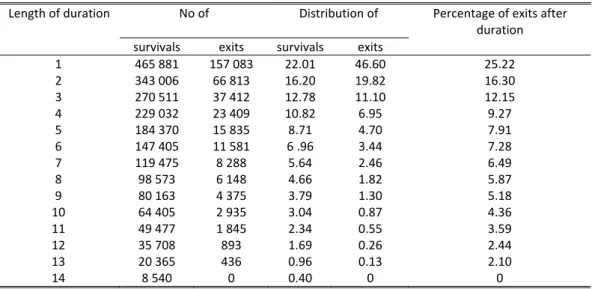
This leaves us with a sample consisting of 2,453,964 observations (1,644,087 observations when non‐offshoring firms are excluded) in the following three dimensions: 518,106 individuals, 25,892 firms (with 29,173 plants), and 14 years, which form 622,963 unique employer‐employee combinations. Table A1 in the appendix shows the distribution of survivals and exits by spell duration, and the pattern resembles other datasets (see Munch, 2010). Around 25% of all new jobs end after just one year, while only two percent of jobs surviving for 13 years end in the 13th year. Thus, almost 47% of all job separations is found during the first year, and only a small fraction (0.4 %) of employer‐employee separations is at the end of the period.
Figure 2: Construction of job spells
14
This group includes exits due to illness and parental leave, as well as other minor outcomes.
Spell start:
New
employer‐
employee
match after
1997 at plant
level (666 989
matches)
Spell time:
No. of years
with the same
match
Spell end: Last
year for a
particular match.
Exit to a new job
(45%)
Exit to
unemployment (4%)
Exit to education
(2%)
Exit to retirement
(1%)
Exit due to illness or
other reasons (1%)
Right‐hand censored, spells
ending in 2011.
(43%)
Spells end due to
reconstructions
2.2 Measuring offshoring
A crucial strategic decision for the firm is how different tasks in the production process should be organized. Helpman (2006) describes this decision in a strategic matrix with two dimensions regarding the production of intermediate inputs. One dimension is whether the firm should keep production within the firm or not (i.e., whether to insource or outsource), while the other is whether to use domestic or foreign sources. Offshoring (i.e., shifting the location of manufacturing and service activities abroad) encompasses both international outsourcing, when the firm keeps an arm’s length distance to its foreign supplier, and vertical FDI, when the firm is supplied by a foreign affiliate.15 A crucial element in both cases of offshoring is that they involve importing tasks (or intermediates) from abroad instead of using domestic sources.
If we want to assess the influence of offshoring on job separations, an important issue is what type of imports to include in our measurement. One point of departure is to include all types of imports. A potential drawback with such a broad definition, however, is that it could involve tasks that will never be produced domestically, neither in‐house nor at arms‐length. For example, Swedish firms would never (at least not without substantial costs) consider a task such as drilling for oil domestically. Feenstra and Hanson (1999) address this issue by considering a narrow definition of offshoring at the industry level by focusing on imports of inputs originating from the same broad industry categorization as the importing firm. The authors argue that this measurement captures the idea of offshoring better since there is at least a potential for a domestic production, if not by other firms then at least within the firm itself.16
A potential problem with measuring offshoring at the industry level is that it also captures changes in firm composition within the industry and not just shifts of domestic tasks to foreign producers (see the discussion in Helpman, 2006). As for the Swedish manufacturing sector, 5‐9% of all firms every year are new startups, and around 13% of these firms start to import directly. Hence, there is a significant risk that an industry‐level measure of offshoring is influenced by firm dynamics. We therefore use firm‐ instead of industry‐level imports, and make use of the BEC (Broad Economic Categories) classification to sort out imports of intermediates. Thus, we define offshoring as firm‐level imports of processed goods for an industry, including parts and accessories, while imports of all other goods (i.e., raw material, fuel, capital goods, transport vehicles, and consumer goods) are excluded from this measure.17 As robustness tests, we will also use a narrower definition of offshoring in line with Feenstra and Hansson (1999), by focusing on products (excluding raw materials, fuel, and finished machines) belonging to the same 3‐digit industry as the firm, as well as a broader definition that includes all imports.
Figure (3) plots the ratios of offshoring at the firm level for manufacturing firms (weighted by firm‐labor shares) to sales, total costs, and the number of employees.18 Interestingly, there does not appear to be a clear trend when it comes to the ratio of offshoring to sales. The ratio remains quite stable, at around 0.10‐0.11 over the period, which may reflect increased possibilities of exporting as better and/or cheaper inputs are available to firms (i.e., sales through exporting is raised in tandem with imports). This is supported by the increasing importance of offshoring
15
See Hummels et al. (2014b) for an in‐depth discussion about offshoring definitions and measurements.
16 Similar measures have been used by, for example, Görg and Görlich (2015) and Munch (2010). 17 The BEC codes used in order to define offshoring are 121, 220, 420, 521, and 530.
18
Note that these figures are based on all firms in the manufacturing sector and not only on those in our
relative to total costs and number of employees. As illustrated, offshoring has increased from 11% to 14% of total costs, and offshoring per employee (in 000s SEK at 1997 prices) has doubled between 1997 and 2011 (RHS axis). The only exception was during the financial crisis, when production as well as trade of all firms dropped dramatically.
Figure (4) focuses on offshoring from a sector‐level perspective by displaying the concentration pattern within 2‐digit industries, measured as the offshoring share of (i) the five largest offshoring firms per industry in total offshoring, (ii) the two largest firms per industry and county19 in total offshoring, and (iii) all firms that have some offshoring activity. One important observation from this figure is that offshoring activity is concentrated in a few firms. The five biggest offshoring firms within industries form, on average, around 50% of the total offshoring volume. Moreover, the previously discussed importance of local buyer‐seller networks implies that firms acting as suppliers of inputs to larger firms should be more concerned about offshoring patterns in their proximity rather than the overall concentration within an industry. Thus, looking at the two largest offshoring firms within each industry and county, we can see a much higher level of concentration, as these firms now account for, on average, 70% of the total offshoring volume. There is not, however, a clear trend in the concentration shares, as both measures exhibit u‐shaped behavior between 1997 and 2011. On the other hand, there is a rather clear downward‐sloping trend for the share of firms with offshoring activity. Around 25% of all firms (using weighted averages and sectors’ labor shares as weights) offshored in 1997, while this share dropped to approximately 22% in 2011 in the aftermath of the financial crisis.
19
A county is a Swedish administrative unit, and there are 21 different counties in Sweden.
20
0
25
0
30
0
35
0
40
0
.09
.1
.1
1
.1
2
.1
3
.1
4
1995 2000 2005 2010
year
Offshoring as share of sales
Offshoring as share of total costs
Offshoring per worker (1000 of SEK in 1997 prices)
2.3 Instrumenting for offshoring
All studies of the offshoring effect on employment or wages face potential endogeneity problems. Measures of offshoring at the industry level may suffer from simultaneous changes in technology and/or the composition of firms that will influence firms’ demand for workers as well as offshoring activities (see the discussion in Hummels et al., 2014b). Similar problems are found at the micro‐level, as productivity shocks affect not only the demand for offshoring because of output changes but also the demand for workers. In addition, a firm’s offshoring decision may be a reaction to job‐separations due to changes in the structure of the workforce. To deal with these endogeneity problems, we instrument for offshoring in a similar way to Hummels et al. (2014a).
The idea is to use the variation of export supply on the world market as exogeneous shocks for Swedish imports. Hence, we start with product‐specific export volumes at the 6‐digit Harmonized System (HS) level of all countries except Sweden (from the COMTRADE database). Thereafter, the firms’ pre‐sample distribution of product‐specific imports (aggregated up from an 8‐digit to a 6‐digit HS‐level) across countries is used to construct a firm‐level instrument for offshoring. Formally, we construct the offshoring instrument for firm f at time t ( ) as follows:
∑ ∑ ; (1)
where is country c’s total exports of product k (defined by HS6) at time t, and is firm f’s import share of product k from source c, defined at the pre‐sample period (1997 in this case). If the firm started to import after 1997, the first import year is used to define the shares.
.6
8
.7
.7
2
.7
4
(ax3)
.5
.5
1
.5
2
.5
3
.5
4
.5
5
(ax2)
.2
2
.2
3
.2
4
.2
5
(ax1)
1995 2000 2005 2010
year Axis 1: Share of firms with offshoring.
Axis 2: Offshoring conc. (5 biggest firms in industry).
Axis 3: Offshoring conc. (2 biggest firms in industry and county).
Note: Weighted means by using industry-labour shares and 2-digit industries.
One concern may be that the instrument becomes weaker and weaker over time if the import pattern in later periods diverges from the one in the pre‐sample. Although we do find that new import links emerge over time, the initial pattern still appears to be quite consistent, as 58% of the sample’s total imports in 2011 are formed by the same source‐product combination that appears in each firm’s pre‐sample distribution (i.e., in ). Another concern is the possibility that the export supply of other countries is influenced by large Swedish importers (i.e., Swedish firms with buyer bargaining power). However, this seems to be a minor problem for imports. Focusing on the most important import product (in values) of each firm, the share of Swedish imports in total world imports range between 0 and 0.36, with a distribution highly skewed towards zero (e.g., the 99th percentile is around 6%). Although the share of Swedish imports on a bilateral basis is larger, ranging between 0 and 0.5, the median is not more than 12%, and the 90th percentile is as low as 36%.
2.4 Spatial dimensions and external offshoring
An important dimension of this paper is the potential effects of external offshoring on job‐ separations because of local buyer‐seller linkages. A possible scenario is that a firm’s offshoring decision affects the workforce of other Swedish firms rather than its own workforce if the decision implies a shift from arm’s‐length domestic to foreign sources. In this case, the offshoring effect becomes indirect through decreased demand for domestically produced inputs. It may therefore be inadequate to focus only on offshoring at the firm‐level if these indirect effects are important. Using industry‐level measures of offshoring captures this issue to some extent, since the measurement confounds the external (or indirect) and the internal (or direct) effects on job‐ separations. However, industry‐level measures of offshoring have other drawbacks because they imply not only identical effects across firms in the same industry, but also homogeneous effects across space. The latter implies that distant offshoring activities will have the same weight as activities in the proximity.
In order to capture the indirect effects and the importance of local networks, we make use of a fine geographical division of Sweden called SAMS (Small Areas for Market Statistics). SAMS divides Sweden’s 290 municipalities into 9,209 small spatial areas, allowing us to construct spatial variables without being concerned about the lumpiness of administrative borders at municipality level.20 The spatial variable faced by plant p is constructed by first allocating firm f’s offshoring spatially, with the help of information on the location of plants. A firms’ total offshoring is distributed to all locations where it has a plant, since we cannot discriminate between locations when it comes to the impact of offshoring. In other words, we assume that a given offshoring volume has a similar impact at all stages of the firm’s production line. The offshoring value ( ) of a plant p located in SAMS area j at time t is therefore equivalent to the firm f’s offshoring:
≡ ; (2)
Thereafter, we construct a location‐specific variable for each plant in the following manner:
20
Around 67% of the areas have an area less than 10km2, while 89% have less than 100km2. The minimum
∑ ∈ , ; (3)
where , includes all establishments excluding plant p located in SAMS j, and has the dimension of Jx1 where J is the number of SAMS areas in Sweden. Thus, the internal offshoring volume of plant p is excluded from the location specific offshoring variable of plant p. Third, we make use of a spatial weight matrix to construct a localized measure of external offshoring giving a larger weight to offshoring activity in the proximity of the plant. In particular, we use a spatial weight matrix Wj with the dimension 1xJ to define the spatial relationship between all SAMS areas in Sweden. Our preferred spatial relationship is the inverse distance function so that the localized external offshoring variable for plant p located in SAMS area j becomes:
∑ ∈ ; (4)
where is the distance in km between SAMS areas j and r. We consider alternative measures for the internal distance within each SAMS (i.e., when j=r). One is to set the internal distance equal to one, which implicitly assumes that all plants are clustered together within an SAMS area. Another is to approximate the internal distance by using an average distance between plants with the help of circle radius, and so we use dij 0.67 area/ as an alternative
measure (see Head and Mayer, 2004). Our preferred measure, however, turns out to be a distance of one, since using a finer grid of squares than SAMS of 250 times 250 meters (alternatively 1,000 times 1,000 meters) reveals that around 45% of the plants are co‐located with one or more manufacturing plants within these fine grids. For grids with only one plant, the internal distance within SAMS areas is, on average, 3.25 times higher when compared to the distance to the nearest grid with additional manufacturing plants. Figure (A1) in the Appendix clearly shows how manufacturing plants tend to cluster within SAMS areas, even in the county with the largest SAMS areas in Sweden (i.e., Norrbotten).
Although we have a very fine spatial disaggregation, there may still be potential bias in our weights due to the underlying aggregation scheme leading to a variation in the size of the SAMS areas. We therefore use row standardization to mitigate this problem. This implies that the spatial weights for external distances (jr) become ∑ .21 Finally, we construct an instrument for external offshoring by using from equation (1) instead of in equation (2). Since the spatial data only covers the period 2005 to 2011, we restrict our study of the indirect effects of offshoring to these years.22 Figure (5) shows the spatial distribution of regional offshoring, as in equation (4), per worker located in each SAMS area with the two different measures of internal distance used in this study. Both maps show a similar spatially heterogeneous pattern when it comes to workers’ exposure to offshoring. The Northern part as well as the Central and Southern parts are areas with the highest exposure, while workers around Stockholm and Gothenburg (the two biggest cities in Sweden) are less exposed.
21
We consider alternative spatial weight matrices as a robustness check. These are described in Section
3.3.
22 For the instrument of external offshoring, the distribution key (see equation (1)) is now defined for the year 2004. In this case, 69% of total imports in 2011 have the same source‐product combination as in
Figure 5: Regional offshoring (spatially weighted with row standardized weights) per worker
Note: The colors divide regions into quintiles, where red implies the highest level of regional offshoring per worker and
dark blue indicates the lowest.
2.5 Empirical model and covariates
When assessing the effects of offshoring on job separations, we follow the survival literature using flow data in order to take into account the dynamic implications of learning over time and its effect on job separations. Thus, we control for the length of each employer‐employee match. This may be particularly important in the Swedish context due to labor laws, where the general principle of “last in first out” implies that the last person employed in an operating unit is the first who should be laid off in the case of redundancy.23 There are also several advantages of using a flow sample. One is that overestimating the mean duration can be avoided, as stock samples tend to be biased towards longer spells (see Amemiya, 1999). Another is that problems related to left‐truncation can be ignored, as we have no information about the employer‐ employee match before 1997. The discrete nature of our data (the underlying continuous
23
Note that this is a general principle and there are several situations when it is not applicable (e.g., for
durations are recorded in discrete units) implies that a bivariate discrete‐time hazard model ( ) for the employer‐employee match m at time t can be employed:24
, , Pr
Pr | , , , ; (5)
where T is the end time of a spell, T is a non‐parametric baseline hazard (i.e., duration dummies) common to all individuals, m is a time‐invariant error term, and is a vector with individual, plant, firm, and location characteristics. An advantage of a discrete duration model is that one could fit the hazard with a logit or a probit panel data model, where job separation takes the value of one if a match going on for T years ends at time t, and zero otherwise. In the case of the
probit model, our specification becomes Pr Θ ′ . In
addition to the offshoring variable discussed above, we control for a large set of individual, plant, firm, and regional characteristics influencing the probability of job separations. These are presented in Table 1. When it comes to individual characteristics, we control for income, education, age (as cohort dummies), number of jobs since 1997, gender, family, and Swedish nationality. Similar characteristics have been shown to be important for the job separation decision in, for example, Munch (2010), Geishecker et al. (2012), and Görg and Görlich (2015). The plant and firm characteristics included are the plant size (measured by the number of employees), firm productivity, and capital intensity. Although similar characteristics have been used in earlier studies on job separations and offshoring, we have more detailed information. Thus, while most previous studies control for the size of the firm, we focus on the size of the plant, which may be more important in situations with multi‐plant firms. In addition, earlier studies measure characteristics reflecting productivity and capital intensity at the industry level, while we use the actual firm‐level equivalent measures. Finally, we exploit detailed and fine information about the location of the plants in order to construct spatial or regional measure of offshoring using spatial weights, as explained above.
A potential problem when it comes to assessing the effects of offshoring on job‐separations is the impact of unobserved variables influencing job separations. The rate of job turnovers and firms’ offshoring possibilities varies across industries, and the economic structure of the local economy has a large impact on workers’ job opportunities. If we are to control for these unobservable effects, our empirical specification needs to take the form of a complex panel with detailed fixed effects for plants, municipalities, years, or some combination of all of these. The use of panel data and instrumental variables makes the non‐linear model highly complicated, and since we are only interested in the partial effects, we chose to use a linear probability model that has been shown to “give good estimates of the partial effects” (Wooldridge, 2010, p. 455; Angrist and Pischke, 2008). We are comfortable with the linear probability model giving us good estimates, since the marginal effects from a probit model described above are very similar to those from a linear probability model when we run them with only year and duration dummies.25
24 The discrete‐time hazard model, in the context of offshoring and job separations, has also been used by Geishecker (2008) and Görg and Görlich (2015). For a discussion on the discrete duration model, see
Jenkins (1995), Gullstrand and Tezic (2008), and Hess and Persson (2012).
25
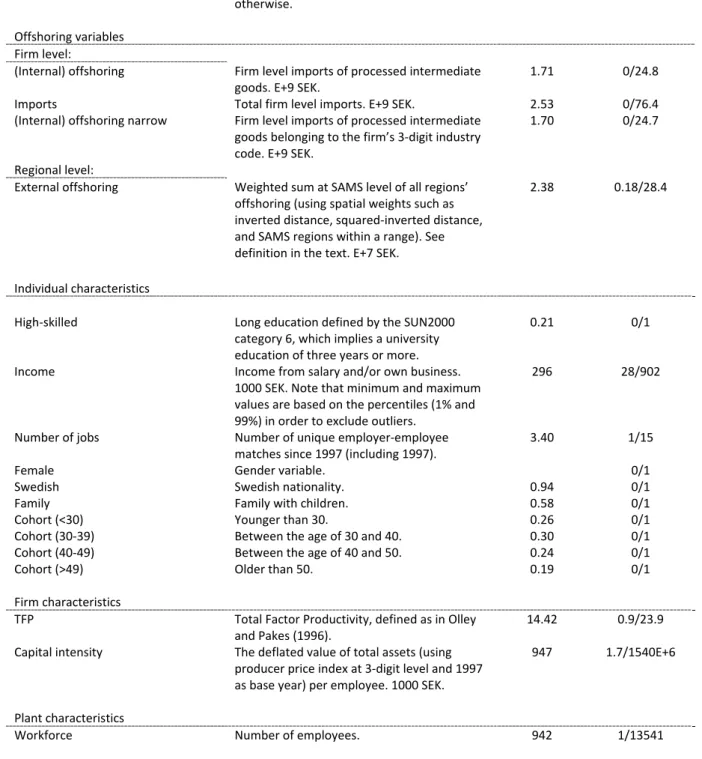
Table 1. Covariates
Variable Definition Mean Min/Max
Spell event Takes the value of 1 at the last year of an
employer‐employee match at plant level, 0
otherwise.
0.13 0/1
Offshoring variables
Firm level:
(Internal) offshoring Firm level imports of processed intermediate
goods. E+9 SEK.
1.71 0/24.8
Imports Total firm level imports. E+9 SEK. 2.53 0/76.4
(Internal) offshoring narrow Firm level imports of processed intermediate
goods belonging to the firm’s 3‐digit industry
code. E+9 SEK.
1.70 0/24.7
Regional level:
External offshoring Weighted sum at SAMS level of all regions’
offshoring (using spatial weights such as
inverted distance, squared‐inverted distance,
and SAMS regions within a range). See
definition in the text. E+7 SEK.
2.38 0.18/28.4
Individual characteristics
High‐skilled Long education defined by the SUN2000
category 6, which implies a university
education of three years or more.
0.21 0/1
Income Income from salary and/or own business.
1000 SEK. Note that minimum and maximum
values are based on the percentiles (1% and
99%) in order to exclude outliers.
296 28/902
Number of jobs Number of unique employer‐employee
matches since 1997 (including 1997).
3.40 1/15
Female Gender variable. 0/1
Swedish Swedish nationality. 0.94 0/1
Family Family with children. 0.58 0/1
Cohort (<30) Younger than 30. 0.26 0/1
Cohort (30‐39) Between the age of 30 and 40. 0.30 0/1
Cohort (40‐49) Between the age of 40 and 50. 0.24 0/1
Cohort (>49) Older than 50. 0.19 0/1
Firm characteristics
TFP Total Factor Productivity, defined as in Olley
and Pakes (1996).
14.42 0.9/23.9
Capital intensity The deflated value of total assets (using
producer price index at 3‐digit level and 1997
as base year) per employee. 1000 SEK.
947 1.7/1540E+6
Plant characteristics
Workforce Number of employees. 942 1/13541
3. Results
This section presents the results from estimating the probability of job separations at the worker‐ plant level following internal and external offshoring. We consider two different versions of equation (4): a benchmark model without interaction terms and a version that includes interaction terms. This section also provides results from various robustness checks.
3.1 Benchmark estimations
Equation (4) is estimated using a linear probability model with and without the instrumental variable discussed in Section 2.3. For the IV estimations, the first‐stage regressions (presented in the appendix) show that the instrument has the expected positive sign and is highly significant. In addition, the Kleibergen‐Paap F‐statistic is well above the rule of thumb of 10. All estimations include plant, municipality year, and spell duration fixed effects. Standard errors are clustered at the SAMS‐year level to control for potential correlation between workers within the local market.
Table 2 presents the results from our benchmark regressions. Columns (1) and (2) focus on internal offshoring and include only offshoring firms, while columns (3)‐(5) incorporate both internal and external offshoring. Notice that column (3) includes all firms, while columns (4) and (5) split the sample into employees in offshoring and non‐offshoring firms respectively. Also, the regressions with external offshoring are based on a shorter time period (2005‐2011) due to the lack of reliable spatial information before 2005.
Before discussing the effects of offshoring, we note that the estimations yield the expected signs for the individual characteristics. Hence, workers who are skilled (or highly educated), have Swedish nationality, or have switched jobs more frequently before are more likely to exit a job spell at any point in time, signaling their higher mobility. On the other hand, higher income, being female, or having a family is negatively associated with the probability of a job exit. Turning to the firm‐ and plant‐level characteristics, we find that both plant size and TFP have a positive impact on job separation in all estimations, demonstrating how increases in size and productivity are associated with the higher risk of a job exit for the individual. This could be due to a positive correlation between productivity growth and savings on labor costs, or that plant growth is related to an internal restructuring process leading to higher job turnover. For capital intensity, the results are less clear. While an increase in capital intensity has a positive (but mostly insignificant) relationship with job turnover in columns (1)‐(4), it has a negative impact in column (5), which includes only workers in firms that do not offshore themselves. Since the group of non‐ offshoring firms mostly consists of small and medium‐sized enterprises, the result suggests that capital accumulation in SMEs is more likely to act as a complement than a substitute to labor.
Considering the effects of offshoring itself, we find no effects of internal offshoring on job separations in any of the estimations. With respect to external offshoring, the coefficient becomes negative and significant for offshoring firms (column (4)). The result indicates that a 10% increase in offshoring by other firms in the proximity decreases the probability of job separation by around 0.4%. The lower probability of a job separation due to external offshoring may be related to better performing firms, as these firms may have access to cheaper and/or better inputs.
Table 2. Estimating worker‐plant job separation: benchmark regressions
Internal offshoring External offshoring
OLS IV IV
(all)
IV
(offshoring firms)
IV
(non‐off. firms)
Variable (1) (2) (3) (4) (5)
Worker level
High‐skilled 0.018*** 0.019*** 0.016*** 0.017*** 0.015*** (0.000) (0.000) (0.000) (0.000) (0.000)
Ln(income) ‐0.055*** ‐0.055*** ‐0.039*** ‐0.040*** ‐0.039*** (0.000) (0.000) (0.000) (0.000) (0.000)
Ln(number of jobs) 0.021*** 0.021*** 0.022*** 0.017*** 0.035*** (0.000) (0.000) (0.000) (0.000) (0.000)
Female ‐0.013*** ‐0.013*** ‐0.021*** ‐0.012*** ‐0.011*** (0.000) (0.000) (0.000) (0.000) (0.000)
Swedish 0.028*** 0.028*** 0.022*** 0.022*** 0.022*** (0.000) (0.000) (0.000) (0.000) (0.000)
Family ‐0.002*** ‐0.002*** ‐0.002*** ‐0.001* ‐0.005*** (0.000) (0.000) (0.000) (0.053) (0.000)
Firm/plant level
Ln(offshoring) ‐0.002 0.004 ‐0.004
(0.119) (0.420) (0.571)
Ln(TFP) 0.006*** 0.004 0.005*** 0.010*** 0.003** (0.002) (0.173) (0.001) (0.001) (0.040)
Ln(capital intensity) 0.004 0.004 0.001 0.011*** ‐0.007*** (0.169) (0.170) (0.656) (0.001) (0.006)
Ln(workforce (plant)) 0.026*** 0.025*** 0.049*** 0.035*** 0.061*** (0.000) (0.000) (0.000) (0.000) (0.000)
Regional level
Ln(external offshoring) ‐0.014 ‐0.037*** 0.016
(0.137) (0.009) (0.126)
Observations 1,643,788 1,643,788 1,632,703 1,082,144 550,549
R‐squared 0.151 0.151 0.163 0.140 0.205
Kleiberger‐Paap F stat 322.83 98.13 65.94 321.79
Notes: All regressions include plant, municipality‐year, and spell duration fixed effects. Cohort age group
dummies are also included. Robust p‐values (in parentheses) are based on standard errors clustered at
SAMS‐year level. ***, **, and * denote statistical significance at the 1, 5, and 10% significance levels
respectively.
3.2 Controlling for heterogeneity
for the low‐skilled. The final indicator is a dummy variable reflecting whether the individual has been matched with the employer for 1‐3 years, and the interaction term thus captures the effect of offshoring on newly‐employed individuals. The reason for including this interaction is mainly driven by the Swedish context and the aforementioned labor‐market principle of “last in first out”, suggesting that the probability of a job separation due to offshoring may be larger for new employees. However, the principle is not written in stone, since there are several exceptions. One is that it is only applicable on the level of operating units (i.e., independent units) within larger plants, and another is that two people of significant importance for the firm may be exempted from this rule in firms with no more than ten employees. It is therefore not always the case that new employees must leave first when firms face a shock leading to layoffs. If larger firms build up new operating units or if smaller firms hire new types of competences as a response to increased offshoring, the probability of exiting due to offshoring may actually fall for the newly employed.
The results in Table 3 show that the impact of offshoring on job separations are highly heterogeneous. For our base group of older employees (in terms of age and number of years in the firm) without university education, an increase of internal offshoring of 10% increases these workers’ probability of exiting by around 0.13% (see column (2) in Table 3). The average increase of internal offshoring is 27% over our observed period, suggesting that the probability of exiting for this group of workers has increased by around 0.35% over the period. This effect is quite modest compared to the results for low‐skilled workers in Munch (2010) and Görg and Görlich (2015).26 The differences in estimated magnitudes between our and previous studies could be due the choice of data level. In particular, the higher risk of a job exit from increased offshoring, when measured at the industry level, may be because it captures industry dynamics as well as offshoring carried out by other firms within the industry.
Regarding the heterogeneous impact, we find that the increased risk of a job separation from internal offshoring disappears for the young cohort of workers and is reduced for the newly‐ employed workers. The effect of internal offshoring seems, therefore, not to discriminate between workers with diverse types of education. Instead the results suggest that the job destruction part of offshoring is more about pushing out older jobs.27
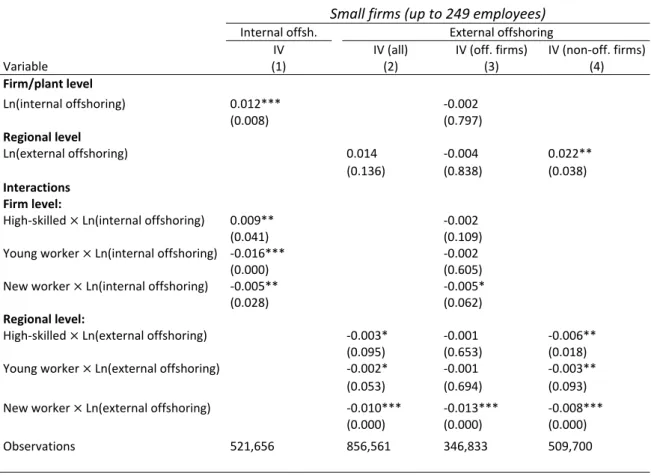
Turning to external offshoring in columns (3)‐(5) in Table 3, a noteworthy finding is that when we take into account heterogeneity across workers, workers in non‐offshoring firms are now influenced by offshoring carried out by other firms in Sweden. For workers in non‐offshoring firms in column (5), a 10% increase in external offshoring increases the likelihood of a job exit for our base group by 0.24%, an impact that is almost twice as large compared to the internal offshoring effect. Furthermore, having an education, being under 40, and being newly employed all reduce the probability of exit. Hence, a newly‐employed young individual with a university degree faces a zero‐increased risk of a job separation due to offshoring. The most important reduction stems from being newly employed, closely followed by a university degree, thereafter belonging to the younger cohort. Workers in offshoring firms also face a reduced risk of a job
26
Görg and Görlich (2015) find the probability of a job separation for low‐skilled workers with a temporary
contract to increase by 0.12% as offshoring increases by one percentage point. Munch (2010) focuses on
the unemployment risk of workers with basic skills and finds that a one percentage point increase of
outsourcing leads to an increased unemployment risk of 1.29%.
27