Homebound patrons are an often-overlooked population, though their needs like their size are growing. This paper examines literature about the population, their needs and the methods used to reach them. Included is research about several North Carolina public library homebound programs that show real world examples of different delivery methods. Different delivery methods include home delivery and mail delivery. Examination of those methods can be used to determine, from a variety of different methods, which method may be financially feasible for a library seeking to add homebound service in their community.
Headings:
by C. Allison Sills
A Master’s paper submitted to the faculty of the School of Information and Library Science of the University of North Carolina at Chapel Hill
in partial fulfillment of the requirements for the degree of Master of Science in
Library Science.
Chapel Hill, North Carolina
April 2015
Approved by
Table of Contents
Introduction... 2
Literature Review ... 3
Methods ... 7
Results... 9
Discussion...21
Conclusion ...30
Appendix A: Library Names Legend...32
Appendix B: Interview Questions ...33
Introduction
Homebound patrons are a hidden population that is often overlooked by public
libraries (Homebound toolkit, 2001). This is exemplified by the fact that many
libraries do not offer any homebound services despite statistics showing even the
smallest communities have patrons in need.
Homebound patrons are often elderly too feeble to leave their homes or
without transportation, but they can include the disabled of all ages. These
populations are often ignored though potentially in the most need of services
(Homebound toolkit, 2001). They are in need because of their age, disability,
poverty, isolation or any combination of all of these.
Some public libraries offer services to these patrons. But many don’t. Why is
that? Perhaps there is a perception that the service is too expensive. And it has costs.
But how much does it really cost per patron? How much per method?
This paper examines several North Carolina libraries that offer the two kinds
of homebound service – mail delivery and home delivery – in an attempt to discover
Literature Review
Medicare defines “homebound” as not necessarily bedridden but having a condition
where leaving the home would require a considerable and taxing effort (Baker, 2001).
Trips to the barber and for groceries, and certainly trips to doctors do not disqualify
someone as homebound. Homebound persons have an illness or injury that restricts
their ability to leave the residence except with the aid of supportive devices, like a
cane or walker, special transportation, or another person. Examples include persons
paralyzed by stroke, persons who have lost use of the upper body and are unable to
open doors, persons who just had surgery, persons with heart disease who must avoid
stress, and persons with a psychiatric problem such as agoraphobia (Baker, 2001).
Elderly beneficiaries who do not often travel from their home because of
feebleness and insecurity brought on by advanced age would NOT meet Medicare’s
criteria for the homebound, but, in most places, this does not apply to library outreach
(Baker, 2001). An example is Durham County Library, Durham, NC. Their website
has an entire page devoted to OASIS or Older Adult & Shut-in Service. Their
criterion for service is age, illness or physical disability (OASIS, Durham County
Library, 2015).
Older adults are individuals over the age of 65; currently this is about 13% of
the population, or about one in eight people (Ortman, 2014). This group is rapidly
growing in size due to increased life expectancy and the maturation of baby-boomers
elderly population will double in size to 80 million by 2050, making the elderly
population 1 in 5 persons (Ortman, 2014).
However, although mortality has decreased, morbidity has increased. Fewer
people are dying from stroke and heart disease but more are living with debilitating
chronic conditions correlated to old age, such as physical impairments that complicate
the activities of daily living (Naleppa, 2003).
Besides age-related issues, disability related issues, and mental health related
issues; there are transportation issues to consider. According to the Department of
Transportation in 2003, 15 million out of 290 million had difficulty getting the
transportation they need. Of these 15 million, 6 million, or 40 percent, were people
with disabilities. Most of the respondents to the DOT’s survey cited lack of a
personal vehicle and hardship with public transportation costs or availability, such as
in rural areas, as reasons for their difficulty. The DOT estimated that 3.5 million
people never leave their homes (Bureau of Transportation Statistics, 2003).
Of those 3.5 million, 54% or 1.9 million had some kind of disability. Of those
1.9 million, 560,000 were able to live independently. The others suffered from
illnesses such as Alzheimer’s disease, senility or dementia. In 2003, with a US
population of 290 million, this puts the homebound population, due to transportation
issues alone, at 0.19 % (Bureau of Transportation Statistics, 2003).
Other statistics one might take into consideration when calculating or
attempting to figure the homebound population in a community include the
percentage of seniors who choose reading as a pastime over other leisure pastimes
such as watching television. The average percentage who prefers to read after age 65
education levels, poverty levels, and current community support for homebound
patrons in other ways like church programs.
Still other types of homebound patrons might include parents or spouses or
other caregivers for a disabled person, children who are disabled, or even people
under house arrest.
And yet while the ALA prioritizes equity of access, access is not inclusion
(ALA, n.d.). Access is a passive delivery of information that excludes people who
might need information the most, like homebound elderly and the infirm.
Homebound library patrons may be difficult to locate, evaluate and serve.
There are two ways commonly used to deliver materials into the hands of
homebound patrons, mail delivery and home delivery. There are pros and cons
attached to each method as well as costs in materials and staff.
Home delivery provides social interaction, which research has shown
positively affects older adults’ life satisfaction (Hummert, 1992). It also: increases
the library’s visibility in the community, allows connection with other organizations
that also provide support to this population, reaches patrons who may not feel
comfortable navigating a mail program, and enables outreach to groups of patrons
living together in nursing facilities or senior centers (Homebound toolkit, 2001).
Cons for home delivery include: the investment of time to make deliveries,
costs such as vehicle maintenance and gas, a longer loan period for materials,
increased training and a limit to the delivery area (Homebound toolkit, 2001).
Mail delivery, however, provides access to patrons at the furthest reaches of
the coverage area and can include patrons in remote, rural areas. The delivery process
speed of the patron. Some patrons may prefer the privacy involved. And there are no
vehicle or gas costs (Homebound toolkit, 2001).
But with mail delivery, at least one home visit may be required anyway to
verify the eligibility of the patron for the service and/or to set up the initial library
card account. It also likely does not meet any social needs of the patron, and it has its
own postage costs. It also limits the materials being borrowed including oversized
books. Also, patrons will have to take on the responsibility of contacting the library
to change their type of materials chosen and take over the responsibility of returning
the items to the library. Service to group homes would no longer be integrated. And
visibility of the program would be substantially reduced (Homebound toolkit, 2001).
There are at least 12 libraries that offer services to the homebound in North
Carolina within 150 miles of Chapel Hill, NC. This paper examines 6 of these
including: Durham County Library, Forsyth County Public Library, Greene County
Public Library, High Point Public Library, Lee County Library and Wilson County
Public Library. This paper studies the real costs of these delivery methods from the
selecting time, to delivery time getting the materials into the hands of the patrons, to
Methods
The literature review was completed using the UNC Library catalog to find articles,
books and websites with relevant statistics to the elderly and homebound patrons
needs. Google searches added statistics including US Census and Department of
Transportation facts. The most useful find through Google was the Homebound
Toolkit.
The Homebound Toolkit was developed by a non-profit organization based
around North Texas Library Partners, or NTLP. As they outgrew serving only North
Texas, they adopted the acronym “Not Typical Library Partners.” NTLP operated for
nine years until it ceased in 2013. Jokingly calling themselves “Now Terminated
Library Partners” NTLP continues to offer certain project websites and information
for other libraries’ future use.
The Homebound Toolkit offers every kind of resource a library would need to
begin a homebound program. It includes definitions of the homebound, statistics
about the homebound, how to determine need, pros and cons of delivery methods,
best practices, even examples of homebound participant applications and how to
create reader’s profiles. This resource was invaluable to this study for its wealth of
information and examples.
Research was conducted through interviews and self-reporting. Twelve
libraries were identified within 150 miles of Raleigh that offered homebound
programs. Each of the libraries was contacted via email. Four of the libraries never
followed through with contact information. The responding seven libraries were all
contacted by phone, and a representative was interviewed.
Of the responding seven, two libraries from within one regional library system
outlined similar stories. Each served a small population, had one homebound patron
and used their own vehicle. To simplify this paper, these two examples were reduced
to one.
The remaining six libraries and the patronage they serve were investigated and
compared. In all cases, the librarian in charge of outreach was interviewed with
questions from Appendix B.
Budget reports and financial statements were obtained online from county or
Results
Libraries are listed in order of lowest population served to highest population served.
Names have been removed, but a legend for each library’s location is available in
Appendix A.
The average car gets 23 mpg (miles per gallon) (US Department of Energy,
2013). Gas is estimated at $2.50 per gallon.
Salaries are listed if available. However, wages may vary from location to
location, from year to year, and from professional to paraprofessional so salary is not
always listed. Instead, job titles are listed and hours worked.
All figures may be rounded up to the nearest whole number, whole cent or
dollar, or percentage point. Costs are listed when known, but many costs are shared
across departments within the library or even across a county.
The smallest library in this study served a population of around 1600 and had
only 1 homebound patron who they were able to visit in their own vehicle. The
library serving the most homebound patrons had the highest person per square mile
density, specifically in one city. And the library with the greatest breadth of services
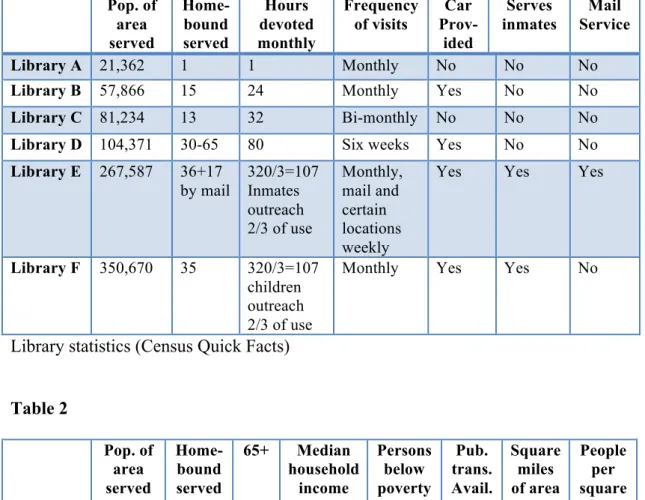
Table 1 Pop. of area served Home-bound served Hours devoted monthly Frequency of visits Car Prov-ided Serves inmates Mail Service
Library A 21,362 1 1 Monthly No No No
Library B 57,866 15 24 Monthly Yes No No
Library C 81,234 13 32 Bi-monthly No No No
Library D 104,371 30-65 80 Six weeks Yes No No
Library E 267,587 36+17
by mail
320/3=107 Inmates outreach 2/3 of use
Monthly, mail and certain locations weekly
Yes Yes Yes
Library F 350,670 35 320/3=107
children outreach 2/3 of use
Monthly Yes Yes No
Library statistics (Census Quick Facts)
Table 2 Pop. of area served Home-bound served
65+ Median
household income Persons below poverty level Pub. trans. Avail. Square miles of area served People per square mile
Library A 21,362 1 14.1 40,853 23.3 No 266 80
Library B 57,866 15 14.4 44,819 18.9 No 255 227
Library C 81,234 13 16.0 39,204 23.2 No 368 221
Library D 104,371 30-65 12.0 43,083 21.4 Yes 54 1940
Library E 267,587 36+17 10.6 51,853 18.5 Yes 286 936
Library F 350,670 35 14.1 45,724 18.6 Yes
408 859
*** A ***
Library A is the smallest of the libraries studied. A is a county library located
in a town of approximately 1600 people; the county has 21,400 people (US Census,
2010). Library A is also one of seven branches in a regional system. The library
employs one librarian and four part-time paraprofessionals, which it maintains on a
budget of $130,000 (Greene County budget, 2014).
Librarian A has been branch manager for four years. Besides librarian and
managerial duties, she also handles all outreach. This outreach includes one
homebound patron.
This homebound patron lives within three miles of the library. Librarian A
uses her personal vehicle to take books to the patron’s home once a month. She
budgets one hour per month to select books for the patron and drive them to her.
Librarian A previously delivered to one assisted living facility, but no one at
the facility was willing to assist in the stewardship of the books. After books went
missing on several occasions, the partnership was ended.
One hour per month for a full-time librarian + $7.83 gas (calculated as 6 miles
round trip per month x 12 months = 72 miles per year. 72/23 = 3.13 gallons of gas.
3.13 gallons x $2.50 per gallon = $7.825 for gas.)
*** B ***
Library B is a county (population 57,866) library located in a city of 28,518
people (US Census, 2010). Library B serves this population with a budget of
$640,596 (Lee County budget, 2014). The library has one main building and one
Librarian B is a retired schoolteacher and full-time Library Outreach
Specialist. Alone, she averages three business days per month on homebound
outreach. The Library Outreach Specialist average pay is $30,395 per year (Lee
County Human Resources, 2014). She spends around 14% of her time on outreach to
homebound patrons (3 x 12 = 36 days / 260 working days per year).
Within those three days per month she visits approximately 15 people in two
nursing homes and six private homes. Each patron is seen once a month. Due dates
are extended to accommodate the additional week, however weekly DVDs are not
allowed. Librarian B keeps track of her patrons past items in a journal to prevent
bringing them the same books a second time.
Library B has a Ford minivan for use by all library personnel at its two
branches. This vehicle was donated, and maintenance and gas have been funding
issues. The recently hired director has applied for grant money to help with vehicle
costs. Librarian B estimates she travels around 30-40 miles per month.
Each patron may have up to 15 items, which are transported in milk crates.
These crates are cumbersome and failing. Librarian B’s wish list includes collapsible
crates with wheels on the bottom.
Marketing is done via word of mouth and a very small blurb on the website
that once included the searchable word “homebound” but that has since been
removed. Now the blurb offers outreach to “area nursing homes” (Lee County
Library, n.d.).
Unexpected costs include devices for homebound patrons such as CD players
and training on those devices. Librarian B has used her own money to purchase these
She finds the job rewarding but also heartbreaking at times. She sees the
opportunity of getting to know patrons more closely benefits both the patron and the
employee.
$4255.30 (14% of salary) labor + $45 (1.5 gallon per month x $2.50 gas x 12
months) gas = $4300.30. Car maintenance and insurance are additional expenses.
*** C ***
Library C is in a county that has a population of 81,234 (US Census, 2010).
Library C’s budget is $1,670,722. In addition to the main location, there are 5
branches. The itemized budget includes figures for gas $290, vehicle maintenance
$277 and vehicles insurance $610 (Wilson County 2014-2015 budget, 2014). The
homebound services librarian uses his own car and is paid 57.5 cents per mile driven,
although he only travels eight to nine miles total ($5.18 gas) per visit.
Librarian C is the Bookmobile Librarian. Besides three rural elementary
school visited throughout the county, he also visits 10 homebound patrons, five at
home and five at assisted living facilities. Three additional patrons have an advocate
that comes to the library for them for a total of 13 homebound patrons served.
Librarian C estimates he spends 8 hours per week (20% of his time) working
for his homebound patrons. He drives every Thursday from 9:30-2pm and sees each
homebound patron once every two weeks ($5.18 x 26 visits = $134.68). His patrons
can check out any kind of material. They can set up library cards over the phone,
although C says his patrons are usually educated and already life-long readers with
cards. Popular kinds of books include medical books and cookbooks.
Marketing is done through leg work and being in the community as well as
and includes a link to register for homebound services. Additional services offered
include a link to The North Carolina Library for the Blind and Physically
Handicapped, which offers free materials for patrons with significant visual
impairment or qualifying physical handicap (Wilson County Public Library, n.d.).
A Google search for this library brings up a link to an older version of the
county website that seems to have been abandoned for a newer site. The old site
outlines the origin of the homebound program. The page names the homebound
program PROMISES, Providing Reading Outreach Materials to Individual Shut-ins
and Every Senior Center. This program was partially funded from gifts to the library
in honor of a friend of Outreach Services. This friend donated many hours to
delivering books to homebound patrons (Wilson County, 2002). When I mentioned
PROMISES to Librarian C he had never heard of it nor the named friend. The older
website page was last updated May 2, 2002.
Another find on this disused page is a link to a bookmobile complete with
photo. As this librarian currently uses his own car, it is unclear what happened to the
van in the photo; it may be out of service or too expensive to use (Wilson County,
2006).
Librarian C said there were few unexpected costs, but one included the need to
use personal devices to help patrons look for books in the online catalog or to help
find suggestions on Goodreads. Complications have arisen when patrons switch
living facilities. Books have gone missing when patrons move.
Librarian C recommends being realistic about the conditions your patrons may
be in physically or financially. You have to be prepared for, at times, poverty level
many. But Librarian C loves to be out of the office and talking to people. And he
sees how the service improves patrons’ quality of life.
1 full-time paraprofessional wage x 20% + $134.55 gas.
*** D ***
Library D is the only municipal library studied and serves a population of
104,371 (US Census, 2010) on a budget of $5,595,836 (High Point Public Library
annual report, 2014). The budget includes statistics such as number of holdings added
to the collection (32,712) and total number of attached museum visits (10,327) (High
Point Public Library annual report, 2014). The library has one main building and one
branch.
Librarian D is the Division Manager of Readers’ Services. She oversees all
outreach. The library calls its adult outreach program SHARE, Senior Homebound
Adult Reading Enrichment. The librarian employs one paraprofessional for 20 hours
per week (part-time, no benefits) to run the SHARE program. One full day is
dedicated to deliveries while the other hours are devoted to item selection.
To qualify for services, patrons must be over 65, have no transportation or in
poor health and live within the city limits. Approximately 30 patrons currently
receive delivery from High Point Public Library, although that number fluctuates and
has risen as high as 65 patrons. Of those 30 patrons, about half are in institutions such
as assisted living spaces or nursing homes. The other half are in private homes. Each
patron sees service once every six weeks, and due dates are amended accordingly to
accommodate the longer check out time.
The homebound staff member has access to a library-owned car, an eight
Three thousand dollars per year is budgeted to pay for maintenance of the vehicle
with any remaining money annually set aside into a savings fund to pay for a future
replacement vehicle.
Any kind of item can be requested including books, CDs and DVDs, but large
print books and audio books are in higher demand. Assisted living and nursing homes
often request DVDs sometimes based around a theme for in-house programming.
Each patron gets a “box” or carrying tub that may contain up to 25 items. Tubs are
paid for out of a supply budget.
Marketing is done by word of mouth, through homebound programs such as
Meals on Wheels, through seniors groups, by the Friends of the Library group and
through brochures
Unexpected costs have included book carts for use in institutions with multiple
patrons. Other additional costs have included special programming around holidays
or enrichment events. During the Christmas season, cards and decorations were
bought with the supplies budget. Enrichment programming has included the talents of
a local musician travelling with the outreach assistant to play his guitar for patrons.
The librarian’s suggestion for libraries considering adding a homebound
program is to make sure you hire the right people for the job. Applicants should be
gracious, as patrons might not always be living in good circumstances. Applicants
should also be physically able, as they may have to carry quite large loads of books to
patrons living on upper floors with no elevator access. And they will need to be able
to work outside in all weather conditions.
Librarian D believes that this is an important service because it creates good
1 paraprofessional for 20 hours a week + $3000 vehicle = $11,320. Supplies,
gas and insurance are additional.
*** E ***
Library E is located in a county that has a population of 267,587 (US Census,
2010). This library was the first free, tax-supported library in North Carolina.
(Durham County Library, n.d.) The library has one main location and six branches.
Its budget to serve this population is $9,478,231 (Durham County NC: budget, 2012).
The budget also contains many notes about the library’s accomplishments for the year
including the addition of a pin number for self-check-out to decrease fraudulent use
and the purchase of new furniture for “a mini-makeover” of the main library.
Librarian E is their Senior Library Assistant in charge of OASIS. OASIS
stands for Older Adult and Shut-In Service. The librarian and one other full-time
employee work on OASIS.
OASIS serves homebound people in rest homes, retirement communities,
senior centers, private residences and prisons (Durham County Library: OASIS, n.d.).
Patrons qualify by age, illness or physical disability. Thirty-six places are visited
once a month except for two larger retirement communities. One is visited all day
every Thursday. And the second is visited twice a month. Three to four stops are
made each of four travelling days, except Mondays and Wednesdays. On Sundays,
workers are kept in-house to work on selection.
Additionally, OASIS visits a correctional facility on the northern tip of their
county. Twelve crates full of books go to this location for dozens of inmates who
month. Crates are delivered in a family van owned by the county. This four year-old
Ford is shared with children’s services.
While the website mentions a 35 foot bookmobile, this has been out of service
for two years. The 2013/2014 budget mentions the intention to repurpose the
bookmobile as a stationary library space. The county has also set aside $45,000 to
upfit one 16-foot sprinter van to replace the bookmobile. The sprinter van will be a
hybrid diesel that is more fuel-efficient (Durham County NC: budget, 2012).
Also of note in the budget is that one “Library Associate” for a branch was
“defunded” (Durham County NC: budget, 2012). This associate appears to have been
part-time.
Cards are set up by phone and any type of material can be lent including audio
books, large print, DVDs and CDs.
Marketing is facilitated by health professionals in the system who spread news
of the service via word of mouth to their patients. Healthcare professionals and
doctors may refer new patrons to the program. Rehab facilities and caretakers
sometimes contact the library directly on behalf of a patient. Also, the website has a
page devoted to services and is up to date.
This is the only library of the six examples that has a mail delivery service.
Mail delivery is sent out daily in purpose bought nylon mailbags. Each bag has an
address pocket where pre-printed, reversible labels are inserted. Patrons seeking less
than 10 items per month are put on the mailing list. Patrons seeking more are put on
the delivery list. Books are sent by library mail rate with return postage prepaid.
Patrons need only reverse the mailing label and reseal the bags to return items. The
Unexpected costs have included lost and damaged mailbags. Also zip ties
have been found necessary to seal mailbags securely. These zip ties are included in
the mailbag for returns as well.
The librarian is passionate about her service to the community. She
mentioned how hard it can be sometimes to leave her patrons because she and her
recipients enjoy their visits together. Of all the programs, this one seemed the most
comprehensive. When asked about the budget, Librarian E recommended speaking to
her supervisor saying only that, “When I need money, I get it.” Attempts to reach the
supervisor in charge of this budget were not answered.
2 full-time paraprofessionals + 4 days a week car use, gas, insurance + mail
service expenses. Mailbags cost around $15 each. Libraries receive special postage
rates that can be viewed here:
http://pe.usps.com/Archive/HTML/DMMArchive0108/183.htm
*** F ***
Library F serves a county with a population of 350,670 (Census, 2010). The
Library operates on a budget of $7,850,958 (Forysth County budget, 2014). It has
one main building and 10 branches.
Librarian F has been the Manager of Outreach Services for 14 years. She
employs two full-time paraprofessionals to run the homebound programs. They visit
20-25 places per month serving 35 homebound patrons in assisted living, private
homes and incarceration.
Staff use county owned and maintained bookmobiles. The larger of the two, a
33 footer, goes out every day and spends the first half of the day serving one or two
with Smart Start funds, and it is in need of upgrading. The other, smaller bookmobile
at 17 feet, serves the Hispanic community.
Bookmobile staff are responsible for all of the tasks a branch is including
setting up memberships, book exchange as well as programming. Bookmobiles are
gassed and maintained by the county Fleet Maintenance Department.
Each patron is served once a month. DVDs or weekly rentals are not allowed,
but all other materials are. In-house library programs are supported through the
bookmobile, such as summer reading.
In the summer, more neighborhoods are visited including camps, lunch
programs and homeless programs.
Librarian F considers outreach rewarding because one is able to see children
and adults have immediate access learning. They know this access will occur
regularly, inspiring word of mouth marketing. This inspires others to come forward
and learn, too. Besides the bookmobiles as billboards, additional marketing is done
on the website and through flyers.
2 full-time paraprofessionals provided by the library. Bookmobiles upkeep,
gas, and insurance provided by Fleet department. These services are intertwined with
Discussion
Results of research
In this small study, the average percentage of 65+ population was not directly
applicable the number of homebound serviced, nor was median income or poverty
level. Even total population served was not indicative. The most accurate measure
of the factors looked at was people per square mile. Density of population had a one
to one relationship with number of homebound patrons served. See Table 2.
There is a link between depression and higher density, which may inspire
more of the reading population to seek a connection to their local library (Sundquist,
2004). Also, participation in group activities, despite common wisdom, decreases in
urban areas (Recsei, 2005). Recsei suggests that social engagement declines as
density increases for various reasons including fewer green spaces, depression and
increased illness. People in higher density living actually have less interaction with
community and activities (Recsei, 2013). Community and activities are two things
outreach can provide.
This study did not take into consideration success of marketing one library
might have over another, the enthusiasm of one outreach librarian over another, or
any additional networking any library might have that another might not. But not one
of the libraries contacted had zero patrons served.
Results show that programs for homebound populations can be tailored to fit
Practical Considerations
The intent of this study was to break down the cost of such a program to the
dollar. The reality of the situation is that most libraries don’t break down costs in
such ways. Just as most libraries don’t know the cost they spend per child, none of
the libraries contacted had any idea how much they spent on homebound patrons.
Resources can be found in a variety of places for a variety of costs. For
example, most staff had no idea how much the vehicle they drove was worth, or what
the budget for that vehicle was. In most cases, costs were difficult to narrow down
because they were shared with either other departments within the library, with other
branches or, in one case, all vehicles were maintained by a countywide fleet budget.
In another case, the vehicle was donated for no expense.
Similarly, most staff only worked on homebound programs a small part of the
time. Most staff studied were categorized as “outreach” staff but that outreach
encompassed both youth and adult outreach. In the case of Library A, the library with
the smallest patronage, the outreach services were provided by the branch manager.
The goal of this paper became trying to estimate the number of hours each
library spent on homebound outreach and outlining ways that each library met their
transportation and mail service needs.
What these findings mean for the practice of library science is that if your
library is interested in serving a homebound patron, there are many different and
affordable ways to accomplish this.
The first step in deciding whether or not to begin a homebound program is to
programs studied began with one person with a passion. Half of those studied were
first or second generation programs.
Identify the needs of the community. While statistics on percentage of 65+
adults may not directly correspond with need, such statistics will provide an estimate
as will other statistics such as poverty levels and population density per square mile.
Senior centers, churches, hospitals, nursing homes, assisted living homes,
groups such as Meals on Wheels and your Friends of the Library may have additional
information about real need.
Balance the needs of the homebound population against what the library can
realistically handle, as was suggested by Librarian C. All of the libraries contacted
had patron qualification standards although some were more lax than others.
Librarian E said she took each patron at their word, while Librarian A pointed out a
situation where an institution with multiple patrons could no longer bear their half of
a partnership. That partnership was subsequently dissolved because the librarian
could not handle the work without their help. Know your limits.
Decide on a delivery method. While mail delivery might seem like the less
expensive choice, this study proved it was not the choice made most often.
Home Delivery
Most libraries chose home delivery, and there are reasons for this choice.
Most of the librarians in this study commented not only on the patron’s need for
society, but also on their own. Librarian C said he loved getting out and talking about
his library with his community. Many homebound patrons lead isolated lives and
Cars marked with library logos increases a library’s visibility within a
community. New patrons may become interested when they see a resource otherwise
forgotten helping out that sweet old lady down the street. Everyone who passes the
car will be reminded this resource exists.
This good will extends to other organizations that are tapped for information
or volunteers, who will then themselves spread the news farther. More organizations
may be drawn in to help with either funds or manpower.
Some patrons may be unwilling to bother with the details of by-mail delivery,
but they will accept a visit from a librarian.
Costs may be reduced if multiple patrons are living within one nursing home
or assisted living facility. In this study, libraries serving more than one person had
half of their patrons living in group homes together, the other half lived
independently. Half of all deliveries were made to one or two locations.
Qualifications for homebound patronage can also be observed by staff first
hand rather than taken on faith; faith that can be abused.
But home delivery also has some drawbacks including it takes more time to
deliver in person than it does by mail. Librarian F talked about having to set time
limits per delivery to 30 minutes to remain on time. Patrons may want to socialize or
need training on electronic devices.
There is some safety risk to persons making deliveries. Patrons may live in
unsafe neighborhoods or in unhealthy living conditions. Staff will need to be hired
based on soft skills to handle these kinds of issues.
Home deliveries may be limited by how far you are willing or able to travel.
miles yet only travels eight to nine miles. He serves two smaller towns within his
county that have no library branch nearby.
Another deterrent with home deliveries is that deliveries to patrons may not be
as often as the patron desires. Most of the libraries in this study made monthly
deliveries. One made deliveries once every six weeks. This can be twice the length
of standard loan periods to non-homebound. However, budgets may dictate this
length.
One of the tragic but very real results of working with homebound patrons is
that they can and do pass away. One cost incurred when a patron dies is the loss of
unreturned items. However, family or caretakers who find the items often return the
books, relieving this risk.
This program is also vulnerable to budget cuts or staff reduction. Decreases in
budget were seen across several libraries studied. Libraries C and E both lost their
bookmobile and were using substitutes; C was using his own car while E was using a
van. Also, Library E had a budgeted staff reduction as one position was listed
defunded.
Mail Delivery
Mail delivery, on the other hand, also has both benefits and deterrents.
Patrons can set the pace of their deliveries with mail delivery. Rather than waiting for
a certain date, deliveries can better match actual reading speed. And while some
patron may not wish to navigate by-mail delivery details, others may prefer the
More patrons can be reached across a greater geographic area with mail
delivery. Librarian E said all of her homebound patrons begin as mail delivery until
they cross a monthly book threshold. If the patron checks out more than 25 books per
month, they are then graduated to home delivery.
Mail delivery can also require less training for new staff, which can have
additional benefits when that staff take a vacation. Other staff can more easily
assume the position in her absence. This decreases expense over time.
The drawbacks are the mail delivery does not meet the social needs of patrons.
It also does not have the visibility in the community that home delivery can have.
Readers advisory may face challenges with mail delivery. Oversized books
and fragile media might be more challenging to send by mail. And costs for sending
those items, postage and packaging, will increase. Although Librarian E, the only
librarian in this study to use mail delivery, said that libraries get a special postal rate
that is very competitive. She also sends items in reusable bags, further dropping cost
expectations.
Lending Practices
Once the decision has been made to create the program and by which delivery
method, then decisions can be made on what to lend.
Two of the libraries in this study, B and F, did not allow DVD rentals because
they had shorter borrowing limits and were in higher demand. The other four libraries
had no such limits. Several commented that audio book were in high demand.
trained her how to use it so she might enjoy that medium. Audio books might be
popular for elderly patrons with failing eyesight.
Making a budget will cover everything from reallocating current staff, to
hiring new staff, to acquiring a vehicle if home delivery is chosen.
Five of the libraries studied used the designated “outreach” librarian to serve
the homebound patrons. Only Library A used a manager. However, beyond that
distinction, the number of hours spend on homebound patrons varied wildly from one
person spending one hour a month to three people spending 100 hours a month.
Hours devoted by library staff per patron range from one to three hours each.
Staff can be supplemented if possible with volunteers, although none of the
libraries in this study used them. Four of the libraries used paraprofessionals to carry
out all of the main duties, which can be a less expensive way to budget new staff.
Many libraries, including Library D, are hiring 20 hours per week or less staff who
will not require investments including health insurance or retirement. The downside
of these jobs is that, being less permanent, employees will more likely move on from
the position within a few years. This may lead to more training time annually or
bi-annually. Another downside is that websites may not be updated as employees leave
and are hired. Several of the websites I looked at had outdated contact names.
Vehicle
The vehicle, as this study shows, is not always necessary. But it can be very
useful and to more programs than homebound.
Each of the libraries in this study handled their vehicles in different ways.
used their own car and was paid per mile. Library B had a car that was donated.
Maintenance and gas for the vehicle was a funding issue. Library D bought its own
car and set aside fund annually to fund its next car. Library E had a bookmobile that
was retired and replaced with a smaller, more fuel efficient van. Library F had a
full-sized 33-foot bookmobile and a 17-foot van, but the county maintained these in a fleet
budget.
Partnerships seem to be a successful method here. Library A partners with her
library to fund the vehicle, as does Library C. Library B partnered with a donor who
gave the library a van. The county spent money to upfit Library E’s sprinter van.
Library F partners with the county to provide transportation. Only Library D
shoulders the burden of their vehicle alone. And they include provisions for future
need into every annual budget.
Marketing
Marketing can be done in many different ways. All of the libraries in this
study used the Internet to bring in patrons with varying degrees of success. In fact, all
of the libraries studied in this paper were found by Internet promotion. Library E has
a dedicated page that outlined the mission, who is served, what you can check out,
and who to contact (County OASIS, n.d.). However, Library B recently had a website
overhaul that removed the searchable “homebound” word and replaced it with
“outreach” (Library services, n.d.). A homebound patron might not stumble upon this
service without all of the appropriate language searchable.
full-sized bookmobile every day into the community through which they learn about
potential patrons in need.
Goals
To measure success it is important to develop goals. Goals can be tracked
through the number of patrons you register to the number of items circulated. Goals
can include the number of deliveries or mail shipments to the number of items
purchased.
Periodic surveys to homebound patrons will help you measure outcomes.
Outcomes can include participants feeling an increased level of knowledge.
Participants might engage more with their community or report an increased value on
lifelong learning. Surveys can also help you refine your methods including
marketing, reader’s advisory or delivery specifics.
Getting Started
Outreach can begin with small programs, bringing in or reaching out to
nursing homes or assisted living facilities. Delivery can be implemented for a short
duration to test to the waters. Another method might include finding ways to bring
homebound patrons to the library. One local library not included in this study that
does not offer a homebound program does partner with a city senior shuttle that stops
at the library and many local markets and shopping centers.
Many avenues are available to libraries thinking about a new homebound
Conclusion
This research has tried to show many different ways a homebound program can be
funded and staffed. Even the smallest of libraries with the least amount of funding
often offer this service. It is affordable.
And while larger cities usually offer reliable public transportation, homebound
patrons may not be able to use that transportation for other reasons including mental
disabilities like agoraphobia or physical disabilities, age related frailty or immunity
disease (Baker, 2001). Patrons outside of the public transportation area may have
transportation related isolation. None of these issues is resolved with reliable city
transportation.
There are two kinds of delivery to homebound patrons. Each has its own
advantages and disadvantages, though home delivery is the preferred method with all
libraries studied using this method.
Each method can be tailored to any size budget. And partnerships are a great
way to make such a program successful. Each library studied handled their program
in a way tailored to their patronage. One library had a prison within its boundaries,
so those homebound patrons were served. Many of the libraries had a children’s
outreach that was almost indivisible from the adult homebound outreach.
The homebound population is usually a small percentage of the population and
Finding a precise cost for each program proved almost impossible, just as
finding an exact cost for children’s services would be almost impossible. In many
cases, only job titles and hours worked were listed in calculations because those
figures may vary wildly between a rural library and a county library.
This study showed that both kinds of libraries and all shades in between have
manageable homebound programs. Most were started by one person with a passion.
Even though many libraries are running on reduced budgets and shortened staffing,
Appendix A: Library Names Legend
Library A is Greene County Pubic Library in Snow Hill, NC
Library B is Lee County Library in Sanford, NC
Library C is Wilson County Public Library in Wilson, NC
Library D is High Point Public Library in High Point, NC
Library E is Durham County Library in Durham, NC
Appendix B: Interview Questions
Quantitative
1. How many employees work on the homebound program? Full-time? If part-time,
how many hours per week?
2. Do you home deliver? If so, is there a car provided?
3. If a car is provided, how much is spent annually on the vehicle?
4. If a car is not provided, how much money is allotted for the personal vehicle of the
employee who makes deliveries per week/month/year?
5. Do you mail deliver? If so, can you tell me about your budget allotment for this
per month/year?
6. Does the patron pay for any part of this delivery method?
7. Can you tell me about any hidden costs you’ve noticed? How much do you spend
on these per month/year?
8. Do you have a bookmobile that services homebound persons? Is this service in
addition to other outreach and/or can you estimate how much money you spend using
the bookmobile to service homebound persons?
9. Do you have a fixed budget for homebound programs?
10. Do you receive any grants or extra funds for homebound programs? If so, from
where and how much?
Qualitative
1. What are the benefits you see having this service?
2. Do you see unexpected results from this service? Good or bad?
3. What do you recommend libraries contemplating this service do before starting?
Supplementary
1. How are homebound patrons set up with their library cards? How is readers
advisory for the patron created or how does the patron request materials?
2. How often are deliveries made to patrons?
Bibliography
American Library Association: Equity of Access. (n.d.). Retrieved from
http://www.ala.org/advocacy/access/equityofaccess
Baker, B. (June 2001). Medicare clarifies its definition of ‘homebound.’ Retrieved
from http://www.acpinternist.org/archives/2001/06/q&a.htm
Bureau of Transportation Statistics. (April 2003). Transportation difficulties keep over half a million disabled at home. Retrieved from
http://www.rita.dot.gov/bts/sites/rita.dot.gov.bts/files/publications/special_reports_an d_issue_briefs/issue_briefs/number_03/html/entire.html
Durham County Library: About. (n.d.). Retrieved from
http://durhamcountylibrary.org/about/
Durham County Library: OASIS (Older Adult & Shut-In Service). (n.d.). Retrieved
from http://durhamcountylibrary.org/services/oasis/
Durham County NC: Complete FY2013-14 Adopted Budget. (July 1, 2012).
Retrieved at http://dconc.gov/home/showdocument?id=7972
Forsyth County, public library, about us: Financial statement, fiscal year 2013-2014 financial summary. (2014). Retrieved from
http://www.forsyth.cc/library/financial_statement.aspx
Federal Interagency Forum on Aging-Related Statistics. (2012). Older Americans 2012: Key indicators of well-being. Retrieved from
http://www.agingstats.gov/agingstatsdotnet/Main_Site/Data/2012_Documents/docs/E ntireChartbook.pdf
Forsyth County budget fiscal year 2014-2015: Culture and recreation. (May 29,
2014). Retrieved from
https://www.co.forsyth.nc.us/Budget/Budget1415/11-Culture_and_Recreation.pdf
Greene County budget ordinance 2014-2015 fiscal year. (June 23, 2014). Retrieved
from
http://www.co.greene.nc.us/client_resources/budget/2014-2015/approved%202014-2015%20ordinance.pdf
High Point Public Library/High Point Museum annual report 2013-2014. (June 30,
2014). Retrieved from
http://highpointpubliclibrary.com/files/AnnualReport2013-2014.pdf
Homebound program toolkit. (August 25, 2001). Retrieved from
Hummert, M. L., Nussbaum, J. F., and Weimann, J. M. (1992). Communication and the elderly: Cognition, language, and relationships. Communication Research 19.4, 413-22.
Lee County 2014-2015 adopted budget. (May 22, 2014). Retrieved from
http://www.leecountync.gov/LinkClick.aspx?fileticket=-iO-HCG1sm8%3d&tabid=166
Lee County Human Resources: Job classes & pay ranges. (2014). Retrieved from
http://www.leecountync.gov/Departments/HumanResources/JobClassesPayRanges.as px
Lee County Library: Library services. (n.d.). Retrieved from
http://leecountync.libguides.com/content.php?pid=655489&sid=5433957
Naleppa, M. J., and Reid, W. J. (2003). Gerontological social work: A task-centered approach. New York: Columbia University Press.
Ortman, J. M., Velkoff, V. A., and Hogan, H. (May 2014). An aging nation: The older population in the United States. Retrieved from
http://www.census.gov/prod/2014pubs/p25-1140.pdf
Recsei, T. (2005). Pipe dreams: The shortcomings of ideologically based planning. People and Place, vol. 13, no. 2, 68-81.
Recsei, T. (September 19, 2013). Health, happiness, and density. Retrieved from
http://www.newgeography.com/content/003945-health-happiness-and-density
Sundquist, K., Frank, G., and Sundquist, J. (2004). Urbanism and incidence of psychosis and depression. British Journal of Psychiatry 184, 293-298.
US Census Bureau. (2010). State and county quick facts: Greene County, Lee County, High Point (city), Wilson County, Durham County, and Forsyth County.
Retrieved from http://quickfacts.census.gov/qfd/states/37000.html
US Department of Energy. (2013). Fuel economy guide. Retrieved from
https://www.fueleconomy.gov/feg/pdfs/guides/FEG2013.pdf
Wilson County 2014-2015 budget. (June 10, 2014). Retrieved from
http://www.wilson-co.com/DocumentCenter/Home/View/7439
Wilson County. (May 2, 2002). Retrieved from
http://www.wilsoncountyems.com/libhomebound.html
Wilson County. (September 15, 2006). Bookmobile. Retrieved from
http://www.wilsoncountyems.com/libmobile.html
Wilson County Public Library: Homebound services. (n.d.). Retrieved from