Rebecca Madeline Beatrice Whaples. The Online Presence of Theological Libraries: A Benchmark Study. A Master’s Paper for the M.S. in I.S degree. April, 2013. 36 pages. Advisor: Rebecca Vargha
This paper examines the online presence of theological libraries. The sample of libraries
was selected from schools accredited by the Association of Theological Schools. A
content analysis of the library websites was done measuring the presence of many
elements including OPACs, databases, reference services, and social media. It was found
that while certain elements are near universal, others are still used by only a minority of
theological libraries. However, in comparison to the past, the online presence of
theological libraries has clearly developed. It is likely that it will continue to do so in the
future.
Headings:
Theological libraries Library websites
Electronic reference services (Libraries) Electronic information resources Online library catalogs
THE ONLINE PRESENCE OF THEOLOGICAL LIBRARIES: A BENCHMARK
STUDY
by
Rebecca Madeline Beatrice Whaples
A Master’s paper submitted to the faculty
of the School of Information and Library Science
of the University of North Carolina at Chapel Hill
in partial fulfillment of the requirements
for the degree of Master of Science in
Information
Science
.
Chapel Hill, North Carolina
April
2013
Approved by
Table of Contents
INTRODUCTION ... 2
BASIC INTERNET PRESENCE ... 3
Websites ... 3
LIBRARY COLLECTIONS AND RESOURCES ... 4
OPACs. ... 4
E-Resources ... 4
LIBRARY SERVICES ... 6
Virtual Reference ... 6
Research Guides... 8
NEW INTERNET TRENDS ... 9
Social Media ... 9
THE CURRENT STATE OF AFFAIRS ... 10
METHOD ... 11
SAMPLE ... 11
PROCEDURE ... 14
OPAC ... 14
Patron Empowerment... 15
Databases ... 15
General Contact ... 15
Reference Contact ... 16
Research Guides... 16
Social Media ... 16
RESULTS ... 17
DISCUSSION ... 24
CONCLUSION... 27
REFERENCES ... 28
The Online Presence of Theological Libraries: A Benchmark Study
In 2001, Mark Stover wrote the article titled “Internet Shock: Change, Continuity, and the Theological Librarian” (2001a). It was a follow up to his 1993 article “Information Technology and the Theological Librarian.” He discussed how the field had changed since the early 1990s. Stover examined how the internet was affecting things. While in 1990 they did have such things as online public access catalogs (OPACs) and electronic databases, by 2001 many of the OPACs had moved to graphical user interfaces and the electronic databases were increasingly available online (instead of only as CD-ROMs). Email was becoming an increasingly important tool, and the possibility of online, or virtual, reference was being discussed, though Stover states it had “not yet come into full bloom” (p. 8). He was quite interested in and concerned about the problem of information organization on the internet. How was this to be dealt with by
theological librarians? He argues that librarians should have a role in organizing and interacting with information on the web on a meta-level. It is within their purview to select various
resources and to organize (links to) them on their own website in a meaningful way. In this respect, organized database lists and library guides would be useful. But despite arguing for this role for librarians, he seems surprisingly critical of the overall digital trend:
Is it a good or a bad thing that theological librarians can do most anything now from their desktops? It is not just the Internet that makes this possible, of course; online public access catalogs, databases, and local networks contribute to this armchair librarianship. But are the chairs in religious and theological libraries really so
Whether or not such concerns have some foundation, it is clear to the casual observer that the trend toward the digital has not abated since the early 2000s. Indeed, the 2001 Stover article is part of a larger work co-published simultaneously as Theological Librarians and the Internet: Implications for Practice and as Journal of Religious & Theological Information, Volume 3, Numbers 3/4 2001. As part of this same volume, various authors looked at internet-based trends in theological libraries and what impact they might have. The next section is an overview of technology in both theological academic libraries specifically and in academic libraries in general.
Basic Internet Presence
Library Collections and Resources
OPACs. This is perhaps the most central and ubiquitous element of library websites. Still
(2001), examining the websites of university libraries in English speaking countries, found that every library she examined had an OPAC. The majority of the schools and libraries included in her sample were larger institutions -which may have been better funded and more at the forefront of technological innovation at the time. Writing in the same year, Dickason (2001) reported that in his examination of the libraries of schools accredited by the Association of Theological Schools, only 78% of the libraries had a web presence, while 65% of the libraries had OPACs. It should be noted that this was a substantial increase over previous years – a study by Pakala in 1995 indicated that only 43% had online catalogs (as cited in Dickason, 2001).
It is not surprising that OPACs should be so central to library websites. One of the primary purposes of a library is to give access to materials – often in the form of monographs – and that is the function of an online catalog virtually. Numerous studies have found that humanists and theologians alike prefer books to other sources (e.g. Penner, 2009; Baruchson-Arbib & Bronstein, 2007). In fact, Penner (2009) found that the library catalog was one of the primary methods of discovery for masters and doctoral theological students at the International Baptist Theological seminary. Baruchson-Arbib and Bronstein (2007) similarly found that Jewish Studies faculty rated their local library’s catalog as their most important information channel. But of course books are not the only things that libraries collect or the only type of source that theologians use.
E-Resources. The second most popular source among theologians is journals – this was
still be listed in the catalog – they increasingly fall under the general heading of e-resources. 1 Even in 2001, this was the case. Dubis (2001) writes about the efforts to greater access to full text religion journals via the ATLA Serials Collection Project, while Eidson (2001) explores in more depth the rise in e-journals. In fact, Baruchson-Arbib and Bronstein (2007) also found online databases important information channels for their respondents. And Penner (2009) found that databases (particularly full-text journal databases) were close to library catalogs as a method of discovering sources. In a non-theological setting, Moyo and Cahoy (2003) indicate that full-text databases closely followed use of the catalog among their distance students. Of course journals and journal databases are not the only type of e-resource. Websites of various natures also fall under this heading. In fact, both Baruchson-Arbib and Bronstein (2007) and Penner (2009) found that websites were still highly used.
The use of e-resources among students, faculty, and theologians in general has clearly been on the rise. When Barrett (2005) interviewed graduate students in a number of disciplines within the humanities, he found that respondents disagreed with the stereotype that humanist dislike e-resources and in fact frequently made use of such resources. They emphasized the efficiency and accessibility advantages that such resources provide to library patrons. However, he noted that graduate students and younger faculty seemed to make use of these resources more than older faculty members. This may have been due in part to a generational shift. When Falciani-White (2008) looked at the characteristics of the millennial generation and how those characteristics might apply to theological students and impact theological libraries, she noted they readily took advantage of e-resources. Penner (2009) found that the students were open to
1
using any sources – as long as they were academic, relevant, and accessible - and most were comfortable with electronic resources. Similarly, Lambert (2010) found that ministers who preached weekly frequently made use of internet resources – which was in keeping with the budding trend noted by both Howard and Smith and Smith in 2001.
Although patrons find these sources useful does not mean that all libraries have incorporated them into their websites. While Still (2001) found that databases of some variety were available on all of the university library websites she reviewed, in her review of theological library websites, Ganksi (2008) found that only 56% of them provided access to e-journals, and only slightly more - 60% - provided access to library-recommended websites (Figure 1).
Figure 1. Percentage of library websites with e-resources. Still (2001) looked at university libraries. Ganski (2008) looked at theological libraries specifically.
Library Services
Virtual Reference. Stover (2001a) discusses the changes to reference services that had brought about by the advent of the web. He noted that there was much talk about email and chat reference, but that these were not widely used among theological librarians. Harmeyer
100
56 60
0 10 20 30 40 50 60 70 80 90 100
Databases (Still, 2001)
E-journals (Ganski, 2008)
Websites (Ganski, 2008)
Per
ce
n
tage
(%
)
(2001) also discussed the possibility of virtual reference for distance education – but only as a future direction. So how has that changed since then?
In 2003, Moyo and Cahoy discussed meeting the needs of the remote students in Penn State’s World Campus (a virtual campus). For this specific group of students, having remote access to resources (such as databases) is essential, but so is remote access to reference help. They provided reference via the telephone, by email, and by real-time chat. They found that while only a small percentage of distance students made use of the virtual reference, it was still perceived as being important – with students preferring real-time assistance at their point of need. But virtual reference is not just for distance students - Fagan and Desai (2003) found that their virtual chat was most frequently used by people in the library building. More recently, Aguilar, Keating, Schadl, and Van Reenen (2011) examined the implementation of a virtual service desk at the University of New Mexico and found that it had greatly increased their reference interactions. Whereas face-to-face reference had been declining for some time, they found that the virtual interactions (including phone, email and chat) are increasing. Kayongo and Van Jacob (2011) further found that late night chat in particular was of value. They found that not only was chat more used during some night hours than during the day hours, but that the level of complexity of the questions asked was also generally higher. There certainly seems to be use and value to virtual reference services.
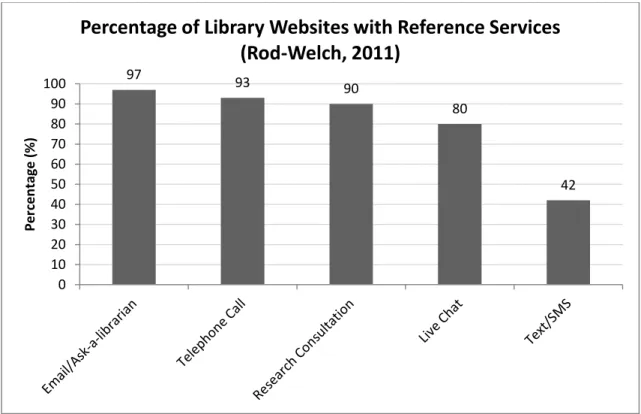
for major research libraries to offer users reference assistance via chat alongside the more traditional in-person (both at a reference desk and through one-on-one research consultations), telephone, and e-mail options” (p.99). Findings by Rod-Welch (2011) support this assertion. Rod-Welch did a content analysis of 125 Association of Research Libraries member websites and found that 97% had email/ask-a-librarian services, 93% had listed telephone numbers, 90% offered research consultations/subject specialist services, and 80% offered live chat. Even the newer text/SMS service was offered by 42% of the libraries (Figure 2).
Figure 2. Rod-Welch's findings on the percentage of library websites with reference services. Rod-Welch examined ARL library websites.
Research Guides. Stover (2001a) spends a good section of his article arguing that
librarians should have a role in organizing information on the web. For him this meant in organizing information for users on library websites – organizing and describing databases and creating library guides linking to other sites, for example. In fact, several other articles in this volume deal with similar concepts. Bellinger (2001) examined the creation of the Wabash Center
97 93
90
80
42
0 10 20 30 40 50 60 70 80 90 100
Per
ce
n
tage
(%
)
Guide to Internet Resources. Howard (2001), Deahl (2001), and Strickland (2001) all focused on the identifying and providing useful internet resources in various areas (homiletics and liturgics, Christian art, and Christian history, respectively). And Wein and Snow (2001) wrote about the creation of an internet tutorial for finding Jewish-themed web sites. This need for and interest in organizing and describing internet resources has not abated since then. This theme reoccurs again and again throughout the literature. For example, Penner (2009) noted that users desired bibliographies on specific topics as well as specific, web-based training. And Falciani-White (2008) recommended the creation of online guides. Gilson (2011), too, argued for the creation of research guides and tutorials by librarians.
The desire for research guides is present, but are the guides themselves? Ganski (2008) found that 60% of theological libraries provided access to library-recommended websites – though whether and how much these were organized is unclear. And given that the users were suggesting more guides in Penner’s study, it would seem that, in her library’s case, guides were either lacking or insufficient (Penner, 2009).
New Internet Trends
So far, this paper examines only at internet-based trends as identified by Stover or others in 2001, but other new trends like social media must also be examined in detail.
Social Media. In their review of the literature, Dickson and Holley (2010) mentioned a
blog/newsfeed format), 53% of the 125 libraries provided Facebook, and 49% used Twitter. Whether or how much these services are used in theological libraries does not appear to have been previously examined (Figure 3).
Figure 3. Rod-Welch's findings on the percentage of library websites with social media. Rod-Welch examined ARL library websites.
The Current State of Affairs
In examining these trends, there is a clear picture of development (in mostly non-theological libraries) since 2001. But what is the current state of affairs? What kind of online presence do theological libraries have now? That is what the present study aims to discover. To accomplish this goal, specific elements were selected from all of the previously discussed areas including:
Basic Web Presence
Does the library have a website? 57
53
49
0 10 20 30 40 50 60 70 80 90 100
RSS Facebook Twitter
Per
ce
n
tage
(%
)
Library Collections and Resources
Does the library have an OPAC? Do they have any form of patron empowerment?
Does the library provide access to databases? If so, how many?
Reference
Does the library provide a phone number?
Does the library provide an email?
Does the library provide a specific reference phone number?
Does the library provide a specific reference email or a reference form?
Does the library provide reference chat? If so, for how many hours a week?
Does the library provide reference text/SMS?
Does the library provide research guides?
Social Media
Does the library have a blog or newsfeed?
Does the library have a Facebook page? If so, when was the last time someone used it?
Does the library have Twitter? If so, how often do they tweet?
Method
Sample
were excluded as were any schools whose websites were primarily in a language other than English. Other exclusions were two schools whose websites’ links did not work and a Google search did not yield the correct web addresses. While some external pages provided some details about the content of the two sites, verification was not possible, so they were not included in the sample. These exclusions left a sample of 200 schools and 183 libraries. There were more schools than libraries because a number of the schools used the same libraries.2
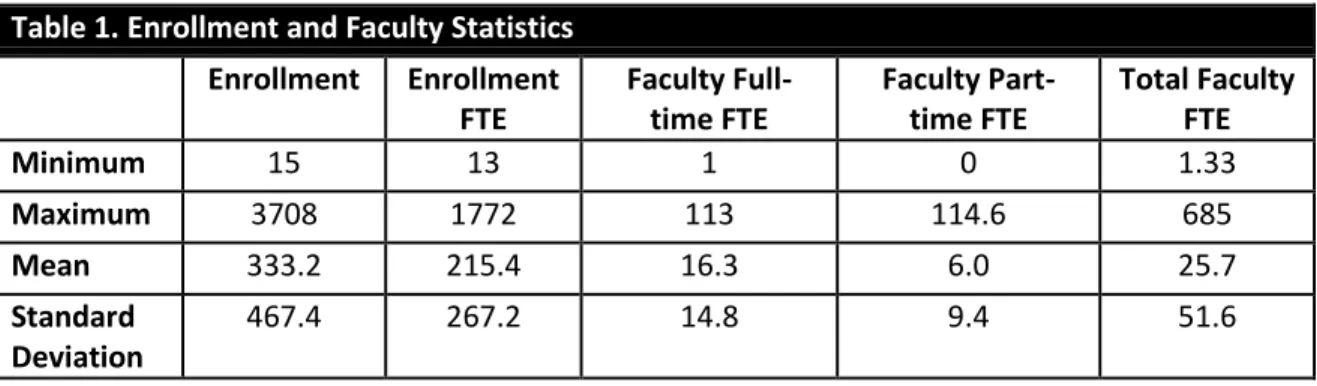
The schools included represented 26 different general religious affiliations (Figure 3). Schools were located in 34 states and the District of Columbia (Figure 4). In terms of highest degree granted by the schools, 135 schools granted doctorates, 64 granted masters, and 1 school did not grant its own degrees (degrees were conferred by another school). 70 schools had comprehensive distance education programs, while 130 did not. Further information about the schools collected from the information published by the ATS is presented in Table 1.
Table 1. Enrollment and Faculty Statistics
Enrollment Enrollment FTE
Faculty Full-time FTE
Faculty Part-time FTE
Total Faculty FTE
Minimum 15 13 1 0 1.33
Maximum 3708 1772 113 114.6 685
Mean 333.2 215.4 16.3 6.0 25.7
Standard Deviation
467.4 267.2 14.8 9.4 51.6
Figure 4. Religious affiliations of the schools. "Other" includes all those affiliations for which there was only one school in the sample. These were: Adventist Bodies, Christian Missionary Alliance, Church of God (Anderson, Indiana), Church of the Nazarene, Churches of God- General Conference, Evangelical Congregational Church, Evangelical Covenant Church, Evangelical Free Church of America, Moravian Church in North America, and the Religious Society of Friends.
Figure 5. Percentage of schools from each region of the country.
6% 13% 2% 22% 5% 15% 5% 2% 7% 6% 2%
2% 7%
2% 1%
3% 5%
Religious Affiliation of the Theological Schools
Anglican/Episcopal Baptist
Brethren
Catholic
Churches of Christ - Christian Churches Interdenominational/ Multidenominational Lutheran Mennonite Methodist Nondenominational Orthodox Pentecostal Presbyterian Reformed Unitarian Universalist
United Church of Christ Other
21%
32% 32%
15%
Schools by US Census Bureau Regions
Procedure
Libraries were first identified by going to the webpages of the schools provided by the ATS (Association of Theological Schools: The Commission on Accrediting, 2012b). Usually there was a link on this page that directed the user to the library webpage. If such a link was not apparent, then a site search was done. If this still did not identify a library page, then a Google search for “library” and the name of the school was done. Many schools did not have their own theological library. Many simply had a collection in the library of the university they are a part of. Others used the library at another school as their own. Still others formed union/joint libraries where multiple theological schools all used the same library. Whatever library was identified as being the primary library for the theological school was evaluated, unless this library had already been evaluated. In that case, if another library was indicated then it was evaluated. This was done even if the library belonged to another university and even if that university was different in size from the school or was not religiously affiliated. If the school had a library that was part of a larger system, whatever website was linked to was evaluated- even if that site included many other libraries besides the theological library. Still, evaluation of the theological library website itself was emphasized. However, if it was clear that patrons could receive certain services from the larger system, those services were counted as though they were provided by the theological library. Once the libraries were identified, a content analysis of the webpages was done during the months of February-April, 2013, looking for the presence of the following elements:
Patron Empowerment. Dickason (2001) identified this as the most common
enhancement of the OPAC. Basically, does the patron have any type of control in the system? Can they view the items they have checked out? Can they renew items? Can they place holds? Can they request interlibrary loans? Etc. This was operationalized as a patron account. If there was any indication that a patron could sign into an account and do any of the above mentioned things, it was counted.
Databases. Both the presence and number of databases were noted. This second part
was a complicated element as each library seemed to count their databases differently. It variously included standard journal databases, subscription or open access databases, electronic encyclopedias, and even just websites. For the purpose of this study, since it was not possible to comprehensively compare the listings of every library, whatever the library listed as either a database or an e-resource was counted –with a few exceptions. Citing software (like RefWorks) was excluded. Anything that could only be accessed in the library (e.g. CD-ROMs) or was clearly not accessible to the theological students (which was sometimes the case in university library systems) was also excluded. Cross references were eliminated so that resources were not double counted. The library catalog was not counted in this measure. Sources did not have to be strictly theological in nature to be included, as it could be imagined that resources from other disciplines could be used by the theological patrons. In fact, Penner (2009) found that the majority of theological students in her sample thought that at least a quarter of their research materials should come from other disciplines.
Reference Contact. This information included five forms of reference contact: a reference phone number, a reference email, a reference form, reference texting/SMS, and reference chat. For a phone number, email, or form to be counted as reference, it needed to be labeled as such in some way. It could be called reference, public service, or even listed as contact information for research help – as long as it was indicated in some manner that a patron could contact them for a research or other reference question. For chat, the hours of availability of the chat service was also recorded. If specific chat hours were not provided, then the hours were taken to be that of the reference desk. If this was also not provided, then the hours were taken as the hours of the library. It is possible that this lead to an overestimation of the chat hours. The chat service was counted whether it was provided by the library itself or by a larger system or service (including state or nationwide services).
Research Guides. This included research guides, subject guides, or LibGuides.
Social Media. Three types of social media were looked at: blogs/newsfeeds, Facebook,
and Twitter. For the blogs/newsfeed, I included anything that was labeled as being a blog or a newsfeed as long as it could either be subscribed to or separately bookmarked. Facebook and Twitter accounts were only counted if they belonged to the theological library or if the
Results
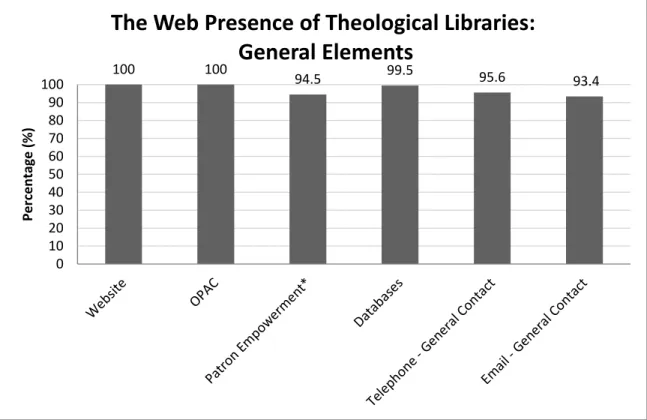
All of the libraries in the sample had some form of website. They also all had online catalogs. Patron empowerment was high, though slightly less than universal at 94.5%. Access to databases of some variety was near universal, with only one library in the sample not showing evidence of such access. General contact phone numbers and emails were both available on over 90% of the websites (Figure 6).
Figure 6. General elements of theological libraries on the web. For more detail, see Appendix A. *Patron
empowerment was only evaluated for 182 libraries. One library could not be evaluated on this element because the relevant portion of the site was done on the occasions it was examined.
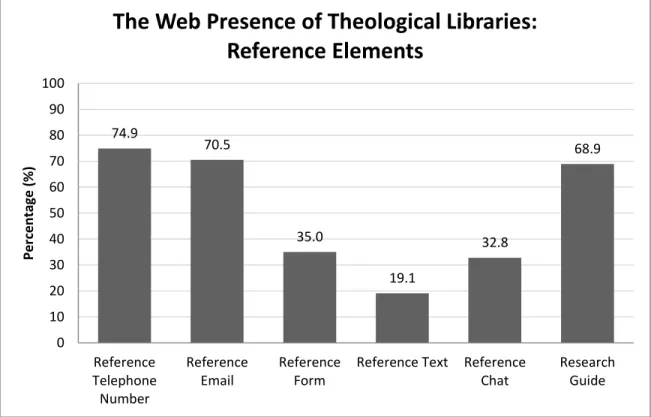
Reference numbers were lower all around (Figure 7). While close to 70% provided reference phone numbers, email, and research guides, the numbers for other forms of reference services were much lower. Only about a third of libraries provided chat and text services were closer to 20%. When splitting by schools that had comprehensive distance education programs and those that did not, generally, a higher percentage of libraries for
100 100
94.5 99.5 95.6 93.4
0 10 20 30 40 50 60 70 80 90 100
Per
ce
n
tage
(%
)
schools with distance education had these reference services – though the numbers were still quite close to those without distance education (Figure 8).3
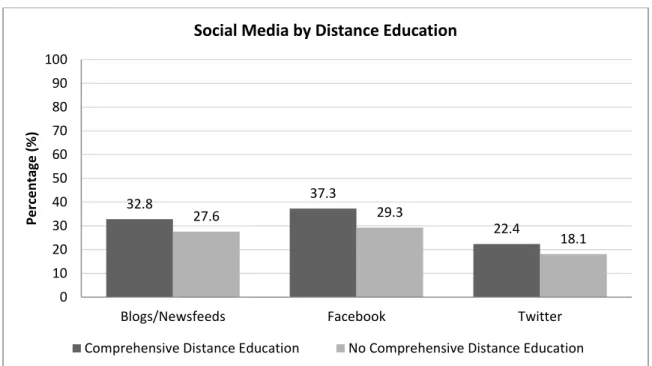
Social media was only used by a small portion of the libraries (Figure 9). The most frequently used was Facebook – which close to a third of the libraries had. Blogs/newsfeeds followed at 29%, while Twitter was used by less than 20% of the schools. Again, when differentiating between programs with and without distance education, a higher number of libraries for schools with distance education had social media – though again the percentages were quite close (Figure 10).
Figure 7. Reference elements on theological library websites. For more detail, see Appendix A.
3 When splitting by schools with or without comprehensive distance education programs, if at least one of the schools that the library supported had such a program, the library was counted as supporting such a program. 74.9 70.5 35.0 19.1 32.8 68.9 0 10 20 30 40 50 60 70 80 90 100 Reference Telephone Number Reference Email Reference Form
Reference Text Reference Chat Research Guide Per ce n tage (% )
Figure 8. Reference elements on theological library websites when split by those libraries for schools with comprehensive distance education programs and those without such programs. For more detail, see Appendix A.
Figure 9. Social media on theological library websites. For more detail, see Appendix A.
82.1 77.6 40.3 19.4 34.3 76.1 70.7 66.4 31.9 19.0 31.9 64.7 0 10 20 30 40 50 60 70 80 90 100 Reference Telephone Number Reference Email Reference Form
Reference Text Reference Chat Research Guide Per ce n tage (% )
Reference Elements by Distance Education
Comprehensive Distance Education No Comprehensive Distance Education
29.0 32.2
19.7 0.0 10.0 20.0 30.0 40.0 50.0 60.0 70.0 80.0 90.0 100.0
Blogs/Newsfeeds Facebook Twitter
Pe rc e n tage ( % )
Figure 10. Social media on theological library websites when split by those libraries for schools with comprehensive distance education programs and those without such programs. For more detail, see Appendix A.
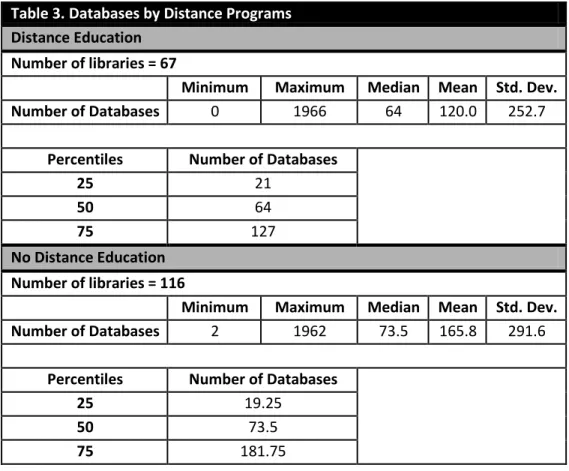
Looking more closely at the databases, there was a wide range in the number accessible through each library, with one library not linking to any databases and another linking to 1966 (Table 2). The mean number of databases was 149, with the median at only 67. In fact, the lowest quartile offered 20 databases or fewer, and three quarters of the libraries offered 173 databases or fewer. Libraries for schools without distance education programs actually had more databases, on average (Table 3).
Table 2. Databases
Minimum Maximum Median Mean Std. Dev.
Number of Databases 0 1966 67 149 278
Percentiles Number of Databases
25 20
50 67
75 173
For a histogram of frequencies, see Appendix A.
32.8 37.3
22.4
27.6 29.3
18.1
0 10 20 30 40 50 60 70 80 90 100
Blogs/Newsfeeds Facebook Twitter
Per
ce
n
tage
(%
)
Social Media by Distance Education
Table 3. Databases by Distance Programs
Distance Education Number of libraries = 67
Minimum Maximum Median Mean Std. Dev.
Number of Databases 0 1966 64 120.0 252.7
Percentiles Number of Databases
25 21
50 64
75 127
No Distance Education Number of libraries = 116
Minimum Maximum Median Mean Std. Dev.
Number of Databases 2 1962 73.5 165.8 291.6
Percentiles Number of Databases
25 19.25
50 73.5
75 181.75
For those libraries that did offer chat reference, the number of hours per week ranged from only 16 hr/wk to 168 hr/wk (full 24/7 service). The mean was 87.5 hr/wk (Table 4). Chat was more available in libraries for schools without distance education (Table 5).
Table 4. Reference Chat*
Minimum Maximum Median Mean Std. Dev.
Hours/week 16 168 70 87.5 46.4
Percentiles Hours/week
25 56
50 70
75 112
Table 5. Reference Chat by Distance Programs
Distance Education Number of libraries = 23
Minimum Maximum Median Mean Std. Dev.
Hours/week 16 168 64 76.7 43.1
Percentiles Hours/week
25 40
50 64
75 89
No Distance Education Number of libraries = 36
Minimum Maximum Median Mean Std. Dev.
Hours/week 36 168 79 94.4 45.6
Percentiles Hours/week
25 58.9
50 79
75 135
Table 6. Facebook
Minimum Maximum Median Mean Std. Dev.
Days since last post 0 240 1 15.0 43.5
Percentiles Days since last post
25 0
50 1
75 7
Table 7. Facebook by Distance Programs
Distance Education Number of libraries = 25
Minimum Maximum Median Mean Std. Dev.
Days since last post 0 124 1 12 30.8
Percentiles Days since last post
25 0
50 1
75 7.5
No Distance Education Number of libraries = 34
Minimum Maximum Median Mean Std. Dev.
Days since last post 0 240 1 17.2 51.2
Percentiles Days since last post
25 0
50 1
75 7.25
Table 8. Twitter
Minimum Maximum Median Mean Std. Dev.
Tweets/month 0.33 117.0 9.7 18.3 22.5
Percentiles Tweets/month
25 5.33
50 9.7
Table 9. Twitter by Distance Programs
Distance Education Number of libraries = 15
Minimum Maximum Median Mean Std. Dev.
Tweets/month 0.33 50.5 7.6 15.6 12.7
Percentiles Tweets/month
25 5.0
50 7.6
75 21.1
No Distance Education Number of libraries = 21
Minimum Maximum Median Mean Std. Dev.
Tweets/month 1.3 117.0 9.9 20.2 26.6
Percentiles Tweets/month
25 5.4
50 9.9
75 24.8
Discussion
Overall, there is clear evidence of a greater online presence of theological libraries. Whereas Dickason (2001) found that only 78% of theological libraries had a web presence, today basically all of them do. And whereas he found only 65% of theological libraries had OPACs, today this is nearly universal. Patron empowerment- then available on only 70% of theological library catalogs- is now available on almost 95% of theological library online catalogs.
Databases access is now closer to that of university libraries, as identified by Still (2001) rather than the lower numbers noted by Ganski (2008). The wide range in database counts is unsurprising given the variety of means of counting and the variance in the size and
schools that were basically only theological school (like SS. Cyril & Methodius Seminary or Evangelical Seminary). It was largely due to factors like these that the libraries for programs with distance education did not have any more databases than those without – many of the larger or better funded schools did not have distance education (none of the schools with over a thousand databases did). Interestingly, on an observational note, many of the smaller schools made up for a lack of subscription databases by including many more open access resources in their lists. Still, with greater limits on funding and staff, it is not surprising that such schools would have fewer databases than larger schools.
service included here – text/SMS reference – was also quite low. This was not particularly surprising since it seems to be used by a minority of academic libraries in general.
If there was anything surprising about the differences in availability of virtual reference services for those libraries supporting programs with distance education and those without it is that there was not even more of a difference given the theoretically greater need of students in distance programs for distance services. Generally, virtual reference was more available at libraries for schools with distance education – but they rarely differed from their counterparts by any more than ten percentage points. Whether this was a significant difference was not determined. Perhaps it is as Fagan and Desai (2003) noted and the majority of virtual reference users are actually not remote but may even be in the library itself.
Research guides were also fairly standard across theological libraries, though here more libraries of schools with distance education had them than those without such programs. The numbers were not surprising given the emphasis on such guides by so many in the field and by users themselves. In fact, Still (2001) had found comparable numbers for similar resources on the library websites of universities in general. At the time it is doubtful that such large percentages of theological libraries made such guides available, but it seems they are now catching up.
The one trend we looked at here that was new since 2001 was the use of social media. It is clear from the numbers that it is still only beginning to be used by theological libraries.
numbers of theological library users, seemed to be used less frequently – with the median library tweeting less than 10 times in a month. There were some differences between libraries for schools with and without distance education. Social media services were more frequent among those libraries for distance education programs, but the use of those services was higher for libraries without distance education. That is, the libraries with distance education more frequently had accounts, but those without more frequently used those accounts. Whether these differences were actually significant was not determined.
Conclusion
Overall, it is clear that despite Stover’s (2001a) misgivings, the trend toward increasing online presence of theological libraries had steadily continued overall the past twelve years. It is likely to continue to do so in the future. Elements that were only just becoming the norm in 2001 are now almost universal (websites, OPACs, patron empowerment, or databases). Other elements that were then just starting out are now quite common (including many varieties of virtual reference). And new things not then imagined have now taken hold (including a number of forms of social media). The logical assumption is that this trend will continue. Certain elements that librarians and users alike find particularly useful will likely continue to grow in prominence (things like research guides), while other elements that are less useful but more time consuming or costly will likely not (for example, chat reference is still not widely available). For the most part, it is too soon to tell which of the newest elements will prove their worth and become widely adopted. And of course, eventually, it is likely that certain older elements will run a natural lifecycle and simply disappear (an example is telnet catalogs). Which elements will remain and which will fade away or be only sparing used will depend largely on what the
References
Aguilar, P., Keating, K., Schadl, S., & Van Reenen, J. (2011). Reference as outreach: meeting users
where they are. Journal of Library Administration, 51(4), 343-358.
Association of Theological Schools: The Commission on Accrediting. (2012a). General institutional standards. Bulletin, 50(1), Retrieved from
http://www.ats.edu/Accrediting/Documents/GeneralInstitutionalStandards.pdf Association of Theological Schools: The Commission on Accrediting. (2012b). Membership
list. Bulletin, 50(2), Retrieved from
http://www.ats.edu/Resources/PublicationsPresentations/Documents/Bulletin/Part2M embershipList.pdf
Barrett, A. (2005). The Information-Seeking Habits of Graduate Student Researchers in the Humanities. Journal of Academic Librarianship, 31(4), 324-331.
Baruchson-Arbib, S., & Bronstein, J. (2007). Humanists as Information Users in the Digital Age: the Case of Jewish Studies Scholars in Israel. Journal of the American Society for Information Science and Technology, 58(14), 2269-2279.
Bellinger, C. K. (2001). The creation of the Wabash Center internet guide. In M. Stover
(Ed.), Theological librarians and the internet: Implications for practice (pp. 87-96). New York, NY: Haworth Press.
Brooks, M., & Zubarev, M. (2012). Another lane on the information highway? A case study of
Deahl, E.D. (2001). Accessing digital images: Sources for Christian art on the internet. In M. Stover (Ed.), Theological librarians and the internet: Implications for practice (pp. 105-126). New York, NY: Haworth Press.
Dickason, J. (2001). The Function of web catalogs in theological libraries. In M. Stover (Ed.), Theological librarians and the internet: Implications for practice (pp. 17-44). New York, NY: Haworth Press.
Dickson, A., & Holley, R. P. (2010). Social networking in academic libraries: the possibilities and
the concerns. New Library World, 111(11/12), 468-479.
Dubis, M. (2001). Religious and theological journals online: The ATLA Serials Collection Project. In M. Stover (Ed.), Theological librarians and the internet: Implications for practice (pp. 13-16). New York, NY: Haworth Press.
Eidson, M. (2001). Electronic journals in religious studies: Theological libraries prepare for the digital future. In M. Stover (Ed.), Theological librarians and the internet: Implications for practice (pp. 45-67). New York, NY: Haworth Press.
Fagan, J. C., & Desai, C. (2003). Site search and instant messaging reference: a comparative
study. Internet reference services quarterly, 8(1-2), 167-182.
Falciani-White, N. K. (2008). Running with perseverance: The theological library's challenge of keeping pace with changing students. Theological Librarianship, 1(2), 16-27.
Ganski, K. (2008). Accessibility of e-resources from theological library websites. Theological Librarianship, 1(1), 38-45.
Howard, R. R. (2001). Homiletics and liturgics on the internet. In M. Stover (Ed.), Theological librarians and the internet: Implications for practice (pp. 97-104). New York, NY: Haworth Press.
Kayongo, J., & Jacob, E. V. (2011). Burning the Midnight Oil: Librarians, Students, and Late-Night
Chat Reference at the University of Notre Dame. Internet Reference Services
Quarterly, 16(3), 99-109.
Keck, A. J. (2001). Opening the front door: Designing a usable library web site. In M. Stover (Ed.), Theological librarians and the internet: Implications for practice (pp. 127-137). New York, NY: Haworth Press.
Lambert, J. D. (2010). The information-seeking habits of Baptist ministers. Journal of Religious & Theological Information, 9(1-2), 1-19. doi:
http://dx.doi.org/10.1080/10477845.2010.508449
Moyo, L. M., & Cahoy, E. S. (2003). Meeting the needs of remote library users. Library
Management, 24(6/7), 281-290.
Penner, K. (2009). Information Needs and Behaviours of Theology Students at the International Baptist Theological Seminary. Theological Librarianship, 2(2), 51-80.
Rod-Welch, L. J. (2012). Incorporation and visibility of reference and social networking tools on
ARL member libraries' websites. Reference Services Review, 40(1), 138-171.
Smith, K. L., & Smith, V. L. (2001). The impact of the internet on parish ministry: A survey and annotated list of web resources. Journal of Religious and Theological Information, 4(1), 9-24.
Still, J. M. (2001). A content analysis of university library Web sites in English speaking
Stover, M. (2001a). Internet Shock: Change, Continuity, and the Theological Librarian. In M. Stover (Ed.), Theological librarians and the internet: Implications for practice (pp. 161-201). New York, NY: Haworth Press.
Stover, M. (2001b). Theoretical and conceptual foundations for web site design in religious and theological academic libraries. In M. Stover (Ed.), Theological librarians and the internet: Implications for practice (pp. 161-201). New York, NY: Haworth Press.
Strickland, M. (2001). Some selected internet resources for novice researchers of Christian history. In M. Stover (Ed.), Theological librarians and the internet: Implications for practice (pp. 151-160). New York, NY: Haworth Press.
Appendix A: Additional Tables and Figures
Table A1. Presence of Various Web Features
Present (number of
libraries)
Percent (%)
Not Present (number of
libraries)
Percent (%)
Website 183 100 0 0
OPAC 183 100 0 0
Patron Empowerment* 172 94.5 10 5.5
Databases 182 99.5 1 0.5
Phone Number - General Contact
175 95.6 8 4.4
Email - General Contact 171 93.4 12 6.6
*Patron empowerment was only evaluated for 182 libraries. One library could not be evaluated on this element because the relevant portion of the site was done on the occasions it was examined.
Table A2. Presence of Reference Elements on Theological Library Websites
Present (number of libraries)
Percent (%)
Not Present (number of libraries)
Percent (%)
Reference Phone Number 137 74.9 46 25.1
Reference Email 129 70.5 54 29.5
Reference Form 64 35.0 119 65.0
Reference Text 35 19.1 148 80.9
Reference Chat 60 32.8 123 67.2
Table A3. Reference by Distance Programs
Distance Education
Present (number of libraries)
Percent (%)
Not Present (number of libraries)
Percent (%)
Reference Phone Number 55 82.1 12 17.9
Reference Email 52 77.6 15 22.4
Reference Form 27 40.3 40 59.7
Reference Text 13 19.4 54 80.6
Reference Chat 23 34.3 44 65.7
Research Guide 51 76.1 16 23.9
No Distance Education
Present (number of libraries)
Percent (%)
Not Present (number of libraries)
Percent (%)
Reference Phone Number 82 70.7 34 29.3
Reference Email 77 66.4 39 33.6
Reference Form 37 31.9 79 68.1
Reference Text 22 19.0 94 81.0
Reference Chat 37 31.9 79 68.1
Research Guide 75 64.7 41 35.3
Table A4. Presence of Social Media on Theological Library Websites
Present (number of libraries)
Percent (%)
Not Present (number of libraries)
Percent (%)
Blogs/Newsfeeds 53 29.0 130 71.0
Facebook 59 32.2 124 67.8
Table A5. Social Media by Distance Programs
Distance Education
Present (number of
libraries)
Percent (%)
Not Present (number of
libraries)
Percent (%)
Blogs/Newsfeeds 22 32.8 45 67.2
Facebook 25 37.3 42 62.7
Twitter 15 22.4 52 77.6
No Distance Education
Present (number of
libraries)
Percent (%)
Not Present (number of
libraries)
Percent (%)
Blogs/Newsfeeds 32 27.6 84 72.4
Facebook 34 29.3 82 70.7
Twitter 21 18.1 95 81.9