Smyth Lai. Library Services and Programming for Older Adults: A Survey of Public Libraries in Durham, Orange, and Wake Counties, North Carolina. A Master’s paper for the M.S. in L.S. degree. June, 2003. 44 pages. Advisor: Claudia Gollop.
The population of older adults in the United States is rapidly increasing. If they have not already, librarians must adopt the responsibility of providing library services that meet the needs of this specific population adequately. This paper examines the various interests and informational needs of older adults through a review of the literature. Additionally, a questionnaire was developed and mailed to public libraries in Durham, Orange, and Wake Counties, North Carolina, in order to determine the current state of services and
programming for older adults in the Triangle. The findings of this survey research indicate that, overall, special services to this population is lacking. Ultimately, public libraries in the Triangle could be doing more to serve older adults.
Headings:
Libraries and the aged—North Carolina
LIBRARY SERVICES AND PROGRAMMING FOR OLDER ADULTS: A SURVEY OF PUBLIC LIBRARIES IN DURHAM, ORANGE AND WAKE COUNTIES,
NORTH CAROLINA.
by Smyth Lai
A Master’s paper submitted to the faculty of the School of Information and Library Science at the University of North Carolina at Chapel Hill
in partial fulfillment of the requirements for the degree of Master of Science
in Library Science.
Chapel Hill, North Carolina June, 2003
Approved by:
Table of Contents
Introduction………..3
Literature Review……….….6
Methodology………....26
Results……….28
Discussion………...30
Appendix A………...38
Introduction
The population of older adults in this county is rapidly increasing. Older adults over 65 numbered 35 million in 2000, representing 12.4% of the United States population. This number indicates a 12% increase from the population of those over 65 in 1990.
Furthermore, this population of older adults is expected to grow considerably. By the year 2030, this segment of the population is predicted to number 70 million, roughly 20% of the population in the U.S. (Administration on Aging, 2003a). If they have not already, public libraries should adopt the responsibility of working to serve the needs of these individuals through services, programming, and collection development.
Several factors have impacted the high proportion of this population segment in the United States. An elevated birth rate in the late 19th and early 20th centuries as well as an
increased number of immigrants prior to World War II set the stage for this growth. Improvements in health care caused a drastic decrease in the mortality rate for infants and children and increased expected life spans in general. Furthermore, the maturation of the baby-boom generation born after World War II will cause an even more rapid rise in the proportion of older adults in the population (Turock, 1982).
Lack of funding represents one problem, but he also theorizes that many libraries are so busy with traditional services and programs that they do not wish to adopt any more. Snyder also makes the point that a public library’s response to the needs of a special population, the elderly for example, is often dictated by its mission statement and its
perceived role(s) in the community. As communities change, these roles and missions should come under review and be revised or altered as needed. Consequently, if the population of older adults continues to grow, public libraries will continue to face the challenge of preparing creative and worthwhile services and programs in order to meet the demands of these community members.
Kendall (1996) states, “Librarians have been criticized for interpreting the needs of older adults in a narrow, stereotyped way, using a ‘medical’ model of old age to concentrate on providing a limited range of services for those unable to leave their homes…” (p. 17). Dee and Bowen (1986) concur, and add that programming which reflects this medical model of aging is based on the assumption of infirmity in old age, thus propagating norms accepted by society. They state, “This encourages a paternalistic approach to elders which can be both insulting to them and debilitating to the library service…” (p. 14).
The viewing of older adults as a homogeneous population when planning for programming is troublesome as well. Social gerontologists divide older adults into three groups: “the ‘young old,’ aged between 60 and 75; the ‘old old,’ aged between 75 and 85; and the ‘very old,’ those aged over 85” (p. 16). Public libraries which fail to recognize distinctions within the wide range of wants and needs of elderly individuals risk neglecting a particular segment of the population.
“well educated, have disposable income, and are more apt to expect quality, tailored library service than their parents” (p. 16). They hold an interest for lifelong learning experiences for themselves and are also concerned with providing care for their own parents. Older adults age 58-67 are classified as the Depression kids, and are not yet old by usual societal standards, but there is a greater concern regarding issues such as personal health, estate planning, and recreational opportunities. Ultimately, this segment of older adults would appreciate a library which focuses on marketing and providing these kinds of services. Those born during World War I and the Roaring Twenties, 68-82 year olds, can also utilize the library as a lifelong learning center, and can benefit from volunteer opportunities and book discussion groups targeted toward older adults. Those over 80 years of age, will mainly benefit from the promotion and service of homebound programs. Furthermore, this group is likely to be comprised of a high proportion of women, as they live, on average, seven years longer than men. They are also more predisposed to be poor, since the majority of these women were homemakers and do not have pensions of their own.
Certainly, with respect to programming needs there will be overlapping and recurring themes within the wide range of older adults. However, it is important that librarians
consider individual differences when organizing programming, such that everyone is adequately served. Taking into consideration the variety of interests and needs among the specific population of older adults, as well as the increasing number of individuals in this group, it is worth exploring how individual libraries approach the situation. Are public libraries in North Carolina actively working to address the needs of the growing population of older adults? The purpose of this study is to determine the ways in which public libraries in Durham, Orange and Wake Counties, North Carolina—otherwise known as The
Literature Review
Adults face a number of challenges as they grow older, but the barriers of ageism and stereotyping may be the most difficult to overcome. One common misconception is that one’s intellectual ability and problem solving capacity decreases with age. Van Fleet (1995) discusses the importance of libraries’ provision of lifelong learning opportunities for older adults. She emphasizes this point by stating, “Older adults learn better, live more
independently, are more active, and are healthier and safer than is generally realized” (p. 150). Learning patterns of older adults may differ from those of their younger
potential older adult audience. With respect to priority levels assigned to each segment of the population, this research indicated that library services to older adults ranked fourth out of five. First place went to general adult services, ages 5 to 14 were ranked second, preschoolers up to age 5 were ranked third, fourth place was assigned to older adults over 65, and young adult services were ranked fifth. Ultimately, 70% of public librarian participants in the survey indicated that the development of library and information services for older adults was a lower priority than that of other groups.
Physical barriers to library service
In addition to the aforementioned barriers, older adults may face difficulties
regarding disabilities and health problems. According to the Administration on Aging (2002), in 2000, 27% of older adults reported their health as fair or poor. In comparison, 9% of all Americans reported their health status as such. Hales-Mabry (1993) points out that some degree of hearing loss is experienced by more than half of all older adults, and those over 65 are thirteen times more likely to wear a hearing aid than younger persons. However, the majority of this population does not suffer from debilitating hearing loss, as it is the very old who are most likely to be afflicted with severe hearing impairments. She states, “…between one-tenth and one-third of older people have some degree of hearing loss that affects their daily life—a substantial number, but not a majority” (pp. 14-15).
Visual impairment represents another sensory perception that may decline as one ages. This degeneration begins after adolescence, continues slowly until approximately age 50, and then accelerates (Casey, 1984). Symptoms of this visual degeneration involve a decline in visual acuity, and a raising of the light threshold. These barriers can be
print collection, books on tape and enlarging machines. Turock (1982) emphasizes the importance of removing architectural barriers within the library to facilitate access to the building. This includes ramps, elevators, automatic doors, good signage, and improved lighting. Much of this is mandated by the Americans with Disabilities Act (ADA) of 1990, and libraries should already be in compliance with its standards.
In addition to hearing and vision impairments, older adults may face more serious barriers to library access and services. Tevis and Crawley (1988) discuss the physical
condition of older adults in terms of a continuum of good health to bad health. They refer to eight descending stages in the continuum as identified by Atchley:
Social, physical, and mental well-being; absence of a disease or impairment; presence of a condition; treatment sought; restriction of activity; restriction of major activity (partial disability); inability to engage in major activity (total disability); and institutionalization. (p. 37)
Those older adults at the latter end of the continuum who are homebound or reside in institutions such as nursing homes are unlikely to visit the library and may require special library services. According to Hobbs and Damon, the older adults’ reliance on others for assistance with Activities of Daily Living (ADL’s) increases with age. With respect to older adults who are not institutionalized, 9.2% of those aged 65-69 need assistance with everyday activities compared with 49.5% of those over 85. These statistics illustrate the need for librarians to incorporate outreach services into their mission, particularly when considering library users over 85. Limitations involving personal care and home management tasks make it more difficult for older adults to travel to the library. For example, the provision of
“…as a person finds it more difficult to remain active, reading can assume greater importance (37).
Saunders (1992) discusses a potential outreach service to older adults. She states, “Library service that adequately provides for the needs of older people in care is, by its nature, more time-consuming, one-on-one, and interactive than more traditional services” (176). Although challenging, an outreach project involving B-Folkal kits represents one way for libraries to help improve the quality of life for older adults, particularly those who are unable to visit the library. The multi-media kits contain cassettes, slides, booklets of songs, poems, photographs, games and crossword puzzles. Additionally, objects with various textures and scents are included in hopes of triggering memories and stories. Ultimately, the Bi-Folkal kits are designed for use in senior centers, nursing homes and retirement
communities and the goal of their use involves getting older adults to reminisce about the past and share aspects of their lives with others. Saunders discovered that the level of
enjoyment experienced by those using Bi-Folkal kits was independent of the degree to which their cognitive abilities were or were not reduced by aging. Saunders experienced great success with the project, but stresses the importance of trained library staff members or volunteers in implementing the program. Budget constraints represent another obstacle to providing specialized services and programming to the older adult population. Saunders relied on grant support as well as donations from outside community agencies. The
Advocates for older adults
Several organizations have been instrumental in identifying the informational wants and needs of older adults as well as lobbying for the implementation of relevant
programming and services for this population. Additionally, White House Conferences as well as legislative mandates have served to improve library and information services for older Americans. The following examples of agencies and legislation dedicated to older adult advocacy are not exhaustive, but merely illustrate the measures which have been taken to improve services to older adults.
Older Americans Act
As a direct result of the 1961 White House Conference on Aging, the Older
Americans Act (OAA) was signed into law by Lyndon B. Johnson in 1965. This act included a program of entitlements intended to aid older adults by providing funds for services, training and research in many fields. Additionally, the act resulted in the establishment of the Administration on Aging (AoA), which administers grants in the field of aging. In
subsequent years, amendments to the act provided additional grants to Area Agencies on Aging with the interests of local entities in mind. This included monies designated for:
…local needs identification, planning, and funding of services, including but not limited to nutrition programs in the community as well as for those who are homebound; programs which serve Native American elders; services targeted at low-income minority elders; health promotion and disease prevention activities; in-home services for frail elders, and those services which protect the rights of older persons such as the long term care ombudsman program. (Administration on Aging, 2003b, p. 1)
for professional use. Furthermore, Title III of the Older Americans Act, Grants for State and Community Programs on Aging, impacts libraries for it increased momentum for library service involving homebound and institutionalized older adults. Title III aided the
development of large-print collections and specialized equipment such as bookmobiles or vans (Turock, 1982). The most recent amendment in 2000 introduced a new program, the National Family Caregiver Support Program which assists those who provide long-term care for older adults in the U.S. According to the Administration on Aging, two-thirds of non-institutionalized persons needing assistance with activities of daily living (ADLs) depend solely on family and friends. This illustrates the need for libraries to provide information about aging for those who care for the aged. This program’s provision of grants to state agencies serves to assist libraries in achieving quality service to older adults and their caretakers.
Administration on Aging (AOA) & National Commission on Libraries and Information Science (NCLIS)
The AoA and NCLIS worked to draft a Memorandum of Understanding (MOU) which obligated the two agencies to work in conjunction at the federal level and utilize their individual networks to promote improved library services to older adults on a local level. The MOU which was signed on March 4, 1985 was comprised of five major objectives:
1. To increase access to library and information services to meet their special needs.
2. To increase the understanding of personnel from state and area agencies on aging about opportunities offered by public libraries for meeting cultural, educational, recreational, and informational needs of the elderly.
3. To increase understanding of state library agencies and local public libraries of the role that state and area agencies on aging performing fostering the development of services for the elderly.
4. To collect information from the state and local level about exemplary library services for the aging in urban and rural areas in order to encourage program replication in other areas.
5. To encourage opportunities for coordinated program planning and other linkages between state library agencies and state agencies on aging, and between local public libraries and area agencies on aging. (Moore & Fisk, 1988, p. 47)
White House Conferences on Aging
In the proceedings of Toward the 1995 White House Conference on Aging, the most recent conference of this nature, recommendations for improving library and information services to older adults were made. NCLIS, the Reference and Adults Services Division (RASD) and the Association of Specialized and Cooperative Library Agencies (ASCLA) of the American Library Association (ALA), and the National Library Services for the Blind and Physically Handicapped of the Library of Congress were all involved in planning and conducting the conference. The theme of the conference was America Now and Into the 21st Century: Generations
Pre-conference participants generated a total of 24 policy recommendations, five of which were deemed high priority and subsequently provided for consideration at the National
Conference in 1995. The following represents these recommendations:
1. Older Adults & Federal Legislative Policy:
Any act that has an information component must include the explicit identification of libraries as access points and agencies of implementation. Thus. Libraries will
be eligible to receive funds from authorized appropriations. 2. Older Adults with Disabilities
Make libraries accessible to older adults with disabilities, including: • Barrier-free access to buildings and programs
• Access to on-line catalogs
• Comfortable, user-friendly environment, and • Staff sensitivity training
3. Older Adults & Research, Education, & Training
Federal, State, and Local research initiatives should require multi-agency collaboration.
4. Older Adults & Lifelong Learning, Arts & Humanities
Resolve that programs for older Americans be recognized as a critical component of the local, State, and National educational infrastructure and that their
importance for the quality of intellectual and civic life is to be reflected in
educational policies and funding at the National, State, and local levels, including: • lifelong learning as part of the budgetary process
• a commitment to National advocacy • utilizing other resources
• concern for and commitment to cultural and historical preservation
5. Libraries, Older Adults, & Technology
In pending telecommunications reform legislation, preferential rates should be provided to libraries and similar institutions. Additionally, telecommunications providers should be required to wire libraries, schools, etc., as a condition of their receiving the franchise.
(Toward the 1995 White House Conference on Aging : priorities and policies for library and information services for older adults : proceedings of a National Pre-White House Conference on Aging, 1995, p. v)
inter-generational and multi-generational programming; coordination among multiple agencies and community institutions; providing specialized information for the disabled, older adults with little formal education, minorities, caregivers, rural elderly, and women; providing resources on health care options, economic security, and housing; expanding options for a quality life.
Reference and User Services Association (RUSA) Guidelines
The first guideline addresses the importance of considering the information needs of older adults when planning the library budget:
1. Integrate library service to older adults into the overall library plan, budget and service program. It is essential for the leaders and policy makers of the
library to understand that service for older adults is not a fad; that the need and demand for library services will only increase; that the stereotypical perceptions about older adults and libraries no longer holds…
1.1 Acknowledge the changing needs of older adults in the library’s strategic planning and evaluation process.
1.2 Incorporate funding for materials and services for older adults in the library’s operating budget.
1.3 Actively seek supplemental funding for programs and services to older adults. (Reference and User Services Association, 1999, p. 25) The elements of this first guideline are echoed by Kleiman (1995) who discusses the need for libraries to expand traditional services to older adults which mainly involve large print
collections and services to the homebound. He argues that libraries must discontinue basing services on stereotypical models and rethink their strategies for reaching this population. He states that librarians should strive to build “a more dynamic and responsive 21st-century
library, one that incorporates technology, lifelong learning, and positive views of aging in its services” (p. 34). This is a challenging task, considering many libraries face budgetary constraints. Kleiman suggests that librarians revisit the recommendations made at the 1995 Pre-White House Conference and utilize funding opportunities outside traditional legislation, such as grants, and collaboration with other agencies.
RUSA’s second guideline is as follows, and focuses on overcoming the physical and architectural barriers that older adults may face when attempting to utilize library services. 2. Provide access to library buildings, materials, programs, and services for older adults…Staff attention to the environmental needs of older adults with visual, physical, and aural acuity benefits more than just seniors. The Americans with Disabilities Act (ADA) of 1990 provides basic guidelines for access to buildings and services for people with disabilities, among which are many older adults. 2.1 Ensure easy access to library buildings by older adults.
2.3 Permit older adults to access information through its provision in a variety of materials and formats.
2.4 Promote the purchase and use of assistive technology devices for older adults to easily access library materials and programs..
2.5 Promote service for older adults who are unable to visit the library easily.
(Reference and User Services Association, p. 26) The importance of providing access to older adults with physical and health limitations, a topic covered earlier in this paper, is also reflected in a study completed by Turock (1987). She states that , “…having a library convenient to them is more than a matter of physical location; it is a question of total accessibility, which is strongly influenced by older adults’ perceptions of the local library’s openness and acceptance…” (p. 164). There does, however, seem to be a delicate balance between providing access to services for disabled older adults and supporting programs for the many older adults who are healthy and active. Much of the literature suggests that librarians focus too narrowly on providing services based on
stereotypical models of older adults rather than using them as viable resources and assisting them with maintaining active lifestyles (Thompson, 1988; Hales-Mabry, 1993). Certainly, it is imperative that libraries follow this guideline; but, they should be mindful that service for older adults should extend beyond the provision of such things as assistive technologies, good lighting, and outreach to nursing homes.
RUSA’s third guideline states:
3. Treat all older adults with respect at every service point...
3.1 Promote better working skills and communication with older adults or people of all ages through continuous staff education.
3.2 Integrate library services to older adults with those offered to other user populations.
“supported the principles found in the ALA statement of library responsibility to aging, there was not a significant difference between their attitudes and the common stereotypes held by the general American public regarding older adults” (p. 165). One can hope that since the publication of this research, respect and sensitivity to older adults is increasing and stereotypes are being abandoned. However, the literature shows that libraries face obstacles in the way of budget and human capital deficits, such that a properly trained staff for the particular needs of older adults is difficult to maintain (Lambert, 1999; Turock, 1982). Turock goes on to state that progress has been made regarding the education of library school students for service to this population. However, as the aged population continues to grow, professional training will need to continue to be broadened, and a greater number of continuing education opportunities should be offered for professionals.
With respect to the third guideline’s last element, Lambert (1999) reiterates the importance of recognizing diversity when providing service to older adults. She states that by 2020, roughly 22% of the older adult population will belong to a minority group. As a result of this demographic shift, “outreach strategies will have to be adapted to appeal to this diverse population…The multilingual capabilities and cultural sensitivities of many consumer information programs will have to be enhanced” (p. 110).
be categorized as falling between the two groups, for they know how to get the information they want, yet cannot fully utilize library services due to lack of time or access issues. He suggests that libraries employ population-specific strategies in order to lessen the discrepancy between the “haves” and “have nots.”
RUSA’s fourth guideline illustrates the importance of recognizing the potential of older adults as educators, employees and volunteers within the library.
4. Utilize the experience and expertise of older adults…
4.1 Recruit older adults to serve as program resources and volunteers.
4.2 Promote the employment of older adults as professional and support staff members.
4.3 Encourage older adults to serve as liaisons to the community. 4.4 Develop opportunities for intergenerational activities.
(Reference and User Services Association, 1999, p. 26)
Turock (1982) points out the many advantages of utilizing the skills of older adults within the public library. Older adult volunteers can test out new programs to see if they work, and can provide insight into the various wants and needs of the older adult
community. Both Turock and Tevis and Crawley (1988) agree that older adults provide an essential link with community agencies, such as civic and religious groups. This represents a way to attract new older adults to the library. Turock states, “One of the best ways for elders to help themselves is to help others, in this case by enriching the library and its programs and acting as an advocate for older-adult services” (p. 67).
public library project in Ohio called “Reading to Seniors.” She discovered that the program proved to be beneficial for both the teenagers and younger adults who participated. The older adults were stimulated by the company of young adults as well as the reading material, and those that read to the seniors claimed to experience a boost in self-esteem. Union states, “These seniors, who had loved books and reading throughout their lives and now lacked the necessary abilities to enjoy them, demonstrated more than any lecture from parents or teachers the lifelong joy and value this skill delivers” (p. 383).
In examining RUSA’s fifth guideline, the importance of information and referral (I&R) services is evident.
5. Provide and promote information and resources on aging…
5.1 Develop collections to reflect the information needs of older adults.
5.2 Act as a clearing house for information and resources on aging for older adults, their families, caregivers, and professionals.
5.3 Incorporate technology resources and access to online and Internet services and information into library collections.
(Reference and User Services Association, 1999, pp. 26) Hales-Mabry (1993) states that the primary purpose of I&R services is to provide a link between the older adult and the information or service that they need. The Administration on Aging, the Social Security Administration and the Community Services Administration all share a role in the provision of I&R on a federal level. On a community level, the public library, in conjunction with various community agencies, is involved with providing I&R services. Thompson (1988) points out that the 1973 Amendment to the Older Americans Act mandated that information and referral be provided for older adults so that they could access relevant information amid “a maze of agencies” (p. 166).
As an I&R center, the public library should strive:
to locate relevant books, pamphlets, government documents, and audio visual materials; to refer requests to agencies and individuals with a particular expertise in solving the problems posed; to collect data on questions that pinpoint needs and gaps in services; to serve as the catalyst for community agency cooperation in providing new services to fill the gaps; and to assist other agencies in providing vital information services for and about aging. (Turock, p. 123)
Zabel (1999) identifies several areas that libraries should be focusing on in order to provide relevant resources for an aging population, particularly the generation of baby boomers. These areas include financial planning, retirement communities, health, travel and leisure. Van Fleet (1995) offers additional areas in which reference librarians receive frequent inquiries from older adults. They include changing family relationships, maintaining autonomy, grieving and death, fitness, sex, and legal affairs.
The sixth RUSA guideline is as follows:
6. Provide library services appropriate to the needs of older adults…
6.1 Provide programming to meet the needs and interests of older adults and family members.
6.2 Train older adults to become self-sufficient library users. 6.3 Provide older adults with access to or training in technology.
6.4 Develop programming and services to meet the needs of older adults unable to visit the library.
6.5 Publicize services and programs for older adults.
(Reference and User Services Association, 1999, pp. 26-27)
interests of this population. Walling (2001) adds that self care, interpersonal relationships, housing, health, gender concerns, and the law are major issues that face both those reaching retirement age as well as caretakers of the elderly. According to the Reference and User Services Association (1997), informational programs for older adults about services in the community, specifically those which are health related, are generally successful.
Programming focusing on popular materials and the library’s existing collection in the form of book talks and reading groups are often liked as well.
Many older adults may be interested in utilizing technology to meet their informational or personal needs. Opalinski (2001) contends that technology can foster successful aging, and he states, “Technology can host an avenue for new relationships, provide a means for continued learning, facilitate personal growth, provide an outlet for hobbies and new experiences, or re-define careers and roles in retirement as losses increase” (p. 205). Fasulo (2001) cites statistics indicating that older adults represent the most rapidly expanding group of internet users in the nation. Over 11.1 million individuals over the age of fifty-five were using the web in 1999, and it is predicted that this number will triple to 34.1 million by 2004. Despite these impressive numbers, many older adults, much like the rest of the population, suffer from technophobia. Research indicates that older adults learn differently than their younger counterparts, so it is imperative that libraries design computer or technology training programs specifically suited for an older adult audience. For example, it is not necessarily true that memory declines with old age, though there may be a change in the process of remembering as one ages. Van Fleet and Antell (2002)assert that older adults evaluate the information they process, and selectively
differences should be kept in mind when organizing computer training programs for older adults. Furthermore, it is likely that older adults will feel less intimidated during these training sessions if they are being run by their peers, another factor which supports the use of older adult volunteers in libraries. Van Fleet and Antell summarize research on the topic of introducing older adults to computers and offer strategies for training this segment of library users:
• Older adults tend not to commit new information to long-term memory unless they feel fairly confident that they will use this information. Therefore, effective training emphasizes not what the computer can do, but what the user can do with the computer….
• …effective training focuses on details: for instance, how to check one’s e-mail rather than what email is or how it works.
• Older adults are much less likely than younger adults to develop a strong ‘automatic attention response’ (AAR) when learning new tasks, so they tend to be slower and less accurate when performing new tasks. However, extensive practice helps older adults become faster and more accurate, despite having a weaker (or nonexistent) AAR. Therefore, effective older adult training includes plenty of self-paced, unhurried time for practice…
• Older adults who succeed in computer training intend to have more positive attitudes toward change, technology, and aging than do those who do not use computers. (p. 154)
Gilbert (2001) discusses the ways in which the internet can assist those with health related problems. He states, “Self monitoring, paying attention to signals from their bodies and seeking information about medical conditions has made the Internet today’s most popular medium for health research” (p. 71). He contends that access to online information can increase an individual’s sense of autonomy, and can assist with consumer health care decision-making. In developing and executing a computer training program specifically about consumer health materials at a senior center, Gilbert identified several helpful
MEDLINE-plus, a more senior-friendly site developed by the Institute on Aging, the American Geriatrics Society, New York Online Access to Health (NOAH), and AARP.
In various parts of this paper, the value of community alliances in serving the older adult population has been stressed. Ultimately, that is what the final RUSA guideline expresses. It states:
7. Collaborate with community agencies and groups serving older adults… 7.1 Identify community organizations and groups of and for older adults.
7.2 Identify roles for library and agency staff in meeting the goals of collaborative organizations.
7.3 Partner with local organizations for library programs and delivery of services. 7.4 Work with existing agencies and educational institutions to promote lifelong
learning. (Reference and User Services Association, 1999, p. 27) Libraries that cooperate with other community agencies stand to gain assistance with
outreach, programming development as well as marketing and publicity. Often, this kind of cooperation can help the library with the various costs--time, energy, money--associated with service provision to older adults. Van Fleet (1989) conducted research and found that libraries most frequently collaborated with state and local departments on aging,
retirement/nursing homes, and social service agencies. Turock (1987) found during her research that health care agencies often assisted by funding patient libraries, providing delivery services to patients, and supplying transportation to the library. Churches provided grants for the library, and helped the library develop a list for those in need of homebound services. Additionally, many fraternal organizations worked to supply the library with volunteers. It is imperative that public libraries coordinate with these kinds of community agencies so that a higher level of service can be provided to older adults.
Methodology
The purpose of this study was to identify and examine the public library services and programming offered for older adults in the Triangle area: Durham, Orange and Wake Counties, North Carolina. Following a review of the literature, a questionnaire was formed. This questionnaire was submitted to the UNC-CH Academic Affairs Institutional Review Board for approval. Subsequent to this approval, the surveys were mailed to the selected libraries.
Research participants
Contact information for every public library in Durham, Orange, and Wake Counties was obtained from the Directory of North Carolina Public Libraries, 2002-2003, available from the State Library of North Carolina website http://statelibrary.dcr.state.nc.us. A total of 28 public libraries were included in the study. It should be noted that although Chapel Hill Public Library, a municipal library, is not a part of the Orange County System, it was included in the study as it is located in and serves members of Orange County.
Survey
Results
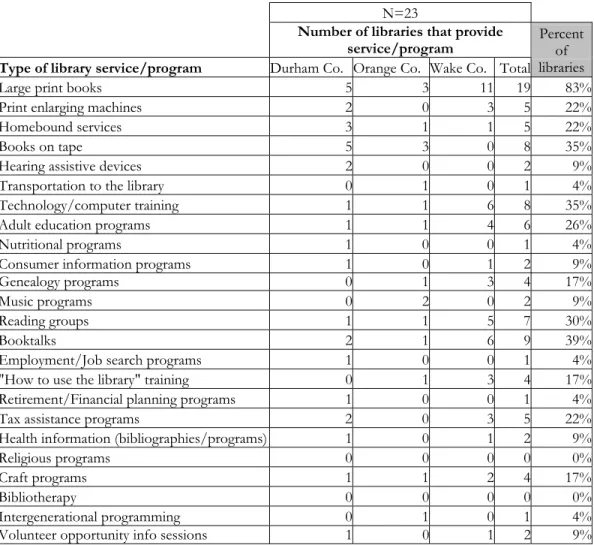
Out of the 28 surveys mailed, 23 were returned. There were seven Durham County respondents, three from Orange County, and thirteen from Wake County. The following tables represent their responses to the questionnaires.
Table 1: Triangle public library offerings of specific services and programming
N=23 Number of libraries that provide
service/program
Type of library service/program Durham Co. Orange Co. Wake Co. Total
Percent of libraries
Large print books 5 3 11 19 83%
Print enlarging machines 2 0 3 5 22%
Homebound services 3 1 1 5 22%
Books on tape 5 3 0 8 35%
Hearing assistive devices 2 0 0 2 9%
Transportation to the library 0 1 0 1 4%
Technology/computer training 1 1 6 8 35%
Adult education programs 1 1 4 6 26%
Nutritional programs 1 0 0 1 4%
Consumer information programs 1 0 1 2 9%
Genealogy programs 0 1 3 4 17%
Music programs 0 2 0 2 9%
Reading groups 1 1 5 7 30%
Booktalks 2 1 6 9 39%
Employment/Job search programs 1 0 0 1 4% "How to use the library" training 0 1 3 4 17% Retirement/Financial planning programs 1 0 0 1 4%
Tax assistance programs 2 0 3 5 22%
Health information (bibliographies/programs) 1 0 1 2 9%
Religious programs 0 0 0 0 0%
Craft programs 1 1 2 4 17%
Bibliotherapy 0 0 0 0 0%
Table 2: Library responses to specific questions about library services to older adults
N=23
Questions yes no No Response
Are library programs for this group regularly attended? 12 4 7
Is the demand high for services and programming for older adults? 5 15 3
Do older adults participate in planning for their own services and
programming? 5 13 5
Does the library collaborate with outside agencies? 13 7 3
Are staff members trained to provide special services and
programming for older adults? 3 20 0
Are older adults surveyed for their services/programming
preferences? 11 11 1
Is funding for materials/services for older adults incorporated into
library budget? 14 9 0
Does the library have a website? 15 8 0
If so, does the website contains information or links specifically for
older adults? 5 10 0
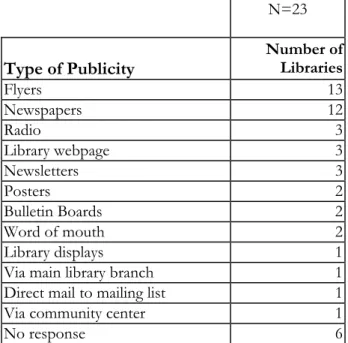
Table 3: Type of publicity used to notify public about older adult programming
N=23
Type of Publicity Number of Libraries
Flyers 13 Newspapers 12 Radio 3
Library webpage 3
Newsletters 3 Posters 2
Bulletin Boards 2
Word of mouth 2
Library displays 1
Via main library branch 1
Direct mail to mailing list 1
Via community center 1
Discussion and Conclusions
With respect to services and equipment that would be beneficial for older adults, the majority of libraries who responded, 83%, provide large print books for older adults. Other materials which would assist those with vision impairments, enlarging machines and books on tape, were not provided as frequently. Only eight libraries provide books on tape, and five provide enlarging machines. Hearing assistive devices are available at two of the 23 libraries who responded, homebound services are offered at five libraries, and one library provides transportation for the elderly. The one library offering transportation services mentioned that they do this with the assistance of the town transportation department, demonstrating a collaboration between community agencies. Overall, with the exception of large print books, there appears to be a deficit in this area of service to older adults.
County, it is not that surprising since they comprised the greatest number of respondents, 13 compared with three from Orange County and seven from Durham County.
The survey also asked respondents to indicate whether their library offered a number of other types of programs. Programming which would enable older adults to become more independent library users was not widely offered. Only four out of 23 libraries, 17%, claimed to offer “how to use the library” training. Though some libraries might offer these kinds of training sessions for all library users, independent of age, it would be beneficial to offer sessions specifically for older adults as their learning styles differ those who are younger, as was established in the literature review. Regarding programming which fosters lifelong learning, six of the 23 respondents, 26%, sponsor adult education programs. Programming which might be considered more informational in nature serves to cultivate a sense of empowerment and independence in older adults and allow them to make informed
decisions. Libraries were asked whether they provide this kind of programming, specifically about nutrition, consumer information, retirement and financial planning, and health. Only one library indicated that nutritional programs are offered for older adults, two libraries sponsor consumer information programs, one library organizes programming about retirement and financial planning, and two libraries prepare bibliographies or offer
suggests is popular with older adults, is offered at four of the libraries who responded. Religious programs and bibliotherapy were the only two programs listed on the survey that no libraries indicated as being offered. Perhaps that is due to the fact that both areas might be considered controversial, or at least very personal in nature.
Tax assistance programming is offered by five respondents. Both Durham and Wake counties indicated that they sponsor such programs, while Orange did not. It would seem important for at least one library in each county to service the older adult community in this way. Two libraries overall mentioned that they offer tax assistance by collaborating with the county tax assistance agency, the Volunteer Income Tax Assistance (VITA) program, and Tax Counseling for the Elderly (TCE).
Programming which serves to help older adults remain productive members of society is of value. Employment/job search programming and volunteer opportunity information sessions represent two ways to achieve this. Merely one library offers the former, and two libraries offer the latter. The literature has indicated that older adults are remaining in the work force longer, so programming which focuses on employment
The survey participants were asked to indicate other services and programming specifically for older adults that were not listed on the survey. These responses included Medicare information programs, a Civil War roundtable discussion group, and a quiz bowl.
these kinds of barriers could be overcome. When asked about this kind of collaboration, 13 libraries said they do cooperate with other agencies, while seven do not. Three respondents did not answer the question. Examples of these agencies include local nursing homes, city parks and recreation department, Friends of the Library, North Carolina Center for the Book, North Carolina State University, National Endowment for the Humanities, Wake County Genealogical Society, Wake County Historical Society, Raleigh Heritage Trail, senior centers and county departments such as housing and transportation. Overall, respondents from Wake county provided the greatest number of agency collaborations.
A more detailed look into monetary and staff resources indicates that the libraries who responded do receive some funds for services for older adults but lack human capital to sponsor them. The survey asked whether funding for materials and services specifically for older adults was incorporated into the library’s operating budget. Fourteen libraries indicated that this funding was available, while nine did not. Only three libraries have staff members trained to provide special services and programming for older adults, while 20 do not. One respondent who indicated that their library had a staff member of this nature stated that their primary responsibility involved outreach services to the institutionalized.
With respect to collection development practices with older adults in mind, 11 respondents indicated that their library did not consider this population during the
acquisition process. The purchase of large print books was the most frequent response and was noted by eight libraries. One library in particular stated that their library’s annual large print budget totals $30,000. Other libraries indicated that their collection development includes large print magazines, books on tape, and the development of a genealogy
the 1930’s through the 1950’s--all areas that they felt were of interest to older adult library users. Ultimately, many of the responses indicated that their collection development
practices for this population are primarily driven by demand. This seems to illustrate a need for wider and more frequent surveying of the population so that librarians can be more aware of the wants and needs of the public.
When asked whether they could estimate what percentage of their library users is comprised of older adults, few respondents were able to give a definitive answer. Eight libraries either did not answer the question or stated “I don’t know.” Many respondents gave a range. The responses ranged from 0% to 90%. Interestingly, one respondent who stated that older adults made up 90% of library users, also indicated that no special services or programs were offered to this population and that older adults were not surveyed for their preferences. Another respondent indicated that older adults comprised 5% of users, yet this library offers eight special programs for this population, including programming focusing on adult education, nutrition, consumer information, reading groups, booktalks,
employment/job search, crafts, and volunteer opportunity information sessions. Ultimately, the number of older adult users does not seem to be commensurate with provision of service.
Regarding the topic of publicity, a variety of responses were given to the question of how the library notifies the public about programming for older adults. The use of flyers and newspaper announcements were most common, 13 and 12 responses respectively. Radio, library webpage, and newsletters were each indicated three times. Two responses each were noted for posters, bulletin boards, and word of mouth. Library displays, publicity via the main branch, direct mail to mailing list, and publicity via the community center were
offer no special services or programming for older adults. Two who did not indicate any forms of publicity do offer special services to this population. Perhaps if publicity were more widespread, program attendance would be higher. It should be noted that 12 of the 23 libraries did claim that programming for older adults is regularly attended, but the number of those attending are not very impressive. The responses regarding average number of
attendees ranged from zero to 40. Sixty-five percent of these responses were numbers under fifteen. One library noted that computer instruction classes are limited to 6 participants, due to space constraints and the number of available computer terminals. Though lack of space is a problem, it may be beneficial to keep these kinds of programs small so that more one-on-one instruction is available.
Publicity via the library website was indicated by three libraries, as was mentioned before. It appears that many libraries that do have their own websites choose not to utilize it for publicity. Fifteen libraries have their own website, while eight do not. Of the 15 that do, only five claim to include information for older adults on the site. Older adults who do not own a computer or are not technologically proficient may find that relevant information is best obtained from outlets other than the internet, so the lack of information on the website is not as important. However, interest in computers among older adults is growing, and of the 23 respondents, 35% did indicate that computer training programming does take place at their library. Additionally, five respondents wrote comments at the end of the survey stating that older adults often come in to use the internet and check email. As more and more older adults become increasingly computer savvy it will be important for libraries to include information relevant to this population on the library website.
Triangle employ, specifically for older adult programming. Of the 23 respondents, five did not answer the question regarding evaluation measures, and nine stated that no evaluation was performed. Four respondents indicated that evaluation forms were distributed post program, two rely on verbal feedback, one stated that an assessment meeting is held after each program, one solicits feedback from the senior center director, and one conducts workshops periodically so that comments from attendees can be gathered. An increase in the frequency that feedback is solicited and a diversification of forms of evaluation would be valuable and should be pursued, as librarians could use the results to improve service to this population.
Appendix A:
MSLS Master’s Paper
Thank you for your participation in this study. Your responses will enable me to determine the current state of public library services and programming available for older adults in the triangle area. Please take 10-15 minutes to complete the survey and return it to me in the enclosed self-addressed stamped envelope by
March 21, 2003
. Please indicate which kinds of services and programming your library actively offers specifically for the population of older adults:
Services/Equipment
___Large print books ___Books on tape
___Enlarging machines ___Hearing assistive devices
___Homebound services ___Transportation for the elderly to the library Programming
___Technology/Computer training ___ “How to use the library” training ___Adult education programs ___Retirement/Financial planning programs ___Nutritional programs ___Tax assistance programs
___Consumer information programs ___Health information (bibliographies/programs) ___Genealogy programs ___Religious programs
___Music programs ___Craft programs
___Reading groups ___Bibliotherapy for older adults ___Booktalks ___Intergenerational programming
___Employment/Job Search programs ___Volunteer opportunity information sessions ___Others? Please list:
Are library programs for this audience regularly attended? ___Yes ___No
Is the demand high for services and programming specifically for older adults? ___Yes ___No
Do older adults participate in planning for their own services and programming? ___Yes ___No
How does the library notify the public about programming for older adults?
What forms of evaluation does the library conduct for these programs
Do you collaborate with outside agencies in order to provide services and programming for older adults? If yes, who?
___Yes ___No
Are any staff members in your library trained to provide special services and programming for older adults (i.e. Senior Specialist)?
___Yes ___No
Do you survey older adult library users for their preferences in services/programming?
___Yes ___No
Is funding for materials and services specifically for older adults incorporated into the library’s operating budget?
___Yes ___No
Can you estimate what percentage of your library users is comprised of older adults?
Does your library have its own website? If so, does it include any information or links specifically for older adults?
References
Administration on Aging (2001). Summary table of age characteristics of the older
population for the United States and for States: 2000. Retrieved April 20, 2003, from http://www.aoa.gov/Census2000/stateprofiles/ageprofile-states.html
Administration on Aging (2003a). A profile of older Americans: 2002. Retrieved March 23, 2003, from http://www.aoa.gov/aoa/stats/statpage.html
Administration on Aging (2003b). Older Americans Act. Retrieved April 14, 2003, from http://www.aoa.gov/about/legbudg/oaa/
Bryan, C. (2000). Help seniors respond to your printed message. Library Imagination Paper, 22(3), 1.
Casey, G. M. (1984). Library services for the aging. Hamden, CT: Library Professional Publications, 1984.
Dee, M., & Bowen, J. (1986). Library services to older people. London: The British Library. Fasulo, L. (2001). Conquering technophobia…A new lease on life. Florida Libraries, 44(2),
16-17.
Gilbert, C. M. (2001). Helping seniors capture the power of the internet. Medical Reference Services Quarterly, 20(2), 71-77.
Griebel, R. (1998). When I’m 64: Libraries and the age wave. Feliciter, 44(2), 14-19.
Hales-Mabry, C. (1993). The world of the aging: Information needs and choices. Chicago: American Library Association.
Kleiman, A. (1995). The aging agenda: Redefining library services for a graying population.
Library Journal, 120, 32-34.
Lambert, T. (1999).Vision 2010: Toward a comprehensive aging information resource system for the next century. Information and Referral, 21, 105-119.
Moore, B. B. & Fisk, C. F. (1988). Improving library services to the aging. Library Journal,
113(7), 46-47.
Opalinski, L. (2001). Older adults and the digital divide: Assessing results of a web-based survey. Journal of Technology in Human Services, 18, 203-221.
Reference and User Services Association (1997). Adult programming: A manual for libraries. Chicago: American Library Association.
Reference and User Services Association/Library Service to Aging Population Committee (1999). Library services to older adults guidelines. Reference and User Services Quarterly, 39(1), 25-27.
Ring, A. M. (1998). Intergenerational library programs in nursing homes. Illinois Librarian, 80(1), 15-17.
Saunders, K. (1992). Expanding outreach services to seniors. American Libraries, 23, pp. 176, 178, 180.
Snyder, W. (1993). Do special populations require special services? North Carolina Libraries, 51, 129-131.
Tevis, J. A. & Crawley, B. (1988). Reading out to older adults. Library Journal, 113, 37-40. Thompson, D. G. (1988). Serving older adults in North Carolina public libraries: A survey.
Toward the 1995 White House Conference on Aging : priorities and policies for library and information
services for older adults : proceedings of a National Pre-White House Conference on
Aging. (1995). Washington, DC : U.S. National Commission on Libraries and Information Science.
Turock, B. J. (1982). Serving the older adult: A guide to library programs and information sources. New York: Bowker.
Turock, B. J. (1987). Public library service for older adults: Update 1984. Library Quarterly, 57(2), 137-170.
Turock, B. J. (1988a). Foreword. In B. J. Turock (Ed.) Information and aging (pp. 1-3). Jefferson, NC: McFarland & Company.
Turock, B. J. (1988b). Public library services for older adults: Update. In B. J. Turock (Ed.)
Information and aging (pp. 7-16).
Union, B. (1996). Reading to seniors. Youth Services in Libraries, 9(4), 381-384.
Van Fleet, C. (1989). Public library service to older adults: Survey findings and implications.
Public Libraries, 28, 107-113.
Van Fleet, C. (1995). A matter of focus: Reference services for older adults. The Reference Librarian, 49/50, 147-164.
Van Fleet, C. and Antell, K. E. (2002). Creating cyberseniors: Older adult learning and its implications for computer training. Public Libraries, 41(3), 149-155.
Walling, L. L. (2001). Library services to the sandwich generation and serial caregivers.
Chicago: Association of Specialized and Cooperative Library Agencies.
Zabel, D. (1999). Look who’s fifty: Building a collection for your aging baby boomers.