R E S E A R C H
Open Access
Comparison of an interactive with a didactic
educational intervention for improving the
evidence-based practice knowledge of
occupational therapists in the public health sector
in South Africa: a randomised controlled trial
Helen Buchanan
1*, Nandi Siegfried
2,3,4, Jennifer Jelsma
1and Carl Lombard
5Abstract
Background:Despite efforts to identify effective interventions to implement evidence-based practice (EBP), uncertainty remains. Few existing studies involve occupational therapists or resource-constrained contexts. This study aimed to determine whether an interactive educational intervention (IE) was more effective than a didactic educational intervention (DE) in improving EBP knowledge, attitudes and behaviour at 12 weeks.
Methods:A matched pairs design, randomised controlled trial was conducted in the Western Cape of South Africa. Occupational therapists employed by the Department of Health were randomised using matched-pair stratification by type (clinician or manager) and knowledge score. Allocation to an IE or a DE was by coin-tossing. A self-report questionnaire (measuring objective knowledge and subjective attitudes) and audit checklist (measuring objective behaviour) were completed at baseline and 12 weeks. The primary outcome was EBP knowledge at 12 weeks while secondary outcomes were attitudes and behaviour at 12 weeks. Data collection occurred at participants’places of employment. Audit raters were blinded, but participants and the provider could not be blinded.
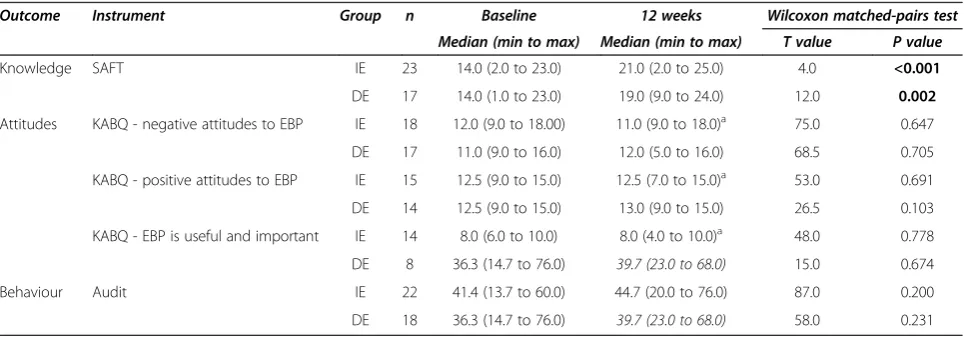
Results:Twenty-one of 28 pairs reported outcomes, but due to incomplete data for two participants, 19 pairs were included in the analysis. There was a median increase of 1.0 points (95% CI = -4.0, 1.0) in the IE for the primary outcome (knowledge) compared with the DE, but this difference was not significant (P= 0.098). There were no significant differences on any of the attitude subscale scores. The median 12-week audit score was 8.6 points higher in the IE (95% CI = -7.7, 27.0) but this was not significant (P= 0.196). Within-group analyses showed significant increases in knowledge in both groups (IE: T = 4.0,P<0.001; DE: T = 12.0,P= 0.002) but no significant differences in attitudes or behaviour.
Conclusions:The results suggest that the interventions had similar outcomes at 12 weeks and that the interactive component had little additional effect.
Trial registration:Pan African Controlled Trials Register PACTR201201000346141, registered 31 January 2012. Clinical Trials NCT01512823, registered 1 February 2012. South African National Clinical Trial Register
DOH2710093067, registered 27 October 2009. The first participants were randomly assigned on 16 July 2008.
Keywords:Pragmatic trial, Randomised controlled trial, Educational intervention, Occupational therapy, Evidence-based practice, South Africa
* Correspondence:[email protected]
1Department of Health & Rehabilitation Sciences, F45 Old Groote Schuur Hospital Building, University of Cape Town, Observatory, 7925 Cape Town, South Africa
Full list of author information is available at the end of the article
Background
Evidence-based practice (EBP) is widely advocated as a means of providing effective healthcare interventions, but implementation has proved challenging. A systematic review of occupational therapists’ knowledge, skills, atti-tudes and behaviour regarding EBP concluded that despite positive intentions and active efforts directed at imple-mentation, occupational therapists in upper-income coun-tries had, at best, moderate EBP knowledge and skills, and application was low [1]. The lack of EBP implementation has been attributed to several practical and conceptual challenges [2]. Barriers such as limited time and skills [3-7] have been widely identified as threats to implemen-tation. If this is the situation in countries where resources are more readily available, it is likely to be worse in devel-oping, or resource-constrained, countries.
A 2004 South African survey of registered occupational therapists (n = 436) similarly found that most respondents had positive perceptions but lacked confidence in EBP skills [1], which 31% attributed to limited knowledge and skills. This finding was affirmed by the low number reporting success finding (46%) and applying evidence (36%). In addition, 25% had received EBP training, sug-gesting the need for additional training opportunities. Preferences for training were workshops (81.5%) and short in-service training sessions (79.8%) [1].
Educational interventions to increase the implementation of evidence-based practice
In a cluster randomised trial to determine change in attitudes to EBP in musculoskeletal physiotherapists working in a community trust in the United Kingdom, an interactive evidence-based educational programme (n = 17) was compared with a standard in-service package (n = 13), both of which lasted five hours. Results indicated that confidence in search and appraisal skills increased significantly six months after an EBP educational inter-vention compared with a standard in-service training programme [8]. As EBP skills were not measured, how-ever, it is unknown whether these attitudinal changes were accompanied by an improvement in skills. Interven-tions that successfully target attitudes and skills may simultaneously address barriers such as limited time. For example, acquiring search skills to locate pre-ap-praised sources of evidence may be time-saving. Thus, educational interventions may be one way to increase confidence and skills and thereby improve readiness to implement EBP.
Cochrane Systematic Reviews of educational interven-tions (as defined by Forsetlundet al.[9]) to improve pro-fessional practice were examined. Although relating to professional practice, these reviews were deemed relevant because competence relies on knowledge as well as other characteristics, such as attitudes and behaviour. The main
findings of these systematic reviews are outlined below for each educational intervention.
There was unclear or weak evidence for the effects of tailored interventions that addressed barriers to change [10], teaching critical appraisal skills [11] and printed educational materials compared to other interventions [12]. Educational outreach visits (EOVs) [13] and audit and feedback [14] resulted in small to moderate behav-iour changes with those that included EOVs being slightly more effective than audit and feedback alone [13]. EOVs were, however, mainly used to change pre-scribing behaviour [13]. Multifaceted interventions that included EOVs were slightly more effective than EOVs alone, but the differences were not significant and the reviewers were unable to discount the possibility that the multifaceted interventions may have cont-ributed to the larger differences in non-prescribing behaviour [13].
The review on continuing education sessions reported
‘small to moderate improvements in professional prac-tice,’ but stated that conclusions could not be drawn about their effectiveness compared to other interventions due to the small number of studies involved [9, p14]. Although didactic interventions could change practice, those with an interactive component appeared to be more effective but unlikely to change highly complex behaviours [9]. The effects of educational meetings did not differ significantly from multifaceted interventions and were considered likely to have similar effects to EOVs and audit and feedback [9]. A limitation of the review was the in-complete descriptions of the interventions in the included studies [9], a lack of studies that included occupa-tional therapists, and the predominance of studies based in North America and Europe. The authors advo-cated further research that compared different types of education [13].
Methods
Trial design
This pragmatic randomised controlled trial (RCT) (here-after referred to as the Occupational Therapy Evidence-Based Practice (OTEBP) trial) employed a matched pair design. This design controls for potential confounders by grouping participants into pairs based on a blocking variable (in this case, knowledge about EBP) and ran-domly assigning each participant in the pair to one of two interventions [15].
Setting
The study was conducted in public health facilities in four district municipalities (Cape Winelands, City of Cape Town, Overberg and West Coast) in the Western Cape. Participants serviced tertiary (n = 3), tuberculosis (n = 1), psychiatric (n = 4) and district/provincially aided hospitals (n = 10), specialised health care facilities (n = 1) and clinics (n = 54).
Participants
The participants were occupational therapists employed in four district municipalities by the Western Cape De-partment of Health (DOH) (n = 98). Therapists working at least 20 hours per week were eligible. Managers were included because of their role in putting structures and systems in place to support EBP activities [16] and enab-ling its successful implementation [17]. For pragmatic reasons, therapists working more than 1½ hours driving time outside Cape Town were excluded. Those leaving the DOH before December 2008 or who knew in advance that they would be on leave, and therefore unable to attend the intervention, were also excluded because it would compromise the outcome data. Recruitment oc-curred over a nine-month period (November 2007 to July 2008). Continuing professional development points were obtained from the official licensing body, and offered as an incentive to participate. Written informed consent was obtained from each participant.
As the primary outcome instrument (refer to section on outcomes) was modified for the OTEBP trial, there were no data to accurately calculate the required sample size. Therefore, the maximum possible number of par-ticipants was recruited so the most precise confidence intervals could be calculated.
Randomisation
Participants were randomised after completing the base-line questionnaires but before the basebase-line audit. Base-line Shortened Adapted Fresno Test of Competence in Evidence-based Practice (SAFT) scores were sorted from highest to lowest per stratum, and pairs were matched on same scores first. Where more than two participants had the same score, pairs were matched by facility. For
example, if four participants had the same score, those at the same facility were matched so that similar practice profiles were obtained in each group. Where participants were from different facilities, matching was done accord-ing to the similarity of the facility. Once all those with same scores were matched, remaining participants were matched by next closest score. Managers were paired according to closest scores. Participants were matched by role (clinician or manager) and baseline knowledge score and individuals in each pair were randomly assigned to receive the IE or DE by coin-tossing. The principal investigator (HB) and research coordinator conducted the coin-tossing procedure together to reduce bias.
Outcomes
Data were collected at baseline and 12 weeks. The pri-mary outcome, EBP knowledge score at 12 weeks, was measured with the Shortened Adapted Fresno Test of Competence in EBP (SAFT). The SAFT was modified for the study from the Adapted Fresno Test of Competence in EBP (AFT) [18] to reduce respondent burden given its length and item difficulty. It contains three items that test different aspects of EBP knowledge objectively. Responses are graded with a rubric and the total possible score is 30 points. The intra-class correlation coefficient (ICC) was calculated based on data from a pilot study involving 26 participants. Using a two-way random effects model for absolute agreement for single measures (ICC type A,1) [19], the SAFT demonstrated excellent inter-rater relia-bility (IRR) (ICC = 0.99, 95% CI: 0.97, 1.0) and test-retest reliability (ICC = 0.95, 95% CI: 0.88, 0.98) [1]. The SAFT and grading rubric are available from the first author on request.
Secondary outcomes were EBP attitudes and behaviour at 12 weeks measured by self-report using a modified Knowledge, attitude and behaviour questionnaire (KABQ) [20,21], and an audit checklist developed for the study as an objective measure of behaviour. Modifications to the KABQ were required because it was developed for med-ical students and thus some of the items and terminology were not relevant for the OTEBP trial participants. Modi-fications included removing items that were not relevant, changing the terminology to relate to occupational ther-apy and modifying the rating scales. The six-point rating scale was changed to five-points due to the difficulty differentiating between ‘moderately agree/disagree’ and
CI = 0.02, 0.7) [1]. Cronbach’s alpha for each item varied from 0.75 to 0.82.
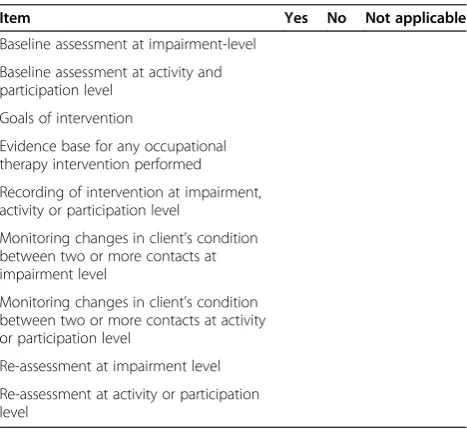
The audit checklist was developed for the trial to measure the extent to which participants were evaluating the effects of their patient interventions through their daily documentation. The checklist underwent a process of development and was reviewed by an expert panel to evaluate face and content validity and clinical utility. The checklist was based on three existing instruments [9,22,23] and used the International Classification of Functioning, Disability and Health (ICF) checklist [24] as a framework. The final checklist consisted of nine items rated on a dichotomous scale (see Table 1).
Pilot testing of the checklist with 10 records of therapists who did not participate in the trial showed that inter-rater reliability (IRR) was at least moderate for each item (kappa ≥0.60). The checklist score was calculated by adding the total number of ‘yes’responses. The maximum possible score was nine. Where an item was ‘not applicable’, it was subtracted from nine to deter-mine the total score. Audit scores for each record were converted into percentages and mean scores were calcu-lated for each participant.
Implementation
Data collection
Questionnaires were delivered to participants with a request for their completion within a stipulated time frame. Baseline questionnaires were completed before randomisation. The SAFT (primary outcome) was scored independently by the PI (HB) and a research assistant who was blind to allocation. The grading rubric was used to reduce variation in scoring between raters. Questionnaires were numbered to ensure anonymity. To
match 12-week questionnaires and track those that were missing, the PI kept a list of participant names and study numbers. The list was not referred to when grading the SAFT.
For the audit, participants supplied their patient lists for a specific week. Five patients per participant were ran-domly selected at each data collection point. If five or fewer patients were seen, all listed records were audited. Managers were excluded as they did not carry a patient load. Participants in one municipality (n = 8) who serviced several community health facilities over a large geograph-ical area, faxed their records to a central point. Identifying details were removed to maintain confidentiality.
Audits were conducted by one of two trained research assistants blinded to allocation. The PI attended all audits to ensure the scoring criteria were followed. Scor-ing discrepancies were discussed and consensus reached. Raters remained consistent for each participant where possible.
Interventions
Educational interventions were conducted in August and September 2008. Each type of training was repeated to obtain maximal attendance. To reduce variation between sessions, a consistent observer completed a standard checklist to document the extent to which the provider adhered to the plan for each session. Blinding of pants and the provider was not possible. Although partici-pants were aware of the two interventions, no information was given of their content. The PI was the sole trainer and presented both interventions apart from the IE appraisal session, which was facilitated by an experienced EBP teacher from another department. As the PI was the pro-vider for both interventions, blinding was not possible.
On arrival, participants received a folder of EBP training materials and an ‘evidence package’ containing a mini-mum of three articles providing evidence for interventions in at least one of their practice areas. The ‘packages’ included evidence-based guidelines, critically appraised papers, systematic reviews or pre-appraised literature con-sidered to be‘best practice’. Articles were selected accord-ing to the hierarchy of evidence with pre-appraised sources being used wherever possible.
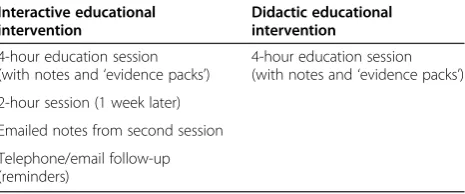
[image:4.595.57.291.519.736.2]The content of the DE and first IE session was similar and consisted of a Microsoft PowerPoint presentation explaining the different steps of EBP. The difference lay in the inclusion of small group discussions and hands-on practical exercises to practice specific skills in the IE. Because the DE did not contain a practical search ses-sion, additional slides were included in the presentation to demonstrate specific features for searching specialised and traditional databases. Table 2 provides an outline of the interventions. Details of the content of each inter-vention are available in Additional file 1.
Table 1 Audit checklist
Item Yes No Not applicable
Baseline assessment at impairment-level
Baseline assessment at activity and participation level
Goals of intervention
Evidence base for any occupational therapy intervention performed
Recording of intervention at impairment, activity or participation level
Monitoring changes in client’s condition between two or more contacts at impairment level
Monitoring changes in client’s condition between two or more contacts at activity or participation level
Re-assessment at impairment level
Didactic educational intervention
The format for this single four-hour intervention was based on the categorisation outlined in a systematic review [9] and consisted of presentations about EBP and its application. Printed educational materials were in-cluded as part of the educational intervention [9]. The focus was on knowledge acquisition rather than skills development or application of concepts. Questions were permitted, but there was no opportunity to practise skills or apply information.
Interactive educational intervention
The IE was multifaceted, consisting of education ses-sions, emailed notes and telephone or email reminders [9]. Education sessions were modelled on the intervention provided by McCluskey and Lovarini [25] and included presentations; small group interactive tasks and skills practice, such as developing a research question using the Participant, Intervention, Comparison, Outcome (PICO) format; and online database searching [9]. Two sessions were provided (four and two hours respectively) with approximately six days between them. Session 1 focused on the steps of EBP with practical exercises to develop skills. Session 2 was split into two halves. In the first half, participants wrote down questions and requests for add-itional input, which were dealt with by the PI. The second half involved small group discussions on evidence-based patient notes, barriers and facilitators to EBP, strategies to address barriers, and actions to strengthen knowledge and use of EBP. Feedback from each small group was recorded and emailed to participants two weeks later. After a further two weeks, participants were telephoned by the research coordinator to check that they had received the emailed notes, establish how they were managing to apply EBP, and gauge their need for additional assistance or information. Participants who could not be reached were emailed.
Data analysis
Data were analysed using STATISTICA 8 [26]. An intention-to-treat analysis was not possible because out-come data was incomplete for some participants. Matched pairs with complete outcome data were included in the analysis regardless of whether they had received the
intervention or not. For baseline descriptive characteris-tics, medians and ranges were calculated for numerical variables, and frequencies and proportions for categorical items. Baseline scores for primary and secondary out-comes were determined and median scores and ranges computed.
For the analysis of 12-week outcomes, differences in scores for each matched pair were determined and median scores and ranges calculated. As data for all outcomes were negatively skewed, the Wilcoxon matched-pairs test was used to establish whether median differences in matched pair scores differed significantly from zero. As there were no significant differences between the groups at 12 weeks, the Wilcoxon matched-pairs test was con-ducted to determine whether any significant within-group changes had occurred. Two-sided significance tests were used throughout. A P value of ≤0.05 was considered significant.
Ethical approval
Ethical approval was received from the Health Sciences Faculty Human Research Ethics Committee, University of Cape Town (REC REF: 259/2006) and the Western Cape Provincial Department of Health (Ref. 19/18/RP37/2008). Confidentiality was protected by using numbers rather than names on audit checklists and questionnaires.
Results
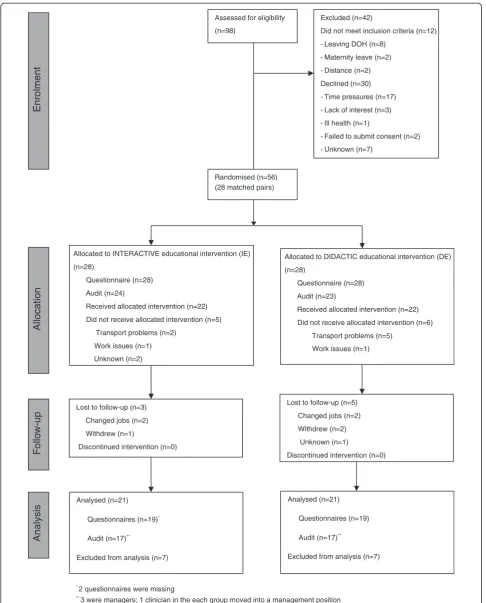
The CONSORT flow diagram for the trial is shown in Figure 1. Of the 86 eligible participants, 56 (65.1%) were enrolled to the trial (28 matched pairs). Twelve eligible participants did not meet the inclusion criteria and 30 declined to participate (refer to Figure 1 for reasons for declining). Twenty participants in the IE attended both educational sessions, one attended session one only, and two attended only the second session. In the DE, 22 attended the intervention. Five participants in the IE and six in the DE did not attend the intervention. Group sizes varied from three to 18, according to participants’ availability (refer to Table 3 for details). At 12 weeks, three participants were lost to follow-up in the IE and five in the DE, resulting in 21 matched pairs being included in the final analysis.
Participant characteristics
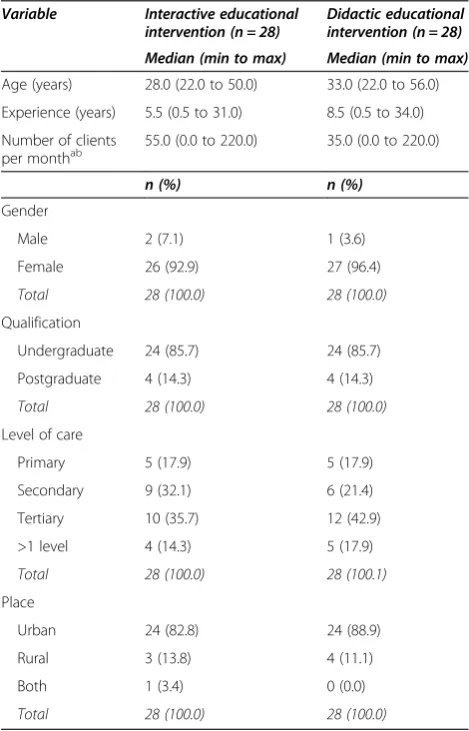
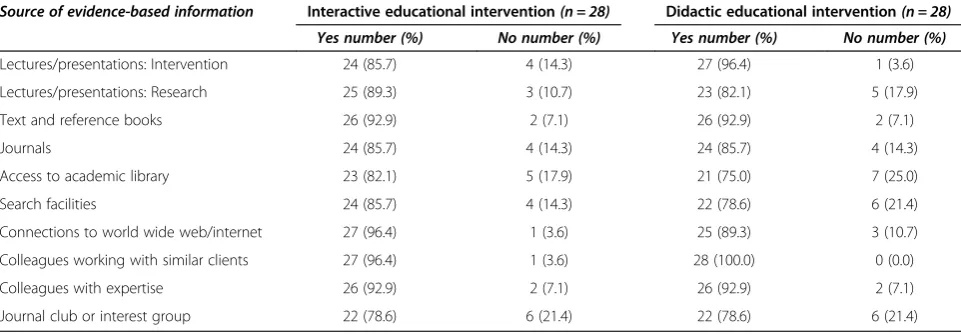
Demographic and practice variables (Table 4) were similar for each group apart from age, experience and number of clients per month. Participants were evenly distributed across facilities (Table 5) and most could access all sources of evidence at work or at home (Table 6).
Baseline and 12-week scores
[image:5.595.58.291.101.198.2]Baseline and 12-week scores for primary and secondary outcomes and the median differences in matched pair
Table 2 Content of the educational interventions
Interactive educational intervention
Didactic educational intervention
4-hour education session (with notes and‘evidence packs’)
4-hour education session (with notes and‘evidence packs’)
2-hour session (1 week later)
Emailed notes from second session
Randomised (n=56) (28 matched pairs) Assessed for eligibility
(n=98)
Excluded (n=42)
Did not meet inclusion criteria (n=12)
- Leaving DOH (n=8)
- Maternity leave (n=2)
- Distance (n=2)
Declined (n=30)
- Time pressures (n=17)
- Lack of interest (n=3)
- Ill health (n=1)
- Failed to submit consent (n=2)
- Unknown (n=7)
Enrolment
Allocated to DIDACTIC educational intervention (DE)
(n=28)
Questionnaire (n=28)
Audit (n=23)
Received allocated intervention (n=22)
Did not receive allocated intervention (n=6)
Transport problems (n=5)
Work issues (n=1)
Analysis
Follow-up
Analysed (n=21)
Questionnaires (n=19)*
Audit (n=17)**
Excluded from analysis (n=7) Lost to follow-up (n=3)
Changed jobs (n=2)
Withdrew (n=1)
Discontinued intervention (n=0)
Analysed (n=21)
Questionnaires (n=19)
Audit (n=17)**
Excluded from analysis (n=7) Lost to follow-up (n=5)
Changed jobs (n=2)
Withdrew (n=2)
Unknown (n=1)
Discontinued intervention (n=0)
Allocation
Allocated to INTERACTIVE educational intervention (IE)
(n=28)
Questionnaire (n=28)
Audit (n=24)
Received allocated intervention (n=22)
Did not receive allocated intervention (n=5)
Transport problems (n=2)
Work issues (n=1)
Unknown (n=2)
* 2 questionnaires were missing **
[image:6.595.56.543.87.691.2]3 were managers; 1 clinician in the each group moved into a management position
scores at 12 weeks are shown in Table 7. Scores were similar across groups at baseline. At baseline, 258 cords were audited at 15 facilities with a mean of five re-cords for most participants (46/49, 93.9%). Two participants had three records audited and one had four - either because they had not seen five different patients
in the selected week or the record was unavailable as it was either in the doctor’s office or being used by another member of the multidisciplinary team at the time. While changes to records could have been made prior to the audit, there was no evidence of this. Audit scores were generally low.
Of the 42 participants (21 matched pairs) who com-pleted the trial, 19 matched pairs comcom-pleted the ques-tionnaire and 17 completed the audit. The median time between completion was 13.0 weeks (min to max = 10.0 to 22.0 weeks) for the IE and 14.0 weeks (min to max = 12.0 to 17.0 weeks) for the DE. Responsiveness, calcu-lated using baseline and 12-week data from OTEBP trial completers, was large (d= 0.92) for the SAFT and small (d= 0.3) for the audit checklist [1]. Of the 35 participants whose records were audited at 12 weeks (one clinician moved into a management position during the study), 23 (65.7%) had the same rater for both data collection points. Analysis of matched-pair scores revealed no signifi-cant differences for primary or secondary outcomes (see Table 7). Withgroup analyses showed significant in-creases in knowledge in both groups (see Table 8), but there were no differences in the remaining outcomes.
Discussion
Despite an increase in median SAFT and audit scores in both groups at 12 weeks, the lack of significance in between-group differences suggests that the interven-tions had similar effects. A possible explanation for not finding a significant difference in the IE may be the high number in this group who did not attend the full inter-vention (20 of 28 participants attended both sessions). This may have lessened the impact on knowledge and behaviour resulting in participants achieving lower me-dian change scores than expected. The greater, albeit not significant, improvement in knowledge and behaviour in the IE supports Forsetlund et al’s [9] systematic review conclusion that educational interventions tend to be more effective when an interactive component is in-cluded. However, the OTEBP trial suggests that where baseline knowledge is low, any mode of education may make a difference. The point difference of 1.0 for know-ledge is possibly indicative of a real difference that was not detected, but uncertainty remains given the lack of precision indicated by the confidence interval, which includes both benefit and appreciable harm.
[image:7.595.56.291.101.244.2]The lack of significant changes in attitudes in either group at 12 weeks may indicate that neither intervention influenced attitudes or it may reflect the poor reliability of the attitude sub-scales in the KABQ. According to Smith et al. [27], changing behaviour at the individual level requires the person to identify the need for change as well as the motivation to move from the stage of con-templation to action. They concluded that not everyone
Table 3 Participant attendance at interventions
Interactive educational intervention (n = 28)
Didactic educational intervention (n = 28)
Session no. Group no. No. (%) Group no. No. (%)
1 1 18 (64.3) 1 14 (50.0)
2 3 (10.7)
Total 21 (75.0)
2 1 13 (46.4) 2 8 (28.6)
2 9 (32.1)
Total 22 (78.6)
Total attending full intervention
[image:7.595.56.291.351.717.2]20 (71.4) Total 22 (78.6)
Table 4 Baseline characteristics of participants (n = 56)
Variable Interactive educational
intervention (n = 28)
Didactic educational intervention (n = 28)
Median (min to max) Median (min to max)
Age (years) 28.0 (22.0 to 50.0) 33.0 (22.0 to 56.0)
Experience (years) 5.5 (0.5 to 31.0) 8.5 (0.5 to 34.0)
Number of clients per monthab
55.0 (0.0 to 220.0) 35.0 (0.0 to 220.0)
n (%) n (%)
Gender
Male 2 (7.1) 1 (3.6)
Female 26 (92.9) 27 (96.4)
Total 28 (100.0) 28 (100.0)
Qualification
Undergraduate 24 (85.7) 24 (85.7)
Postgraduate 4 (14.3) 4 (14.3)
Total 28 (100.0) 28 (100.0)
Level of care
Primary 5 (17.9) 5 (17.9)
Secondary 9 (32.1) 6 (21.4)
Tertiary 10 (35.7) 12 (42.9)
>1 level 4 (14.3) 5 (17.9)
Total 28 (100.0) 28 (100.1)
Place
Urban 24 (82.8) 24 (88.9)
Rural 3 (13.8) 4 (11.1)
Both 1 (3.4) 0 (0.0)
Total 28 (100.0) 28 (100.0)
a
Participant’s estimated the average number of clients seen per month.
b
involved in a programme aimed at changing practice will actually implement the necessary changes [27]. The fact that both interventions were relatively short in duration resulted in an emphasis on knowledge and skills rather than focussing on strategies targeted at positive attitu-dinal change.
The low median audit scores at baseline and 12-weeks showed that participants were not documenting infor-mation related to patient interventions sufficiently to be able to evaluate the effects of their interventions. Incom-plete documentation was similarly identified in an audit of occupational therapy stroke records at an academic hospital in South Africa [28]. It was disappointing that there were no significant improvements in audit scores at 12 weeks particularly considering that the second IE session contained a discussion on evidence-based record-keeping. Studies involving occupational therapists [25] and public health physicians [29] similarly found little difference in EBP behaviour after an educational interven-tion. The researchers concluded that while no behaviour change was seen, changes in knowledge and attitudes
may, in fact, precede changes in behaviour [29], and that changes are needed at both individual and organisational levels for EBP to be implemented successfully [25]. By contrast, a multifaceted evidence-based medicine (EBM) intervention with 47 doctors in a department of medicine in the UK, was effective in improving practice [30]. Inter-estingly, none of the doctors involved in the study had prior EBM training, and yet after seven hours of training, significantly more of their patients received interventions shown to be beneficial in RCTs [30].
Generalisability
[image:8.595.58.539.104.263.2]The findings of this trial are specific to occupational therapists working in the public health sector in the Western Cape and other urban areas in South Africa. The extent to which the findings are applicable to occu-pational therapists working in other sectors, such as private practice, or other government departments, such as the Department of Education, is uncertain. The fact that participants were self-selected due to the ethical requirement of informed consent may have positively
Table 5 Description of facilities and participant roles (n = 56)
Type of facility Interactive educational intervention(n = 28) Didactic educational intervention(n = 28)
No. of facilities
Clinicians no. (%)
Managers no. (%)
Total no. (%)
No. of facilities
Clinicians no. (%)
Managers no. (%)
Total no. (%)
Tertiary hospital 3 10 (35.7) 0 (0.0) 10 (35.7) 3 12 (42.9) 1 (3.6) 13 (46.4)
District/provincially aided hospital
3 3 (10.7) 0 (0.0) 3 (10.7) 2 2 (7.1) 0 (0.0) 2 (7.1)
Tuberculosis hospital
1 2 (7.1) 0 (0.0) 2 (7.1) 1 1 (3.6) 0 (0.0) 1 (3.6)
Psychiatric hospital 3 2 (7.1) 2 (7.1) 4 (14.3) 3 2 (7.1) 2 (7.1)a 4 (14.3)
Clinics 26 4 (14.3) 0 (0.0) 4 (14.3) 32 4 (14.3) 1 (3.6)b 5 (17.9)
Specialised health care facilities
1 3 (10.7) 2 (7.1) 5 (17.9) 4 3 (10.7) 0 (0.0) 3 (10.7)
Total 37 24 (85.6) 4 (14.3) 28 (100.0) 45 24 (85.7) 4 (14.3) 28 (100.0)
a
One clinician who was moving into a management position at another DOH facility was allocated as a manager. b
One clinician was appointed as a manager during the study.
Table 6 Access to information sources (n = 56)
Source of evidence-based information Interactive educational intervention(n = 28) Didactic educational intervention(n = 28)
Yes number (%) No number (%) Yes number (%) No number (%)
Lectures/presentations: Intervention 24 (85.7) 4 (14.3) 27 (96.4) 1 (3.6)
Lectures/presentations: Research 25 (89.3) 3 (10.7) 23 (82.1) 5 (17.9)
Text and reference books 26 (92.9) 2 (7.1) 26 (92.9) 2 (7.1)
Journals 24 (85.7) 4 (14.3) 24 (85.7) 4 (14.3)
Access to academic library 23 (82.1) 5 (17.9) 21 (75.0) 7 (25.0)
Search facilities 24 (85.7) 4 (14.3) 22 (78.6) 6 (21.4)
Connections to world wide web/internet 27 (96.4) 1 (3.6) 25 (89.3) 3 (10.7)
Colleagues working with similar clients 27 (96.4) 1 (3.6) 28 (100.0) 0 (0.0)
Colleagues with expertise 26 (92.9) 2 (7.1) 26 (92.9) 2 (7.1)
[image:8.595.57.538.567.734.2]biased the effects of the intervention as participants may have been more motivated to learn about and apply EBP than those who declined. Findings may therefore not be generalisable to all occupational therapists but rather to those interested in learning more about EBP.
Strengths and limitations
Controlling for possible allocation bias by balancing knowledge levels across groups was a strength of the study. While coin-tossing was a quick, feasible method of randomisation at the time, it is not a satisfactory method due to the possibility of manipulating the out-come according to the technique used and thereby introducing bias [31]. In response to the criticism that previous educational evaluation studies relied on self-reports that can overestimate effects [32], the OTEBP
trial included objective measures of knowledge and be-haviour, thereby strengthening the validity of the results. Furthermore, the study sought to address the failure of researchers to provide detailed descriptions of interven-tions [9].
[image:9.595.67.540.101.283.2]The study would have been strengthened had a blinded assessor, rather than the PI, scored the SAFT as this may have raised questions about bias. The low test-retest reliability of the KABQ attitude subscales and audit checklist may have contributed to the lack of sig-nificant findings. As there were no other instruments available for measuring EBP attitudes or behaviour at the time, and considering they measured secondary out-comes, a decision was made to continue with the instru-ments despite this limitation. The findings related to the secondary outcomes should, therefore, be treated with
Table 7 Baseline and 12-week scores with median differences in 12-week matched pair scores
Domain Item (possible score) Interactive educational
intervention (IE)
Didactic educational intervention (DE)
Median difference in matched pairsa(95% CI)
P value for Wilcoxon matched-pairs
test
Baseline 12 weeks Baseline 12 weeks
Median (min to max)
Median (min to max)
Median (min to max)
Median (min to max)
(n = 28) (n = 19) (n = 28) (n = 19) n = 19
Knowledge SAFT score (30) 14.0 (2.0 to 23.0) 21.0 (2.0 to 25.0) 14.0 (1.0 to 23.0) 19.0 (9.0 to 24.0) 1.0 (−4.0, 1.0) 0.098
Attitudes Negative attitudes to EBP (25)
12.0 (9.0 to 18.00) 11.0 (9.0 to 18.0)b 11.0 (9.0 to 16.0) 12.0 (5.0 to 16.0) 0.0 (−2.0, 4.0) 0.728
Positive attitudes to EBP (15)
12.5 (9.0 to 15.0) 12.5 (7.0 to 15.0)b 12.5 (9.0 to 15.0) 13.0 (9.0 to 15.0) −1.0a(−3.0, 1.0) 0.187
EBP is useful and important (10)
8.0 (6.0 to 10.0) 8.0 (4.0 to 10.0)b 8.0 (2.0 to 10.0) 8.0 (6.0 to 10.0) 0.0 (−2.0, 0.0) 0.064
IE (n = 24) IE (n = 17) DE (n = 24) DE (n = 17) n = 17
Behaviour Audit (%) 42.9 (13.7 to 60.0) 45.5 (20.0 to 69.4) 36.3 (14.7 to 76.0) 39.7 (23.0 to 68.0) 8.6 (−7.7; 27.0) 0.196
a
A negative value indicates that the DE scored higher than the IE. b
Missing data for one participant.
EBP, evidence-based practice; SAFT, Shortened Adapted Fresno Test of Competence in Evidence-based Practice.
Table 8 Within-group changes from baseline to 12 weeks
Outcome Instrument Group n Baseline 12 weeks Wilcoxon matched-pairs test
Median (min to max) Median (min to max) T value P value
Knowledge SAFT IE 23 14.0 (2.0 to 23.0) 21.0 (2.0 to 25.0) 4.0 <0.001
DE 17 14.0 (1.0 to 23.0) 19.0 (9.0 to 24.0) 12.0 0.002
Attitudes KABQ - negative attitudes to EBP IE 18 12.0 (9.0 to 18.00) 11.0 (9.0 to 18.0)a 75.0 0.647
DE 17 11.0 (9.0 to 16.0) 12.0 (5.0 to 16.0) 68.5 0.705
KABQ - positive attitudes to EBP IE 15 12.5 (9.0 to 15.0) 12.5 (7.0 to 15.0)a 53.0 0.691
DE 14 12.5 (9.0 to 15.0) 13.0 (9.0 to 15.0) 26.5 0.103
KABQ - EBP is useful and important IE 14 8.0 (6.0 to 10.0) 8.0 (4.0 to 10.0)a 48.0 0.778
DE 8 36.3 (14.7 to 76.0) 39.7 (23.0 to 68.0) 15.0 0.674
Behaviour Audit IE 22 41.4 (13.7 to 60.0) 44.7 (20.0 to 76.0) 87.0 0.200
DE 18 36.3 (14.7 to 76.0) 39.7 (23.0 to 68.0) 58.0 0.231
a
Missing data for one participant.
[image:9.595.57.541.540.709.2]caution. At the end of the trial, two 12-week question-naires were missing for the DE, but the data could not be re-collected as the 12-week measurement period had passed. Missing data were not imputed due to the possi-bility of introducing uncertainty and bias [33,34]. There-fore, only matched pairs with complete outcome data were included in the analysis whether they had received the intervention or not. The high proportion of missing data may have led to the non-significant findings and is a further reason for exercising caution when interpreting the findings. As the number lost to follow-up and rea-sons for non-completion were similar in each group, it is unlikely that participants left the study as a result of the interventions.
Complete outcome data were available for 19 matched pairs for the primary and all secondary outcomes, apart from audit data for which there were 17 matched pairs. However, this represented data from only two-thirds of the included participants indicating a high level of attrition. Despite the high level of engagement between researcher and participants, clinical priorities and depart-mental obligations prevented many participants from remaining fully active in the trial for the entire period. The fact that one-third of the eligible participants declined to be enrolled in the trial reflects on the acceptability of the intervention and the generalisability of the reported results to this target group. The trial sample size was restricted to the number of available occupational thera-pists in the public sector. Increasing the sample to include therapists working in other sectors, such as education or private practice, would have increased precision, but it would also have increased the complexity of the trial and was not feasible. Further limitations include the reason-ably high loss to follow-up resulting from incomplete data, lack of intention-to-treat analysis and baseline differences, all of which may introduce a high risk of bias. The results should be treated with caution and may not be a true reflec-tion of the benefits or not of the interactive intervenreflec-tion.
Contamination was difficult to prevent due to the strong possibility that participants may have had contact either socially or at other work- or profession-related activities. As this would be likely to occur in ‘usual’ practice, no attempt was made to prevent exchange of information among participants. This may have resulted in improvements in knowledge in both groups, which would underestimate an effect.
Conclusions
The OTEBP study showed no differences in the trial outcomes at 12 weeks. Participating in either interven-tion produced a substantial increase in knowledge at 12 weeks. Thus, it seems that the interactive component had very little additional effect.
Additional file
Additional file 1:Content of the educational interventions.
Abbreviations
AFT:Adapted Fresno Test of Competence in Evidence-based Practice; DE: didactic educational intervention; DOH: Department of Health; EBP: evidence-based practice; EOVs: educational outreach visits; ICC: intra-class correlation coefficient; ICF: International Classification of Functioning, Disability and Health; IE: interactive educational intervention; IRR: inter-rater reliability; KABQ: knowledge, attitude and behaviour questionnaire; OTEBP trial: Occupational Therapy Evidence-Based Practice Trial; PI: principal investigator; PICO: participant, intervention, comparison, outcome; RCT: randomised controlled trial; SAFT: Shortened Adapted Fresno Test of Competence in Evidence-based Practice.
Competing interests
The study was conducted as part of HB’s doctoral thesis. No competing interests were declared by the authors.
Authors’contributions
HB, NS and JJ conceptualised this trial, which was conducted as part of HB’s doctoral degree. HB applied for, obtained and managed the funding for the study. HB was the principal investigator who managed and conducted all aspects of the trial under the supervision of NS and JJ. CL advised on the trial design and statistical analysis. HB drafted the paper and NS, JJ and CL commented on draft versions. All authors read and approved the final manuscript.
Acknowledgements
This work was funded by the National Research Foundation, South Africa, and the University Research Committee of the Faculty of Health Sciences at the University of Cape Town. The first author would like to thank Fadia Gamieldien for her role as research coordinator, Lauren Bluck and Pippa Langley for assisting with the inter-rater reliability testing of the audit checklist and for conducting the audits, and Janet Whelan for entering data and checking its accuracy.
Author details
1Department of Health & Rehabilitation Sciences, F45 Old Groote Schuur Hospital Building, University of Cape Town, Observatory, 7925 Cape Town, South Africa.2Current: Department of Psychiatry and Mental Health, J-Block, Groote Schuur Hospital, University of Cape Town, Observatory, 7925 Cape Town, South Africa.3During the study: South African Cochrane Centre, Medical Research Council, PO Box 19070 Tygerberg, 7505 Cape Town, South Africa.4During the study: School of Public Health and Family Medicine, Falmouth Building, University of Cape Town, Observatory, 7925 Cape Town, South Africa.5Biostatistics Unit, Medical Research Council, PO Box 19070 Tygerberg, 7505 Cape Town, South Africa.
Received: 25 June 2013 Accepted: 23 May 2014 Published: 10 June 2014
References
1. Buchanan H:Evidence-based practice in occupational therapy in South Africa and the Western Cape. PhD dissertation.Cape Town: University of Cape Town; 2011.
2. Bennett S, Townsend E, Mancini M, Taylor C:Evidence-based practice in occupational therapy: international initiatives.WFOT Bull2006,53:6–12. 3. Curtin M, Jaramazovic E:Occupational therapists’views and perceptions
of evidence-based practice.Br J Occup Ther2001,64:214–222. 4. Bennett S, Tooth L, McKenna K, Rodger S, Strong J, Ziviani J, Mickan S,
Gibson L:Perceptions of evidence-based practice: a survey of Australian occupational therapists.Aust Occup Ther J2003,50:13–22.
5. Dysart A, Tomlin G:Factors related to evidence-based practice among US occupational therapy clinicians.Am J Occup Ther2002,56:275–284. 6. Humphris D, Littlejohns P, Victor C, O’Halloran P, Peacock J:Implementing
7. McCluskey A:Occupational therapists report on low level of knowledge, skill and involvement in evidence-based practice.Aust Occup Ther J2003, 50:3–12.
8. Stevenson K, Lewis M, Hay E:Do physiotherapists’attitudes towards evidence-based practice change as a result of an evidence-based educational programme?J Eval Clin Pract2004,10:207–217. 9. Forsetlund L, Bjorndal A, Rashidian A, Jamtvedt G, O’Brien M, Wolf F,
Davis D, Odgaard-Jensen J, Oxman AD:Continuing education meetings and workshops: effects onprofessional practice and health care outcomes.Cochrane Database Syst Rev2009,2:CD003030. 10. Baker R, Camosso-Stefinovic J, Gillies C, Shaw E, Cheater F, Flottorp S,
Robertson N:Tailored interventions to overcome identified barriers to change: effects on professional practice and health care outcomes.
Cochrane Database Syst Rev2010,3:CD005470.
11. Parkes J, Hyde C, Deeks J, Milne R:Teaching critical appraisal skills in health care settings.Cochrane Database Syst Rev2001,3:CD001270. 12. Farmer A, Legare F, Turcot L, Grimshaw J, Harvey E, McGowan J, Wolf F:
Printed educational materials: effects on professional practice and health care outcomes.Cochrane Database Syst Rev2008,3:CD004398.
13. O’Brien MA, Rogers S, Jamtvedt G, Oxman AD, Odgaard-Jensen J, Kristoffersen DT, Forsetlund L, Bainbridge D, Freemantle N, Davis D, Haynes RB, Harvey E:Educational outreach visits: effects on professional practice and health care outcomes (Review).Cochrane Database Syst Rev2007, 4:CD000409.
14. Jamtvedt G, Young J, Kristoffersen D, O’Brien M, Oxman A:Audit and feedback: effects on professional practice and health care outcomes.
Cochrane Database Syst Rev2006,2:CD000259.
15. AP statistics tutorial: experimental design.[http://stattrek.com/ experiments/experimental-design.aspx]
16. Caldwell E, Whitehead M, Fleming J, Moes L:Evidence-based practice in everyday clinical practice: strategies for change in a tertiary occupational therapy department.Aust Occup Ther J2008,55:79–84.
17. Dopson S, Fitzgerald L:The role of the middle manager in the implementation of evidence-based health care.J Nurs Manag2006, 14:43–51.
18. McCluskey A, Bishop B:The adapted Fresno test of competence in evidence-based practice.J Contin Educ Health Prof2009,29:119–126. 19. McGraw K, Wong S:Forming inferences about some intraclass correlation
coefficients.Psychol Methods1996,1:30–46.
20. Johnston J, Leung G, Fielding R, Tin K, Ho L:The development and validation of a knowledge, attitude and behaviour questionnaire to assess undergraduate evidence-based practice teaching and learning.
Med Educ2003,37:992–1000.
21. MacDermid J, Solomon P, Law M, Russell D, Stratford P:Defining the effect and mediators of two knowledge translation strategies designed to alter knowledge, intent and clinical utilization of rehabilitation outcome measures: a study protocol.Implement Sci2006,1:14.
22. MacDermid J, Law M, Stratford P, Solomon P:Evaluation of two knowledge transfer strategies to improve knowledge and use of outcome measures.In15th International Congress of the World Federation of Occupational Therapists.Santiago, Chile: World Federation of Occupational Therapists; 2010.
23. Foote H, Lamont S, Burger E, Leishman A:The introduction of a quality assurance programme in Gauteng Health hospital occupational therapy services.S Afr J Occup Ther2006,36:6–10.
24. World Health Organization:ICF checklist, version 2.1a, clinician form for International Classification of Functioning, Disability and Health.Geneva: 2001. 25. McCluskey A, Lovarini M:Providing education on evidence-based practice improved knowledge but did not change behaviour: a before and after study.BMC Med Educ2005,5:40.
26. StatSoft Inc:STATISTICA 8 (data analysis software system).InVersion 8 edn. Tulsa, OK.; 2008.
27. Smith H, Brown H, Hofmeyr G, Garner P:Evidence-based obstetric care in South Africa - influencing practice through the’better births initiative’.
S Afr Med J2004,94:117–120.
28. Mlambo T, Amosun S, Concha M:Assessing the quality of occupational therapy records on stroke patients at one academic hospital in South Africa.S Afr J Occup Ther2004,34:10–13.
29. Forsetlund L, Bradley P, Forsen L, Nordheim L, Jamtvedt G, Bjorndal A: Randomised controlled trial of a theoretically grounded tailored
intervention to diffuse evidence-based public health practice.BMC Med Educ2003,3:2.
30. Straus S, Ball C, Balcombe N, Sheldon J, McAlister F:Teaching evidence-based medicine skills can change practice in a community hospital.J Gen Intern Med2005,20:340–343.
31. Clark MPA, Westerberg BD:Holiday review. How random is the toss of a coin?Can Med Assoc J2009,181:E306–E308.
32. Gulmezoglu A, Langer A, Piaggio G, Lumbiganon P, Villar J, Grimshaw J: Cluster randomised trial of an active, multifaceted educational intervention based on the WHO Reproductive Health Library to improve obstetric practices.Br J Obstet Gynaecol2006,114:16–23.
33. Moher D, Hopewell S, Schulz K, Montori V, Gotszche P, Devereux P, Elbourne D, Egger M, Altman D:CONSORT 2010 explanation and elaboration: updated guidelines for reporting parallel group randomised trials.BMJ2010,340:c869.
34. Hollis S, Campbell F:What is meant by intention to treat analysis? Survey of published randomised controlled trials.BMJ1999,319:670–674. doi:10.1186/1745-6215-15-216
Cite this article as:Buchananet al.:Comparison of an interactive with a
didactic educational intervention for improving the evidence-based practice knowledge of occupational therapists in the public health sector in South Africa: a randomised controlled trial.Trials201415:216.
Submit your next manuscript to BioMed Central and take full advantage of:
• Convenient online submission
• Thorough peer review
• No space constraints or color figure charges
• Immediate publication on acceptance
• Inclusion in PubMed, CAS, Scopus and Google Scholar
• Research which is freely available for redistribution