Jerry M. Spiller. The Design and Construction of a Machinima-Based Language
Instruction Tool. A Master's paper for the M.S. in I.S. degree. November, 2004. 31 pages. Advisor: Gary Marchionini
The intent of this study is to furnish an example to instructors and instructional
technology staff who wish to create machinima-based instruction tools using common and relatively inexpensive multimedia applications, and to examine some technological and methodological issues in that creation process.
Headings:
Multimedia Education
THE DESIGN AND CONTSTRUCTION OF A MACHINIMA-BASED LANGUAGE INSTRUCTION TOOL
by Jerry M. Spiller
A Master's paper submitted to the faculty of the School of Information and Library Science of the University of North Carolina at Chapel Hill
in partial fulfillment of the requirements for the degree of Master of Science in
Information Science.
Chapel Hill, North Carolina November, 2004
Approved by:
Introduction
The new and burgeoning video genre of machinima consists of movies created from video games and 3D modeling tools rather than traditional film studios or hand-drawn, cell-based animation. The format offers promise for end-users to make their own
animations with little of the cost in money or man-hours associated with more traditional media. The intent of this project is to serve as example to instructors and instructional technology staff who wish to create machinima-based instruction tools using common and relatively inexpensive multimedia applications, and to examine some technological and methodological issues in that creation process.
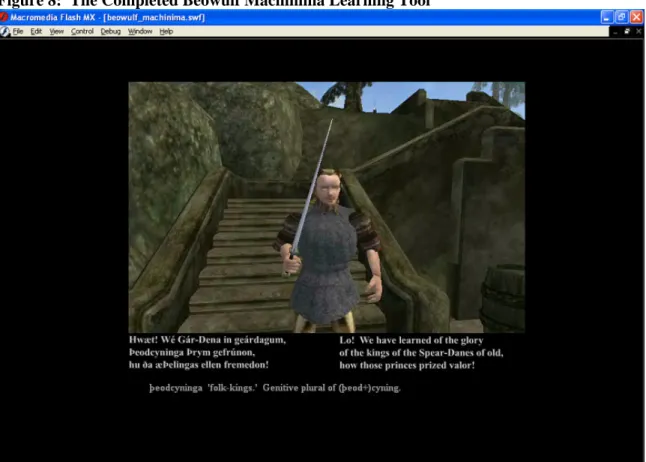
The completed Beowulf Machinima can be found at:
Background
Language instructors are always seeking new ways to engage their students. The use of technology in language classrooms has increased dramatically in recent years. Many teachers have come to consider multimedia and hypermedia tools to be indispensable parts of their curricula. Audio and video supplements allow reinforcement of new vocabulary, grammar and cultural concepts, while hypertext allows for quick dictionary searches and explanatory notes. Multimedia packages, however, can be expensive and may not be well tailored to a specific instructor’s curriculum or particular student needs.
A new multimedia format has arisen that may provide an answer to these problems: machinima. Frank Dellario of www.machinima.org defines the new genre:
Machinima is filmmaking within a real-time, 3D virtual environment. In an expanded definition, it is the convergence of filmmaking, animation and game development. By combining the techniques of filmmaking, the flexibility of animation production and the technology of real-time 3D game engines, Machinima makes for a very cost- and time-efficient way to produce films.
languages are offered. If the new medium can prove a useful tool for helping students learn language, it would be welcomed by teachers of low enrollment languages having little multimedia software to supplement classroom instruction, and those of high enrollment languages who prefer a lower cost and more adaptable tool.
The attainment of fluency in a language requires various conceptual levels of
competence, the most basic of which are grammatical competence, dealing with elements of language such as vocabulary and syntax, and textual competence, which entails
cohesion and rhetorical organization (Bachman, qtd. in Hadley 8). Researchers in language instruction, like those in many areas of pedagogy, have in recent decades come to acknowledge that different students exhibit different learning styles. Certain students respond better to audio stimuli, others to reading and writing. Some prefer passive learning while others demand activity. Researchers have come to posit various models of learning in a quest to understand the cognitive processes that result in learning, so that they might explain student variation and suggest adaptations for teachers to deal with it in the classroom.
Proponents of multimedia and hypermedia in language instruction have sought to maximize learning by maximizing the degree of learner control of and cognitive engagement in audio and visual channels, which lead into working memory, long-term memory and learning (Hede 183). Results of studies seeking to show the benefit of multimedia instruction, however, have failed to conclusively show that use of multimedia instruction has a positive effect on learning (Hede 178; Neuman et al 378). Nevertheless, when adopting course textbooks instructors are encouraged to look for candidates with supplementary multimedia “such as video programs, CD-ROMS, and Web sites” (Hadley 460).
Similarly, redundancy of audio and video channel input has yet to be proved a boon due to “dual-coding” or a hindrance due to “split attention” (Hede 179). Redundancy of information between channels is not the only touted benefit of multimedia and hypermedia, however. Within the visual channel, for example, text can be enhanced through searching or links to definitions, yielding obvious benefits over traditional texts (Heath 1). Interplay between knowledge within and across channels creates a rich environment for learning.
Overview
The intent of this project was to create a machinima based language instruction tool for Old English teachers, recreating the introduction to Beowulf in the new medium. A further goal of this project has been to prove that the machinima component of the tool could be created with simple tools, readily available software packages such as
Macromedia Flash, Techsmith Camstasia Studio and the video game itself. After
storyboarding ideas for representation of the text, design and construction of this tool was split into four main stages:
• Game Selection • Game Modification • Filming
• Flash Integration
Game Selection
The first stage of the project was selecting the game to be used. Numerous roleplaying games (RPG’s) exist for the personal computer. These games often allow the user to create a personal player character, or several player characters, with which to explore a virtual environment, interacting with other player characters or AI-driven non-player characters (NPC’s) in very open-ended scenarios rather than a “win/loss” format. Many RPG’s with a medieval fantasy theme can be easily found today, and many of these offered the possibility of a good environment for a machinima film set in the Germanic Migration. To stand out for consideration, a game would have to meet the following criteria:
• Inclusion of settings, characters and accessories that lend themselves to recreating a historically plausible Germanic Migration setting
• Inclusion of an editor for the game engine • Reasonable availability (not too old)
• High resolution graphics (in relative terms, again related to age)
If the game lacks native objects and environments that can be used in a historically plausible representation of the Danes and Geats of the 8th Century, then the role of the game editor for customization in this regard becomes more important. The more such features are already present in the game, the less work will need to be done in the next stage, modification. The amount of modification needed may vary in other projects, but some customization, if not an extensive amount, should be expected.
The task of finding an appropriate game can be daunting, particularly if the creator is unfamiliar with the gaming market of recent years. There are many role-playing games (RPG’s) that might be suitable and seem to fit the requirements of being readily available and having sufficient graphics to create films that are capable of drawing in the viewer. Information needs regarding the content and customizability of any given game,
however, can be more difficult to resolve. Description from the game’s packaging or advertisements may be both untrustworthy and incomplete. Firsthand information from other users is invaluable in making this decision. There are many online forums where the advice of players and customizers can be sought. Gamespot is one popular site gamers use to share information.
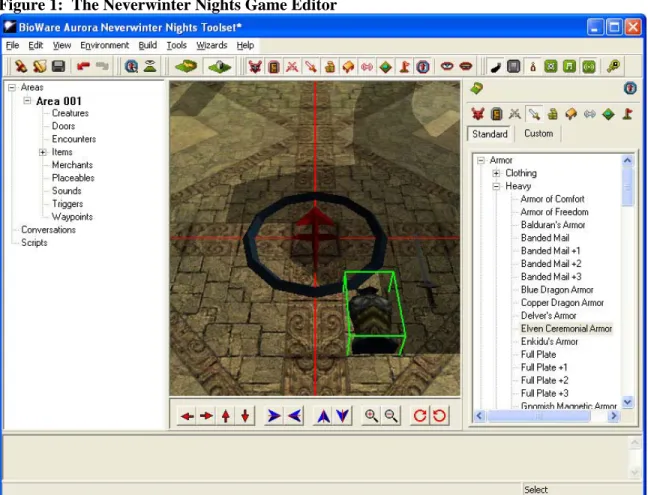
became apparent that the possibilities for modification using this title were rather finite (Figure 1).
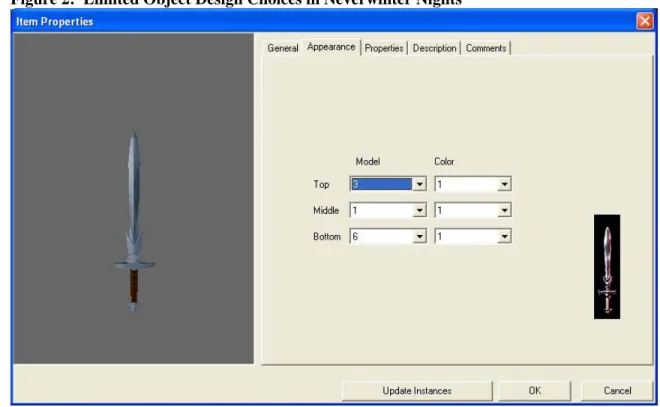
For instance, Neverwinter Nights did not have any swords that were typical of the Germanic Migration era, and the choices its editor offered for creating swords were only the combinations of 6 pommel and 6 crosshilt types, most of which were fantasy, rather than historically, based (Figure 2).
The ability to modify other aspects of the game, be it characters, settings, armor or other equipment, was similarly restricted to combinations of already made fantasy items. I was forced to come to the decision that environments created with Neverwinter Nights would not be historically accurate enough to add value to the end user’s learning experience, and thus another game would have to be chosen.
Figure 2: Limited Object Design Choices in Neverwinter Nights
For the next round of game selection, I decided that I should seek firsthand information from gamers. I consulted the Iowa Student Computer Association BBS’ Video Game forum. I asked the ISCA gamers if they knew of an RPG more customizable than
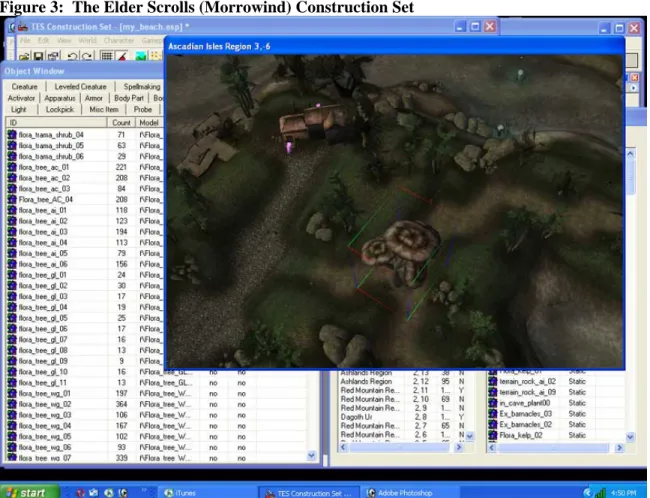
Morrowind. The Morrowind editor, The Elder Scrolls (TES) Construction Set, proved to be much more robust than Neverwinter Nights’ toolset (Figure 3).
Figure 3: The Elder Scrolls (Morrowind) Construction Set
Game Modification
Modification of the virtual environment is an extremely open ended task. One must decide at the outset just what needs to be created or altered in this stage to avoid scope creep once work begins. It is recommended that a clear and finite set of goals be delimited at the beginning of work. Knowing that Morrowind already contained
adequate characters, clothing, buildings and boats for the Beowulf machinima, my main goals in the modification stage were to create the settings necessary to film the segments I had storyboarded earlier and to see that the characters could be equipped with
appropriate armor, shields and weaponry.
The first task was learning to use TES Contruction Set itself. This editor offered many more features than the Neverwinter Nights editor. In fact, it offered so many options as to be bewildering to the novice user. The Constuction Set, however, came with no documentation, nor did the game’s official website offer any instructions. Again,
information had to be sought from virtual communities of gamers. An online player and developer community, Morrowind Summit, offered a few tutorials that were valuable in learning how to use this complex editor.
• Cell View: contains Cartesian coordinates for the location being viewed, and a list of all objects (characters, creatures and items, including vegetation, and effects such as lighting) in that location.
• Object View: lists all objects (characters, creatures and items, including
vegetation, and effects such as lighting) in the game according to categories such as Weapons, Ingredients and NPC. This window also provides the interface for creating and editing such objects.
• Render View: displays the virtual world at the location selected in the Cell View window. Objects on screen can be moved around and also edited from here, as can the landscape itself
• Top Menu – contains typical “file” tasks for the module being edited, as well as landscape editing functions and “view” features such as wire grids and lighting in the Render View (for the editor, as opposed to in-game lighting that players will see).
The original Morrowind game and everything it contained existed in a file called
discern. Considering the unreliability of using modules created by other gamers, I quickly decided that I would need to make all modifications myself.
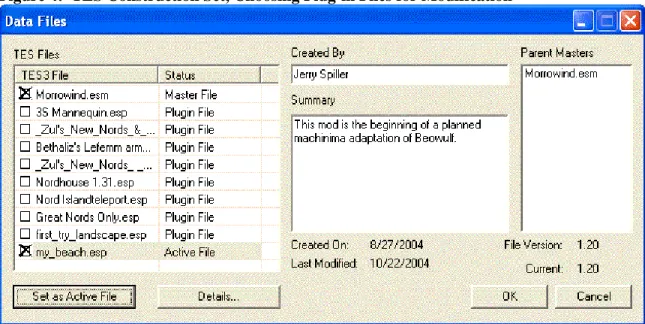
Figure 4: TES Construction Set, Choosing Plug-in Files for Modification
Beowulf characters at different ages by using the same character templates but changing such features as hair color or height.
It was apparent at this stage that there was one necessary character that could not be created: the foundling, baby version of Scyld. There are no babies in Morrowind. Baby Scyld would need to be shown in at least a quick shot arriving to the Danish shore in his treasure-laden ship. It was decided that the foundling Scyld would have to be represented in an image file, with a picture of a baby added to a screenshot of the inside of his
longboat in Photoshop. Most of the shot would show the outside of the boat (without the young Scyld) from afar in video format, with the static of image of the baby added between video clips in Flash.
Having all the other versions of the characters in place, I set about getting them equipped with armor, weapons and shields. I learned, again through Morrowind Summit’s
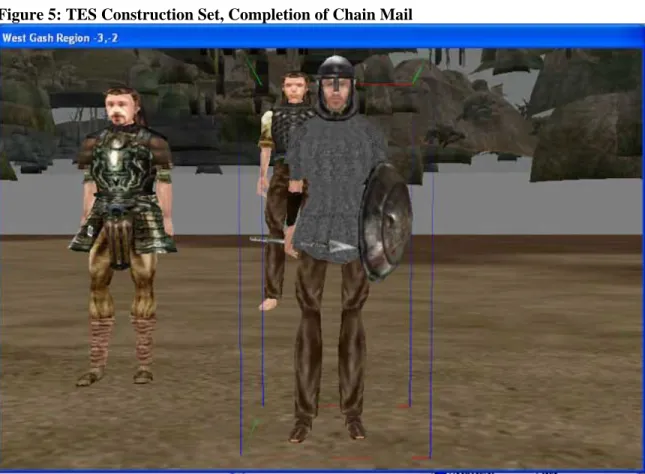
tutorials, how to create new objects. My first attempt at object creation was chain mail armor. Morrowind’s virtual objects are constructed from two files: a .nif mesh or framework model and a .bmp or .tif skin that is stretched over that model. The mesh file’s header contains a pointer to the skin that should be associated with that object. I created a bit map that was just a square picture of chain mail links, using the same
skins were distorted by meshes were unpredictable. Each mesh and skin combination creates an object for one body part, in this case the chest because I started with a shirt mesh to mimic loose chain mail. This process was repeated to create the mail’s sleeves by associated upper arm armor meshes with the same skin.
Figure 5: TES Construction Set, Completion of Chain Mail
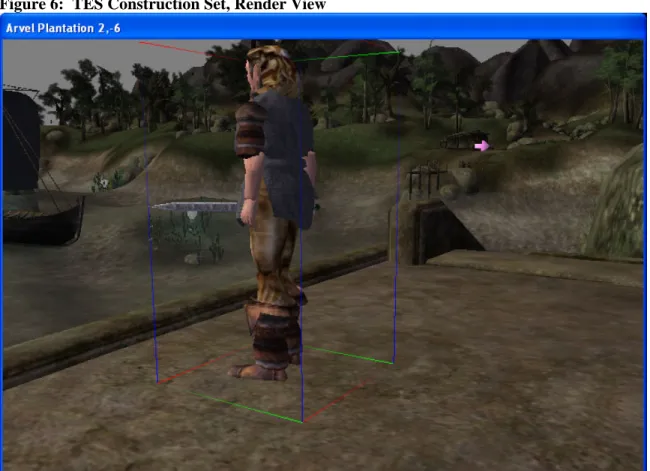
Satisfied with both suits of chain mail, I turned to weapons and shields. I knew that creating new version of either type of item would require creating new mesh files, since the game offered no examples of either swords or shields that were historically accurate. I also knew that being unfamiliar with the CAD software needed to create new 3D frameworks, creating new meshes would beyond the scope of this project.
Figure 6: TES Construction Set, Render View
game did offer a small buckler not unlike those used in classical Greece and Rome. Considering the time that would be lost in creating an accurate Nordic replacement, using the game’s bucklers had to be considered the cost-effective decision.
Filming
The process of acting out the ideas I had storyboarded for the introduction to Beowulf at the outset of the project and capturing the subsequent video was less technically
complicated than the Game Modification stage, but did offer its own challenges. I use the term filming to preserve the analogy with traditional film making, but of course the process in this case is entirely digital.
As with traditional filming, many takes of the same shots had to be done to get a good result, with the correct combination of lighting, pacing and non-player character (NPC) behavior, which can be unpredictable. The Beowulf characters I created had built-in AI scripts that caused them to walk around and appear to greet other player or non-player characters who walked within a certain distance. Such AI scripts were built-in to the game, to allow the “friendly” NPC’s, such as the characters I’d created, to perform game related functions such as buying and selling items from players or “unfriendly” NPC’s, such as monsters, to wander around and attack players. The latter case caused many an interruption in video capture. It is suggested that all hostile NPC’s either be removed from filming areas in the game editor, or killed in-game before filming begins.
the film. The only character the player has any real control over is his own.
Consequently, it was necessary to duplicate many NPC’s as player characters and play the game using whichever character must be performing any actions in a given scene. It is useful in this regard to keep extensive notes on the creation of NPC’s (their appearance and items that they are equipped with), so that matching player characters can be created later.
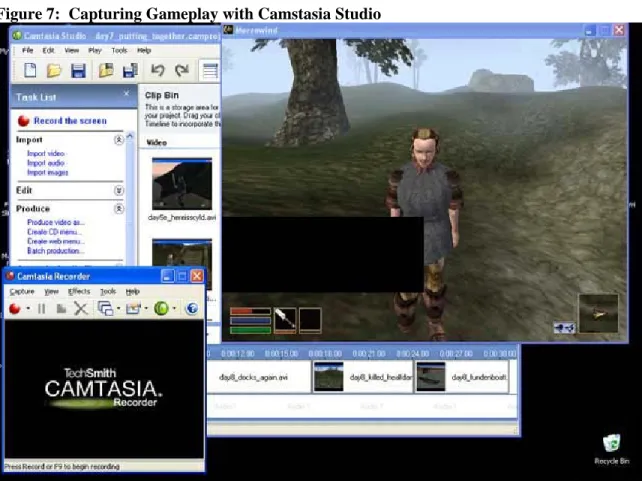
Techsmith Camtasia Studio was used to capture video of Morrowind gameplay enacting the storyboards. Macromedia RoboDemo was also considered as a video capture
application, but it was rejected when it was found to not truly capture video but rather images of the user’s mouse events for creating tutorials. Camtasia was run
simultaneously with Morrowind, and set to capture the game window (Figure 7). It should be noted that in Windows it is necessary to open Camtasia Studio or at least some other application window before the game is launched or it will not be possible to use Alt + Tab to leave the game window. Each day’s captures were saved to a new Camtasia project file in an uncompressed avi format. The video could then be edited in Camtasia. It was necessary to cut out a lot of video from each capture, such as the mouse actions required to switch windows, and prepare the in-game character for his scene (equipping weapons and other items, for instance). The edited video was then saved to a new file.
options tended more toward preservation than reduction of file size, yielding video clips of 20 to 50 MB for 30 seconds to 1 minute of video.
Figure 7: Capturing Gameplay with Camstasia Studio
Flash Integration
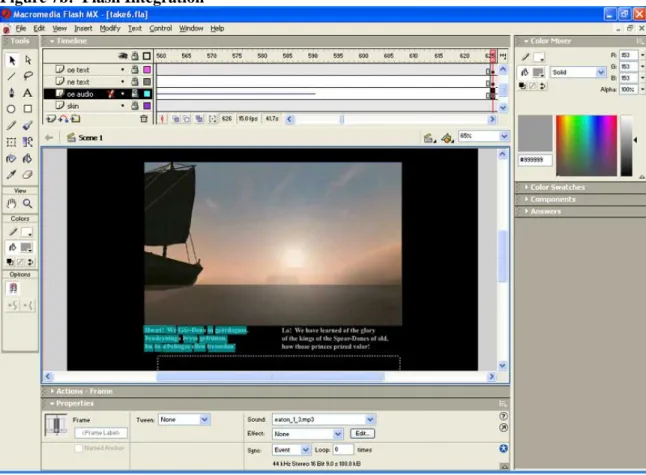
Macromedia Flash was the application used to put the video clips together and build a language instruction tool around the completed machinima. This tool would be
comprised mainly of Old English and Modern English text, as well as Old English audio, versions of the introduction to Beowulf following along with the video clips created in the last stage. The Old English text would also link to notes in a hypertext-like manner, allowing the user to select any word and view its definition and notes on its grammatical function in the sentence in which it appeared. Accompanying audio was also ripped from Old English scholar Trevor Eaton’sReads Beowulf CD using MusicMatch Jukebox and edited into short mp3 segments using Cool Edit Pro.
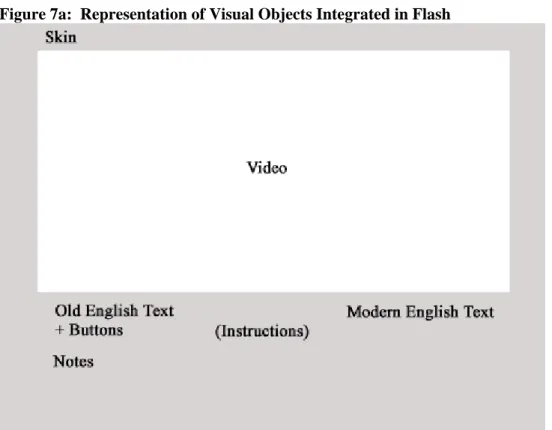
A Flash movie was created with the following layers (see Figures 7a and 7b): • instructions: Modern English instructions for the end user
• help_box: the layer in which the notes on each OE word would appear • buttons: containing all the buttons enabling the OE text to link to notes • oe text: the original excerpt from Beowulf
• ne text: the Modern English translation of OE text above • oe audio: the mp3 audio of Trevor Eaton’s readings
• video: the video of game play from the last stage, plus the image of baby Scyld
Figure 7a: Representation of Visual Objects Integrated in Flash
A transparent button symbol was created so that instances of the symbol could be placed over each OE word in the text with the following Action Script to generate its definition and notes:
on (release) {
Figure 7b: Flash Integration
Reflections
This project was undertaken for the purpose of showing that language instructors, either alone or with help from instructional technology staff, could create their own
machinima-based language instruction tools. I believe that the end product created here, the interactive Flash movie and this paper detailing its creation, do just that. Those wishing to create similar tools will need to be forearmed with certain knowledge. The first thing to consider is the hardware and software necessary in such a project. Below is a list of every application used in this project (including the those rejected like
Neverwinter Nights, as similar issues in resource selection are to be expected in other projects) and their approximate fiscal cost.
Figure 9: Costs
Neverwinter Nights $19.99
The Elder Scrolls III: Morrowind $19.99
Techsmith Camtasia Studio Free 30 Day Trial ($299 Full Version) Macromedia RoboDemo 5 Free 30 Day Trial ($499 Full Version Macromedia Flash MX 2004 Free 30 Day Trial ($499 Full Version) Adobe Photoshop 7.0 (replaced by CS) (Photoshop Elements 3.0, $99; GIMP, free)
XVI32 Hex Editor Freeware
Cool Edit Pro Free 30 Day Trial (now Abobe Audition, $299)
MusicMatch Jukebox Freeware
If care is taken in the planning stages, it is possible to create a machinima-based
who would find most of this software or satisfactory alternatives should already be available from tech support or campus labs.
With the completion of this project, some advice can be offered to creators of similar tools. Game selection is an important step and should be considered carefully, with as much input from users familiar with gameplay and editing in candidate titles. They should be aware of their system specifications. Brand new games with higher system requirements should be generally be avoided as running the game and video capture software simultaneously could be too taxing on central and video card processors and RAM, resulting in choppy gameplay and poor video quality. Much hard drive space will be required for video, especially for longer machinima.
Much can also be learned about methodology. Proper planning and scheduling will enable users to employ free trial versions of needed applications and reduce project costs. Notes should be kept on game modifications. Modifications should be checked in-game early in development to avoid having to rebuild areas and characters. Non-player characters may have to be duplicated as player characters, and player characters themselves may have to be duplicated if saved games become unresponsive to new modifications. It is recommended that creators, again, plan carefully to avoid the need to make further game modifications once filming has begun.
come in the final stage dealing with Flash. Flash can be an intimidating program for the novice user, but with a short introduction to the concepts of key frame animation and layering basic use of the program can be learned relatively quickly. Students in this school, for example, routinely learn to make basic Flash animations after only two periods of classroom instruction with the tool.
As this project is finished, its product stands to be used and evaluated. A comparison of the learning or retaining of vocabulary and grammatical concepts by students who used the tool versus students who used more traditional text based tools would be useful. I look forward to the use of the Beowulf Machinima by Old English students, and hope to expand the tool to recreate more of the narrative in the future. Issues in design in the final stage of this project will be addressed in future versions as the product is refined. It has not been left unconsidered that video combined with many text areas may overwhelm the end user visually and inhibit learning. While studies of the efficacy and
References
Bachman, L. Fundamental Considerations in Language Testing. Oxford: Oxford University Press, 1990.
Baddeley, A.D. “Is working memory working?” Quarterly Journal of Experimental Psychology. 44A.1 (1992): 1-31.
Beowulf, author unknown.
Dellario, Frank. “Machinima FAQ.” Machinima.org. Academy of Machinima Arts & Sciences, Inc. 2002-2003 http://www.machinima.org/
Eaton, Trevor. “Scyld’s Final Voyage.” Reads Beowulf. Pearl, 1997. Gamespot <http://www.gamespot.com>
Hadley, Alice Omaggio. Teaching Language in Context. 3rd ed. Boston: Heinle & Heinle, 2001.
Heath, Sebastian. “The Perseus Project: classical civilization through optical media” CD-ROM Professional. 3.6 via InfoTrac (1990).
Hede, Andy. “An Integrated Model of Multimedia Effects on Learning.” Journal of Educational Multimedia and Hypermedia. 11.2 (2002): 177-191.
Iowa Student Computer Association BBS. <telnet://bbs.isca.uiowa.edu> Morrowind Summit. <http://www.rpgplanet.com/morrowind/index.asp>
Neuman, Delia, Gary Marchionini and Kenneth Morrel. “Evaluating Perseus 1.0:
Methods and Final Results.” Journal of Educational Multimedia and Hypermedia 4.4 (1995): 365-382.