Bogeum Choi. The relationship between task complexity, working memory and
information search. A Master’s Paper for the M.S. in I.S degree. April, 2018. 59 pages. Advisor: Robert Capra
In recent years, there has been growing interest in better understanding human actors in human information seeking behavior studies. Although a number of studies have been conducted to explore users’ individual differences in search behavior, there have been few studies taking both a theoretical and empirical approach to the relationship between users’ cognitive ability, task complexity and search interactions. The study presented in this paper evaluated the effect of task complexity and working memory in human information searching behavior. Twenty-four participants from a non-college-bound adolescents sample (ages 18-50+) performed two search tasks of varying levels of
complexity and were administered measures of working memory. ANOVA tests revealed three important trends: (1) task complexity had a significant main effect on users’
perceptions about the task (i.e., temporal demand and level of satisfaction with time spent on the task), (2) working memory capacity had a significant main effect on users’ search behavior (i.e., queries, clicks, time until 1st click and time between search activities), and (3) a significant interaction effect was found for several search interaction measures (i.e., queries, clicks and time between search activities) and perceived level of temporal demand. Specifically, participants with high working memory capacity carried out more search activities at a faster pace and experienced less temporal workload. Taken together, these results suggest that task complexity and working memory capacity can have effects on users’ search behavior as well as their perceptions about the search experience.
Headings:
Information retrieval
User studies
Cognitive ability
Working memory
Task complexity
Locus of control
THE RELATIONSHIP BETWEEN TASK COMPLEXITY, WORKING MEMORY AND INFORMATION SEARCH
by Bogeum Choi
A Master’s paper submitted to the faculty of the School of Information and Library Science of the University of North Carolina at Chapel Hill
in partial fulfillment of the requirements for the degree of Master of Science in
Information Science.
Chapel Hill, North Carolina
April 2018
Approved by
_______________________________________
Table of Contents
1. Introduction ... 2
2. Background ... 4
2.1 Cognitive ability... 4
2.1.1 Working memory ... 6
2.2 Task complexity ... 9
2.3 Workload... 10
2.4 Locus of control ... 12
3. Research questions ... 16
4. Methods... 17
4.1 Participants ... 18
4.2 Procedures ... 18
4.3 Working memory task... 20
4.4 Search tasks ... 22
4.5 Post-task survey ... 24
4.6 Search behavior measures ... 25
4.7 Search outcome measures ... 26
5. Results ... 30
5.1 Working memory ... 30
5.2 Effects on users’ perception ... 31
5.3 Effects on users’ search behavior ... 34
6. Discussion ... 38
7. Conclusion ... 42
8. Acknowledgements ... 44
9. Reference ... 45
Appendix 1. Consent form ... 50
Appendix 2. General instructions page ... 53
Appendix 3. Search tasks ... 54
1. Introduction
Information seeking behavior can be considered as an assemblage of cognitive
activities. That being said, it is key to understand the extent to which variations in
cognitive abilities can impact one’s search behaviors, perceptions, and outcomes. In the
field of behavior analysis, there have been a substantial number of studies focusing on
consistent differences in the level of performance among individuals and cognitive
abilities have received substantial attention in this regard (Kuncel, Hazlette & Ones,
2004; Rohde & Thompson, 2007; Schmitt, 2014; Ruffing, Wach, Spinath, Brunken &
Karbach, 2015). However, not so much attention has been drawn to individual variation
in cognitive abilities in information behavior studies. In an educational setting, individual
differences in performance are among the most salient aspects of behavior. Some people
learn and understand the complex material with relative ease, whereas others labor to
succeed. Learning and searching share core areas of commonality in that they both
require interaction with texts and becoming informed as a result of the actions, which
means search behavior may also be under the influence of such individual differences.
Among those individual differences factoring into the dynamics of human information
behavior, this study focuses mainly on cognitive abilities, working memory in particular.
In this study, I also manipulated complexity of task as an attempt to see how individuals
with varying degree of cognitive ability accommodate search behavior to cope with
The study can contribute to the body of knowledge of human information behavior
with emphasis on human factors in the dynamics between users, task, and system.
Findings from this study can also help us in making interactive information systems more
attuned to individual differences and the variance of tasks. Furthermore, it may lead us to
develop supplementary tools that allow users to utilize the system in a way that works
2. Background
This section describes four areas of prior work related to this study: cognitive
abilities, task complexity, workload and locus of control.
2.1 Cognitive ability
Cognitive science sees the individual as a processor of information, in much the
same way that a computer takes in information and follows a process to produce an
output. This basic assumption of cognitive science led to the emergence of the
information processing model as a framework for studying human mind. To envision
how this information processing approach can provide a good fit to the mental model of
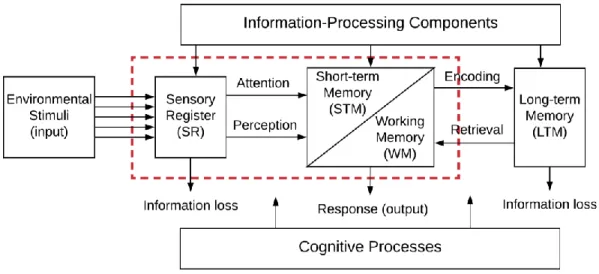
information seeking behavior, I include Figure 1 below. Figure 1 is developed from the
original information processing model proposed by Atkinson and Shiffrin (1968) which
is also known as a multi-store model of memory.
Marchionini (1995) produced a model of the information-seeking process for
computer-based searches. Among the eight phases that consist the model are recognizing
information problem, formulating a query by which to fit the information need,
examining results and extracting information from the results. Kulhthau (1991) also
argued cognitive actions such as locating relevant information about the general topic,
reading to become informed and relating new information to what is already know is
required in the “exploration” stage of her information search process model. These
attention, encoding, rehearsal and retrieval) embedded in each of the main activities
in a search process as a low-level action.
This approach can be a good way to see view search process in that it allows us to
clearly distinguish the cognitive processes embedded in a search process, which include
perception, attention, encoding, rehearsal, and retrieval.
Figure 1. Information processing model (Atkinson & Shiffrin, 1968)
A psychological approach to information studies has been taking up its position as
a dimension of human information behavior studies, focusing on searching behavior
(Wilson, 2000). In early computing and interactive information retrieval (IIR), cognitive
ability was introduced as a factor that shapes the interaction between users and system.
Early studies investigated the influence of cognitive abilities in text editing systems,
hierarchical file systems and databases, and general computer-based software programs.
Cognitive abilities were found to be causal factors of individual differences in task
performance, accuracy, and navigation. For example, those with higher visual memory
1982; Gomez, Egan, Wheeler, Sharma & Gruchacz, 1983). Gomez, Egan and Bowers
(1986) also found that those who showed higher associative memory performance made
fewer first-try errors and completed an editing task faster. A few other cognitive abilities
such as perceptual speed (Salthouse & Babcock, 1991; Fisk & Warr, 1996; Brennan,
Kelly & Arguello, 2014; Turpin, Kelly & Arguello, 2016) or working memory (Gwizdka,
2009; MacFarlane, Albrair, Marshall & Buchanan, 2012; Gwizdka, 2013; Gwizdka,
2017) have been found to serve as factors associating with searching behavior.
2.1.1 Working memory
One of the core abilities that holds great influence throughout the whole cognitive
process in the information processing model is working memory. Working memory refers
to a cognitive ability responsible for providing access to information required for ongoing
cognitive processes. Working memory is critical for making sense of anything that
unfolds over time and that requires holding in mind what happened earlier and relating
that to what comes later. For example, doing any math in your head requires working
memory, as does incorporating new information into your thinking or action plans
(updating), considering alternatives, and mentally relating information to see relations
between items or ideas (Diamond, 2013).
Miller (1956) made an early argument that there is a limitation that is imposed on
our ability to process information. The length of chunked items that an individual can
maintain in memory-storage is called memory span and this limited capacity has a
profound effect on human information processing and interaction with the external world,
(WMC) is used to refer to an individual differences construct reflecting the limited
capacity of a person’s working memory.
Working memory has been studied as a factor that can impact search behavior in
IR literature. Gwizdka (2009) explored the relationships between selected tasks, cognitive
abilities (i.e., working memory, verbal closure) and search result interfaces. The study
found that searchers with higher cognitive abilities were faster in the interface where they
were provided an overview interface (vs. list interface with no overview of results shown)
during less demanding tasks. Searchers with higher cognitive abilities also exerted more
search effort in the interface where tags were presented in a form of a list without an
overview while performing more demanding tasks. These findings suggests the
importance of considering cognitive ability such as working memory in the design of
search results presentation.
As a follow-up to the previous study, Gwizdka (2013) explored the effects of task
complexity and working memory span on participants searching a collection of social
bookmarks related to travel, sightseeing, and shopping, under two different interface
conditions. The study reported the interaction between memory span and task complexity
for task duration and query behaviors. On simple tasks, participants with higher memory
span spent less time, issued fewer queries, and opened fewer documents than participants
with lower memory span. On more complex tasks, however, participants with higher
memory span spent more time, issued more queries, and opened more documents. They
also performed cognitive actions (i.e., issuing and reformulating queries, opening a
Gwidka (2017) also investigated the effects of working memory on search effort.
The findings show that searchers with higher working memory perform more actions than
searchers with lower working memory, confirming results from previous work. Also, it
has shown that participants with higher working memory spent significantly longer time
on completing a task, particularly on reading search results than participants with lower
working memory. The study also noted a trend that higher working memory participants
showed their efforts across different phases of search in a more consistent manner than
lower working memory participants.
In another empirical study MacFarlane and his colleagues (MacFarlane, Albrair,
Marshall & Buchaman, 2012) studied the impact of working memory on information
searching by university students using TREC collections and topics. They recruited eight
dyslexic students and eight non-dyslexic students to compare two different user groups.
There is a compelling evidence that cognitive deficit that causes dyslexia lies in the
impaired phonological working memory. The authors assumed that reading ability of
users would show different search behaviors given that reading is one of the key activities
required for searching. They found that the number of documents marked irrelevant was
significantly correlated with a measure of working memory. Participants with higher
working memory viewed more documents in total during the task completion and they
marked more document as non-relevant than participants with lower working memory
(i.e., the percentage of documents judged non-relevant as well as the absolute number of
the documents), which demonstrates the impact of impaired working memory on search
behavior. Findings of these studies suggest working memory can play an important role
2.2 Task complexity
Previous works have found that task complexity affects search behavior (Jansen,
Booth, & Smith, 2009; Wu, Kelly, Edwards & Arguello, 2012) and post-task assessments
of task difficulty (Arguello, 2014; Wu, Kelly, Edwards & Arguello, 2012). Various
approaches to viewing task complexity were taken by different researchers. Early work
by Wood (1986) regarded complexity as depending on the number of desired outcomes,
the number of actions required to produce the outcomes, and the quality of the
information cues processed during the task. Additionally, Campbell (1986) mentioned
that task complexity can be measured by the number of required outcomes, the number of
alternative paths to the outcomes, the level of uncertainty regarding the paths, and the
degree of interdependence between subparts consisting a task. He also found that task
complexity has a significant impact on participants’ perception of their task performance
as well as objective measures of task performance.
Gwizdka (2013) examined user behavior on information search tasks at two levels
of complexity (i.e., simple and complex) and reported the significant main effect of task
complexity on time and search effort as well as the length of eye fixation. Walhout,
Oomen, Jarodzka & Brand-Gruwel (2017) explored the effect of search task complexity
on search query formulation, evaluation of search results, and task performance. The
study showed that an increase in task complexity results in more search queries, more
time spent on formulating queries, and higher consideration for results from SERPs (i.e.,
search engine result pages). Brennan, Kelly, and Arguello (2014) conducted an empirical
study to evaluate the relationship between cognitive ability, task complexity and
and workload, and task complexity and search behaviors. While the interactions were not
significant, the differences were found to be more pronounced for more complex tasks.
Prior studies showed an evidence of the effect of task complexity and it’s
reasonable to assume that complex task will invite a user to more challenges in
information search. In this study, I used task complexity as another independent variable,
hoping that it will give me more room to explore individual differences in users’ search
behavior and perception by causing a different quantity of demands on users.
2.3 Workload
The concept of workload and mental workload was emerging as an important
aspect to be considered not only in the evaluation of professional task performance but
also in the domain of scientific research (Silva, 2014). A theoretical approach to mental
workload has been associated with the need for a proper understanding of the interaction
between human-machine systems, the advantages and limitations underlying this
interaction and also the outcomes as a result of the interaction. Mental workload began to
be associated with studies on safety and effectiveness of operator performance in many
organizational contexts where the concept was primarily related to the limit and amount
of mental effort, and tasks allowing to maintain an adequate level of performance.
De Waard (1996) pointed out that mental workload not only reflects external
demands placed by a task but also inherently reports a specific person’s situation.
Kahneman (2002) mentioned that workload can be defined by the amount of resource
required by a set of concurrent tasks, as well as by the use of resources needed to perform
best to clearly describe the construct I was measuring by distinguishing two main aspects
of mental workload. The amount of workload an individual experiences during the task is
a result of that individual’s capability (i.e., defined by cognitive abilities), task demand
(and features) and the person’s situation (Jex, 1988).
The measurement of workload has been used to understand search tasks in
different ways by IIR researchers. Haapalainen, et al. (2010) measured mental demand to
verify the levels of workload imposed to participants in their study. They combined
workload scores with task completion time to conduct a manipulation check of task
difficulty. Workload has also been incorporated to see other effects it has on users’
experiences. For example, it was found that text vs. visual based interface had a
significant effect on workload; reported mental load for the visual query interface was
significantly lower than that for the text-based approach. (Speier et al., 2003). Kelton and
Pennington (2012) found that information presentation format (i.e., hyperlink vs. paper)
can affect users’ decision-making performance in terms of the amount of mental effort
put on the task. In another study, Gao (2011) investigated users’ motivation,
performance, and workload when they use tagging interface (as opposed to categorization
interface) to organize personal information system. He found that participants who used a
tagging interface reported a significantly higher level of mental demand and frustration
when performing organizational tasks.
In this study, I used the NASA-Task Load Index (TLX) to measure workload,
which measures the mental, physical, and temporal demands imposed on individuals by a
work task along with individual’s evaluations of their performance, effort and
2.4 Locus of control
Locus of control, in social psychology, refers to the extent to which individuals
believe that they can control events and outcomes in their own lives (Rotter, 1966), as
opposed to external forces beyond their control. The idea was first introduced by Julian
B. Rotter (1954) who conceptualized a person’s loci (plural of locus; Latin for place or
location) being on a continuum from internal to external. Individuals with strong internal
locus of control believe that the responsibility for the outcome of life activities lies with
themselves. Internals believe that success or failure is due to their own efforts. On the
other hand, externals believe that the reinforcers (i.e., stimuli given as a consequence of
one’s action, in other words, an outcome of one’s behavior) in life are controlled by luck,
chance, or powerful others. Therefore, they see little impact of their own efforts on the
amount of reinforcement they receive.
It is documented that perceived causal attribution influences changes in goal
expectancy thus is presumed to guide motivated behavior (1985, Weiner). Within social
psychology, the work of Heider (1958), deCharms (1968; 1976), Jones and Nisbett
(1972) and others have focused upon a causal explanation of events as major
determinants of the behavior exhibited during those events. To give a real-world
example, if students either attribute their academic success or failure to having a bad day,
or unfair grading procedures on their teacher’s part, they can be said to have a more
external locus of control. Since they attribute both their successes and failures to luck or
chance, they tend to lack persistence and not have very high levels of expectation. Lei
academic success to internal factors that they have control over, such as effort. It leads to
the conclusion that for students to be able to be persistent in academic activities, they
need to believe that they are competent and that by working hard they can be successful.
Information seeking behavior can be defined as the purposeful seeking for
information as a consequence of a need to satisfy some goal (Wilson, 2000). In the course
of seeking, the individual interacts with either manual or computer-based systems. Here,
we can identify three main entities involved in the process; human, system and
information need that primarily relates to the context where the interaction between
human user and system takes place. In interactive information retrieval setting
information need is usually imposed on a user by a task at hand, and the notion of task
completion can go parallel to goal attainment in an achievement-related setting. I thought
the construct may provide a good approach to better understand users’ perception for
their own search performance, and furthermore, I expected an explanatory power of this
concept in explaining patterned variations of users’ search behavior as well as achieved
search outcome.
In order to measure the locus of control in the context of human information
seeking behavior, I adapted the multi-dimensional multi-attributional causality scale
(MMCS) that was introduced by Lefcourt, von Baeyer, Ware, and Cox (1979). The
original MMCS is composed of two parts, each of which deal with causal beliefs about
their respective areas; achievement and affiliation. It comprises 48 items, 24 dealing with
achievement, 24 with affiliation. Affiliation locus of control assumes interpersonal
situations and since I’m dealing with an achievement-related setting, I excluded the
Half of each set concern success and half failures. Within each 12-item set, there are four
attributions composed of three items each. These consists of ability and effort as the
internal attributions (also known as dispositional attributions), and luck and context as the
external attributions (also known as situational attributions).
Lefcourt et al. (1979) found the percentage of time that subjects showed to
complete a given task (i.e., anagram procedure) was significantly related to achievement
locus of control scores as well as the interaction effects with difficulty stage of the task
(simple - intermediate - difficult - unsolvable). In brief, the result suggested that the more
internal were the subject’s expectancies for achievement, the more likely the subjects
were to exhibit signs of discomfort during the task, particularly during the more difficult
sections of that task when failure became increasingly probable. This suggests that
individuals’ belief in their control of reinforcement can specifically affect their reaction
to hardships associated with a task.
Earlier work by Dweck and her colleagues (Dweck, Davidson, Nelson & Enna,
1979; Dweck & Reppucci, 1973) have also demonstrated that difficulties in learning that
result from the tendency to give up in the face of failure can be accounted for by
attributions of ability as opposed to effort. They found that a child having difficulty with
arithmetic is more apt to stop trying and give up if he or she construes failures as
evidence of his or her lack of ability. On the other hand, if attributions are made to an
effort, persistence despite failure turned out to be more likely. Again, given that the scale
has been successfully used to predict things including academic success and one’s
interesting dynamics of users’ perception and behavior while they are completing a
3. Research questions
Based on the review of the literature, I posit several research questions about the
effects of working memory and task complexity on search experience. My manipulations
and variables are described in the next section.
RQ 1: How does task complexity affect users’ a) perception, b) search behavior, and c)
search outcome?
RQ 2: How does variance of the working memory impact users’ a) perception, b) search
behavior, and c) search outcome?
RQ 3: Are there interaction effects of task complexity and working memory on a)
4. Methods
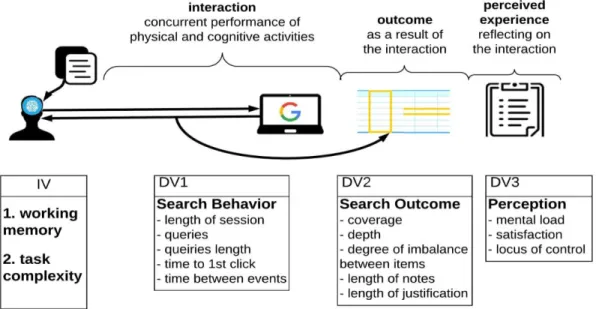
A controlled experiment study was conducted to investigate my three main
research questions (R1-R3). The study involves two dependent variables; working
memory capacity and task complexity, each of which has two levels and looks at three
categories of dependent variables; search behavior, search outcome and users’ perception.
The overall study design with variables of my interest is presented in Figure 2.
Working memory capacity was a between-subject variable that consisted of two
groups: high and low. Participants were divided up into two groups (i.e., high and low)
according to their memory span for operation task split at the median. Task complexity
was manipulated as a within-subject variable and consisted of two levels: simple and
complex. All participants were exposed to two search tasks with each task associated
with a different level of complexity.
4.1 Participants
To increase the chances of obtaining a sample with a wider range of cognitive
abilities, I recruited twenty-four participants from university employees, rather than
relying on to university students. Additionally, a number of laboratory user studies in IIR
have been conducted with university students, and I wanted to contribute to the research
of which findings are more generalizable to the general public. A total 24 participants
consisting of 18 females and 7 females (aged 18–late 50+ years) completed this study.
The study was conducted in Interactive Information System Lab (IISL) at the University
of North Carolina at Chapel Hill.
4.2 Procedures
The study protocol was as follows. Upon arrival to the session, the researcher
briefed participants on the goals of the study and gave an overview of the study session
(i.e., they were informed that there are two search tasks, a post-task survey for each task
and memory task to perform). Participants then were given an informed consent form
(see Appendix 1) that acknowledged: that participation is voluntary, that they may cease
at any time with no penalty and that no personal identifiers will be collected during the
session. Participants were randomly assigned to treatments and given a unique participant
ID (i.e., a number between 1 and 24). After they agreed to participate the study,
participants were directed to a custom-built search engine and logged into the system by
entering their participant ID. The system used in this study was provided by Jaime
(Turpin, Kelly & Arguello, 2016). The system used the Bing Web Search API to retrieve
results from the open web and allowed participants to issue queries, click and view
results, and navigate away from the landing page. The system also logs user interactions
on the search engine result page including scroll and mouse movements as well as
timestamp mapped to each of those behavior using JavaScript and AJAX.
After they fill out a brief demographic questionnaire, the researcher pulled up a
Microsoft Word document on the right side of the desktop screen (see Appendix 2).
General instructions for task completion were shown on the first page of the document
which was followed by a task description and a search outcome table for the two tasks of
varying complexity. The instructions for the memory task was displayed on the last page.
Participants were encouraged to read along the written instructions while the moderator
was explaining it to them. An example of a comparative task (i.e., a type of task used in
the study) was included on the first page with an empty table to ensure that participants
clearly understand the characteristics of the task. The detailed information about a
comparative task is provided in Section 4.4. To help participants remember the task and
to make it easier for participants to fill out a given table while searching for information,
the Word document remained visible at the right side of the desktop screen during the
whole search session.
Participants completed two search tasks of different levels of complexity. The
order of search tasks was rotated across participants. For each task, participants were
asked to create a response by either typing notes or copying and pasting information they
found relevant (i.e., URL of a webpage or text from useful web pages) into a given table
find as much information as you think is needed to address each cell in the table. … Time
that takes for you to complete is task is not important; but for the sake of your time, you
will be given twenty minutes per task. You don’t have to use up the whole time. You can
stop searching for information when you feel like you have the adequate amount of
information to make a decision.”
After performing two search tasks, they completed a post-task which contained
items about workload, perceived satisfaction with search performance, and locus of
control questionnaire (see Appendix 4). Participants then conducted a working memory
span task (i.e., OSPAN) which lasted 10 to 15 minutes. At the end of the study, the
participant received the compensation of $15 and signed on a paper copy of a receipt. The
study took approximately 60 minutes in total.
4.3 Working memory task
In their extensive methodological review on working memory (WM) span tasks,
Conway et al. (2005) argued that working memory system would be unlikely to evolve
for the sole purpose of allowing a human to store or rehearse information (e.g., phone
number) while it was doing nothing else. Rather, a more adaptive system would allow the
organism to keep task-relevant information active and accessible in memory during the
execution of other cognitive tasks. It explains the purpose of complex working memory
span tasks (i.e., reading span task, operation span task, and counting task) where a
participant is required not only to store and rehearse an information but also to process
additional information that occurs simultaneously (Case, Kurland & Goldberg, 1982;
In the light of Conway’s argument, in this study, Turner and Engle (1989)’s
operation-word-span task (OSPAN) was used to measure working memory span. In
OSPAN task, participants are asked to read out loud and verify a simple math problem
such as “Is (4/2) - 1 = 1?” and then read a word after the operation such as “snow”. After
a series of problems and words have been presented, the participants recall the words that
followed each operation. Three trials of each set size (i.e., list length is from 2 to 6) are
presented, with the order of set size varying randomly, so that participants cannot predict
the number of items they will see in the next sequence. A participant’s operation span is
calculated by adding up the length of all word lists perfectly recalled in order.
Additionally, in order to ensure that participants are not trading off between solving the
operations and remembering the words, an 85% accuracy criterion on the math operations
is required.
The task has demonstrated good reliability and validity (Conway et al., 2002;
Engle, Tuholski, Laughlin & Conway, 1999; Klein & Fiss, 1999). For example, with a
sample size of 236, Kane et al. (2004) observed coefficient alphas of .80 for operation
span, which indicates that subjects who responded with the correct answer for one set of
span stimuli in the task (e.g., equation word pairs) tended to respond with the correct on
the others (and vice versa). Evidence also suggested that the task is reliable in the sense
that the rank order of span scores is stable across time. Test-retest correlations of .70-.80
have been observed for operation span task over weeks, and over 3 months (Klein & Fiss,
1999). The task was operated using the CogLab 2.0 CD from a cognitive lab textbook
4.4 Search tasks
In this study, I used comparative search tasks. A comparative search task is a type
of task in which one has to compare a set of items along different dimensions. Tasks were
designed at two levels of complexity and the complexity level was manipulated by the
numbers of items and dimensions that had to be considered during a search. Simple tasks
required a comparison between two items along two dimensions; whereas, complex task
involved four items with four dimensions. This increased the level of complexity by
creating multiple interdependent paths to the task outcome. A task scenario was
constructed to present realistic situations to provide participants with the search context
and the basis for relevance judgments. In all tasks, participants were motivated to look for
information for their friend. At the end of the task, they were asked to make a decision to
choose one item among given items and generate the answer in the format of giving a
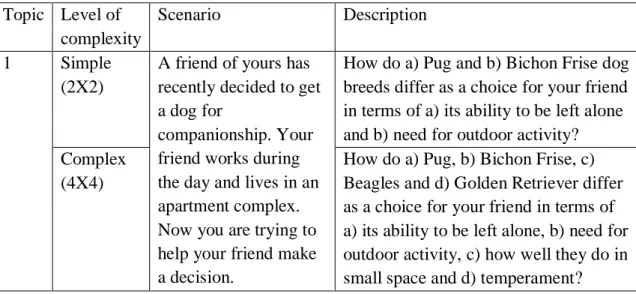
suggestion to their friend. An example of task description is displayed in Table 2. Tasks
were presented to participants in a counter-balanced order in terms of both topic and
levels of complexity.
Table 2. Assigned search task example (items X dimensions)
Topic Level of complexity
Scenario Description
1 Simple (2X2)
A friend of yours has recently decided to get a dog for
companionship. Your friend works during the day and lives in an apartment complex. Now you are trying to help your friend make a decision.
How do a) Pug and b) Bichon Frise dog breeds differ as a choice for your friend in terms of a) its ability to be left alone and b) need for outdoor activity? Complex
(4X4)
There are two main purposes for using a comparative task in this study. First of
all, cognitive activities that comparative task involves explicitly require the role of
working memory. For instance, in order to perform a task, a participant has to first
recognize different items, search for relevant information that corresponds to a specific
condition (e.g., cost of nicotine replacement therapy), then compare a piece of
information to another. This requires processing new information, while retaining prior
information. Besides its explicit reflection of the role of working memory, I was also able
to manipulate the level of complexity in a fairly straightforward way by simply adjusting
the number of components (i.e., item and dimension) that consist a task. An individual’s
working memory capacity is often represented in the number of discrete units of
information over which one can successively distribute one’s attention and maintain in an
active state. Therefore, it seems reasonable that increasing the number of elements to
consider could increase the memory load.
Secondly, search outcome of a comparative task can be generated in the form of a
table with columns and rows, which can give me a visual representation of distribution of
information (i.e., degree of balance or imbalance across the items). As such, this
two-dimensional matrix structure enables an analysis of measures such as coverage, depth,
and degree of imbalance of search outcome. These measures will be discussed in more
4.5 Post-task survey
Perceptions are the basic means by which people experience the world and build a
worldview to explain those experiences. As opposed to sensations serving as direct
sensory stimuli, perceptions are the ways we interpret those sensations to make sense of
what we are sensing. This paper will also examine users’ perceptions of their own search
experience as a main category of dependent variable.
I used a questionnaire (see Appendix 4) with 17 items in order to measure (1)
workload (2) satisfaction and (3) locus of control for each task. For the work load
questions, I selected four items from six items of the NASA Task Load Index
(NASA-TLX). I took out an item that measures physical demand, judging that physical activities
involved in performing web search tasks will not say much about the variables of interest
of this study. I also didn’t include an item which asks about frustration level because an
emotional aspect of the experience was not in the scope of the purpose of the study. As a
result, the survey consisted of items that measure mental demand, temporal demand,
overall performance, and effort.
In an attempt to capture more of users’ perception of their own performance, I
asked five questions about satisfaction on task performance on a 5-point scale: (1)
perception of whether one found enough information, (2) satisfaction with the amount of
time spent for the task, (3) satisfaction with the amount of information found, (4)
satisfaction with the quality of information found and (5) satisfaction with the chosen
strategy.
For locus of control, I adapted questions from the
assess the locus of control for achievement and were constructed from items representing
each quadrant of the locus and stability of causal attribution model of B. Weiner et al
(1971). The questions were adapted for the purposes of this paper to see one’s beliefs
about the causes of one’s successes, which in this case means task completion. Several
modifications made include deleting some items and modifying others to make them
more appropriate for the context of web searching. I attempted to see if a user’s
perception of causal attribution for an observed outcome (i.e., their own search task
performance) can vary depending on factors such as one’s cognitive ability and task
complexity, and if this shows any relationship with actual search outcome generated by a
user. The survey was presented using Qualtrics software that allows participants to fill
out the questionnaire online. The questionnaire took the participants about three minutes.
4.6 Search behavior measures
Participants’ search interaction data were recorded by a customized system used
for the study. Measures taken from the log are in Table 3.
Table 3. Measures taken from search behaviors
duration total amount of time spent during a session
queries # of queries
query_length # of unique terms per query
clicks # of total clicks made on SERP
time_1st click average time taken for a participant between issuing a query
time_between_events average time between all search activities (e.g., query issue,
click, etc.)
4.7 Search outcome measures
In this study, participants were asked to complete a search task by doing their best
to fill out a table. They were instructed to consider it as notes that they can refer to when
it comes to a decision-making point. The instruction also indicated that it is totally up to
them to do the following: a. what to put in a table and b. how much information they put
in each cell. These participant-generated notes were considered as another dependent
variable in addition to search behavior. I viewed it as an actual evidence of completeness
of their performance as well as a visual representation of participants’ search experience.
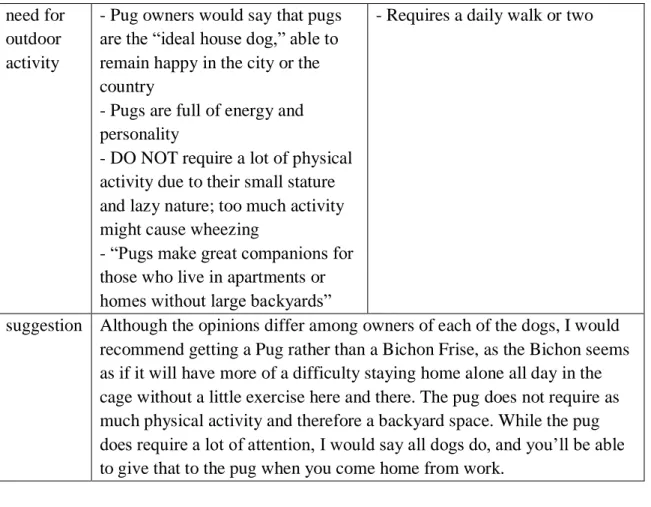
I presented an example of search outcome in Table 4.
The idea of completeness can branch out into two operationalized concepts;
breadth and depth. It is a commonly accepted idea that depth and breadth tradeoff exists
in a variety of cases although both are necessary conditions for a quality outcome. In any
circumstance where there is resource constraint that needs to be reconciled with the need,
a tradeoff between breadth and depth occurs. Miller (1981) discussed the depth and
breadth tradeoff in the context of human engineering evaluation, emphasizing that system
designers should consider the optimal balance between depth (i.e., the number of menu
levels) and breadth (i.e., the number of choices per menu). Pfeiffer (2012) considered
depth and breadth of search as primary variables for consumer’s decision-making
behavior. Additionally, in their work of developing a model of data quality, Wang and
breadth, depth, and scope of information contained in the data”. I found it as a good
framework to incorporate in interpreting the search outcome formed in metrics table.
In this study, breadth was referred to as coverage which can be simply defined as
the coverage of task facets in final notes. It was measured by the number of cells
sufficiently filled with the relevant information over the total number of cells. The
sufficiency threshold was set at 1, which means a cell should contain at least one piece of
information (i.e., a discrete unit of information of a participant’s choice; phrases
separated by comma or dash or bullet; sentences; links, etc.) to be counted as covered.
Depth was measured in the following manner. First, I counted the number of pieces of
information saved in an outcome table for each item across different dimensions then
averaged those values. The final value indicates how deep a participant went to navigate
and gather information for a specific item. The process of computing the depth also
yielded an interesting insight into information cascade in distribution which shows the
degree of unevenness or imbalance in the distribution of information in a table. All these
measures are sorted and denoted in Table 4 below.
Table 4. Example of search outcome (Notes by participant 9 for simple version of task 1)
Pug Bichon Frise
ability to be left alone
- Pugs are often called “shadows,” staying close to their owners’ sides at all times
- Nap frequently but almost always ready to play
- “Pugs do best in homes where they receive plenty of attention and are treated like members of the family, and in turn, they offer heaps of devotion and affection.”
- Said to be difficult to train in a house
- “Your bichon will want to be near you all the time, so that is another positive if you like a dog on or near your lap”
need for outdoor activity
- Pug owners would say that pugs are the “ideal house dog,” able to remain happy in the city or the country
- Pugs are full of energy and personality
- DO NOT require a lot of physical activity due to their small stature and lazy nature; too much activity might cause wheezing
- “Pugs make great companions for those who live in apartments or homes without large backyards”
- Requires a daily walk or two
suggestion Although the opinions differ among owners of each of the dogs, I would recommend getting a Pug rather than a Bichon Frise, as the Bichon seems as if it will have more of a difficulty staying home alone all day in the cage without a little exercise here and there. The pug does not require as much physical activity and therefore a backyard space. While the pug does require a lot of attention, I would say all dogs do, and you’ll be able to give that to the pug when you come home from work.
For instance, in this case, the coverage of the search outcome generated by
participant 9 is 1 because all the cells were sufficiently covered. And, the depth will be
5.5 ((7+4)/2). Lastly, the degree of imbalance will be 1.27 (7/5.5). This set of values can
provide a good sense of how a participant assigned their effort in terms of generating
search outcome (i.e., filling out a table), which is a primary part of task completion. Apart
from the coverage, depth, and degree of imbalance, I also examined other measures from
search outcome as indicated below in Table 5.
Table 5. Measures taken from search outcome
coverage # of cells covered
depth average # of pieces of information saved per item degree of imbalance maximum # of pieces of information saved for an item/
notes_length # of unique terms in table
5. Results
5.1 Working memory
Descriptive statistics of working memory span score of the sample (N=24) is
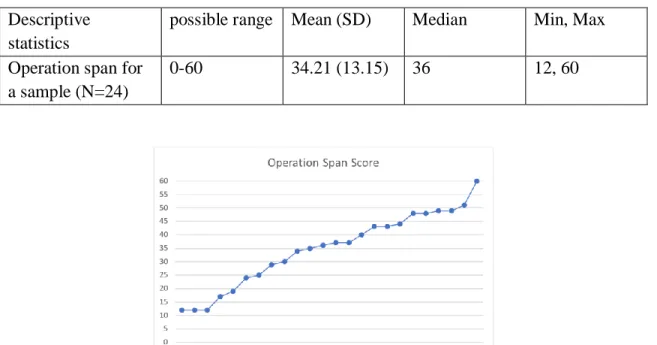
provided in Table 6 and individual scores is presented in Figure 3. As one can see,
participants’ operation span scores covered a wide enough range and were nicely
distributed within the range. For analysis, I divided participants into low- and high-
groups using a median split. The operation scores were divided at 36 (low=0-36,
high=37-60). This binary classification may result in loss of information, but given my
low number of participants, I felt this would allow more reliable analysis.
Table 6. Descriptive statistics for operation span score
Descriptive statistics
possible range Mean (SD) Median Min, Max
Operation span for a sample (N=24)
0-60 34.21 (13.15) 36 12, 60
5.2 Effects on users’ perception
The alpha level for all analyses was set at .05. The central analysis for this study
was a 2 (working memory: high and low) X 2 (level of task complexity: simple and
complex) mixed-factor ANOVA. The main effects of task complexity and working
memory capacity, as well as the interactions between those two factors, were examined,
using dependent variables of measures of search behavior and self-reported responses
from a post-task questionnaire. For the exploratory purpose of the study, I considered
participants’ responses to each TLX item.
My first research question (RQ1) investigates whether task complexity affects
users’ perception of their own performance while performing tasks of varying levels of
complexity. I conducted one-way ANOVA analysis for each of measures I used in the
post-task survey. Table 7 shows the means and standard deviations of all items, and the
results of the ANOVA. Significant main effects were detected for temporal demand and
satisfaction for the time spent on a task. None of the other measures showed a
significantly strong relationship with task complexity. Participants reported greater
temporal demand and lower level of satisfaction with time spent on a task during a
complex task.
Table 7. Mean (Standard deviation) responses to the post-task survey items
according to task complexity, F statistics and p-value
Simple task
Complex task
F (p<0.05*)
TLX Mental demand 2.58
(1.412)
2.88 (1.227)
F(1, 46)=.584, p=.449
Temporal demand 2.54 (1.414)
3.38 (1.135)
Performance 3.96 (.806) 3.63 (.770) F(1, 46)=2.146, p=.150
Effort 3.04
(1.268)
3.29 (1.197)
F(1, 46)=.493, p=.486
Satisfaction Enough information 3.96 (1.042)
3.46 (1.250)
F(1, 46)=2.265, p=.139
Time spent on the task 3.92 (1.100)
3.13 (1.154)
F(1, 46)=5.918, p=.019*
Amount of information found 3.83 (1.167) 3.42 (1.176) F(1, 46)=1.517, p=.224
Quality of information found 3.79 (1.179) 3.50 (1.180) F(1, 46)=.734, p=.396
Strategies taken 4.17 (.761) 3.83 (.816) F(1, 46)=2.140, p=.150 Locus of control
Internal_ability 4.92 (1.886)
4.83 (1.880)
F(1, 46)=.023, p=.879
Internal_effort 5.46 (1.587)
5.33 (1.926)
F(1, 46)=.060, p=.807
External_task 5.29
(1.334)
5.50 (1.319)
F(1, 46)=.296, p=.589
External_system 4.54 (1.474)
4.21 (1.444)
F(1, 46)=.626, p=.433
My second RQ (RQ2) investigates whether working memory influences users’
perception toward their own experience during a search task. No main effect of working
memory capacity has been found from participants’ responses to the post-task
questionnaire. The F-statistics are not reported here to conserve space and were all
smaller than 1.5. However, temporal demand of workload showed a relationship leaning
toward significance [F(1, 46)=2.353, p=.132] and the ability dimension of internal locus
of control almost attained significance [F(1, 46)=3.650, p=.062]. The mean values with
Figure 4. Trend analysis of working memory capacity for users’ perceptions
To address RQ3, I examined the joint effect of task complexity and working
memory on the users’ perception. A two-way ANOVA yielded significant interaction
effects for temporal demand [F(2, 45)=3.907, p=.027] and marginal significance for
satisfaction with the time spent on a task [F(2, 45)=2.967, p=.061]. The effect of
cognitive ability on perceived temporal demand and the level of satisfaction with time
spent per task was stronger in the complex task condition. Figure 5 shows the means and
95% confidence intervals for those two post-task measures. No significant interaction
effects were found for other measures (all F < 2). The results show low- group
participants experienced higher temporal demand than high- group participants, and the
difference was greater in complex task condition. Also, participants reported a lower
level of satisfaction with the time they spent on complex task than simple task, and the
Figure 5. Interaction effects of task complexity and working memory capacity
found on users’ perception
5.3 Effects on users’ search behavior
The same statistical analysis was conducted to see the effect of working memory
and task complexity on each measure of search interactions (i.e., queries, a length of
query, clicks, time spent until 1st click, session length, and time between events). For my
first research question (RQ1), I investigated the main effect of task complexity on users’
search behavior and no significant relationship was found for any of search interaction
measures (all F < 1) except a marginal significance found for queries [F(1, 46)=2.595,
p=.114].
My second RQ (RQ2) examines the effect of working memory capacity on users’
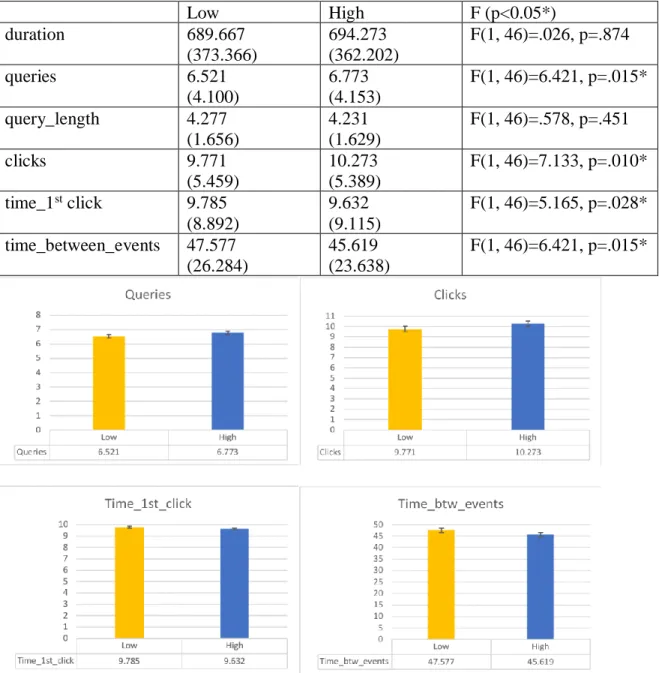
search behavior. Table 8 shows the means and standard deviations of all items, and the
results of the ANOVA. Significant main effects were detected for queries, clicks, time
taken until the first click, and time between events (i.e., query issues, clicks, etc.). To
better understand the trends for the main effect of working memory capacity, Figure 6 is
attached for the measures that returned significant relationship. Overall results strongly
suggest that working memory capacity has an impact on users’ search behavior. High-
group participants exerted more effort than low- group participants by issuing more
queries and more clicks, and low- participants took longer time until the first click and
between search activities throughout the whole session. This trend of high- group
participants performing activities but spending less time per activity suggests the idea of
should also note that the effect sizes are very small; It is possible that this could be due to
the use of median split in the analysis.
Table 8. Mean (Standard deviation) value for search interaction measures
according to working memory capacity, F statistics and p-value
Low High F (p<0.05*)
duration 689.667
(373.366)
694.273 (362.202)
F(1, 46)=.026, p=.874
queries 6.521
(4.100)
6.773 (4.153)
F(1, 46)=6.421, p=.015*
query_length 4.277 (1.656)
4.231 (1.629)
F(1, 46)=.578, p=.451
clicks 9.771
(5.459)
10.273 (5.389)
F(1, 46)=7.133, p=.010*
time_1st click 9.785 (8.892)
9.632 (9.115)
F(1, 46)=5.165, p=.028*
time_between_events 47.577 (26.284)
45.619 (23.638)
F(1, 46)=6.421, p=.015*
Figure 6. Main effects of working memory on search behavior (i.e., queries, clicks,
For my third RQ (RQ3), I conducted a two-way ANOVA to understand if there is
an interaction between the working memory capacity and task complexity for search
behavior. Significant interaction effects were detected on queries [F(2, 45)=3.635,
p=.034] and clicks [F(2, 45)=4.187, p=.022]. Also, marginal significance was found for
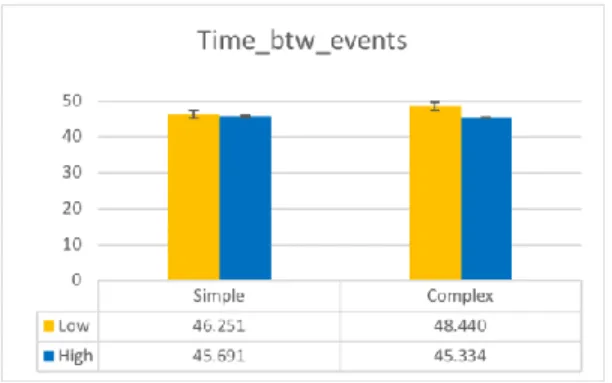
time between events [F(2, 45)=3.141, p=.053]. Figure 7 shows the means and 95%
confidence intervals for queries, clicks and time between events. No significant
interaction effects were found for other measures (all F < 3). Trend analysis show that
main effect of working memory was greater in simple task condition for queries and
clicks measures. However, in terms of time between search activities, the variance caused
by working memory capacity was much greater under complex task condition than
simple task condition. Low- group participants took much longer time between search
activities than high- group participants especially when performing a complex task. Here
also, effect sizes were found to be relatively small. Again, it is possible this may be
attributable to the use of median split which can potentially cause a loss of effect size and
Figure 7. Interaction effects of task complexity and working memory capacity
6. Discussion
The findings from this study provided some insights about the relationship
between working memory, task complexity and search behavior as well as users’
perceptions about their experience. Task complexity had a significant main effect on
users’ perceived temporal workload (one dimension of workload considered in the
NASA-TLX) as well as perceived level of satisfaction with time spent on a task. Yet, it
didn’t show any significant relationship with search behavior measures, which was not
exactly in line with the findings of similar studies conducted (Brennan, Kelly & Arguello,
2014; Capra, Arguello, Crescenzi & Vardell, 2015). It is possible that users’ perception
was affected by confounding factors such as task topic and their prior knowledge about it,
hindering the direct effect of manipulated factor (i.e., task complexity). In future studies,
I intend to administer manipulation check to ensure that participants experienced the
planned contrast between the two conditions. But, even then, the analysis revealed a
significant effect of task complexity on users’ time perception.
Working memory capacity had a significant main effect on several search
behavior measures. High- group participants exhibited more search activities (i.e., queries
and clicks) at a faster pace (i.e., shorter time until 1st click and shorter lag times between
activities). This result was expected given that working memory capacity correlates
comparatively highly with information processing speed (Kyllonen & Christal, 1990). It
is worth noting that participants were instructed that they could stop searching any time
difference found in task duration between high- and low- group. High-
participants carried out as much search activities during simple tasks as they did with
complex tasks, while low- participants did less with less complex tasks. This suggests
that users may have a different view or expectation in task completion according to their
working memory capacity. In other words, task completion can be interpreted differently
depending on users, rather than the number of requirements determine the amount of
effort required for task completion. This may also suggest a correlation between working
memory capacity and other constructs such as a need for cognition (Wu & Kelly, 2015).
With regard to locus of control measure, I assumed that low- group participants
may experience more difficulties in performing complex task, possibly produce
incomplete or partial search outcome and attribute the outcome to external cause such as
task difficulty. On the other hand, I hypothesized that high- group participants would
encounter fewer difficulties when seeking information, more likely complete a task to
one’s satisfaction and attribute the outcome (task success) to internal cause such as one’s
search ability or effort. However, I couldn’t find any significant relationship between
working memory and locus of control scale except that there was a marginal significance
detected for the ability dimension of locus of control measures. General trend showed
that high- group participants tended to attribute the outcome to one’s search ability more
than low- group participants.
One possible explanation for why locus of control measure did not show a
significant relationship with either task complexity or cognitive ability is that because I
did not include a half of the subscale. For the sake of simplicity, I only utilized items for
incomplete performance in the current study. The subscales of MMCS
(Multidimensional-multiattributional causality scales) contrasts the responses to success
and failure and is designed to measure the attribution (causal belief) of both success and
failure with respect to internal or external goal specific locus of control.
Lefcourt (1981) once argued that if one wished to create a locus of control index
that would allow for precise predictions of human behavior, each of the subscales would
be of vital concern. He also pointed out that positive and negative outcomes are often
construed differently by the same persons; hence the responses to success, or positive
outcomes, and failure, or negative outcomes should be assessed separately if only to
make possible an exploration of the effects of such differential responding to events.
Despite the concerns, I didn’t strictly follow the given instructions, which can be
acknowledged as a limitation of the study. I was under the assumption that all the
participants will one way or another complete a whole task in a given time, which turned
out not necessarily the case for everyone. So, asking if the main ingredient of task
completion was one’s search ability was not a proper question to ask to those who
couldn’t quite complete a task to their satisfaction. This will be reflected in my future
studies.
Notwithstanding the limitation, the study shows interesting patterns of interaction
dynamics between task complexity and working memory capacity on users’ search
behavior and perception of their performance. Working memory capacity had a stronger
effect in complex task condition and this was primarily caused by low- group participants
showing behavioral change. Additionally, even though the relationship was only
high- group participants with both simple and complex tasks and they experienced even
more temporal demands in complex task; whereas, high- group participants showed no
difference in perceived temporal demand according to task complexity. Altogether, it
suggests that task complexity may have a bigger impact on people with lower working
memory capacity by imposing a greater challenge for them to cope with. However,
caution must be applied in assessing the effect due to the small effect size. It could be
partly because I used the median splits in data analysis, which could result in increases in
Type II errors through loss of contrast (McClelland, Lynch, Irwin, Spiller & Fitzsimons,
2015).
I did not include analysis of participants’ search outcome (i.e., notes and
justification) for tasks in this paper. I plan to analyze the responses in future work. It will
be interesting to see if there is any gap between participants’ perception of their own
7. Conclusion
In this study, I examined the ways in which users’ working memory capacity
impacts their search behaviors and perceptions while conducting search tasks of varying
complexity.
My work makes the following contributions to the IIR research community. First,
it confirmed an effect of task complexity on perceived mental load (although it returned
significance with only one subscale; temporal demand). Second, it also yielded
supporting evidence of cognitive ability playing a key role in users’ web searching.
Third, it provided findings about the general adult population with good variability in
working memory. Fourth, it used operation task for measuring one’s complex working
memory. To my knowledge, there has been no studies in the field that investigated
working memory capacity using OSPAN which is designed to capture simultaneous
storage and processing in conditions of interference that has high overlap with real-world
information seeking situations. Fifth, it adopted the locus-of-control scale in task-based
information retrieval setting as an attempt to understand users’ attributional style for the
causality of search task performance and outcome.
My findings reveal patterns of users with lower working memory experiencing
greater demand, exerting fewer activities at a slower pace, and reporting a lower level of
satisfaction. And, the impact of this cognitive ability was more prominent when users
working on a more complex task. Although a significant relationship has been found, the
more research is needed to examine the impacts more closely. Considering the usage of
web search engines should not be restricted only to simple tasks but also be able to
address users’ complex need, the finding can call attention to the need for supplementary
tools that could help users mitigate the difficulties they may experience during the
complex search. Furthermore, since our cognitive abilities can show a decline with
advanced age, design of search interfaces that enable customizing the interactions can be
8. Acknowledgements
This project would not have been possible without the help and support of Robert
9. Reference
J. Arguello, W.-C. Wu, D. Kelly, and A. Edwards. Task complexity, vertical display and user interaction in aggregated search. In SIGIR, pages 435–444. ACM, 2012.
J. Arguello, Predicting Search Task Difficulty. In Proceedings of the 36th European Conference in Information Retrieval (ECIR'14), 2014.
Atkinson, R. C., & Shiffrin, R. M. (1968). Human Memory: A Proposed System and its Control Processes. Psychology of Learning and Motivation - Advances in Research and Theory, 2(C), 89–195. https://doi.org/10.1016/S0079-7421(08)60422-3
Brennan, K., Kelly, D., & Arguello, J. (2014). The Effect of Cognitive Abilities on Information Search for Tasks of Varying Levels of Complexity. In Proceedings of the 5th Information Interaction in Context Symposium (pp. 165–174). New York, NY, USA: ACM. https://doi.org/10.1145/2637002.2637022
Campbell, D. J., 1988. Task Complexity: A Review and Analysis. Acad Manage Rev, 13, 1, 40-52.
Walhout, J., Oomen, P., Jarodzka, H., & Brand-Gruwel, S. (2017). Effects of Task Complexity on Online Search Behavior of Adolescents. J. Assoc. Inf. Sci. Technol., 68(6), 1449–1461. https://doi.org/10.1002/asi.23782
Capra, R., Arguello, J., Crescenzi, A., & Vardell, E. (2015). Differences in the Use of Search Assistance for Tasks of Varying Complexity. In Proceedings of the 38th International ACM SIGIR Conference on Research and Development in Information Retrieval (pp. 23–32). New York, NY, USA: ACM.
https://doi.org/10.1145/2766462.2767741
Case, R., Kurland, M. D., & Goldberg, J. (1982). Operational efficiency and growth of short-term memory span. Journal of Experimental Child Psychology, 33, 386-404.
Conway, A. R. A., Cowan, N., Bunting, M. F., Therriault, D. J., & Minkoff, S. R. B. (2002). A latent variable analysis of working memory capacity, short-term memory capacity, processing speed, and general fluid intelligence. Intelligence, 30, 163 – 183.
De Waard D. (1996). The Measurement of Drivers’ Mental Workload. Ph.D. thesis, Traffic Research Center, Groningen University, Groningen.
Diamond, A. (2013). Executive Functions. Annual Review of Psychology, 64(1), 135– 168. https://doi.org/10.1146/annurev-psych-113011-143750
Dweck, C. S., & Reppucci, N. D. (1973). Learned helplessness and reinforcement responsibility in children. Journal of Personality and Social Psychology, 25, 109-116.
Dweck, C. S., Davidson, W., Nelson, S., & Enna, B. (1978). Sex differences in learned helplessness: II. The contingencies of evaluative feedback in the classroom and III. An experimental analysis. Developmental Psychology, 14(3), 268–276.
https://doi.org/10.1037/0012-1649.14.3.268
Egan, D. E., Bowers, C., & Gomez, L. M. (1982). Learner characteristics that predict success in using a text-editor tutorial. Proceedings of the Conference on Human Factors in Computing Systems, Gaithersburg, Maryland.
Engle, R. W., Tuholski, S. W., Laughlin, J. E., & Conway, A. R. A. (1999). Working memory, short-term memory and general fluid intelligence: A latent variable approach. Journal of Experimental Psychology: General, 128, 309-331.
Fisk, J. E., & Warr, P. (1996). Age and working memory: the role of perceptual speed, the central executive, and the phonological loop. Psychology and Aging, 11(2), 316–323.
Francis, G., Neath, I., & Mackewn, A. (n.d.). Student Manual for CogLabTM, 122.
Gao, Q. (2011). An Empirical Study of Tagging for Personal Information Organization: Performance, Workload, Memory, and Consistency. International Journal of Human- Computer Interaction, 27(9), 821-863.
Gomez, L. M., Egan, D. E., Wheeler, E. A., Sharma, D. K., & Gruchacz, A. M. (1983). How interface design determines who has difficulty learning to use a text editor. Proceedings of the SIGCHI Conference on Human Factors in Computing Systems, Boston, MA.
Gomez, L. M., Egan, D. E., & Bowers, C. (1986). Learning to use a text editor: Some learner characteristics that predict success. Human Computer Interaction, 2(1), 1-23.
Gwizdka, J. (2009). What a difference a tag cloud makes: Effects of tasks and cognitive abilities on search results interface use. Information Research, 14(4).
Gwizdka, J. (2017). I Can and So I Search More: Effects of Memory Span On Search Behavior. In Proceedings of the 2017 Conference on Conference Human Information Interaction and Retrieval (pp. 341–344). ACM.
Haapalainen, E., Kim, S. J., Forlizzi, J. F., & Dey, A. K. (2010). Psycho-physiological measures for assessing cognitive load. Proceedings of the ACM International Conference on Ubiquitous Computing, Copenhagen, Denmark.
Hart, S. G., & Staveland, L. E. (1988). Development of NASA-TLX (Task Load Index): Results
of empirical and theoretical research. In P. A. Hancock & N. Meshkati (Eds.), Human Mental Workload. Amsterdam: NH Press.
Hüsser, A. P. (2017). Median Split. In The International Encyclopedia of Communication Research Methods (pp. 1–2). American Cancer Society.
https://doi.org/10.1002/9781118901731.iecrm0148
B. J. Jansen, D. Booth, and B. Smith. Using the taxonomy of cognitive learning to model online searching. Inf. Process. Manage., 45(6):643–663, Nov. 2009.
Jex, H. R. (1988). Measuring mental workload: Problems, progress, and promises. In P. A. Hancock & N. Meshkati (Eds.), Human Mental Workload (Vol. 52, pp. 5-39). Amsterdam, The Netherlands: Elsevier Science Publishers B.V.
Kahneman, D. (1973). Attention and effort. Prentice-Hall.
Kane, M. J., Hambrick, D. Z., Tuholski, S. W., Wilhelm, O., Payne, T. W., & Engle, R. W. (2004). The generality of working memory capacity: A latent-variable approach to verbal and visuo-spatial memory span and reasoning. Journal of Experimental
Psychology: General, 133, 189-217.
Kelton, A. S., & Pennington, R. R. (2012). Internet financial reporting: The effects of information presentation format and content differences on investor decision making. Computers in Human Behavior, 28(4), 1178–1185.
Klein, K., & Fiss, W. H. (1999). The reliability and stability of the Turner and Engle working memory task. Behavior Research Methods, Instruments, & Computers, 31, 429-432.
Kuhlthau, C.C. (1919). Inside the search process: Information seeking from the user’s perspective. Journal of the American Society for Information Science, 42, 361-371.