0
Fetomaternal Outcomes of Grand Multiparas
Over Two Decades in Mali
By
Amelia Walling Maïga
A Master’s Paper submitted to the faculty of the University of North Carolina at Chapel Hill
in partial fulfillment of the requirements for the degree of Master of Public Health in
the Public Health Leadership Program.
Chapel Hill
2010
_______________________ (date) _______
Advisor:
_______________________ (date) _______
1
Table of Contents
Manuscript ... 2
Abstract ... 4
Introduction ... 5
Methods ... 6
Results ... 10
Discussion... 12
Figures ... 16
Tables ... 17
Addendum #1: Introduction ... 21
Definition of Grand Multiparity ... 21
Methods ... 21
Critical Appraisal ... 23
Maternal and obstetric risk ... 23
Fetal and neonatal risk ... 30
Summary ... 37
Research Question ... 39
Addendum #2: Discussion ... 40
2
Manuscript
Fetomaternal outcomes of grand multiparas over two decades in Mali
Authors:
Ibrahima TEGUETE, MD*
Gabriel Touré Teaching Hospital, Department of Obstetrics and Gynecology, Bamako, Mali
Amelia W. MAIGA, MPH*§
Duke University School of Medicine, Durham, NC, USA
§
August 2010
Phyllis C. LEPPERT, MD, PhD
Department of Obstetrics and Gynecology, Duke University School of Medicine, Durham, NC, USA
*Both authors contributed equally to this research report. Dr. Teguete is responsible for the establishment and maintenance of the Point G National Hospital Obstetrical database. He contributed to the study design, interpretation of the study, and substantially to the manuscript preparation. Ms. Maiga is responsible for the study design, all statistical analyses, substantial interpretations of results, and the writing of the manuscript.
Source of financial support: None
Presentation information: None
Author responsible for reprint requests:
Name: Amelia W. Maiga
Address: 79 Central Avenue, Hamburg, NY, 14075 E-mail: [email protected]
Corresponding author:
Name: Amelia W. Maiga
Address: 79 Central Avenue, Hamburg, NY, 14075 Telephone: 716-631-2962
3 Article condensation:
A higher odds for placental abnormalities, perinatal death, and high birthweight, but lower
odds for maternal death found for multiparas in Mali.
Short version of article title:
4
Abstract
Objective: To analyze the association between grand multiparity and maternal and perinatal
morbidity and mortality.
Study design: Cross-sectional study of 18,697 singleton births at a tertiary care hospital in Mali
(1985-2003) compared outcomes between 3,617 grand multiparas (para ≥5) and 9,723
pauciparas (para 1-4). Odds ratios [OR] were adjusted for maternal age, prenatal care utilization,
socioeconomic status, and region of origin.
Results: Grand multiparas were older, poorer, and less likely to have accessed prenatal care.
Grand multiparas had a lower adjusted odds of maternal death (adjusted OR, 0.66; 95% CI,
0.45-0.97), but higher odds of perinatal death (adjusted OR, 1.33; 95% CI, 1.12-1.59), placental
abnormalities (adjusted OR, 1.57; 95% CI, 1.21-2.05), and high birthweight (adjusted OR, 1.42;
95% CI, 1.05-1.92).
Conclusion: The healthy person effect may explain grand multiparas’ lower odds of maternal
death. Reducing grand multiparity and improving grand multiparas’ access to prenatal care may
improve population-level perinatal outcomes.
Ibrahima TEGUETE, Amelia W. MAIGA, and Phyllis C. LEPPERT
Key words: Grand multiparity
Mali
5
Introduction
The International Federation of Gynecology and Obstetrics (FIGO) and most recent
literature define grand multiparity as parity ≥5.1-4 Recent attention to a global decline in maternal
mortality rates has reemphasized the presumed causality between population-level multiparity
and maternal mortality.5-6 Grand multiparity has historically been associated with numerous
maternal and perinatal adverse outcomes, including maternal death,7-9 post-partum infection,7, 9
uterine rupture,10 post-partum hemorrhage,1, 9-10 placental abnormalities,1-2, 11-13 toxemia,10, 14
stillbirth,4, 9, 15-16 neonatal death,3, 17-18 low birthweight or prematurity,19 and high birthweight or
macrosomia.2, 20 A 2005 review cited widespread poor study design and heterogeneous outcome
definitions, but did find evidence for a higher risk of placental pathologies and increased
birthweight with increasing parity.2
However, researchers from developed countries with uniform prenatal care have
challenged the characterization of high multiparity as an independent risk factor, highlighting the
potent confounding effects of increased maternal age and differential socioeconomic status and
prenatal care.14, 21-22 Many of these studies tending towards the null hypothesis are limited in
sample size, making valid conclusions about rare outcomes like mortality and uterine rupture
difficult.2 In contrast, some well-powered studies have demonstrated a persistent link between
grand multiparity and feto-neonatal risks even after accounting for confounders.3, 16-17, 19 Grand
multiparity remains highly relevant in most African countries where the total fertility rate
exceeds five.23 Immigrant populations in developed countries have similarly high birth rates.24 In
light of the globally insufficient and conflicting literature, we need robust studies from contexts
6 The primary aim of the present study was to determine whether grand multiparity is
independently associated with maternal and perinatal mortality, placental abnormalities, obstetric
complications, and abnormal neonatal birth weight after adjusting for confounders. Second, we
explored any dose-response relationships between parity and specific adverse outcomes. Finally,
we evaluated how a reduction in the average parity of multiparous Malian women between 1985
and 2003 contributed to a reduction in perinatal mortality over this time.
Methods
This cross-sectional study was conducted at Point G National Hospital, a tertiary referral
facility in Bamako, the capital city of Mali. One of the poorest countries in the world, Mali ranks
178 out of 182 on the United Nations Human Development Index.25 The current total fertility
rate in Mali is 6.5 children per woman, down from 7.4 in 1990.23 Point G is an
academically-affiliated referral center that provides emergency obstetric and gynecologic care to women
referred or evacuated from health centers across Mali, in addition to routine prenatal and delivery
care to a catchment area of approximately 10% the population. Pregnant women are also
frequently cared for by the surgery, urology, anesthesia, and internal medicine departments.
The initial study population was all pregnant women admitted to Point G National
Hospital between January 1, 1985 and December 31, 2003 (n=19,253). Multiple births (n=556)
were excluded to avoid confounding, leaving 18,697 singleton births. Of the 18,076 women
(96.7%) with parity data, 3,617 grand multiparas (para ≥5) and a comparison group of 9,723
pauciparas (para 1-4) were identified. Nulliparas (n=4,736) were not included in the comparison
group due to their higher obstetric risk.17 No further exclusion criteria were applied for assessing
7 weeks (n=1,617), including all spontaneous and therapeutic abortions (n=840), and molar (n=43)
and ectopic (n=570) pregnancies. Ten additional ectopic pregnancies discovered after 28 weeks
gestation were also excluded, giving a final perinatal population of 17,070.
As previously described,26 data from all relevant department records were integrated into
a single computer database to minimize under-reporting. In neighboring Burkina Faso, 70% of
in-hospital maternal deaths were missed using obstetric records only.27 Data were double
abstracted by two independent trained individuals to ensure accuracy, with discrepancies
resolved by a third party.Due to the 19-year period from which data were collected and the lack
of a unique identifier for each woman, some may have contributed more than one delivery to the
study. Maternal and perinatal mortality and morbidity outcomes, admission type, pregnancy type
(i.e., ectopic, abortion, molar, or normal), week of gestation, parity, birth interval, and basic
socio-demographic data were collected. Follow-up data after hospital discharge were not
available except in rare cases of re-admission. Research protocols and data were approved by the
ethics committee of the Faculty of Medicine, Pharmacy, and Dentistry at the University of
Bamako. Institutional review board exemption was obtained from Duke University on the basis
of a de-identified database.
The primary outcomes of this study were maternal and perinatal mortality. We defined
maternal mortality using the World Health Organization definition as “the death of a woman
while pregnant or within 42 days after termination of pregnancy, irrespective of the duration and
site of the pregnancy, from any cause related to or aggravated by the pregnancy or its
management, but not from accidental or incidental causes.”28 However, deaths after hospital
discharge were not captured.Perinatal mortality included stillbirths and early neonatal deaths (up
8 Secondary obstetric outcomes included placental abnormalities (a composite of previa
and abruption, defined clinically), uterine rupture (determined during cesarean), post-partum
infection (defined clinically), post-partum hemorrhage (≥500 ml blood loss within 24 hours after
delivery), eclampsia (defined clinically), and cesarean delivery. We also compared average
neonatal birth weights and proportions of low birthweight (<2500 g) and high birthweight
(>4000 g) infants. Because reliable dating techniques like early ultrasound are infrequent in
Mali, we were unable to reliably distinguish between small for gestational age and preterm
infants. We thus used the composite outcome of low birthweight. Similarly, high birthweight
infants included both large for gestational age and post-term infants.
We defined parity as the number of previous pregnancies either ≥22 weeks or resulting in
an infant ≥500 g (stillborn or live). Parity was the principal covariate, divided into para 1-4 and
para ≥5. We also used parity as a categorical variable (para 1-4, 5-6, 7-9, and ≥10). Great-grand
multiparas were defined as those with ≥10 prior pregnancies. Covariates included as potential
confounders were maternal age (both as a simple continuous variable and as number of years
over age 30), socioeconomic status (low, medium, and high), region of origin (greater Bamako
area vs. outside Bamako), and prenatal care utilization (any vs. none). Covariates were checked
for association with each outcome using Pearson’s correlation coefficient. Relative
socioeconomic status was determined using a culturally-appropriate algorithm that paired a
woman’s profession with that of her partner. Region of origin was an additional proxy for
socioeconomic status. While maternal smoking status is another potent confounder,17 the female
smoking rate in Mali is negligible (<3%) and contributes minimally to adverse fetomaternal
9 We first characterized the study population in terms of basic demographics and mode of
admission. Means or medians were reported for continuous variables and percentages for
categorical variables. Next, we compared unadjusted outcomes between grand multiparas and
pauciparas using Student’s t-test (or the Wilcoxon rank-sum test for nonparametric data) for
continuous outcomes and Pearson’s chi-square test for categorical outcomes. We then
constructed multivariable models (multiple linear regression for birth weight, logistic regression
for the dichotomous outcomes) with the four confounders. Results are expressed as odds ratios
with 95% confidence intervals. All models were run in duplicate with a time cohort adjustment
to assess for temporal effects. Multiple imputations (n=5) were done to account for missing data,
and all models were re-run on this imputed dataset. Results are from the original dataset unless
otherwise noted. Stata version 11 (Stata Corp, College Station TX, USA) was used for all
analyses. P values <.05 were considered statistically significant.
Dose-response analysis involved comparing the rates of each significant outcome by
individual parity group, with P values calculated from the likelihood ratio test for the difference
of the adjusted probabilities. Great-grand multiparas (para ≥10) were pooled due to small sample
size. Finally, we correlated mean institutional parity with institutional perinatal mortality rates,
both unadjusted and adjusted for parity, after stratifying the study population into four time
cohorts of roughly equivalent observations (1985-1988, 1989-1992, 1993-1997, and 1998-2003).
Nulliparas were excluded to avoid confounding. In addition to confounders, we also adjusted
perinatal mortality for changes in referral patterns over time. Previous work demonstrated that
increases in the proportion of referred cases masked a significant drop in institutional maternal
10
Results
Of the 18,076 women with parity data, 26.2% were nulliparas, 53.8% pauciparas, 20.0%
grand multiparas, and 1.6% great-grand multiparas (Table 1). This distribution did not differ
substantially in the perinatal study population. In comparison to pauciparas, grand multiparas
were significantly older and of lower socioeconomic status. They were more likely to be from
outside Bamako and to have been evacuated from another facility to the hospital, and less likely
to have accessed prenatal care (Table 2). The age distribution by parity group was particularly
illuminating because of the minimal overlap: three-quarters of pauciparas were under age 30,
whereas three-quarters of grand multiparas were over 30.
The unadjusted maternal mortality rate (MMR) in grand multiparas was significantly
higher than that in pauciparas (2.7% vs. 1.5%, p<.01) (Table 3). Eighty-three (20.4%) of the 407
maternal deaths occurred in women with missing parity data, but age was recorded for 71
(85.5%) of these 83. The difference in MMR remained significant after distributing these 71
deaths among parity groups based on estimations derived from the differential age distribution of
nulliparas, pauciparas, and grand multiparas (3.2% vs. 1.8%, p<.01). The top three causes of
maternal mortality were uterine rupture (25.7%), partum hemorrhage (21.0%), and
post-partum infection (19.8%). After adjusting for confounders, grand multiparas had a significantly
lower odds of maternal death (adjusted OR, 0.66; 95% CI, 0.45-0.97) (Table 4).
Excluding pregnancies ending <28 weeks, there were 1,911 perinatal deaths. Perinatal
death was more frequent in grand multiparas than in pauciparas (17.9% vs. 9.1%, p<.01) (Table
3), and this association persisted on multivariable analysis (adjusted OR, 1.33; 95% CI,
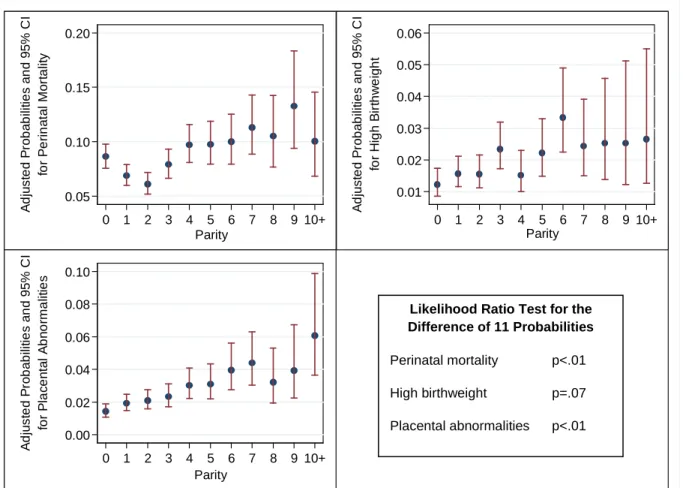
11 mortality and parity, with the lowest adjusted odds in women of para 2 and the highest in para ≥4
(Fig 1). An absolute 2.5% reduction in the adjusted institutional perinatal mortality rate (PMR)
(from 7.5% in 1985-1988 to 5.0% in 1998-2003) paralleled an absolute 0.58 reduction in mean
institutional parity (3.63 to 3.05). Further adjusting the change in PMR for parity reduced this
absolute PMR reduction to 2.2% (7.3% minus 5.1%). This difference of 0.3% (2.5% minus
2.2%) in the absolute PMR reduction over time can be thus solely attributed to parity reductions.
Placental abnormalities included 390 cases of previa and 158 abruptions (7 had both).
Grand multiparas had twice the rate of placental abnormalities than did pauciparas (5.8% vs.
2.6%, p<.01) (Table 3). In the adjusted analysis grand multiparas remained at higher odds for
placental abnormalities (adjusted OR, 1.57; 95% CI, 1.21-2.05) (Table 4). Adjusted odds ratios
for previa and abruption were 1.41 (95% CI, 1.04-1.92) and 2.07 (95% CI, 1.28-3.36). Odds of
abruption also correlated with parity; women of para 5-6, 7-9, and ≥10 had adjusted odds ratios
of 1.98 (95% CI, 1.14- 3.44), 1.99 (95% CI, 1.03-3.84), and 3.91 (95% CI, 1.40-10.93),
respectively. Grand multiparas under age 35 had a particularly high adjusted odds of placental
abnormalities at 1.70 (95% CI, 1.26-2.32), whereas this association was not significant for
women ≥35 (p=.19). Dose-response analysis demonstrated a clear positive step-wise interaction
between parity and placental abnormalities, beginning with 3.1% at a parity of 5 and increasing
to 6.1% among great-grand multiparas (Fig 1).
Women delivering via cesarean were more likely to be diagnosed with any placental
abnormality (70.6% vs. 29.4%, p<.01), and three times as likely to be diagnosed with previa
(76.6% vs. 23.4%, p<.01). Adjusting for cesarean delivery in the models strengthened the
association between grand multiparity and placental abnormalities from an adjusted odds ratio of
12 The mean neonatal birth weight was 2983 grams. In the unadjusted analysis grand
multiparas had significantly heavier babies than did pauciparas (3058 g vs. 3016 g, p<.01) (Table
3). In the multivariable analysis, birth weight as a continuous outcome was not associated with
grand multiparity (p=.39). However, grand multiparas were at higher odds for high birthweight
infants (adjusted OR, 1.45; 95% CI, 1.07-1.95) (Table 4). High birthweight infants had twice the
mortality rate than normal weight infants (PMR 20.1% vs. 8.4%, p<.01).
Grand multiparas had significantly higher unadjusted rates of uterine rupture (5.4% vs.
2.7%, p<.01) and post-partum hemorrhage (PPH) (4.6% vs. 2.5%, p<.01) (Table 3). Upon
multivariable analysis, grand multiparas had a lower adjusted odds ratio of cesarean delivery
than pauciparas (0.54; 95% CI, 0.47-0.62) (Table 4). Other obstetric complications did not differ
significantly between pauciparas and grand multiparas on multivariable analysis.
Discussion
This cross-sectional study of 18,697 women delivering at a tertiary referral facility in
Mali sought to determine whether grand multiparity is independently associated with serious
fetomaternal outcomes. After adjusting for confounders, paucipara mothers were actually 52%
more likely than grand multiparas to die. Grand multiparity did confer a 33% increased odds of
perinatal death and a 59% increased odds of placental abnormalities over that in pauciparas.
Confirming previous studies,2, 20 grand multiparas were also 42% more likely to deliver high
birthweight (>4000 g) infants. This represents the largest published study of grand multiparas in
Africa to date and the only to employ multivariable analysis (MEDLINE; 1952-May 2010;
13 Strengths of our study include its large sample size allowing for comparison of rare
complications and our ability to adjust for all recognized confounders. While our study’s
observational nature precludes conclusions on causality, including time as a covariate in the
models did not change any conclusions, reducing the likelihood of temporal bias. We do rely on
data from a single institution, but our population is reasonably representative of the Malian
health care system as >30% of women were referred or evacuated from outside facilities. The
major limitation of our study is the potential for measurement bias. We were limited to
comparing in-hospital mortality rates, and were unable to meaningfully compare birth intervals,
as they were missing for 39% of observations in our study and self-reported intervals lack
precision in Mali. Previous authors have hypothesized that grand multiparity may be a proxy risk
factor for an abbreviated birth interval.15, 18
Recent global reductions in maternal mortality have been attributed to decreasing parity.
5-6
This study does not support that assumption. Our surprising finding of a negative association
between grand multiparity and maternal mortality confirms the paramount importance of
maternal age, prenatal care utilization, and socioeconomic status on grand multiparas’ outcomes.
Two additional factors may be at play. The “healthy person effect” means women who
experience obstetric complications in earlier deliveries are more likely to end their childbearing
early either voluntarily or involuntarily (e.g., by perishing during a delivery).15 Pauciparas were
also 85% more likely to deliver via cesarean. Women delivering via cesarean had a 5.5% MMR
as compared to 0.8% in those delivering vaginally.
Our most clinically relevant finding was the strong correlation between increased parity
and perinatal mortality that persisted even after adjusting for the potent confounder of maternal
14 a strong dose-response relationship between increasing parity >10 and stillbirth risk.16 We
hypothesize the reduction in institutional PMR during our study period to be due in part to a
decrease in the mean parity of multiparous women and in part to better care at Point G Hospital
and the improved condition of referred and evacuated patients. In 1994 a National Perinatality
Program reorganized the referral system to better link primary health centers to facilities like
Point G, dramatically reducing the institutional MMR.31 While prospective studies must establish
causality, population-level reductions in parity may also reduce perinatal mortality.
Grand multiparas, particularly those <35 years, were at increased odds of placental
abnormalities in our study, confirming two population-based studies’ findings.3, 13 Increasing
maternal age increases previa risk by changing uterine blood flow.13 Similarly, in young grand
multiparas the cumulative effects of many deliveries may prematurely age the uterus and
increase the subsequent risk of developing previa.32 Although hypertension has long been
hypothesized to place a causal role in placental abruption in grand multiparas,11 women with
abruption in our study did not have higher blood pressure readings. Rather, nutritional
deficiencies may play a role in the pathophysiology of abruption.33-34 Grand multiparity may
either be a marker for or a direct cause of poor nutrition. Multiple pregnancies and long periods
of breastfeeding may deplete nutritional stores, and grand multiparas may prioritize the
nutritional needs of their growing families over their own intake.
Although previous studies in populations with good obstetric care have downplayed the
fetomaternal morbidity and mortality risks of placental abnormalities,10, 12, 21, 30 others have
correlated antepartum fetal death with both placental abnormalities and grand multiparity.4 More
than half (50.9%) the pregnancies in our population with placental complications ended in
15 discrepancy likely reflects the higher proportion of clinically non-significant cases detected in
more developed settings where ultrasound examinations are part of routine prenatal care.
However, it should also serve as a call to action for improving prenatal coverage for grand
multiparas as a means to reduce the fetomaternal implications of placental problems.
In conclusion, our findings are important for clinical and public health practice in Africa
and beyond. First, providers should communicate the increased odds of fetomaternal
complications (including perinatal mortality) for pregnancies after the fifth delivery, and provide
appropriate contraceptive options to patients. Policies that succeed in reducing population-level
fertility rates below five may reduce perinatal mortality rates. Second, access to quality prenatal
care for grand multiparas must be prioritized, particularly in low-income settings. Prospective
studies are needed to evaluate the potential causal linkages between placental abnormalities,
perinatal mortality, and increasing parity, in addition to exploring the risks and benefits of
screening for placental abnormalities in grand multiparas.
Acknowledgements: To Russell Harris, MD for reviewing the manuscript and providing
valuable feedback, and to Amadou Dolo, MD, head of the Department of Obstetrics and
Gynecology at Point G National Hospital, for his constant encouragement and support for the
16
Figures
Figure 1: Dose-Response Analysis. (Adjusted for maternal age, socioeconomic status, region of origin and prenatal care utilization; P values calculated using predxcat.)
0.05 0.10 0.15 0.20 fo r P e rin a ta l M o rt a lit y
0 1 2 3 4 5 6 7 8 9 10+ Parity A d jus te d P rob ab ili ti e s an d 95% C I 0.01 0.02 0.03 0.04 0.05 0.06 for H igh B ir thw ei g ht
0 1 2 3 4 5 6 7 8 9 10+ Parity A d jus te d P rob ab ili ti e s an d 95% C I 0.00 0.02 0.04 0.06 0.08 0.10 for P lac en ta l A bn or m al it ies
0 1 2 3 4 5 6 7 8 9 10+ Parity A d jus te d P rob ab ili ti e s an d 95% C I
Likelihood Ratio Test for the Difference of 11 Probabilities
Perinatal mortality p<.01
High birthweight p=.07
17
Tables
Table 1: Study Population Distribution by Parity Parity n Percent Cumulative n (%)
0 4,736 26.2% 4,736 (26.2)
1 3,622 20.0%
9,723 (53.8) 2 2,685 14.9%
3 1,940 10.7% 4 1,476 8.2% 5 1,119 6.2%
1,949 (10.8)
3,617 (20.0) 6 830 4.6%
7 655 3.6%
1,382 (7.7) 8 436 2.4%
9 291 1.6% 10 139 0.8%
286 (1.6)
11 77 0.4%
12 43 0.2%
13 16 0.1%
18 Characteristic populationa (N=18,697) (para 1-4) (n=9,723) multiparas
(n=3,617) P
Medianb parity (interquartile range) 2 (0-4) 2 (1-3) 6 (5-8) <.01
Medianb birth intervalc in months (interquartile range)
24 (15-36) 24 (15-36) 24 (16-36) .40
Mean maternal age in years (range) 26.4 (13-50) 26.1 (13-48) 34.1 (16-50) <.01 Socioeconomic status - Low - Medium - High 14.2% 42.6% 43.2% 12.8% 39.9% 47.3% 23.1% 40.2% 36.7% <.01 Region of origin
- Bamako
- Outside of Bamako
78.2% 21.8% 80.7% 19.3% 70.9% 29.1% <.01 Prenatal care utilization
- Yes - No 84.1% 15.9% 86.8% 13.2% 76.4% 23.6% <.01 Mode of admission
- Self-admitted
- Referred from other center - Evacuated from another center
68.7% 12.6% 18.7% 71.0% 14.0% 15.0% 66.2% 9.8% 24.0% <.01 P values calculated from Student’s t-test, Wilcoxon rank-sum test, or two-sided Fisher’s exact test, as appropriate.
a
Provided for comparison only; includes nulliparas, pauciparas (para 1-4), and grand multiparas (para ≥5). Statistical tests compare grand multiparas to pauciparas only. Percentages are by column.
b
Median values reported due to positive skew of data distribution; mean values are 2.5, 2.1, and 6.7, respectively, for parity and 30.1, 30.8, and 29.3 months, respectively, for birth interval.
c
19 Table 3: Unadjusted Maternal, Obstetric and Feto-neonatal Outcomes by Parity Group
Characteristic
Entire study population (N=18,697)
Pauciparas (para 1-4) (n=9,723)
Grand multiparas
(n=3,617) P
Maternal mortalitya 407 (2.2) 148 (1.5) 97 (2.7) <.01
Placental abnormalities 541 (3.0) 248 (2.6) 206 (5.8) <.01
Uterine rupture 540 (2.9) 260 (2.7) 194 (5.4) <.01
Post-partum infection 1,235 (6.6) 574 (5.9) 233 (6.4) .25
Post-partum hemorrhage 494 (2.6) 244 (2.5) 167 (4.6) <.01
Eclampsia 196 (1.1) 53 (0.6) 11 (0.3) .09
Cesarean 4,358 (25.4) 2,276 (24.9) 848 (25.1) .85
Characteristic
Entire study population (N=17,070)
Pauciparas (para 1-4) (n=9,082)
Grand multiparas
(n=3,369) P
Perinatal mortality 1,911 (11.3) 822 (9.1) 599 (17.9) <.01
Mean birth weight in grams (SD) 2983 (579) 3016 (551) 3058 (647) <.01
Low birthweight infants 2,387 (14.2) 1,115 (12.4) 463 (13.9) .03
High birthweight infants 364 (2.2) 181 (2.0) 141 (4.2) <.01
Data are n (%) unless otherwise noted.
P values calculated from Student’s t-test for mean birth weight and two-sided Fisher’s exact test for all other variables. a
20 Table 4: Adjusted Maternal, Obstetric and Feto-neonatal Outcomes by Parity Group
Characteristic
Para 5-6 (n=1,949)
Para 7-9 (n=1,382)
Para ≥10 (n=286)
All grand multiparas (para ≥5) (n=3,617) Maternal mortality 0.81 (0.53-1.23) 0.42 (0.24-0.74) 0.17 (0.05-0.56) 0.66 (0.45-0.97) Placental abnormalities 1.46 (1.08-1.97) 1.65 (1.15-2.37) 1.60 (0.86-2.98) 1.57 (1.21-2.05) Uterine rupture 1.27 (0.94-1.73) 0.81 (0.54-1.23) 0.49 (0.21-1.17) 1.14 (0.86-1.51) Post-partum infection 0.94 (0.75-1.19) 0.84 (0.62-1.13) 1.29 (0.73-2.29) 0.90 (0.73-1.11) Post-partum hemorrhage 1.22 (0.89-1.67) 1.54 (1.06-2.25) 1.01 (0.50-2.07) 1.30 (0.99-1.72) Eclampsia 0.48 (0.18-1.29) 0.48 (0.14-1.63) 0.69 (0.07-7.05) 0.52 (0.23-1.20) Cesarean 0.55 (0.47-0.65) 0.50 (0.41-0.62) 0.23 (0.15-0.35) 0.54 (0.47-0.62)
Characteristic
Para 5-6 (n=1,819)
Para 7-9 (n=1,286)
Para ≥10 (n=264)
All grand multiparas (para ≥5) (n=3,369) Perinatal mortality 1.23 (1.01-1.51) 1.37 (1.07-1.76) 1.01 (0.62-1.65) 1.33 (1.12-1.59) Low birthweight infants 1.08 (0.90-1.30) 1.05 (0.83-1.33) 0.92 (0.58-1.47) 1.09 (0.93-1.28) High birthweight infants 1.46 (1.04-2.03) 1.31 (0.85-2.02) 1.53 (0.65-3.59) 1.42 (1.05-1.92)
Data are OR (95% CI). Pauciparas (para 1-4) were used as the reference group.
21
Addendum #1: Introduction
Definition of Grand Multiparity
The fetomaternal hazards of extreme parity have been vigorously debated for the past
nearly 150 years in the scientific literature.7 While some attribute the term to the early French
literature,35 Bethel Solomons is generally said to have first introduced the term “grand multipara”
in the 1930s, correlating increased parity with pregnancy complications and describing a steady
rise in maternal mortality in women with five to ten previous pregnancies.8 Shortly thereafter,
Eastman demonstrated grand multiparity to be a risk factor for perinatal mortality as well.35 The
term grand multipara is defined variably in the early literature as a woman having delivered at
least four to eight prior late-term pregnancies.8, 15, 36-38 The International Federation of
Gynecology and Obstetrics (FIGO) and more recent studies use a definition of parity of at least
five.1-2, 39-42 Another term, “great-grand multipara”, commonly refers to a woman who has
delivered at least 10 prior term pregnancies.2 This latter term is more consistently applied
throughout the literature than is grand multipara.
Methods
In order to identify relevant studies on the fetomaternal risks of grand multiparity, an
abbreviated systematic literature review was conducted in the following manner. An electronic
search of MEDLINE and other bibliographic databases (Web of Science, EMBASE, and CAB)
was conducted in January 2010 using the keywords “parity”, “multipar*”, “grandmultipar*”,
“pregnancy outcome”, “pregnancy complication”, “mortality”, “birth outcome”, “obstetric
22 After reviewing the abstracts of these articles for relevancy and eliminating duplicates,
approximately 120 full-text articles were selected for review. The search was not time-limited,
and only articles published in either the English or French language with full text versions
available (either electronic or hardcopy) were selected for review. Further studies, including
those published prior to 1954 and not yet included in the MEDLINE database, were identified by
hand searching the bibliographies of key articles. Several additional articles newly indexed to
MEDLINE between January 2010 and June 2010 were also included by repeating the literature
search strategy on a weekly basis.
A total of 163 articles were reviewed and critically appraised. An evidence table was
constructed that contained relevant information from each of the studies, including the type of
study design, sample size, comparison group used, outcomes evaluated, inclusion and exclusion
criteria, statistical methods employed, confounders adjusted for, results, and study strengths and
23
Critical Appraisal
Maternal and obstetric risk
Numerous previous studies have highlighted the various maternal risks of grand
multiparity, including maternal death,3, 7-9, 35, 43-46 postpartum infection,7, 9, 43 uterine rupture,10,
47-51
antepartum and postpartum hemorrhage,9-10, 15, 39, 52-55 placental abnormalities,1, 11-13, 32, 35, 53,
56-62
pre-eclampsia and eclampsia,10, 14, 63-65 other hypertensive disorders,10, 14, 21, 35, 64, 66 and
diabetes.14, 21, 42, 66-68 Similarly, obstetric complications, such as malpresentation,48, 52, 59, 69-70
prolonged labor and dystocia,43, 48, 63, 71 increased rate of cesarean delivery,41, 65, 72-73 premature
rupture of membranes (PROM),63, 70, 74 and cord prolapse,59, 75-76 have been linked to increased
parity.
Writing from Scotland in 1865, Duncan is generally recognized to be the first to have
linked high parity to maternal mortality, describing an increase in both maternal death and fatal
postpartum infection rates with parity above nine, compared to the general obstetric population.7
Several decades later, Peckham and Solomons reviewed obstetric records from the U.S. and
Ireland, respectively, and both described a dose-response relationship between parity and
maternal death among multiparas (i.e., all women excluding nulliparas).8, 43 Interestingly,
Peckham excluded all referred emergency cases and limited observations to viable deliveries in
an effort to better represent the U.S. child-bearing population at the time.43 Another large
cross-sectional study from the U.S. observed a threshold effect at a parity level above eight, with those
women at increased odds of maternal death.35 A higher rate of maternal death in women of parity
≥7 was also reported from a small retrospective study from Trinidad.45
In addition, a 1977
review of crude maternal mortality rates in the U.S. from 1919-1969 demonstrated that grand
24 With the exception of the 1977 study that employed bivariate methods, all of these early
studies listed above were essentially descriptive in nature and failed to adjust for any important
confounders such as maternal age and socioeconomic status. In 1955 Oxorn et al. looked at 1056
grand multiparas (defined here as para ≥7) and linked grand multiparity to maternal death,
postpartum infection, and postpartum hemorrhage.9 While this study did make an effort to
stratify observations into two groups by maternal age, they failed to fully take other confounders
into consideration in the analysis, and thus the potential for selection bias was high. In their 2005
large retrospective U.S. population-based cohort study, Yasmeen et al. were the first and only to
document a significantly increased odds of maternal death in grand multiparas (defined here as
parity 5-9) compared to pauciparas (para 2-4) even after adjusting for multiple confounders using
multivariable analysis.3 Specifically, odds ratios were adjusted for maternal age, ethnicity
(primarily Hispanic and non-Hispanic Caucasian), and payer type.
Preeclampsia and eclampsia are typically considered diseases of nulliparity,7 and even
some very early studies, such as Peckham’s report from 1933, have failed to show an association
between grand multiparity and eclamptic diseases.43 However, some authors have actually
reported higher rates or odds of eclamptic diseases in grand multiparas. Writing in 1965, Israel
and Blazar documented an increased risk of eclamptic disease in grand multiparas (defined as
para ≥7) as compared to all other deliveries (para ≤6).10 Theirs was a mid-sized retrospective
study using bivariate statistics, although observations were stratified by both maternal age (≤34
and ≥35) and race (African-American and Caucasian). While the authors also observed higher
odds of other maternal complications (postpartum hemorrhage, uterine rupture, and placental
25 the overall low maternal mortality rate (0.05%) and relatively small sample size increased the
likelihood of a type II error.
Another retrospective study from Australia in the late 1970s found an association
between hypertension, preeclampsia, and grand multiparity (defined here as para ≥5).64 Although
the study authors attempted to take maternal age into consideration by analyzing the bivariate
relationship between maternal age and hypertension (which, at p=0.17, was not statistically
significant), they acknowledged the need for larger sample size and multivariable modeling to
definitively explore this association. In more recent years, a prospective Israel study concurred
that grand multiparas (para ≥7) were at higher odds of preeclampsia than were pauciparas (para
2-6); these observations were stratified by socioeconomic status only.14 Finally, a small
retrospective case control study in Jordan of great-grand multiparas (defined here as para ≥9)
compared to pauciparas (para 1-4) also found unadjusted odds of preeclampsia to be higher in
those women of higher parity.65 No studies have yet demonstrated a robust association between
high parity and eclamptic disease upon multivariable analysis.
Postpartum hemorrhage is among the causes of maternal mortality that was earliest linked
to increased parity. A number of small American studies have shown the odds of postpartum
hemorrhage to increase with increasing parity.15, 52-53 Although these were all based on
descriptive statistics, Nelson et al. did note the rate of prenatal care utilization to be comparable
between grand multiparas (defined as para ≥7) and the general cli nic population, and the
observations in their study were also almost uniformly African-American (95%).52 Another
larger U.K. study described a similar rate of postpartum hemorrhage between grand multiparas
(para ≥5) and other observations (para <5), but noted postpartum hemorrhage to be more severe
26 this complication.54 As mentioned previously, Israel and Blazar also documented a higher odds
of postpartum hemorrhage in grand multiparas (para ≥7) than in other women (para ≤6), after
stratifying by age and race.10 Finally, a small retrospective case control study from Nigeria
demonstrated an increased odds of postpartum hemorrhage in grand multiparas (para ≥5) as
compared to age-matched paucipara controls (para 2-4).39
Two additional studies identified high parity as a risk factor for postpartum hemorrhage,
although neither was designed to study the association between parity and this complication
specifically. Al-Kadri et al. reported a 17% adjusted increased risk of postpartum hemorrhage
among women of higher parity in a small case-control study from Saudi Arabia.77 Similarly, a
population-based study of post-partum hemorrhage in Zimbabwe found grand multiparas (para
≥5) to have a 1.9 relative risk (RR) of post-partum hemorrhage (95% CI: 1.0, 3.5) than
pauciparas (para 2-4), but this RR dropped to a non-significant 1.1 (95% CI: 0.49, 2.4) after
adjusting for maternal age.78 Of note, both of these studies employed multivariable analysis to
adjust for confounders, whereas the earlier studies listed above relied on either bivariate or, more
commonly, simple descriptive statistical methods.
Uterine rupture is another serious obstetric complication and was one of the primary
causes of maternal death in the majority of studies examined. A small retrospective study of poor
Caucasian women in Kentucky found grand multiparas (para ≥7) to be at h igher odds of several
obstetric complications, including uterine rupture, than either pauciparas (para 0-3) or the rest of
the obstetric population (para 0-6).49 While statistical analysis was limited to bivariate tests,
observations were also stratified by maternal age. A similar study from South Africa reached the
27 maternal age distribution.48 The study by Israel and Blazar also documented a higher odds of
uterine rupture in grand multiparas (para ≥7) after stratifying by age and race.10
A case series of 133 uterine ruptures between 1958 and 1960 found that women of higher
parity (para ≥3) were three times as likely to have traumatic uterine rupture as women of lower
parity (para 0-2), and ten times as likely to have spontaneous uterine rupture.47 Statistics were
purely descriptive, and no effort was made to account for any confounders in the analysis. Two
additional small studies focusing on uterine rupture, one a retrospective case series from Kuwait
and the second a prospective case control study from Nigeria, also associated uterine rupture
with grand multiparity.50-51 One Israeli study comparing obstetric outcomes in great-grand
multiparas (para ≥10) to those in other grand multiparas (para 6-9) found great-grand multiparity
to be an independent risk factor for uterine rupture after adjusting for maternal age.70 However,
these conclusions were based on data from a single clinic, and the different control group (grand
multiparas rather than pauciparas or the general obstetric population) limits the external validity
of this study.
Comparatively more has been written on the association between placental abnormalities
and grand multiparity. Placental abnormalities typically include placenta previa, placental
abruption, retained placenta, and various composite outcome definitions. As early as 1933,
Peckham commented on the high prevalence of placenta previa in his large retrospective study,
stating that “previa is not only a disease of multiparity but essentially one whose incidence
increases in direct relation to parity.”43 Eastman also partially attributed the increased risk of
maternal death in women of parity above eight to higher rates of placenta previa.35 A Finnish
study in a high-risk population found higher odds of placental abnormalities (previa, abruption,
28 of the observations (para ≤6) after stratifying by maternal age. 56 In this same study, the
difference between the two groups was not statistically significant for either uterine rupture or
maternal mortality, although the rates of those two outcomes were probably too low to
meaningfully compare. A descriptive French study also concluded that placental abnormalities
(low placenta and retained placenta, considered separately) were more common in grand
multiparas.32
A small retrospective cohort study from Norway concluded that women of higher parity
(para ≥4) had a tendency towards delivering preterm infants due to higher rates of placenta
previa and placental abruption.57 This study was limited by small sample size and bivariate
analysis. Brunner et al. out of Saudi Arabia reported on one of the only prospective case control
studies on grand multiparity, concluding that grand multiparas (para ≥4) were at higher risk of
placental complications than were pauciparas (para 1-2).12 Although the analysis was only
bivariate, paucipara controls were age-matched and the study population was a
socioeconomically homogenous group with uniform free access to medical care (including
prenatal care).
The interactions between age, parity, and placental abnormalities have been addressed by
a few studies. A case series of 219 severe placental abruptions from Ireland found grand
multiparity (para ≥5) to be a risk factor for severe abruption only in women over the age of 40.
However, although the study authors used multivariable analysis to adjust for maternal age, they
failed to adjust for differential socioeconomic status, despite the fact that there was a higher rate
of abruption in the lower socioeconomic group and that parity was differentially distributed
29 Nova Scotia found higher parity (para ≥3) to be a risk factor for placenta previa and placental
abruption only in younger women (< 35 years).13
A U.S. study on placenta previa determined that while age over 30 was a stronger risk
factor for preview, grand multiparity (defined as para ≥4) also independently conferred an odds
ratio of 1.7 relative to the nullipara control group.60 This was a well-designed study that adjusted
for a large number of potential confounders, including race, education, socioeconomic status,
previous cesarean delivery, smoking status, fetal gender, and maternal age. In contrast, a smaller
case control study on placenta previa from Jordan found previa to be associated with higher
parity (para ≥3) but not with increasing maternal age.58 No adjustment for confounders was made
in this latter study.
A small study comparing a wide variety and large number of adverse birth outcomes in
great-grand multiparas (para ≥10), other grand multiparas (para 5-9), and pauciparas (para 2-4)
found placental abruption to be more common in women of the highest parity (great-grand
multiparas).1 Although all women were over 35 and of similar socioeconomic status, no
adjustment for confounders was attempted, and the authors also failed to adjust for multiple
testing. Finally, a small Finnish retrospective case control study of placenta previa identified
grand multiparity as an independent risk factor for previa, with an impressive adjusted odds ratio
of 5.8.62 Although this study was able to adjust for a large number of maternal demographics and
comorbidities, and carefully defined placenta previa, grand multiparity was not defined, making
comparison to other studies difficult.
In contrast to the above summary of studies, more recent literature, primarily from more
developed countries like Israel79-81, Finland21, 56 and Hong Kong82, have challenged the assertion
30 (para ≥10) from 1968 concluded advanced parity to be “an obstetric challenge but not a
prohibitive risk.”79 Two decades later, a slightly larger study of grand multiparas (para ≥6) in the
same country concluded grand multiparity was not an obstetric risk factor in a healthy and
economically stable population with good obstetric care.80 The assertion that women of higher
parity who receive good perinatal care are “basically healthy” was reiterated by another Israeli
study in great-grand multiparas (para ≥9) compared to multiparas (para ≥2).81
One common limitation of all of the above three studies is sample size and a
susceptibility for type II error. For example, even a larger Finnish study that was enriched in a
high-risk obstetric population failed to make any meaningful conclusions on maternal mortality
and uterine rupture due to low complication rates.56 An interesting longitudinal cohort study of
great-grand multiparas (para ≥10) in Finland with their prior deliveries used as controls again
concluded that extremely high parity was not a major problem with good prenatal and obstetric
care.20 Finally, a small retrospective cohort study from Hong Kong comparing obstetric
outcomes in grand multiparas (para ≥5) to overall hospital rates reached the same conclusion that
grand multiparity was not a significant maternal risk factor with modern medical care.82 There
were no cases of maternal mortality in this study.
Fetal and neonatal risk
Grand multiparity has also been associated with specific fetal and neonatal risks,
including increased rates of stillbirth,4, 9, 16, 30, 35, 38, 52, 83-86 neonatal death,3, 17, 37, 39, 44, 87-88
spontaneous abortions,89 low birthweight or prematurity,19, 49, 63, 90-91 increased birthweight or
macrosomia,20, 92-95 neonatal jaundice,64, 96 low APGAR scores,73 and fetal malformations.97
31 While grand multiparity was linked to maternal mortality in the scholarly literature as
early as the 19th century,7 in an impressively large retrospective cross-sectional study, Eastman et
al. first demonstrated grand multiparity to be a risk factor for perinatal mortality in 1940.35
Perinatal mortality is a composite term that includes both stillbirths and neonatal deaths. A
decade later, another smaller study confirmed this association between stillbirth rates and higher
parity.15 Although this second study did attempt minimal stratification by maternal age, both
relied on descriptive analysis, as did Miller’s study of grand multiparas (para ≥6) in 1954 that
showed the stillbirth rate to increase in the higher parity brackets.38 Miller, however, should be
credited for providing a comprehensive methods description compared to his contemporaries, as
well as for increasing his study’s external validity by including some midwife-assisted home
births among his observations.
Another Canadian study in 1955 reinforced the association between grand multiparity
(para ≥7) and fetal death after stratifying by maternal age, although the overall fetal mortality
rate dropped from 15% to 9% over the 20-year period from which the study derived data.9 There
was no attempt to evaluate the presence of temporal bias in this study. The previously-cited study
by Nelson et al. also found twice the stillbirth rate in grand multiparas (para ≥7) than in the
general clinic population in a uniformly poor, African-American population with non-differential
prenatal care access.52 Baird et al. examined the causes of so-called “obstetric deaths” (roughly
equivalent to perinatal deaths but only including stillbirths and neonatal deaths within the first
week of life) via autopsy and found the mortality due to prematurity or low birthweight to be
highest in young grand multiparas (para ≥3).37 However, the authors were again unable to adjust
for socioeconomic status, and acknowledged the possibility that most of the young multiparas
32 More recent studies, while variable and flawed in some ways, have continued to
demonstrate an association between higher parity and perinatal death. A 1989 population-wide
survey of all grand multiparas (para ≥6) delivering in Israel hospitals over a three month period
linked grand multiparity to perinatal death, although the latter term was not defined and all
deaths beyond 26 weeks of gestation were included (versus the more common cut-off point of 28
weeks gestation).87 No true adjustments for confounders were made, but the authors ran bivariate
tests to evaluate the association between the outcomes evaluated and maternal age, and
determined maternal age to be partially responsible for the link between parity and perinatal
death. This study included records from 30 different facilities, which while increasing the
external validity of its findings also makes this study more susceptible to measurement bias due
to the heterogeneous outcome and covariate definitions used and the differential distribution of
grand multiparity among the facilities.
Another study based on 30 years of obstetric records from a single Canadian institution
primarily highlighted the risk of fetal death with increased maternal age, but also documented an
(unadjusted) odds ratio of 1.7-1.8 in women of higher parity (para ≥3), with a 30-year-old para
1-2 within medical risk factors as the reference group.30 The study population was overwhelmingly
white and had access to prenatal care, but was socioeconomically diverse; no comment was
made on any association between parity or maternal age and the outcome of interest. In contrast
to most previous studies, cases of perinatal deaths were robustly defined, with autopsies
performed in 97% of deaths. In 2005, a hospital-based Saudi cohort of stillbirths identified grand
multiparity (para ≥5) as one of many factors independently associated with unexplained fetal
33 One of the most robust studies of perinatal outcomes, a large population-based
cross-sectional study of more than 500,000 grand multiparas (para 4-8) in Australia found grand
multiparas to be at higher odds of perinatal death (and of a questionable composite outcome
“obstetric complications”) even after adjusting for maternal age, smoking status, and
socioeconomic status on multivariable analysis.17 While women of parity ≥9 were excluded, thus
limiting the generalizability of the study findings to great-grand multiparas, one strength of this
study was the ability to capture all deliveries, including out-of-hospital births assisted by
midwives. A second population-based study, this one from the U.S., also found a 1.5 odds of
perinatal death after adjusting for multiple confounders (maternal age, ethnicity, source of
payment, among others).3 A third well-designed study that also adjusted for confounders on
multivariable analysis documented a dose-response relationship between high parity (para ≥5)
and stillbirth rates, particularly in great-grand multiparas (para ≥10).16 Unlike most previous
studies, this last study was well-powered enough to allow meaningfully commentary on this
subpopulation of great-grand multiparas.
In a rare early study originating from Africa, a large retrospective cohort study from
Sudan published in 1980 also found the rate of both stillbirth and neonatal death to be higher in
grand multiparas (para ≥6) than in pauciparas (para 2-4).84 While unadjusted for confounders,
these results have perhaps the best current external validity of any study in light of the fact that
grand multiparity now remains most relevant on a population level in Africa. A more recent
retrospective case-control out of Nigeria limited to gestations ≥28 weeks found an increased
odds of perinatal death in grand multiparas (para ≥5).39 However, confounders were not adjusted
34 A few studies have examined sets of sibships rather than general obstetric records. In his
classic 1968 paper on stillbirth and birth order, James documented a higher risk of stillbirth
above parity of three within sibships, but noted the strong possibility that maternal age and
socioeconomic status confounded this association.83 An Israeli study of 657 sibships determined
grand multiparity (para ≥7) to be a risk factor for stillbirth but not for low birthweight.86
Although they only used bivariate statistics, the study population a priori included a
subpopulation of 97 sibships from a socioeconomically and racially homogenous ultraorthodox
community; results were identical in this subpopulation to those in the overall study population.
Higher parity has also been associated with fetal morbidity, most notably abnormal
neonatal birth weight. An early French study suggested the presence of an association between
higher parity (para ≥6) and prematurity.63 At that time, prematurity was defined by the size or
weight of the infant, thus the more contemporary interpretation of their outcome would be low
birthweight. Reporting in 1955, Petry et al. did not find low birthweight to be more common in
grand multiparas (para ≥7) among poor Kentucky whites, but did find this complication to carry
a higher neonatal mortality rate in grand multiparas.49 Low birthweight was significantly more
common in grand multiparas (para ≥5) from a small retrospective Nigeria study, but no
adjustment for confounders was made to strengthen this conclusion.91 The best evidence for an
association between high parity and low birthweight comes from a U.S. epidemiologic study by
Aliyu et al. that documented a dose-response relationship between high parity and proportion of
low birthweight infants after adjusting for multiple confounders.19 The authors suggested that
higher parity might work by shortening gestation rather than by physical size restriction (i.e.,
small for gestational age). In contrast to the above reports, the well-done Israeli sibship study
35 (para ≥7).86 Although birthweight data in this study was collected retrospectively by maternal
recall, the validity of this measurement was tested in a subgroup and found to be accurate within
200 grams in 87% of cases.
Perhaps paradoxically, grand multiparity has also been linked to high birthweight or
macrosomia. In fact, some studies have shown grand multiparas to be at higher odds of having
both low and high birthweight infants (i.e., to be less likely to have normal weight infants).94 As
early as 1952, an impressive multivariable analysis from the U.K. showed a positive correlation
between birthweight and parity, best observed after adjusting for maternal age, which was
negatively correlated with birthweight.92 A more recent U.S. prospective case-control study
compared mostly Hispanic grand multiparas (para 5-10) to age-matched pauciparas (para 2-4),
and found a higher odds of macrosomia at 1.58 (P <0.03) in grand multiparas.95 However, this
study was primarily designed to compare intrapartum complications, and the authors did not
adjust for prenatal care or socioeconomic status despite demonstrating that these variables were
differentially distributed among parity groups. Some of the best evidence for a higher risk of
macrosomia comes from an interesting longitudinal cohort study from Finland that used patients
as their own controls through parity stages and found birth order to be an independent predictor
of birthweight even until the tenth delivery.20 Women of parity ≥12 were excluded due to small
sample size. Acknowledging the risk of temporal bias in light of the 20-year study period, the
authors adjusted birthweight for the secular trend and showed this positive association between
parity or birth order and birthweight to be robust.
As with maternal risk, the validity of these feto-neonatal risks has also been challenged in
more recent years,12, 14, 22, 64, 86, 98-99 with authors highlighted the confounding effect of
36 mortality outcomes in grand multiparas. Authors of an Israeli review even went so far as to say
“the term dangerous multipara should be removed from the medical literature,” citing problems
with selection bias in previous studies that showed an increased risk in grand multiparas.100
A small prospective Saudi study from 1992 found no difference in perinatal mortality
rates between grand multiparas (para ≥4) and age-matched paucipara controls (para 1-2) with
similar prenatal care utilization patterns.12 The same study did find a higher frequency of
placental complications in grand multiparas, and with an overall perinatal mortality of less than
1%, this first finding could be attributed to a type II error. Another slightly larger prospective
study from Israel found no difference between perinatal mortality and low birthweight rates in
grand multiparas (para ≥7) and pauciparas (para 2-6) after stratifying by socioeconomic status,
arguing instead that these outcomes correlated with low socioeconomic status and thus could be
solely explained by adjusting for this confounder.14 A third study from the United Arab Emirates
comparing great-grand multiparas (para ≥10) to other grand multiparas (para 5-9) and pauciparas
(para 2-4) concluded that extreme grand multiparity was not a risk factor for adverse perinatal
outcomes in a setting with favorable socioeconomic conditions and prenatal care.22 While this
study was relatively well powered compared to previous ones in the great-grand multipara
population, the authors did not attempt a dose-response analysis and attributed the increase in
stillbirth rate among great-grand multiparas to so-called “defaulters” who did not seek adequate
prenatal care. In fact, their own data suggested that great-grand multiparas had 3.56 times the
odds of stillbirth than pauciparas (95% CI: 1.49-8.51).
The above reports concur with a retrospective Australian study from 1977 that reported
that the stillbirth rate was not higher in grand multiparas (para ≥5) than in the rest of the obstetric
37 note, both of these studies pooled primiparas (i.e., para=0) with pauciparas as the comparison
group, which likely resulted in a bias towards the null.
Lastly, an interesting Israeli study compared perinatal outcomes in grand multiparas (para
≥7) from low socioeconomic background to another group of grand multiparas coming from a
high socioeconomic background, and cited the finding that the latter group had significantly
better neonatal morbidity and mortality indices as evidence that the “environment” of the grand
multipara (i.e., low socioeconomic status) explained any independent risk attributed to this
factor, rather than an inherent biological mechanism.99 Although these findings demonstrate the
need to account for the confounder of socioeconomic status, they do not necessary negate the
possibility of grand multiparity as an independent risk factor. Furthermore, it is unclear how well
these findings can be generalized to other contexts beyond Israel.
Summary
Several discrete challenges exist in interpreting and comparing the body of literature on
the fetomaternal risks of high parity. First, the definition of grand multiparity (or high parity)
varies widely from parity above three to parity above eight. Great-grand multiparity is more
consistently taken to mean parity above ten, but some studies instead use parity above nine as a
definition. Second, outcome definitions used are not consistent across studies, and in fact many
studies fail to adequately define the outcomes used. Third, the comparison group is not consistent
across studies. Fourth, interpretation of many studies, particularly in the light of specific adverse
outcomes, is complicated by the fact that most were not designed to answer specific questions,
38 general by testing a wide range of separate negative outcomes, often upwards of 20+. None of
the studies mentioned adjusting for multiple testing.
In general, studies reaching the conclusion that grand multiparas are at higher odds or
risk of adverse fetomaternal outcomes than are women in the comparison group were more likely
to be susceptible to selection bias by virtue of the fact that potential confounders were
differentially distributed between parity groups and unaccounted for by either study design or
analysis. Issues of measurement bias apply to the vast majority of studies that are retrospective or
cross-sectional in nature, particularly those that pooled and analyzed data from more than one
source. The direction of this bias is very difficult to ascertain with the minimal information
provided in most method sections.
Studies tending towards the null hypothesis were often limited in sample size, making
valid conclusions about rare outcomes like mortality and uterine rupture difficult. On the other
hand, recent large-scale studies have documented a persistent link between grand multiparity and
fetomaternal risk even after accounting for confounders in multivariable analysis.3, 16-17, 19 For
example, a cross-sectional study of more than 500,000 women from Australia did find those with
≥4 prior pregnancies to be at higher risk of obstetric complications even after adjusting for
confounders.17 The inclusion of primiparas in the comparison group was another common
limitation of studies reaching the null hypothesis due to type II error.
In addition to the threats to internal validity mentioned above, it is particularly important
to note the generalizability of studies on grand multiparity given the diversity of contexts in
which grand multiparas currently give birth. In particular, very few studies have been completed
using data from the African continent. While per-woman fertility rates below three in the U.S.
39 “disappearing” risk factor, it remains highly relevant on a population level in most African
countries where the average total fertility rate is above five.23
A comprehensive review published in 2005 cited widespread problems with conflicting
evidence, heterogeneous outcome definitions, and poor study design, but did find evidence for a
higher risk of medical complications and placental pathologies among women of extreme parity,
in addition to sufficient evidence for increased birthweight in infants born to grand multiparas.2
Since that review was released, more substantial evidence for perinatal mortality and morbidity
risk in grand multiparas has been released, but is far from conclusive.
Research Question
Despite the large number of studies conducted in a variety of countries and populations,
the globally insufficient and conflicting nature of the data necessitates the dissemination of
well-powered and well-designed studies from the developing world where grand multiparity is most
relevant today.
The primary research objective of the present study was to determine whether grand
multiparity is independently associated with maternal and perinatal mortality. The secondary
research objective was to determine whether grand multiparity is independently associated with
fetomaternal morbidity (specifically, placental abnormalities, obstetric complications, and
abnormal neonatal birth weight). To that end, the PICO (population, intervention, comparison,
and outcome) formatted research question was the following: In pregnant Malian women
delivering at Point G National Hospital between 1985 and 2003, are the odds of specific
perinatal morbidity and mortality outcomes higher in grand multiparas (para ≥5) than in
40
Addendum #2: Discussion
Despite its flaws, the present study is significant in that it represents the largest published
study of grand multiparas in Africa to date and the only to employ multivariable analysis
(MEDLINE; 1952-July 2010; search terms: “grand multipar*” AND [“pregnancy outcome OR
pregnancy complications”]). The four main conclusions of this study are as follows:
1. Grand multiparas are at higher odds of perinatal death than are pauciparas
2. Grand multiparas are at higher odds of placental abnormalities than are pauciparas
3. Grand multiparas are at higher odds of high birthweight than are pauciparas
4. Pauciparas are at higher odds of maternal death than are grand multiparas
In this study, grand multiparas had a 33% increased odds of perinatal death and a 59%
increased odds of placental abnormalities over those in pauciparas. These two findings are
related. Yasmeen et al. also found grand multiparas (para 5-9) to be at higher adjusted odds of
both placental abruption (odds ratio 1.3) and perinatal death (odds ratio 1.5) than pauciparas
(2-4), even after taking maternal age, ethnicity, and payment source into account on multivariable
analysis.3 This U.S. study was conducted in a very different population yet reached nearly
identical conclusions, suggesting that our findings may complement and increase the
generalizability of that study. Moreover, another large population-based study from Australia
also concluded that grand multiparas (para 4-8) were at higher odds of perinatal death (odds ratio
1.21, 1.20, 1.30, and 1.56 for parity=4, 5, 6, and 7-8, respectively) after adjusting for multiple
confounders.17 Although both of these population-based studies excluded great-grand multiparas,
a recent U.S. epidemiologic study was well-powered enough to demonstrate a true dose-response