Sharif University of Technology
Scientia IranicaTransactions D: Computer Science & Engineering and Electrical Engineering www.scientiairanica.com
A new technique for ecient reconguration of
distribution networks
S. Abazari
and M. Heidari Soudejani
Department of Electrical Engineering, University of Shahrekord, Shahrekord, P.O. Box 115, Iran. Received 18 January 2015; received in revised form 14 June 2015; accepted 4 August 2015
KEYWORDS Reconguration; Distribution network; Ant colony
optimization; Real power loss.
Abstract.This paper presents an eective method to solve the reconguration problem of distribution systems for minimizing the real power losses using the new proposed technique and the ant colony optimization. The proposed technique, based on three operations on loop removal, loop update, and loop subscription, is introduced to generate the feasible solutions and correct the infeasible solutions during the whole evolutionary process without applying tedious mesh checks; therefore, the computational burden and optimization time are reduced. The eectiveness of the suggested technique is demonstrated on 33-, 69-, and 118-bus test distribution systems. The simulation results indicate that the proposed method is useful and ecient for the reconguration problem of distribution networks. © 2015 Sharif University of Technology. All rights reserved.
1. Introduction
In the distribution network, conguration changes under dierent conditions to optimize the objective function by considering the operational constraints. This change in network structure or reconguration is done by altering the close/open status of sectionalizing and tie-switches considering this switching must be done in a way that satises the radial structure of the distribution system. Thus, because of the large number of switching states and maintaining the radial structure of the network, reconguration of the distribution system is a very complex, combinatorial optimization problem.
In recent years, much research has been done to solve the reconguration problem of distribution system. Merlin and Back [1] were the rst to present a reconguration method to minimize real power losses of distribution network. They formulated the problem as a mixed integer nonlinear optimization problem
*. Corresponding author. Tel.:+98-9133144539; Fax: +98-38-32324438
E-mail addresses: [email protected] (S. Abazari); [email protected] (M. Heidari Soudejani)
and solved it by a method called discrete branch-and-bound. Later [2-4] they proposed heuristic algorithms based on the branch exchange. Since the recongura-tion problem has become more complex with increasing the size of real distribution systems, a quality solution cannot be provided by this heuristic techniques. There-fore, researchers were inclined toward using population-based meta-heuristic algorithms so that Nara et al. [5] introduced Genetic Algorithm (GA) to solve recong-uration problem of the distribution system for power loss reduction. Later, several GA-based methods [6-10] and also some other stochastic-based techniques like tabu search algorithm [11,12], particle swarm optimiza-tion [13,14], ant colony optimizaoptimiza-tion [15,16], simulated annealing [17,18], etc. were used for reconguration of the distribution systems.
Given that, reconguration of the distribution network in order to optimize the objective function must be done in some way that satises the radial struc-ture constraint; also, in the stochastic-based search algorithms, a large number of infeasible individuals exist in the initial and produced population during the evolutionary process which violate the radial structure constraint. So this causes more populations to be gen-erated to get the various feasible individuals to achieve
optimal solution. Consequently, it increases CPU time and computational burden in the optimization process. To resolve this issue, Morton and Mareels [19] presented a brute-force algorithm to list and evaluate all radial structures of distribution system. For the moderate size distribution network, this method guar-antees optimal solution using graph theory including semi-sparse transformations of a current sensitivity matrix; but the method cannot be applied for a large distribution network, because there are a large number of radial congurations. Therefore, to solve this issue, many dierent codications have been presented for meta-heuristic algorithms. Hong and Ho [20] proposed the Prufer number codication. In this method, each chromosome is coded as a Prufer number. There-fore, during evolutionary process, after crossover and mutation operation, any chromosome is generated as a Prufer number and is decoded somehow that the radial structure of the network is satised. Delbem et al. [21] developed an integral proposal using the graph theory concept. In this approach, only the specialized mutation operator was used and the crossover operator was neglected, because it usually produces infeasible solutions. Romero et al. [22] suggested a method called path-to-node to ensure the generation of feasible individuals. In this method, the paths linking each bus to the substation are obtained; therefore, if there is more than one path to a bus, it means that the loop has been created and a number of buses have been isolated in the network. Therefore, the open/close status of switches is modied in some way that only one path for each bus is created, and consequently, the radial structure of the network is produced. Enacheanu et al. [10] combined the Kruskal algorithm with the Metroid theory to generate a chain of spanning trees during crossover and mutation operation. Carreno et al. [23] proposed a method of genetic algorithm coding to guaranty the production of radial topologies. In this way, the chromosome length is equal to the total number of network branches and each gene only consists of a switch number. So the radial structure is obtained by adding the switches correspond to the rst gene to the last gene in succession. But in this method, because of the large length of chromosome, especially for large sized distribution networks, the search space becomes larger and the diversity of solutions is lost, thus obtaining a global optimum will be very time-consuming. On the other hand, this method can only be implemented by genetic algorithm and it is not compatible with other search space-based meta-heuristic algorithms. Abdelaziz et al. [14] proposed an algorithm based on the bus incidence matrix ^A for checking the radiality of network topology. In this algorithm, the determinant value of matrix ^A is calculated so that the values of 1 or -1 and 0, respec-tively, represent the feasible and infeasible solution. If
the solution is infeasible, each switch is replaced by other switches of the network through the correction algorithm. It seems very manually and will be time-consuming, especially for large-sized distribution net-works. Swarnkar et al. [24] suggested a new ecient codication based on the concept of graph theory to generate only feasible radial topologies of distribution networks. Thus, the generated infeasible population, in the initial stage and during the evolutionary process, is corrected under the guidance of graph theory rules and is converted to feasible population. Therefore, for small-sized distribution networks, the terms forming the graph rules can be obtained. But for real large-sized distribution networks, the number of these terms is high and, therefore, obtaining them is dicult, and also, correcting the infeasible population according to these terms is very time-consuming. De Mac^edo Braz et al. [25] proposed two approaches for network encoding, called subtractive and additive approaches, to generate only feasible radial topologies of distri-bution networks. In the additive encoding, at rst, all branches of the network are opened. Then, the branches are added one after another, sequentially, to produce a radial structure of the distribution network. In the subtractive encoding, all branches are closed rst; then by opening a switch in a loop, this loop is removed and if the open switch be common with another loop, then a new loop is formed. Thus, it continues until all the loops are eliminated and the radial structure of the network is formed. However, due to the irregular switching operation, the convergence of solutions will be low and so optimization time will increase.
This paper presents a new ecient technique to generate only feasible radial topologies in initialization and during evolutionary process using three operations of loop removal, loop update, and loop subscription. In this work, the proposed technique is demonstrated using Ant Colony Algorithm (AC) to solve the recon-guration problem of distribution network. Then, in Section 2, the system power losses formulation will be introduced. In Sections 3 and 4, the proposed new technique and Ant Colony Algorithm (AC) are demonstrated. In Section 5, the simulations are carried out on the IEEE 33-, 69-, and 118-bus networks. The simulation results indicate the eectiveness of the proposed method in comparison with other methods in terms of optimization convergence and time.
2. System power losses formulation
Reconguration of the distribution networks is done to achieve various objectives such as reducing power losses, load balancing index, voltage prole improve-ment, reducing the switching number, etc. In this pa-per, the network topology is frequently recongured to
obtain minimum power losses while satisfying various operating constraints. Therefore, the power losses in the distribution network feeders can be formulated as follows:
Minimize: f =
M
X
j=1
RjjIjj2+ P: (1)
Subject to:
Vmin Vi Vmax for i = 1; 2; ; N; (2)
Sj Sjmax for j = 1; 2; ; M; (3)
where, N and M are the total numbers of nodes and branches in the system; Rj and jIjj are the jth branch
resistance and current; and P is the penalty function which is equal to a large number when the voltage and apparent power constraints are violated; otherwise, it is zero. Eq. (1) is the objective function which is optimized and represents the sum of power losses of all branches in the distribution system. Eq. (2) considers the minimum and maximum voltage limits for each node of the system. Eq. (3) corresponds to the apparent power and maximum capacity limit of the jth branch.
3. Proposed new technique
In the distribution networks, there are sectionalizing switches and tie switches which are open in the radial mode. In a reconguration, a number of these switches are opened or closed and the network topology changes, thus the variable of reconguration problem is the number of switches which must be opened to maintain the radial structure of the network. The length of this variable is equal to the number of fundamental loops [26].
S = M N + 1; (4)
where S is the number of network fundamental loops or open switches; and N and M are the total numbers of nodes and branches in the network.
According to Eq. (4), the number of switches, equal to the number of fundamental loops, must be open for the radial structure of network to be main-tained and so that no load node be isolated so each time testing the network, only one switch be open in each fundamental loop. So the problem variable will be:
Z = [Z12 L1; Z22 L2; ; ZS2 LS]: (5)
L1; L2; ; LS are the fundamental loops of
distribu-tion network. Z1; Z2; ; ZS are the numbering of
opening switches in any fundamental loop.
After the switches are numbered and the funda-mental loop is determined, a population of solutions is generated by the search space-based optimization algorithm during initialization as well as at each in-termediate evolutionary stage that a large number of these solutions are infeasible, because they violate the radial structure constraint; consequently the conver-gence of the algorithm will be low. Therefore, to achieve the optimum feasible solution, more popula-tions of solupopula-tions must be generated which leads to the enlargement of the search space and, as a result, increases the computational burden and optimization time. To resolve this issue, an algorithm is needed to generate an initial population of feasible solutions as well as correct infeasible solutions during the evo-lutionary process and convert them to the feasible population. Therefore, in this paper, the proposed technique based on three operations on loop removal, loop update, and loop subscription is introduced. First, to illustrate the proposed technique, there is a need to establish the following two steps for the distribution network.
Step 1. All the fundamental loops of the meshed network are obtained and loop vector Li
including all switches of the ith fundamental loop is created, i = 1; 2; ; S.
Step 2. All the initial loop vectors are created as follows:
Li initial= Li for i = 1; 2; ; S:
Denition 1: The loop will be removed by opening a switch inside it. This procedure is called loop removal operation.
Denition 2: By switching in the Li, if the switch,
which has been opened, is common with Lj, then a
hybrid loop is formed which includes all members of the Li and Lj minus a share of them. Since the
corresponding switch was selected in the Li, the Li is
removed and the Lj will be updated which is equal to
the hybrid loop:
Lj= xor(Li; Lj): (6)
This procedure is called loop update operation. For example, as shown in Figure 1, in the 33-bus test network with 33 buses, 37 switches, and 5 fundamental loops, the L1 is removed by opening switch 4 on the
L1, but since the switch 4 is common with the L4, a
hybrid loop is formed from the combination of L1 and
L4, therefore the L4is updated as follows:
L4= xor(L1; L4)
Figure 1. Loop update and loop subscription for the 33-bus system.
Denition 3: To create the radial structure of the network, there is the need to open only one switch within any fundamental loops Li (i = 1; 2; ; S)
which are updated during the switching operation. On the other hand, to have the regular switching operation and thus the better convergence of optimization, a switch that is opened in Limust belong to the Li initial.
Therefore, to solve this issue, there is a need to share the Li with the Li initial, and then select the switch
from it. This procedure is called loop subscription operation.
For example, as shown in Figure 1, for switching in loop 4, a switch that belongs to:
(L4\ L4 initial) = f22; 23; 24; 37; 25; 26; 27; 28g;
is randomly selected to be opened. 3.1. Implementation of the proposed
techniques
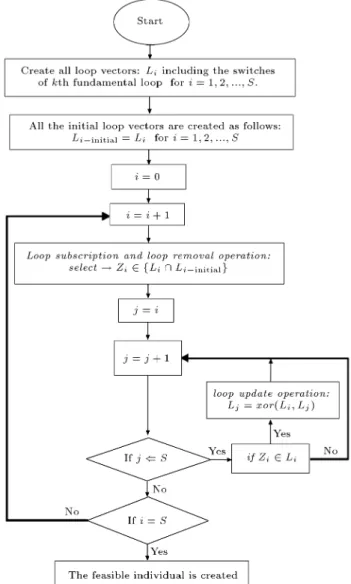
In Figure 2, the owchart of the proposed technique is shown to produce feasible individual. In this technique, the switching operation, respectively, begins from the 1th loop vector L1and continues to the Sth loop vector
LS. First, in the L1, a switch is randomly selected
and opened. As a result, this loop is removed; so if the opened switch is not common with another loops, just loop remove occurs and other network loops will remain in their previous states. Otherwise, if the open switch is common with another loop, for example Lj,
then this loop vector is updating and will be equal to xor(L1; Lj). After switching operations in Lj, a switch
must be selected that belongs to Lj initial and also
removes the Lj; so, to solve this issue, a switch which
belongs to (Lj\ Lj initial) is randomly chosen. This
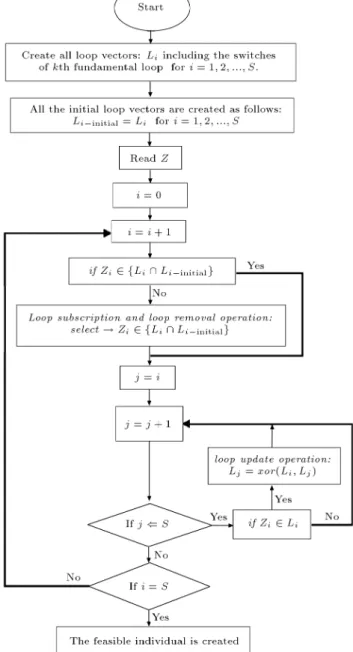
process is performed for all the loop vectors. Finally all fundamental loops are opened and the radial structure of the network is produced. Similarly, as shown in Figure 3, infeasible individuals are corrected during the evolutionary process.
Figure 2. The proposed technique owchart to create the feasible individual. Ziis the ith member of problem variable (the switch that is opened in ith fundamental loop).
3.2. Illustration of the proposed technique To understand more, the above techniques run to generate the radial structure of the network for 33-bus test network. Before switching operation, the mentioned two steps are formed as follows:
L1= f2; 3; 4; 5; 6; 7; 33; 20; 19; 18g;
L2= f8; 9; 10; 11; 35; 21; 33g;
L3= f9; 10; 11; 12; 13; 14; 34g;
L4= f22; 23; 24; 37; 28; 27; 26; 25; 5; 4; 3g;
L5=f26; 27; 28; 29; 30; 31; 32; 36; 17; 16; 15; 34; 8; 7; 6g;
Figure 3. The proposed technique owchart to correct the infeasible individual. S is the number of fundamental loop; and Z is the problem variable.
since the switching operation sequentially is started from the rst loop and is continued to loop 5. So, rst, switch 7 is selected randomly in L1. As a result,
according to Figure 4, L1 is removed and considering
that switch 7 is common with L5, L5is updated.
Now, the next switch should be selected in L2.
As shown in Figure 5, L2 is removed by selecting the
switches 9 in it, randomly, and because this switch is common with L3, L3is updated.
In the next stage, for the switching operation in L3, considering that the L3 has been updated during
the previous stages, a switch must be selected that also belongs to L3 initial and also removes the updated L3;
therefore, switch 34 which belongs to (L3\L3 initial) is
Figure 4. The switching operation in L1.
Figure 5. The switching operation in L2.
Figure 6. The switching operation in L3.
randomly chosen. As shown in Figure 5, L3is removed
and considering that switch 34 is common with L5, this
loop is updated again.
According to Figure 6, in this stage, the rings network has been reduced to two loops containing L4
and updated loop L5. Continuing switching operation
in L4, considering that this loop has not been updated
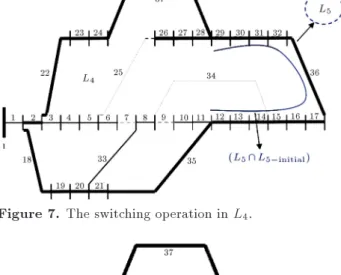
in the previous steps, it is equal to initial loop vector L4 initial. Therefore, L4 is removed by selecting the
switches 25 in it, randomly, and as this switch is common with L5, L5 is updated again.
After switching operation in L1 to L4 and
Figure 7. The switching operation in L4.
Figure 8. The switching operation in L5.
L5 remains which is removed by randomly selecting
switch 36 that belongs to (L5\ L5 initial). As shown
in Figure 8, the radial topology of network is formed. Finally, the reconguration problem variable Z = [7; 9; 34; 25; 36] that satises the radial structure of the network is obtained.
4. Ant colony optimization
The ACO is inspired by the behavior of the ants while searching for food. Ants communicate with each other by secret chemicals called pheromone while moving in the paths between the nest and food. This pheromone evaporates with time. So the ants can be directed to cross the shortest path marked with more accumulated pheromone. Therefore, the AC algorithm procedures can be generally summarized as follows [27].
4.1. State transition rule
Each ant is placed on node i. Then, any ant will build a full path from the nod i to the node j, through repetitive application of the state transition rule as follows:
Pk
i;j= (i;j) (
i;j)
P
m2Jk(i)
(i;m)(i;m); 8 j 2 Jk(i); (7)
where i;j is the deposited pheromone on the edge
between nodes i and j, i;j is the desirability of the
edge between nodes i and j (e.g. 1=di;j, where di;j
is the distance between node i and node j), is the impact factor of deposited pheromone, is the impact factor of path's desirability, Jk(i) is the set of nodes
that remain to be visited by kth ant positioned on node i. Eq. (7) shows that the state transition rule guides ants toward shorter paths with greater amount of deposited pheromone.
4.2. Local updating rule
While constructing its tour, an ant also modies the amount of pheromone on the visited path by applying the local updating rule.
i;j= (1 )i;j+ i;jk ;
k i;j=
8 > < > :
1
Ck if ant k travels on the edge i j
0 otherwise
(8) where i;j is the deposited pheromone on the edge
between nodes i and j, is the rate of pheromone evap-oration, k
i;j is the amount of pheromone deposited
by the kth ant and Ck is the cost of the kth ant's tour
(typically length).
The local updating rule provides a wide search space and avoids the convergence of problem toward the local optimum solution.
4.3. Global updating rule
When tours are completed, the global updating rule is applied to edges belonging to the best ant tour. This rule is intended to provide a greater amount of pheromone to shorter tours, which can be expressed below:
i;j= i;j+ i;j; (9)
where i; j is the best global path, is a constant multiplier, and i;jis the amount of pheromone of the
globally best tour from the beginning of trial. This rule is intended to make the search more directed; therefore, the capability of nding the optimal solution can be enhanced through this rule in the problem solving process.
4.4. Termination
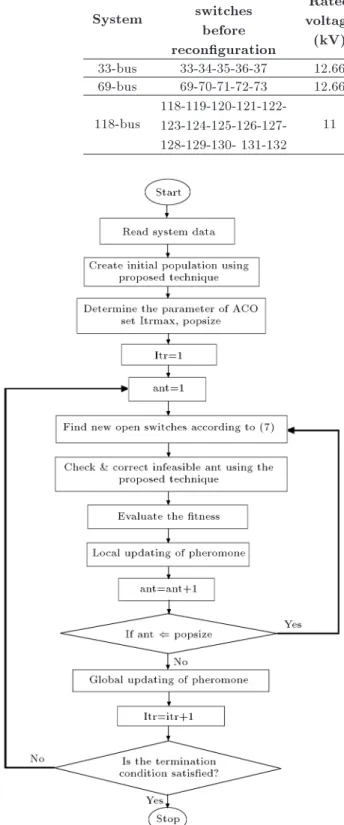
As shown in Figure 9, the algorithm is terminated when the iteration number reaches the predened maximum or all the ants of the current population reach the solution with the same tness. The owchart of the proposed algorithm is shown in Figure 9.
5. Simulation result
In this section, the proposed algorithm is tested on IEEE 33-bus test distribution network [2], 69-bus
Table 1. Test networks information.
System
Open switches
before reconguration
Rated voltage
(kV)
Total active
load (kW)
Total reactive
load (kVAR)
Power losses (kW)
Minimum node voltage
(p.u) 33-bus 33-34-35-36-37 12.66 3715 2300 202.68 0.9133 69-bus 69-70-71-72-73 12.66 3802 2694 224.95 0.9092 118-bus
118-119-120-121-122- 123-124-125-126-127-128-129-130- 131-132
11 22709.7 17041.1 1298.09 0.8688
Figure 9. The proposed algorithm owchart.
distribution network [28], and 118-bus distribution network [29]. Considering that, buses and lines in the 118-bus distribution network are numbered as in Figure 10.
The initial conguration, total real and reactive
Table 2. The control parameters of the ACO.
System ACO parameters
33-bus Generation=600, = 1, = 0, = 0:1, = 2, pc = 0:2 69-bus Generation=600, = 1, = 0,
= 0:1, = 3, pc = 0:2 118-bus Generation=2000, = 1, = 0,
= 0:1, = 10, pc = 0:2 : The probability of changing one switch randomly with
other switches in the same fundamental loop.
loads, real power losses, minimum node voltage, and system rated voltage of these test distribution systems are summarized in Table 1.
Values of the control parameters of the ACO are frequently changed during numerous trials to provide the best possible result. Finally, the optimal values of the parameters are set as expressed in Table 2.
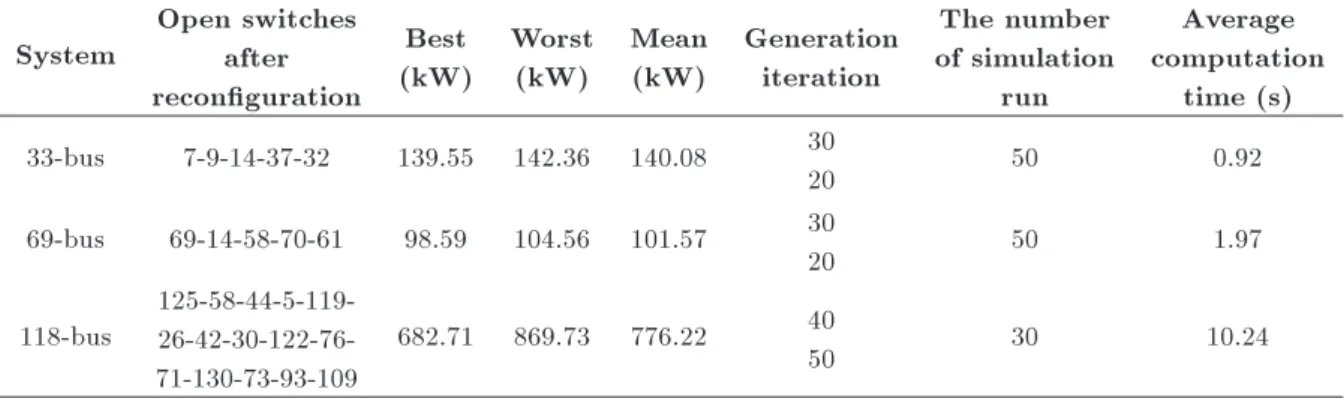
The proposed algorithm is coded in MATLAB language and run several times for each test dis-tribution system in a PC with CPU: Intel core i7-2630QM and Memory: 6 GB DDR3. The test results for loss minimization are summarized in Table 3. For example, for the 33-bus test network, simulation was run each time with the number of generation 30 over 20 iterations (600 individuals) that during 50 times of running, the best solution with opened switch 7 9 14 37 32, power losses 139.55 kW and the worst result with power losses 142.36 kW are achieved. The simulation runtime is varied, depend-ing on the number of generated infeasible individ-uals during the evolutionary process and modifying them. Thus, the Average time to run the simula-tion 50 times is obtained 0.92 second. Therefore, the results show that by using the proposed method and thereby shrinking the search space, the optimal solution is obtained with less number of individu-als and thus eectively reduced computation time. Moreover, the negligible dierence between the av-erage losses reduction and the optimum one shows the very favorable convergence of the optimization process.
re-Figure 10. The 118-bus system.
Table 3. Optimization results for minimizing power losses using the proposed method. System
Open switches after reconguration
Best (kW)
Worst (kW)
Mean (kW)
Generation iteration
The number of simulation
run
Average computation
time (s) 33-bus 7-9-14-37-32 139.55 142.36 140.08 30
20 50 0.92
69-bus 69-14-58-70-61 98.59 104.56 101.57 30
20 50 1.97
118-bus
125-58-44-5-119- 26-42-30-122-76-71-130-73-93-109
682.71 869.73 776.22 40
50 30 10.24
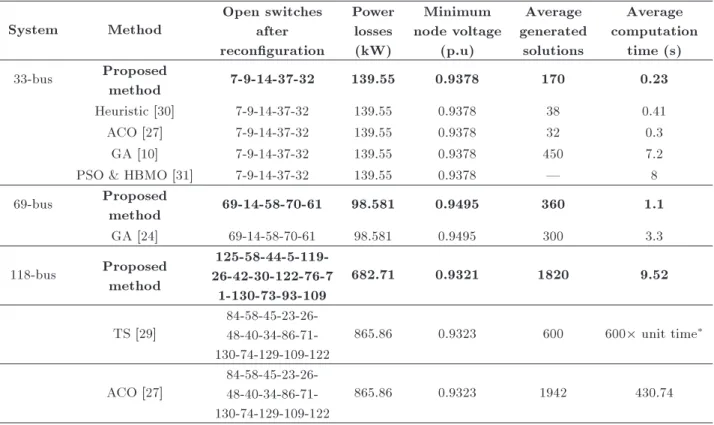
sults obtained for these listed test distribution networks using the proposed method with other heuristic and meta-heuristic techniques available in the literature. The minimum node voltage and real power losses for the optimal solution are found to be either the same or better than those of other methods. Considering that the optimization process is terminated when the same global optimal solution is achieved during the predened iteration number, the average computation time when using the proposed method is much less as compared to the computation times mentioned in the literature using latest AI (Articial Intelligence) techniques. This clearly shows the computation
ef-ciency of the proposed method for small, medium, and large-scale distribution systems, so that in this work, for 118-bus distribution network, the best so-lution is obtained which has not been achieved in any of the papers so far. As shown in Table 4, the minimum power losses can be achieved 687.21 kW after reconguration of 118-bus distribution network, whereas in the other methods, the minimum power losses obtained are equal to 865.86 kW. To under-stand more, as shown in Figure 11, node voltages are better improved after reconguration using the proposed method compared to the latest AI tech-niques.
Table 4. Comparison results for test distribution systems
System Method
Open switches after reconguration
Power losses (kW)
Minimum node voltage
(p.u)
Average generated
solutions
Average computation
time (s) 33-bus Proposed
method 7-9-14-37-32 139.55 0.9378 170 0.23
Heuristic [30] 7-9-14-37-32 139.55 0.9378 38 0.41
ACO [27] 7-9-14-37-32 139.55 0.9378 32 0.3
GA [10] 7-9-14-37-32 139.55 0.9378 450 7.2
PSO & HBMO [31] 7-9-14-37-32 139.55 0.9378 | 8
69-bus Proposed
method 69-14-58-70-61 98.581 0.9495 360 1.1
GA [24] 69-14-58-70-61 98.581 0.9495 300 3.3
118-bus Proposed method
125-58-44-5-119-26-42-30-122-76-7
1-130-73-93-109
682.71 0.9321 1820 9.52
TS [29]
84-58-45-23-26- 48-40-34-86-71-130-74-129-109-122
865.86 0.9323 600 600 unit time
ACO [27]
84-58-45-23-26- 48-40-34-86-71-130-74-129-109-122
865.86 0.9323 1942 430.74
: Production time of each generation in [29].
Figure 11. The voltage prole before and after reconguration.
6. Conclusions
Network reconguration is one of the best ways to optimize distribution network for dierent purposes. In this paper, a new technique based on three operations on loop removal, loop update, and loop subscription was presented for the population-based meta-heuristic algorithms to solve reconguration problem. This proposed technique generates an initial population of feasible solutions and also corrects infeasible solutions during the evolutionary process with the shortest pos-sible time, as shown in Table 5. This preserves the diversity in the search process; thus, the convergence of solutions is increased and optimization time is signicantly reduced. The proposed method was
per-Table 5. Computational eciency of the proposed method.
System Generated population
Average infeasible population
Average correction time for each
infeasible individual
(s)
33-bus 600 412 0.00041
69-bus 600 464 0.00084
118-bus 2000 1409 0.0034
formed on the IEEE 33-, 69-, and 118-bus distribution networks. The results showed the eectiveness of the proposed algorithm compared with other methods, especially for large-sized distribution networks. References
1. Merlin, A. and Back, H. \Search for a minimum-loss operating spanning tree conguration in an urban power distribution system", 5th Power Syst. Comput. Conf., Cambridge, UK, pp. 1-18 (1975).
2. Baran, M.E. and Wu, F.F. \Network reconguration in distribution systems for loss reduction and load balancing", IEEE Trans. Power Deliv., 4(2), pp. 1401-1407 (1989).
for distribution systems loss reduction", Electr. Power Syst. Res., 78(11), pp. 1953-1958 (2008).
4. Gohokar, V.N. and Khedkar, M.K. \G.M. Dhole, For-mulation of distribution reconguration problem using network topology: a generalized approach", Electr. Power Syst. Res., 69(2-3), pp. 304-310 (2004).
5. Nara, K., Shiose, A., Kiagawa, M. and Ishihara, T. \Implementation of genetic algorithm for distribution system loss minimum reconguration", IEEE Trans. Power Syst., 7(3), pp. 1044-1051 (1992).
6. Zhu, J.Z. \Optimal reconguration of electric distribu-tion network using rened genetic algorithm", Electr. Power Syst. Res., 62, pp. 37-42 (2002).
7. Hong, Y.Y. and Ho, S.Y. \Determination of network conguration considering multiobjective in distribu-tion systems using genetic algorithms", IEEE Trans. Power Syst., 20(2), pp. 1062-1069 (2005).
8. Sahoo, N.C., Ranjan, R., Prasad, K. and Chaturvedi, A. \A fuzzy-tuned genetic algorithm for optimal recon-gurations of radial distribution network", European Transaction on Electrical Power, 17(2), pp. 97-111 (2007).
9. Mendoza, J., Lopez, R., Morales, D., Lopez, E., Dessante, P. and Moraga, R. \Minimal loss recon-guration using genetic algorithms with restricted population and addressed operators: real application", IEEE Trans. Power Syst., 21(2), pp. 948-954 (2006).
10. Enacheanu, B., Raison, B., Caire, R., Devaux, O., Bienia, W. and HadjSaid, N. \Radial network recong-uration using genetic algorithm based on the Metroid theory", IEEE Trans. Power Syst., 23(1), pp. 186-195 (2008).
11. Ramirez-Rosado, I.J. and Dominguez-Navarro, J.A. \New multiobjective tabu search algorithm for fuzzy optimal planning of power distribution systems", IEEE Trans. on Power Syst., 21(1), pp. 224-233 (Feb. 2006).
12. Zhang, D., Fu, Z. and Zhang, L. \An improved TS algorithm for loss-minimum reconguration in large-scale distribution systems", Electr. Power Syst. Res., 77, pp. 685-694 (2007).
13. Li, Z., Chen, X., Yu, K., Sun, Y. and Liu, H. \A hybrid particle swarm optimization approach for distribution network reconguration problem", IEEE Power and Energy Soc. Gen. Meet., pp. 1-7, July 20-24 (2008).
14. Abdelaziz, A.Y., Mohammed, F.M., Mekhamer, S.F. and Badr, M.A.L. \Distribution systems recongu-ration using a modied particle swarm optimization algorithm", Electr. Power Syst. Res., 79(11), pp. 1521-1530 (Nov. 2009).
15. Su, C.T., Chang, C.F. and Chiou, J.P. \Distribu-tion network recongura\Distribu-tion for loss reduc\Distribu-tion by ant colony search algorithm", Electr. Power Syst. Res., 75, pp. 190-199 (2005).
16. Falaghi, H., Haghifam, M.R. and Singh, C. \Ant colony optimization-based method for placement of sectionalizing switches in distribution networks using
a fuzzy multiobjective approach", IEEE Trans. Power Deliv., 24(1), pp. 268-276 (Jan. 2009).
17. Su, C.T., Lee, C.S. and Huang, L.L. \Feeder recong-uration employing simulated annealing for distribution systems", European Transaction on Electrical Power, 11(5), pp. 341-347 (2001).
18. Parada, V., Ferland, J.A., Arias, M. and Daniels, K. \Optimization of electrical distribution feeders us-ing simulated annealus-ing", IEEE Trans. Power Deliv., 19(3), pp. 1135-1141 (July 2004).
19. Morton, A. and Mareels, M.Y. \An ecient brute-force solution to the network reconguration problem", IEEE Trans. Power Deliv., 15(3), pp. 996-1000 (July 2000).
20. Hong, Y.Y. and Ho, S.Y. \Determination of network conguration considering multiobjective in distribu-tion systems using genetic algorithms", IEEE Trans. Power Syst., 20(2), pp. 1062-1069 (May 2005).
21. Delbem, A.C.B., Pd, A.C., Carvalho, L.F. and Bretas, N.G. \Main chain representation of evolutionary algo-rithms applied to distribution system reconguration", IEEE Trans. Power Syst., 20(1), pp. 425-436 (Feb. 2005).
22. Romero, E., Gomez, A., Riquelme, J. and Llorens, F. \Path-based distribution network modeling: ap-plication to reconguration for loss reduction", IEEE Trans. Power Syst., 20(2), pp. 556-564 (May 2005).
23. Carreno, E.M., Romero, R. and Feltrin, A.P. \An ecient codication to solve distribution network re-conguration for loss reduction problem", IEEE Trans. Power Syst., 23(4), pp. 1542-1551 (Nov. 2008).
24. Swarnkar, A., Gupta, N. and Niazi, K.R. \A novel codication for meta-heuristic techniques used in dis-tribution network reconguration", Electric Power Systems Research., 81, pp. 1619-1626 (2011).
25. De Mac^edo, B., Helon, D. and de Souza, B.A. \Distribution network reconguration using genetic algorithms with sequential encoding: Subtractive and additive approaches", IEEE Trans on Power Syst., 26(2), pp. 582-593 (2011).
26. Stagg, G.W. and Abaid, A.H.E., Computer Methods in Power Systems Analysis, McGraw-Hill book company. London, p. 427 (1968).
27. Swarnkar, A., Gupta, N. and Niazi, K.R. \Adapted ant colony optimization for ecient reconguration of balanced and unbalanced", Swarm and Evolutionary Computation, 1, pp. 129-137 (2011).
28. Savier, J.S. and Das, D. \Impact of network re-conguration on loss allocation of radial distribution systems", IEEE Trans. Power Deliv., 22(4), pp. 2473-2480 (2007).
29. Zhang, D., Fu, Z. and Zhang, L. \An improved TS algorithm for loss-minimum reconguration in large-scale distribution systems", Elect. Power Syst. Res., 77, pp. 685-694 (2007).
30. Martn, J.A. and Gil, A.J. \A new heuristic approach for distribution systems loss reduction", Electr. Power Syst. Res., 78(11), pp. 1953-1958 (2008).
31. Niknam, T. \An ecient multi-objective HBMO algo-rithm for distribution feeder reconguration", Expert Systems with Applications, 38, pp. 2878-2887 (20011).
Biographies
Saeed Abazari received his BSc degree in Electrical Engineering from Isfahan University of Technology, Isfahan, Iran, in 1989, the MSc degree from Ferdowsi University, Mashhad, Iran, in 1992, and the PhD
degree from Sharif University of Technology, Tehran, Iran, in 2002. Currently, he is an Assistant Professor at Electrical Engineering Department in Shahrekord University, Shahrekord, Iran. His research interests are electric power distribution system, smart grid, power system operation and control, and FACTS controllers. Mohsen Heidari Soudejani received his BSc and MSc degrees in Electrical Engineering from Shahrekord University, Shahrekord, Iran, in 2008 and 2014. His research activities are centered on distribution network, distributed generation, smart grid, and Optimization methods for power systems.