36 Journal of Asynchronous Learning Networks, Volume 14: Issue 4
A QUALITY SCORECARD FOR THE
ADMINISTRATION OF ONLINE EDUCATION
PROGRAMS: A DELPHI STUDY
Kaye Shelton
Dallas Baptist University
ABSTRACT
As the demands for public accountability increase for the higher education, institutions are seeking methods for continuous improvement in order to demonstrate quality within programs and processes, including those provided through online education. A six round Delphi study was undertaken with 43 seasoned administrators of online education programs who agreed upon 70 quality indicators that administrators should examine within their programs to evaluate quality. A method for scoring was also developed. The original set of quality indicators from the Institute for Higher Education Policy study, Quality on the Line: Benchmarks for Success in Internet-Based Distance Education (2000) were used as a starting point and determined still valid in 2010, with modifications. The study resulted in a quality scorecard for the administration of online education programs.
KEYWORDS
Online Education, Online Education Administration, Online Education Assessment, Online Education Programs
I.
INTRODUCTION
The development of the Internet has forever changed higher education and distance learning programs. Prior to its arrival, distance education, also called distance learning or distributed education, used varied methods for course delivery such as mail correspondence, telecourses, or satellite delivery, and was clearly on the periphery of higher education. When course delivery using the Internet became an option—creating the new phrase online education—it wasn’t long before enrollments began to rapidly increase and online education became firmly entrenched within higher education. In fact, numerous studies cite tremendous growth in online education, which has outpaced that of traditional higher education with the majority of accredited institutions now offering distance learning courses [1, 2].
While some institutions willingly responded to the increased student demand for flexibility and convenience, others grudgingly responded because of the increased competition for student enrollment. However, after experiencing success with a few online courses, many institutions developed full degree programs to be offered completely online. While the online programs were expected to increase student access and increase enrollment, both administrators and faculty expressed concern regarding quality [3], how should it be measured, and what evaluation methods should be used for continuous improvement strategies and accreditation requirements. Today, in light of the public call for accountability, quality assurance of educational programs is still one of the greatest challenges in higher education today [4, 5, 6].
II.
BACKGROUND OF THE STUDY
Like many industries in the 21st century, higher education is finding that demands for accountability [7] along with increased competition, stimulate a need for developing quality improvement strategies. In fact, a research study by Rice and Taylor [8] found that 88% of the colleges and universities surveyed affirmed
they were engaged in some form of continuous improvement strategy and striving toward increased quality in all areas of the institution, including distance and online learning programs. The much talked about rapid growth of online education programs may be the reason that the regional accreditors began to look closely at online programs and their claims of quality.
Interestingly, many institutions advertise using the word “quality” with online education programs because they believe it creates public interest and market advantage. However, quality online education is still difficult to define [9] and many have recognized the need for a more comprehensive system for evaluation [10]. Unlike industry recognized quality stamps for corporations, such as the Total Quality Management criteria for excellence or the Malcolm Baldrige National Quality Award, an instrument is yet to exist for online education for measuring quality programs, and facilitating strategic planning and program improvement. However, because of the tremendous growth in online education, higher education could benefit from an instrument comprised of industry standards endorsed by online education administrators.
Several rubrics do exist for measuring quality online course materials, such as University of Maryland’s Quality Matters, California State University-Chico’s rubric for online instruction, and Blackboard’s Exemplary Course rubric. In fact, the Quality Matters program is an industry recognized quality seal for online course materials and used by many programs in both the United States and other countries. Online education administrators could greatly benefit from a quality indicator tool for program administration to not only determine program quality but also assist with future goal setting and strategic planning. Online education administrators must take the issue of quality seriously because students may go elsewhere in search of quality educational programs [11].
A research study by the Institute for Higher Education Policy (IHEP) cited a significant need for improved research for distance learning programs and quality standards [12]. Commissioned by the National Education Association and Blackboard, Inc., the IHEP followed with a second study that identified 24 separate quality indicators chosen by various respected online education leaders of higher education institutions out of the original 45 indicators provided by a literature search. The latter report, Quality on the Line: Benchmarks for Success in Internet-Based Distance Education [13], is still abundantly referenced throughout the literature today.
III.
PURPOSE OF THE STUDY
This study sought to determine if experts in the administration of online education of various types of higher education institutions believe the original 24 indicators of quality online education identified by the Institute for Higher Education Policy study [13] are still relevant today and if additional indicators are needed to identify quality online education programs. The central purpose was the development of a scorecard to measure and quantify elements of quality within online education programs in higher education that may also support strategic planning and program improvements. The following questions guided the research:
• Are the standards identified in the IHEP study in 2000 still relevant in 2010 for indicating quality in online education programs in higher education?
• What additional standards should be included that address the current industry in 2010?
• If additional standards are suggested, will they fall into the already identified themes or will new themes emerge?
• What values will be assigned to the recommended standards that will ultimately yield a numeric scorecard for measuring quality online education programs from an online education administrator’s perspective that could also support strategic planning and program improvements?
38 Journal of Asynchronous Learning Networks, Volume 14: Issue 4
IV.
LITERATURE REVIEW SUMMARY
A review of the literature of quality evaluation of online education programs reveals several commonalities among each article or research study [14, 15, 16, 17, 18, 19, 13, 20, 10, 21, 22, 23, 24, 25]. The institutional commitment, support, and leadership theme and the teaching and learning theme were the most used when determining standards for online education programs. The literature focused on the quality of teaching and pedagogy far more than the overall quality of programs. Early in the literature, it was the overall design of the course that most authors wrote about since courses moved online before complete programs. Faculty support was the second most identified theme in quality evaluation. For success in teaching online, faculty require support, training, motivation, compensation, and policy. Student support and course development were the third most cited themes in the analyzed studies. It is interesting that student support was not cited as much as learning effectiveness. Students require the same support services that traditional students need; however, it is often more challenging to find ways to deliver those services and support in an online environment.
Technology, organizational/institutional impact, and evaluation were identified in only 6 of the 14 articles and studies reviewed. Technology is foundational to the infrastructure of online education and should be considered a critical component to quality and success. Cost effectiveness and management and planning were only identified three times in the studies and faculty satisfaction, student satisfaction and student retention only listed twice out of the 14 examined. A rubric for determining the quality of online program administration could not be located within the literature.
V.
RESEARCH DESIGN AND METHODOLOGY
A.
Method
The Delphi Method, developed by the Rand Corporation in the early 1950s by Norman Dalkey and Olaf Helmer [26], was the methodology utilized for this study. While considered suspect by some, many researchers have employed the Delphi Method to gain consensus from experts on a given topic because “it replaces direct confrontation and debate by a carefully planned, anonymous, orderly program of sequential individual interrogations usually conducted by questionnaires” [27]. In fact, according to Day and Bobeva, “The Delphi is founded upon the use of techniques that aim to develop, from a group of informants, an agreed view or shared interpretation of an emerging topic area or subject for which there is contradiction or indeed controversy” [28].
The Delphi Method was selected as the appropriate research method to develop the quality scorecard because of its ability “to seek out information which may generate a consensus on the part of the respondent group and correlate informed judgments on a topic spanning a wide range of disciplines” [29]. Topics or decisions considered to be subjective usually do not have a single correct solution. The “affective, emotional, and expressive dimensions of a problem often subordinate the objective, analytical quality of a decision” [30]. Because the topic of this study, the quality of online education programs, is so subjective, the researcher believes the Delphi process for reiteration improved the overall outcome of the quality scorecard and achieved a greater strength of consensus and buy-in from the members of the expert panel.
B.
Study Population, Sample Frame and Sampling Plan
According to Rossman and Eldredge, “A key factor in any Delphi Study is the qualification of the population selected to receive the questionnaires” [31]. The study population consisted of online education administrators in higher education who were considered experts in the respective field. According to Ziglio [32], if the Delphi panel of experts is selected by personal preference of the researcher, the overall validity of the study could decrease. Therefore, the sampling frame was identified by the Sloan Consortium (Sloan-C), an organization highly respected for its work with quality online
education initiatives. For this study, potential panel members were first identified by Sloan-C as recognized experts in the administration of online education who met the following criteria:
• Five or more years of experience as an administrator of online program in higher education
• Identified by the Sloan Consortium as a respected expert in the field of online education (having published or presented)
• Work at one of the various types of higher education institutions:
o Community College
o Public University
o Private College or University
o Faith-based College or University
o For-Profit Institution.
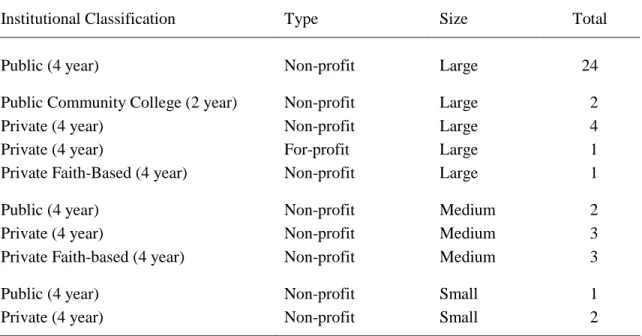
For this study, 76 experts were invited and 43participated as panel members in the first survey round. Table 1 shows the institutional classification for the members of the expert panel. It is important to note that more than 83% of the panel members had nine or more years of experience in the administration of online education programs. Of the 43 panel members, 56% were from large public institutions.
Table 1. Institutional Classification for Expert Panel Members Who Participated
C.
Instrumentation and Data Analysis
The majority of Delphi studies use an open-ended questionnaire for collecting data in the initial phase [34, 35]; however, since the IHEP quality standards [13] already existed before this study, judgment of the 24 quality standards identified by the IHEP study occurred in Delphi Round I. Respondents were also invited to suggest additional quality indicators they believed to be relevant for measuring quality in online education programs. Therefore, a combination of open-ended and closed questions was used for each survey round.
For this research study, descriptive statistics were formulated and reviewed for each survey using a five-point Likert-scale:
1 = Definitely Not Relevant 2 = Not Relevant
Institutional Classification Type Size Total
Public (4 year) Non-profit Large 24
Public Community College (2 year) Non-profit Large 2
Private (4 year) Non-profit Large 4
Private (4 year) For-profit Large 1
Private Faith-Based (4 year) Non-profit Large 1
Public (4 year) Non-profit Medium 2
Private (4 year) Non-profit Medium 3
Private Faith-based (4 year) Non-profit Medium 3
Public (4 year) Non-profit Small 1
40 Journal of Asynchronous Learning Networks, Volume 14: Issue 4 3 = Slightly Relevant
4 = Relevant
5 = Definitely Relevant.
Mean and median scores along with standard deviation and mode analysis may be used in Delphi studies to determine consensus as well as percentage of responses [34, 36, 37]. Many Delphi studies suggest that when 60-80% of panelists agree with a survey item, this signifies consensus [38, 39, 40] with a level of 70% being the most commonly chosen [38]; however, a clear guideline for consensus still did not exist in the literature [35]. According to Hsu and Sandford [36], mean and mode analysis are the most favorably used in the literature.
The Delphi Round I survey encouraged the expert panel to validate and revise existing IHEP quality standards and add new items to indicate quality for inclusion in the Delphi Round II survey. The Delphi Round II survey was developed by including all items from the Delphi Round I survey achieving a mean score of 4.0 or above and a panel member agreement of 70% or more along with the revision of the existing quality standards, and additional quality indicators suggested by the panel of experts. The Delphi Round III survey was developed to include items from the Delphi Round II survey that achieved a mean score of less than 4.0 but selected by 70% of panel members. The Delphi Round III survey included those items for further review by the panel of experts. It also invited panel members to suggest further quality indicators they felt were missing from the previous round. The Delphi Round IV survey was developed to include all items from the Delphi Round III survey that achieved a mean score of less than 4.0 but selected by 70% of the panel of experts. The Delphi Round IV survey also requested members of the expert panel to suggest possible scoring methods for the quality standards in order create the quality scorecard. The Delphi Round V survey was developed to include the scoring methods suggested in the Delphi Round IV survey. Those items that did not achieve a mean score 4.0 or better or 70% consensus level were fed back to the members of the panel for a re-vote. In Delphi Round V, panel members were asked to vote on the best method of scoring, based on their perceptions as administrators for its accuracy in evaluating a quality online program. The Delphi Round VI survey was developed to include those items from the Delphi Round V survey that were selected by 70% of the panel members as possible scoring methods for the quality scorecard but had not yet reached consensus. The Delphi study concluded with a fully developed scorecard for quality online education as perceived by online education administrators.
D.
Expert Panel Participation
Seventy-six prospective panel members were identified by the Sloan Consortium as meeting the criteria for this research study and were solicited for participation in the study. Forty-three experts in online education administration participated in the first survey round. Typical for the Delphi process, 59% of the original panel members completed all six rounds of the Delphi survey process. As confirmed by the literature, it is difficult to keep a panel of experts fully engaged for 18 weeks. However, the participation rate of 86.8% - 97.7% for each round is well above the 70% per round rate that was recommended by Hasson, Keeney, and McKenna [34] and Sumsion [42].
E.
Description of Delphi Rounds
1.
Delphi Round I
The Delphi Round I results revealed that the members of the expert panel believed that 23 of the 24 IHEP quality indicators were still relevant in 2010; however, each indicator received numerous suggestions for revisions for the wording of the text. Mean scores ranged from M = 4.00 to M = 4.97. The IHEP quality indicator #15 that was not believed to be relevant, “Students are provided with hands-on training and information to aid them in securing material through electronic databases, interlibrary loans, government archives, news services, and other sources” had a mean of 3.74, a standard deviation of .912, and 66.2% consensus. This did not meet the guidelines for relevance in this study; however, there were 22
additional comments and suggested revisions from the panel for this particular quality indicator, and seven of those specifically addressed the phrase “hands on” as being questionable. Only the suggested revisions were provided in the next survey round since #15 was not determined relevant. The suggested revisions for each quality indicator were fed back to the panel in Delphi Round II for further analysis with an option to keep the original statement without revisions for all but IHEP #15.
In addition to the 24 IHEP quality indicators being evaluated, the members of the expert panel used two open-ended questions in Delphi Round I to provide additional categories of quality indicators and individual quality indicators they believed were not included in the original 24 IHEP list of indicators. Twenty-nine panel members provided additional comments and suggestions for additional quality indicators that were not addressed by the original IHEP 24 standards. The data were examined for content analysis and duplicate elements were removed during the data reduction phase. Of the 29 narrative responses (most responses contained several suggestions), 80 potential quality indicators were derived after all responses were coded and placed into the original IHEP categories until additional categories had been approved by the panel.
Nineteen responses were provided by panel members in response to the request for additional categories of quality indicators although not all responses included suggestions for additional categories. From the 19 responses, 20 additional categories were suggested. Included in these qualitative responses were suggestions to change the Institutional Support category to Institutional and Technology Support and also a suggestion that these should be two individual categories. This decision was fed back in the next survey round.
2.
Delphi Round II
A total of 38 expert panel members (95.5% response rate) completed the survey in Round II. Delphi Round II fed back to the panel of experts the results from Delphi Round I in an attempt to gain consensus on all of the IHEP indicator revisions, newly suggested categories, and potential quality indicators. The first question addressed the Institutional Support category question from Delphi Round I: Should the word Technology be added to the title, making it Institutional and Technology Support, or should the category remain titled Institutional Support, or if Technology Support should become a standalone category. The majority of responses were split between the following two options: Institutional and Technology Support (40% of the panel agreed) or separating them into two categories, Institutional Support and Technology Support (40% of the panel agreed) with some written feedback regarding the type of technology support was academic or educational.
Each of the additional 20 categories that were suggested by the panel in Delphi Round I was rated in Delphi Round II using the same Likert-scale and a possible additional rating of Not a Category/Theme but should be a quality indicator. Only three of the categories received 70% of the panel votes to be returned in Delphi Round III: Social and Student Engagement (Mean = 3.81, 70% panel agreement); Accessibility (Mean = 4.60, 62.5% panel agreement); and Instructional Design (Mean = 4.03, 60% panel agreement). Consensus was not reached in Delphi Round II on the original 24 IHEP indicators or suggested revisions, presented in questions #3 - #26. In fact, six additional revisions were suggested to the original IHEP indicators through qualitative responses and were added to Delphi Round III survey for five of the 24 IHEP Indicators. Revisions that did not receive 70% of the panel vote were eliminated and not included in Delphi Round III.
Fourteen of the 80 additional quality indicators suggested by the panel in Delphi Round I were approved with a mean of 4.0 or and met the established parameter of having 70% or more of the panel in agreement. Of the remaining quality indicators that were previously suggested by the panel, eight were eliminated due to receiving low response from the panel (less than 70% of the panel members believed they were relevant). The remaining indicators that received 70% of the panel vote were returned for another vote in Delphi Round III.
42 Journal of Asynchronous Learning Networks, Volume 14: Issue 4
3.
Delphi Round III
Thirty-three expert panel members completed the survey in Round III. In Delphi Round I, the panel suggested that the category of Institutional Support should address those standards with the scope of support provided by the institution and the Technology Support category should become a standalone category. Consensus was achieved by 81.3 for the category to become two distinct categories: Institutional Support and Technology Support.
Three additional categories from Delphi Round II were presented. Two of the three categories received consensus in this round: Social and Student Engagement with M = 4.04 and 70.8% consensus and Instructional Design with M = 4.27 and 86.7% consensus. Because there was no clear distinction between Instructional Design and the already existing Course Development category, the category was renamed to Course Development and Instructional Design. The Accessibility category decreased in Mean from 4.60 in Delphi Round II to 3.86 in Delphi Round III (a quality indicator addressing accessibility in the Student Support category was approved in Delphi Round II).
Fifteen of the original IHEP Indicators were approved with revisions (#1, #2, #6, #9, #10, #12, #13, #14, #15, #16, #17, #20, #21, #23, #24). The expert panel determined that the IHEP indicators #18, Technical assistance in course development is available to faculty, who are encouraged to use it and #19, Faculty members are assisted in the transition from classroom teaching to online instruction and are assessed during the process, should be combined into one quality indicator—Technical assistance in course development and assistance with the transition to teaching online is provided.
Also in Delphi Round III, the panel of experts, with 72.7% consensus, determined that the IHEP indicator #10, Before starting an online program, students are advised about the program to determine (1) if they possess the self-motivation and commitment to learn at a distance and (2) if they have access to the minimal technology required by the course design, should be divided into the following two quality indicators: Before starting an online program, students are advised about the program to determine if they possess the self-motivation and commitment to learn at a distance and Before starting an online program, students are advised about the program to determine if they have access to the minimal technology required by the course design. The panel of experts also determined that the two new indicators should be moved from the Course Structure category to the Student Support category.
Thirteen additional quality indicators suggested by the panel were approved with a mean of 4.0 or and met the established parameter of having 70% or more of panel agreement. Seven suggested quality indicators were eliminated due to receiving low response from the panel. The remaining indicators that received 70% of the panel vote were returned for another vote in Delphi Round IV.
4.
Delphi Round IV
Delphi Round IV addressed the remaining IHEP indicators (#3, #4, #5, #7, #8, #11, and #22) that the panel had yet to reach consensus on, the suggested indicators remaining without consensus, and invited the panel to suggest their ideas for potential methods for scoring the quality scorecard. Each of the remaining seven indicators achieved consensus with either a revision to the statement or it was left in its original form.
IHEP #4, Guidelines regarding minimum standards are used for course development, design, and delivery, while learning outcomes—not the availability of existing technology—determine the technology being used to deliver course content, reached consensus with 89.7%. However, the revision suggested by the panel was to divide the original indicator into two separate indicators: Guidelines regarding minimum standards are used for course development, design, and delivery of online instruction and Technology is used as a tool to achieve learning outcomes in delivering course content. The context of the original indicator remained the same in context with there being a need for course development guidelines and that learning outcomes should drive the course development process, not technology.
Of the 31 suggested quality indicators returned to the panel of experts in Delphi Round IV, 17 achieved consensus and were moved to the quality scorecard. Fourteen suggested indicators did not reach consensus and were retired.
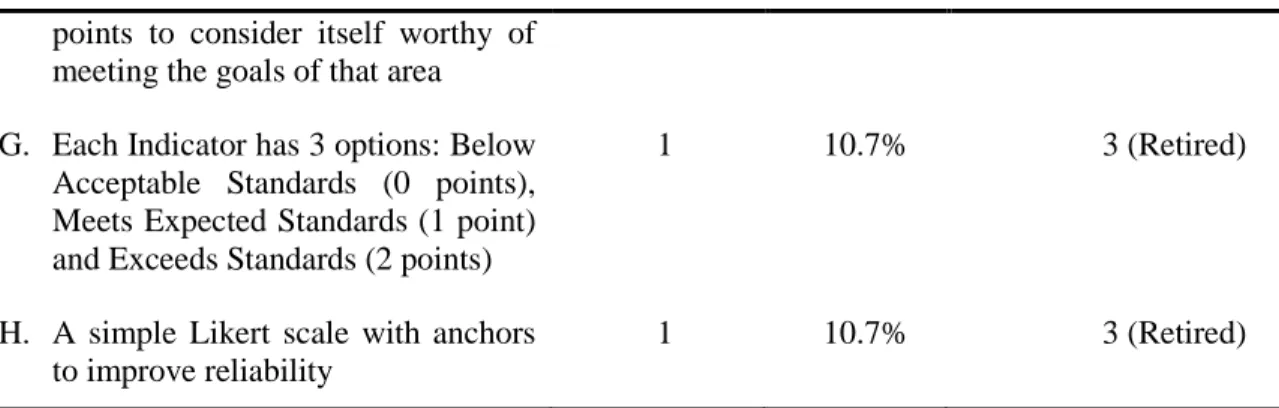
Delphi Round IV invited the panel of experts to suggest potential methods for scoring the quality scorecard. Fifteen of the 30 panel members suggested a total of eight possible methods, identified as Methods A, B, C, D, E, F, G, and H (Table 2). The most popular suggestion, Method C, which received votes from five panel members, was to allow ten points for each category of quality indicators, thereby making the scorecard worth a total of 90 points.
5.
Delphi Round V
A total of 28 panel members completed the survey in Round V. Consensus was not reached for the scoring method, therefore, an additional Delphi round was needed to select a scoring method. Eight methods for scoring the quality scorecard were suggested by the panel of experts in Delphi Round IV (Methods A, B, C, D, E, F, G, and H). Not one of the scoring methods was agreed upon by 70% of the panel. The results of each scoring method, in order of popularity, are: Method C and F received six votes of from panel members, which equaled 21.4% of the vote, respectively; Method E received five votes from panel members, which was 17.9% of the total vote; and Method A received four votes from panel members, which was 14.3% of the total vote. Methods A, C, E, and F received 75% of the total vote from panel members and were fed back to the panel of experts to gain consensus in Delphi Round VI. The following scoring methods were retired because they did not receive votes from 70% or more of the expert panel members: Methods G and H both received 3 votes, which were 10.3% of the panel vote; Method B received 1 vote, which was 3.6% of the panel vote; and Method D received 0 votes.
Suggested Scoring Method
Frequency of Suggestions in Round IV
Percent of Panel Votes in Round V
Frequency of Votes in Round V
A. One point per quality indicator 4 14.3% 4
B. Five points per quality indicator 1 3.6% 1 (Retired)
C. Each category equals a total of 10 points
5 21.4% 6
D. Each category equals one point for each
1 0% 0 (Retired)
E. Each indicator equals one point but has 3 possible options: Does not meet standard (0 points). Partly meets standard (.5 point). Meets or exceeds standard completely (1 point). Quality programs must achieve 85% of possible points
1 17.9% 5
F. Each indicator has 3 possible points (0 - not observed, 1 - insufficient, 2 - moderate use, 3 - completely meets criteria), then each area must have a certain percentage of the
44 Journal of Asynchronous Learning Networks, Volume 14: Issue 4 points to consider itself worthy of
meeting the goals of that area G. Each Indicator has 3 options: Below
Acceptable Standards (0 points), Meets Expected Standards (1 point) and Exceeds Standards (2 points)
1 10.7% 3 (Retired)
H. A simple Likert scale with anchors to improve reliability
1 10.7% 3 (Retired)
Table 2. Results of Suggested Scoring Methods of Delphi Round V
6.
Delphi Round VI
A total of 26 panel members completed the survey in Round VI. Consensus was reached on the method of scoring and two of the final six quality indicators were deemed relevant and included in the quality scorecard. Consensus was achieved with Method F, Each Indicator has 3 possible points (0 - not observed, 1 - insufficient, 2 - moderate use, 3 - completely meets criteria), then each area must have a certain percentage of the points to consider itself worthy of meeting the goals of that area, receiving 73.1% of the total vote (19 of 26 expert panel members selected this method as the best for scoring a quality scorecard for online education programs). This round ended the data collection process as a quality scorecard for the administration of online education programs was developed with 70 quality indicators and a scoring method of up to a possible three points per indicator, with a total score of 210 points.
VI.
RESULTS
The following results are organized by the appropriate research question.
Are the standards identified in the IHEP/NEA study in 2000 still relevant in 2010 for indicating quality in online education programs in higher education?
The expert panel determined that 23 of the 24 indicators were still relevant today in 2010. Only one of the IHEP original standards was not determined relevant; however, the panel agreed upon a revised version of the standard to still be included in the quality scorecard. For each original IHEP standard, panel members provided revisions to improve relevancy. These suggestions were fed back to the expert panel in subsequent rounds to determine whether the original version should still be used as a quality indicator or were the suggested revisions more relevant. This resulted in only one of the 24 IHEP standards not being revised (IHEP #3), and one more that only had one word change (IHEP #8). The remaining 22 standards were slightly-to-moderately revised including two standards being divided into two additional standards. IHEP #4 was only slightly changed with the second indicator focusing technology as a tool for achieving learning outcomes. IHEP #10 was moved from the Course Structure category to the Student Support category but only slightly changed aside from being split into two indicators.
Table 3 displays the indicators that originated from the IHEP (2000) study and the resulting revision the panel determined relevant for today. The most significant revisions were to IHEP #11 and #22. For #11 (Students are provided with supplemental course information that outlines course objectives, concepts, and ideas, and learning outcomes for each course are summarized in a clearly written, straightforward statement), the panel of experts specified that all course information including the syllabus should be available to the student at the time of registration. Table 3 also summarizes the differences in each of the revised standard from the original IHEP standards.
Original IHEP Indicator (2000) Revised Indicator (2010) Differences Addressed
Institutional Support
#1. A documented technology plan that includes electronic security measures (i.e., password protection, encryption, back-up systems) is in place and operational to ensure both quality standards and the integrity and validity of information.
1. A documented technology plan that includes electronic
security measures (e.g., password protection, encryption, secure online or proctored exams, etc.) is in place and operational to ensure quality standards, adherence to FERPA and the integrity and validity of information.
1. Online exams and adherence to FERPA guidelines
#2. The reliability of the technology delivery system is as failsafe as possible
2. The technology delivery systems are highly reliable and operable with measurable standards being utilized such as system downtime tracking or task benchmarking.
2. Measurable standards are in place for technology performance
#3. A centralized system provides support for building and maintaining the distance education infrastructure.
3. A centralized system provides support for building and maintaining the distance education infrastructure. (Unchanged)
3. Unchanged
Course Development #4. Guidelines regarding
minimum standards are used for course
development, design, and delivery, while learning outcomes—not the availability of existing technology—determine the technology being used to deliver course content.
4a. Guidelines regarding minimum standards are used for course development, design, and delivery of online instruction 4b. Technology is used as a tool to
achieve learning outcomes in delivering course content.
4a. Split into two statements
4b. Technology is a tool
#5. Instructional materials are reviewed periodically to ensure they meet program standards.
5. Instructional materials, course syllabus and learning outcomes are reviewed periodically to ensure they meet program standards.
5. Course syllabus and learning outcomes are reviewed
#6. Courses are designed to require students to engage themselves in analysis, synthesis, and evaluation as part of their course and
6. Courses are designed so that students develop the necessary knowledge and skills to meet learning objectives at the course and program level.
6. Focus is on learning outcomes along with student engagement
46 Journal of Asynchronous Learning Networks, Volume 14: Issue 4 program requirements. These may include
engagement via analysis, synthesis and evaluation. Teaching And Leaning
#7. Student interaction with faculty and other students is an essential characteristic and is facilitated through a variety of ways, including voice-mail and/or e-mail.
7. Student-to-Student interaction and Faculty-to-Student interaction are essential characteristics and are
facilitated through a variety of ways.
7. Student to Student and Faculty to Student interaction was specified
#8. Feedback to student
assignments and questions is constructive and provided in a timely manner.
8. Feedback on student
assignments and questions is constructive and provided in a timely manner. (one word change)
8. Just one word changed “on”
#9. Students are instructed in the proper methods of effective research, including
assessment of the validity of resources.
9. Students learn appropriate methods for effective research, including assessment of the validity of resources and the ability to master resources in an online environment.
9. Student learn instead of Students are instructed; resources in an online environment were added
Course Structure
#10.Before starting an online program, students are advised about the program to determine (1) if they possess the self-motivation and commitment to learn at a distance and (2) if they have access to the minimal technology required by the course design.
10a. (Was in Course Structure) Divided into two:
1) Before starting an online program, students are advised about the program to
determine if they possess the self-motivation and
commitment to learn at a distance.
10b. Before starting an online program, students are advised about the program to
determine if they have access to the minimal technology required by the course design.
10a. Divided into two statements.
10b. Divided into two statements
#11.Students are provided with supplemental course information that outlines course objectives, concepts, and ideas, and learning outcomes for each course are
11. The online course site includes a syllabus outlining course objectives, learning outcomes, evaluation methods, textbook information, and other related course information, making
11. Specifies syllabus available at time of registration which includes all course requirements
summarized in a clearly written, straightforward statement.
course requirements transparent at time of registration.
#12.Students have access to sufficient library resources that may include a “virtual library” accessible through the World Wide Web.
12. The institution ensures that all distance education students, regardless of where they are located, have access to library/learning resources adequate to support the courses they are taking (SACS statement).
12. Adequate support was specified
#13.Faculty and students agree upon expectations regarding times for student
assignment completion and faculty response.
13. Expectations for student assignment completion, grade policy, and faculty response are clearly provided in the course syllabus.
13. The word agree was removed; expectations are provided, not agreed upon
Student Support #14.Students receive
information about programs, including admission requirements, tuition and fees, books and supplies, technical and proctoring requirements, and student support services.
14. Students receive (or have access to) information about programs, including admission
requirements, tuition and fees, books and supplies, technical and proctoring requirements, and student support services prior to admission and course registration.
14. Access to needed information is provided prior to admission and registration
#15.Students are provided with hands-on training and information to aid them in securing material through electronic databases, interlibrary loans,
government archives, news services, and other sources.
15. Students are provided with access to training and information they will need to secure required materials through electronic databases, interlibrary loans, government archives, new services and other sources.
15. Hands On was removed; access to training was added
#16.Throughout the duration of the course/program, students have access to technical assistance, including detailed instructions regarding the electronic media used, practice sessions prior to the beginning of the course, and convenient access to
16. Throughout the duration of the course/program, students have access to appropriate technical assistance and technical support staff.
16. Removed instructions for electronic media and practice sessions
48 Journal of Asynchronous Learning Networks, Volume 14: Issue 4 technical support staff.
#17.Questions directed to student service personnel are answered accurately and quickly, with a structured system in place to address student complaint.
17. Student support personnel are available to address student questions, problems, bug reporting, and complaints.
17. Problems and bug reporting was added
Faculty Support
#18.Technical assistance in course development is available to faculty, who are encouraged to use it.
18/19 Combined: Technical assistance in course
development and assistance with the transition to teaching online is provided [for faculty].
18. Combined with #19
#19.Faculty members are assisted in the transition from
classroom teaching to online instruction and are assessed during the process.
18/19 Combined: Technical assistance in course
development and assistance with the transition to teaching online is provided [for faculty].
19. Combined with #18
#20.Instructor training and assistance, including peer mentoring, continues through the progression of the online course.
20. Instructors are prepared to teach distance education courses and the institution ensures faculty receive training, assistance and support at all times during the development and delivery of courses.
20. Instructors are prepared
#21.Faculty members are provided with written resources to deal with issues arising from student use of electronically-accessed data.
21. Faculty receive training and materials related to Fair Use, plagiarism, and other relevant legal and ethical concepts.
21. Training was added; Fair Use, plagiarism, and legal and ethical were specified
Evaluation and Assessment #22.The program’s educational
effectiveness and
teaching/learning process is assessed through an
evaluation process that uses several methods and applies specific standards.
22. The program is assessed through an evaluation process that applies specific
established standards.
22. Education effectiveness and teaching and learning not specified, program assessment is more general, and it should be against established standards #23.Data on enrollment, costs, 23. A variety of data (academic 23. Variety of data
and successful/innovative uses of technology are used to evaluate program
effectiveness.
and administrative information) are used to regularly and frequently evaluate program effectiveness and to guide changes toward continual improvement.
including academic is frequently used to guide changes
#24.Intended learning outcomes are reviewed regularly to ensure clarity, utility, and appropriateness.
24. Intended learning outcomes at the course and program level are reviewed regularly to ensure clarity, utility, and appropriateness.
24. Program level outcomes were added
Table 3. Final Results of the Original IHEP 24 Indicators
What additional standards should be included that address the current industry in 2010?
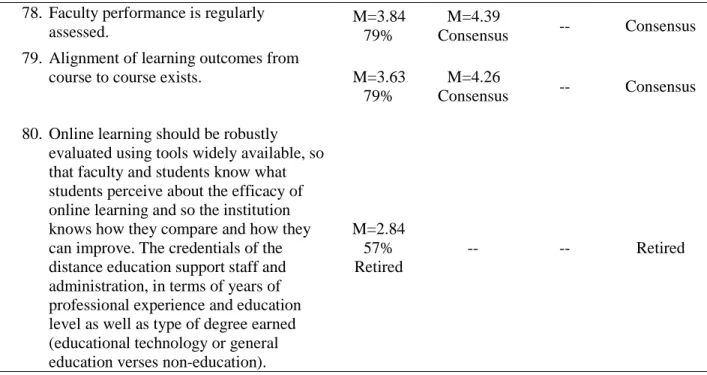
After the six Delphi survey rounds, the panel of experts suggested a total of 80 potential quality indicators and determined that 45 of those suggested indicators were relevant for a scorecard for quality assessment of an online education program. Table 4 reports the results for each quality indicator suggested by the panel.
INSTITUTIONAL SUPPORT CATEGORY
Round II Result
Round III Result
Round IV Result
Final Action 1. The institution provides documented
processes and procedures that enable distance learning.
M=3.19
65% Retired -- -- Retired
2. Underlying learning managements systems are flexible enough to support emerging technologies, e.g. social networking tools, mobile devices, Web 2.0, etc.
M=3.65 84%
M=3.35
Retired -- Retired
3. Institutions must provide guidance to faculty and students on use of unsupported
technologies.
M=3.19
65% Retired -- -- Retired
4. The institution makes bookstore services available to students.
M=3.39
72% M=3.55
M=3.62
Retired Retired 5. The institution has defined the strategic
value of distance learning to its enterprise and to its relevant parts.
M=3.59
76% M=3.87
M=4.03
50 Journal of Asynchronous Learning Networks, Volume 14: Issue 4 6. The tech plan also needs to consider and
address vended relationships and,
especially, support via cloud computing. It needs to ensure end to end operability of all systems that support distance learning. Also, “security measures” are generally handled for all campus enterprise systems through an LDAP server which authenticates users.
M=3.05
62% Retired -- -- Retired
7. Policy for Copyright ownerships of course materials exists.
M=4.16 95% Consensus
-- -- Consensus
8. The institution has put in place a governance structure to enable effective and
comprehensive decision making related to distance learning.
M=4.11 92% Consensus
-- -- Consensus
INSTITUTIONAL SUPPORT CATEGORY cont.
Round II Result
Round III Result
Round IV Result
Final Action
9. Policies are in place to authenticate that students enrolled in online courses, and receiving college credit are indeed those completing the course work
M=4.11 95% Consensus
-- -- Consensus
10. Sustainability and Scalability: A stable support mechanism/financial model to reduce recreating the same course multiple times for example if an instructor leaves the university and there is no agreement governing the intellectual property that would allow the continued use of the course materials.
M=3.66 82%
M=3.29
Retired -- Retired
11. Students ensured all they need for degree is offered in program before enrolling,
M=3.45
70% M=3.52
M=3.90 Retired
TECHNOLOGY SUPPORT Round II Result
Round III Result
Round IV Result
Final Action 12. Appropriate policies are developed,
reviewed, and disseminated to all
stakeholders. (moved to Technology Support for Round IV)
M=3.84
84% M=3.91
M=3.99
Retired Retired
13. Faculty, staff, and students are supported in the development and use of new
technologies and skills. (moved to Technology Support for Round IV)
M=3.74
79% M=3.75
M=4.15
Consensus Consensus
14. Institution maintains system for backup for data availability. (moved to Technology Support)
M=4.03 90% Consensus
-- -- Consensus
15. The course delivery technology is considered a mission critical enterprise system and supported as such. (moved to Technology Support for Round IV)
M=3.89 84%
M=4.35
Consensus -- Consensus
COURSE DEVELOPMENT/ INSTRUCTIONAL DESIGN
Round II Result
Round III Result
Round IV Result
Final Action 16. There is consistency in course development
for student retention and quality
M=4.11 95% Consensus
-- -- Consensus
17. Instructional design is provided for creation of effective pedagogy for synchronous sessions.
M=3.55 79%
Retired
Duplicate -- Retired
18. Curriculum development is a core responsibility for faculty.
M=3.32
74% M=3.45
M=4.03
Consensus Consensus 19. Learning objectives describe outcomes that
are measurable.
M=3.82 79%
M=4.32
Consensus -- Consensus 20. Development of online course materials
takes into account the changing context of media delivery
M=3.55
84% M=3.75
M=3.93
52 Journal of Asynchronous Learning Networks, Volume 14: Issue 4 21. Selected assessments measure the course
learning objectives and are appropriate for an online learning environment
M=3.92 84%
M=4.32
Consensus -- Consensus
22. Course objectives provide opportunity for student interaction.
M=3.84 78%
M=3.77
Retired -- Retired
23. Course design promotes both faculty and student engagement.
M=4.16 86% Consensus
-- -- Consensus
24. Student-centered instruction is considered during the course-development process.
M=4.03 92% Consensus
-- -- Consensus
25. Instructional design is provided for creation of effective pedagogy for both synchronous and asynchronous class sessions.
M=3.84
84% M=3.84
M=4.24
Consensus Consensus 26. Current and emerging technologies are
evaluated and recommended for online
teaching and learning. M=3.87
92% M=3.91
M=4.10
Consensus Consensus
TEACHING AND LEARNING
Round II Result
Round III Result
Round IV Result
Final Action 27. Students are provided access to library
professionals and resources that help them to deal with the overwhelming amount of online resources.
M=3.39
79% M=3.58
M=4.00
Consensus Consensus
28. Course material presented in a variety of
ways M=3.42 82% M=3.52 M=3.82 Retired
29. Interactive elements such as video and flash graphics to help engage the students’ understanding of key learning objectives
M=3.30
30. Students are provided access to library professionals and resources that help them to deal with the overwhelming amount of online resources.
M=3.11 69%
Duplicate
Retired -- Retired
31. Online courses/programs use one course management platform, creating a single delivery model, and students receive an online instructional orientation to the course management platform.
M=3.66
79% M=3.81 M=3.86 Retired
COURSE STRUCTURE Round II Result Round III Result Round IV Result Action Final 32. Instructors use specific strategies to
create a presence in the course. --- Presented Round VI
M=4.12 Consensus
Round VI
Consensus 33. Opportunities/tools provided to
encourage student-student collaboration (i.e, web conferencing, instant
messaging, etc). M=3.50 76% M=3.81 Consensus M=4.14 Consensus
34. Honor code used to enable a culture of
accountability M=3.39
76%
M=3.19
Retired -- Retired
35. Links or explanations of technical
support are available in the course. M=3.95 87%
M=4.29
Consensus -- Consensus 36. Instructional materials are easily
accessible and usable for the student. M=4.26 89% Consensus
-- -- Consensus
37. The course adequately addresses the special needs of disabled students via alternative instructional strategies and/or
referral to special institutional resources. M=4.29 95% Consensus
-- -- Consensus
38. Optional synchronous sessions with faculty are offered and archived to be available asynchronously as well, to
allow students access to faculty M=3.11
54 Journal of Asynchronous Learning Networks, Volume 14: Issue 4 39. Documents attached to modules are in a
format that is easily accessed with multiple operating systems and productivity software (PDF, for
example). --
Presented Round VI
M=4.32 Consensus
Round VI
Consensus
40. Each course includes an orientation
module. -- Presented
Round VI
M=3.64 Retired Round VI
Retired 41. Students have at least some choice in
their activities/assignments. -- Presented Round VI
M=2.92 Retired Round VI
Retired 42. Course modules are designed for visual
appeal as well as clarity and consistency (use of white space, color, well-chosen fonts, no gimmicky graphics/animations
that have no real purpose. -- Presented Round VI
M=3.60 Retired Round VI
Retired
43. Institution branding is evident in every part of each course.
-- Presented Round VI
M=3.08 Retired Round VI
Retired
STUDENT SUPPORT Round II
Result
Round III Result
Round IV Result
Final Action 44. Students are provided relevant
information: ISBN numbers, suppliers, etc. and delivery modes for all required instructional materials: digital format, e-packs, print format, etc. to ensure easy access.
M=3.50
76% M=3.94
M=4.14
Consensus Consensus
45. While technologies may not be supported centrally (like available in the cloud or openly), there needs to guidance on how these tools will be supported and the
46. Student support services are provided for outside the classroom such as academic advising, financial assistance, peer support, etc.
M=4.05 89% Consensus
-- -- Consensus
47. Program demonstrates a student-centered focus rather than trying to fit service to the distance education student in
on-campus student services. M=3.79 79% M=3.81 Consensus M=4.07 Consensus
48. Automated support tools are available for faculty to provide early intervention to
support student success. M=3.51
81% M=3.55 M=3.69 Retired
49. Efforts are made to engage students with
the program & institution M=3.58
79% M=3.84
M=4.07
Consensus Consensus 50. Students are instructed in the appropriate
ways of communicating with faculty and
students M=3.68
82% M=3.87
M=4.21
Consensus Consensus 51. Students are instructed in the appropriate
ways of enlisting help from the program. M=3.50
74% M=3.71
M=4.33
Consensus Consensus 52. Support services designed to build
communication and affiliation among the
online student population -- --
M=3.63
Retired Retired 53. Students agree and understand the
expectations of the program and courses M=3.66
79% M=3.90
M=3.97
Retired Retired 54. Students should be provided a way to
interact with other students in an online community
M=3.42 74% Duplicate
Retired
-- -- Retired
55. The institution provides guidance to both students and faculty in the use of all forms of technologies used for course delivery
M=3.44
71% M=3.77
M=4.21
56 Journal of Asynchronous Learning Networks, Volume 14: Issue 4 56. Students have access to effective
academic, personal, and career counseling
M=3.82 87%
M=4.19
Consensus -- Consensus 57. Tutoring is available as a learning
resource. M=3.89 92% M=3.94 M=4.07
Consensus Consensus 58. Minimum technology standards are
established and made available to students.
M=3.97 82%
M=4.13
Consensus -- Consensus 59. Policy and process is in place to support
ADA requirements.
M=4.16 87% Consensus
-- -- Consensus
SOCIAL AND STUDENT ENGAGEMENT Round II Result
Round III Result
Round IV Result
Final Action 60. Students should be provided a way to
interact with other students in an online
community. M=3.61 79% M=3.94 Consensus M=4.07 Consensus
FACULTY SUPPORT Round II
Result
Round III Result
Round IV Result
Final Action 61. New learning skills for online teaching
and learning are identified. M=3.30
76% M=3.50
M=3.62
Retired Retired 62. Review of web.2.0 tools and emerging
technologies and faculty. M=3.14
73% M=3.35
M=3.31
Retired Retired 63. Workshops are provided for keeping
faculty updated in selection and use of tools.
M=3.57 81% Duplicate
Retired
-- -- Retired
64. Faculty are provided ongoing professional development related to online teaching and learning.
M=4.16 87% Consensus
-- -- Consensus
65. Faculty workshops are provided to make them aware of emerging technologies
and the selection and use of these tools. M=3.50
76% M=3.77
M=4.03
Consensus Consensus 66. Clear standards are established for
faculty engagement and expectations around online teaching
M=4.05 84% Consensus
EVALUATION AND ASSESSMENT Round II Result
Round III Result
Round IV Result
Final Action 67. Online learning should be robustly
evaluated using tools widely available, so that faculty and students know what students perceive about the efficacy of online learning and so the institution knows how they compare and how they can improve.
M=3.42
71% M=3.55
M=3.71
Retired Retired
68. A process is in place for the assessment
of faculty and student support services. M=3.97 87%
M=4.26
Consensus -- Consensus 69. Course and program retention is
assessed. Results of course evaluations are used as part of faculty/instructor performance evaluations.
M=3.84 84%
M=4.19
Consensus -- Consensus 70. Recruitment and retention are examined
and reviewed M=3.55 76% Consensus M=4.06 -- Consensus
71. Evaluation should include evaluation by
potential employers. M=2.76 55%
Retired
-- -- Retired
72. Course evaluations collect student feedback on quality of content and effectiveness of instruction.
M=4.03 89% Consensus
-- -- Consensus
73. The relationship between online education programs and institutional mission must be included as a measure.
M=3.32
71% M=3.48
M=3.41
Retired Retired 74. Program demonstrates compliance and
review of accessibility standards (Section
508, etc.). M=3.82 84% Consensus M=4.29 -- Consensus
75. Student evaluations of
course/instructor/program are made available.
M=3.43
70% M=3.86
M=3.86
Retired Retired 76. Course evaluations are examined in
relation to faculty performance evaluations.
M=3.68 82%
M=4.00
Consensus -- Consensus 77. Aggregation of data to ensure each class
is being taught well. M=3.21 66% Retired
58 Journal of Asynchronous Learning Networks, Volume 14: Issue 4 78. Faculty performance is regularly
assessed. M=3.84 79% Consensus M=4.39 -- Consensus
79. Alignment of learning outcomes from
course to course exists. M=3.63
79%
M=4.26
Consensus -- Consensus 80. Online learning should be robustly
evaluated using tools widely available, so that faculty and students know what students perceive about the efficacy of online learning and so the institution knows how they compare and how they can improve. The credentials of the distance education support staff and administration, in terms of years of professional experience and education level as well as type of degree earned (educational technology or general education verses non-education).
M=2.84 57% Retired
-- -- Retired
Table 4. Suggested Quality Indicators
If additional standards are suggested, will they fall into the already identified themes or will new themes emerge?
The majority of the additional standards suggested by the experts did indeed fall naturally into the existing seven IHEP Categories: Institutional Support, Teaching and Learning, Student Support, Faculty Support, Course Structure, Course Development, and Evaluation and Assessment. It is important to point out that in the original IHEP list of quality indicators, the Institutional Support category primarily addressed technology support standards and not necessarily those related to institutional support such as mission and strategic planning; therefore, the panel of experts determined two categories were necessary: Technology Support and Institutional Support. The existing IHEP indicators in the Institutional Support category were moved to the Technology Support since their focus was technology support provided by the institution.
Aside from dividing the Institutional Support and Technology Support categories, the panel of experts suggested an additional 20 categories but only 2 of those suggestions achieved consensus: Instructional Design and Social and Student Engagement. The researcher combined Instructional Design with the Course Development category, now called Course Development and Instructional Design, because there lacked clear distinction for identifying quality indicators for either category. After all panel voting had concluded, the Technology Support and Social and Student Engagement category were the only two new categories added to the Scorecard; however, it is interesting to note there was only one quality indicator in Social and Student Engagement category that achieved panel consensus.
At the conclusion of the study, nine categories of quality indicators existed: Institutional Support, Technology Support, Faculty Support, Course Structure, Course Development and Instructional Design, Teaching and Learning, Student Support, Social and Student Engagement, and Evaluation and Assessment.
What values will be assigned to the recommended standards that will ultimately yield a numeric scorecard for measuring quality online education programs from an online education administrator’s perspective that could also support strategic planning and program improvements?
Eight potential scoring methods were suggested in Delphi Round IV. After voting in Delphi Round V concluded, four of the methods were removed for lack of consensus. Only those selected by 70% of the
panel were reviewed again by the panel of experts. The panel of experts determined that each quality indicator should be worth a potential three points for a total of 210 points. Each quality indicator will be scored in the following manner: 0 points - not observed, 1 point - insufficient, 2 points - moderate use, 3 points - completely meets criteria. The panel had also suggested that a parameter or a minimum score be established for each category of the scorecard (a certain percentage of the points) to establish a goal; however, the panel did not make a suggestion as to what the minimum score for each category should be.
VII.
IMPLEMENTATION AND NEXT STEPS
The quality scorecard is versatile enough to be used to demonstrate the overall quality of online education programs, no matter what size or type of institution. The following steps for use and implementation are suggested that will yield a measurable result:
1. The online education administrator examines the online program for evidence of each of the 70 quality indicators. Based upon the level of evidence observed, the administrator chooses one of the following values: 0 points - not observed, 1 point - insufficient, st2 points - moderate use, 3 points - completely meets criteria.
2. For each indicator, the online education administrator should provide examples of the observed evidence. For example, the first indicator listed in the Institutional Support category is: The institution has put in place a governance structure to enable effective and comprehensive decision making related to distance learning. To substantiate the score for this indicator, evidence should be documents such as digital copies of organizational charts, reporting structures, and advisory committee minutes demonstrating how a decision is processed.
3. The online education administrator totals the score for each indicator and then determines the level of quality observed:
A perfect score = 210 points.
90-99% = 189-209 - Exemplary (little improvement is needed)
80-89% = 168-188 - Acceptable (some improvement is recommended)
70-79% = 147-167 - Marginal (significant improvement is needed in multiple areas)
60-69% = 126-146 - Inadequate (many areas of improvement are needed throughout the program) 59% and below = 125 points and below - Unacceptable
The quality scorecard tool resulting from this research study is available on the Sloan Consortium (Sloan-C) website at http://sloanconsortium.org/quality_scoreboard_online_program. It is the intent of the author and Sloan-C to make the scorecard interactive so that administrators of online education programs may use the scorecard tool to demonstrate program evaluation. An ancillary handbook for use and implementation of the quality scorecard is being developed to better guide the administrator in its use. Each of the seventy quality indicators will be defined with more depth and examples and best practices will be provided to better demonstrate the level of quality that may be reached with each indicator. A community of practice website has been developed by Sloan-C that provides a forum for notes and queries to be shared regarding the scorecard and process for program evaluation.
VIII.
CONCLUSION
The purpose for this study was the development of a scorecard to measure and quantify elements of quality within online education programs in higher education. Quality is a perception that varies within industries, including that of higher education whose traditional indicators for quality are changing. In fact, Pond observed,
It is quite clear that education in the 21st century presents challenges to quality assurance that were unimaginable just a quarter century ago. E-learning in particular, with its ability to render time and place irrelevant, requires that we abandon traditional indicators of
60 Journal of Asynchronous Learning Networks, Volume 14: Issue 4 “quality” such as “contact hours,” “library holdings,” and “physical attendance” among others in favor of more meaningful measures. [43]
As we abandon the traditional indicators we have used for so long, higher education needs a method to identify and assess quality within online education programs that could provide a method of benchmarking and a path to improvement. This study provides just such a process by creating a scorecard for the administration of quality online education programs. The study also extends further validity to the original 24 IHEP indicators [13], in spite of it being a decade later. The original IHEP research study identified a strong base of quality indicators that, for the most part, have withstood the test of many changes throughout the field of online education. The original indicators are all included in the quality scorecard, although, all but two were revised without the primary focus being changed.
While there are rubrics being used to assess quality in online course materials, until now, there was not an industry agreed upon instrument being used to evaluate online education programs. Many institutions prolifically advertise they offer quality online education but have not had a way to quantify or benchmark their programs. How do students know they are enrolling in a quality program? The scorecard developed as a result of this research study provides an instrument that could identify strengths and weaknesses of an online education program and be used as a benchmarking tool for evaluation against other like programs in the industry.
The identification of quality online education programs satisfies a great need in our field and has been requested by many online education administrators as a tool for program improvement. The assessment of quality online education has never been more important as fierce competition from for-profit programs as well as many non-profits programs continues to increase and students all over the world are clicking to find a respectable degree program. Quality online education really does matter as the ultimate impact is to our students.
IX.
ABOUT THE AUTHOR
Kaye Shelton is the Dean of Online Education at Dallas Baptist University whose program now facilitates the delivery of 54 programs and majors fully online. Teaching online since 1999, Mrs. Shelton holds a certification in Online Teaching and Learning instruction. Her education includes an M.S. in Education emphasizing Online Teaching and Learning from California State University East Bay and a Ph.D. in Educational Leadership (Higher Education) from the University of Nebraska-Lincoln. She has published and presented on the best practices for teaching online, quality online course development, and the development of online education programs including a book entitled An Administrator's Guide to Online Education. She has also served as an advisor and consultant regarding online education programs for several peer institutions.
X.
REFERENCES
1. Allen, I. E., and J. Seaman., Staying the Course: Online Education in the United States, 2008,
Needham, MA: Sloan Consortium, 2008.
2. Parsad, B., and L. Lewis., Distance Education at Degree-Granting Postsecondary Institutions:
2006–07, Washington, DC: National Center for Education Statistics, Institute of Education Sciences, Department of Education, 2008.
3. Benson, A. D. Dimensions of Quality in Online Degree Programs. The American Journal of
Distance Education. 17(3): 145-49 (2003).
4. Bates, A. W., and G. Poole, Effective Teaching with Technology in Higher Education: Foundations
for Success, San Francisco: Jossey-Bass, 2003.
5. Meyer, K. The Impact of Competition on Program Quality. Planning for Higher Education. 32(4):
13 (2004).
6. Sallis, E.. Total Quality Management in Education, 2nd ed., London: Kogan Page, 1996.
7. Wergin, J. F. Higher Education: Waking up to the Importance of Accreditation. Change. 37(3):