TRANSFORMATIONAL INTERVENTION FOR PRINCIPAL LEADERSHIP (TRIPLE): A FEASIBILITY STUDY OF AN INNOVATIVE PROFESSIONAL DEVELOPMENT WORKSHOP FOR PRINCIPALS OF SCHOOLS WITH EXCLUSIONARY DISCIPLINE
Ariel I. Washington
A dissertation submitted to the faculty at the University of North Carolina at Chapel Hill in partial fulfillment of the requirements for the degree of Doctor of Philosophy in the School
Psychology Program in the School of Education.
Chapel Hill 2020
Approved by: Steven Knotek
Jeri-Elayne Goosby Smith Marisa Marraccini
ABSTRACT
Ariel I. Washington: A Feasibility Study of an Innovative Professional Development Workshop for Principals of Schools with Exclusionary Discipline
(Under the direction of Steven Knotek)
As leaders in schools, principals are responsible for ensuring that all students have equal access to a high-quality education, that faculty and staff are supported and provided opportunities to grow professionally, and that their school environment is equipped to adequately meet the needs of all students. Principals’ responsibilities compel them to critically evaluate and change ineffective educational policies and practices that create negative consequences for students and negative work environments for their faculty and staff. Transformational leadership is a broad perspective that describes how leaders inspire their followers to perform beyond expectation to carry out significant changes in organizations. Research shows that principals’ transformational leadership practices and behaviors positively influence their relationships with teachers,
teachers’ attitudes and ability to become active problem-solvers in their schools, and their schools’ overall climate. These elements are all needed to transform ineffective school policies and practices, such as zero tolerance policies and exclusionary discipline practices.
Numerous studies have shown that zero tolerance policies and exclusionary discipline practices in schools are ineffective as they do not deter student misbehavior but instead have negative academic and social-emotional consequences for students, contribute to racial
attitudes toward school exclusion, students are more likely to receive out-of-school suspension and expulsion. Because zero tolerance and exclusionary discipline are ineffective disciplinary policies and practices that lead to inequitable educational opportunities for minority students and negative school climates, principals must address the use of these discipline methods in their schools.
This study investigates a novel professional development workshop, Transformational
Intervention for Principal Leadership (TrIPLe), that seeks to decrease elementary and middle school principals’ over-reliance on zero tolerance policies and overuse of exclusionary discipline practices. The current study aims to determine TrIPLe’s feasibility and acceptability for future
implementation in a school district by using the Delphi method to collect qualitative and quantitative data from members of three groups directly involved in TrIPle’s implementation:
elementary and middle school principals, school psychologists, and business leaders.
ACKNOWLEDGEMENTS
Thank you to my patient and supportive dissertation committee: my dissertation chairperson, Dr. Steve Knotek, who always offered words of encouragement during my most stressful moments; my internship guide, Dr. Marisa Marraccini, who helped me start my career in my current school district; my academic advisor, Dr. Rune Simeonsson, who pushed me to be methodological in my studies; my leadership capstone project advisor, Dr. Jaye Goosby Smith, who helped me develop the foundation of this study; and finally, my friend and mentor, Dr. Kerry Taylor, who has supported me on this journey for several years and whose passion for social justice has strengthened my resolve to fight for equity in education.
Thank you to my family, friends, and colleagues who have supported me on this eleven-year journey to earning my doctorate. Special thanks to my mother, Rosalee Washington, and to my sisters, Kendra Bolton, Crystal McKenzie, Jerrica Brown, and Tammy Washington, for always having faith that I would accomplish my goals. Thank you to my nieces and nephew, Kiana Bolton, Steven Williams, Tamiyah Washington-McDaniel, and Joleigh Brown, who motivate me to continue fighting for equity in our schools.
TABLE OF CONTENTS
LIST OF TABLES………...x
LIST OF FIGURES………xi
CHAPTER I: INTRODUCTION……….………1
CHAPTER II: LITERATURE REVIEW………4
Principals as Change Agents……….……...4
Transformational Leadership………...6
Bass’ Model of Transformational Leadership……….……8
Bennis and Nanus’ Model of Transformational Leadership………..10
Kouzes and Posner’s Model of Transformational Leadership………...11
Principals as Transformational Leaders………..………...13
Transformational Leadership in Education and the Impact of Race………..18
Zero Tolerance Policies and Exclusionary Discipline Practices……….…….……..20
Outcomes of Zero Tolerance Policies………....22
Racial Disparities in Exclusionary Discipline Practices………23
Disciplinary Process………..……….25
Principals’ Attitudes toward Zero Tolerance and Exclusionary Discipline……...28
CHAPTER III: METHODOLOGY..……….…31
Transformational Intervention for Principal Leadership (TrIPLe)……….…31
Intervention Framework……….………34 Intervention Process………..…….36 Research Aim..…….………..41 Research Methods………..41 Research Design……….41 Participants………..………...42 Ethical Considerations………...43
Intersectionalityof Researcher and Program Developer ……….……….44
Data Collection Strategies………..………..………..45
Data Analyses………..………..…………46
Credibility………..47
Confirmability………47
CHAPTER IV: RESULTS….……….………...48
Participant Demographics………..………...48
Round 1 Questionnaire……….….49
Round 2 Survey………..…....55
Round 3 Survey………..56
CHAPTER V: DISCUSSION………....58
Perceived Effectiveness of TrIPLe……..……….59
TrIPLe’s Fit in the Greater Context of Professional Development………..60
Effect of the Participants’ Roles on Their Responses………61
Need for Mentorship……….……….62
Implications for Future Research………….………...………..……….64
APPENDIX A: TRIPLE FACILITATOR MANUAL………..66
APPENDIX B: RECRUITMENT EMAIL………...………..….109
APPENDIX C: CONSENT FORM……….110
APPENDIX D: DEMOGRAPHIC SURVEY………..…..….…115
APPENDIX E: SAMPLE ROUND 1 QUESTIONNAIRES……...117
APPENDIX F: ROUND 1 THEMES AND ROUND 2 SURVEY ITEMS………123
APPENDIX G: ROUND 2 SURVEY………...………..124
APPENDIX H: SAMPLE ROUND 3 SURVEYS……..………...………….128
LIST OF TABLES
Table 1. Roles and Responsibilities of Principals.……….……..……5
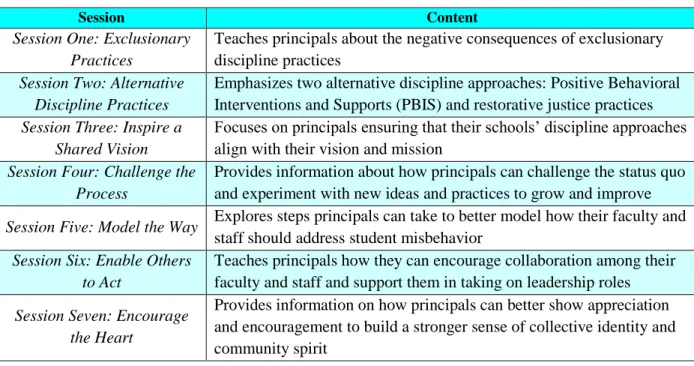
Table 2. TrIPLe Sessions....………..40
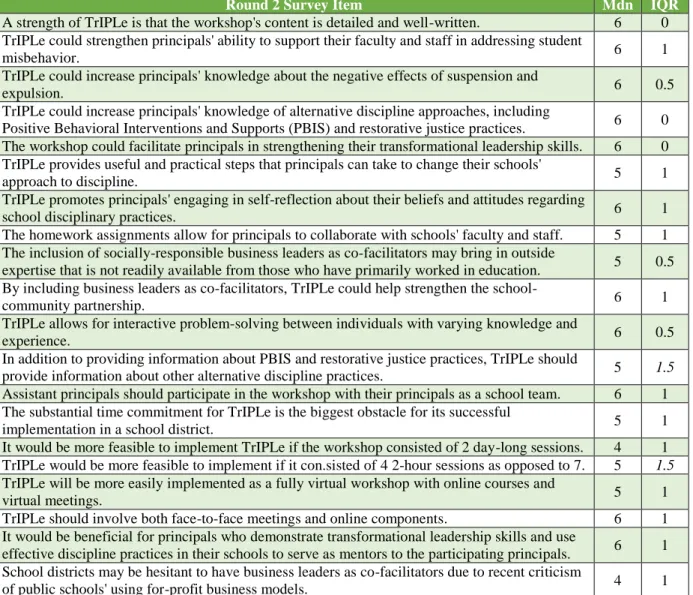
Table 3. Median (Mdn) and Interquartile Range (IQR) for Round 2 Survey Items…………...55
LIST OF FIGURES
Figure 1. TrIPLe’s Fit in the MTSS Framework………..36
Figure 2. TrIPLe’s Logic Model………..………..……...37
Figure 3. TrIPLe’s Theory of Change………..39
CHAPTER I: INTRODUCTION
The principal is one of the most influential factors in the quality and character of a school as he/she controls many of the schools’ basic organizational structures (Cohen, McCabe,
Michelli, & Pickeral, 2009). Schools in the improvement process often examine the various leadership factors that play a role in school effectiveness (Bruggencate, Luyten, Scheerens, & Sleegers, 2012). Transformational leadership, one of the most prominent theories of leadership, is a style that has been advocated for success in the school change process (Allen, Grigsby & Peters, 2015; Moolenaar, Daly, & Sleegers, 2010). Transformational leadership is a broad perspective that describes how leaders inspire their followers to perform beyond expectations by articulating a shared vision for the future, motivating others through personal example, and meeting their followers’ individual needs (Northouse, 2013). Principals who demonstrate the behaviors of transformational leadership have been found to change teachers’ behaviors,
stimulate innovation, and increase organizational commitment and effort for change (Leithwood, Harris, & Hopkins, 2008; Nguni, Sleegers, & Denessen, 2006; Yu, Leithwood, & Jantzi, 2002). Given the importance of transformational leadership as a contributing factor to positive school climate, or environments in which the whole of the school community prospers, principals should work on developing their transformational leaders skills in an effort to positively impact school climate and their faculty and staff’s commitment to change (Allen et al., 2015; Cohen et al., 2009).
Transformational Intervention for Principal Leadership (TrIPLe) is an innovative district-level professional development program that seeks to address the problem of principals’ over-relying on zero tolerance policies when dealing with student misbehavior. TrIPLe partners elementary and middle school principals with school psychologists as they are experts in
consultation and schoolwide interventions to promote student success and with business leaders in the community who have demonstrated a commitment to improving their communities. The program teaches principals how to apply the tenets of transformational leadership to guide changes in disciplinary practices and policies. The current study aims to determine TrIPLe’s
CHAPTER II: LITERATURE REVIEW
Principals as Change Agents
The school principal is one of the most influential factors in the development of the quality and character of a school (Cohen et al., 2009; Hauserman & Stick, 2013; Hoy & Smith, 2007; Price, 2012). Principals are central figures in schools as their actions directly shape their school’s climate (Price, 2012). Positive school climates are characterized as environments in which the whole of the school community prospers (Price, 2012). Principals especially influence the organizational climate of the school when they can foster trusting, cooperative, and open environments where input from faculty and staff is welcome and cohesion around and
commitment to school goals are encouraged (Bryk, Sebring, Allensworth, Luppescu, & Easton, 2010; Finnigan & Stewart, 2009; Louis et al., 2010; Price, 2012). Principals who can genuinely establish a trusting school environment for all school members can become drivers of change (Moolenaar et al., 2010; Price, 2012).
In addition to greatly influencing their school’s climate, many of the school’s basic organization structures are controlled and shaped by principals as they serve as the school’s leader of personnel, students, instruction and academic performance, government and public relations, finance, and strategic planning (Allen et al., 2015; Colvin, 2007; Hess & Kelly, 2007; Leithwood et al., 2004; Lynch, 2012; Portin, 2004). Table 1 displays the roles and
Table 1. Roles and Responsibilities of Principals
Managerial Role Responsibility
Personnel Ensure the hiring of qualified faculty and staff; support faculty and staff in reaching the school’s goals
Students Foster a high-quality learning environment for all students; influence the moral character of students in part by implementing effective disciplinary practices Instruction Oversee the curriculum and develop and implement an effective instructional
program; help teachers improve their teaching School Safety
Develop and enforce school discipline policies; assign supervisor responsibilities among school personnel; ensure that facilities and equipment are safe and in good working order
Government and Public Relations
Influence state and community level perceptions of the schools; serve as a connection between the school system and the community; promote the public image of the school
Finance Balance the school budget; secure funding and resources
Strategic Planning Make both daily decision as well as long-term decisions that promote the school’s vision, mission, and goals
While superintendents and school districts provide policy guidance, principal leadership is responsible for change at the school level (Hauserman & Stick, 2013). Research shows that a principal’s leadership style impacts a variety of teacher characteristics, including job satisfaction and attitudes toward the school, and student outcomes, including academic achievement and school engagement (Allen et al., 2015; Hauserman & Stick, 2013; Price, 2012; Shatzer,
Caldarella, Hallam, & Brown, 2014). Principals play pivotal roles as change agents facilitating organizational change (Hauserman & Stick, 2013; Marks & Nance, 2007; Price, 2012; Shaked & Schechter, 2013). School transformation requires that a principal foster a belief in change among his/her faculty and staff, encourage and support the change process, and lead change through strategic planning and targeted actions (McCarley, Peters, & Decman, 2016). It is imperative that principals in schools attempting to improve student learning understand the essential role
collaboration plays in implementing change and adopt a leadership style that will have the most positive impact on the change process (Marks & Nance, 2007). One such leadership style is transformational leadership.
Transformational Leadership
Transformational leadership, one of the most popular and researched approaches to leadership, is a broad perspective that describes how leaders can initiate, develop, and carry out significant changes in organizations by inspiring followers to perform beyond expectations while putting aside self-interest for the good of the organization (Avolio, Walumbwa, & Weber, 2009; Balyer, 2012; Leithwood & Jantzi, 2006; McKinney et al., 2015; Northouse, 2013; Printy, Marks, & Bowers, 2009). Transformational leadership began with political sociologist James MacGregor Burns’ 1978 seminal work Leadership, in which he analyzed the ability of some leaders across many types of organizations to engage with staff in ways that inspired them to new levels of energy, commitment, and moral purpose (Hauserman & Stick, 2013; McCarley et al., 2016; Northouse, 2013, p. 186; Robinson, Lloyd, & Rowe, 2008). Transformational
being Bass’ model, Bennis and Nanus’ model, and Kouzes and Posner’s model of transformational leadership.
Bass’ model of transformational leadership. In 1985, Bass expanded transformational leadership by focusing more attention on followers’ needs, by suggesting that transformational leadership could apply to situations where the outcomes were not positive, and by describing charisma as a necessary but not sufficient condition for transformational leadership (Northouse, 2013, p. 190). Bass argued that transformational leaders motivate followers to do more than expected by raising followers’ levels of consciousness about the importance and value of specific and idealized goals, by getting followers to transcend their own self-interest for the sake of the organization, and by moving followers to address higher-level needs (Northouse, 2013, p. 190).
Bass defined four transformational leadership dimensions: idealized influence, individual consideration, inspirational motivation, and intellectual stimulation (Balwant, 2016; McKinney et al., 2015; Moolenaar et al., 2010; Shatzer et al., 2014). Idealized influence or charisma is the emotional component of leadership. Idealized influence describes leaders who articulate a sense of mission, emphasize trust, act as strong role models for followers, consider the needs of others before their own personal needs, avoid the use of power for personal gain, demonstrate high moral and ethical standards, and set challenging goals for their followers (Balwant, 2016; Balyer, 2012; Northouse, 2013, p. 191). Followers identify with these leaders and want very much to emulate them (Northouse, 2013, p. 191). These leaders are deeply respected and trusted by their followers (Balwant, 2016; Northouse, 2013, p. 191). Idealized influence is measured on two components: an attributional component that refers to the attributions of leaders made by
The second factor, inspirational motivation, describes leaders who communicate high expectations to followers, inspiring their followers through motivation, enthusiasm and optimism to become committed to and a part of the organizations’ shared vision (Balwant, 2016; Balyer, 2012; Northouse, 2013, p. 193). These leaders use symbols and emotional appeals to focus group members’ effort to achieve more than they would in their own self-interest and to enhance team spirit (Northouse, 2013, p. 193).
Intellectual stimulation includes leadership that stimulates followers to be creative and innovative and to challenge their own beliefs and values as well as those of the leaders and the organization (Northouse, 2013, p. 193). These leaders act as coaches or mentors to support followers as they try new approaches and develop new ways of dealing with organizational issues (Balyer, 2012; Northouse, 2013, p. 193). Transformational leaders encourage and challenge followers to conceptualize, understand, and analyze problems in new ways on their own (Balwant, 2016). Transformational leaders may encourage their followers to spend more time on training and professional development (Moolenaar et al., 2010). They foster an organizational culture in which creative efforts and the distribution of new knowledge and practices are encouraged (Balwant, 2016; Moolenaar et al., 2010).
The final transformational leadership factor defined by Bass is individualized
risk with team members when adopting new strategies, and recognize individual contributions to the team (Moolenaar et al., 2010). These leaders may use delegation to help followers grow through personal challenges (Northouse, 2013, p. 193).
Bennis and Nanus’ model of transformational leadership. The second model of transformational leadership created by Bennis and Nanus has similar characteristics as Bass’ model. In 1985, Bennis and Nanus asked 90 leaders basic questions, such as, “What are your strengths and weaknesses?” and “What past events most influenced your leadership approach?” (Northouse, 2013, p. 197). From the leaders’ answers, Bennis and Nanus identified four common strategies used by leaders in transformational organizations. First, transformational leaders have a clear vision of the future state of their organizations that is attractive, realistic and believable (Northouse, 2013, p. 197). The vision usually is simple, understandable, beneficial and energy-creating (Northouse, 2013, p. 197). When an organization has a clear vision, it is easier for people within the organization to learn how they fit in with the overall direction of the
organization (Northouse, 2013, p. 197). Bennis and Nanus found that, to be successful, the vision must grow out of the needs of the entire organization and be claimed by those within it
(Northouse, 2013, p. 197).
Second, transformational leaders are social architects for their organizations who create a shape or form for the shared meanings people maintain within their organization (Northouse, 2013, p. 197). These leaders communicate a direction that transform their organization’s values and norms (Northouse, 2013, p. 197). In many cases, these leaders mobilize people to accept a new group identity or a new philosophy for their organization (Northouse, 2013, p. 197).
by articulating a direction and then consistently implementing the direction even though the vision may involve a high degree of uncertainty (Northouse, 2013, p. 197). Bennis and Nanus found that when leaders established trust in an organization, it gave the organization a sense of integrity (Northouse, 2013, p. 197).
Fourth, transformational leaders use creative deployment of self through positive self-regard (Northouse, 2013, p. 197). Leaders know their strengths and weaknesses, and they emphasize their strengths rather than dwelling on their limitations (Northouse, 2013, p. 197). Effective leaders immerse themselves in their tasks and the overarching goals of their
organizations (Northouse, 2013, p. 197). Bennis and Nanus found that positive self-regard in leaders has a reciprocal impact on followers, creating in them feelings of confidence and high expectations (Northouse, 2013, p. 197).
Kouzes and Posner’s model of transformational leadership. Building on the earlier two models, Kouzes and Posner expanded the model of transformational leadership by
emphasizing previously excluded behaviors of transformational leaders. Kouzes and Posner’s model of transformational leadership consists of five fundamental practices and behaviors that enable leaders to get extraordinary goals accomplished: model the way, inspire a shared vision, challenge the process, enable others to act, and encourage the heart (Abu-Tineh, Khasawneh & Omary, 2009; McKinney et al., 2015; Northouse, 2013, p. 198). To model the way, leaders should be clear about their own values and philosophy. Transformational leaders set a personal example for others through their daily acts and follow through on their promises and
principles, and high standards they advocate and share with others in their organization (Abu-Tineh et al., 2009; Northouse, 2013, p. 198).
Effective leaders create compelling visions that unite members of an organization by fostering a commitment to a shared future they seek to create (Abu-Tineh et al., 2009).
Transformational leaders communicate their ideal vision of what the organization can become in the future; their optimistic and hopeful visions generate enthusiasm and excitement in their followers (Abu-Tineh et al., 2009). These leaders also listen to the dreams of their followers and show them how their dreams can be realized (Northouse, 2013, p. 198).
Transformational leaders challenge the process and are willing to change the status quo to grow and improve (Abu-Tineh et al., 2009; Northouse, 2013, p. 198). They seek out challenging opportunities to test their skills and abilities and look for innovative ways to improve their organizations (Abu-Tineh et al., 2009, Northouse, 2013, p. 199). Mistakes are seen as
opportunities to learn and improve, and risk-taking is encouraged with steps taken one at a time (Abu-Tineh et al., 2009; Northouse, 2013, p. 199).
Transformational leaders work effectively with others, build trust, and promote collaboration and empowerment (Abu-Tineh et al., 2009; Northouse, 2013, p. 199). They are open to different points of view, involve others in planning, allow others to make their own decisions, and support followers’ decisions (Northouse, 2013, p. 199). Transformational leaders empower their followers to have a sense of ownership and responsibility in the organization (Abu-Tineh et al., 2009).
celebrating achievements together, followers feel greater collective identity and community spirit (Northouse, 2013, p. 199).
All three models of transformational leadership show that this leadership approach is a broad perspective that emphasizes leaders understanding followers’ needs and motives and using shared values, morals, standards, and long-term goals to empower them to enhance their
performance. Transformational leaders are change agents who are good role models, who empower followers to meet higher standards and nurture them in change, and who act in ways that improve the morale of the organization and promote a culture of collaboration and trust. An encompassing approach, transformational leadership can describe a wide range of leadership behaviors, from specific attempts to influence followers on a one-to-one level to broad attempts to change entire organizations. In a situation where a principal is attempting to change his/her schools’ disciplinary approaches, both efforts to change individual faculty and staff member’s handling of student misbehavior and broad efforts to change the school’s culture and climate are needed; thus, transformational leadership a suitable leadership style for principals to adapt. While research shows that transformational leadership is an effective leadership approach, research also shows that leaders’ characteristics, such as gender, race, ethnicity, and language, may impact the effectiveness of transformational strategies in organizations.
Principals as Transformational Leaders
Transformational leadership in schools is defined as the ability to lead students and staff through a creation of values and long-term goals to create positive and successful schools (McCarley et al., 2016). As transformational leaders, principals have the responsibility to develop and sustain a school climate that is conducive to positive change (Bass & Riggio, 2006; McCarley et al., 2016). Studies have shown that transformational leadership positively improves teachers’ perceptions of school conditions, teachers’ individual commitment to change, teacher and staff relations, organizational learning, and student outcomes (Allen et al., 2015; Balyer, 2012). Principals who exhibit transformational characteristics play a major role in the fostering of conditions for school improvement by stimulating faculty and staff members’ engagement in professional learning activities, which can impact student achievement (Allen et al., 2015).
Leithwood and Jantzi (2000) assert that transformational leadership has seven dimensions in schools: building school vision and establishing school goals; providing intellectual
stimulation; providing individualized support; modeling best practices and organizational values; setting high academic standards and behavior expectations; creating a productive school culture; and fostering participation in decisions. The more principals perform transformational behaviors and practices, the more leadership in their schools is distributed or shared among the individuals in the schools who have influence (McCarley et al., 2016). It is imperative that principals
recognize that collaboration is essential for effectively implementing change. Principals who adopt the practices and behaviors of transformational leaders are best equipped to create a school culture that is open, democratic, and ready to apply necessary changes (Hauserman & Stick, 2013).
transformational leadership qualities among principals. Ten randomly selected teachers from each of the study’s 77 participating schools completed the Multifactor Leadership Questionnaire (MLQ) for their respective principals. The MLQ measures the principles of transformational leadership outlined in Bass’ model. The MLQ was used to stratify principals according to whether they possessed high or low levels of transformational leadership qualities. Once the principals were stratified, ten teachers were selected for in-depth interviews, five of whom worked with principals characterized as highly transformational. Concerning idealized influence, highly transformational principals were identified as those who helped to develop the leadership capacity of all staff members, held students and teachers accountable, had high expectations, led by example, mentored their staff, showed consistent fairness, and made ethical decisions.
Professional growth for personnel was deemed a priority and the principals modeled such
activities. Principals rated high in the category of inspirational motivation emphasized teamwork, encouraged and supported teachers, and served as good role models. Principals rated high in intellectual stimulation were characterized as visionaries who were able to push forward and think outside the box, asked questions that challenged the status quo, explained decisions, provided creative solutions, and were proactive problem-solvers. Regarding individualized consideration, principals rated as exhibiting high levels of this aspect of transformational leadership assisted teachers with problems and encouraged reflection. Problems were discussed openly without fear of retaliation and the decision-making process involved those who were directly impacted by the decisions. These principals were viewed as colleagues rather than bosses.
perceptions of the degree to which their principals display factors of transformational leadership and the perceived school climate. A sample of 399 teachers representing five high schools in a large urban school district in southeast Texas was administered the MLQ to assess his/her school principal in terms of their being a transformational leader. The teachers were also administered the Organizational Climate Description Questionnaire (OCDQ) to evaluate their respective schools’ climate. The OCDQ is a 34-item instrument that breaks down school climate into five dimensions: supportive behavior, directive behavior, engaged behavior, frustrated behavior, and intimate behavior. The OCDQ measures principal leadership on the supportive and directive dimensions and teacher interactions on the engaged, frustrated, and intimate behavior
dimensions. The supportive dimension describes leaders who work hard, utilize constructive criticism, and give reasons for criticism. The direction dimension describes leaders who control their staff by supervising teachers closely and monitoring all actions of teachers. Engaged teachers help and support each other and assist students with their individual needs. Frustrated teachers have nonverbal communication that is unproductive, are overwhelmed by paperwork, and are assigned excessive non-teaching duties. Intimate teachers have personal friendships within the school and socialize outside of school. The results showed that there was a statistically significant positive relationship between all factors of transformational leadership assessed by the MLQ and the supported and engaged elements of school climate. A statistically significant negative relationship between factors of transformational leadership and frustrated elements of school climate was also found.
research article was defined as a leader’s ability to increase organizational members’
commitment, capacity, and engagement in meeting goals. Principals’ social network position referred to three measures of centrality: degree, defined as the number of teachers who seek a relationship with the principal; closeness, defined as the extent to which a principal has a direct relationship with teachers in the school; and betweenness, defined as the degree to which a principal occupies a position between disconnected teachers. The researchers studied 51 principals and 702 teachers in 51 Dutch elementary schools within a large educational system. All teachers and principals responded to a social network survey. The schools’ instrumental network was assessed with the question, “Whom do you go to for work related advice?”; the schools’ expressive network was assessed by asking the question, “Whom do you go to for guidance on more personal matters?” Teachers’ perception of their principals’ transformational leadership was assessed using a scale that specifically looked at principals’ vision building, individualized consideration, and intellectual stimulation. A six-item scale was developed to assess schools’ orientation to improve measured teachers’ perceptions of their schools’ climate in support of innovation. Results of the analyses indicated that transformational leadership was positively and significantly related to teachers’ perceptions of their schools’ innovative climate and to principals’ popularity in both the instrumental and expressive network.
between principals and their faculty and staff, faculty and staff engagement in decision-making, and a school environment that is supportive of innovation and change are necessary to transform ineffective school policies and practices to those that are effective and promote students’
learning (Bryk et al., 2010; Hauserman & Stick, 2013; Hoy et al., 2002; Leithwood et al., 2004; Moolenaar et al., 2010).
Transformational Leadership in Education and the Impact of Race
Educational leaders play an important role in advancing key institutional priorities, such as ensuring that the school environment is inclusive and welcoming and allows all students to be successful. For schools prioritizing issues related to diversity and moving diversity agendas forward, some researchers have suggested that transformational leadership styles are necessary (Kezar & Eckel, 2008). Transformational leadership has been considered to be the most
appropriate leadership style of school leaders attempted to diversify their schools based on the assumption that fundamental or deep change requires individuals to rethink their basic values and transformational leaders seek to empower others to create motivation and work ethic to change the values and preferences of an organization (Kezar & Eckel, 2008).
presidents’ pursuing a personal agenda rather than as an institutional imperative. The presidents of color were wary of demonstrating a personal commitment to diversity and stressed the
importance of getting key groups, such as the school board and faculty and staff, to support them and speak on behalf of diversity issues and/or publicly support the presidents’ commitment and agenda. Presidents of color discussed using transactional strategies more than transformational strategies as transactional strategies often rely less on rhetoric and public discussion but still bring about significant changes. Kezar and Eckel (2008) concluded that:
Presidents of colour face explicit challenges associated with campus diversity because of their race and ethnicity. The rules for how presidents address similar challenges differ with race. Leaders of colour must recognize that what works for their majority colleagues may not have the same pay-off for them and in fact may hinder their effectiveness, suggesting that they need to look to leaders similar to themselves for role models. Based on the qualitative data collected by educational leaders, Kezar and Eckel (2008) concluded that race plays a role in educational leaders demonstrating transformational strategies; similarly, Carter, Mossholder, Feild, and Armenakis (2014) investigated whether the race of supervisors and subordinates moderated transformational leaders’ impact on their followers’ work-related outcomes. Carter et al. (2014) found that supervisor-subordinate racial dissimilarity impacted the outcome of transformational leadership. Interracial interactions may provoke anxiety and uncertainty when the interactions are ambiguous and do not follow familiar
behavioral scripts. This can be an obstacle for educational leaders who previously demonstrated a different leadership approach and are changing to adopt a more transformational leadership approach as this change may be perceived unfavorably by subordinates of different racial groups who may assign stereotypical values and aspirations to the leaders.
within and outside racial stereotypes. While minority educational leaders may face obstacles when attempting to apply transformational strategies to change school policies and practices, especially for those that involve racial and/or diversity issues, transformational leadership continues to hold promise as a way to align diverse needs (Santamaria & Jean-Marie, 2014).
Zero Tolerance Policies and Exclusionary Discipline Practices
Principals have the responsibility as transformational leaders to attend to the needs of their students, faculty and staff, and school to support their students in reaching their full potential. These responsibilities compel principals to critically evaluate and change ineffective educational policies that create negative consequences for students and negative work
environments for their staff. An example of flawed policies that have been shown to result in negative effects on students’ academic, behavioral, emotional and social outcomes are zero tolerance policies.
Zero tolerance is traditionally and commonly associated with drug, alcohol, and weapon codes of conduct (Fergus, 2015; Hoffman, 2014; Jones, 2013). But the GFSA gave discretionary freedom to administrators to modify the policy, and with time, school districts have expanded that application to include more subjective and difficult-to-define categories, such as willful disobedience, dress code violations, and intentionally treating authority with disrespect (Fergus, 2015; Jones, 2013; Triplett et al., 2014). The offenses originally meant to be addressed by zero tolerance policies, including those involving weapons and drugs, are less frequent than those related to subjective behavioral infractions that are not necessarily physically dangerous but rather are considered distracting, disorderly, or inappropriate (Hoffman, 2014; Evans & Lester, 2012; Fergus, 2015).
Zero tolerance policies are based on the assumptions that harsh sanctions will deter school misconduct and that removal of the most serious offenders from the school will improve the school climate (Heilbrun, et al., 2015; Jones, 2013). The philosophy of zero tolerance is based on the “broken-window” theory (Skiba, 2014). The theory maintains that communities must react to even minor disruptions in the social order with relatively strong force to “send a message” that certain behaviors will not be tolerated (Jones, 2013; Skiba, 2014). Advocates of zero tolerance believe that the failure to intervene in this way allows the cycle of disruption and violence to gain a solid footing in the schools and community (Skiba, 2014). Zero tolerance policies rely primarily upon school exclusion – in-school and out-of-school suspension and expulsion and referrals to juvenile justice systems – and increases in security and policy presence in schools (Han & Akiba, 2011; Skiba, 2014).
disproportionate to the offense, suggesting that zero tolerance policies have reached illogical extremes (Evans & Lester, 2012; Hoffman, 2014; Jones, 2013; Skiba, 2014). Reports have documented incidents in which students have been suspended or expelled for bringing a plastic knife in their lunchbox, pointing a gun drawn on paper at classmates, and bringing a plastic axe to school as part of a Halloween costume (Skiba, 2014).
Outcomes of zero tolerance policies. Research suggests that there is no evidence to support the effectiveness of zero tolerance as a disciplinary policy as these policies neither deter student misbehavior nor improve school climate (Heilbrun et al., 2015; Hoffman, 2014; Jones, 2013; Losen, 2013; Skiba, 2014). Further, research shows that students who are suspended once are more likely to be suspended again, with no evidence of a deterrent or remedial effect (Fabelo et al., 2011; Tobin, Sugai, & Colvin, 1998). Exclusionary discipline removes students from the learning environment and potentially increases the amount of time that they spend unsupervised and with out-of-school youth (Evans & Lester, 2012; Losen, 2013; Jones, 2013; Triplett et al., 2014). When students are suspended from their traditional school setting for more than ten days, the school is required to provide alternative educational opportunities. Yet in many cases, these alternative educational opportunities are inferior and worsen students’ educational frustrations (Han & Akiba, 2011). Students suspended for less than ten days often are not given any type of alternative educational placement and are frequently prevented from making up missed work, which increases the likelihood of academic failure (Evans & Lester, 2012). For students who have been expelled, most U.S. states do not require local education agencies to provide alternative education services (Han & Akiba, 2011). Even states that have laws requiring
emotional consequences for students, including increased risk for future delinquency, anxiety, substance use, school dropout (Anyon et al., 2014; Losen, 2013; Triplett et al., 2014).
Beyond having negative consequences for individual students, zero tolerance policies also have been shown to fail in creating safer schools or improving school climate (Evans & Lester, 2012; Han & Akiba, 2011; Hoffman, 2014; Losen, 2013). Zero tolerance policies result in the unnecessary criminalization of what many consider to be typical child and adolescent behavior and increase the link between the education system and the juvenile justice system, exacerbating student misbehavior and creating negative school climates (Jones, 2013; Losen, 2013). Negative school climates have been shown to increase both teacher turnover rates and student dropout rates (Evans & Lester, 2012). Exclusionary discipline mandated by zero tolerance policies often create antagonistic relationships between students and teachers and administrators (Hoffman, 2014).
Racial disparities in exclusionary discipline practices. In addition to being
consistently suspended at rates two to three times higher than the rates for other students and are similarly overrepresented in office referrals, expulsions, corporal punishment, and referral to law enforcement (Anyon et al., 2014; Hoffman, 2014; Losen, 2013; Skiba, 2014). The racial gap remains even when poverty and other sociodemographic variables are accounted for (Heilbrun et al, 2015).
Previous research suggests that school-to-school variations in suspension rates cannot be adequately explained by differences in student behavior (Heilbrun et al., 2015; Skiba, Edl, & Rausch, 2007; Skiba et al., 2011). Studies have shown that white students are referred more than black students for more objective offenses, such as smoking and vandalism, while black students are referred more than white students for more subjective offenses, such as disrespect and
loitering (Jones, 2013; Skiba, 2014). Black males are more likely than white students and students of other racial minority groups to be suspended for subjective, relatively minor disciplinary infractions, such as insubordination and disruption, and to receive more severe penalties for minor misconduct (Heilbrun et al., 2015; Skiba 2014). Black male students tend to be disciplined more harshly for the same behaviors that are committed by white students (Anyon et al., 2014; Hoffman, 2014).
Hoffman (2014) assessed the effect the expansion of zero tolerance policies had on both racial differences in the percentage of students recommended for expulsion from a mid-sized urban school district and racial differences in the proportion of days that all students in the district’s secondary schools were suspended from school. The sample district served more than 24,000 students. Results showed that the expansion of zero tolerance policies increased the percentage of students recommended for expulsion and that the effect on the population of black students in the district was much greater than the effect on students of any other race or ethnicity. The percentage of white students recommended for expulsion increased from 0.3% before the policy change to 0.5% after the policy change. For Latino students, the percent of students increased from 0.8% to 1.0% of secondary students. The already high percentage of black
students recommended for expulsion more than doubled from 2.2% to 4.5%. While the estimated percentage of days white students were suspended was unaffected by the expansion of zero tolerance, the percentage of days black students were suspended increased by approximately 0.1 percentage points, equaling an additional 700 days of instruction lost to suspension.
Disciplinary Process
educators as consciously deciding to misbehave and students’ decisions to misbehave are seen as directly determining whether they are referred to the principal’s office and suspended (Kinsler, 2011; Skiba et al., 2014). Because school personnel view the disciplinary process as being driven by student behavior, disciplinary outcomes such as suspension and expulsion are thus perceived as direct indicators of the extent of student disruption (Skiba et al., 2014). While educators often believe the simplistic explanation that connects student misbehavior and discipline, data suggests that school suspension or expulsion is the result of a complex process that cannot be described as a straight line leading from student misbehavior to an invariant consequence delivered by the principal or disciplinary team (Skiba et al., 2014). Judgements about the student’s behavior are influenced by several factors such as the student’s disciplinary history and the immediate context of the behavior, making school exclusion more of a process than an event (Skiba et al., 2014; Welch & Payne, 2010).
The National Center for Education Statistics (NCES) surveyed a nationally representative sample of 1,234 school principals or disciplinarians to learn what they considered to be the most pervasive disciplinary problems in their schools (Skiba et al., 2014). The most frequently cited problems at all school levels were nonviolent behaviors such as tardiness (40%) and absenteeism (25%), with the most severe behaviors such as drug use and possession of a weapon reported to occur only 9% and 2% of the time, respectively (Skiba et al., 2014). Nonviolent offenses resulting in high suspension rates for minority students revealed that individual-level discretion was employed by principals when determining which student behaviors to address (Welch & Payne, 2010).
2014). The percentage of black students enrolled in a school has been shown to predict the use of more exclusionary discipline practices and less supportive interventions for discipline (Anyon et al., 2014; Skiba et al., 2014; Welch & Payne, 2010). Racial threat is a theoretical orientation that can explain the influence of racial composition on discipline (Payne & Welch, 2015). Racial threat predicts that the presence of a high ratio of black individuals will intensify public punitive actions because of the perceived political, economic, or criminal threat that a relatively large minority population presents to the white majority (Payne & Welch, 2015).
Anyon et al. (2014) investigated whether race independently contributed to students’ risk of office discipline referral, suspension, law enforcement referral, and/or expulsion and whether alternative approaches to resolving discipline problems protected students from out-of-school suspension and expulsion. The sample size of 87,997 students in 183 schools consisted of all students in kindergarten to grade 12 enrolled in Denver Public Schools during the 2011-2012 academic year. Results indicated that student racial background and school racial compositions were enduring risk factors across key decision points in the school discipline process. Black, Latino, and multiracial students were often punished more harshly than white students for the same offenses. Schools with higher proportions of black and Latino students were more likely to use school exclusion as a disciplinary practice.
disciplinary response, percentage of black students, and several control variables, including principal leadership, the quality and quantity of the discipline training school personnel received, the percentage of Latino students, and the percentage of students who qualified for free or
reduced lunch. The study found that schools with higher black enrollments were more likely to have higher rates of exclusionary discipline, court action, and zero tolerance policies, even after controlling for school levels of misbehavior and other factors that have been shown to affect discipline practices. The only other significant predictor was greater principal leadership, with principals who perceive themselves as effective leaders in terms of supervision, feedback, consideration, presence, visibility, and planning being more likely to use mild disciplinary practices and restitutive techniques.
Principals’ attitudes toward zero tolerance and exclusionary discipline. Like racial composition, school-to-school variations in suspension rates may be partly caused by differences in attitudes held by school principals regarding the value of school suspension as a disciplinary practice (Heilbrun et al., 2015; Skiba et al., 2007; 2014). Mukuria (2002) examined the
that they strictly adhered to district disciplinary policy without considering the circumstances and did not appear to value or respect their teachers’ suggestions on discipline matters.
Skiba et al. (2014) examined the contributions of behavior, student characteristics, and school-level variables to exclusionary discipline and racial disparities in discipline. A total of 1,068 principals’ perspectives on school discipline were assessed using an adaptive version of the Disciplinary Practices Survey. The survey was comprised of 42 questions and covered seven content areas: attitude toward discipline in general; awareness and enforcement of discipline procedures; beliefs concerning suspension, expulsion, and zero tolerance; beliefs about responsibility for handling student misbehaviors; attitude toward differential discipline of disadvantaged students or students with disabilities; resources available for discipline; and attitude toward the availability of prevention strategies as alternatives to exclusion. Among the researchers’ several findings was the result that principals’ perspective on discipline predicted discipline practices concerning the use of out-of-school suspension and expulsion. In schools with principals who had more favorable attitudes toward school exclusion, students were more likely to receive out-of-school suspension or expulsion compared to in-school suspension. Conversely, schools with principals that favored preventive alternatives to suspension and expulsion were less likely to use out-of-school suspension and expulsion as discipline methods.
The study by Heilbrun et al. (2015) examined whether Virginia high school principals who endorsed zero tolerance had higher suspension rates and a greater racial disparity in
Tolerance Attitudes (ZTA) Scale, a brief measure derived from the best-discriminating items on zero tolerance from Skiba’s 60-item Disciplinary Practices Survey, was used to assess principals’ attitudes toward the use of zero tolerance and suspension (Skiba & Edl, 2004). Information from the Virginia Department of Education provided discipline data for all incidents that resulted in suspension from the 2011-2012 school year. Principals’ endorsement of zero tolerance was moderately associated with suspension rates for both white and black students. Black students were significantly more likely to be suspended for disruptive behavior and white students were more likely to be suspended for alcohol- and drug-related offenses.
In recent years, researchers, school-based mental health professionals, and educators have suggested that the goal of reaching educational equity for vulnerable youth cannot be met
without eliminating racial disparities in school discipline practices (Anyon et al., 2014). The federal government has identified school discipline policy as a national priority for education and juvenile justice reform, calling on localities to reduce out-of-school suspensions and expulsions, especially among students of color (Anyon et al., 2014). Research shows that poor principal leadership is associated with greater use of punitive discipline (Welch & Payne, 2015). In contrast, discipline policies are more likely to be effective in improving student behavior and accountability in schools with strong principal leadership (Welch & Payne, 2015). Because of the link between principal leadership and schools’ approaches to student discipline, interventions that strengthen principal leadership may ultimately result in schools’ implementing more
CHAPTER III: METHODOLOGY
Transformational Intervention for Principal Leadership (TrIPLe)
With effective principal leadership being a crucial element in the implementation of any large-scale change at the school level, it is imperative that principals seeking to change their schools’ disciplinary practices receive sufficient and relevant training on both the harmful effects of exclusionary discipline and feasible steps they can take to bring about positive change. This study examined the feasibility and acceptability of an innovative intervention, Transformational
Intervention for Principal Leadership (TrIPLe). TrIPLe is a manualized, district-level professional development workshop for principals in elementary and middle schools with suspension and expulsion rates in the top 10-15% of their school district. The program aims to decrease the rate of suspension and expulsion in schools by educating principals about the ineffectiveness and detrimental effects of zero tolerance policies and exclusionary discipline and by supporting principals in using transformational leadership practices to bring about changes in their schools’ approaches to dealing with student misbehavior.
roles and responsibilities of principals, tenets of transformational leadership, exclusionary discipline practices and their effects on student outcomes and school climate, and how principals can adopt a transformational leadership approach to implement discipline changes in their schools. It provided guidelines for principals who aimed to introduce changes in their schools to improve student outcomes by adopting a transformational approach and served as the first step to the development of this manualized intervention.
In the spring of 2018, the creation of TrIPLe continued as a project in a required course in the School Psychology Doctoral Program in the University of North Carolina at Chapel Hill’s (UNC) School of Education. The course’s objectives were to analyze a pressing
psychoeducational need related to children and youth in an educational context and to conduct a problem analysis that supported the development of an innovative intervention to address the problem. The development of a problem theory and logic model followed to guide the
development of a new intervention. The course also focused on understanding the foundations of social entrepreneurship, a concept in which entrepreneurs develop and implement innovative solutions for social, cultural, or environmental issues. Based on the literature review and guidelines for principals I completed for the leadership capstone project and the course
objectives, I developed TrIPLe and created the first draft of the intervention manual detailing the content and activities of each session.
In the fall of 2017, I was accepted to UNC’s Creating University Born Entrepreneurs (CUBE) 2017-2018 program, a program that provides students the opportunity to better
activities by interviewing potential beneficiaries, customers, and community members. The CUBE allowed me to move the design of TrIPLe into a prototype ready for launch with the completion of the manual and structural changes that made the intervention more practical for implementation.
Intervention facilitators. All sessions of TrIPLe will be implemented by two
facilitators.The lead facilitator of TrIPLe will be a school psychologist practicing primarily in public schools located in the participating schools’ district. A school psychologist was chosen to lead this intervention because school psychologists are uniquely qualified as experts in
schoolwide practices to promote student learning, prevention and intervention services, and consultation and collaboration. The co-facilitator will be a socially responsible business leader whose business is in the communities of the participating schools. Socially responsible
businesses are for-profit enterprises that continually commit to behaving ethically while benefiting the local community and society at large (Holmes & Watts, 2000; Wilburn, 2009). Growing interdependence between the business community and schools, especially in rural areas where school districts are often a town’s largest employer and the cultural center of the
community, have led to growing mutual economic obligations and increasing accountability to the public (Hux & Nichols, 2016; Tekniepe, 2015; Valackienė & Micevičienė, 2012). The loss of jobs in rural areas following the 2007-2009 recession has had a devastating impact on many rural economies, making creating and sustaining collaborative partnerships between rural communities and schools a necessity for survival (Hux & Nichols, 2016; Tekniepe, 2015). Because
interest in decreasing the use of these practices in schools as students are their future customers and employees.
While there are differences between the structure of a school and that of a business, schools are organizations that have a lot of the same elements of a business, such as having a vision and mission, a unique culture, team members/employees, and the goal of serving
customers, which in the case of schools are students, families, and communities. As facilitators of TrIPLe, business leaders will focus on organizational improvement, such as aligning actions with the organization’s shared mission and developing and carrying out coherent,
well-coordinated actions to overcome challenges. School psychologist will focus on applying each of the tenets of transformational leadership to the process of changing schools’ disciplinary
practices. Business leaders will bring in outside expertise that is not readily available from those who have primarily worked in education. The business leader will work with the school
psychologist to provide fresh insight into how to use resources and opportunities to combat the problem of principals’ over-relying on exclusionary discipline practices when dealing with student misbehavior.
Intervention framework. Most professional development for educators are one-day workshops that produce little improvement in performance due to limited opportunity to practice newly learned skills and inadequate feedback (Desimone, Porter, Garet, Yoon, & Birman, 2002; Yoon, Duncan, Lee, Scarloss, & Shapley, 2007). For some educators, in-service training alone may not be enough; additional supports may be necessary. Research by Joyce and Showers indicated that professional development trainings for teachers that merely provide information about more effective teaching and classroom management strategies result in teachers
Professional development that includes a combination of in-service and follow-up support in the form of coaching has been shown to be more effective in promoting changes in educator behaviors (Garbacz, Lannie, Jeffery-Pearsall, & Truckenmiller, 2015; Goodwin & Taylor, 2019; Jager, Reezigt, & Creemers, 2002; Knight, 2009; Kretlow & Bartholomew, 2010; Kretlow, Wood, & Cooke, 2011; Yoon et al., 2007). Joyce and Shower’s model of educator training provided four key components of effective training. The first component focuses on knowledge and involves explaining the theory or rationale underlying a skill or strategy. This first step includes detailing when a given skill or strategy should be used and how to use it. The next step is modeling and involves providing the opportunity for educators to observe the demonstration of the skills. Modeling ideally happens in a setting closely approximate to the real-world setting. The third step is the practice phase, which involves the trainees practicing the skills in the training setting or under stimulated conditions. The final step provides peer coaching that involves collaborative planning and development and implementation of the content aimed at achieving collective goals (Joyce & Showers, 2002).
having participated in professional development trainings available to all principals. As with any Tier II intervention, TrIPLe provides small-group support using elements that have been shown to be effective; for professional development, these elements include the program being coherent and content-focused and incorporating active and collaborative learning experiences (Leko & Brownell, 2009). Figure 1 shows how TrIPLe applies the MTSS framework used to support students’ academic and social/emotional functioning to address the problem of principals’ over-relying on zero tolerance policies and exclusionary discipline practices.
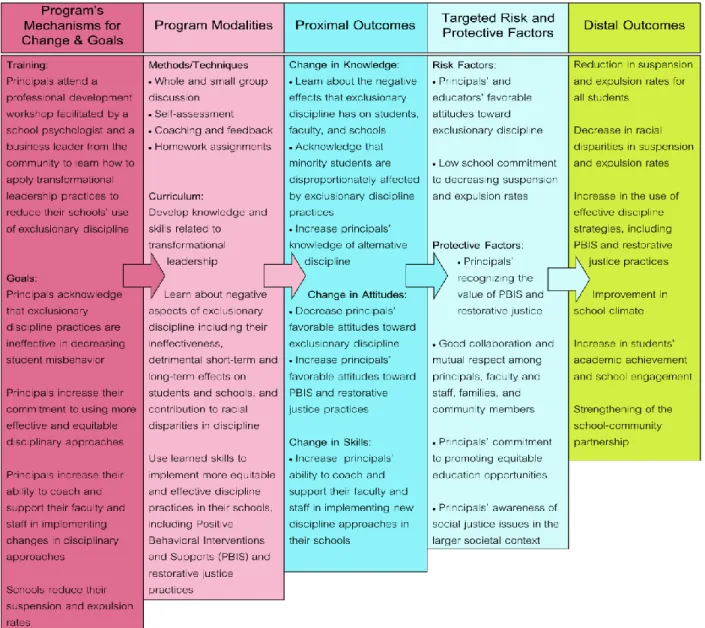
Intervention process. Core components refer to the essential functions and intervention activities that are intended to produce the desired proximal outcomes and increase the likelihood that distal outcomes will be achieved (Blase & Fixsen, 2013).An intervention’s logic model crystallizes the vision and process of a program and displays how the program theoretically should work (Peyton & Scicchitano, 2017). Figure 2, TrIPLe’s logic model, shows the
connections between the intervention’s core components, including its objectives, lesson content, Figure 1. TrIPLe’s Fit in the MTSS Framework
The short-term, or proximal, goals of the intervention are to: 1) decrease principals’ favorable attitudes toward zero tolerance policies and exclusionary discipline practices; 2) increase principals’ knowledge of and favorable attitudes toward alternative discipline practices, specifically Positive Behavior Interventions and Supports (PBIS) and restorative justice; 3) and increase principals’ ability to coach and support their faculty and staff in implementing discipline
changes. Long-term, or distal, goals include: 1) reduction in the rate of suspension and
expulsions for all students; 2) decrease in racial disparity in suspension and expulsion rates; 3) increase in the use of effective discipline strategies; 4) improvement in school climate; and 5) increase in students’ academic achievement and school engagement. Factors that may increase the likelihood of this intervention being successful are: principals’ recognizing the value of alternative discipline approaches; schools having pre-existing collaborative relationships among principals, faculty and staff, families, and community members; schools’ commitment to
promoting equitable education opportunities; and principals’ awareness of social justice issues in the larger social context. Risk factors that may hinder principals’ progress are principals’ positive attitudes toward zero tolerance policies and exclusionary discipline and low school commitment to changing exclusionary discipline practices.
mechanisms by which change is expected to occur (Blase & Fixsen, 2013). TrIPLe’s theory of
change, depicted in Figure 3, identifies the assumptions that underlie the programs’ hypothesis and tracks the intermediate outcomes expected as a result of the linked strategies and activities (Dhillon & Vaca, 2018).
Kouzes and Posner’s model of transformational leadership serves as TrIPLe’s model of
choice because this model’s five fundamental leadership practices – inspire a shared vision, challenge the process, model the way, enable others to act, and encourage the heart – are
particularly relevant for principals’ attempting to change their schools’ discipline methods. Table 2 provides an overview of TrIPLe’s seven sessions.
The process of organizations’ bringing about substantial change has been theorized in several different theories. Lippitt, Watson, and Westley (1958) developed a seven-step theory that focuses on how change agents bring about change in organizations, rather than the change itself (Kritsonis, 2004). The seven steps outlined in the theory are:
1) Diagnose the problem.
2) Assess the motivation and capacity for change.
3) Assess the resources and motivation of the change agent. This includes the change agent’s commitment to change, power, and stamina.
4) Choose progressive change objects. In this step, action plans are developed and strategies are established.
5) The role of the change agents should be selected and clearly understood by all parties so that expectations are clear. Examples of roles are: cheerleader, facilitator, and expert.
6) Maintain the change. Communication, feedback, and group coordination are essential elements in this step of the change process.
7) Gradually terminate from the helping relationship. The change agent should gradually withdraw from their role over time. This will occur when the change becomes part of the organizational culture. (Lippitt, Watson, & Westley, 1958)
Session Content
Session One: Exclusionary Practices
Teaches principals about the negative consequences of exclusionary discipline practices
Session Two: Alternative Discipline Practices
Emphasizes two alternative discipline approaches: Positive Behavioral Interventions and Supports (PBIS) and restorative justice practices
Session Three: Inspire a Shared Vision
Focuses on principals ensuring that their schools’ discipline approaches align with their vision and mission
Session Four: Challenge the Process
Provides information about how principals can challenge the status quo and experiment with new ideas and practices to grow and improve
Session Five: Model the Way Explores steps principals can take to better model how their faculty and
staff should address student misbehavior
Session Six: Enable Others to Act
Teaches principals how they can encourage collaboration among their faculty and staff and support them in taking on leadership roles
Session Seven: Encourage the Heart
Provides information on how principals can better show appreciation and encouragement to build a stronger sense of collective identity and community spirit
Lippitt, Watson, and Westley stated that changes are more likely to be stable if they spread to neighboring systems or to subparts of the system that are immediately affected (Kritsonis, 2004). The TrIPLe logic model and theory of change show that the workshop aims to have principals learn transformational leadership strategies and apply those tenets to change their schools’ discipline approaches; however, as principals strengthen their transformational leadership skills, they will be better able to apply those strategies to improve other areas of schools, such as curriculum and instruction.
Research Aim
This study employed a mixed-methodology design to collect qualitative and quantitative data from a sample of public elementary and middle school principals, school psychologists, and business leaders. The goal of this study was to reach a group consensus regarding the feasibility and acceptability of TrIPLe for future implementation in a school district by gathering responses from the individuals who will be affected by TrIPLe and whose cooperation is needed to
implement and improve the workshop (Green, 2014).
Research Methods
undesirable group dynamics such as manipulation and coercion to conform to a certain viewpoint. Further, the participants can revise their opinions in response to other group members’ opinions and respond to the points raised by other participants (Hsu & Sandford, 2007).
While the Delphi process can theoretically be continuously iterated until consensus is determined, three to five rounds are often sufficient to reach a consensus, with three rounds being the standard (Green, 2014; Hsu & Sandford, 2007; Wester & Borders, 2014). In the first round, qualitative data is gathered using a questionnaire with open-ended questions about a content area. The participants’ responses on the questionnaire are converted into a structured, quantitative survey instrument for the second round. For the second round and the start of the search for consensus, participants complete the structured survey and review the information summarized by the investigator based on the first round’s collected data. In the third and final round, the participants complete another structured survey that includes the items and ratings summarized in the previous round. Participants are told what items have reached consensus, what items have not, their ratings, and minority opinions. They are given a final opportunity to revise their judgment or to describe their reasons for maintaining their previous ratings (Hsu & Sandford, 2007).
and acceptability of TrIPLe to improve it for future implementation, members of the three groups directly involved with TrIPLe’s implementation and whose cooperation is needed to
improve the intervention were eligible to participate: public elementary and middle school principals, as a small group of ideally six to eight elementary and middle school principals will be recipients of the intervention; school psychologists working predominantly in public schools because a school psychologist will serve as the intervention’s lead facilitator carrying out
TrIPLe; and business leaders who have shown past commitments to improving their
communities as a socially-responsible business leader will be TrIPLe’s co-facilitator. Research
suggests that when various reference groups are involved in a Delphi study, a sample of between 15 and 20 respondents is recommended (Hsu & Sandford, 2007). Each of the three groups of participants in this study were comprised of five individuals, for a total of 15 participants.
Potential participants were contacted via e-mail regarding their willingness to participate in the study. Once individuals agreed to participate, they were emailed an informed consent form detailing the procedures for the study, estimated time commitment, and expected costs and benefits of participating. While TrIPLe is a professional development workshop that targets elementary and middle school principals whose schools have suspension and expulsion rates in the top 10-15% of their school district, for the purposes of this feasibility study the sample consisted of principals who volunteered to participate despite their schools’ suspension and expulsion rates.
Ethical considerations. This study was reviewed by UNC’s Office of Human Research Ethics and was determined to be exempt from further review according to the regulatory