molecular dynamics
Oliviero Andreussi and Nicola Marzari
Citation: J. Chem. Phys. 137, 044508 (2012); doi: 10.1063/1.4737388 View online: http://dx.doi.org/10.1063/1.4737388
View Table of Contents: http://jcp.aip.org/resource/1/JCPSA6/v137/i4 Published by the American Institute of Physics.
Additional information on J. Chem. Phys.
Journal Homepage: http://jcp.aip.org/
THE JOURNAL OF CHEMICAL PHYSICS137, 044508 (2012)
Transport properties of room-temperature ionic liquids from classical
molecular dynamics
Oliviero Andreussi1,2,a) and Nicola Marzari2,b)
1Department of Materials Science and Engineering, Massachusetts Institute of Technology,
77 Massachusetts Ave., Cambridge, Massachusetts 02139, USA
2Theory and Simulations of Materials (THEOS), École Polytechnique Fédérale de Lausanne,
Station 12, 1015 Lausanne, Switzerland
(Received 27 April 2012; accepted 26 June 2012; published online 30 July 2012)
Room-temperature ionic liquids (RTILs) have attracted much attention in the scientific community in the past decade due their novel and highly customizable properties. Nonetheless, their high viscosities pose serious limitations to the use of RTILs in practical applications. To elucidate some of the physi-cal aspects behind transport properties of RTILs, extensive classiphysi-cal molecular dynamics physi-calculations are reported. Here, in particular, bulk viscosities and ionic conductivities of butyl-methyl-imidazole based RTILs are presented over a wide range of temperatures. The dependence of the properties of the liquids on simulation parameters, e.g., system-size effects or the choice of the interaction potential, is analyzed in detail.© 2012 American Institute of Physics. [http://dx.doi.org/10.1063/1.4737388]
I. INTRODUCTION
In recent years, room-temperature ionic liquids (RTILs) have seen much interest due to their promising properties in “green chemistry” applications.1,2Similar to the well-known high-temperature molten salts, RTILs are liquids composed solely by ions. As opposite to molten salts, the presence of large asymmetric organic cations inhibits crystallization and allows these salts to be liquid at temperatures as low as 100 ◦C. Despite the fact that the first report of a RTIL dates back to the beginning of the last century,3the first generation
of RTILs, based on chloroaluminate(III) systems, was theo-retically predicted4 and experimentally realized5,6just in the
1980s. Nonetheless, the practical applications of chloroalumi-nate ionic liquids were strongly limited by their high moisture sensitivity.7,8It is just with the advent of water and air stable
RTILs (Ref.9) that the full potential of these new compounds became apparent. Several reviews on this topic appeared in the last years,1,10–17 clearly highlighting the interest in this
field.
Properties of RTILs are as different from standard molec-ular solvents as ionic crystals differ from molecmolec-ular ones. Due to the ionic nature of their constituents, RTILs generally show negligible vapor pressure and high thermal stability, and they tend to be very good solvents for most organic and inorganic species. Moreover, they typically present very high electro-chemical stability and are intrinsically able to conduct electri-cal currents. Despite all these remarkable properties, none of the existing RTILs possesses all of them at the same time. Nonetheless, since RTILs are based on organic molecules, they can be easily modified by standard chemical reactions. Indeed, both the cation and the anion can be individually tai-lored in order to tune the physico-chemical properties of the resulting RTIL. This allows a great degree of flexibility in the
a)Electronic mail: [email protected]. b)Electronic mail: [email protected].
design of the most suitable compound, given that the num-ber of different possible combinations scales as the product of the number of oppositely charged ions. When considering the number of binary and ternary mixtures of all available cations and anions, the range of possibilities quickly diverges. In this perspective, the idea of task-specific RTILs has emerged and applications of RTILs in the most diverse fields have been proposed and patented. Organic synthesis and the catalysis, extraction, and treatment of rare-earths elements are some of the most studied fields of application of RTILs.
Particular attention has been devoted to the possible ap-plications of RTILs in electrochemistry.15,17,18 Specifically,
RTILs as electrolytes in dye-sensitized solar cells,19–21 fuel
cells,22and lithium batteries,17,23have been extensively
stud-ied both for safety and efficiency. Indeed, the low volatility of these liquids insures their safety against combustion and explosion. In addition, some of the existing RTILs present very high electrochemical stability,24thus allowing the use of
higher voltages in batteries and improving the overall energy density of the devices. A major limitation in the actual ap-plications of RTILs as electrolytes is represented by the high viscosities of all RTILs known to date. Even though the con-ductivity of some of the available RTILs is already sufficiently high for battery applications,23design rules to improve ionic
conductivity are currently the subject of intense experimental and theoretical study. In this context, much of the scientific effort is directed towards understanding the molecular mech-anisms that influence transport properties.
Despite the huge increase in the literature on RTILs, ex-perimental results still suffer from some limitations, and in particular can be affected by the presence of water and impu-rities in the systems studied.25,26Indeed, water was shown to
strongly affect transport properties of RTILs, with a decrease of diffusion coefficients by orders of magnitude in water-RTILs mixtures being reported.27 A full quantitative charac-terization of the amount and kind of impurities is often lack-ing and results can be difficult to compare.
In order to provide a detailed picture of the molec-ular mechanisms behind the properties of RTILs, several theoretical works have appeared in the literature. The first semiempirical and ab initio calculation on RTILs were performed at the end of the 1980s,4,5 with the main purpose
of investigating the stability and the structure of isolated ions; theoretical literature on RTILs started increasing after 2001, when some of the first parameterizations of classical inter-action potentials (force fields) were reported.28–34 The first
calculations typically also reported results on single ions and ion pairs as obtained from density-functional theory (DFT). These results were used to fit classical empirical potentials that were exploited to compute some of the fundamental properties of the liquids. In order to validate the force fields against available experimental results, radial and angular distribution functions, densities, and diffusion coefficients were the first quantities investigated. The agreement between simulation results and experimental data were not always satisfactory, with approximations in the functional form of the interaction potential being too crude.35 In particular, it was
shown that using an “All Atom” picture instead of a “Unified Atoms Method” was more effective in reproducing experi-mental densities.31 Similarly, including polarization effects
was shown to significantly improve the agreement with ex-perimental results, in particular for transport properties.36,37
Despite some of the limitations of the available force fields, molecular dynamics (MD) simulations were effective in predicting and validating some of the new features char-acteristic of the RTILs’ structure, such as the presence of heterogeneities and holes in the liquids.38Nonetheless, some properties still lack an accurate analysis and characterization. This is particularly true for transport properties, such as viscosity and conductivity, that, due to the slow glassy-like dynamics of most RTILs, require long simulation times and large system sizes. Indeed, while parameterized force fields are generally checked against structural properties, few groups have reported a careful analysis of viscosities and conductivities.39–46 For these reasons, in the present work,
an extensive set of classical MD simulations on prototypical RTILs is reported. After a short methodological section (Sec. II), our results on the effect of temperature and sim-ulation parameters on the transport properties are presented (Sec. III A). Eventually, results on ionic liquids based on different anions are compared in Sec.III B.
II. SIMULATION DETAILS
Classical molecular dynamics (MD), as implemented in the DL_POLY program, was used throughout.47–49Three
dif-ferent 1-n-butyl-3-methylimidazolium (BMIM) based RTILs were examined, namely the salts obtained with the PF−6, BF−4, and bis(trifluoromethylsulfonyl)-imide (Tf2N−) anions. As
for the interaction potential, three different force fields were considered for the case of BMIM-PF6,29,50–52 while
simula-tions on BMIM-BF4 and BMIM-Tf2N were performed using
the force fields developed by Canongia-Lopeset al.51–53The
force fields from Morrow et al. and from Canongia-Lopes
et al. were chosen due to their widespread use in the litera-ture, being some of the first proposed force fields for RTILs.
On the other hand, the force field proposed by Liu and co-workers was considered as it was suggested to give better agreement with the experiments on transport properties. An interaction cutoff radius of 15 Å was used throughout. Initial configurations containing 128, 432, and 1024 ion pairs were generated starting from a fcc lattice with the ions occupying random lattice sites. Equilibration in the NPT ensemble was enforced using Berendsen’s thermostat and barostat,54 with
equilibration runs performed until the convergence of the sta-tistical average of the density was achieved. Following equi-libration, up to four different production runs for each system were performed in the NVT ensemble, using the Nose-Hoover thermostat.55,56 Errors in the computed quantities, when
ex-plicitly reported, have been estimated from the variance of the results obtained by different production runs. Although this estimate of the error is the least prone to simulation bi-ases, it should be pointed out that it still represents a lower limit to the global error bars, since it does not take into ac-count errors due to the poor sampling of autocorrelations at long time scales. A simulation time step of 2 fs was used for temperatures lower or equal to 500 K, while 1 fs was chosen for simulations at higher temperatures.
Diffusion coefficients of the ions were computed in terms of mean square displacements (MSD),
ri2(t)= |ri(t)− ri(0)|2,
using the Einstein relation57,58
Di = lim t→∞
1 6
∂r2 i(t)
∂t . (1)
In order to assess the true diffusive behavior of the ions, MSDs will be displayed in log-log plots, following standard methodology (e.g., as reported in Ref.44), together with the slopesβ(t) as a function of time,
β(t)= dlogMSD(t)
dlogt . (2)
At very short times, a value of β equal to two is expected, corresponding to a free, ideally ballistic, motion of the ions. On the other extreme, at very long times, β should reach a value equal to one, corresponding to a real diffusive regime, in which the mean square displacements of the ions grow lin-early with time. At intermediate times, a sub-linear behavior is expected, characterized by a logarithmic slopeβ(t) lower than one. We would like to stress here that this analysis is crucial in determining the effective achievement of diffusive behavior and in determining the portion of the MSD plot that should be used to fit diffusion coefficients. This is particularly important in the case of slow, viscous liquids, such as RTILs. The Einstein formalism was also used in the calculation of ionic conductivities57,58
λ= lim
t→∞
e2 6V kBT
∂ Ni,j=1zizjri(t)rj(t)
∂t , (3)
while viscosities (η) were computed from the auto-correlation of the off-diagonal elements of the stress tensorσxy, exploit-ing the Green-Kubo relation57,58
η= V kBT
∞
0
044508-3 O. Andreussi and N. Marzari J. Chem. Phys.137, 044508 (2012)
TABLE I. Densitiesρ, cation diffusion coefficientsD+, anion diffusion coefficientsD−, viscositiesη, and conductivitiesλof the BMIM-PF6 RTIL as a function of temperature, as computed by classical NVT molecular dynamics simulations on a periodic cell of 128 ion pairs using the LHW2004 force field. In the first two lines, experimental results are also reported.
Systems (K) ρ(g/cm3) D+(m2/s) D−(m2/s) η(mPa s) λ(S/cm)
298.15 (exp. (Ref.60)) 1.37 1.6±0.2×10⁻¹¹ . . . 196±20 4.04±0.4×10⁻³ 300 (exp. (Ref.59)) 1.37 8.0±3.0×10⁻¹² 5.9±2.4×10⁻¹² 230±65 1.66±0.3×10⁻³ 300 1.36 4.8±1.0×10⁻¹³ 2.6±0.5×10⁻¹³ 2400±2000 1.5±0.7×10⁻⁴ 350 1.33 4.0±1.0×10⁻¹² 2.0±0.8×10⁻¹² 940±400 1.9±0.8×10⁻³ 375 1.32 1.0±0.1×10⁻¹¹ 6.2±1.0×10⁻¹² 421±200 1.4±0.5×10⁻³ 400 1.29 3.1±0.1×10⁻¹¹ 2.0±0.3×10⁻¹¹ 111±4 8.7±0.6×10⁻³ 450 1.26 1.14±0.06×10⁻¹⁰ 7.9±0.8×10⁻¹¹ 31±1 1.5±0.3×10⁻² 500 1.22 2.5±0.2×10⁻¹⁰ 1.9±0.1×10⁻¹⁰ 12±1 4.8±1.0×10⁻² 600 1.16 8.5±0.1×10⁻¹⁰ 7.5±0.04×10⁻¹⁰ 7±1 9.7±1.0×10⁻²
1000 0.87 7.6×10⁻⁹ 7.3×10⁻⁹ 5 2.25×10⁻¹
III. RESULTS A. BMIM-PF6
A system composed of 128 BMIM-PF6 ion pairs, de-scribed with the interaction potential parameterized by Liu
et al.(Ref. 50, abbreviated in the following as LHW2004), was equilibrated at several temperatures, ranging from 300 K to 1000 K. Densities, reported in Table I, are in agreement with other simulations reported in the literature and show a good match with the experimental results59,60 available at the lowest temperatures. The radial distribution functions
(re-6
PF
+
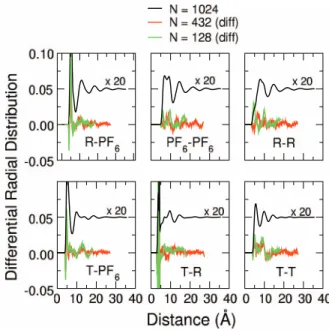
T RFIG. 1. Radial distribution functions of BMIM-PF6RTIL, as computed by classical NVT molecular dynamics simulations on a periodic cell of 128 ion pairs described by the LHW2004 force field. The BMIM cation (top panel) is partitioned in two distinct subregions, corresponding to the charged aromatic ring (R) and the long alkyl tail (T). The radial distribution functions at 300 K are reported in black, while for higher temperatures, the differentials radial distributions with respect to 300 K have been reported (colored lines). Strong charge-induced correlations are evident from the leftmost series of panels. A reasonably strong correlation is also present between the alkyl tails of the cation, as shown in the T-T plot (rightmost series, central panel). All the dis-tribution functions show non-negligible correlations for distances as long as half the cell size, even at the highest temperatures.
ported in Figure1) are also in very good agreement with pre-vious results.50In order to provide a more detailed description
of the structure of the liquid, when analyzing radial distribu-tions, the cation has been subdivided in two distinct regions, corresponding to the charged aromatic ring (R) and the long alkyl tail (T). Charge-induced correlations in the liquid can be clearly evinced from the reported plots and persist, with some broadening, even at the highest temperatures considered. Van der Waals interactions, instead, are responsible for the high degree of correlation between the alkyl chains of the cations. Due to the local, short-range nature of the van der Waals in-teraction, the first peak in the tail-tail plot is one of the most sensibles to temperature, shifting towards larger distances as the simulation temperature increases.
1. Transport properties
Mean square displacements of the different ions are re-ported in Figure2as a function of time for the range of tem-peratures studied.
FIG. 2. Mean square displacements (left panel) and corresponding values of
FIG. 3. Diffusion times, i.e., times necessary to the ions to reach a diffusive regime withβ1, as extracted from classical NVT molecular dynamics simulations on a periodic cell of 128 BMIM-PF6ion pairs, as described by the LHW2004 force field (filled circles). Non-linear curve fits of the formf =Aexp (B/(T−T0)) are added to the computed results and represented with solid lines.
Despite the remaining noise in the logarithmic derivatives at long times, it is seen from these plots that a diffusive behav-ior is reached within the simulation times at each temperature but the lowest one. Diffusion times, i.e., the times necessary to the ions to reach a diffusive regime withβ 1, are sum-marized in Figure3. The curves show a divergent behavior at low temperature and can be fitted with good accuracy by a Vogel-Fulcher-Tammann (VFT) relation
f =Aexp(B/(T −T0)). (5)
A value ofB −1720/−1730 K and a divergence tempera-tureT0 200/215 K can be extracted for the diffusion times of the cation and the anion, respectively. By extrapolating these behavior to the lowest temperature considered (300 K), a diffusion time of the order of 108ps can be estimated. Thus, a straightforward determination of the diffusion coefficients of the ions at this temperature appears beyond the limits of standard computational resources. For this reason, the differ-ent transport properties of the system at 300 K are only esti-mated by averaging the results over several independent cal-culations. In order to improve the statistics in the results and get an estimate of the errors, the same approach was used for simulations below 600 K that show the diffusion times of the order of few nanoseconds.
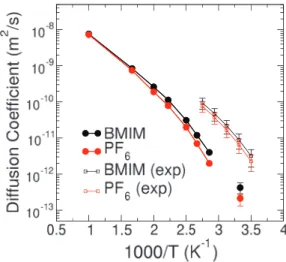
Diffusion coefficients of both the cations and the anions, reported in Figure4and in TableI, show Arrhenius behavior at high temperatures, while a deviation from linearity is evi-dent at the lowest temperatures. As expected, diffusion coeffi-cients at 300 K appear overestimated due to the lack of a true diffusive regime in the simulations at this temperature. Acti-vation energies ofE=31.4/28.4×10−3kJ/mol for the diffu-sion of the cation/anion can be inferred from the high temper-ature slopes of the curves reported in Figure4. The change in slope at low temperature is an indication of the glassy behav-ior of the liquid, consistent with the very slow non-ergodic dynamics of the systems in this range of temperatures. As was done for the diffusion times, fitting the data with a Vogel-Fulcher-Tammann relation points to a divergence temperature
T0 230/235 K. The correct qualitative behavior of the
re-FIG. 4. Diffusion coefficients of cations (black) and anions (red) as extracted from the MSDs computed on a periodic cell of 128 BMIM-PF6ion pairs, as described by the LHW2004 force field (filled circles). Experimental results from Ref.59are also reported for comparison (empty squares).
sults is well reproduced, together with accurate slopes as a function of temperature, with anions diffusing slower than cations, despite their smaller size. The higher conformational flexibility of the cation, due to the presence of alkyl chains, is generally acknowledged as the main explanation for this be-havior. Nonetheless, computed results are one order of mag-nitude far from the experimental data available at the lowest temperatures.59 This discrepancy may be due to the intrinsic
deficiency of the non polarizable force-field to reproduce the real dynamics of the systems.36 On the other hand, the
pres-ence of even a small fraction of impurities in the experimental samples can be responsible for a significant change in the re-ported results.27
It is important to note that original results on the LHW2004 force field50showed an impressive agreement with experiments. This apparent contradiction can be explained by the very short simulation times used to extrapolate the diffu-sion coefficients in Ref.50. Especially for results at the low-est temperature, according to the considerations above and the results in Figure3, a sub-linear non-diffusive behavior of the MSD should be inferred for all simulation times reported in Ref.50. In order to validate this conclusion, short partial tra-jectories were used to evaluate diffusion coefficients at 300 K: results, reported in Table II, appear to be greatly overesti-mated when the simulation times of the order of 1−2 ns are used, with diffusion coefficients almost an order of magnitude larger than the ones obtained with longer, although still not diffusive, trajectories. Longer simulations on the same sys-tems at 350 K appeared in the literature61and showed a very
close agreement with the present results, thus further validat-ing our conclusions. Moreover, it is worth notvalidat-ing that a refine-ment of the LHW2004 force field, where the overall charges of the ions have been rescaled to implicitly account for polar-ization effects, has been recently shown to produce improved results for the transport properties of this RTIL.62
044508-5 O. Andreussi and N. Marzari J. Chem. Phys.137, 044508 (2012)
TABLE II. Diffusion coefficients of cations at 300 K (in units of m2/s) computed on partial trajectories of three uncorrelated realizations of a periodic cell of 128 BMIM-PF6ion pairs, as described by the LHW2004 force field. Full trajectories correspond to the simulation times of 20−30 ns.
System 1 ns 2 ns 4 ns 8 ns 16 ns Full
1 1.8×10⁻¹² 1.3×10⁻¹² 8.2×10⁻¹³ 4.9×10⁻¹³ 4.4×10⁻¹³ 4.2×10⁻¹³ 2 1.4×10⁻¹² 9.3×10⁻¹³ 7.9×10⁻¹³ 4.2×10⁻¹³ 4.4×10⁻¹³ 4.3×10⁻¹³ 3 1.8×10⁻¹² 9.6×10⁻¹³ 6.5×10⁻¹³ 6.9×10⁻¹³ 5.4×10⁻¹³ 4.7×10⁻¹³
cases, results one order of magnitude lower than the values reported in the literature were obtained, even if their trends with respect to temperature are well reproduced. In particular, by fitting the data with a VFT relation (Eq.(5)), the values of
B 785/−787 K and the activation temperatures of T0250/230 K are obtained for the viscosity and conductiv-ity, respectively. The experimental temperature dependencies of these quantities are, instead, characterized by the values of B 639/−855 K and the activation temperatures of
T0 201/174 K,59 thus confirming that the system modeled
has a glass-like transition at a temperature higher than the experimental on, even if the dynamics show comparable acti-vation energies. It should be stressed that the uncertainties in the computed values for these transport properties are higher than the average errors in computing diffusion coefficients: this is due to the fact that viscosity and conductivity are the global properties of a system, while calculations of diffusion coefficients benefit from ensemble averages over all different particles in the system.
2. Size effects
As shown by radial distribution functions (Figure 1), Coulomb-induced ordering of the systems is significant for distances comparable and larger than the 128-ion-pairs simu-lation cell. Thus, particular care should be taken in evaluating size effects on the structure and on the transport properties of the liquid.
In Figure 6, the radial distribution functions as a func-tion of the number of ion pairs (128, 432, 1024) are reported at 400 K. Correlations due to the electrostatic interactions in the liquid decay completely at half the cell size only for the larger systems, composed by 1024 ion pairs. Nonetheless, the local structure of the liquid is well reproduced in the smaller
FIG. 5. Bulk viscosities (left) and ionic conductivities (right) of BMIM-PF6, as computed by classical NVT molecular dynamics simulations on a periodic cell of 128 ion pairs described by the LHW2004 force field. Experimental re-sults from Ref.59(exp1, empty squares) and Ref.60(exp2, empty diamonds) are also reported for comparison.
systems, the differences in the computed radial distribution functions being generally less than 2%.
In agreement with what was found for the distribution functions, results in Table IIIshow that system size affects only marginally the computed densities. On the other hand, transport properties tend to show more pronounced changes in going from the smallest to the largest systems. At the low-est temperature considered (300 K), these differences can be attributed to the very slow non ergodic dynamics of the sys-tem and to the lack of a true diffusive regime. At the highest temperatures, simulations seem to identify the intermediate size system (N=432) as the least mobile one. It is important to stress that incomplete sampling at long simulation times can lead to a significant underestimate of the errors, which could be sensibly higher for the viscosities and conductivities of large systems. Thus, although system size appears to have a relative impact on computed transport properties, its overall effect appears to be not dramatically influent in a comparison with the experiments.
TABLE III. Densitiesρ, cation diffusion coefficientsD+, anion diffusion coefficientsD−, viscositiesη, and conductivitiesλof the BMIM-PF6 RTIL as a function of temperature and system size, as computed with classical NVT molecular dynamics simulations using the LHW2004 force field.
Systems T(K) ρ(g/cm3) D+(m2/s) D−(m2/s) η(mPa s) λ(S/cm)
N=128 300 1.36 4.8±1.0×10⁻¹³ 2.6±0.5×10⁻¹³ 2400±2000 1.5±0.7×10⁻⁴
N=432 300 1.36 1.3×10⁻¹³ 5.0×10⁻¹⁴ 10000 2.8×10⁻⁵
N=1024 300 1.37 4.4×10⁻¹³ 4.0×10⁻¹³ 1700 1.5×10⁻⁴
N=128 400 1.29 3.1±0.1×10⁻¹¹ 2.0±0.3×10⁻¹¹ 111±4 8.7±0.6×10⁻³
N=432 400 1.295 2.4×10⁻¹¹ 1.5×10⁻¹¹ 150 4.2×10⁻³
N=1024 400 1.297 3.0×10⁻¹¹ 2.0×10⁻¹¹ 135 4.7×10⁻³
N=128 500 1.22 2.5±0.2×10⁻¹⁰ 1.9±0.1×10⁻¹⁰ 12±1 4.8±1×10⁻²
N=432 500 1.222 2.5×10⁻¹⁰ 1.9×10⁻¹⁰ 73 2.4×10⁻²
N=1024 500 1.223 2.9×10⁻¹⁰ 2.3×10⁻¹⁰ 37 4.2×10⁻²
3. Effect of the force field
In order to characterize the effect of the computa-tional parameters on the calculated transport properties of the system, a comparison has been performed between dif-ferent force fields available. In addition to the results dis-cussed in Secs. III A 1andIII A 2, additional simulations were performed with the interaction potentials developed by Lopes et al. (Refs. 51 and 52, abbreviated in the follow-ing as CLDP2004), and by Morrow and Maginn (Ref. 29, abbreviated as MM2002). The differences between these force fields lie mostly in the magnitude of the electrostatic charges and in the description of the four-body bonded in-teraction (dihedral angles) between atoms in the ring and the alkyl chains. Results for these systems are reported in Figure7and TableIV.
In addition, a few test simulations on the CLDP2004 force field have been performed by changing the descriptions of the intramolecular bonds. A set of simulations with the har-monic constants of bonds and angles reduced by half is re-ported, together with results obtained by constraining all the bond lengths of the system to their equilibrium values. Results for these systems are reported in Figure8and TableV.
For all the reported force fields, computed densities are close to experimental results. On the contrary, radial
distribu-tion funcdistribu-tions show a marked dependence on the force field used (see Figures7and8). The strongest effect is on the in-tramolecular ring-tail and the intermolecular anion-anion dis-tribution functions. In the more flexible molecules, the alkyl chain is able to come in closer contact with the ring, thus creating some steric hindrance that interferes with the cation-anion interactions. This is reflected in the decrease of the sec-ond anion-anion peak, together with a slight increase of the mean cation-anion separation.
The effect of constraining all the bonds in the molecule is negligible compared to the other parameters in the interac-tion potentials (see Figure 8). On the contrary, relaxing the force constants of bonds and angles is responsible for notice-able changes in the local structure of the liquid, increasing the overall correlation and allowing the charged residues to come in closer contact, at the expense of the non-polar portions of the cations.
Transport properties reflect what was found on the struc-ture of the liquid (see Tables IV and V). In particular, the MM2002 potential shows significantly higher mobility with respect to the other force fields considered. This is prob-ably related, in first place, to the use of reduced charges for the isolated ion. Such an expedient has been introduced to account for polarization and charge transfer effects in an
TABLE IV. Densitiesρ, cation diffusion coefficientsD+, anion diffusion coefficientsD−, viscositiesη, and conductivitiesλof the BMIM-PF6RTIL as a function of temperature and interaction potentials, as computed by classical NVT molecular dynamics simulations on a system composed by 128 ion pairs.
Systems T(K) ρ(g/cm3) D+(m2/s) D−(m2/s) η(mPa s) λ(S/cm)
LHW2004 300 1.36 4.8±1.0×10⁻¹³ 2.6±0.5×10⁻¹³ 2400±2000 1.5±0.7×10⁻⁴
MM2002 300 1.353 3.2×10⁻¹² 2.1×10⁻¹² 2200 4.1×10⁻⁴
CLDP2004 300 1.357 5.0×10⁻¹³ 2.1×10⁻¹³ 7600 2.3×10⁻⁵
Exp (Ref.59) 300 1.37 8.0×10⁻¹² 5.9×10⁻¹² 230 1.66×10⁻³ LHW2004 350 1.33 4.0±1.0×10⁻¹² 2.0±0.8×10⁻¹² 940±400 1.9±0.8×10⁻³
MM2002 350 1.305 1.3×10⁻¹¹ 9.4×10⁻¹² 77 3.9×10⁻³
CLDP2004 350 1.318 4.2×10⁻¹² 2.3×10⁻¹² 903 7.6×10⁻⁴
Exp (Ref.59) 350 1.33 8.3×10⁻¹¹ 5.1×10⁻¹¹ 26 1.1×10⁻² LHW2004 400 1.29 3.1±0.1×10⁻¹¹ 2.0±0.3×10⁻¹¹ 111±4 8.7±0.6×10⁻³
MM2002 400 1.268 8.0×10⁻¹¹ 5.7×10⁻¹¹ 26 9.8×10⁻³
CLDP2004 400 1.275 2.5×10⁻¹¹ 1.7×10⁻¹¹ 196 7.4×10⁻³
LHW2004 500 1.22 2.5±0.2×10⁻¹⁰ 1.9±0.1×10⁻¹⁰ 12±1 4.8±1.0×10⁻²
MM2002 500 1.185 4.7×10⁻¹⁰ 4.0×10⁻¹⁰ 10 6.1×10⁻²
044508-7 O. Andreussi and N. Marzari J. Chem. Phys.137, 044508 (2012)
TABLE V. Densitiesρ, cation diffusion coefficientsD+, anion diffusion coefficientsD−, viscositiesη, and conductivitiesλof the BMIM-PF6RTIL as a function of temperature, as computed by classical NVT molecular dynamics simulations on a system composed by 128 ion pairs and described with the CLDP2004 interaction potential. Different choices of the strength of bonds and angles have been adopted, corresponding to: (a) the one reported in the original paper;51,52(b) an interaction potential with all the bonds constrained to their equilibrium
positions (CLDP2004 Rigid); (c) an interaction potential with all the harmonic constants of bonds and angles reduced by half (CLDP2004 Flexible).
Systems T(K) ρ(g/cm3) D+(m2/s) D−(m2/s) η(mPa s) λ(S/cm)
CLDP2004 300 1.357 5.0×10⁻¹³ 2.1×10⁻¹³ 7600 2.3×10⁻⁵ CLDP2004 Rigid 300 1.358 2.8×10⁻¹³ 2.3×10⁻¹³ 8600 1.2×10⁻⁴ CLDP2004 Flexible 300 1.346 7.0×10⁻¹³ 6.0×10⁻¹³ 600 1.4×10⁻⁴ CLDP2004 350 1.318 4.2×10⁻¹² 2.3×10⁻¹² 903 7.6×10⁻⁴ CLDP2004 Rigid 350 1.318 3.7×10⁻¹² 1.9×10⁻¹² 474 7.5×10⁻⁴ CLDP2004 Flexible 350 1.314 5.1×10⁻¹² 2.0×10⁻¹² 209 1.6×10⁻³ CLDP2004 400 1.275 2.5×10⁻¹¹ 1.7×10⁻¹¹ 196 7.4×10⁻³ CLDP2004 Rigid 400 1.280 3.3×10⁻¹¹ 2.0×10⁻¹¹ 46 6.5×10⁻³ CLDP2004 Flexible 400 1.274 3.5×10⁻¹¹ 2.3×10⁻¹¹ 69 9.2×10⁻³ CLDP2004 500 1.200 2.4×10⁻¹⁰ 2.1×10⁻¹⁰ 12 2.7×10⁻² CLDP2004 Rigid 500 1.203 2.6×10⁻¹⁰ 2.0×10⁻¹⁰ 28 2.7×10⁻² CLDP2004 Flexible 500 1.196 2.5×10⁻¹⁰ 2.0×10⁻¹⁰ 22 5.0×10⁻²
FIG. 7. Radial distribution function of the BMIM-PF6 RTIL, as computed by classical NVT molecular dynamics simulations at 400 K on periodic cells of 128 ion pairs with different force fields. The BMIM cation is partitioned in two distinct subregions, corresponding to the charged aromatic ring (R) and the long alkyl tail (T) (see Figure1). For each plot, the regions where the radial distribution functions present the largest dependence on the inter-action potential have been highlighted in the insets. While most of the radial distributions show only minor differences due to the choice of the force field, the anion-anion distribution function and the intramolecular ring-tail coor-dination show marked changes in the different simulations. Moreover, only one of the force fields considered shows the appearance of a shoulder at short distances in the ring-ring distribution function.
FIG. 8. Radial distribution function of the BMIM-PF6 RTIL, as computed by classical NVT molecular dynamics simulations at 400 K on periodic cells of 128 ion pairs described by the CLDP2004 force field. For each plot, the regions where the radial distribution functions present the largest dependence on the interaction potential have been highlighted in the insets. Different choices of the strength of bonds and angles have been adopted, correspond-ing to the one reported in the original paper51,52(CLDP2004 Original), to an
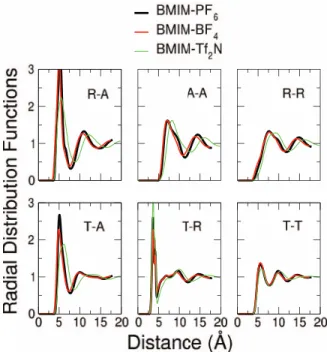
FIG. 9. Radial distribution function of BMIM-based RTILs for three differ-ent anions as computed by classical NVT molecular dynamics simulations at 400 K on periodic cells of 128 ion pairs described by the CLDP2004 force field. The three anions considered (A) are PF−6 (thick black line), BF−4 (red line), and Tf2N−(thin green line). The two inorganic anions show very sim-ilar distribution functions, with almost identical first peak positions. This re-flects the similar interactions in the two systems between the fluorine atoms of the anions and the cation. On the contrary, the larger and more asymmetric Tf2N−anion presents correlations between charged residues that are broader and shifted towards larger distances, while the short-ranged tail-tail interac-tions in the cation are only slightly affected.
implicit manner,63–65and was shown to significantly improve
the transport properties of ionic liquids.62,63A second
contri-bution to the increased mobility found in the MM2002 simu-lation can be ascribed to the reduced flexibility of the ring-tail dihedral angle of the cation, which favors an unfolded configuration for the alkyl chain and broadens the cation-anion correlation function. Despite the differences between the LHW2004 and the CLDP2004 force fields, diffusion co-efficients for the two cases are in close agreement and al-most one order of magnitude smaller than the experiments. Viscosities and ionic conductivities show a less clear trend with respect to the force field, probably due to the uncer-tainty in the computed results due to a lack of proper en-semble averages. Nonetheless, the qualitative picture is con-sistent with the results for the diffusion coefficients, with MM2002 showing lower viscosities and higher conductivi-ties at all temperatures with respect to the other two force fields. Artificially reducing or increasing the rigidity of the bonds and angles of the CLDP2004 force field has a lim-ited impact on transport properties, the overall effect being within the numerical accuracy of the quantities reported (see Figure9). Contrary to what was found above for the different classes of force fields, increasing the overall flexibility of the cation seems to increase the overall diffusivities in the system. Comparing with experiments, the MM2002 force field appears to provide better results for the transport properties, with diffusivities, conductivities, and viscosities within a fac-tor of ∼3 to ∼5 of the experimental values. This should be
compared with the slower dynamics obtained with the other force fields (LHW2004 and CLDP2004), typically an order of magnitude smaller than experiments. The improvement in transport properties is counterbalanced by a somewhat worse agreement in the computed densities, which are lower than experiments, and that can be ascribed to the implicit account of polarization effects through the rescaled ionic charges of MM2002 force field.62,63 Other aspects of the force fields,
such as the charge distribution within the ions and the internal vibrational and dihedral degrees of freedom, appear to have a minor impact on the dynamics of the systems studied.
B. Effect of the anion
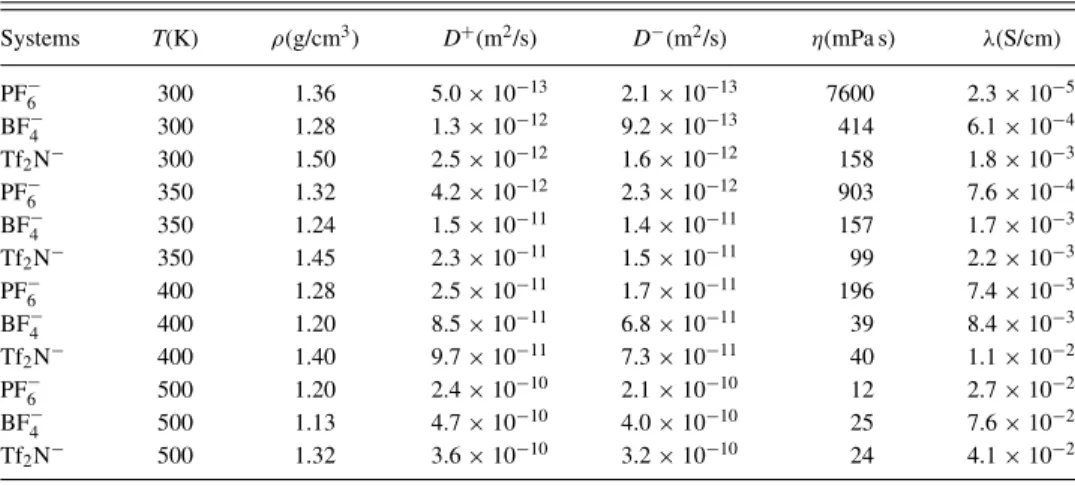
We considered three of the most studied anions in RTILs, namely PF−6, BF−4, and Tf2N−. In order to treat all the
systems on a similar footing, force fields developed by the same authors (Lopeset al., Refs.51,52, and53) were chosen for all the ions. Results are reported in Figures9and10and in Table VI. Examining the radial distribution functions (see Figure 9), we can see that the two inorganic anions display a very similar behavior, with almost identical first peak posi-tions. This is a result of the comparable size of the two anions and the similar interactions in the two systems between fluorine atoms on the anions and the cation. On the contrary, the larger and more asymmetric Tf2N−anion presents
corre-lations between charged residues that are broader and shifted towards larger distances. As expected, the cation-cation distribution functions are the least affected by the choice of anion, in particular, in the short-ranged tail-tail interactions.
044508-9 O. Andreussi and N. Marzari J. Chem. Phys.137, 044508 (2012)
TABLE VI. Densitiesρ, cation diffusion coefficientsD+, anion diffusion coefficientsD−, viscositiesη, and conductivitiesλof BMIM-based RTILs as a function of temperature, as computed by classical NVT molecular dynamics simulations on a system composed by 128 ion pairs and described with the CLDP2004 interaction potential.
Systems T(K) ρ(g/cm3) D+(m2/s) D−(m2/s) η(mPa s) λ(S/cm)
PF−6 300 1.36 5.0×10⁻¹³ 2.1×10⁻¹³ 7600 2.3×10⁻⁵ BF−4 300 1.28 1.3×10⁻¹² 9.2×10⁻¹³ 414 6.1×10⁻⁴ Tf2N− 300 1.50 2.5×10⁻¹² 1.6×10⁻¹² 158 1.8×10⁻³ PF−6 350 1.32 4.2×10⁻¹² 2.3×10⁻¹² 903 7.6×10⁻⁴ BF−4 350 1.24 1.5×10⁻¹¹ 1.4×10⁻¹¹ 157 1.7×10⁻³ Tf2N− 350 1.45 2.3×10⁻¹¹ 1.5×10⁻¹¹ 99 2.2×10⁻³ PF−6 400 1.28 2.5×10⁻¹¹ 1.7×10⁻¹¹ 196 7.4×10⁻³ BF−4 400 1.20 8.5×10⁻¹¹ 6.8×10⁻¹¹ 39 8.4×10⁻³ Tf2N− 400 1.40 9.7×10⁻¹¹ 7.3×10⁻¹¹ 40 1.1×10⁻² PF−6 500 1.20 2.4×10⁻¹⁰ 2.1×10⁻¹⁰ 12 2.7×10⁻² BF−4 500 1.13 4.7×10⁻¹⁰ 4.0×10⁻¹⁰ 25 7.6×10⁻² Tf2N− 500 1.32 3.6×10⁻¹⁰ 3.2×10⁻¹⁰ 24 4.1×10⁻²
Densities are in good qualitative agreement with exper-imental results at room temperature, but quantitative results are obtained only for the BMIM-PF6 system (see Figure10
and TableVI). The other two show deviations from experi-ments much larger than the experimental uncertainty in the data. Similar to what was obtained for the BMIM-PF6 RTIL,
transport properties are within one order of magnitude from corresponding experimental data (see Figure 10). Nonethe-less, also in this case, computed results show a general good qualitative agreement with experiments at room temperature. BMIM-Tf2N shows the highest conductivity and diffusivity
and lowest viscosity at room temperature, while BMIM-PF6
instead gives rise to the least diffusive behavior among the liquids in the whole temperature range considered. It is in-teresting to notice that, although computed density changes are uniform for the three liquids and linear with temperature, transport properties show temperature dependencies strongly related to the choice of the anion. In particular, the Tf2N anion
is the one showing the smallest variations in the temperature interval studied. As a consequence, already at 400 K, BMIM-BF4 shows viscosities and conductivities comparable to the
case of Tf2N (see Figure10).
IV. CONCLUSIONS
In conclusion, a series of extensive classical MD simu-lations on BMIM-based ionic liquids has been reported. A careful analysis of simulation parameters has been performed to estimate the accuracy of the results. The highly viscous nature of the ionic liquids studied poses serious problems in evaluating transport properties and was shown to require sim-ulation times larger than 100 ns to converge at temperatures below 400 K. In most cases, converged quantities could only be estimated at room temperature, where the systems stud-ied are trapped in glass-like dynamics. Diffusion coefficients, viscosities, and conductivities show good qualitative agree-ment and correct temperature trends when compared with ex-perimental results. The correct trend for the transport prop-erties of the different ionic liquids is also recovered, with
BMIM-Tf2N being the less viscous, RTIL and BMIM-PF6
showing the slowest dynamics. Nonetheless, results remain at least half an order of magnitude away from experimental data, with the MM2002 force field performing globally bet-ter than the other two in reproducing transport properties. The discrepancy with experiments and the better performances of the MM2002 force field could be explained either in terms of the polarizability and charge-transfer terms included in the in-teraction potentials,37,65 or originating in the small fractions
of impurities in the experimental measurements.26
ACKNOWLEDGMENTS
This work was supported by E. I. duPont de Nemours and Co. through the DuPont-MIT Alliance program. The au-thors acknowledge Shyue Ping Ong, Gerbrand Ceder, Steve R. Lustig, and William L. Holstein for useful discussions and collaborations.
1N. V. Plechkova and K. R. Seddon,Chem. Soc. Rev.37, 123 (2008). 2T. Torimoto, T. Tsuda, K. Okazaki, and S. Kuwabata,Adv. Mater.22, 1196
(2010).
3P. Walden, Bull. Acad. Imp. Sci. St.Pétersbourg8, 405 (1914).
4J. S. Wilkes and C. L. Hussey, Frank J. Seiler, Research Laboratory Tech-nical Report 1982.
5J. S. Wilkes, J. A. Levisky, R. A. Wilson, and C. L. Hussey,Inorg. Chem.
21, 1263 (1982).
6C. L. Hussey,Pure Appl. Chem.60, 1763 (1988).
7A. K. Abdulsada, A. G. Avent, M. J. Parkington, T. A. Ryan, K. R. Seddon, and T. Welton,J. Chem. Soc., Chem. Commun.1987(21), 1643. 8A. K. Abdulsada, A. G. Avent, M. J. Parkington, T. A. Ryan, K. R. Seddon,
and T. Welton,J. Chem. Soc., Dalton Trans.1993(22), 3283.
9J. S. Wilkes and M. J. Zaworotko,J. Chem. Soc., Chem. Commu.1992(13), 965.
10J. Dupont, R. F. de Souza, and P. A. Z. Suarez,Chem. Rev.102, 3667 (2002).
11K. Binnemans,Chem. Rev.107, 2592 (2007).
12F. van Rantwijk and R. A. Sheldon,Chem. Rev.107, 2757 (2007). 13H. Weingärtner,Angew. Chem., Int. Ed.47, 654 (2008). 14T. L. Greaves and C. J. Drummond,Chem. Rev.108, 206 (2008). 15P. Hapiot and C. Lagrost,Chem. Rev.108, 2238 (2008). 16J. P. Hallett and T. Welton,Chem. Rev.111, 3508 (2011).
18M. Armand, F. Endres, D. R. MacFarlane, H. Ohno, and B. Scrosati,Nature Mater.8, 621 (2009).
19P. Bonhote, A. P. Dias, M. Armand, N. Papageorgiou, K. Kalyanasundaram, and M. Gratzel,Inorg. Chem.35, 1168 (1996).
20S. Ito, S. M. Zakeeruddin, P. Comte, P. Liska, D. B. Kuang, and M. Gratzel,
Nat. Photonics2, 693 (2008).
21D. Kuang, S. Uchida, R. Humphry-Baker, S. M. Zakeeruddin, and M. Gratzel,Angew. Chem., Int. Ed.47, 1923 (2008).
22A. Fernicola, S. Panero, B. Scrosati, M. Tamada, and H. Ohno,Chem. Phys.
Chem.8, 1103 (2007).
23A. Fernicola, F. Croce, B. Scrosati, T. Watanabe, and H. Ohno,J. Power Sources174, 342 (2007).
24S. P. Ong, O. Andreussi, Y. B. Wu, N. Marzari, and G. Ceder,Chem. Mater.
23, 2979 (2011).
25K. R. Seddon, A. Stark, and M. J. Torres,Pure Appl. Chem.72, 2275 (2000).
26H. V. Spohr and G. N. Patey,J. Chem. Phys.132, 234510 (2010). 27A. L. Rollet, P. Porion, M. Vaultier, I. Billard, M. Deschamps, C. Bessada,
and L. Jouvensal,J. Phys. Chem. B111, 11888 (2007).
28C. G. Hanke, S. L. Price, and R. M. Lynden-Bell,Mol. Phys. 99, 801 (2001).
29T. I. Morrow and E. J. Maginn,J. Phys. Chem. B106, 12807 (2002). 30J. K. Shah, J. F. Brennecke, and E. J. Maginn,Green Chem.4, 112 (2002). 31J. K. Shah and E. J. Maginn,Fluid Phase Equilib.222, 195 (2004). 32C. J. Margulis, H. A. Stern, and B. J. Berne,J. Phys. Chem. B106, 12017
(2002).
33J. de Andrade, E. S. Boes, and H. Stassen,J. Phys. Chem. B106, 3546 (2002).
34J. de Andrade, E. S. Boes, and H. Stassen,J. Phys. Chem. B106, 13344 (2002).
35P. A. Hunt,Mol. Simul.32, 1 (2006).
36T. Y. Yan, C. J. Burnham, M. G. Del Popolo, and G. A. Voth,J. Phys. Chem. B108, 11877 (2004).
37T. Y. Yan, Y. T. Wang, and C. Knox,J. Phys. Chem. B114, 6886 (2010). 38Z. H. Hu and C. J. Margulis,Proc. Natl. Acad. Sci. U.S.A.104, 9546
(2007).
39O. Borodin, G. D. Smith, and H. Kim,J. Phys. Chem. B113, 4771 (2009). 40M. H. Kowsari, S. Alavi, M. Ashrafizaadeh, and B. Najafi,J. Chem. Phys.
130, 014703 (2009).
41M. H. Kowsari, S. Alavi, M. Ashrafizaadeh, and B. Najafi,J. Chem. Phys.
129, 224508 (2008).
42J. Habasaki and K. L. Ngai,J. Chem. Phys.129, 194501 (2008). 43B. Qiao, C. Krekeler, R. Berger, L. Delle Site, and C. Holm,J. Phys. Chem.
B112, 1743 (2008).
44C. Cadena, Q. Zhao, R. Q. Snurr, and E. J. Maginn,J. Phys. Chem. B110, 2821 (2006).
45C. Rey-Castro and L. F. Vega,J. Phys. Chem. B110, 14426 (2006). 46C. Rey-Castro and L. F. Vega,J. Phys. Chem. B110, 16157 (2006). 47W. Smith and T. R. Forester,J. Mol. Graphics14, 136 (1996). 48W. Smith, C. W. Yong, and P. M. Rodger,Mol. Simul.28, 385 (2002). 49W. Smith,Mol. Simul.32, 933 (2006).
50Z. P. Liu, S. P. Huang, and W. C. Wang,J. Phys. Chem. B108, 12978 (2004).
51J. N. C. Lopes, J. Deschamps, and A. A. H. Padua,J. Phys. Chem. B108, 2038 (2004).
52J. N. C. Lopes, J. Deschamps, and A. A. H. Padua,J. Phys. Chem. B108, 11250 (2004).
53J. N. C. Lopes and A. A. H. Padua, J. Phys. Chem. B 108, 16893 (2004).
54H. J. C. Berendsen, J. P. M. Postma, W. F. Vangunsteren, A. Dinola, and J.
R. Haak,J. Chem. Phys.81, 3684 (1984). 55S. Nose,Mol. Phys.52, 255 (1984). 56W. G. Hoover,Phys. Rev. A31, 1695 (1985).
57D. Frenkel and B. Smit,Understanding Molecular Simulation, From
Algo-rithms to Applications, 2nd ed., Computational Science, From Theory to Applications Vol. 1 (Academic, 2001).
58M. Allen and D. J. Tildesley,Computer Simulation of Liquids, paperback
ed. (Oxford University Press, USA, 1989).
59H. Tokuda, K. Hayamizu, K. Ishii, M. Abu Bin Hasan Susan, and M. Watanabe,J. Phys. Chem. B108, 16593 (2004).
60H. Jin, B. O’Hare, J. Dong, S. Arzhantsev, G. A. Baker, J. F. Wishart, A. J.
Benesi, and M. Maroncelli,J. Phys. Chem. B112, 81 (2008).
61S. Tsuzuki, W. Shinoda, H. Saito, M. Mikami, H. Tokuda, and M. Watan-abe,J. Phys. Chem. B113, 10641 (2009).
62V. V. Chaban and O. V. Prezhdo,Phys. Chem. Chem. Phys.13, 19345 (2011).
63B. L. Bhargava and S. Balasubramanian,J. Chem. Phys. 127, 114510 (2007).
64J. Schmidt, C. Krekeler, F. Dommert, Y. Y. Zhao, R. Berger, L. Delle Site, and C. Holm,J. Phys. Chem. B114, 6150 (2010).
65F. Dommert, K. Wendler, R. Berger, L. Delle Site, and C. Holm,Chem.