A STUDY OF THE COMPREHENSION OF
EQUATIVE TAUTOLOGIES IN ADULTS AND CHILDREN
Zachary A. Wilkins
A thesis submitted to the faculty at the University of North Carolina at Chapel Hill in partial fulfillment of the requirements for the degree of Master of Arts in the Department
of Linguistics.
Chapel Hill 2014
Approved by:
Bruno Estigarribia
Misha Becker
Patricia Amaral
ii
iii ABSTRACT
ZACHARY A. WILKINS: A Study of the Comprehension of Tautologies in Adults and Children.
(Under the direction of Bruno Estigarribia)
The main objective of this paper is to examine the interpretation of so-called
“equative tautologies” in adults and children. An experiment designed to assess the
capacity of adults and children ages 7-9 to calculate implicature from tautologies is
discussed. The prediction of the “Radical Semantic” account of tautologies (Wierzbicka
1987, Gibbs & McCarrell 1990) that human referent tautologies (e.g. “a plumber is a
plumber”) are easier to interpret than concrete referent tautologies (e.g. “a snack is a
snack”) was not confirmed by data from 23 adult subjects. Furthermore, the child data
suggest that children do not interpret tautologies in an adult-like way. When presented
with tautological statements, 7-year-olds tended to rely on their own preferences and
knowledge of others’ preferences rather than computing a conversational implicature as
adults do, but this tendency decreased with age. Several explanations are provided to
explain the poor performance of children compared to adults in the experiment, with
iv
ACKNOWLEDGEMENTS
First, I would like to thank my incredibly patient thesis committee: Misha Becker,
Patricia Amaral, J. Michael Terry and especially my very supportive and encouraging
director, Bruno Estigarribia. This incredible group of linguists provided insight and
guidance that were invaluable in making this project a reality.
I would also like to thank Gregory Ward and his course at the 2013 Linguistic
Institute at the University of Michigan for helping create the original proposal for this
thesis. Thanks also to many faculty and graduate students in Department of Linguistics at
UNC-Chapel Hill for their suggestions at various iterations of this study, as well as the
faculty and graduate students in UNC’s Department of Psychology.
In addition, I am eternally indebted to the Kidzu Children’s Musuem in Chapel
Hill for their generosity in allowing me to use their facility to recruit children for my
study. Lastly, I would like to thank Christopher Wiesen at UNC’s Odum Institute who
v
TABLE OF CONTENTS
Chapter 1: Introduction ... 1
Chapter 2: Equative Tautologies in Adults ... 2
Section 2.1: Tautologies and Implicature ... 2
Section 2.2: The Neo-Gricean Account of Tautologies ... 4
Section 2.3: The “Radical Semantic” Account of Tautologies ... 7
Section 2.4: Conventionalized/Short-Circuited Tautologies ... 12
Chapter 3: Equative Tautologies and Pragmatic Development in Children ... 17
Section 3.1: Late Pragmatic Development in Children ... 17
Section 3.2: Previous Work on Equative Tautologies in Children ... 20
Chapter 4: Experiment ... 23
Section 4.1: Motivation ... 23
Section 4.2: Participants ... 23
Section 4.3: Predictions ... 24
Section 4.4: Methodology ... 26
Section 4.5: Responses ... 28
Section 4.6: Results/Discussion – Quantitative Analysis ... 29
Section 4.7: Results/Discussion – Qualitative Analysis ... 33
Chapter 5: Conclusions ... 37
vi
Section 5.2: Future Studies ... 39
APPENDIX 1 – RAW CHILD DATA ... 41
APPENDIX 2 – STIMULI ... 45
1
Chapter 1: Introduction
The main objective of this paper is to examine the interpretation of so-called
“equative tautologies” in adults and children. An experiment designed to assess the
capacity of adults and children ages 7-9 to calculate an implicature from tautologies is
discussed. The prediction of the “Radical Semantic” account of tautologies (Wierzbicka
1987, Gibbs & McCarrell 1990) that human referent tautologies (e.g. “a plumber is a
plumber”) are easier to interpret than concrete referent tautologies (e.g. “a snack is a
snack”) was not confirmed by data from 23 adult subjects. The child data suggest that
children do not interpret tautologies as adults do. When presented with tautological
statements, 7-year-olds tended to rely on their own preferences and knowledge of others’
preferences rather than computing the conversational implicature that adults do, but this
2
Chapter 2: Equative Tautologies in Adults
Section 2.1: Tautologies and Implicature
Tautologies are statements that are true in every possible world. This truth is
independent of evidence from the real world; the form of the tautology itself makes the
statement necessarily true. For example, the statement in (1):
(1) Either you go or you don’t go.
The statement in (1) cannot be false—regardless of whether the hearer goes or doesn’t
go, the statement holds. (1) does not provide falsifiable information about the world.
Thus, whatever meaning the utterance has must be inferred in some way.
Equative tautologies1 in particular are utterances that exhibit the form "x is x" (e.g. "water is water") where x is some NP (or DP). As with all tautologies, equatives are semantically uninformative in that they are necessarily true in all possible worlds.
Regardless of the actual real-world properties of referent of chair (whether there are many or only one, whether they are large or small, etc.), it is always true to say that a chair’s a chair.
In his seminal work Logic and Conversation, Grice (1975) coined the term “implicature” to describe meaning that is implied rather than being explicitly stated, and
more specifically “conversational implicature” to indicate an inference that the hearer is
1 Equative tautologies are sometimes also referred to as “nominal tautologies” (Okamoto 1991, Gibbs
3
compelled to make, assuming the speaker is obeying the cooperative principle. He
identified two types of conversational implicature, generalized conversational implicature and particularized conversational implicature (Grice 1975).
Generalized conversational implicatures are implicatures associated with a
particular form that persist throughout a variety of contexts, while particularized
conversational implicaturesare highly dependent on a specific context to be licensed. The
difference between these two types of implicature is illustrated in the example below.
(2) A: Is it time to call everyone for dinner?
B: I burned some of the pizza.
IMPLICATURE1: It is not yet time to call everyone in for dinner.
IMPLICATURE2: Not all of the pizza is burned.
In the particular context of A’s utterance, B’s utterance generates IMPLICATURE1.
However, the form “I burned some of the pizza” does not carry the implicature “It is not
yet time to call everyone for dinner” in other contexts. This is because IMPLICATURE1
is a particularized conversational implicature. The implicature is licensed only in the context of the preceding utterance. On the other hand, IMPLICATURE2 is not
specifically licensed by this context. The lexical item some generates the conversational implicature not all across a variety of contexts.
Grice considered tautologies extreme examples of a flouting of the maxim of
Quantity (1975: 33). Upon hearing a tautology, a hearer knows that since the speaker is
being cooperative in conversation, he or she knows to make all conversational
contributions as informative as is required by the context. Thus, the hearer knows that if
4
done so. The hearer must reason through the tautology and attempt to extract the meaning
that the speaker intended.
However, Grice does not provide explicit predictions how implicature is
generated by a tautology in context. Rather, according to Grice, the hearer’s
interpretation hinges upon her or her ability to explain a particular tautology in its context
(Grice 1975: 33). In other words, he advocates for no uniform interpretation of
tautologies, relegating their meaning to the context in which they were uttered.
Since Grice’s (1975) first characterization of them, tautological statements have
been the subject of intense debate in the pragmatics literature, with several proposals
attempting to capture their meaning. The neo-Gricean approach (Ward & Hirschberg
1991) has expanded how the maxim of Quantity (as well as the maxim of Relation)
applies to the case of tautologies by claiming that tautologies are commonly used to
identify a class of referents (to the exclusion of other classes). Discarding the need for
universal pragmatic maxims, the “radical semantic” account Wierzbicka (1987) of
tautologies has proposed a different means of interpreting them.
Section 2.2: The Neo-Gricean Account of Tautologies
Neo-Griceans (Levinson 1983, Ward & Hirschberg 1991) claim that hearers
interpret tautologies in a similar way across contexts, and thus tautologies are said to
5
(3) A: My husband really wants me to buy a Toyota and my mother really wants me
to buy a Ford…
B: A car’s a car.
(4) IMPLICATURE: Speaker B regards individual differences between cars as irrelevant.
Ward & Hirschberg (1991) have expanded the Gricean program to delineate
explicitly how the maxims of Quantity and Relation apply to (equative) tautologies in
order to generate the implicature in (4) from the context in (3). The authors state that
when a speaker S utters an equative tautology (as in the example a car’s is a car in (1)) the hearer H may reason as follows:
¤ S has affirmed a tautological utterance of the form ‘a is a’, which appears to add
nothing to our mutual beliefs in general, and, in particular, nothing to our mutual
beliefs about ‘a’.
¤ Assuming that S is observing the Cooperative Principle, then, by the maxims of
Quantity and Relation, S has said as much as s/he truthfully can about ‘a’.
¤ S might have produced utterances of a similar form, say ‘a is b’, which could have added something to our mutual beliefs about ‘a’.
¤ S chose not to utter such alternatives.
¤ Thus S implicates that these alternatives are not relevant for the purposes of the
exchange.
(Ward & Hirschberg 1991: 511)
6
the prototype of a bird is an animal that features feathers and has the ability to fly.
Consider this in light of the following example:
(5) A: You said you were taking me to the zoo to show me some pretty birds, but all I
see are these penguins that sit around and don’t fly.
B: A bird is a bird.
In the example above, Speaker B indicates with the tautology that divergence from a
prototype, i.e., individual differences within the class of all birds, are not relevant for the
purpose of the exchange.
The crux of Ward & Hirschberg’s (1991) expansion of the Gricean (1975)
approach to tautologies is the exclusion of alternatives. Ward & Hirschberg noted one
expansion of this idea in that within certain contexts, speakers use tautologies to
communicate to the hearer the importance of boundaries between two given sets. For
example, Speaker B in (5) seeks to communicate that membership or non-membership of
an animal in the class of all birds is unambiguous; Speaker A is expected to draw upon
the common knowledge that a penguin is, in fact, a bird. This particular use of equative
tautologies was noted by Ward & Hirschberg as “a denial that… a distinction between
particular members of the class denoted is relevant” (Ward & Hirschberg 1991: 511).
However, Ward & Hirschberg (1991) were not the only researchers to note this
common use of equative tautologies. For Bulhof & Gimbel (2004), when a given
predicate denotes a “vague set” (that is, it denotes a set with some internal variation) a
tautology can be used to disregard that internal variation within that set. Gibbs &
McCarrell (1990) termed this use of tautologies “token indifference,” but did not explore
7
examples. The authors simply recognized that the meaning expressed by equative
tautologies in this context is “that any one instance of a concept is equivalent to any
other” (Gibbs & McCarrell 1990: 129).
Whether it is referred to as (in)distinction of class members (Ward & Hirschberg
1991), a “vague set” (Bulhog & Gimbel 2004) or “token indifference” (Gibbs &
McCarrell 1990), this particular use of equative tautologies constitutes an important one,
worth investigating. However, while noted in the literature, this feature of tautologies has
yet to be tested experimentally to corroborate informal observations; it remains to be seen
if, in fact, speakers employ this understanding of tautologies in a diversity of contexts.
This particular use of tautology will be the subject of much analysis in the experiment
presented in this paper, but first it is essential to discuss an alternative approach to
tautologies.
Section 2.3: The “Radical Semantic” Account of Tautologies
The primary alternative to a neo-Gricean approach has its origins in Wierzbicka’s
(1987) self-described “radical semantic” account of tautologies.2 Wierzbicka’s (1987)
central claim about tautologies, for which Gibbs & McCarrell (1990) sought to offer
empirical evidence, is that in order to interpret otherwise uninformative tautologies,
hearers infer specific propositions that are dependent upon utterance-internal factors,
2 Wierbicka (1987) explains the use of the word “semantic” for her approach as follows: “According
8
such as the type of referent in the NP of the tautology (i.e. abstract, human, or concrete)
and the syntax of the tautology (i.e. singular or plural, the presence or absence of an
article). Wierzbicka (1987) divides the class of equative tautological utterances into three
subclasses based on their form. Each is interpreted as conveying some kind of speaker
attitude:
A. A ‘sober attitude towards complex human activities’ is expressed by the syntactic
formula Nabstract is Nabstract (e.g. ‘war is war’)
B. ‘Tolerance for human nature’ is associated with the rule Nhum.plural are Nhum.plural (e.g. ‘boys are boys’)
C. ‘Obligations’ and ‘rules of human behavior’ map to the form (Art) N is (Art) N.
(e.g. ‘the law’s the law’)
(Wierzbicka 1987: 105-107)
In this way, Wierzbicka argues that universal pragmatic principles are unnecessary for
the interpretations of tautologies. Rather, she suggests that specific propositions are
somehow generated via a hearer’s recognition of the type of referent used in the
tautology. That is, specific tautologies have conventionalized meanings depending on the
semantics of the noun.
Gibbs and McCarrell (1990) conducted an experiment on adults, in which they
sought to provide evidence for Wierzbicka’s claim by showing that the interpretation of
tautology depends on the type of the NP in a given equative tautology (i.e. whether the
referent is abstract vs. concrete vs. human, and whether the tautology is plural or singular
and has or lacks a determiner). In their first experimental study, they tested the effect of
9
tautologies. TGibbs & McCarrell varied the tautological utterances in this first
experiment in both the syntax and the type of referent. They split their tokens into six
groups: two groups varied by noun type (“human/abstract/concrete inanimate”), two
groups varied by “modality” (x will be x / x is x) and two groups varied by number (x is x / x’s are x’s).
In their first experiment, tautologies were presented in isolation to the subjects,
who were asked to evaluate each utterance without context. The goal was to ascertain the
subjects’ perceived “attitudes towards” and “acceptability of” certain noun phrase
tautologies. Subjects ranked the tautologies that appeared on-screen from 1 to 7 for two
measures: “highly unacceptable to highly acceptable” and affectively “very positive to
very negative.” Gibbs & McCarrell’s (1990) results from the first experiment suggest that
speakers interpret most easily: human or abstract nouns over concrete inanimate (e.g.
“business is business” > “a flower is a flower”) nouns and “non-modal” syntactic
structures over “modal” constructions (e.g. “kids are kids” > “teachers will be teachers”).
In addition, their affectivity results suggested that certain phrases (e.g. “boys will be
boys”) have context-independent negative charge. For the authors, this is evidence that
each tautology has a token-specific meaning as well as token-specific affective charge,
and they interpret this as confirmation that there is no systematic mechanism responsible
for proper interpretation of tautologies.3 However, as I will discuss in greater detail
below, in recording the judgments of their subjects the authors did not consider the
frequency of each tautology, which could potentially influence both their “affective
charge” and “acceptability.”
3 Gibbs & McCarrell (1990) provide no qualitative information about subjects’ interpretation of
10
The second experiment incorporates context into the interpretation of tautology,
providing either a positive or negative context in order to encourage positive or negative
readings of the tautology. For example, for the tautology “Boys will be boys”,
participants were presented with one of two scenarios: “Boys give such trouble…” or
“Boys give such joy…”. The result of the procedure yielded a preference similar to that
of Experiment 1 wherein human and abstract nouns were more easily processed than
concrete inanimate nouns. In the discussion of Experiment 2, Gibbs & McCarrell (1990)
note that some tautologies (e.g. “a telephone is a telephone”) showed considerable
contextual sensitivity. However, these authors do not consider that the potential impact of
participants’ previous exposure to tautologies that have become conventionalized (e.g. “a promise is a promise”) may cause those tautologies to be less contextually sensitive than non-conventionalized tautologies (e.g. “a telephone is a telephone”).
With respect to the affectivity ratings (i.e. “positive” or “negative”) of certain
tautologies, Gibbs & McCarrell (1990) posit that some referent types being more
positively regarded than others as evidence that stereotypical information facilitates
interpretation of tautologies. A stronger reaction to a tautology may be an accurate
measure of a stronger stereotype associated with a particular class of referents. However,
negative charge for a given tautology did not seem to be a good indicator of acceptability
of the tautology in Gibbs & McCarrell’s experiment. For example, the mean affectivity
ratings for each referent type in their first experiment (human = 4.11, abstract = 3.75,
concrete = 4.14) did not map predictably onto the mean acceptability ratings (human =
4.99, abstract = 4.62, concrete = 3.84). In other words, even though abstract noun
11
interpret. As will be discussed in the following section, other predictors such as high or
low conventionalization in speech of tautologies may explain this discrepancy.
Furthermore, Gibbs & McCarrell’s (1990) results do not necessarily provide
evidence of context independence; a positive response may in fact be a reflection of the
speaker’s personal feelings regarding the class of all referents denoted by a particular NP.
For example, if we observe a more positive affectivity rating for “A plumber is a plumber” than for “A doctor is a doctor”, the result may in fact provide more insight about speakers’ views on plumbers and doctors rather than speakers’ views on tautologies
in general.
In addition, Wierzbicka (1987) claims that tautologies are not interpreted
uniformly by speakers cross-linguistically, but, rather, have language- and token-specific
meanings. For example, she notes the fact that the tautology “Boys will be boys” in
English is incomprehensible in French:
(6) #Les garçons sont les garçons.4
Wierzbicka (1987) uses the fact that this and other such tautologies cannot be easily
translated as evidence that a universal pragmatic approach is untenable.
Wierzbicka and other proponents of the “radical semantic” approach have
received criticism in the literature for using the non-translatability of certain tautologies
as evidence that their interpretation does not require any universal pragmatic principles.
As Ward & Hirschberg note, the lack of translatability of tautologies is no stronger a
claim than to say that any literal translation should maintain other components of
4 “#Les garçons sont les garçons” is the original translation used by Wierzbicka (1987), and this
12
utterance meaning (Ward & Hirschberg 1991: 509). For example, that fact that a
language does not possess determiners comparable to English a and the is not an indication that the language does not possess the capacity for scalar implicature
exemplified by the English Horn scale < a, the >.
In spite of the flaws in her argument mentioned above and pointed out in the
literature (cf. Fraser 1988, Bulhof & Gimble 2004, Meibauer 2008, inter alia), Wierzbicka’s (1987) and Gibbs & McCarrell’s (1990) approach sheds light on a very
revealing aspect of the tautology debate that has seemed to elude researchers on both
sides. This aspect is that, in fact, some tautologies have become conventionalized in
speech and do not need to be calculated. The pragmatic approach as well has been
encumbered by a preoccupation with attempting to explain certain highly familiar
tautologies, such as war is war (Levinson 1983) or business is business (Meibauer 2008), which appear to carry meaning that has become conventionalized in speech by frequent
use that is difficult to project on to equivalent tautologies in other languages. I will argue
that this is an important component to a discussion on all equative tautologies, though,
and I propose a way to think about these conventionalized tautologies in light of the
(seemingly) infinite number of nonce tautologies.
Section 2.4: Conventionalized/Short-Circuited Tautologies
I argue in this paper that prior to analyzing equative tautologies, one should
consider sub-dividing all equative tautologies into one of two categories:
conventionalized and non-conventionalized. This crucial aspect of the class of all
13
is, Wierzbicka’s (1987) observation that not all tautologies are interpreted equally was
not unfounded. Indeed, certain tautologies (war is war, business is business, a promise is a promise) have become so commonplace in speech that pragmatic principles are no longer needed for their interpretation. In other words, the meaning has become stored in
the lexicon and the implicature is not calculated in the conversational exchange.
The conventionalization of certain tautologies can be thought of in terms of
“short-circuited” implicature (Morgan 1978). That is, certain implicatures, such as “Can
you pass the salt?” have become so conventionalized in speech that they no longer
require the listener to compute the implicature. Rather, the meaning is readily available
upon hearing a specific sequence.5 On the other hand, when a speaker is presented with a
novel tautology, he calls upon Gricean principles in order to recover meaning from an
otherwise uninformative utterance (Ward & Hirschberg 1991). In the case of “Can you
pass me the salt?” it would be infelicitous to inquire about the hearer’s ability to pass salt
when it is obvious to both speakers that he or she possesses the ability to pass the salt. So,
the hearer infers that the speaker must have intended something other than this request for
information, namely, that the speaker is requesting that the hearer actually reach and grab
the salt.
However, as Morgan (1978) states, this process of reasoning is unnecessary in
actual speech due to the fact that requests of this type are so common in speech; that is,
the implicature is “short-circuited”, and the hearer immediately interprets a request upon
hearing the utterance. By making this key distinction between conventionalized and
non-conventionalized implicature, we can isolate those tautologies for which the implicature
5 Whether conventionalized tautologies acquired their idiomized meanings historically from the
14
is not short-circuited. This allows us to isolate tautologies that exploit the maxims of Quantity and Relation in a more predictable way.
The Corpus of Contemporary American English (COCA, Davies 2008) was used
to identify those tautologies which, as a result of greater frequency in usage, are more
likely to have become conventionalized in speech due to short-circuiting. This corpus is a
compilation of 450 million words from transcripts of spoken language, fiction,
magazines, newspapers, and academic journals. The corpus will help in determining
which tautologies have become ‘conventionalized’ from their high frequencies and aid in
isolating the remainder, which can be labeled as ‘non-conventionalized’.
This idea of conventionalized implicature vs. non-conventionalized implicature is
especially enlightening in view of Gibbs & McCarrell’s claims about tautologies. The
authors state that the type of referent in an equative tautology conditions its
interpretation. As justification for their looking at the “acceptability” of certain
tautologies in their experiment, Gibbs & McCarrell (1990) state the following:
“Phrases such as A hat is a hat or Carrots will be carrots seem less acceptable as meaningful tautologies than do phrases such as Business is business or Boys will be boys that mention people or activities for which speakers/listeners have strong stereotypes.”
(Gibbs & McCarrell 1990: 129)
Gibbs and McCarrell assume that the stereotypes associated with “business” and “boys”
monitors their participants’ interpretation of tautologies. Yet, there is one salient
alternative for explaining why some of the authors’ referent classes may be more readily
15
common in American English (≈conventionalized) with those that they seem to have
coined themselves (≈unconventionalized). This likely has an effect on their participants’
responses because it narrows the interpretation of the tautology toward its conventional
use in speech. At no point do Gibbs & McCarrell address the potential influence of
frequency in the input on their results. The authors do note that some tautologies such as
Business is business and Boys will be boys are listed as idioms in some dictionaries, but nevertheless argue for the need for a universal account of tautologies that groups
common tautologies with novel ones. The following table shows the frequency of the
representative tautologies mentioned above from Gibbs & McCarrell (1990) above in the
Corpus of Contemporary American English (COCA):
Figure 1: Frequency of Conventionalized vs. Non-Conventionalized Tautologies in the Corpus of Contemporary American English (COCA)
Tautology “A hat is a hat” “Carrots will be carrots” “Business is business” “Boys will be boys”
Frequency
in COCA 1 0 55 108
(Davies 2008)
The fact that phrases such as Business is business and Boys will be boys are clearly more common in everyday speech as evidenced by the corpus suggests that
respondents may employ memorized knowledge about certain tautologies as a potential
resource for interpreting these semantically uninformative utterances. This kind of
association is crucial for Gibbs & McCarell’s (1990) hypothesis that stereotypical
knowledge is the determining factor in speakers’ interpretation of tautologies. While the
16
American English (e.g. teachers will be teachers, vacations are vacations), these cases represent a small portion of the materials they provide in their appendix. I argue that
meanings have become conventionally associated with certain frequently used tautology,
in a way similar to certain idioms that have been identified as “non-compositional”
(Nunberg, Sag & Wasow 1994), that is, having conventionally acquired a meaning that is
automatically calculated from memory rather than from context.6
6 As Nunberg, Sag & Wasow (1994) note, many idioms do in fact contain some level of semantic
17
Chapter 3: Equative Tautologies and Pragmatic Development in Children
As discussed in the previous chapter, it is possible to isolate a generalized
conversational implicature generated by tautologies in certain contexts, as seen in
example (5). Namely, this implicature denotes a lack of class-internal distinction (Ward
& Hirschberg 1991), a “vague set” (Bulhof & Gimbel 2004) or “token indifference”
(Gibbs & McCarrell 1990). While adults perceive this implicature in conversation7, it
remains to be seen at what age children begin to use generalized conversational
implicature to understand these tautologies. Before investigating this question, it is useful
to examine previous studies of pragmatic knowledge in children to determine when they
begin to understand other generalized conversational implicatures, such as scalar
implicature.
Section 3.1: Late Pragmatic Development in Children
Do children ages 7-9 exhibit pragmatic skills in previous studies on implicature in
children? What does this suggest for a study on child comprehension of tautologies? As
Clark & Amaral (2010) have noted, while some studies suggest that certain Gricean
maxims such as Quality and Relation are used by children as young as 3 or 4, often many
scalar implicatures (generated by the maxim of Quantity) seem to create difficulty for
18
children as old as 9 or 10. Recent studies on the pragmatic development of children
(Noveck 2000, Chierchia et al 2001, Bott & Noveck 2004) suggest that children as old as
9 do not interpret scalar implicatures in an adult-like way. That is, children tended to
favor a semantic interpretation rather than an interpretation enriched by recognizing that
the speaker chose to utter a weaker term when a stronger term is available. For example,
while adults infer someelephants to mean not all elephants, children infer some
elephants to mean some and possibly all elephants. As the authors state, this is because adults pragmatically restrict the domain of items such as some to exclude all while children only interpret the terms semantically.
Noveck (2000) found that the ability to restrict the domain of “might” to exclude
“must” increases with age, and by extension the ability to calculate (scalar) implicature
increases over time. Another study by Noveck & Chevaux (2004) suggests that in fact the
generalized conversational implicature often associated with and in which conjoining propositions are expected to have occurred in temporal succession is not quite grasped in
children ages 7-10. Similarly, Chierchia, Crain, Guasti, Gualmini & Meroni found in
their experiment looking at disjunctive or, children “lack the computational resources to apply scalar implicatures when a single assertion is presented alone.” (2001: 157). Taken
in conjunction, these studies seem to suggest that the computation of scalar implicature
involves an advanced mechanism that is acquired very late in the scheme of language
acquisition. This computation requires that the child develop a complete understanding of
how the maxim of Quantity applies in conversation. That is, when a speaker makes a
conversational contribution that is semantically under-informative, children do not enrich
19
of Quantity would cause clear problems for tautologies, which convey no
truth-conditional meaning.
Other, more recent studies (Papafragou & Tantalou 2004, Musolino 2004, Miller,
Schmitt, Chang & Munn 2005) have found that by reducing the cognitive burden of the
experimental paradigm, children may in fact be able to compute scales as young as 4 or 5.
For the case of tautologies, a similar prediction may be made; an experimental paradigm
that removes cognitive confounds may provide the earliest possible indication of a child’s
ability to compute implicature.
As Noveck & Chevaux (2002) point out, more research is needed on child
comprehension of other types of implicature. Tautologies present a unique opportunity for examining child interpretation of non-scalar Quantity-derived implicature; as pointed
out by Ward & Hirschberg (1991), tautologies involve both the maxim of Quantity and
the maxim of Relation and require computation of decidedly non-scalar implicature.
While both tautologies and scales involve pragmatic enrichment triggered by insufficient
information (Quantity), tautologies, unlike scales, involve an additional burden of the
speaker to integrate a semantically uninformative utterance into the discourse (Relation).
That is, the main difference between implicature calculated in the context of tautologies
and scalar implicature is that while both involve Quantity, tautologies involve one
additional pragmatic maxim than scalar implicature, Relation.
Given the two groups of studies on scalar implicature stated above, two salient
hypotheses emerge for how children interpret tautologies: on the one hand, children may
only be able to compute this implicature in the latter part of this age range. On the other,
20
conditions that minimize cognitive burden. This study provides a unique opportunity for
examining whether children interpret non-scalar implicatures in an adult way, and it may
provide us with a clearer picture of the development of pragmatic competence in
children.
Section 3.2: Previous Work on Equative Tautologies in Children
The best-known previous study conducted on child interpretation of tautological
utterances is that of Osherson & Markman (1975). The authors were primarily interested
in whether children were capable of evaluating tautologies (as well as contradictions)
truth-conditionally. That is, are children aware that tautologies are inherently true (and
contradictions inherently false) by virtue of their linguistic form, rather than evidence?
The experiment involved the reading of statements regarding the color of an
object in the experiment’s hands, usually a chip. The experimenter would either hide the
chip inside his or her hands, or leave it exposed for the child to see. The researcher read
the 7-year-olds both tautological and contradictory utterances, such as “Either this chip is
green or it is not green” and “This chip is green and it is not green”, respectively. The
experimenter then asked the child “Is it true? Is it false? Or can’t you tell?” Children
experienced considerable difficulty in providing a response to these utterances. The table
below from Osherson & Markman (1975) summarizes some of the authors’ results. Note
21
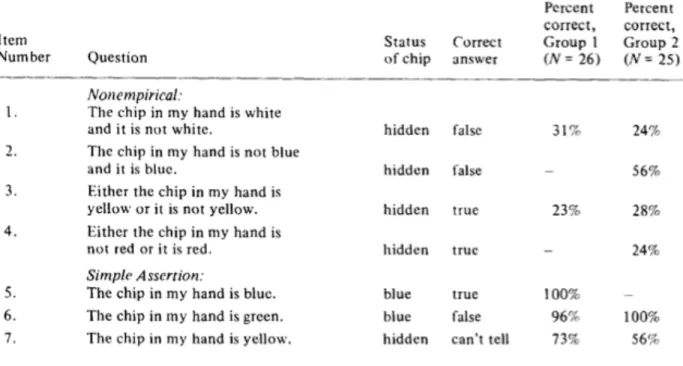
Figure 2: Data from Osherson & Markman’s (1975) Experiment
(Osherson & Markman 1975: 218)
Ultimately, the authors conclude that children cannot interpret tautologies because of an
inability to process metalinguistic truth-value, which is independent of tangible,
real-world evidence. That is, they see children’s failure to interpret these tautologies as true or
false as a result of the fact that the children preferred to look for real-world correlates to
prove or disprove each utterance, rather than recognizing that it is true or false based on
the form of the sentence.
In the aforementioned results, only a quarter of Osherson & Markman’s
7-year-olds provided what they deemed the ‘correct’ answer, which is that the statement is
automatically true since it is a tautology. However, it is difficult to regard Osherson &
Markman’s as conclusive evidence that children are incapable of calculating
metalinguistic truth values from tautologies and contradictions, especially without an
22
response to items (3) and (4) above (deemed incorrect by the experimenters) as the
children did; it cannot be certain that subjects interpret “can’t tell” as “I can’t tell whether
the statement is true or false” rather than “I can’t tell what color the chip is”, when the
chip is hidden from view.
Prior to moving on to an experiment on children’s ability to evaluate tautologies
pragmatically, is it important to consider whether Osherson & Markman’s (1975)
experiment provides evidence as to whether children interpret tautologies as semantically
uninformative. However, given the lack of adult control group in the experiment, it is
unclear if the children did not recognize tautologies as “adding nothing to our mutual
beliefs about ‘a’” (Ward & Hirschberg 1991) which is necessary prior to calculating
implicature. Without conclusive data to this respect, it is admittedly an assumption that
children do in fact recognize the uninformativity of tautologies. The current experiment
simply addresses children’s ability to compute implicature from contexts with
23
Chapter 4: Experiment
Section 4.1: Motivation
The goal of the present experiment is to assess child comprehension of novel
tautologies, specifically whether children compute implicature from tautologies as adults
do in a controlled context. While tautologies may be involved in the computation of
several different implicatures depending on the context, one specific implicature
computed from tautology will be tested for in this experiment. Equative tautologies
license the implicature that, when a hearer is given several options from within a salient
class, “all options are equally relevant” (Ward & Hirschberg 1991). To examine Ward &
Hirschberg’s theory for actual adult speech, a control group of adults is first assessed, and
then used to compare with the child group. Since the context in the experiment is
controlled and limited to one particular type of implicature that can be generated by
tautologies, the adult group will also provide evidence for or
against the impact of the of referent x is a given equative tautology x is x, as proposed by Wierzbicka (1987).
Section 4.2: Participants
Sixteen child and twenty-three adult American English-speaking participants completed
24
older. All participants resided in central North Carolina, in the Triangle region of Chapel
Hill, Durham and Raleigh. Participants were recruited using advertisements throughout
the Triangle and via in-person recruitment at the Kidzu Children’s Museum in Chapel
Hill. The target age range of 7-9 years was chosen based on Noveck (2000) and Noveck
(2001), due to the fact that of their groups of 5-, 7- and 9-year-olds, age 7 appeared to be
the first point at which children began to exhibit to at least a minimal degree the
pragmatic ability that Noveck examined. To the right is the actual age distribution of the
child participant pool.
Figure 3: Child Participants Age in Years/Months
Section 4.3: Predictions
The adult group is expected to calculate this implicature at a high frequency. This
particular implicature is that upon hearing “a is a”, an interlocutor recognizes that class-Child
Years
Child Months
1 7 0
2 7 6
3 7 6
4 7 8
5 7 9
6 7 9
7 7 9
8 7 11
9 7 11
10 8 0
11 8 0
12 8 8
13 8 10
14 9 0
15 9 1
25
internal differences among all a are not relevant for the purposes of the exchange. That is, the prediction is that when a participant is presented with a scenario in which three
options are presented to a person in the story and that person utters a tautology, he or she
implies that all three options are equally acceptable. For example, as in the example in
(1), say we present three different models of cars to an interlocutor: a Toyota, a Honda,
and a Ford. If, when asked to choose among the three, the interlocutor states “A car’s a car”, we infer that she has no preference among the three. All three cars are thought to be acceptable. On the other hand, if the 9-year-olds were to be unable to calculate this
implicature, the children would use other information to make a decision about
desirability, such as personal preference or knowledge about others’ preferences8. The
data will also be examined to see if this rate of comprehension increases significantly
with age (i.e., from age 7 to age 9), which would be an indication of increasing capacity
to calculate this implicature as the child gets older.
In addition, another condition was built into the adult group, in which an equal
number of three different referent types were used: abstract nouns, concrete nouns and
human nouns. The purpose of this was to examine the neo-Gricean argument that the
implicature is derived independent of the referent type, whereas the alternate “radical
semantic” argument predicts that due to the stereotypes commonly associated with
abstract and human referents, concrete referent tautologies should be more difficult to
compute (as discussed above). Under the neo-Gricean prediction, all three referent types
should be comprehended roughly equally. Under the “radical semantic” prediction,
concrete-referent tautologies (e.g. “a drink is a drink”) should be significantly more
8 For example, a participant could use personal preference to respond “no” to bottled water simply
26
difficult to comprehend than abstract- or human-referent tautologies (e.g. “a sport is a
sport” / “a plumber is a plumber).
Section 4.4: Methodology
The participants were presented with a PowerPoint presentation that included
fifteen slides, each containing an audio recording and three pictures. The pictures always
included three members of some class (e.g. “a sweet apple, a sour apple and an old apple”
/ “lemonade, cherry soda, and bottled water”). The participant listened to an audio
recording of the scenario with one image each of the three options.
Five slides were of the tautology condition (e.g. “an apple is an apple” / “a color
is a color”). Five slides were of a condition which I will call Control A, in which the
interlocutor expresses some preference about certain members of the class (e.g. “I want
an apple that tastes good” / “I want a color that’s good for a baby girl”). Finally, five
slides were of a condition I will call Control B, in which the interlocutor states
indifference towards individual class differences (e.g. “Any of those apples sounds good”
/ “I think all of those colors look good”). These three groups were alternated randomly
throughout the presentation, with the limitation that the PowerPoint never begin with a
tautology. Find in Figure 4 a representative example of these stimuli (see Appendix 2 for
27
Figure 4: Example of Visual Stimulus
The participant was then asked three yes-or-no questions about each of the three
options given what the character in the story said. In order to avoid conditioning the
responses for or against ‘yes-to-all’ responses, no practice trials were provided to the
participant. For example, “Do you think John would eat the sweet apple? (Yes/No) Do
you think John would eat the sour apple? (Yes/No) Do you think John would eat the old
apple? (Yes/No)”. Context will be provided for novel tautologies such that a flouting of
the maxims of Quantity and Relation provides a straightforward interpretation mirroring
that outlined by Ward & Hirschberg (1991). That is, upon hearing a tautology x is x,
participantsare predicted to accept all items that are considered to be within the category
of all x’s. Uniformity in participant interpretation of the tautologies will be taken as evidence that speakers are indeed making predictable decisions based on pragmatic skills.
The prediction for this portion of the study is that indeed children begin to possess the
kind of pragmatic reasoning necessary to felicitously interpret tautologies within this age
28
Figure 5: Transcript of Audio Stimulus Example
Section 4.5: Responses
Responses were coded in a binary fashion in which successes were given a value
of 1 and failures were given a value of 0. Success was calculated differently for the
Control A, Control B and Tautology conditions. See for example one of the fifteen
scenarios below, for which a participant heard one of three responses from John: a
tautology, an explicit preference, or explicit indifference.
i. Control A:
• Interlocutor expresses an explicit preference (e.g. “I don’t want anything sweet.”) • Success = Detected Stated Preference (e.g. no to cherry soda, yes to bottled water)
ii. Control B:
• Interlocutor expresses explicit indifference (e.g. “I’m thirsty, so I’ll take any of them.”) • Success = Yes to All
iii. Tautology:
29
In this way, the participant was believed to have comprehended Control A if he or she
replied “yes” to one specific target option and “no” to another specific target option. The
participant was believed to have comprehended Control B if he or she replied “yes” to all
three. Similarly, the participant was believed to have comprehended the Tautology
condition if he or she replied “yes” to all three.
Section 4.6: Results/Discussion – Quantitative Analysis
As seen in the table below, adults had a very high rate of success in calculating
the target implicature when hearing the tautology.
Figure 8: Adult Tautology Success Rate Across Referent Type
Tautology type Successes Out of (n=) Comprehension Rate
Abstract noun 37 40 92.5
Human noun 32 40 80.0
Concrete noun 36 40 90.0
All Tautologies 105 120 87.5
Furthermore, the prediction made by Wierzbicka (1987) and colleagues that, due to
salient stereotypes, abstract- and human-noun tautologies should be significantly easier to
compute does not seem to bear out in this data. In fact, human nouns seem to be the most
difficult of the three, though much more data is needed to reject the null hypothesis that
the three values are significantly different.
Now let us compare the success rates of adults and children to see if child
30
below, children were largely unable to compute the appropriate implicature that was
licensed from the tautology. A chi-squared test was performed on these values, and this
difference was found to be highly significant, x2 (1, N = 200) = 30.16, p < .0001.
Figure 9: Overall Tautology Success Rates – Adults and Children
Group Successes Out of (n=): Comprehension Rate
Children 18 80 22.5
Adults 105 120 87.5
Furthermore, the children did increase their ability to interpret the tautology with age
significantly x2 (1, N = 80) = 5.94, p = 0.042. This ability can be observed in the following plot9:
Figure 10: Tautology Condition Success Rate Across Age
9 Also, see qualitative responses in the section below regarding one outlier child.
0 0.2 0.4 0.6 0.8 1
7 8 9
C omp re h en si on R at
e
(o
ut
o
f 5
)
Exact Age
Child
31
The line draws the approximate mean probability of success at a given age, with exact
values given below. While ability to compute the implicature was very significantly
lower than that of adults, some children closer to age 10 did indeed begin to show an
ability to compute the implicature.10 Nevertheless, as seen in the graph, there is a still a
great deal of variation in the children near age 9. Less than a third of all child participants
were older than age 8, so more data from 9-year-olds is needed to provide further support
for this conclusion.
The question then becomes: why did the children fail to compute the implicature
when the adults did? There may be many possible reasons, but one plausible answer
might be that children use their personal preferences and knowledge of others’
preferences rather than using information from the tautology in the scenario. This will be
further explored in the next section where qualitative responses are discussed. In addition,
those kids that were more likely to use their own preferences on the tautology conditions
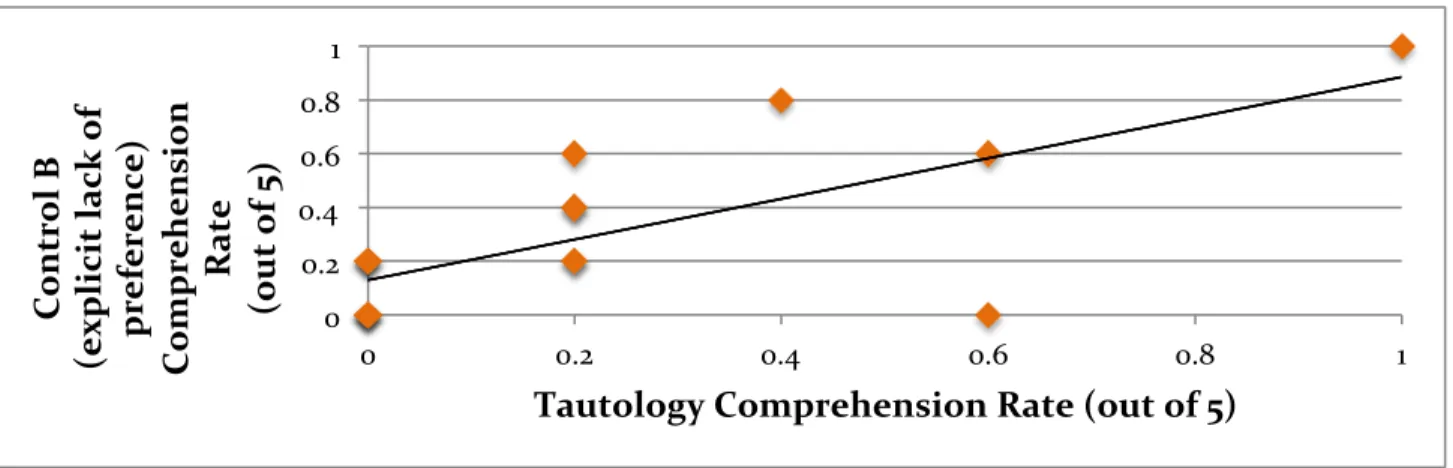
were also more likely to do so on the Control B condition (explicit indifference). The
correlation coefficient between these two conditions was .732 (p =.0013).
Figure 11: Control B Success Rate Across Age
10 Statistical significance was found within the child group itself, without considering the adult
data.
0 0.2 0.4 0.6 0.8 1
0 0.2 0.4 0.6 0.8 1
Control
B
(e
xp
li
ci
t
la
ck
o
f
p re fe re n ce ) C omp re h en si on Ra te (o ut o
f 5
)
32
That is, some children (especially those closer in age to 7) relied on personal preference
and knowledge of others’ preferences in both the Control B condition and the tautology
condition.
Given this data, one may be inclined to assume that children employed their own
opinions and knowledge of others’ opinions across all conditions, with no regard to the dialogue. However, this pattern did not hold for Control A (explicit stated preference):
Figure 11: Summary of Child Success Rates for All Three Conditions Condition Successes Out of (n=): Comprehension Rate
Tautology 18 80 22.5
Control A 69 80 86.3
Control B 22 80 27.5
As seen above, while children were overall unsuccessful on the Tautology and Control B
conditions, they were generally successful on the Control A condition. Important to note
in the measurement of success on Control A is that the child was required to detect a
specific preference from the dialogue (e.g. “I don’t want anything too sweet” and “I want a toy that I can play with outside”). This is relevant for the conclusion because it tells us that children were indeed able to detect preferences in the dialogue. However, in the
absence of clear preferences for one or two options in the Tautology and Control B
conditions, the children drew on other information, especially personal preference or
knowledge of other people’s preferences, to accept only one (or two) of the options
33
explicit preference in the story (e.g. “I want a strong plumber”, “I don’t want anything
sweet”) than detecting indifference towards all three options. One reason for this may be
that younger children hesitate to accept all three options, and as a result if the story does
not provide them a means of excluding at least one of the three, the children then proceed
to employ their own opinions or knowledge of others’ opinions to exclude one or more
options.
Section 4.7: Results/Discussion – Qualitative Analysis
Upon completing the experiment with each child, the experimenter proceeded to
ask specific questions to investigate the child’s motivations behind any non-target
responses on the tautology condition. The goal was to see how children were making
decisions when they failed to compute the “token indifference” implicature from the
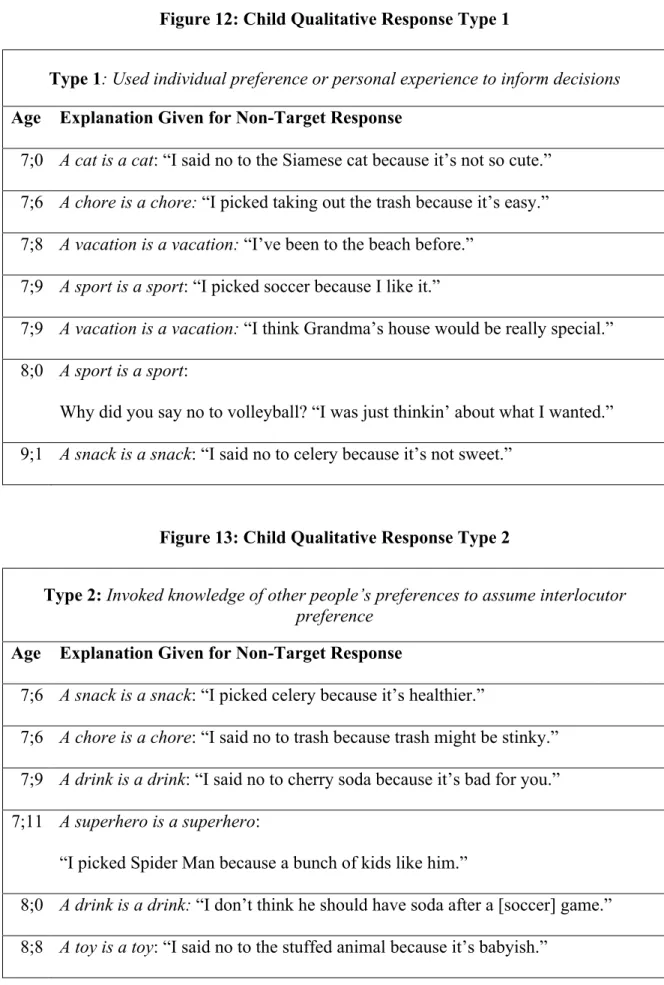
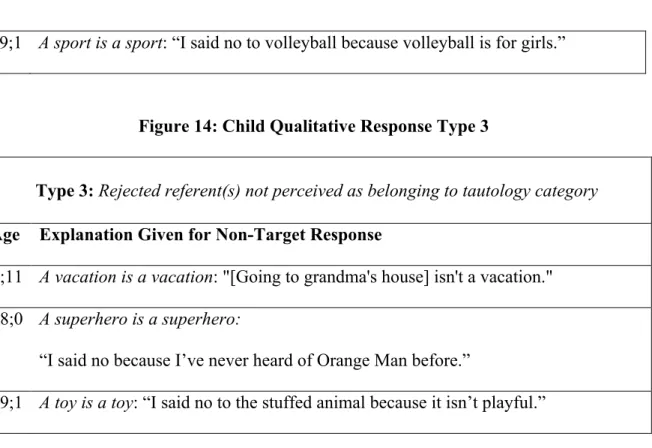
tautology. These responses have been organized chiefly into three categories: “Type 1” in
which the child used individual preference or personal experience to inform decisions;
“Type 2” in which the child invoked knowledge of other people’s preferences to respond
“yes” to certain options to the exclusion of others; and “Type 3” in which the child
seemed to reject one referent on the basis that it did not belong in the greater category
stated. These three response types are organized in the tables below. Children were also
asked about what they think specific tautologies mean, and these responses are
34
Figure 12: Child Qualitative Response Type 1
Type 1: Used individual preference or personal experience to inform decisions Age Explanation Given for Non-Target Response
7;0 A cat is a cat: “I said no to the Siamese cat because it’s not so cute.” 7;6 A chore is a chore: “I picked taking out the trash because it’s easy.” 7;8 A vacation is a vacation: “I’ve been to the beach before.”
7;9 A sport is a sport: “I picked soccer because I like it.”
7;9 A vacation is a vacation: “I think Grandma’s house would be really special.” 8;0 A sport is a sport:
Why did you say no to volleyball? “I was just thinkin’ about what I wanted.”
9;1 A snack is a snack: “I said no to celery because it’s not sweet.”
Figure 13: Child Qualitative Response Type 2
Type 2: Invoked knowledge of other people’s preferences to assume interlocutor preference
Age Explanation Given for Non-Target Response
7;6 A snack is a snack: “I picked celery because it’s healthier.”
7;6 A chore is a chore: “I said no to trash because trash might be stinky.” 7;9 A drink is a drink: “I said no to cherry soda because it’s bad for you.” 7;11 A superhero is a superhero:
“I picked Spider Man because a bunch of kids like him.”
35
9;1 A sport is a sport: “I said no to volleyball because volleyball is for girls.”
Figure 14: Child Qualitative Response Type 3
Type 3: Rejected referent(s) not perceived as belonging to tautology category
Age Explanation Given for Non-Target Response
7;11 A vacation is a vacation: "[Going to grandma's house] isn't a vacation." 8;0 A superhero is a superhero:
“I said no because I’ve never heard of Orange Man before.”
9;1 A toy is a toy: “I said no to the stuffed animal because it isn’t playful.”
The prevalence of Type 1 and Type 2 across different children seems to indicate
that these were the two primary strategies that kids employed to guide their
decision-making. This information supports the claim from the quantitative analysis above that
children used personal preference or knowledge of other people’s preferences, in the
absence of a clear preference provided by the dialogue. Category membership of all three
referents is a necessary prerequisite to felicitously generating the implicature of interest
in this experiment, and Type 3 seemed to show that some children did not draw the same
mental category boundaries as suggested in the dialogue. With only three instances, this
mismatching seems to be perhaps a product of this experiment and not an indication of
global strategies children were using to guide their responses in the experiment.
36
interesting responses. One child (age 7;11) offered variable information about the
meaning of tautologies. When first asked what the speaker in the dialogue meant when he
said A superhero isa superhero, he responded “he wants a powerful superhero”, but when asked about A plumber is a plumber, he stated “that means he’ll take all of them,” offering clear rationale for the “yes” answers he had provided for all three. Furthermore,
the only child to receive a perfect score on the tautologies (age 9;0) explained in the
experimental follow-up that “A plumber is a plumber means he doesn't care even if the plumbers are different." This child also received perfect scores on Control A and Control
B (as seen in the figure in the previous section).
Perhaps most interestingly, the only nine-year-old of the three to receive a zero on
the comprehension task offered indications that he was in fact capable of computing
implicature from tautologies. Despite the fact that he responded “yes” only to the color
“green” (among green, blue and pink) after the experiment the child (age 9;1) stated "A color is a color means it doesn't matter which one." When pressed about A drink is a drink, he gave a similar response, stating that all three drinks were okay, even though he had said “no” to cherry soda during the experiment. When asked why this may have
been, he responded, “Oh, I guess I forgot.” This anecdote seems to indicate that children
near age 9 were capable of calculating the same implicature from tautologies as adults,
but used other information to make decisions in the experiment. With more data, this may
provide support for the trend found in the previous section of proficiency increasing with
37
Chapter 5: Conclusions
Based on the data gathered in the experiment presented in this paper, two
conclusions can be drawn. First, the prediction of the “Radical Semantic” account of
tautologies (Wierzbicka 1987, Gibbs & McCarrell 1990) that human referent tautologies
(e.g. “a plumber is a plumber”) are easier to interpret than concrete referent tautologies
(e.g. “a snack is a snack”) was not confirmed by data from 23 adult subjects. While Gibbs
& McCarrell (1990) had a higher number of subjects (36) in their study, the fact that the
opposite trend was observed in the current 23 subjects lends support to a “Radical
Pragmatic” account of tautologies (Ward & Hirschberg 1991), whereby referent type is
not a significant factor in the interpretation of tautologies by adults. The difference
between Gibbs & McCarrell’s (1990) result and the result of the current study may be
explained by the fact that the current experiment carefully controlled for
conventionalization of tautologies (e.g. “business is business”). Only tautologies
infrequent or absent in a corpus of American English (Davies 2008) were included, while
Gibbs & McCarrell mixed these two sub-types indiscriminately in their stimuli. Second,
adults performed significantly better than children in providing target responses to
tautological utterances. Several reasons may be attributed for the higher performance of
38
Section 5.1: Why did adults understand tautologies better than children?
While adults succeeded, children at age 7 failed to comprehend tautologies
presented in context. This result is consistent with the original predictions of the
experiment based on data on child interpretation of scalar implicature (Noveck 2000,
Chierchia et al 2001, Bott & Noveck 2004). That is, that children ages 7-9 do not yet
have a complete understanding of the maxim of Quantity, necessary for interpreting both
tautologies and scalars. However, is it clear that children failed to behave like adults due
to a pragmatic failure, or could the result be attributed to some other experimental
confound or cognitive burden?
The data presented in the previous section suggest that rather than using context
(i.e., the tautology) in forming their responses to questions in the experiment, children
drew on other strategies to inform their responses, such as personal preference or
knowledge of others’ preference. This experimental confound prevents one from reaching
the conclusion that children ages 7-9 lack the pragmatic competence that adults possess.
Furthermore, additional research must be conducted in order to conclusively
establish whether children recognize the fact tautologies such as x is x are inherently uninformative, which is a necessary step that must come before calculating the
implicature (Ward & Hirschberg 1987). The question was raised by Osherson &
Markman (1975) but must be tested more carefully in the future with an adult control
group to determine whether children in fact recognize tautologies as uninformative
39 Section 5.2: Future Studies
A revised study that successfully averts interference of extralinguistic information
in the computation of implicature is needed. Such a study will determine whether the
reason for children’s low success rate in comprehending tautologies is a product of their
failure to compute an implicature. A paradigm that prevents the child from selecting
based on personal preference would first begin with a meticulously designed priming
phase. In this phase, children would be presented with scenarios in which the interlocutor
either (a) expresses a preference the child likely shares (e.g. “sweet apple”), (b) expresses
a preference the child likely does not share (e.g. “old apple”), or (c) expresses an
indifference towards all three options, even if one of these options is undesirable.
Upon receiving each response, the experimenter needs to provide the child with
explicit feedback as to whether there response was “correct” or “incorrect”. This phase
will condition the child to pay close attention to the dialogue as the sole guiding source of
information for their responses. Children are then discouraged from using information,
such as personal preference, in making their selections. These steps should provide
additional protection against the confounds reported in this paper’s experiment.
Such an experiment should also include an additional adult control group that
helps determine more conclusively whether children recognize tautologies as
semantically uninformative. This portion of the study would be similar of Osherson &
Markman’s (1975) approach, asking adults (in addition to children) whether tautologies
(or contradictions, etc) are “true” or “false”, as the authors did with children. The adult
40
only in children. Careful piloting would be needed to ensure that this method is usable
41
APPENDIX 1 – RAW CHILD DATA
Child 1 Group 1 (tautology) (preference) (no preference)
Age 7;11 A-T-B Tautology Control A Control B
op1 op2 op3 op1 op2 op3 op1 op2 op3
apple N Y N drink N N Y toy Y Y Y
cat N N Y snack Y Y N time out Y Y N
vacation Y Y N color N Y N sport Y Y Y
superhero Y Y Y chore Y N N babysitter Y Y Y
plumber Y Y Y teacher Y N N waiter Y Y Y
Child 2 Group 2 (tautology) (preference) (no preference)
Age 7;9 A-B-T Tautology Control A Control B
op1 op2 op3 op1 op2 op3 op1 op2 op3
snack Y Y Y apple N Y N toy N Y N
color N Y N cat Y N N time out N Y N
chore Y N N vacation Y Y N sport N N Y
teacher Y N Y superhero Y N N babysitter Y Y N
drink Y N Y plumber N Y N waiter Y Y Y
Child 3 Group 3 (tautology) (preference) (no preference)
Age 7;0 B-T-A Tautology Control A Control B
op1 op2 op3 op1 op2 op3 op1 op2 op3
cat Y N Y time out N Y N snack N Y N
sport Y N N vacation Y N N color N N Y
superhero N Y N babysitter N Y N chore Y N N
waiter N Y N plumber N Y N teacher Y N N
drink Y N N toy N N Y apple N Y Y
Child 4 Group 1 (tautology) (preference) (no preference)
Age 8;8 A-T-B Tautology Control A Control B
op1 op2 op3 op1 op2 op3 op1 op2 op3
apple N Y N drink N N Y toy N Y Y
cat N Y Y snack Y Y N time out Y N N
vacation N Y Y color Y N Y sport N Y Y
superhero N Y N chore Y N Y babysitter N N N
plumber Y Y Y teacher N N Y waiter Y N Y
Child 5 Group 2 (tautology) (preference) (no preference)
Age 7;6 A-B-T Tautology Control A Control B