The handle http://hdl.handle.net/1887/45569 holds various files of this Leiden University dissertation.
Author: Vogelaar, B.
Title: Dynamic testing and excellence: unfolding potential
Dynamic Testing and Excellence
Unfolding potential
Dynamic Testing and Excellence
Unfolding potential
Proefschrift
ter verkrijging van
de graad van Doctor aan de Universiteit Leiden, op gezag van Rector Magnificus prof.mr. C.J.J.M. Stolker,
volgens besluit van het College voor Promoties te verdedigen op woensdag 18 januari 2017
klokke 15:00 uur
door
Bart Vogelaar
Promotor:
Prof.dr. W.C.M. Resing Co-promotor:
Dr. A.J.M. Hoogeveen (Radboud Universiteit) Promotiecommissie:
Prof.dr. E.A.M. Crone
Contents
General Introduction
Gifted and average-ability children’s progression in analogical reasoning in a dynamic testing setting
2.1 Introduction 2.2 Method 2.3 Results 2.4 Discussion
Dynamic testing and test anxiety amongst gifted and average- ability children
3.1 Introduction 3.2 Method 3.3 Results 3.4 Discussion
Dynamic testing of gifted and average-ability children’s analogy problem-solving: Does executive functioning play a role?
4.1 Introduction 4.2 Method 4.3 Results 4.4 Discussion
Changes over time and transfer of analogy-problem solving of gifted and non-gifted children in a dynamic testing setting 5.1 Introduction 5.2 Method 5.3 Results 5.4 Discussion General Discussion References
Summary in Dutch
1
CHAPTER 1
In many countries, gifted and talented children have long been “forgotten” in education. Educational professionals have commonly held the view that these children would manage on their own, and would not benefit from additional help or extra attention (Persson, 2010). Recently, however, more attention is being paid to gifted learners in education, in general as well as in relation to their educational needs (Swanson, 2016; VanTassel-Baska & Stambauch, 2005). In order to be able to cater to gifted learners’ educational needs, reliable and valid identification of gifted students is key. Although some researchers and practitioners have argued that static measures of intelligence are inadequate for these purposes (Lohman & Gambrell, 2012; Worrell & Erwin, 2011), shortened measures of intelligence are often used in identification of giftedness (Nisbett, 2009; Pierson, Kilmer, Rothlisberg, & McIntosh, 2012).
Conventional, static tests are, however, said to capture only part of cognitive functioning (e.g., Elliott, 2003; Lohman & Gambrell, 2012). Moreover, these tests are believed to measure previous learning experiences, which do not always correspond with children’s cognitive potential (Sternberg & Grigorenko, 2002). Research has suggested that some children are disadvantaged when taking these tests, including those with a low socio economic status, a different cultural background, special needs (Robinson-Zañartu & Carlson, 2013), or test anxiety (Meijer, 1996). Moreover, static tests are primarily focused on testing outcomes, taking into account psychological processes involved in learning only indirectly (Jeltova, Birney, Fredine, Jarvin, Sternberg et al., 2007). This seems in contrast with the aim of gifted education, and education in general: unfolding and maximising talent and potential of each individual child (Nicpon & Pfeiffer, 2012). Gaining insight into how an individual (gifted) child learns, and what conditions are optimal for this child to demonstrate his or her potential therefore seem a necessity. This notion seems even more salient, as practitioners and educational professionals have voiced concerns that tailoring to the needs of gifted learners often proves difficult, which could ultimately result in loss of cognitive potential (Ryan & Coneybeare, 2013).
General Introduction
1
Dynamic testing
Dynamic tests exist in many different forms, but they all have in common that they provide instruction, help, or feedback as part of the testing procedures, and, in doing so, are aimed at structured measuring of children’s progression in learning (Sternberg & Grigorenko, 2002). This is one of the main objectives of dynamic testing, while providing insight into the type of help a child needs in order to learn is another key objective (Resing, 2013). Generally speaking, there are two dynamic testing formats: the cake, and the sandwich format (Sternberg & Grigorenko, 2001). As part of the cake format, a child is offered help, item by item, as soon as he or she experiences a substantial difficulty in solving a task. The sandwich format, also known as the pre-test-training-post-test design, is used in the current thesis.
Whereas some dynamic tests offer tailored, individual prompts, help, or feedback, other tests provide standardised instruction. In this thesis, children were provided with standardised prompts during the training phase based on graduated prompting principles. Graduated prompting has repeatedly shown to lead to progression in learning (Bosma & Resing, 2006; Ferrara, Brown, & Campione, 1986; Resing, 2013; Resing & Elliott, 2011). Graduated prompting refers to a form of training as a part of which children are provided with a prompt as soon as they experience a significant difficulty in solving a task (Campione & Brown, 1987; Resing & Elliott, 2011). In the studies that are part of this thesis, prompts were tailored to each test item, and provided hierarchically; ranging from very general metacognitive prompts, to task-specific cognitive prompts, to modelling (Resing, 2000). Providing these prompts in a hierarchic fashion enables measuring of different degrees of help each individual child needs in order to demonstrate learning.
Dynamic testing of analogical reasoning
Many dynamic tests employ inductive reasoning tasks (e.g., Ferrara et al., 1986; Resing, 2013). Inductive reasoning has been noted for its central role in a variety of cognitive skills and processes (Csapó, 1997), such as general intelligence (Klauer & Phye, 2008), problem-solving (Richland & Burchinal, 2012), and acquisition and application of knowledge (Goswami, 2012). Inductive reasoning has been found to develop throughout childhood, during primary and secondary school (Csapó, 1997; Molnár, Greiff, & Csapó, 2013). In the studies part of this thesis, visuo-spatial analogical reasoning matrices were employed of the type A:B::C:?. These tasks were utilised, as opposed to more traditional scholastic tasks, for example in the domains of reading or maths, as these skills are often taught in several gradations with differences between schools being apparent. Measuring these skills would, therefore, require using a multitude of different dynamic tests. Analogical reasoning, a subtype of inductive reasoning, is said to play an important role in children’s everyday learning (Richland, Morrison, & Holyoak, 2006). Moreover, research has shown that performance on analogical reasoning matrices, such as those used in the current thesis, is associated with scholastic achievement (Balboni, Naglieri, & Cubelli, 2010), as well as individual differences in IQ scores, as well as in fluid intelligence (Caropreso & White, 1994; Vendetti, Wu, & Holyoak, 2014).
Giftedness
General Introduction
1
Although increasingly more attention is currently being paid to giftedchildren (see Dai, Swanson, & Cheng, 2011 for an overview), generalising research findings to practical solutions for identification and education of gifted children has revealed to be challenging (VanTassel-Baska, 2006). Researchers and practitioners alike have voiced their concerns in relation to the fact that there is no consensus on a definition of giftedness (Dai & Chen, 2013; Nicpon & Pfeiffer, 2011). Over the past century, there has been a shift in the general view that giftedness is not a unidimensional, but rather a multidimensional construct. While in one of the first definitions, giftedness was equalled by an IQ of at least 140 (Terman, 1925), already in the 1970s, although expanded on in more recent years (e.g., Renzulli, 2005; Renzulli & D’Souza, 2014; Renzulli & Sytsma, 2008), Renzulli (1978) noted that giftedness occurs in the interplay of above average cognitive capacities, creativity and task persistence.
At the beginning of the 21st century, definitions of giftedness started to emerge that also took into account interaction with the environment, and sociocultural content (Barab & Plucker, 2002). One of the most recent developments in the conceptualisation of giftedness is the model posited by Subotnik, Olzewski-Kubilius, and Worrell (2012) who define giftedness as
“performance that is clearly at the upper end of the distribution in a specific talent domain even relative to other high-functioning individuals in that domain. Further, giftedness can be viewed as developmental in that in the beginning stages, potential is the key variable; in later stages, achievement is the measure of giftedness; and in fully developed talents, eminence is the basis on which this label is granted” (p. 176).
studies in this thesis consisted of parents’ and teachers’ nominations, in addition to their enrolment in these settings. In addition, the children participating
in the studies described in Chapters 3, 4, and 5, in accordance with the NAGC, were found to have a percentile score of at least 90 of the Raven Standard Progressive Matrices Test (Raven, 1981). As described above, although various factors play a role in the conceptualisation of giftedness, in this thesis only cognitive factors are considered.
Developing Expertise Model
An alternative view on giftedness was posited by Sternberg (1999, 2001; Sternberg, Jarvin, & Grigorenko, 2011), who views giftedness as developing expertise. In his model of developing expertise, which links the measurement of potential for learning with giftedness, learning new abilities is similar to the development of expertise. Sternberg’s model posits that five elements, metacognition, motivation, knowledge, thinking, and learning itself, play a role in becoming an expert. These elements are interactive, influencing each other both directly and indirectly. Through practice, a novice can become an expert in a specific learning context. Sternberg (2001) further proposed that giftedness equals an exceptional ability to develop expertise, within a zone of proximal development, on the basis of existing or developing abilities and skills. In his view, gifted children have greater potential for developing expertise, they develop expertise at a faster rate, to higher levels, or to qualitatively different levels than non-gifted children.
In this thesis, the relationship between a number of the factors described in the Developing Expertise Model and dynamic testing outcomes were examined; specifically two aspects of executive functioning, cognitive flexibility and metacognition, as well as the ability to generalise knowledge and skills (transfer). Moreover, it was investigated whether test anxiety would be related to these test outcomes.
Executive functioning
Executive functioning plays a central role in developing expertise, as posited in Sternberg’s Developing Expertise Model. In line with his model, gifted children are often said to have an executive functioning advantage (Arffa, 2007). Executive functioning is an umbrella term used to refer to a number of complex cognitive processes enabling conscious control of thought and action that are critical to purposeful, goal-directed behavior (Monette, Bigras, & Guay, 2011). Executive functioning is deemed important when learning new skills (e.g., Diamond, 2013) and has been found to be a predictor of academic success (Viterbori, Usai, Traverso, & De Franchis, 2015).
General Introduction
1
Miyake et al., 2000; Viterbori et al., 2015). In general, two types of instrumentsare used to obtain measures of executive functioning: (self and informant) rating scales and performance-based tasks. A difficulty of measuring executive functioning is that most performance-based tasks have originally been developed for adults (Isquith, Crawford, Andrews Espy, & Gioia, 2005). Using these instruments for children has several implications, particularly when taking into account the developmental nature of executive functions. Studies have indicated that executive functions develop throughout childhood until late adolescence (Gathercole, Pickering, Ambridge, & Wearing, 2004; Huizinga, Dolan, & Van der Molen, 2006). In addition, some researchers have also noted that rating scales do not always fully capture children’s executive functioning (e.g., Sadeh, Burns, & Sullivan, 2012). Due to these reasons, researchers recommend the use of various instruments when assessing executive functions (Toplak, West, & Stanovich, 2013). In the present thesis, the influence of cognitive flexibility, the ability to be flexible in adjusting thinking to meet changing demands (Diamond, 2013), measured by means of a performance-based task, and metacognition in general, measured by a teacher rating scale, was examined in relation to static versus dynamic measures of analogy problem-solving.
Test anxiety
In addition to elements that facilitate learning and the development of expertise, there are also factors that may hinder learning. One of these factors is test anxiety. The adverse effects of test anxiety on cognitive performance have been well-documented, ranging from, for instance, scholastic achievement (e.g., Segool, Carlson, Goforth, Von der Embse, & Barterian, 2013), to intelligence testing (e.g., Hopko, Crittendon, Grant, & Wilson, 2005; Meijer, 1996, 2001). Test anxiety has even been described as one of the causes of underperformance of various learners, including gifted children (e.g., Reis & McCoach, 2010). It is estimated that 10 to 40 per cent of all students have experienced clinical levels of test anxiety (Segool et al., 2013). It has been stated in the literature that in the gifted population, test anxiety is less prevalent; these children are assumed to have higher intellectual coping resources that may lead to them coping better in stressful academic situations (Zeidner & Shani-Zinovich, 2011).
testing in gifted children, however, is scarce (for studies on test anxiety and dynamic testing, in general, see e.g., Bethge et al., 1982; Meijer, 1996; 2001). In this thesis, it was examined whether test anxiety, as measured by a self-report questionnaire, has a differential influence on static and dynamic measures of analogy problem-solving.
Transfer
Transfer is the ability to apply and adapt knowledge to a new context, and is an important goal of education (Day & Goldstone, 2012). In spite of the fact that transfer has been examined for more than a century (Engle, 2012), eliciting transfer of learning has proven to be difficult (Day & Goldstone, 2012). It is assumed that two specific factors are important in the effectiveness of transfer: the content and the context. The content refers to the actual content being transferred (Barnett & Ceci, 2002), whereas the context is used to denote the different domains from and to which transfer takes place (Klahr & Chen, 2011). Different types of transfer have been proposed, which are based on the extent to which the base and target problem share similarities (Barnett & Ceci, 2002). Often, transfer is classified in terms of near versus far transfer (Mestre, 2005), and surface versus deep transfer (Forbus, Gentner, & Law, 1995).
Although the underlying processes of transfer are still not fully understood, research suggests that successful transfer is associated with the extent to which an individual child mastered the task to be transferred (Siegler, 2006). Expertise, and a deep understanding of the task at hand seems to be required in order for deep transfer to be successful (Barnett & Ceci, 2002). Some studies suggested that gifted children outperform their average-ability peers with regard to the extent to which they demonstrate successful transfer (e.g., Klavir & Gorodetksy, 2001), but other studies have supported this conclusion only partially; on near transfer tasks gifted and average-ability children show similar rates of transfer (Carr, Alexander, & Schwanenflugel, 1996), while in other studies on far transfer tasks gifted children demonstrated superior transfer rates (Geake, 2008; Kanevsky, 2000). In the current thesis, transfer was investigated by utilising a ‘reversal’ procedure, in the form of an analogy construction task (e.g., Bosma & Resing, 2006; Harpaz-Itay, Kaniel, & Ben-Amran, 2006). The potential role of training on transfer success and effectiveness was investigated, as well as the roles of giftedness, and mastery of analogy problem-solving.
Outline of this thesis
General Introduction
1
Developing Expertise Model that possibly influence dynamic testing outcomeswere examined, with a specific focus on executive functioning. Children’s progressions in analogy problem-solving and analogy construction were considered, taking into account the roles that age, ability, executive functioning, and test anxiety played.
In Chapter 1, the studies that are part of this thesis were introduced, and a theoretical background for these studies was provided. In Chapter 2, dynamic testing principles were employed to examine potential differences in progression of analogy problem-solving of gifted and average-ability children of 5-8 years old. Taking into account age, it was investigated whether gifted and average-ability children demonstrated differential progression in analogy problem-solving, benefitted differentially from a dynamic training procedure, and showed differential instructional needs.
In Chapters 3 and 4, we further examined 7 and 8 year old gifted and average-ability children’s progression in analogy problem-solving, using Linear Mixed Modeling analysis with a multilevel approach. In both chapters, the growth trajectories of children in the various conditions were investigated. In Chapter 3, the potential role of test anxiety was examined in relation to static and dynamic progression in analogy problem-solving. In Chapter 4, analogy problem-solving was examined in relation to two aspects of executive functioning: cognitive flexibility, as measured by a performance-based task, and metacognition in general, as measured by a teacher rating scale. Potential differences in instructional needs of gifted and average-ability children were further
explored in this chapter.
CHAPTER 2
Gifted and average-ability children’s progression in
analogical reasoning in a dynamic testing setting
2
To be published as:
Vogelaar, B., & Resing, W. C. M. (2016). Gifted and average-ability children’s progression in analogical reasoning in a dynamic testing setting. Journal of Cognitive Education and Psychology, 15(3).
Abstract
Gifted and average-ability children’s progression in analogical reasoning in a dynamic testing setting
2
2.1 Introduction
In many educational systems in the world, emphasis has traditionally been on average-ability students. In various countries, it is still seen as controversial, at the very least, that gifted students might require, or benefit from, special educational needs (Persson, 2010). It is often taken for granted that gifted children will somehow manage their classroom learning, and do not need any help or extra attention (De Boer, Minnaert, & Kamphof, 2013). This view, however, seems to be changing; currently, there is more attention for the presumed needs of these children (e.g., Robinson & Olly, 2014), although tailoring the learning to their specific needs is still challenging (Reis & Renzulli, 2010). Given this current interest in the education of gifted children, the main aim of our study was to find out whether, and if so, how children identified as gifted differ from average-ability children regarding their potential for learning and their need for instruction in a classroom setting.
Because of the diverse nature of the body of research into giftedness, and education of gifted children (Dai, Swanson, & Cheng, 2011), research into this field is challenging (VanTassel-Baska, 2006). One of the challenges in the field of research on giftedness is that there is no agreement among researchers on a definition of this concept (Dai & Chen, 2013). What generally seems to be agreed on, however, is that gifted persons have exceptional cognitive capacities (e.g., Renzulli, 2002), and, in addition, a heightened capacity for solving complex problems (Sternberg, 2001). Children are often identified as being gifted by means of conventional, static, and often shortened intelligence tests (Kline, 2001; Lohman & Gambrell, 2012). However, the idea that conventional, static intelligence measures may not always lead to valid and reliable outcomes has been known for some time (Budoff, 1987). Opponents of these tests argue that they predominantly test previously acquired knowledge and skills (Elliott, Grigorenko, & Resing, 2010), which means, for example, that children with a low socio-economic status, a different cultural background, or with special needs can be disadvantaged on these tests (Elliott, 2003; Grigorenko, 2009; Serpell, 2000). Children with a different ethnic background often grow up in different environments, having less preschool education, and different expectations of their parents (Calero et al., 2013; Peña, 2000; Resing, Tunteler, de Jong, & Bosma, 2009; Tzuriel & Kaufman, 1999). As a result, they have less knowledge and skills required for achieving excellent static test scores. A consequence of this is that children’s cognitive abilities and intellectual potential may not be accurately portrayed (Elliott, Lidz, & Shaughnessy, 2004).
Lidz, 2007; Lidz & Elliott, 2000; Sternberg & Grigorenko, 2009). Dynamic testing is a form of testing that assumes to measure a child’s potential for learning (Budoff, 1987; Resing & Elliott, 2011), while incorporating individualized feedback and instruction in the testing process (Elliott, 2003; Jeltova et al., 2007), and measuring a child’s improvement after feedback/help has been given. In this way, these tests have the potential to provide in-depth insight into the learning process and development of children (Grigorenko, 2009) as well as the underlying processes involved in learning. Because individualized feedback and instruction are intertwined in the testing process (Elliott, 2003), it is assumed that dynamic testing has the potential to create a more reliable profile of a child’s performance level, cognitive strengths, and weaknesses (Jeltova et al., 2007). This individualized approach to instruction and feedback has been assumed to provide a more reliable picture of future academic performance than using static tests only (Elliott et al., 2010). The possibility of measuring the potential for learning or the processes involved in learning new skills make this form of testing a potentially interesting tool for devising educational strategies and interventions (Jeltova et al., 2007).
Whereas a wealth of research has shown the beneficial value of the application of dynamic testing in special populations, such as children with a low socio-economic status or ethnic minorities, and special needs children such as learning disabled, over the past decades, only a few studies have focused on using dynamic tests with regard to giftedness (Boling & Day, 1993; Calero, García-Martin, & Robles, 2011; Passow & Frasier, 1996) and the placement of gifted children into talented programs (Lidz & Macrine, 2001; Matthews & Foster, 2005). The results did suggest that dynamic tests can be used to assess the learning abilities of gifted children. Even more importantly, Kanevsky’s (2000) research among preschool children has shown that gifted children have a more extensive zone of proximal development, the ability to learn new skills faster, and are better at generalizing new knowledge obtained. The learning of gifted children was also found to show high levels of motivation, metacognition, self-regulation, and cognitive flexibility (Calero, García-Martín, Jiménez, Kázen, & Araque, 2007). Moreover, Calero et al. (2011) found that gifted children between 6 and 11 years old showed more progression from pre-training to post-training, started at a higher performance level, and showed significantly more improvement than their non-gifted peers. In summary, the studies stated earlier found that gifted children had a higher learning capacity and potential than non-gifted children, and in some cases, children would not have been identified as gifted if static tests only had been used.
Gifted and average-ability children’s progression in analogical reasoning in a dynamic testing setting
2
the standardized administration process, whereas in the latter the focus is onchildren’s improvement in their performance after explicit training or assistance. In-depth examination of children’s responses to these forms of training or assistance is, according to proponents of dynamic testing, of added value to our understanding of the nature of children’s learning (Grigorenko, 2009; Jeltova et al., 2011). A form of dynamic testing that specifically enables investigating the need for instruction is the graduated prompts approach (Campione & Brown, 1987; Resing, 2000). These highly structured techniques not only incorporate specific problem-solving skills and strategies but also include training metacognitive skills such as planning and monitoring (Campione, Brown, & Ferrara, 1982). A more recent study has shown that graduated prompts techniques provide additional information about children’s potential for learning by comparing the minimum number of prompts, and investigating differences in the number of metacognitive and cognitive prompts children received in solving problems (Resing et al., 2009). To make dynamic testing even more insightful regarding these processes, dynamic testing procedures could be combined with microgenetic methods of measurement. Microgenetic research methods, developed to examine both spontaneous, unprompted development and changes in children’s cognitive abilities (Siegler & Crowley, 1991), include several measurements within a relatively short and sensitive time frame and focus on individual changes in performance on a single cognitive task (Steiner, 2006). Microgenetic methods have, for example, been used successfully in providing more insight into age-related developments, such as the ability to solve analogy problems. Analogical reasoning, a form of inductive reasoning (Barnett & Ceci, 2002), is considered of crucial importance to the acquisition and application of knowledge (Pellegrino & Glaser, 1982), and solving problems (Chi, Glaser, & Rees, 1982). It is generally known that older children are better at solving analogies than younger children (Csapó, 1997; Hosenfeld, van den Boom, & Resing, 1997). Siegler and Svetina’s (2002) microgenetic study showed that while although 6-year-old children’s initial analogical reasoning ability was found to be lower than their older peers, after unguided practice, these children’s analogical reasoning abilities were found to be similar to 7- and 8-year-old children’s abilities. Microgenetic studies among gifted children are, however, limited (e.g., Steiner, 2006).
Boom, 1997; Tunteler, Pronk, & Resing, 2008). These studies have revealed that training in addition to unguided practice can have an added value to children’s progression in analogical reasoning. In this study, we combined two approaches, unguided practice and dynamic testing, aiming to examine whether two groups of children,1 a group identified as gifted by their teachers and parents, and a group of average-ability children profited differently from unguided practice, and the intervention provided by dynamic testing, hoping to obtain more insight into differences in performance of visuospatial analogical reasoning tasks and differences in instructional needs.
Our first cluster of research questions concerned changes over time in the progression of accuracy scores when comparing children identified as gifted and average-ability children, taking into account age. First, we focused on the potential effects of unguided practice. Taking into account ability, we expected that the children identified as gifted would outperform their average-ability age-mates in accuracy scores regarding both initial reasoning ability and progression paths. We therefore hypothesized significant differences in pre-test scores between both groups of children; children identified as gifted starting with higher performances on the Pretest 1, a main effect of unguided practice, and an interaction effect of unguided practice, considering the progression from Pretest 1 to Pretest 2, whereby children identified as gifted would show more progression as a result of unguided practice than the average-ability children (Calero et al., 2011). We also hypothesized a main effect of age; younger children were expected to profit less than older ones (Siegler & Svetina, 2002). Then, we focused on the potential effects of dynamic testing. A main effect of treatment was hypothesized, trained children showing more advanced progression paths in accuracy when solving analogies (Resing, 2000; Stevenson, Hickendorff, Resing, Heiser, & de Boeck, 2013). Furthermore, we hypothesized an interaction between treatment and ability; trained children identified as gifted would show more advanced progression compared to the average-ability trained children (Kanevsky, 1990).
Gifted and average-ability children’s progression in analogical reasoning in a dynamic testing setting
2
the instructional needs of all dynamically tested children and expected thatconsidering that older children were found to be better at solving analogies (Csapó, 1997; Hosenfeld, Van den Boom et al., 1997), they would need less help than the younger children, regardless of their ability.
2.2. Method Participants
Two hundred and sixty-six participants took part in the study, aged 5-8 years old (M = 6.23 in years, SD = 13.40 in months), ranging from 5 years and 1 month to 8 years and 10 months in age, 128 boys, and 138 girls. Four children were excluded from the analyses because they did not participate at all measurement moments. All participants spoke Dutch, and went to 1 of 12 regular primary schools in various parts of The Netherlands at the time of testing. The age of 5-8 years old was chosen, because previous research has shown that analogical reasoning skills are developed at this age (Tunteler & Resing, 2007). In this study, children were categorized as “identified as gifted” if both their parents and teachers judged their child to be gifted and were all enrolled in gifted, or talented programs. A second group of children were classified as “average-ability”. Seventy-eight children were categorized as identified as “gifted”, 188 as “average-ability”. Written permission was obtained from the schools and the parents prior to participation in the study.
Design
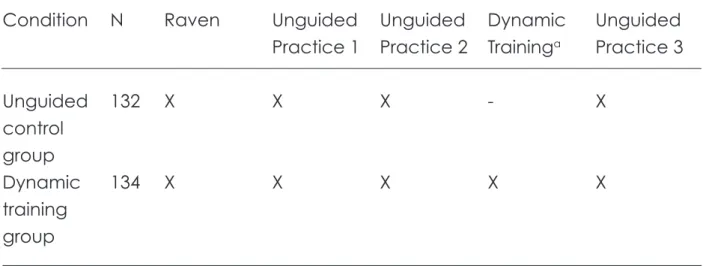
This study used a three-sessions repeated measurements randomized blocking design with two treatment conditions, the Raven. As a measure of initial reasoning ability, three unguided practice sessions, and a short training session (Table 1). Possible differences in initial inductive reasoning ability between conditions were controlled by this randomized blocking procedure based on the children’s Raven score, administered before unguided practice Session 1. Blocked pairs of children were randomly allocated to the two treatment conditions (dynamic training vs. unguided control). All sessions took approximately 20-30 mins. Non-trained children participated in the Raven and unguided practice Sessions 1, 2, and 3 but were not provided with the dynamic training procedure.
Table 1. Experimental Design; Raven was Administered Before the Test Sessions
Condition N Raven Unguided Unguided Dynamic Unguided
Practice 1 Practice 2 Traininga Practice 3
Unguided 132 X X X - X
control group
Dynamic 134 X X X X X
training group
Notea: The children in the dynamic training group received a graduated prompts training session
consisting of similar geometric analogies, the unguided control group did not receive a practice, nor a training session.
Materials
Raven. The Raven Progressive Matrices Test (Raven, 1981) was administered to all participants. The raw scores were used as an indication of their fluid intelligence and initial level of analogical reasoning. The Raven test is a non-verbal intelligence test with multiple-choice figural analogies. The Raven test was shown to have a high level of internal consistency, as determined by a Cronbach’s alpha of .83 (Raven, 1981). Among the 5- and 6-year-old children, answer sheets were used with pictures of the multiple-choice options from which the children could circle the correct answer to ensure the validity of the collected data scores. The standard testing procedure was used for the 7- and 8-year-old children. Raw Raven scores were used in the analyses instead of standardized scores because no norm scores were available for 5- and 6-year-old children.
Gifted and average-ability children’s progression in analogical reasoning in a dynamic testing setting
2
was constructed by means of five possible transformations: changing position,adding or subtracting an element, changing size, halving, and doubling. The test was administered as a paper-and-pencil test, and the children were asked to draw the correct answers. Because the children were asked to construct and draw their answers themselves, a test session could not have more than 20 items because of time constraints. Test Session 1 (the pre-test) had a high level of internal consistency, as determined by a Cronbach’s alpha of .94 for the accuracy scores
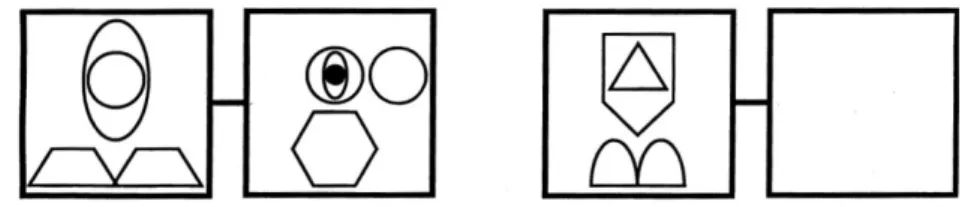
Figure 1. Example of a difficult analogy item.
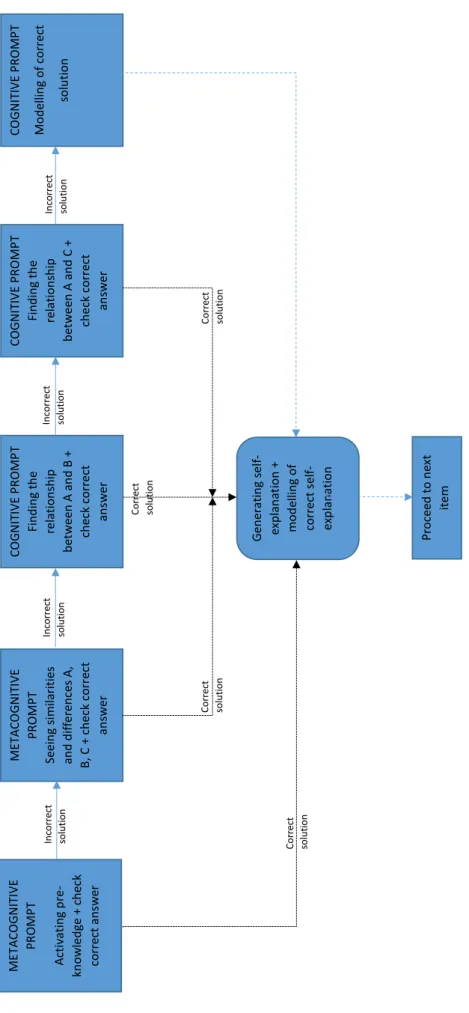
The training session consisted of 10 geometric analogies. Because the training session took, on average, about 20 mins to conduct, the session could not contain any additional items. None of the items presented in the training session were similar to the items to be solved in the unguided practice sessions. The children in the dynamic training group were given a graduated prompts training (Campione & Brown, 1987; Resing, 2000), a specialized form of dynamic testing consisting of several prompts given to a child when he or she makes an error or a mistake when solving problems. The training procedure was based on Resing’s (2000) principles, an adapted form of Campione & Brown’s (1987) original graduated prompts approach, and was standardized for all children, containing five steps. Prompts were administered hierarchically: from very general metacognitive prompts to concrete cognitive prompts tailored to the item to be solved. At each step in the solving process, children were asked to draw the solution of the analogy. Each time they drew a solution, they were asked to check their answer. If, after the final step, a child did not succeed in solving the analogy, the test leader provided the child with the correct answer by means of modeling. After having given the correct answer, or having had the correct answer shown by the test leader, for each item, the children were asked to generate a self-explanation: They were asked to explain why they thought their answer was correct. Then, the test leader provided a correct self-explanation, by means of modeling, which included all the transformations necessary to solve the analogy. A schematic overview of the training protocol is provided in Appendix.
General procedure. The children were tested once a week in a period of five consecutive weeks. First, the Raven test was administered in small groups. Then, the unguided practice sessions were administered individually. There were
three unguided practice sessions in total. After the second unguided practice session, the children in the dynamic training group received a short dynamic training session. At the beginning of each test session, the children were given a piece of paper containing the six geometrical shapes used for the analogies. The test leader then named each shape and asked the child to copy the shapes below the printed shapes (analogous to Tunteler et al., 2008). This served three purposes: the children’s pre-knowledge regarding the shapes was activated, the test leader and the children both used the same terms for the shapes, and it facilitated the scoring procedure, because the test leader could check which shape the child intended to draw. During the three unguided practice sessions, participants did not receive any feedback on their given answers, nor were they given any help while solving the analogies. The children received minimal instructions only. They were told that they had to solve puzzles with different shapes. Each puzzle had three boxes that were filled and one empty box. The test leader then asked the child which shapes had to be drawn in the fourth box to solve the puzzle.
2.3. Results Descriptive data
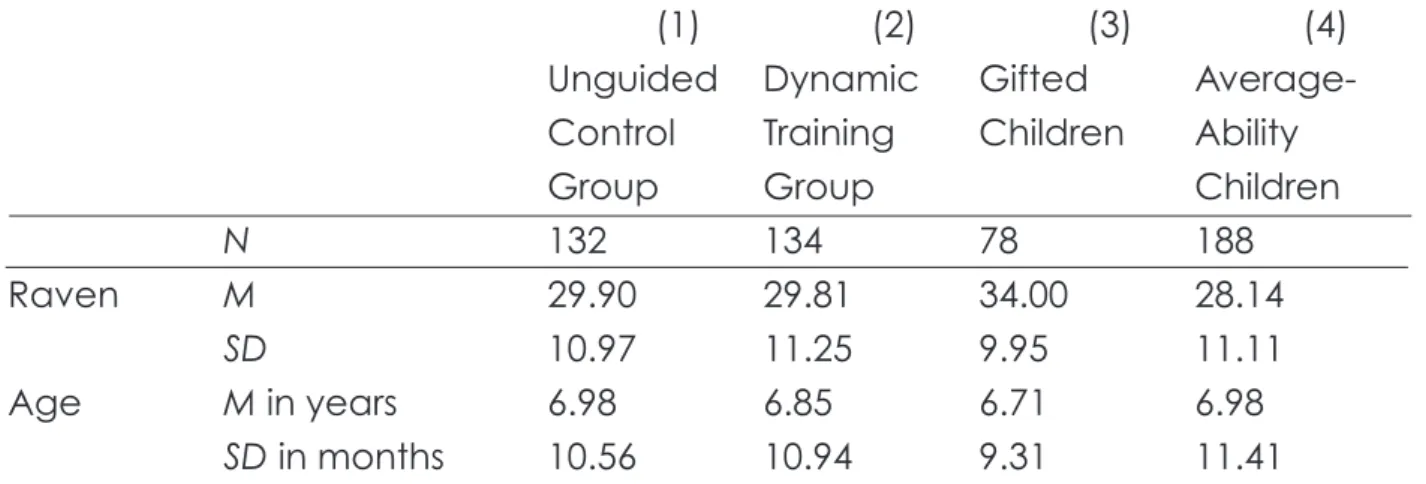
Two one-way analyses of variance with children’s initial level of inductive reasoning and age, respectively, as dependent variables and treatment as factor were conducted to evaluate possible differences between children in the two treatment conditions. No significant differences in Raven scores or in mean age were revealed between the two treatment groups, F(1, 268) = 0.001, p = .98, and F(1, 268) = 0.45, p = .50, respectively (see Table 2, columns 1 and 2, for mean scores and standard deviations).
(1) (2) (3) (4)
Unguided Dynamic Gifted
Control Training Children Ability
Group Group Children
N 132 134 78 188
Raven M 29.90 29.81 34.00 28.14
SD 10.97 11.25 9.95 11.11
Age M in years 6.98 6.85 6.71 6.98
SD in months 10.56 10.94 9.31 11.41
Gifted and average-ability children’s progression in analogical reasoning in a dynamic testing setting
2
categories (gifted vs. average-ability). As expected, the gifted subgroup wasfound to have significant higher Raven scores than the average-ability subgroup, F(1, 268) = 16.29, p < .001, ηp2 = .03. The analysis regarding age revealed no
significant differences between the ability categories, F(1, 268) = 0.36, p = .55 (see Table 2, columns 3 and 4, for mean scores and standard deviations).
Changes over time in progression of accuracy
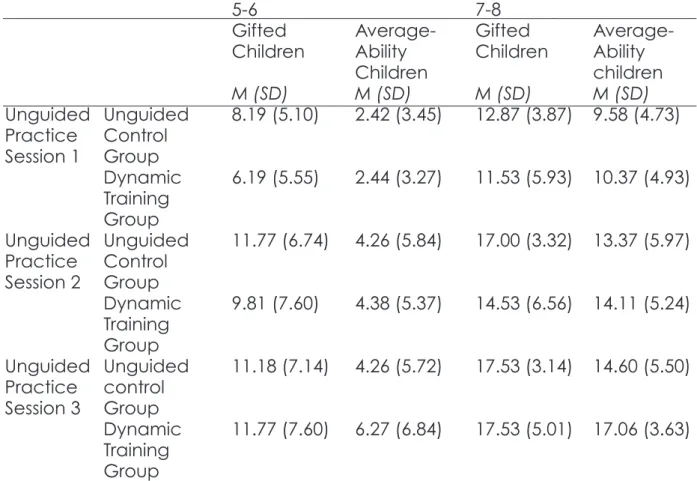
Our first cluster of research questions addressed changes over time in the progression of accuracy scores when comparing gifted and average-ability children, and taking into account age. In Table 3, the mean accuracy scores and standard deviations of the children’s performance on each of the three unguided practice sessions have been provided, divided by age and subgroup.
Table 3. Mean Scores and Standard Deviations of Analogical Reasoning Accuracy Scores, Divided by Age and Subgroup
To examine our first cluster of hypotheses, a repeated measures (RM) analysis of variance (ANOVA) with one within-factor Session (Session 1, Session 2, Session 3) and three between-factors Treatment (unguided control vs. dynamic training), Ability Category (identified as gifted vs. average-ability), and Age (5-6 vs. 7-8 years) was conducted with the number of accurately solved analogy items at the three sessions as the dependent variable. The results showed, as expected,
significant between effects for Ability Category and Age, F(1, 258) = 33.23, p < .001, ηp2 = .12 and F(2, 258) = 107.94, p < .001, ηp2 = .30, respectively, and a significant
main session effect, F(2, 516) = 151.72, p < .001, ηp2 = .37. Contrast analysis and visual
inspection revealed significant progressions from Session 1 to Session 2 and Session 2 to Session 3, F(1, 258) = 214.07, p < .001,ηp2 = .45, and F(1, 258) = 21.48, p < .001, η
p2
= .08, respectively, indicating that all groups of children progressed significantly in their accuracy to solve analogies from one session to the next. The RM analysis, as expected, further showed a significant Session x Treatment interaction, F(2, 516) = 12.62, p < .001, ηp2 = .05. Contrast analysis showed, as expected, only a significant
interaction from Session 2 to Session 3, F(1, 258)=21.29, p<.001, ηp2=.08, indicating
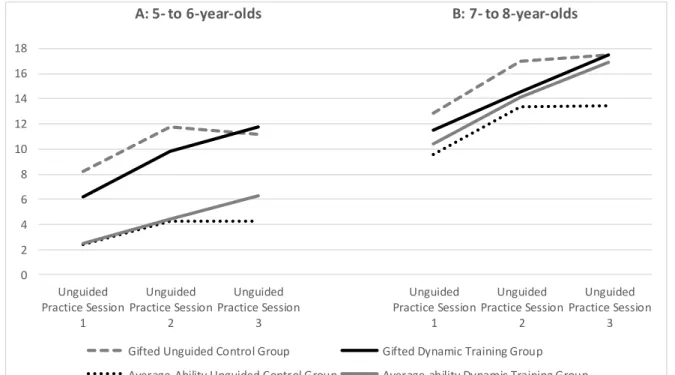
that the dynamically trained groups of children after Session 2 outperformed the groups of children that had unguided practice experiences (see also Figure 2). However, in contrast with our expectations, no significant interactions between Ability Category and Treatment, Ability Category and Session, or Ability Category and Treatment and Session were revealed. These findings indicate that children who were categorized as gifted did have higher scores in analogical reasoning in general but, regardless of whether they were trained or not, showed parallel progression paths when compared with the group of children who were not categorized as gifted. A significant Session x Age effect, F(2, 516) = 5.25, p = .006, ηp2 = .02, followed by contrast analysis (only significant from Session 1 to Session 2,
F(1, 258) = 4.37, p < .04, ηp2 = .02), showed that the age groups only differed in the
extent to which they progressed from Session 1 to Session 2, but not from Session 2 to Session 3.
Gifted and average-ability children’s progression in analogical reasoning in a dynamic testing setting
2
Figure 2. Mean Scores of the Number of Items Correct on session 1,2, and 3 per subgroup, divided by age in two separate parts for clarity reasons: 5- to 6-year-olds (A) and 7- to 8-year-6-year-olds (B).
Need for instruction
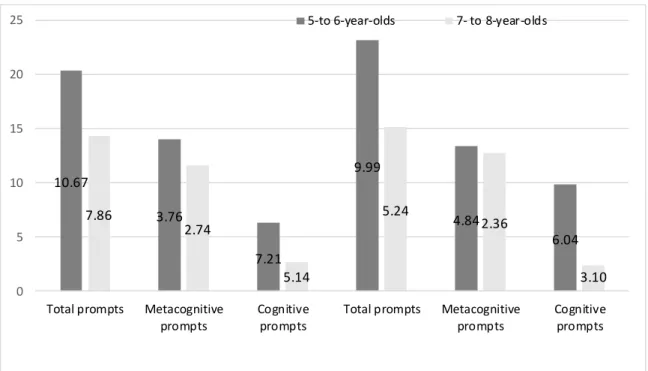
Our second cluster of research questions addressed differences in instructional needs amongst gifted and average-ability children, while taking into account age. We analyzed the total number of prompts, as well as the metacognitive, and the cognitive prompts the children had received during the dynamic training session. A one-way ANOVA was performed with the total number of prompts as the dependent variable, and Ability Category (gifted vs. average-ability), and Age (5-6 years vs. 7-8 years) as independent variables. As opposed to our expectations, the main effect for Ability Category, F(1, 127) = 1.13, p = .29, and the Ability Category x Age interaction, F(1, 127) = .34, p = .56, were not significant, indicating that the children classified as gifted needed approximately similar amounts of help as their average-ability peers, also when taking into account the two age groups. The main effect for Age was, as expected, significant, F(1, 127) = 17.04, p < .001, ηp2 = .12; younger children
needed more help in solving analogies (Figure 3).
To research whether the children classified as gifted showed a differential need for metacognitive and cognitive help, a multivariate ANOVA was conducted with the total number of metacognitive, and the total number of cognitive prompts as the dependent variables, on the one hand, and, on the
0 2 4 6 8 10 12 14 16 18
Unguided Practice Session
1
Unguided Practice Session
2
Unguided Practice Session
3
Unguided Practice Session
1
Unguided Practice Session
2
Unguided Practice Session
3
A: 5-‐ to 6-‐year-‐olds B: 7-‐ to 8-‐year-‐olds
Gifted Unguided Control Group Gifted Dynamic Training Group Average-‐Ability Unguided Control Group Average-‐ability Dynamic Training Group
other hand, Ability Category (gifted versus average-ability), and Age (5-6 years vs. 7-8 years) as independent variables. For both metacognitive and cognitive prompts, the main effect for Age was significant, F(1,127)=3.98, p<.05, ηp2=.03, and
F(1, 127) = 26.86, p < .001, ηp2 = .18, respectively. The analyses, however, did not
reveal significant effects for Ability Category or Ability Category x Age effects. These outcomes contradicted our expectations that the children categorized as gifted would need less help, and, in particular, less metacognitive help, irrespective of age. After inspection of the mean scores in Figure 3, our findings led us to conclude that, in general, gifted and average-ability children did not show a differential need for instruction, regarding both the amount and the type of instruction, and that younger children, regardless of ability category, needed more help in general as well as more metacognitive and cognitive help than their older peers.
Figure 3. Mean scores and standard deviations (as shown in the individual bars) of the total number of prompts, metacognitive, and cognitive prompts received during training by talent and age.
2.4. Discussion
This study sought to examine whether two groups of children, a group identified as gifted through qualitative judgments by their teachers and parents, and a group of average-ability children, profited differently from unguided practice, and the dynamic testing intervention. Our aim was to obtain more insight into differences in performance of visuospatial analogical reasoning tasks, and differences in instructional needs, taking into account different age groups. Unlike
10.67
3.76
7.21
9.99
4.84
6.04 7.86
2.74
5.14
5.24
2.36
3.10
0 5 10 15 20 25
Total prompts Metacognitive
Gifted and average-ability children’s progression in analogical reasoning in a dynamic testing setting
2
several studies in the field in which significant differences between gifted andnon-gifted children have been found in their performance on a dynamic test (e.g., Calero et al., 2011; Kanevsky, 1990, 1992, 2000; Lidz & Macrine, 2001), and their progression after unguided practice (e.g., Steiner, 2006) were revealed, the children categorized as gifted in this study showed similar, rather than different, progression paths to their average-ability age-mates, while starting at a higher initial ability point than the ability and outperforming their average-ability age-mates at each session, regardless of training and age.
Our findings support the idea that microgenetic research methods could lead to additional insight into children’s learning, as posited in earlier research (e.g., Siegler, 2006) but that, in this study, they did not show the full picture of change. It seemed that both unguided practice and an additional dynamic training intervention led to progression in children, regardless of ability and age. The progression of the children who did not receive a dynamic training intervention, however, seemed to have stalled after the second session, with no significant increase from the second to the third session. Alexander et al. (1989) found that unprompted performance in geometric analogical reasoning among 4- and 5-year-old children led to a significant increase in performance only after the first session, which, according to these authors, was most probably the result of familiarity with the task. These authors described unprompted geometric analogical reasoning performance of young children as rather stable, which finding seems to be confirmed by this study, even for those children categorized as gifted.
because of average school results. It is well-documented that children, and in particular gifted children, do not always live up to their potential for excellent performance, potentially as a result of character traits, motivation, internal mediators such as fear of failure, or incorrect usage of strategies (e.g., Reis & McCoach, 2000). It remains as yet unclear, however, whether this might have influenced our research findings.
It must also be taken into consideration that the materials used may not have been sufficiently challenging for the older gifted children, as witnessed by their high mean scores after training. It is possible that there was a moderate ceiling effect, which could also have played a role in the research outcomes regarding potential differences between the ability categories. However, in previous studies using these materials (e.g., Hosenfeld, Van der Maas et al., 1997; Tunteler et al., 2008) children of up to 8 years of age were asked to complete the analogy items. The authors make no mention of a ceiling effect among their older participants, raising the question to what extent this moderate ceiling effect is related to giftedness, to be examined in future research. The latter notion underlines the importance of ensuring that testing and educational material for gifted children is sufficiently difficult (e.g., Kanevsky & Geake, 2004).
Gifted and average-ability children’s progression in analogical reasoning in a dynamic testing setting
2
strategy choice.When it comes to the children’s performance across the different age groups, in accordance with earlier studies (Csapó, 1997; Hosenfeld, Van der Maas et al., 1997), we found that the younger children’s analogical reasoning was characterized by lower initial performance scores, regardless of ability. In addition, our results showed that differential progression paths among the two age groups only occurred from the first to the second session and not from the second to the third, with an advantage for the older children whose progression paths were steeper. It is well-known that great variability exists throughout childhood in the development of children’s ability to solve analogies (e.g., Siegler & Svetina, 2002; Tunteler et al., 2008), which becomes apparent through large individual differences within each age group regarding initial ability as well as progression. The fact that the older children showed more progression from Session 1 to Session 2 could be explained, partially, by the fact that through unguided practice in analogical reasoning, children develop various, seemingly more sophisticated, strategies (e.g., Tunteler et al., 2008), and rules, that are more likely to lead to accurate problem solving. Younger children have in previous findings been shown to be more inflexible when it comes to changing to a new strategy or rule, because their ability to execute a new rule or strategy requires inhibiting the old one, and this process is, amongst younger children, still fragile (e.g., Kirkham, Cruess, & Diamond, 2003), which could account for the fact that the progression paths of the older children were steeper from the first to the second session.
a type of education that in general aims to make as much use of high potential as possible (Dai & Chen, 2013), and endeavors to enable independent learning (Heller, 1999), it is surprising that their analogical reasoning progression in this study was not characterized by more independent learning. Future research could investigate this more closely, investigating whether the type of education
influences the extent to which a child portrays independent learning, in the hopes of tailoring these types of education even more to the specific needs of talented and gifted children to achieve the best possible fit.
In addition to the limitations mentioned in the preceding text, our study had some other limitations. Our study looked into the learning progression of 5-to-8-year-old children. Because there were no norm scores available for 5-year-old children, we used the raw scores of the Raven instead of percentile or IQ scores. By means of answer sheets with pictures of the multiple-choice options, we safe-guarded the validity of the collected data. Using percentile scores, however, could have been of additional use in categorizing children as gifted or non-gifted, because it might have led to two more distinct groups of children than in this study. As explained earlier, we cannot be entirely certain that our group of average-ability children did not contain any children who did not excel in school but, nonetheless, did have above-average intelligence, in spite of the fact that the two ability categories (gifted vs. average-ability) in our study were found to differ in terms of Raven scores. Of course, in this light, it must be noted that the Raven scores are static, rather than dynamic, scores that have been known to be biased (e.g., Elliott, 2003), and can lead to underestimation of a child’s true cognitive abilities (e.g., Jeltova et al., 2007). In future research, categorization into gifted and average-ability groups based on dynamic rather than static measures is advisable. Moreover, if, indeed, moderate ceiling and bottom effects were revealed in our study, one would assume that the group of children experiencing the bottom effect, the 5- and 6-year-old average-ability children would show a need for significantly more instruction, whereas the group of children experiencing the ceiling effect would show they needed significantly less instruction. The reasons as to why the children’s instructional needs were not found to differ are as yet unknown and can be investigated further in future studies.
Gifted and average-ability children’s progression in analogical reasoning in a dynamic testing setting
2
needs answering is whether, and if so, to what extent, gifted, talented, andnon-gifted children really differ qualitatively regarding their learning characteristics and processes (Dai & Chen, 2013). Our research results underline the importance and usefulness of combining microgenetic research results with dynamic testing procedures and gained more insight into potential differences in analogical reasoning development of young gifted and average-ability children. Hopefully, future research employing microgenetic techniques in combination with dynamic testing procedures could shed more light on this question. Important and promising areas to research in more detail employing these techniques would be strategy use and transfer because these are areas in which gifted children are assumed to differ significantly from non-gifted children in performance (e.g., Kanevsky, 1990; Scruggs & Mastropieri, 1988). Combining these topics in research might lead to a more detailed insight into the learning processes and educational needs of talented and gifted children, which would enhance our understanding of the underlying concepts involved. This, in turn, would greatly inform educational practice of these special groups.
Note
Generation of
self-explanation + modelling of correct explanation
Prompts
Activating pre-knowledge on previous solving strategy + check correct answer
Seeing similarities and differences A, B, C + check correct answer
Finding the relationship between A and B + check correct answer
Finding the relationship between A and C + check correct answer
Modelling of correct solution
Step
1
2
3
4
5
Incorrect solution
Correct solution
Correct solution
Correct solution
Correct solution Incorrect solution
Incorrect solution
Incorrect solution
CHAPTER 3
Dynamic testing and test anxiety amongst gifted and
average-ability children
Vogelaar, B., Bakker, M., Elliott, J. G., & Resing, W. C. M. (under revision).
Dynamic testing and test anxiety amongst gifted and average-ability children. [British Journal of Educational Psychology]
Bart Vogelaar Merel Bakker Julian G. Elliott Wilma C. M. Resing
Abstract
Background. Dynamic testing has been proposed as a testing approach that is less disadvantageous for children who may be potentially subject to bias when undertaking conventional assessments. For example, those who encounter high levels of test anxiety, or who are unfamiliar with standardised test procedures, may fail to demonstrate their true potential or capabilities. While dynamic testing has proven particularly useful for special groups of children, it has rarely been used with gifted children.
Aim. We investigated whether it would be useful to conduct a dynamic test to measure the cognitive abilities of intellectually gifted children. We also investigated whether test anxiety scores would be related to a progression in the children’s test scores after dynamic training. Sample. Participants were 113 children aged between 7 and 8 years from several schools in the western part of the Netherlands. The children were categorised as either gifted or average-ability, and split into an unguided practice or a dynamic testing condition.
Methods. The study employed a pre-test-training-posttest design. Using Linear Mixed Modeling analysis with a multilevel approach we inspected the growth trajectories of children in the various conditions, and examined the impact of ability and test anxiety on progression and training benefits.
Dynamic testing and test anxiety amongst gifted and average-ability children
3
3.1. Introduction
Over the last few decades, the notion that gifted and talented children might need special assistance in their learning has become increasingly acknowledged. For a long time, it has been a commonly held belief that this group of children could manage classroom learning on their own. Fortunately, with greater recognition that the notion of inclusive education should apply to all children, increasing attention is being paid to the educational needs of gifted and talented children (De Boer, Minnaert, & Kamphof, 2013).
Formal assessment of intellectual giftedness typically involves the use of conventional, static assessments of intelligence or school achievement (Kline, 2001). These tests, however, have been shown to be disadvantageous for certain groups of children (Haywood & Lidz, 2007), such as those who experience test anxiety (Meijer, 1996, 2001). In contrast to static, conventional tests, dynamic tests incorporate feedback and instruction into the testing procedure (Elliott, Grigorenko, & Resing, 2010), and are considered to tap into individual children’s potential for learning (Sternberg & Grigorenko, 2009). In addition, the literature on dynamic testing has indicated that static tests may underestimate the cognitive potential of socially or educationally disadvantaged children. Examples include ethnic minority, learning disabled, or those who have not had access to educationally stimulating environments (Grigorenko & Sternberg, 1998; Haywood & Lidz, 2007; Robinson-Zañartu & Carlson, 2013). In contrast, dynamic tests are considered to have less test bias towards such children (Elliott, 2003).
The focus of our current study was two-fold. We investigated whether it would be useful to conduct a dynamic test in order to measure the cognitive abilities of intellectually gifted children. In addition, we investigated whether test anxiety scores would be related to progression in test scores after dynamic training.
Dynamic testing
of the task with each new prompt. In the current study, we used a dynamic approach (Resing, 2000) to examine progression in analogical problem-solving. Our participant sample consisted of seven and eight year old children who were split into gifted and average-ability groups. Analogical reasoning, a subtype of inductive reasoning, is considered to play a central role in cognitive development (Klauer & Phye, 2008; Pellegrino & Glaser, 1982). Empirical studies have shown that this ability develops significantly in young primary school children (e.g., Tunteler & Resing, 2007).
The large majority of studies into dynamic testing have focused on the special populations mentioned above. Far more scarce are studies applying dynamic testing to children who have the potential to excel (although, see Lidz & Elliott, 2006). Most dynamic testing studies involving talented or gifted children have focused upon children who are considered to suffer bias in conventional test settings, such as those with a low SES (e.g., Frasier & Passow, 1994), or ethnic minorities (e.g., Lidz & Macrine, 2001). Empirical studies indicate that the cognitive advantage of gifted and talented children is expressed by a more extensive zone of proximal development (e.g., Calero, García-Martín, & Robles, 2011). Such studies show they learn new skills faster, and have an advantage in generalising knowledge (e.g., Kanevsky, 2000). The role that test anxiety potentially plays amongst this group of learners when they are dynamically tested rather than in a conventional static fashion has not been studied before, and this was a key aim of the current study.
Test anxiety
Test anxiety has been described as a negative emotional or cognitive response to situations in which performance is being measured or assessed (Cassady & Johnson, 2002). It is comprised of two dimensions: a cognitive and an emotional component (McDonald, 2001). The cognitive component of test anxiety has been described as consisting of worrying and negative thoughts that are unwanted, uncontrollable and aversive, and which lead to emotional discomfort (Davey, 1994). This component can often occur before, during and after an evaluation or an assessment (Cassady & Johnson, 2002). Some empirical studies have suggested that the prevalence of test anxiety may be lower amongst children with the potential to excel than amongst children with average-ability (Davis & Connell, 1985; Wooding & Bingham, 1988; Zeidner & Schleyer, 1999). It has been hypothesised that this may be due to these children having higher intellectual coping resources that lead them to cope better in stressful academic situations (Zeidner & Shani-Zinovich, 2011).
Dynamic testing and test anxiety amongst gifted and average-ability children
3
underperformance on standardised tests, allocation to lower performing groupsin school to dropping out of school altogether (Everson, Millsap, & Rodriguez, 1991; Hancock, 2001; Sub & Prabha, 2003). A variety of research has shown that students who experience high levels of test anxiety perform significantly lower on school tests, and are found to have a lower grade point average (e.g., Segool, Carlson, Goforth, Von der Embse, & Barterian, 2013). In addition, some studies have found that test anxiety may have a negative impact on intelligence test performance (e.g., Meijer, 2001; Morris & Liebert, 1969) with some authors finding a moderate negative correlation of -.2 between text anxiety and static measures of intelligence (Zeidner, 1998).
Whereas the relationship between test anxiety and static intelligence and educational tests has been heavily researched, there are only few studies investigating the association between test anxiety and performance on dynamic tests. These studies do, nevertheless, support the expectation that testing dynamically rather than statically is advantageous for children who experience test anxiety. Meijer (1996, 2001), for example, found that amongst adolescent learners, dynamic mathematics tests showed less bias towards children experiencing test anxiety than conventional, static mathematics tests. A study by Bethge, Carlson, and Wiedl (1982) revealed that amongst third grade children, test anxiety seems to be diminished when children’s analogical reasoning ability was assessed dynamically. No study, however, has investigated the relationship between test anxiety and test performance in a dynamic test context, on the one hand, and potential differences between gifted and average-ability children, on the other.
The current study
condition would also show more progression than their average-ability peers in the unguided practice condition (Calero et al., 2011).
Our second aim was to provide insight into the association between test anxiety and progression in test performance after dynamic testing. First of all, we expected that test anxiety would influence the level of accuracy scores of analogical reasoning. Given that in prior research with adolescent learners, dynamic testing has indicated lower test anxiety bias than static testing (Meijer, 1996, 2001), we expected a significant interaction between test anxiety and condition. In relation to the effect of training, we expected to find a differential effect of dynamic training on children with different levels of test anxiety. More specifically, we hypothesised (2a) that children with higher test anxiety scores would benefit more from training than children with lower test anxiety scores. Focusing on differences between the gifted and average-ability children, we also expected a significant interaction between condition, test anxiety and ability category. We further hypothesised (2b) that the progression paths of average-ability children with higher levels of test anxiety would be steeper than their gifted peers with higher levels of test anxiety (Zeidner & Shani-Zinovich, 2011).
3.2. Method Participants
Study participants were 113 children, 54 boys and 59 girls, ranging in age from 7 years and 1 month to 8 years and 9 months (M=7.91 in years, SD=6.40 in months). All the children were born in the Netherlands, and attended mainstream primary schools or were enrolled in special settings for gifted and talented children in the western part of the Netherlands. In this country, intelligence testing is not standard practice in primary schools and placement into gifted or talented programmes is often based on the qualitative judgements of parents and teachers. Schools participated on a voluntary basis. Gifted children were over-sampled and identified on the basis of a qualitative judgment of parents and teachers regarding their giftedness. Additionally, all of the children in our gifted sample each scored at, or above the 90th percentile on the Raven’s Progressive Matrices Test (Raven, 1981). Written permission from parents and schools to participate in the study was obtained for each child. Six children dropped out in the course of the study, as they did not participate in each test session. Their data were not included in the analyses.
Design
Dynamic testing and test anxiety amongst gifted and average-ability children
3
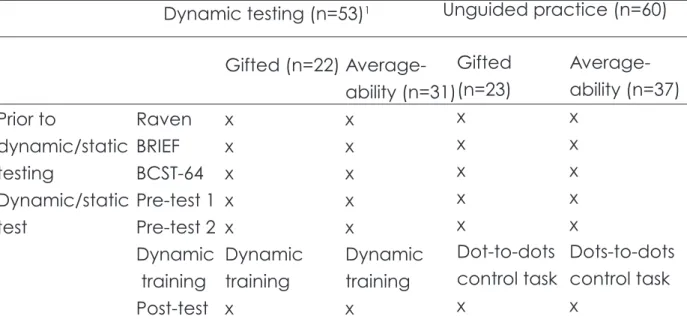
of the children, allocated to the unguided practice condition, received adot-to-dot control task. Before the actual study commenced, prior to pre-test 1, the Raven Progressive Matrices Test (Raven, 1981) was administered to allocate the children to the various conditions. Children with Raven percentile scores of at least the 90th percentile were allocated to the “gifted” condition; the other children to the average-ability condition. Further, Raven scores were used to ensure that any differences in initial reasoning ability were as small as possible across the children in the dynamic training and unguided practice conditions. Pairs of children with equal scores (blocking) were randomly assigned to the dynamic testing or unguided practice condition, resulting in four subgroups: gifted dynamic training (N=22), gifted unguided practice (N=23), average-ability dynamic training (N=31) and average-ability unguided practice (N=37).
Our design included pre-test sessions 1 and 2 in order to enable comparison between static and dynamic progression. During the pre-test sessions and the post-test, the children were provided with only short, general instructions and were not given any feedback. After the post-test, all children were asked to complete the Children’s Test Anxiety Scale (CTAS), a domain-general self-report questionnaire measuring test anxiety amongst children in grades 3-6 of elementary school. Administration of the instruments in the three sessions and the dynamic training each took approximately 20-30 minutes.
Condition Dynamic training (N=53) Unguided practice (N=60) Groups Gifted (22) Average-ability (31) Gifted (23) Average-ability (27) Pre dynamic testing Raven X X Pre-test 1 X X Pre-test 2 X X Dynamic training Dynamic training Dot-to-dot control task Post-test X X Post dynamic testing CTAS X X Dynamic/Static test
Materials
Raven. The Raven Progressive Matrices Test (Raven, 1981) was administered to all children as a blocking instrument. The Raven is a non-verbal intelligence test measuring fluid intelligence by means of multiple choice figural analogies. In our sample of participants, the internal consistency of the Raven accuracy scores was found to be high, as measured by Cronbach’s α of .94.
Children’s Test Anxiety Scale (CTAS). To measure test anxiety in children, a Dutch translation of the Children’s Test Anxiety Scale (CTAS) was used (Wren & Benson, 2004). The CTAS is a 30 item self-report questionnaire for school children in grades 3 through 6 that utilises a 5-point Likert scale. Here, children were asked to answer statements on three dimensions (their thoughts, autonomic reactions, and behaviour) measured by the questionnaire, when taking tests. The internal consistency of the CTAS was found to be high in our sample of participants (Cronbach’s α = .92).
Dynamic test of analogical reasoning. The dynamic test used in the present study consisted of open-ended series of geometric analogies, of varying difficulty, of the type A:B::C:D, assumed to measure inductive reasoning (Barnett & Ceci, 2002). The pre-tests and the post-test, parallel sessions, included 20 analogy items of various difficulty, originally created by Hosenfeld, Van den Boom, and Resing (1997), and adapted by Tunteler, Pronk, and Resing (2008). Six basic geometrical shapes were used in each analogy item: squares, triangles, hexagons, pentagons, circles, and ovals. Each analogy item contained five possible transformations: changing position, adding or subtracting an element, changing size, halving, and doubling (Hosenfeld et al., 1997). The test was administered as an open-ended paper-and-pencil test and the children had to draw their own answers. Figure 1 shows an example of a difficult item.
Figure 1. Example of a difficult analogy item.
Dynamic testing and test anxiety amongst gifted and average-ability children
3
shapes had to be drawn in the fourth box in order to solve the puzzle. Pre-test 1was found to have high internal consistency (Cronbach’s α = .94).