https://www.phoenixpub.org/journals/index.php/jaar 133 Journal of Applied and Advanced Research, 2019: 4(5) 133140
http://dx.doi.org/10.21839/jaar.2019.v4i5.304 ISSN 2519-9412 / © 2019 Phoenix Research Publishers
Research Article – Biochemistry
Purification, characterization and application of bromelain from
Ananas comosus
S. Bhagavathy٭, K. Pushya, R. Gayathridevi, J. Jeniffer
PG & Research Department of Biochemistry, Mohamed Sathak college of Arts and Science, Sholinganallur, Chennai-600 119, India
(Received: 15-08-2019; Accepted 04-09-2019; Published Online 22-09-2019) ٭Corresponding author (E-mail. [email protected])
Abstract
Bromelain is a major protease, isolated from pineapple (Ananas comosus). Bromelain is accumulated in the entire plant to different extent and properties depending on its source. In the present study, Bromelain was extracted from all parts of pineapple using sodium citrate buffer. Bromelain was filtered, centrifuged and used for further studies. After the determining the protease activity and protein content, the Core and Pulp extract of A.comosus was chosen using gelatin as the substrate. The Bromelain was purified by precipitation and dialysis. Then SDS-PAGE was performed in order to determine the molecular size of the obtained protein. Then the effectiveness of Bromelain as an anti-browning agent, extracted and purified from pineapple core and pulp was determined. The study showed that Bromelain is a better anti-browning agent when compared with some of the available commercial anti-browning agents. Further the application of Bromelain was tested by stain removal, compared to positive control, the ability of stain removing property for the produced enzyme was observed to be good. Immobilized Bromelain prepared using calcium alginate beads and its stability and characters were noted.
Keywords: Ananas comosus, Bromelain, Pine apple, SDS-PAGE, Immobilised enzyme
Introduction
Pineapples widely grow in tropical countries may be cultivated from a crown cutting of the fruit, possibly flowering in 20–24 months and fruiting in the following six months. Pineapple does not ripen significantly post-harvest. Pineapples are consumed fresh, cooked, juiced, and preserved and are found in a wide array of cuisines. In addition to consumption, in the Philippines, the pineapple leaves are used to produce the textile fibre pina employed as a component of wallpaper and furnishings, among other uses. Pineapple (Ananas comosus) is one of the tropical plants that have been used as traditional medicines from a long time. It was originated from tropical South America and was discovered by Europeans (Bhattacharrya, 2008).
A protease is also termed as peptidase or proteinase is any enzyme that performs proteolysis activity by hydrolysis of the peptide bonds that link amino acids together in the polypeptide chain forming the protein. Proteases have evolved multiple times, and different classes of protease can perform the same reaction by completely different catalytic mechanisms (Oda, 2012). Proteases can be found in animals, plants, bacteria, archea and viruses. Papaya and pineapple are two of the richest plant sources, as attested by their traditional use as natural "tenderizers" for meat. Papain and Bromelain are the respective names for the proteolytic enzymes found in these fruits (Hale et al, 2005a).
Bromelain has been used widely in food, medical, pharmaceutical and cosmetic industries and other industries as well. In the food industry, it is used for meat tenderization, grain protein solubilisation, beer clarification, baking cookies and protein hydrolysate production (Walsh, 2002). It was studied that pineapple juice was an effective enzymatic browning inhibitor in fresh apple slices and
several important medical applications (Hale et al., 2005b; Hale et al., 2002).
Materials and Methods
Collection
Fresh pineapple was collected from local market, Chennai. The samples were washed, peeled and rinsed with tap water and distilled water to remove any dust particles repeatedly. It was then kept in the refrigerator for experimental studies.
Extraction
10g of the sample was weighed and homogenized with 0.1M of Sodium Citrate buffer (pH 5) (cooling condition) (1:1 ratio) using mortar and pestle, it was then filtered. The filtrate was centrifuged at 10,000 rpm for 15 minutes. The supernatant was stored and used as enzyme source.
Qualitative Protease assay
Water agar medium (half strength) is to be supplemented with proteinous substrate (1% gelatin, casein and skimmed milk) for the assay of proteolytic enzyme was prepared and autoclaved at 1210C for 15minutes. The plates were allowed to solidify and then, 5 wells (8mm diameter) were made by using a sterile cork borer. The 4 different volumes (25µl, 50µl, 75µl and 100µl) of the supernatant were loaded in the wells and 25μl of phosphate buffer was used as control. The plates were incubated for 24h at room temperature. After 24h of incubation, the plates were flooded with mercuric chloride indicator solution (concentrated HCl-20 ml, Distilled water-80 ml and HgCl2
https://www.phoenixpub.org/journals/index.php/jaar 134 produced, one test material will be selected for further
studies (Dubey et al., 2007).
Estimation of protein
1ml of the enzyme source (supernatant) was mixed with 5ml of CBB dye solution (Coomassive Brilliant Blue-G250). The mixture was mixed well and incubated for 5 minutes at room temperature. Simultaneously, control without the enzyme source and with 5ml of CBB-dye solution was maintained. The OD of the solution was measured at 595nm in a spectrophotometer and compared with Bovine Albumin Serum (BSA) to determine the protein content of the sample (Bradford, 1976).
Determination of Protease activity
An assay mixture was prepared by mixing 0.5ml of 1% gelatin with 0.5ml of cell free culture filtrate (enzyme source). The mixture was incubated at 370C for 60 minutes.
1ml of 10% trichloroacetic acid (TCA) was added to the reaction mixture. The reaction mixture was centrifuged at 10,000rpm for 15 minutes and the supernatant was collected. To 0.5ml of supernatant, 2.5ml of alkaline solution (2.9% Na2CO3 and 0.3N NaOH) and 0.75ml Folin phenol reagent
(1ml of reagent diluted with 3ml of double distilled water before use was added and incubated at room temperature). After 20 minutes, the absorbance of the solution was measured at 650nm in a spectrophotometer. Simultaneously, control without the enzyme source was maintained. One unit of protease activity is defined as the amount of enzyme required to liberate 1μmol of tyrosine/ml/min/mg of protein was expressed (Mc Donald and Chen, 1965).
Production and Purificationof Bromelain
The pineapple fruit was chosen, weighed and homogenized with Sodium Citrate buffer using mortar and pestle. It was then filtered. The filtrate was centrifuged at 10,000 rpm for 15 minutes. The supernatant was stored in the refrigerator and used for further purification.
Purification of Bromelain
Precipitation of proteins using organic solvent is done usually at 0ᵒC or subzero temperature in order to minimize
denaturation of proteins especially enzymes by acetone. Hence the acetone is cooled overnight at -20ᵒC and added
slowly with constant stirring to an icecold solution of the enzyme in cool condition. 65% acetone precipitation was preferred for precipitating the proteins. The enzyme source was transferred to clean beaker and the magnetic pellet was dropped inside the beaker and was placed on the magnetic stirrer. While the sample is stirring, required amount of acetone was slowly added until desired saturation level attains. After the total amount of acetone was added, the mixture was incubated over night to ensure complete precipitation. Then the sample was centrifuged 8000rpm for 15minutes. The supernatant was carefully removed and the pellet was dissolved in sodium phosphate buffer and stored in a refrigerator for purification process. The precipitated sample was subjected to the determination of enzyme activity and also for application studies (Dubey et al., 2007). Dialysis
The dialysis membrane is usually treated to remove some undesirable impurities such as glycerol, heavy metals, sulphide. First, the membrane was treated with sterile
distilled water at 65ᵒC for 10 minutes to remove glycerol.
Then, the membrane was immersed in 50ml of 10mM EDTA containing half pellet NaOH to remove heavy metals. Then the membrane was transferred to 30ml 2% sodium bicarbonate to remove the sulphur molecules. Finally, it was washed with sterile distilled water. The sample solution was filled up to 2/3 of the tube volume carefully and the open end was closed securely by tying with a thread. The bag was placed in sodium phosphate buffer overnight at required temperature with gentle agitation provided by magnetic stirrer. The dialyzed sample was carefully taken out using sterile syringe and stored in microfuge tubes. This was further used for the determination of molecular weight by SDS-PAGE (Dubey et al., 2007).
Characterization of proteins
The protease enzyme was characterized by Sodium Dodecyl sulphate-Polyacrylamide gel electrophoresis (SDS-PAGE)
Immobilization of Bromelain
Sodium alginate was used as the immobilizing agent for the bead preparation. Various concentrations of aqueous sterilized sodium alginate solution ranging from 1% to 6% were prepared to find out an optimum concentration for stable bead preparation (Choi et al., 2002). The sample was suspended in cooled alginate and the sample-alginate suspension was transferred into a disposable plastic syringe. Then the alginate-sample mixture was extruded drop by drop into a gently stirred 0.2M calcium chloride solution and hardened in this solution for 30 min. The resulting calcium alginate gel beds were thoroughly washed with sterile saline water and used (Rishi et al, 2011).
Application studies
Anti browning activity
Fresh red apples were purchased from local market and were washed and peeled to remove the outer layer. Apples were crushed using the kitchen blender; the resulting juice was filtered using muslin cloth. The juice was transferred into new eppendorf tubes containing pulp sample and core sample and commercial anti-browning agents such as Acetic acid, Ascorbic acid, Citric acid, Oxalic acid and etc. Apple juice alone serves as a control. Samples were incubated at room temperature for 1hr and the absorbance was read at 420nm in a spectrophotometer for every 10minutes for 1h. The percentage of inhibition was calculated using values coming from control and fractions.
Destaining activity
https://www.phoenixpub.org/journals/index.php/jaar 135 added. All the four plates were stirred gently and incubated
at 600C for 15 minutes. The solutions were poured off, and
the plates were dried. The stain removing capability was evaluated on three conditions such as poor removal, moderate removal and complete removal.
Results and Discussion
Collection and Extraction of Bromelain
The Crown extract of pineapple were green in colour, this may be due to the presence of chlorophyll. The Pulp and Core extract were yellow in colour, this may be due to the presence of carotenoids and xanthophylls. The peel extract were brown in colour, which may be due to the presence of melanin. On extraction, various volume of crude sample was obtained, Pulp - 25ml, Core - 23ml, Peel - 19ml and Crown - 16ml. The difference in volume of extraction obtained may be due to the amount of water content, fibre and other components present in A.comosus. The chemical composition of pineapple it has also to be mentioned the presence of bromelain enzyme and phenol compound.
Qualitative Protease assay
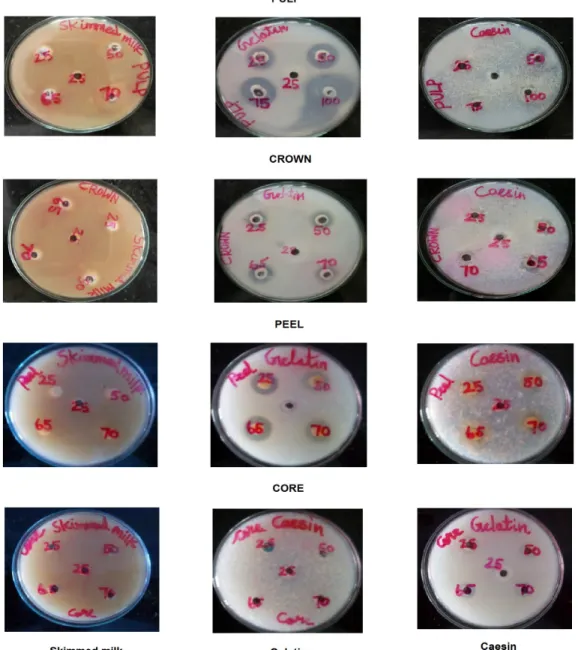
The sample of pulp, peel, crown, core extract of A. comosus was tested for the presence of protease and to detect the suitable substrate. Screening for protease producing samples was tested on water agar medium with three different substrates Gelatin, Casein and Skimmed milk, based on the zone formation due to protease hydrolysis. The more suitable substrate was selected based on the zone of clearance observed. Casein exhibited zone of clearance in lower amount when compared to gelatin and skimmed milk did not exhibit the zone of clearance. On comparison of all four samples (Pulp, Core, Peel and Crown), the pulp extract showed highest zone of clearance (28mm) when compared to the zone of clearance obtained by Peel (22mm), Crown (17mm), Core(13mm). From the result obtained, it was concluded that the selected four samples has protease activity and gelain is considered as the most suitable substrate (Table 1, and Fig. 1). Choudhary and Jain (2012), in their study reported that alkaline protease activity of 141 test fungi was determined using 0.5% casein as protein substrate on solid Reese media.
https://www.phoenixpub.org/journals/index.php/jaar 136 Table 1. Qualitative protease assay
Substrate Control Zone of Inhobition (mm)
Pulp (μl) Core (μl) Peel (μl) Crown (μl)
25 50 65 70 25 50 65 70 25 50 65 70 25 50 65 70
Caesin Nil Nil Nil Nil Nil Nil Nil Nil Nil 17 19 21 22 Nil Nil Nil Nil
Skimmed milk Nil Nil Nil Nil Nil Nil Nil Nil Nil 12 14 15 16 Nil Nil Nil Nil
Gelatin Nil 14 20 22 28 10 11 12 13 18 19 20 22 12 13 15 17
Determination of Protease Activity
The results showed that the crude pulp sample had higher activity. Followed by it, the peel sample had higher activity than the core and crown sample (Table 2). Mohan et al. (2016), in their study reported that the activity of crude Bromelain enzyme from fruit was found to be 4.71 U/mL of enzyme and from peel was found to be 4.52 U/mL. Aravind Krishnan and Gokulakrishnan (2015) reported that the enzyme assay was conducted to determine the activity of the crude extracts and it was found to be the highest in the leaves followed by the peel, stem and was lowest in the pulp. Table 2. Determination of Protease activity
Sample Protease assay (EU/ml)
Pulp 2802.7
Peel 2016.1
Core 1268.9
Crown 281.5
Estimation of protein for crude sample
The protein content of the crude pulp sample was found to be 26.22mg/ml. Next to pulp the crude core sample had higher protein content, which shows 20.46mg/ml. The quantity of protein found in crude crown sample had 13.74mg/ml. The least amount of protein was identified in the crude peel sample 7.08mg/ml. Comparatively within all the selected parts of A.comosus the pulp and core were rich in protein content may be reflect in the level of enzymes (Fig. 2). Extracts concluded that on quantitative estimation by Lowry’s method and the concentration of the enzyme in the crude extracts of the peel, pulp, leaves and stem was found to be 11.4 mg/ml, 9 mg/ml, 2.08 mg/ml and 6.2 mg/ml respectively. Hence the concentration of the enzyme in the crude extracts was the highest in the peel and lowest in the leaves.
0 10 20 30
Crude Pulp Crude Peel
Crude Core Crude Crown
Co
nc
en
tr
at
io
n(
m
g/
m
l)
Fig. 2. Estimation of protein for crude sample
Purification of Bromelain
The ammonium sulphate precipitataion and purification of protein yields 70ml of pulp and core bromelain with 130ml of acetone. We obtained approximately 15 to 20ml of
precipitated core and pulp bromelain. Then the enzyme activity of the precipitated sample was determined. Fig. 3 shows the Bromelain activity for precipitated samples.
Fig. 3. Determination of Bromelain activity on precipitated pulp and core samples
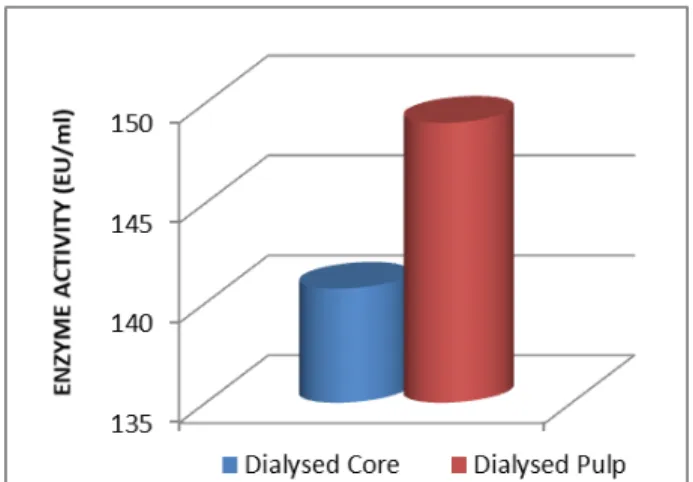
Fig. 4. Determination of Bromelain activity on dialysed pulp and core samples
https://www.phoenixpub.org/journals/index.php/jaar 137 concentration, numerically, 0 U/mg at 0-20% to 150 U/mg at
40-60% of Ethanol. But the recovery profile shows a reverse pattern i.e. at low concentration of ethanol recovery is highest and it drops down with slight change from 20-80% of Ethanol. The enzyme activity was quantified for dialyzed sample and the effectiveness was comparatively observed and proved to be in higher purity after dialysis process. Fig. 4 shows the Bromelain activity for precipitated samples.
The enzyme activity was found to be 134.5 EU/ml for precipitated core sample and the enzyme activity of precipitated pulp sample was found to be 260.8 EU/ml. The enzyme activity is 140.7 EU/ml for dialyzed core sample and the enzyme activity is found to be 149.0 EU/ml for dialysed pulp. The activity of Precipitated sample was higher than the activity of the dialysed sample. Of the precipitated samples, the activity of the pulp sample was higher than the core sample. Of the dialysed sample, the activity of the pulp sample was higher than the core sample.
Estimation of protein from Purified Bromelain
The amount of protein present in the purified samples before abd after dialysis was shown in Fig. 5. Aravind Krishnan and Gokulakrishnan (2015) reported that the purified bromelain from the different parts were subjected to quantitative method and the concentration of bromelain from the peel, pulp, leaves and stem was found to be 0.22 mg/ml, 0.64 mg/ml, 0.12 mg/ml and 0.24 mg/ml respectively. It can be observed that the concentration of the purified bromelain was the highest in the pulp followed by the stem, peel and lowest in the leaves.
Fig. 5. Estimation of protein from purified Bromelain The concentration of the purified bromelain was less
when compared to the crude enzyme concentration as the later contains the presence of other proteins. Mohapatra et al. (2013) reported that the protein concentration after dialysis of stem extract concentration as 75µg/0.1ml, Pulp extract concentration as 70 µg/0.1ml and Peel extract Concentration as 30µg/0.1ml.
Characterization of proteins
The SDS-PAGE was performed in order to determine the molecular size of the obtained protein. The pulp and core bromelain samples were loaded in their respective wells. The molecular weight of the pulp bromelain was found to be 45 kDa and the molecular weight of the core bromelain was found to be 60 kDa when compared with protein marker. Fig. 6 indicates SDS-PAGE for the dialyzed sample. Bromelain is becoming increasingly important in high value applications in the textile industry, medicinal industry and the production of variety chemicals and drugs. Grzonka et al., (2007) and Kumar et al., (2011) reported that the molecular weight range for SBM is 26-37 kDa and for FBM molecular weight range is 24.5-32 kDa. Grzonka et al., (2007), Lopes et al., (2009), Gautam et al., (2010) reported that the molecular weight of the protein in pulp was to be 40 - 60 KDa and crown was to be 30 - 60 KDa respectively.
Lane 1: Core (30µl), Lane 2: Core (35µl), Lane 3: Core (40µl), Lane 4: Molecular Marker (20µl), Lane 5: Pulp (30µl), Lane 6: Core (35µl), Lane 7: Core (40µl)
Fig. 6. SDS-PAGE of Purified Bromelain
Immobilization of bromelain
Various concentrations of aqueous sterilized sodium alginate solution ranging from 1% to 6% were prepared to find out an optimum concentration for stable bead preparation. The 6% concentration of sodium alginate is capable of forming a stable bead when compared to the others. As of core, the number of bead was formed more by 5% sodium alginate solution. As of pulp, the number of bead fomed was more by 2% sodium alginate solution (Fig. 7 and Table 3).
Anti browning activity
https://www.phoenixpub.org/journals/index.php/jaar 138 Fig. 7. Immobilized Bromelain
Table 3. Immobilized Bromelain
Concentration (%) Quantity Stability Shape
Pulp Core Pulp Core Pulp Core
1 30 8 Less Stable Round
2 92 41 Less stable Round
3 85 53 Less Stable Round
4 74 47 Moderately Stable Round
5 64 61 Moderately Stable Round
6 69 35 More Stable Round
Table 4. Anti browning activity for Pulp and Core Bromelain
Sample
% of Inhibition Incubation time in minutes
10 20 30 40 50 60
Control 1.834 1.937 1.910 1.921 1.932 1.904
Acetic acid 85.7 99.01 94.76 96.0 98.63 94.18
Ascorbic acid 99.06 98.39 97.58 96.54 95.61 93.97
Citric acid 82.30 97.15 92.30 91.94 93.61 89.66
Core 75.87 91.68 84.97 87.88 89.99 87.66
Pulp 73.09 87.14 82.83 84.13 84.60 81.68
core was significantly effective in preventing browning. On comparison of pulp bromelain and core bromelain, the pulp Bromelain showed better activity. This can be explained by the fact that protein content in the fruit was found out to be more, which directly correlates it to the amount of protease present (i.e.) amount of protease is more in the fruit extract (Table 4). Although commercial anti-browning agents are widely used, some are being restricted and banned by FAO such as sulfites. Even with many beneficial effects there are several negative attributes associated with sulfite use which has led to decreased consumer acceptance. In particular, sulfites can induce severe allergic reactions or even anaphylactic shock in a proportion of the asthmatic
https://www.phoenixpub.org/journals/index.php/jaar 139
Destaining Activity
The stain removal activity of the bromelain were been carried out. In stain removal, the bromelain showed good activity on the test sample as compared with positive control which contains only detergent and distilled water as shown in the Fig. 8. Compared to positive control, the ability of stain removing property for the produced enzyme was observed to be good. De staining properties with detergents, after 10min of incubation at 60°C the detergent solution supplemented with the enzyme was able to remove the blood strains completely, while the detergent solution only could not remove it. Bhosale et al. (1995) has reported high activity of alkaline proteases of Conidiobolus coronatus showing compatibility at 50°C in the presence of 25 mM CaCl2 with varieties of detergents. Adinarayana et al. (2003)
worked with Bacillus subtilis PE II proteases and reported its compatibility and stability with various locally available detergents at 60°C in the presence of CaCl2 and glycine as
stabilizers.
1 - Test, 2 - Control, 3 - Positive Control, 4 - Negative Contrl Fig. 8. Destaining activity of Bromelain
Summary and Conclusion
Protease is one of the major groups of enzyme that plays the important role in the regulation and nutritional value in the living system. Due to the diverse application field of protease enzyme, they are in great demand and are being produced in high amount. Protease can be used in the detergents, food industries, cheese production, meat processing, the medical field so the demand is also increasing day by day. In recent times protease accounts for the 60% of the total enzyme consumed in the market. Acknowlegement
The autors are gratefully acknlowledged management of Mohamed Sathak College of Arts and Science, Sholinganallur, Chennai to carry out the research work. References
Adinarayana, K., Ellaiah, P., and Prasad, D.S. (2003). Purification and partial characterization of thermostable
serine alkaline protease from a newly isolated Bacillus subtilis PE-11. AAPS Pharmaceutical Science Technician, 4, 56-63.
Aravind Krishnan, V., and Gokulakrishnan, M. (2015). Extraction, Purification of bromelain from pineapple and determination of its effect on bacteria causing periodontitis. International Journal of Pharmaceutical Sciences and Research, 6(12), 5284-5294.
Bhattacharrya, B.K. (2008). Bromelain: Over view. Natural product radiance 7(4), 359-363.
Bhosale, S.H., Rao, M.B., Deshpande, V.V., Srinivasan, M.C. (1995). Thermostability of high activity alkaline protease from Conidiobolus coronatus. Enzyme and Microbial Technology, 17(2), 136-139.
Bradford, M.M. (1976). Rapid and sensitive method for the quantitation of microgram quantities of protein utilizing the principle of protein-dye binding. Analytical Biochemistry, 72, 248–254.
Choi, B.Y., Park, H.J., Hwang, S.J., and Park, J.B. (2002). Preparation of alginate beds for floating drugs delivery system: effects of CO2 gas-forming agents. International
Journal of Pharmaceutics, 239(1-2), 81-91.
Choudhary, V., Jain, P.C. (2012). Screening of alkaline protease production by fungal isolates from different habitats of Sagar and Jabalpur district (M.P). Journal of Academia and Industrial Research. 1(4), 2278-5213. Devakate, R.V., Patil, V.V., Waje, S.S. and Thorat, B.N.
(2009). Purification and drying of bromelain. Separation and Purification Technology, 64, 259-264.
Dubey, V.K., Pande, M., Singh, B.K., and Jagannadham, M.V. (2007). Papain-like proteases: applications of their inhibitors. African Journal of Biotechnology, 6(9), 1077– 1086.
Gautam, S.S., Mishra, S.K., Dash, V., Goyal, A.K., and Rath, G. (2010). Comparative study of extraction, purification and estimation of bromelain from stem and fruit of pineapple plant. Thai Journal of Pharmacology, 34(1), 67-76.
Grzonka, Z., Kasprzykowski, F., and Wiczk, W. (2007). Cysteine proteases. In: Polaina, J., and P. MacCabe. Industrial Enzymes, 181-195.
Hale LP, Greer PK, Trinh CT and James C L (2005b). Proteinase activity and stability of natural bromelain preparations. International Immunopharmacology, 5, 783–793.
Hale, L.P., Greer, P.K., and Sempowski GD (2002). Bromelain treatment alters leukocyte expression of cell surface molecules involved in cellular adhesion and activation. Clinical and Immunology.104, 183-190. Hale, L.P., Greer, P.K., Trinh, C.T., and Gottfried, M.R.
(2005a). Treatment with oral bromelain decreases colonic inflammation in the IL-10-deficient murine model of inflammatory bowel disease. Clinical and Immunology, 116, 35-142.
https://www.phoenixpub.org/journals/index.php/jaar 140 comosus L. Merryl) waste. Process Biochemistry, 46,
1216–1220.
Lopes, F.L.G., Junior, J.B.S., Souza, R.R., Ehrhardt, D.D., Santana, J.C.C., and Tambourgi, E.B., (2009). Concentration by membrane separation processes of a medicinal product obtained from pineapple pulp. Brazilian Archives Biology Technology, 52(2), 457-464. Maurer, H.R. (2001). Bromelain: Biochemistry, Pharmacology and Medical Uses. Cellular and Molecular Life Sciences, 58, 1234-1245.
Mc Donald, C.E., and Chen, L.L. (1965). Lowry modification of the Folin reagent for determination of proteinase activity. Anaytical Biochemistry, 10, 175– 177.
Mohan, R., Sivakumar, V., Rangasamy, T., and Muralidharan, C. (2016). Optimisation of bromelain enzyme extraction from pineapple (Ananas comosus) and application in process industry. American Journal of Biochemistry and Biotechnology, 12(3), 188-195. Mohapatra, A., Rao, M., and Ranjan, M. (2013).
Comparative study of the increased production and characterization of Bromelain from the peel, pulp and
stem pineapple (Anannus commas). International Journal of Advancements in Research & Technology, 2(8), 249.
Oda, K., (2012). New families of carboxyl peptidases: serine-carboxyl peptidases and glutamic peptidases. Journal of Biochemistry, 151(1), 13–25. Ramalingam, C., Srinath, R., and Islam, N. (2012). Isolation
and characterization of bromelain from pineapple (Ananas Comosus) and comparing its anti-browning activity on apple juice with commercial antibrowning agents. Elixir Food Science, 45, 7822-7826.
Rishi, P., Bhadoria, S., Suman, R. (2011). Preparation and characterization of sodium alginate-carbopol-934P based mucoadhesive microbeds. Scholars Research Library, 3(5), 1-11.
Tochi, B.N., Wang, Z., Xu, S.Y., and Zhang, W. (2009). Effect of stem bromelain on the browning of apple juice. American Journal of Food Technology, 4,146-153.
Walsh, G. (2002). Proteins: Biochemistry and Biotechnology. 1st Edition., John Wiley and Sons