Assessment of Effects Prevention
Programmes on Specific Performance
in Young Soccer Players
Ahmed Fadhil
,
Hazar Shakir, Ahmed Yousif
Faculty of Health Sciences, UITM, Malaysia Faculty of Health Sciences, UITM, Malaysia College of physical education, Babylon University, Iraq[email protected] [email protected] [email protected]
Article Info
Received: May 18, 2013
Accepted:June 21, 2013
Published online: October 01, 2013
ABSTRACT
In this article we review effects of prevention programmes on specific performance. Soccer is the most popular sport in the world. Unfortunately players get injured during soccer play. Many researchers have shown a disparity in injury incidence between male and female soccer players. Training programs have been developed to prevent injuries among youth players. These programs are also aimed at improving soccer specific performance. In this article we review the different of prevention programs including comparison between training prevention programs on effects in preventing injury, the results of nineteen performance studies on injury prevention programs. This suggests that the implementation of the programs due to low attendance to soccer training sessions resulting in low player compliance with the programs and lower training frequency than intended. The low compliance may be one reason for the lack of results, and another part of the lack of results may be due to the inability of the test measurements to truly measure training benefits of the previous programs. Therefore a couple of studies have investigated if injury prevention programs may improve performance at the same time, which theoretically will improve compliance with the program.
Keywords: soccer players, prevention program, training, injury risk
Introduction
Participating in sports on a regular basis is considered a vital component of an active and
healthy lifestyle to reduce the risk of various diseases and to contribute to better social and
142
The incidence rate of soccer injuries is among the highest of all sports, particularly for
young male and female soccer players (Schmikli et al, 2011). Soccer is a high-intensity sport
characterized by continuous changes of direction and high-load actions. Participating in
soccer imposes high demands on neuromuscular control, agility and eccentric/concentric
strength. Most soccer injuries are related to the lower extremities, in which muscle injuries
are among the major problems (Ekstrand et al, 2011; Emery et al, 2005). Several studies have
shown that the incidence of football injuries can be reduced by adopting various injury
prevention strategies including: warm-up, with an emphasis on stretching; proper medical
attention for injuries; appropriate recovery methods and time; appropriate cool-down; use of
protective equipment; good playing field conditions and adherence to existing rules (Dvorak
et al., 2000; Ekstrand et al., 1983; Hawkins and Fuller, 1999).
Injury prevention programs may be more effective if the compliance with the program is
high (Van Toggle et al, 2008). Van Toggle et al. (2008) have proposed that injury prevention
programs and player behavior in sports should be integrated in the ordinary training at young
ages to make those measures routine later in life. The compliance with injury prevention
programs is thought to improve if the program is designed as a warm-up program (Renström
et al, 2008) and non-compliance is probably less frequent when training under supervision
compared to home-exercise programs (Taylor et al, 1996).
Emery et al. (2007) showed in a study on high school basketball players that less than
60% of the players performed the injury prevention balance program at home even once and
far less players performed the program as often as intended. DI Stefano et al. (2010) points to
the great importance of supportive parents and coaches to achieve better compliance in
youths, which may be a problem otherwise. Kiani et al. (2010) reported that most of their
involved teams indicated the compliance to be more than 75% (from a scale ranging between
less than 50%, more than 50%, more than 75% or 100% compliance), which may be one
reason for the good results in injury prevention.
The compliance may have been high since the program was constructed to be part of the
regular warm-up and with easily accomplished exercises. Pfeiffer et al. Reported difficulties
in introducing an injury prevention program to the coaches and to make them change their
training protocols, and consequently no injury incidence reduction were seen. Sometimes it
can be hard to motivate the coaches and players to introduce injury prevention programs if
143
Definition of injury
Variations in the definitions and methodologies used in injury epidemiology have
contributed to differences in results and conclusions from published investigations.
Therefore, some terms and definitions related to sports injury require clarification. The
National Athletic Injury Registration System (NAIRS) has defined a sports injury to be an
injury which occurs as a result of participation in sports and which limits the athletic
participation for at least one day after onset (van Mechelen et al., 1992). A recent consensus
statement on injury definitions and data collection procedures in football suggested that an
injury is “Any physical complaint sustained by a player that results from a football match or
football training, irrespective of the need for medical attention or time loss from football
activities”. An injury that results in a player receiving medical attention is referred to as a „„medical attention‟‟ injury, and an injury that causes the player to be unable to fully take part in match or training sessions the day following the injury is referred to as a “time loss” injury
(Fuller et al., 2006).
In most epidemiological studies, regardless of sport, the time loss injury definition as
used by NAIRS has commonly been used (Östenberg & Roos, 2000; Söderman et al., 2000 ;
Myklebust et al., 2003; Faude et al., 2005; Hägglund et al., 2007; Olsen et al., 2005;Waldén
et al., 2005a; Ekstrand et al., 2006; Árnason et al., 2008). However, in tournament football
play, Junge et al. (2006) have made use of a definition which defines an injury irregardless of
the consequences with respect to absence from the match or training (“tissue” injury
definition). A few other studies in female football have limited injury recording to those
injuries which were defined as requiring medical treatment or evaluated for insurance claims
(Giza et al., 2005).
The time loss and tissue injury definitions have been useful in comparing injury
epidemiology within and between sports. However, researchers should be careful of certain
limitations when applying these injury definitions. When including time loss injuries only,
accuracy in injury recording will depend on the frequency of training and match sessions in
the particular study population. Minor injuries in particular can easily be missed in amateur
and youth football when there is not play every day, and comparison to higher level play can
be biased. Furthermore, easy access to health care, which is the expected standard at the top,
first and second division male football, but not necessarily in female and youth football, will
also influence the decision as to whether a player will be ready or not to play the day
144
One other limitation of the time loss definition is its sports specificity, as shown by the
example of a broken finger. This fracture will usually stop a team handball, basketball or
volleyball player from sports participation, but not a football outfield player. The tissue injury
definition on the other hand, allows all complaints to be recorded within the particular sport
of interest and includes slight injuries which do not necessarily affect players´ health, for
example pain, blisters, or skin abrasions. Since these injuries often do not stop the player
from playing nor do they require further medical follow-up, high-quality injury recording
relies on staff awareness in detecting every tissue injury.
Closely related to the issue of injury definition, is the classification of injury severity,
necessary for a comparison between studies. Severity can be described using the following
criteria: nature and duration of injury, type of treatment, sporting time lost, working time lost,
permanent damage, and costs (van Mechelen et al., 1992). The most frequently used
classification systems for injury severity, independent of sport, are based on the number of
days of absence from matches or training. NAIRS classifies injuries as minor (1-7 days
absence), moderate (8-21 days absence) or major (>21 days absence) (van Mechelen et al.
1992).
According to the latest consensus discussions in FIFA (Federation of International
Football Associations) and UEFA (Union of European Football Associations), injury severity
is categorized into four categories, slight (1-3 days absence), minor (4-7 days absence),
moderate (8-28 days absence) and major (>28 days absence) (Hägglund et al., 2007). This
classification system is a further development from that of Ekstrand et al. (1983) which
combined slight and minor injuries in one category, “minor”, with 1-7 days absence from
play. The latter two injury classifications have primarily been used in investigations with elite
players, in male (Waldén et al., 2005a) and female football (Engström et al., 1991; Söderman
et al., 2000;Faude et al., 2005) although the exact number of days of absence varies slightly
between studies.
However, it is now strongly recommended, regardless of playing level, to follow the
football consensus statement (Fuller et al., 2006) and split the first week (1-7 days absence)
into “slight” and “minor”. The incidence of injury is usually expressed as the number of
injuries per 1000 playing hours of exposure, with one exception. In many studies from North
America, one athlete participating in one training session or match is defined as a unit of risk
(Agel et al., 2005; Kucera et al., 2005; Dick et al., 2007), since this is the recording method
established in the NCAA injury surveillance system. The duration in hours of one training g
145
studies presenting data as the number of injuries per 1000 player hours of exposure vs. per
1000 athlete exposures is not fully comparable.
Injury prevention
So far only 14 injury prevention intervention studies have been carried out on a
world-wide basis in football (Table 1) even though the first study was done as long as 25 years ago
and with very promising results (Ekstrand et al., 1983). In this study, the intervention group
sustained 75% fewer injuries than the control group. More recently, research groups tested
different prevention approaches, such as or those (Tropp et al., 1985; Surve et al., 1994),
balance training (Caraffa et al., 1996), eccentric hamstring strength training (Askling et al.,
2003; Árnason et al., 2008), a video-based awareness program (Árnason et al., 2005), and
multimodal exercise programs (Junge et al., 2002; Engebretsen et al., 2008; Hägglund et al.,
2007). All prevention approaches except two (Árnason et al., 2005; Engebretsen et al., 2008)
could report a reduction of injuries in the intervention period. We do not know if this
knowledge of male football can be transferred to the females.
In female football, less scientific work has been done, and until now, there are only three
studies published on female football players alone (Heidt et al., 2000; Söderman et al., 2000;
Mandelbaum et al., 2005). Additionally, there are two studies which included both genders
(Hewett et al., 1999; Johnson et al., 2005) and athletes from several sports, including football
players (Hewett et al., 1999). These five studies have focused on the prevention of injuries in
general (Söderman et al., 2000; Johnson et al., 2005) or on ankle and knee injuries (Hewett et
al., 1999; Heidt et al., 2000; Mandelbaum et al., 2005). Hewett et al. (1999) evaluated the
effect of a neuromuscular training program on the incidence of knee injuries in female team
sport athletes, where 290 of 1 263 were football players.
They found a trend towards a higher incidence of ACL and MCL (medial collateral
ligament) injuries in the control group compared to trained female players in the intervention
group. In another non-randomized study, Heidt et al. (2000) examined the effect of a 7-week
pre-season training program among 300 female football players at the high school level (aged
14-19 years). A total of 42 players went through a training program consisting of warm up
exercises, plyometrics (jump training), strength and flexibility training. Players in the
intervention group had significantly fewer injuries than those in the control group. However,
146
Söderman et al. (2000) examined the effect of balance board training among 221 senior
female players at various levels. The players were randomized to train on a balance board
daily for 30 days, then three times a week during the season, or to the control group, training
as normal. In contrast to the results of Caraffa et al. (1996) who performed a similar study on
male semiprofessional players, Söderman did not find any protective effect for ACL injuries
in the intervention group. Again, the power of the study was low which suggests careful
interpretation of the results in order to conclude that balance board training alone at least
based on a home training program, is not sufficient to prevent ACL injuries in females. In
five-month approaches with male and female elite football players in Sweden, Johnson et al.
(2005) identified players at high injury risk by screening them with a questionnaire for
psychosocial risk factors.
High-risk players (9 female and 7 male players) received intervention including
relaxation and imagery training, which lowered the number of injuries within four months of
intervention. Mandelbaum et al. (2005) conducted a neuromuscular and sports-specific
training program over two seasons on about 3 000 14- to 18-year old female football players.
The intervention consisted of education, stretching, strengthening, plyometrics and
sports-specific agility drills. Their results showed an 88% decrease in ACL injuries in the enrolled
players compared to the control group during the first year. In year two, the reduction was
74%. However, this study was not randomized. In conclusion, there is still a lack of
well-designed studies on injury prevention among female footballers, most likely due to limited
knowledge of the causes and mechanisms of injuries, which again makes it difficult to
develop targeted preventive measures.
As shown in studies from football and team handball, several programs have successfully
incorporated one or more exercise components to prevent injuries, e.g. plyometrics, strength,
neuromuscular training, or running and cutting movement patterns, to prevent injuries in
female (Hewett et al., 1999; Heidt et al., 2000; Myklebust et al., 2003; Mandelbaum et al.,
2005; Olsen et al., 2005) and male athletes (Askling et al., 2003). However, as compliance is
a concern in injury prevention (Myklebust et al., 2003), it may be difficult to motivate
coaches and players to follow such exercise programs merely to prevent injuries, unless there
147
Comprehensive neuromuscular training programs that combine plyometrics, core
strengthening, balance, resistance or speed/agility training may improve several measures of
performance concomitantly, and at the same time improve biomechanical measures related to
lower extremity injury risk (Hewett et al., 2004; Paterno et al., 2004; Myer et al., 2005; Myer
et al., 2006). FIFAs Medical Assessment Research Center (F-MARC) has recently developed
a specific training program, the “11” in order to prevent the four most common injury types
in football, i.e. Injuries to the ankle, knee, hamstring and groin. The exercises composing the
“11” represent an evidence based rehabilitation exercises for lower limb injuries (F-MARC,
2005) and key exercises from other effective injury prevention programs. The “11” has been
feasibility tested in a pilot study as “F-MARC bricks” (Jung et al., 2002) and thereafter been modified to the final “11”.
Table 1. Injury prevention studies designed to reduce the risk of injuries in female and male football players.
Study Level Number Age
Design Follow-up
Injuries Intervention* Effect of intervention
Male players Jung et al. 2002
Youth n=194 14-19 years
Prospective Cohort 1 Year
All Multi-modal program 21% fewer injuries in the
intervention group (n.s.)
Caraffa et al. 1996
Elite + amateur n=600 Age unknown
Prospective Cohort 3 years
ACL Balance training 87% fewer ACL injuries per
team in the intervention group Surve et
al. 1994
Elite + amateur n=504 Age unknown
RCT 1 season Ankle
sprains
Semirigid ankle orthosis
60% lower incidence of ankle sprains in the intervention group, no effect for players without previous ankle sprains
Tropp et al. 1985
Amateur n=439 Age unknown
RCT 6 months ALL Multi-modal program 75% fewer injuries in the
intervention group
148
Table 1. To be continued.
Study Level Number Age
Design Follow-up
Injuries Intervention* Effect of intervention
Female players Mandelbaum et al. 2005
Youth n=2946 (1041 in the intervention, 1905 in the control groups) 12-18 years
Prospective Cohort 2 years
ACL Neuromuscular
training program flexibility, plyometrics, weight training
74-88% fewer ACL injuries in the intervention group
Söderman et al. 2000
Amateur n=221 (121 in the intervention, 100 in the control groups) x=20±5 years
RCT 7 months
Acute lower extremity
Balance board training at home; 10-15 min initially each day for the first 30 days, and then 3 times per week during the rest of the season
No injury reduction in the intervention group, but a significantly higher incidence of major injuries in the intervention group Heidt
et al. 2000
Youth n=300 (42 in the intervention, 258 in the control groups) 14-18 years
Prospective Cohort 1 year
ALL 7-week preseason
Program of sport specific conditioning, Plyometric training, sport cord drills, strength and flexibility exercises; 1-2 times weekly
41% fewer injured players in the intervention group
Hewett et al. 1999
Youth n=290 (97 in the intervention, 193 in the control groups) 14-18 years
Prospective Cohort 1 year
ACL, MCL Neuromuscular
training program flexibility, plyometrics, weight training; 60-90 min 3 times weekly for 6 months in preseason
Trend towards fewer knee injuries in the intervention group
Female and male players Johnson et al. 2005
Elite n=32 (16 in the intervention, 16 in the control groups Females: 20.1 yrs Males: 22.9 years
RCT 6 months
All Cognitive behavioral
training with relaxation and imagery training
83% fewer injuries in the intervention group
Male players Hägglund et al. 2007
Amateur n=482 15-46 years
RCT 10 months
All 10-step rehabilitation
program
66%-75% fewer re-injuries in the intervention group Engebretsen
et al. 2007
Elite + amateur n=508 Age unknown
RCT 8 months Ankle and Knee sprains, hamstring and groin strains Neuromuscular and/or strength training programs
No effect in the intervention group
Árnason et al. 2007
Elite n= ca. 600 Age unknown Prospective Cohort 2 seasons Hamstring strains Stretching, Flexibility and/or Eccentric hamstring training
35% fewer hamstring strain in the group training with both eccentric strength and flexibility compared to that training flexibility alone
Árnason et al. 2005
Elite + amateur n= ca. 350 Age unknown
RCT 6 months
All acute Educational video-based
Awareness program
No effect in the intervention group
Askling et al. 2003
Elite n=30 24 years RCT
11 months
Hamstring strains
Pre-season strength training
70% fewer injured players in the intervention group
149
The effects of injury prevention programs on performance
The programs that have been used for injury prevention, for example “The 11”, PEP and
“The 11+” are also aiming at improving performance in soccer, but there is disagreement
whether the programs actually can improve performance. According to Griffin et al. (2006),
however, it seems logical that injury prevention programs may improve performance. Some
studies have examined the effects on performance of injury prevention programs in children
and adolescents (Table 2).
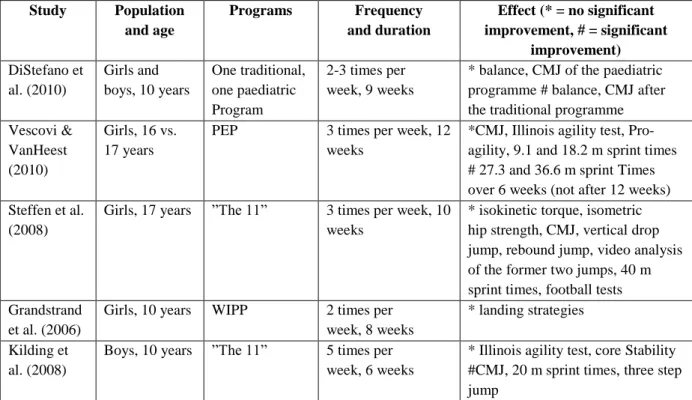
The studies by Vescovi & VanHeest (2010), Steffen et al. (2008) and Grandstrand et al.
(2006) were performed on female soccer players between 9 and 18 years of age, the study by
DiStefano et al. (2010) was performed on youth male and female soccer players and the study
by Kilding et al. (2008) was performed on boys at the age of ten. The studies by Kilding et al.
(2008) and DiStefano et al. (2010) showed improvements of some aspects of the soccer
specific performance after completion of an injury prevention program, while the studies by
Steffen et al. (2008) and Grandstrand et al. (2006) didn‟t show any improvement at all and
the study by Vescovi & VanHeest (2010) showed a temporary improvement of sprint times
for longer distances.
The training is thought to work specifically on the functions trained and is not always
observable when evaluating in a different way than the training was performed. All injury
prevention programs for youth players except the program by Kilding et al. (2008) were used
as part of the warm-up before soccer training. The program by Kilding et al. (2008) was used
in connection with soccer practice once a week and was performed at home four times per
week for six weeks. If the injury prevention program was given more time during training it
was thought that it wouldn‟t be used by many coaches for the program would interfere with the soccer training, which is the very reason for the players‟ attendance.
In the study by DiStefano et al. (2010) two different injury prevention programs were
used-one traditional and one pediatric program. Both programs included strength,
plyometrics, core strengthening, balance and agility training with progression of the exercises
and took 12-14 minutes to complete. The pediatric program had more gradual changes, which
was assumed to be more suited for the children, however significant improvements were only
seen in the group performing the traditional program. Kilding et al. (2008) showed
improvements in jump height and sprinting performance, while agility and core stability
150
No performance improvements were seen. Much supervision was used in the
performance studies by DiStefano et al. (2010) and Kilding et al. (2008) with the aim of
improving compliance and correct performance, which may be one reason for the
improvements seen in these studies. Vescovi & VanHeest (2010) evaluated the effect of the
PEP-program on performance and minor improvements were seen in sprinting performance
after six weeks of training. Grandstrand et al. (2006) evaluated the WIPP program (The
Sports metrics Warm- Up for Injury Prevention and Performance program) by Cincinnati
Sportsmedicine Research and Education Foundation.
The program included plyometrics, strength and flexibility exercises and was performed
in youth female players as 20 minutes warm up before soccer practice. The kinematics of
jumping and maximum vertical jumping height was evaluated. No significant improvements
were seen after the intervention period, probably partly due to the inability of the players to
perform all exercises correctly, which forced the authors to adjust some of the exercises in the
program (Grandstrand et al, 2006).
Table 2. The results from five performance studies on injury prevention programs
Study Population and age
Programs Frequency and duration
Effect (* = no significant improvement, # = significant
improvement)
DiStefano et al. (2010)
Girls and boys, 10 years
One traditional, one paediatric Program
2-3 times per week, 9 weeks
* balance, CMJ of the paediatric programme # balance, CMJ after the traditional programme Vescovi &
VanHeest (2010)
Girls, 16 vs. 17 years
PEP 3 times per week, 12
weeks
*CMJ, Illinois agility test, Pro-agility, 9.1 and 18.2 m sprint times # 27.3 and 36.6 m sprint Times over 6 weeks (not after 12 weeks) Steffen et al.
(2008)
Girls, 17 years ”The 11” 3 times per week, 10 weeks
* isokinetic torque, isometric hip strength, CMJ, vertical drop jump, rebound jump, video analysis of the former two jumps, 40 m sprint times, football tests Grandstrand
et al. (2006)
Girls, 10 years WIPP 2 times per
week, 8 weeks
* landing strategies
Kilding et al. (2008)
Boys, 10 years ”The 11” 5 times per week, 6 weeks
* Illinois agility test, core Stability #CMJ, 20 m sprint times, three step jump
151
Conclusion
This suggests that the implementation of the programs due to low attendance to soccer
training sessions resulting in low player compliance with the programs and lower training
frequency than intended. The low compliance may be one reason for the lack of results, and
another part of the lack of results may be due to the inability of the test measurements to truly
measure training benefits from the previous programs. Therefore a couple of studies have
investigated if injury prevention programs may improve performance at the same time, which
theoretically will improve compliance with the program.
References
Agel, J., Arendt, E. A., & Bershadsky, B. (2005). Anterior cruciate ligament injury in National Collegiate Athletic Association basketball and soccer a 13-year review. The
American Journal of Sports Medicine, 33(4), 524-531.
Arnason, A., Andersen, T., Holme, I., Engebretsen, L., & Bahr, R. (2008). Prevention of hamstring strains in elite soccer: an intervention study. Scandinavian journal of
medicine & science in sports, 18(1), 40-48.
Arnason, A., Engebretsen, L., & Bahr, R. (2005). No effect of a video-based awareness program on the rate of soccer injuries. The American Journal of Sports Medicine, 33(1), 77-84.
Askling, C., Karlsson, J., & Thorstensson, A. (2003). Hamstring injury occurrence in elite soccer players after preseason strength training with eccentric overload. Scandinavian
journal of medicine & science in sports, 13(4), 244-250.
Caraffa, A., Cerulli, G., Projetti, M., Aisa, G., & Rizzo, A. (1996). Prevention of anterior cruciate ligament injuries in soccer. Knee Surgery, Sports Traumatology,
Arthroscopy, 4(1), 19-21.
Dick, R., Putukian, M., Agel, J., Evans, T. A., & Marshall, S. W. (2007). Descriptive epidemiology of collegiate women's soccer injuries: National Collegiate Athletic Association Injury Surveillance System, 1988–1989 through 2002–2003. Journal of
Athletic Training, 42(2), 278.
DiStefano, L. J., Padua, D. A., Blackburn, J. T., Garrett, W. E., Guskiewicz, K. M., & Marshall, S. W. (2010). Integrated injury prevention program improves balance and vertical jump height in children. The Journal of Strength & Conditioning Research, 24(2), 332-342.
Dvorak, J., Junge, A., Chomiak, J., Graf-Baumann, T., Peterson, L., Rösch, D., & Hodgson, R. (2000). Risk factor analysis for injuries in football players possibilities for a prevention program. The American Journal of Sports Medicine, 28(suppl 5), S-69-S-74.
152
Ekstrand, J., Hägglund, M., & Waldén, M. (2011). Epidemiology of muscle injuries in professional football (soccer). The American Journal of Sports Medicine, 39(6), 1226-1232.
Ekstrand, J., Timpka, T., & Hägglund, M. (2006). Risk of injury in elite football played on artificial turf versus natural grass: a prospective two-cohort study. British journal of
sports medicine, 40(12), 975-980.
Emery, C. A., Meeuwisse, W. H., & Hartmann, S. E. (2005). Evaluation of risk factors for injury in adolescent soccer implementation and validation of an injury surveillance system. The American Journal of Sports Medicine, 33(12), 1882-1891.
Emery, C. A., Rose, M. S., McAllister, J. R., & Meeuwisse, W. H. (2007). A prevention strategy to reduce the incidence of injury in high school basketball: a cluster randomized controlled trial. Clinical Journal of Sport Medicine, 17(1), 17-24.
Engebretsen, A. H., Myklebust, G., Holme, I., Engebretsen, L., & Bahr, R. (2008). Prevention of Injuries Among Male Soccer Players A Prospective, Randomized Intervention Study Targeting Players With Previous Injuries or Reduced Function.
The American Journal of Sports Medicine, 36(6), 1052-1060.
Engström, B., Johansson, C., & Tornkvist, H. (1991). Soccer injuries among elite female players. The American Journal of Sports Medicine, 19(4), 372-375.
Faude, O., Junge, A., Kindermann, W., & Dvorak, J. (2005). Injuries in Female Soccer Players A Prospective Study in the German National League. The American Journal
of Sports Medicine, 33(11), 1694-1700.
F-MARC. Football medicine manual. Zurich. 2005: 81-93.
Fuller, C. W., Ekstrand, J., Junge, A., Andersen, T. E., Bahr, R., Dvorak, J., . . . Meeuwisse, W. H. (2006). Consensus statement on injury definitions and data collection procedures in studies of football (soccer) injuries. Scandinavian journal of medicine
& science in sports, 16(2), 83-92.
Giza, E., Mithöfer, K., Farrell, L., Zarins, B., & Gill, T. (2005). Injuries in women‟s professional soccer. British journal of sports medicine, 39(4), 212-216.
Grandstrand, S. L., Pfeiffer, R. P., Sabick, M. B., DeBeliso, M., & Shea, K. G. (2006). The effects of a commercially available warm-up program on landing mechanics in female youth soccer players. The Journal of Strength & Conditioning Research, 20(2), 331-335.
Griffin, L. Y., Albohm, M. J., Arendt, E. A., Bahr, R., Beynnon, B. D., DeMaio, M., . . . Hannafin, J. A. (2006). Understanding and Preventing Noncontact Anterior Cruciate Ligament Injuries A Review of the Hunt Valley II Meeting, January 2005. The
American Journal of Sports Medicine, 34(9), 1512-1532.
Hägglund, M., Waldén, M., & Ekstrand, J. (2007). Lower Reinjury Rate With a Coach-Controlled Rehabilitation Program in Amateur Male Soccer A Randomized Controlled Trial. The American Journal of Sports Medicine, 35(9), 1433-1442. Hawkins, R. D., & Fuller, C. W. (1999). A prospective epidemiological study of injuries in
153
Heidt, R. S., Sweeterman, L. M., Carlonas, R. L., Traub, J. A., & Tekulve, F. X. (2000). Avoidance of soccer injuries with preseason conditioning. The American Journal of
Sports Medicine, 28(5), 659-662.
Hewett, T. E., Lindenfeld, T. N., Riccobene, J. V., & Noyes, F. R. (1999). The Effect of Neuromuscular Training on the Incidence of Knee Injury in Female Athletes A Prospective Study. The American Journal of Sports Medicine, 27(6), 699-706.
Hewett, T. E., Myer, G. D., & Ford, K. R. (2004). Decrease in neuromuscular control about the knee with maturation in female athletes. The Journal of Bone & Joint Surgery, 86(8), 1601-1608.
Johnson, U., Ekengren, J., & Andersen, M. B. (2005). Injury prevention in Sweden: Helping
soccer players at risk. Human Kinetics Publishers.
Junge, A., Langevoort, G., Pipe, A., Peytavin, A., Wong, F., Mountjoy, M., . . . Charles, R. (2006). Injuries in team sport tournaments during the 2004 Olympic Games. The
American Journal of Sports Medicine, 34(4), 565-576.
Junge, A., Rösch, D., Peterson, L., Graf-Baumann, T., & Dvorak, J. (2002). Prevention of soccer injuries: a prospective intervention study in youth amateur players. The
American Journal of Sports Medicine, 30(5), 652-659.
Kiani, A., Hellquist, E., Ahlqvist, K., Gedeborg, R., Michaëlsson, K., & Byberg, L. (2010). Prevention of soccer-related knee injuries in teenaged girls. Archives of internal
medicine, 170(1), 43-49.
Kucera, K. L., Marshall, S. W., Kirkendall, D. T., Marchak, P., & Garrett, W. (2005). Injury history as a risk factor for incident injury in youth soccer. British journal of sports
medicine, 39(7), 462-462.
Mandelbaum, B. R., Silvers, H. J., Watanabe, D. S., Knarr, J. F., Thomas, S. D., Griffin, L. Y., . . . Garrett, W. (2005). Effectiveness of a Neuromuscular and Proprioceptive Training Program in Preventing Anterior Cruciate Ligament Injuries in Female Athletes 2-Year Follow-up. The American Journal of Sports Medicine, 33(7), 1003-1010.
Myer, G. D., Ford, K. R., Brent, J. L., & Hewett, T. E. (2006). The effects of plyometric vs. dynamic stabilization and balance training on power, balance, and landing force in female athletes. The Journal of Strength & Conditioning Research, 20(2), 345.
Myer, G. D., Ford, K. R., PALUMBO, O. P., & Hewett, T. E. (2005). Neuromuscular training improves performance and lower-extremity biomechanics in female athletes.
The Journal of Strength & Conditioning Research, 19(1), 51-60.
Myklebust, G., Engebretsen, L., Brækken, I. H., Skjølberg, A., Olsen, O.-E., & Bahr, R. (2003). Prevention of anterior cruciate ligament injuries in female team handball players: a prospective intervention study over three seasons. Clinical Journal of Sport
Medicine, 13(2), 71-78.
Olsen, O.E., Myklebust, G., Engebretsen, L., Holme, I., & Bahr, R. (2005). Exercises to prevent lower limb injuries in youth sports: cluster randomised controlled trial. Bmj, 330(7489), 449.
Östenberg, A., & Roos, H. (2000). Injury risk factors in female European football. A prospective study of 123 players during one season. Scandinavian journal of medicine
154
Paterno, M. V., Myer, G. D., Ford, K. R., & Hewett, T. E. (2004). Neuromuscular training improves single-limb stability in young female athletes. The Journal of orthopaedic
and sports physical therapy, 34(6), 305-316.
Renstrom, P., Ljungqvist, A., Arendt, E., Beynnon, B., Fukubayashi, T., Garrett, W., . . . Krosshaug, T. (2008). Non-contact ACL injuries in female athletes: an International Olympic Committee current concepts statement. British journal of sports medicine, 42(6), 394-412.
Schmikli, S. L., De Vries, W. R., Inklaar, H., & Backx, F. J. (2011). Injury prevention target groups in soccer: injury characteristics and incidence rates in male junior and senior players. Journal of science and medicine in sport, 14(3), 199-203.
Söderman, K., Werner, S., Pietilä, T., Engström, B., & Alfredson, H. (2000). Balance board training: prevention of traumatic injuries of the lower extremities in female soccer players? Knee Surgery, Sports Traumatology, Arthroscopy, 8(6), 356-363.
Steffen, K., Myklebust, G., Olsen, O. E., Holme, I., & Bahr, R. (2008). Preventing injuries in female youth football–a cluster‐randomized controlled trial. Scandinavian journal of
medicine & science in sports, 18(5), 605-614.
Surve, I., Schwellnus, M. P., Noakes, T., & Lombard, C. (1994). A fivefold reduction in the incidence of recurrent ankle sprains in soccer players using the Sport-Stirrup orthosis.
The American Journal of Sports Medicine, 22(5), 601-606.
Taylor, A. H., & May, S. (1996). Threat and coping appraisal as determinants of compliance with sports injury rehabilitation: An application of protection motivation theory.
Journal of Sports Sciences, 14(6), 471-482.
Tropp, H., Askling, C., & Gillquist, J. (1985). Prevention of ankle sprains. The American
Journal of Sports Medicine, 13(4), 259-262.
Van Mechelen, W., Hlobil, H., Kemper, H.C.(1992). Incidence, severity, aetiology and prevention of sports injuries. A review of concepts. Sports Med, 14, 82-99.
Van Tiggelen, D., Wickes, S., Stevens, V., Roosen, P., & Witvrouw, E. (2008). Effective prevention of sports injuries: a model integrating efficacy, efficiency, compliance and risk-taking behaviour. British journal of sports medicine, 42(8), 648-652.
Vescovi, J., & VanHeest, J. (2010). Effects of an anterior cruciate ligament injury prevention program on performance in adolescent female soccer players. Scandinavian journal of
medicine & science in sports, 20(3), 394-402.
Waldén, M., Hägglund, M., & Ekstrand, J. (2005). UEFA Champions League study: a prospective study of injuries in professional football during the 2001–2002 season.