HighLevel Access Control for Web based Cloud Computing
Services
M.NAGA MALLESWARI, A.VENKATESH
P G Student, Dept. Of CS., Qis College of Engineering and Technology, Ongole
Asst.Professor of CSE, Qis College of Engineering and Technology, Ongole
Abstract: In this paper, we have a tendency to present a Two-factor authentication (2FA) get to system for electronic cloud processing administrations. In particular, in our arranged 2FA access system, attribute-based access management component is upheld with the need of each a client mystery key and a lightweight security gadget. As a client can't get to the system on the off chance that they are doing not hold each, the component will upgrade the security of the system, especially in those projections wherever a few clients share a proportional workstation for electronic cloud administrations. also, attribute-based management inside the system furthermore enables the cloud server to constrain the entrance to those clients with a proportionate arrangement of attributes though moderating client privacy, i.e., the cloud server exclusively knows about that the client satisfies the coveted predicate, anyway has no arrangement on the exact personality of the client.
Keywords: two-factor, access control, web services
1. INTRODUCTION
Cloud processing is a virtual host registering system that enables ventures to purchase, rent,
offer, or convey programming and distinctive advanced assets over the web as an on-request benefit. In spite of the fact that the new worldview of cloud figuring gives incredible points of interest, there are mean while likewise concerns with respect to security and privacy particularly for online cloud administrations. Information security, as it exists in numerous different applications, is among these difficulties that would raise extraordinary worries from clients when they store delicate data on cloud servers. These worries begin from the way that cloud servers are generally worked by business suppliers which are probably going to be outside of the trusted area of clients [3].
the cloud. There are two issues for the customary record/secret key based system [6]. To start with, the customary record/password based authentication isn't privacy-protecting. In any case, it is all around recognized that privacy is a fundamental component that must be considered in cloud processing systems. Second, usually to share a PC among various individuals. It might be simple for programmers to introduce some spyware to take in the login watchword from the web browser. In existing, Even however the PC might be bolted by a watchword, it can in any case be perhaps speculated or stolen by undetected malwares [2].
A three-factor authentication (3FA) is another Fine grained three-component authentication (3FA) get to control strategy for cloud based gateways. Exceptionally, in our proposed 3FA access control strategy includes, an attribute, Policy and gadget based security component is completed to create mystery key and a lightweight assurance system. As a client can't get to the system if s/he doesn't hold both, the instrument can upgrade the security of the system, particularly in those situations where numerous clients share a similar PC for electronic cloud administrations. Furthermore, attribute-based control in the system additionally empowers the cloud server to limit the entrance to those clients with a similar arrangement of attributes while saving client privacy, i.e., the cloud server just realizes that the client satisfies the required predicate, yet has no clue on the correct personality of the client. A cloud system may have numerous cloud specialist co-ops (CSPs) to help the execution of said system. In view
of accessibility and work stack, the system chooses a CSP for the customer getting to it. Hundreds or thousands of customers may get to the system at the same time; thus the accessibility is a noteworthy issue. It can be
enhanced by CSPs with information
replication. The information proprietors might need to set a few limitations to customers who are attempt to get to the information. In this situation, the circulated information should keep all insights about the diverse access control approaches set to information. Be that as it may, again the approved customers ought to be ordered by authorization; it will be an issue in a disseminated system with numerous customers.
Principle commitments of this paper can be outlined as takes after. We propose a fine-grained three-factor get to control convention for online cloud registering administrations, utilizing a lightweight security gadget.
1. The gadget has the accompanying
properties: (an) it can process some lightweight calculations, e.g. hashing and exponentiation; and (b) it is alter safe, i.e., it is accepted that nobody can break into it to get the mystery data put away inside.
2. Our convention gives a 3FA security.
In the following segment, we will audit some related works that are identified with our idea.
2. RELATED WORK
We audit some related works including attribute-based cryptosystems and access control with security gadget in this area.
2.1 Attribute-Based Cryptosystem
Attribute-based encryption (ABE) is the foundation of attribute-based cryptosystem. ABE empowers fine grained get to control over encoded information utilizing access strategies and partners attributes with private keys and ciphertexts.
Inside this unique circumstance, figure content arrangement ABE (CP-ABE)[2]allows a versatile method for information encryption with the end goal that the encryptor defines the entrance approach that the decryptor (and his/her attributes set) needs to fulfill to unscramble the figure content. In this way, unique clients are permitted to decode diverse bits of information as for the pre-defined arrangement. This can dispense with the trust on the capacity server to avoid unapproved information get to. Other than managing confirmed access on scrambled information in cloud stockpiling administration [4][5],ABE can likewise be utilized for get to control to
cloud processing administration,
correspondingly as an encryption plan can be utilized for authentication reason: The cloud server may encode an irregular message utilizing the entrance approach and request that the client decode. On the off chance that the client can effectively unscramble the
figure content (which implies the client's attributes set fulfills the endorsed approach), at that point it is permitted to get to the cloud processing administration.
Notwithstanding ABE, another cryptographic crude in attribute-based cryptosystem is attribute-based mark (ABS). An ABS conspire empowers a client to sign a message with fine-grained control over recognizing data. In particular, in an ABS conspire, clients get their attribute private keys from an attribute expert. At that point they can later sign messages for any predicate fulfilled by their attributes. A verifier will be persuaded of the way that the endorser's attributes fulfill the marking predicate if the mark is substantial. In the meantime, the character of underwriter stays covered up. In this way it can accomplish mysterious attribute-based access control productively. As of late, Yuen et al. [6] proposed an attribute-based access control instrument which can be viewed as the intuitive type of ABS.
2.2 Access Control with Security Device
Security Mediated Cryptosystem
more. As of late, an attribute-based adaptation of SEM was proposed in[8].
The idea of SEM cryptography was
additionally changed as security interceded certificate less (SMC) cryptography[9],In a SMC system, a client has a mystery key, open key and a character. In the marking or unscrambling calculation, it requires the mystery key and the SEM together. In the mark confirmation or encryption calculation, it requires the client open key and the comparing character. Since the SEM is controlled by a specialist which is utilized to deal with client renouncement, the expert declines to give any participation to any denied client. In this way repudiated clients can't create signature or decode figure content. Note that SMC is not the same as our idea. The fundamental reason for SMC is to take care of the renouncement issue. Hence the SME is controlled by the specialist. At the end of the day, the specialist should be online for each mark marking and figure content unscrambling. The client isn't unknown in SMC. While in our system, the security gadget is controlled by the client. Secrecy is likewise safeguarded.
Key-Insulated Cryptosystem
The worldview of key-protected cryptography was presented in [10]. The general thought of key-protected security was to store long haul enters in a physically-secure however computationally-constrained gadget. Here and now mystery keys are kept by clients on a
capable however shaky gadget where
cryptographic calculations happen. Here and now insider facts are then revived at discrete
eras by means of cooperation between the client and the base while the general population key stays unaltered all through the lifetime of the system. Toward the start of each day and age, the client acquires a halfway mystery key from the gadget. By consolidating this halfway mystery key with the mystery key for the past period, the client reestablishes the mystery key for the present day and age. Not quite the same as our idea, key-protected cryptosystem requires all clients to refresh their keys in each day and age. The key refresh process requires the security gadget. Once the key has been refreshed, the marking or decoding calculation does not require the gadget any more inside a similar day and age. While our idea requires the security gadget each time the client endeavors to get to the system. Moreover, there is no key refreshing required in our system.
3 SYSTEM DESIGN
It can be depicted as a move from client's perspective to programming planners or database individual's perspective. The course of action sort out goes about as a development between the required particular and the execution mastermind.
The setup mastermind joins two stages particularly:
• Top - Level Design
is the most basic variable affecting the method for the thing. Here we gather the Block Diagram that will be profitable to get a handle on the lead of the system.
3.1 Detailed Design
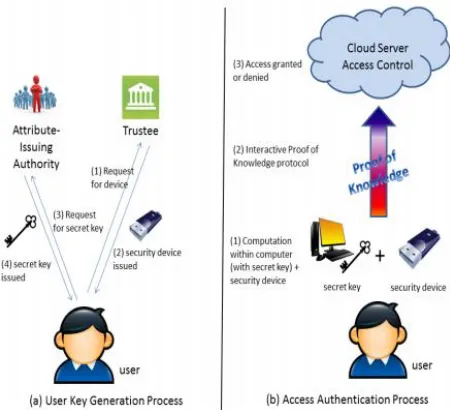
In this Paper, we propose a fine-grained two factor get to control convention for electronic cloud figuring administrations, utilizing a lightweight security gadget. The gadget has the accompanying properties: (1) It can process some lightweight calculations, e.g. hashing and exponentiation and (2) it is alter safe, i.e., it is assume that nobody can break into it to get the mystery data put away inside. With this gadget, our convention gives a 2FA security. To start with the client mystery key (which is generally put away inside the PC) is required. Likewise, the security gadget ought to be additionally appended to the PC (e.g. through USB) with a specific end goal to validate the client for getting to the cloud. The client can be allowed get to just in the event that he has the two things. In any case, the client can't utilize his mystery key with another gadget having a place with others for the entrance
The building is one of the depictions of the speculative system that describes the structure, direct close by more insights about the structure. It demonstrates the important relationship of the system that depicts diverse parts in it and their relationship with each other.
Fig -1: Overview idea of our system.
Our system consists of the following entities:
- Trustee: It is in charge of creating all system parameters and instated the security gadget.
- Attribute-issuing Authority: It is capable to create client mystery key for every client as per their attributes.
- User: It is the player that makes authentication with the cloud server. Every client has a mystery key issued by the attribute-issuing expert and a security gadget introduced by the trustee.
- Cloud Service Provider: It gives administrations to mysterious approved clients. It interfaces with the client amid the authentication procedure.
3.2 Contribution of the Project
utilizing a lightweight security gadget. The gadget has the accompanying properties: (1) it can register some lightweight calculations, e.g. hashing and exponentiation; and (2) it is alter safe, i.e., it is expected that nobody can break into it to get the mystery data put away inside.
With this gadget, our convention gives a 2FA security. To begin with the client mystery key (which is generally put away inside the PC) is required. What's more, the security gadget ought to be additionally associated with the PC (e.g. through USB) with a specific end goal to validate the client for getting to the cloud. The client can be conceded get to just in the event that he has the two things. Moreover, the client can't utilize his mystery key with another gadget having a place with others for the entrance.
Our convention bolsters fine-grained attribute-based access which gives an awesome adaptability to the system to set diverse access strategies as indicated by various situations. In the meantime, the privacy of the client is likewise protected. The cloud system just realizes that the client has some required attribute, yet not the genuine character of the client.
3.3 Assumptions
The focal point of this paper is on anticipating private data spillage at the period of access authentication. Along these lines we make a few suspicions on system setup and correspondence channels. We accept every client speaks with the cloud specialist co-op through an unknown channel [8], [9] or
utilizes IP-concealing innovation. We likewise accept that trustee produces the security parameters as per the calculation endorsed. Other potential assaults, for example, IP commandeering, appropriated foreswearing of-benefit assault, man-in-the center assault, and so on., are out of the extent of this paper.
4. LITERATURE SURVEY
Rashmi 1, Dr.G.Sahoo2, Dr.S.Mehfuz3,[1] introduced securing programming as an administration model of cloud which is utilized to portray the security challenges in Software as a Service (SaaS) model of cloud processing and furthermore end eavors to give future security investigate bearings. From this paper we have alluded the arrangement On Cloud Computing Security.
Kashif Munir and Prof Dr. Sellapan Palaniappan,[2] exhibited system for secure cloud figuring. A cloud security model and security structure that distinguishes security challenges in cloud processing. From this paper we have alluded the answer for security challenges in cloud registering and proposed a security model and system for secure cloud figuring condition that recognizes security necessities, assaults, dangers, concerns related to the sending of the clouds.
Mr. AnkushKudale, Dr. Binod Kumar,[3] proposed an investigation on authentication and access control for cloud registering. The security issues are still in circle of arrangements, in light of that such a large number of associations are sitting tight for
appropriation of cloud figuring
authentication and access control for cloud figuring. From this Paper, we have alluded a decent arrangement authentication and access control for the cloud processing.
Harvinder Singh1, Amandeep Kaur2,[4] displayed get to control demonstrate for cloud stages utilizing multi-level graphical authentication. This proposed conspire has been assessed under different circumstances. Both of the graphical secret key plans have been assessed separately with different watchword blends. The new multi-level graphical secret key plan can be considered as a safe plan for cloud stages. From this Paper, we have alluded the model will be upgraded with greater usefulness and more elevated amount of authentication security; it would be executed by utilizing security questions, picture based security for the login insurance and at the last level User Identification Number (UIN) would be utilized to access or view the information in cloud stages on cell phones and programming systems for PCs.
Joseph K. Liu, Tsz Hon Yuen, Man Ho Au, Xinyi Huang, Willy Susilo, and Jianying Zhou,[5] proposed k-times attribute-based unknown access control for cloud figuring which is especially intended for supporting cloud registering condition. From this Paper, We have alluded an attribute-based access control instrument which can be viewed as the intelligent type of Attribute Based Signature.
Sharp systems are relentlessly supplanting customary power arranges in perspective of expanded practicality, reliability, economy, and criticalness of vitality associations. Taking after the accomplishment of ENEL
Telegestore which yielded a yearly wander resources of 500 million Euros, other sharp cross area works out, for example, Hydro One expect in Canada, the Evora Inov Grid extend in Portugal, and the Modellstadt Mannheim (Moma) connect in Germany have kept running with a comparable illustration. Because of requirements in getting epic measure of data from a broad number of front-end sharp gadgets, astute cross segments couldn't be passed on at a huge scale (e.g., in the entire nation). To allude to a case, the measure of information required to deal with exchanges of two million clients at a specific utility achieved 22 gigabytes for reliably. Along these lines, the confirmation, design, checking and examination of such monstrous sharp system information is certifiably not a clear errand. Further, consistent data prepare is routinely required in the watchful matrix. Any deferral may understand a veritable outcome in the entire structure. To walk around these challenges, passed on figuring has been utilized as a part of light of its adaptability, versatility, deftness, vitality ability, and cost sparing properties.
As a rule, when a client scrambles fragile information, it is fundamental that she set up a particular find the opportunity to control
system on who can unscramble this
information. For instance, acknowledge that the FBI open debasement workplaces in Knoxville and San Francisco are examining an affirmation of pay off including a San
Francisco lobbyist and a Tennessee
certain abilities or at-tributes can get to it. For example, the head master may show the running with get the chance to structure for getting to this data: (("Public Corruption Office" AND ("Knoxville" OR "San Francisco")) OR (association level > 5) OR "Name: Charlie Eppes").
By this, the director could propose that the invigorate ought to just be seen by overseers who work at general society contamination workplaces at Knoxville or San Francisco, FBI authorities high up in the association chain, and a master named Charlie Eppes.
As showed up by this case, it can be imperative that the individual having the confound information can pick a get the chance to design in light of particular learning of the significant information. Furthermore, this individual may not know the correct personalities of each and every other individual who ought to be able to get to the information, yet rather she may basically have an approach to manage portray them with respect to undeniable characteristics or insistences.
5. CONCLUSION
In this undertaking, we have exhibited another 2FA (counting both client mystery key and a lightweight security gadget) get to control
system for online cloud figuring
administrations. In light of the attribute-based access control instrument, the proposed 2FA access control system has been distinguished to not just empower the cloud server to confine the entrance to those clients with a similar arrangement of attributes yet in
addition protect client privacy. Point by point security examination demonstrates that the
proposed 2FA access control system
accomplishes the coveted security necessities. Through execution assessment, we showed that the development is plausible. We leave as future work to additionally enhance the proficiency while keeping every single pleasant component of the system.
REFERENCES
[1] J. Baek, Q. H. Vu, J. K. Liu, X. Huang, and Y. Xiang, “A secure cloud computing based framework for big data information management of smart grid,” IEEE Trans. Cloud Comput., vol. 3, no. 2, pp. 233–244, Apr./Jun. 2015.
[2] M. Bellare and O. Goldreich, “On defining proofs of knowledge,” in Proc. 12th Annu. Int. CRYPTO, 1992, pp. 390–420.
[3] J. Bethencourt, A. Sahai, and B. Waters, “Ciphertext-policy attributebased encryption,” in Proc. IEEE Symp. Secur. Privacy, May 2007, pp. 321–334.
[4] D. Boneh, X. Boyen, and H. Shacham, “Short group signatures,” in Advances in Cryptology. Berlin, Germany: Springer-Verlag, 2004, pp. 41–55.
[5] D. Boneh, X. Ding, and G. Tsudik, “Fine-grained control of security capabilities,” ACM Trans. Internet Technol., vol. 4, no. 1, pp. 60– 82, 2004.
logarithm problem,” Ph.D. dissertation, ETH Zurich, Zürich, Switzerland, 1998.
[7] J. Camenisch, M. Dubovitskaya, and G. Neven, “Oblivious transfer with access control,” in Proc. 16th ACM Conf. Comput. Commun. Secur. (CCS), Chicago, IL, USA, Nov. 2009, pp. 131–140.
[8] J. Camenisch and A. Lysyanskaya, “A signature scheme with efficient protocols,” in Proc. 3rd Int. Conf. Secur. Commun. Netw. (SCN), Amalfi, Italy, Sep. 2002, pp. 268–289
[9] J. Camenisch, “Group signature schemes and payment systems based on the discrete logarithm problem,” Ph.D. dissertation, ETH Zurich, Zürich, Switzerland, 1998.
[10] J. Camenisch, M. Dubovitskaya, and G. Neven, “Oblivious transfer with access control,” in Proc. 16th ACM Conf. Comput. Commun. Secur. (CCS), Chicago, IL, USA, Nov. 2009, pp. 131–140.
[11] J. Camenisch and A. Lysyanskaya, “A signature scheme with efficient protocols,” in Proc. 3rd Int. Conf. Secur. Commun. Netw. (SCN), Amalfi, Italy, Sep. 2002, pp. 268–289.
[12] J. Camenisch and A. Lysyanskaya,
“Signature schemes and anonymous
credentials from bilinear maps,” in Advances in Cryptology. Berlin, Germany: Springer-Verlag, 2004, pp. 56–72.
AboutAuthors:
M.NAGA MALLESWARI is current pursuing
M.Tech in CS. dept., Qis College of
Engineering and Technology, Ongole,
Prakasam (Dist.)-523001, AP.
A.VENKATESH, Asst.Professor in CSE, Qis
College of Engineering and Technology,