
Triple Handshakes and Cookie Cutters:
Breaking and Fixing Authentication over TLS
Karthikeyan Bhargavan
∗, Antoine Delignat-Lavaud
∗, C´edric Fournet
†, Alfredo Pironti
∗and Pierre-Yves Strub
‡∗
INRIA Paris-Rocquencourt
†Microsoft Research
‡IMDEA Software Institute
Abstract—TLS was designed as a transparent channel abstrac-tion to allow developers with no cryptographic expertise to protect their application against attackers that may control some clients, some servers, and may have the capability to tamper with network connections. However, the security guarantees of TLS fall short of those of a secure channel, leading to a variety of attacks.
We show how some widespread false beliefs about these guar-antees can be exploited to attack popular applications and defeat several standard authentication methods that rely too naively on TLS. We present new client impersonation attacks against TLS renegotiations, wireless networks, challenge-response protocols, and channel-bound cookies. Our attacks exploit combinations of RSA and Diffie-Hellman key exchange, session resumption, and renegotiation to bypass many recent countermeasures. We also demonstrate new ways to exploit known weaknesses of HTTP over TLS. We investigate the root causes for these attacks and propose new countermeasures. At the protocol level, we design and implement two new TLS extensions that strengthen the authentication guarantees of the handshake. At the application level, we develop an exemplary HTTPS client library that implements several mitigations, on top of a previously verified TLS implementation, and verify that their composition provides strong, simple application security.
I. TRANSPARENTTRANSPORTLAYERSECURITY? TLS is the main Internet Standard for secure communica-tions and still, after 20 years of practice, the security it provides to applications remains problematic.
I-A APPLICATIONS VSPROTOCOLS. By design, TLS intends to provide a drop-in replacement of the basic networking functions, such as connect, accept, read and write, that can effortlessly protect any application against a net-work attacker without the need to understand the protocol or its underlying cryptography. Pragmatically, TLS offers much flexibility, so the security properties provided by the protocol [43, 35, 32, 29] and its implementations [20, 14, 15] depend on how TLS is used. For instance, if the application enables an unsuitable ciphersuite [4], uses compression [25], or ignores state changes [45], it opens itself to attacks. Furthermore, applications-level security mechanisms increasingly seek to benefit from the underlying TLS connection by reusing its authenticated peer identities, key materials [48], and unique identifiers [6].
As a consequence, TLS libraries provide low-level APIs that expose many details of the cryptographic mechanisms and certificates negotiated during successive handshakes. Some application-level libraries, such as CURL, seek to recover the simplicity of a secure channel by implementing an abstraction layer that smooths over the details of TLS by managing
sessions, validating certificates, etc. Meanwhile, TLS appli-cations continue to rely on URLs, passwords, and cookies; they mix secure and insecure transports; and they often ignore lower-level signals such as handshake completion, session resumption, and truncated connections.
Many persistent problems can be blamed on a mismatch between the authentication guarantees expected by the appli-cation and those actually provided by TLS. To illustrate our point, we list below a few myths about those guarantees, which we debunk in this paper. Once a connection is established:
1) the principal at the other end cannot change;
2) the master secret is shared only between the two peers, so it can be used to derive fresh application-level keys; 3) the tls-unique channel binding [6] uniquely
identi-fies the connection;
4) the connection authenticates the whole data stream, so it is safe to start processing application data as it arrives. The first is widely believed to be ensured by the TLS renego-tiation extension [49]. The second and third are used for man-in-the-middle protections in tunneled protocols like PEAP and some authentication modes in SASL and GSS-API. The fourth forms the basis of HTTPS sessions on the web.
These assumptions are false, and this enables various at-tacks, even against applications using the latest, fully-patched TLS 1.2 implementations. Whether these attacks should be blamed on the protocol or its usage, we argue that the transport and application protocols must be analyzed together to achieve reliable, meaningful, application-level security.
On the other hand, our paper does not challenge the cryp-tographic security of the core constructions of TLS—most of our attacks apply even under the (theoretical) assumption that clients and servers only use cryptographically strong ciphersuites, as formalized, for example, in [15, 35, 29, 16]. I-B NEWATTACKS OVER TLS. We report new practical at-tacks against applications that rely on TLS for their security. The first family of attacks uses a combination of successive TLS handshakes over multiple connections to disrupt client authentication. The second family of attacks targets HTTPS message integrity but may apply to other application protocols.
Triple Handshakes Considered Harmful (§V, §VI) We
first point outunknown key-share[17] vulnerabilities in RSA, DHE, and abbreviated handshakes, and we compose them to implement a malicious TLS proxy that can synchronize the keys on separate connections with honest peers. Some of these vulnerabilities were previously known, and do not in them-selves constitute attacks on the integrity and confidentiality guarantees of TLS. However, we show that they enable new
2
man-in-the-middle attacks that break a variety of authentication mechanisms built over TLS, including (a) client-authenticated TLS renegotiation—for example if a client presents her cer-tificate to two TLS servers, one can impersonate the client at the other; (b) compound authentication in tunneled protocols; (c) channel bindings for application-level challenge-response protocols; and (d) channel bindings for bearer tokens. We report concrete attacks against published specifications and popular applications in all these categories, including main-stream browsers and HTTP client libraries, VPN applications, wireless applications, and mail and chat servers.
Truncating Headers & Forcing Cookies (§III) Indepen-dently, we show that web browsers and servers often ignore TLS disconnections and tolerate ill-formed messages, thereby enabling message truncations. Although this vulnerability is generally known [13, 52], we show how to apply truncation to HTTP headers and HTML forms, opening new exploits. In particular, our attacks completely defeat cookie-based authen-tication. We also show new exploits based on known attack vectors like cookie-forcing and its use for login CSRF [12, 18]. In particular, we show that building new application-level protocols such as single sign-on and synchronization protocols using cookies is foolhardy; they amplify login CSRF attacks and enable network attackers to steal users’ private files. I-C TOWARDS VERIFIED APPLICATION SECURITY. In light of the two families of attacks outlined above, how to ensure that a TLS application properly handles its interactions with the TLS API? How to reliably lift TLS security to application security? Broadly, we can either build countermeasures into TLS; or carefully implement and verify simpler security APIs over TLS; or, less robustly, promote prudent practices for writing secure applications over TLS.
Proposed TLS Extensions (§VII) One approach is to
strengthen the protocol to provide more robust security. To this end, we propose two new TLS extensions that prevent the attacks of§VI without the need to change applications. These extensions have a negligible impact on performance and code complexity, and can be deployed while preserving backward compatibility. They apply to all protocol versions from SSL3 to TLS 1.2, as well as DTLS. To validate them experimentally, we implemented and tested patches for two existing TLS implementations: OpenSSL and miTLS. As future work, we plan to formally model their security benefits by extending the verified cryptographic model of miTLS [15, 16].
Simple Verified HTTPS over TLS (§VIII) In principle,
carefully-written applications can defend against these attacks, without the need to change TLS. To validate our main recom-mendations, and show that “transparent” application security can indeed be achieved over TLS, we program miHTTPS: a simple HTTPS library in F#, similar to CURL, on top of miTLS. We specify its intended security properties and we verify them using F7, a type-based verification tool. Thus, we formally relate the precise, low-level TLS API provided by miTLS to a simpler, more abstract HTTPS API. In combination, we obtain the first cryptographically-verified implementation for HTTPS. In its current state, miHTTPS is a proof-of-concept: it does not nearly provide the flexibility
required by modern browsers and web services. However, it automatically handles all the details of the underlying TLS connections, including multiple handshakes, resumption and negotiation, and truncations.
I-D MAIN CONTRIBUTIONS. We describe a new class of man-in-the-middle attacks against authentication over TLS, targeting the resumption and renegotiation features of the handshake. We also present new exploits on HTTPS sessions based on cookie-forcing and truncation. We apply these attacks to break the expected authentication guarantees of several state-of-the-art protocols, libraries, applications, and web ser-vices. We have contacted many vendors, proposing immediate mitigations and countermeasures, as well as more long-term fixes to the corresponding protocol specifications. Our TLS-level proposals are consolidated in patches for OpenSSL and miTLS. We have also built and verified a basic high-level HTTPS API on top of miTLS, to validate our main application-level recommendations in a simplified setting.
Contents §II reviews the dangers of application security over TLS. §III illustrates these dangers by presenting new attacks caused by truncating HTTPS traffic and forcing cookies. §IV recalls the relevant protocol aspects of TLS.§V describes a ma-licious TLS proxy that synchronizes connections between TLS clients and servers. §VI presents new proxy-based attacks on applications that use client authentication.§VII discusses TLS countermeasures, implemented in OpenSSL and miTLS.§VIII illustrates application-level countermeasures, demonstrating a simple, provably secure HTTPS API on top of miTLS. §IX discusses impact, limitations and responsible disclosure of the attacks presented in this paper.
Online Materials An extended version of this paper, the
two patches implementing our proposed countermeasures for OpenSSL and for miTLS, our verified implementation of miHTTPS and further experimental data are available online at https://secure-resumption.com.
II. TLS INTERFACES AND THEIRSAFEUSAGE
Modern clients and servers interact with TLS in ways far beyond the original intended interface. We discuss typical usages of the protocol, relevant to the attacks of §III and §VI. II-A SESSION AND CERTIFICATE MANAGEMENT. HTTP is by far the most widely used application protocol over TLS. Even the most basic HTTP operation, getting a file from a given URL, may require multiple connections to different servers due to redirections, authentication requests, temporary errors, and many other factors. Thus, any HTTPS client must manage and isolate multiple TLS sessions with different principals: if a client ever uses a cached session with the wrong server, the security guarantees of TLS collapse.
Similarly, any TLS application must implement a server certificate validation procedure, which can combine subject name and certificate purpose validation, pinning of certification authorities, trust on first use (TOFU), among others [22, 28]. Once again, any error in this process may completely void the security guarantees of TLS.
While session and certificate management are critical to the security of the protocol, they are implemented at the application level in contradiction to the network abstraction of TLS. Even when TLS libraries provide default functionality for these operations, they are not necessarily secure; for instance, OpenSSL shares the client-side session cache between all connections, even if they are to different hosts, unless it is explicitly partitioned by the application.
II-B EXPOSURE TO TLS EVENTS. Another recurrent prob-lem with TLS APIs is the way they should expose transport-level events to the application. In this paper, we focus on two events that can lead to attacks if ignored by the application: renegotiation, and TCP connection closure.
Once a TLS connection is established, most applications typically only use read, write and close. How can a TLS library notify the application when renegotiation occurs? What if the cipher or the peer certificate changes? At best, the read primitive can return a non-fatal error code (like in GnuTLS) which the application can either ignore or use to enforce further checks on the new parameters. At worst, the change is only visible if the application keeps polling specific session parameters. To protect applications that ignore such events from man-in-the-middle attacks [45], most TLS libraries implement a protocol extension [49]. §VI-A shows how these applications can still be attacked despite this countermeasure. Since SSL3, the closure of a connection must be notified to the other party with an authenticated protocol alert called
close_notify. Without this graceful closure, a man-in-the-middle may have closed the TCP connection in the man-in-the-middle of a TLS connection. To make this distinction, TLS libraries should return a special error code when truncation is detected, signaling to the application not to process any partial data that may be buffered. However, in several implementations, the
read primitive returns the number of bytes read, while error checking requires manual verification of a different parameter. Many applications do not distinguish between normal and unexpected closure, sometimes deliberately for compatibility.
Another class of problems appears when TLS is an optional feature of the application protocol, or if state is shared between encrypted and plaintext connections. §III illustrates how to exploit these issues against HTTP.
II-C CLIENT AUTHENTICATION. Applications can use vari-ous mechanisms for client authentication: client certificates (e.g. in browsers, for virtual private networks, and for wireless access points), bearer tokens (e.g. HTTP sessions cookies and OAuth access tokens), or challenge-responses protocols (e.g. HTTP digest authentication, and several SASL mechanisms used by mail and chat servers).
TLS client authentication is generally considered the safest, but is seldom used. Weaker mechanisms that rely on bearer tokens are more common, but they allow complete long-term impersonation of the user when a token is compromised. Challenge-response authentication within TLS tunnels offers better protection, but is still vulnerable to man-in-the-middle attacks [8, 41]: if the user is willing to authenticate on a server controlled by the attacker, the attacker can forward a challenge from a different server to impersonate the user at that server.
To address the shortcomings of authentication at the applica-tion level, new soluapplica-tions have been recently proposed to expose values taken from the TLS handshake to applications in order to bind their bearer tokens and challenge-response protocols to the underlying TLS channel. Hence, tunneled wireless pro-tocols like PEAP [42] use compound authentication schemes [44] to protect against rogue access points. SASL mechanisms like SCRAM [39] use TLS channel bindings [6], in partic-ular the tls-unique binding, to prevent man-in-the-middle attacks even on anonymous TLS connections. Channel ID [10], a follow up to Origin-Bound Certificates [24], proposes that the client generate a long-lived pair of keys associated with each top-level domain it connects to. The public key is treated as a client identifier and, by binding bearer tokens such as cookies to this public key, the server can ensure they can only be used by the client they have been issued for, thus mitigating token compromise. §VI studies the assumptions such mechanisms make about TLS and presents attacks on a number of them.
III. TRANSPORT-LAYERATTACKS ONHTTPS As a case study of the API problems of §II, we consider the use of HTTP over TLS [47]. In HTTP, messages consist of two parts: the headers and an optional body, separated by an empty line. Headers consist of colon-separated name-value pairs, each terminated by a line break. The first header line is special: in requests, it contains the method (either GET or
POST), path, and protocol version; in responses, it contains the protocol version, status code, and status message. The HTTP body is formatted according to the headers: by default, its length is specified in the Content-Length header; if the Content-Transfer-Encoding header is set to
chunked, the body is a sequence of fragments, each prefixed by the fragment length, terminated by an empty fragment.
Due to the variety of (not necessarily correct) HTTP im-plementations, most clients are very permissive when parsing HTTP. For instance, they often accept message bodies whose length does not match the one indicated in the headers, or missing the last empty fragment in the chunkedencoding.
For authentication, almost all websites rely on cookies, which are name-value pairs set by servers in theSet-Cookie
header and sent back by clients in the Cookie header of subsequent requests. The cookie store is shared between HTTP and HTTPS connections, opening up a variety of attacks. III-A COOKIEINTEGRITY. Modern web security policies are expressed in terms oforigin, i.e., the combination of protocol, domain and port. Hence, HTTP requests and JavaScript inter-actions are unrestricted within the same origin, and strictly regulated across different origins [58]. In contrast, cookie policies rely on domain and path; furthermore, cookies may be set for any domain suffix and path prefix of the current page, e.g.http://y.x.com/acan set cookies with domain
x.com and path/. This discrepancy causes major problems:
• Protocol: since there is no separation between HTTP and HTTPS, by default, cookies set on encrypted connec-tions are also attached to plaintext requests, in plain sight of the attacker. To prevent this, thesecureflag can be sent when setting the cookie to indicate to the browser
4
never to send this cookie unencrypted. This protects the confidentiality of cookies, but not their integrity, as it still possible to overwritesecurecookies over HTTP.
• Domain: domains prefixed with a dot will match any
subdomain. Thus, a request toa.x.comattaches cook-ies set for.x.com, but not those set forb.x.com. A page may set cookies on any of its own domain suffix that is not a public (such as “com” or “co.uk”), leading to related-domain attacks.
• Port: since the port number is ignored, and even if a website is only served over TLS, an attacker can still use some unencrypted port to tamper with its cookies. Cookies with the same name but different domain or path are stored separately; all matching cookies are sent back in the
Cookieheader in an unspecified order. Finally, there is a limit on the number of cookies that can be stored for each top-level domain name (e.g. x.co.uk). Beyond this limit, typically around 1000, older cookies are automatically deleted. Thus, an attacker can reliably delete legitimately set cookies.
Cookie forcing,cookie fixation, and cookie tossingall refer to tampering with cookies, either from the network or from a related subdomain. These issues have been well known for years, and many proposals address them [12, 18, 24], but there is still no way to defend against cookie forcing by a network attacker that works on all current browsers. Experimentally, we were able to force sessions on the top 10 Alexa websites in the US, despite the mitigations deployed on some of them. Worse, the impact of such forcing attacks has increased considerably recently. For instance, many websites rely on single sign-on services for authentication. If the session on the identity provider (such as Facebook, Twitter or Google) is replaced with the attacker’s, the victim may unwittingly associate his accounts on many websites with the attacker’s identity, even after leaving the attacker’s network. Furthermore, in modern websites, many operations are performed asyn-chronously. Thus, if a session is forced onto the browser before such an action, it may be associated with the attacker’s account without any feedback to the user. Finally, some browsers rely on web login forms to provide features such as synchronization of tabs, bookmarks and stored passwords. We found that login CSRF attacks could trigger such features; even though a user confirmation dialog is shown with the account name of the forced session, it provides a tempting phishing target. III-B THE COOKIE CUTTER ATTACK. As discussed in §II, most HTTP software does not enforce proper TLS termination, letting the attacker truncate a message at any TLS-fragment boundary by closing the underlying TCP connection. If the attacker controls the length of some of the contents of the message, he may chose a specific truncation point. Although this pattern has been exploited before to delete entire HTTP re-quests or to truncate message bodies [13, 52], we demonstrate new truncation attacks within headersof HTTP messages.
A network attacker can trigger a request with any path and parameters (in fact, any website can trigger such requests to any other website) and inject data into itsCookieheader us-ing forcus-ing techniques, thus controllus-ing the TLS fragmentation of the request. In response headers, when a redirection occurs,
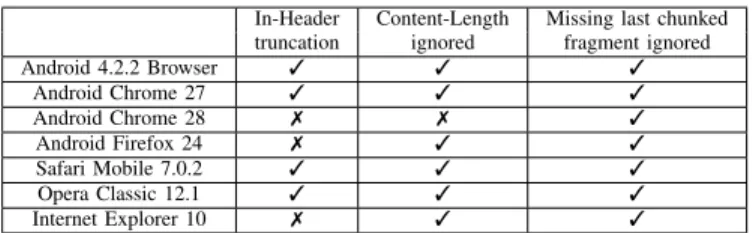
TABLE I. TLS TRUNCATION INBROWSERS
In-Header Content-Length Missing last chunked truncation ignored fragment ignored
Android 4.2.2 Browser 3 3 3
Android Chrome 27 3 3 3
Android Chrome 28 7 7 3
Android Firefox 24 7 3 3
Safari Mobile 7.0.2 3 3 3
Opera Classic 12.1 3 3 3
Internet Explorer 10 7 3 3
for instance after a successful login, the new URL given in the
Location header typically includes parameters taken from the request (e.g., the page the user was trying to access before logging in). Such parameters are often under attacker control, and allow targeted truncation in response headers as well.
Truncating Responses Recall that browsers do not
at-tach cookies set with the secure flag to HTTP requests. In the Set-Cookie header, however, the flag occurs af-ter the cookie, so the attacker can selectively truncate it and redirect the user to an unencrypted URL to recover the cookie value. Concretely, consider a login form at
https://x.com/login?go=P that sets a session cookie and redirects the user to https://x.com/P. The headers of the response are as follows:
HTTP/1.1 302 Redirect Location: https://x.com/P
Set-Cookie: SID=[AuthenticationToken]; secure Content-Length: 0
The attacker can chosePsuch that the first TLS fragment ends just before ‘;’ and close the connection before the second fragment is sent, allowing the cookie to be stored without the secure flag (and thus, visible to the attacker over HTTP). We successfully mounted this attack against Google Accounts.
The attack is possible because some browsers, including Chrome, Opera, and Safari, accepted incomplete HTTP re-sponses (missing an empty line at the end of headers). We reported the vulnerability to each vendor; their responses are given in§IX-A. Table I summarizes the possible truncations in current browsers; we focus on mobile versions because they are more likely to connect to untrusted networks. While header-truncation attacks have mostly been fixed, chunked-body-truncation attacks remain possible on HTML and JavaScript.
Truncating Requests While most servers do not accept
truncated headers, some do accept a truncated body. In the case ofPOSTrequests, typically used when submitting a form, the parameters are sent in the body of the request. This is most notably the case of requests sent through Apache SAPI modules, such as PHP. The main difficulty when truncating a
POST request is to guess the length of the body parameters, which may be difficult since they often contain user input.
Consider a scenario where the victim invites one of her friend [email protected] on a social network where the attacker wants to access her profile. The attacker registers the domaindomain.coand monitors the victim as she accesses the invitation page (for instance, by inspecting the length of the returned page). The query to truncate is of the form:
Host: socialnetwork.com
Content-Type: application/x-www-form-urlencoded Cookie: SID=X; ForcedByAttacker=Z
Content-Length: 64
csrf_token=Y&[email protected]
When the query is sent, the attacker truncates it such that the invitation will be sent to [email protected]. The victim gets a blank page due to the truncation, and may try the request again. Meanwhile, the attacker receives credentials to access the victim’s profile. We were able to mount this attack on a popular social network that uses Apache and PHP.
III-C TLS CONNECTION INTEGRITY. Because most users connect to websites using plain HTTP, even if a website redirects all unencrypted connections to HTTPS, it is easy for a man in the middle to forward HTTPS contents over HTTP to the user, rewriting all links and pointers to encrypted pages. This attack, called SSL stripping [37], is very popular thanks to simple tools to mount it on public wireless networks.
To protect against SSL stripping, several browsers support HTTP Strict Transport Security [30] (HSTS), which introduces aStrict-Transport-Security header for websites to indicate that the browser should always connect to its domain over TLS, regardless of the port. The header includes a
max-age value, specifying how long this indication should be enforced, and an optional includeSubDomains flag, indicating that the policy also applies to all subdomains.
HSTS has several known weaknesses. The first problem is bootstrapping: the user may use HTTP the first time it connects to the website, before receiving the HSTS header in the response. This bootstrapping problem is typically mitigated by browsers that use a pre-registered HSTS domain list for sensitive websites that wish to opt-in to this feature.
Second, HSTS preserves cookie integrity only when enabled on the top level domain with theincludeSubDomainsflag, and if the user visits this domain first [18]. This is an expensive requirement for large websites, as it forces all contents for the entire domain to be served over HTTPS. We found that not a single website from the top 10,000 Alexa list is using theincludeSubDomainsoption on their top-level domain, even though some are indeed using HSTS. Thus, in practice, HSTS is not used to prevent cookie forcing attacks.
We found a new attack to bypass HSTS on some clients. A network attacker can truncate the Strict-Transport-Security header after the first digit of the max-age pa-rameter. If the client accepts and processes this header, the HSTS entry for that website will expire after at most ten seconds, after which HTTP connections to the domain will be allowed again,even if the domain has pre-registered to the HSTS domain list on the browser.
Concretely, to attack x.com, the man-in-the-middle takes any HTTP request for any server and redirects it to a page on
x.comthat returns a parameter-dependentLocationheader followed by the Strict-Transport-Security header. We successfully tested the attack on Chrome, Opera, and Safari. We further note that by using this attack first, a network attacker can re-enable SSL stripping, cookie forcing, and the
ClientC ServerS
1. ClientHello(pvmax, cr,[KEX ALG1, . . .],[ENC ALG1, . . .]) 2. ServerHello(pv, sr,sid,KEX ALG,ENC ALG)
3. ServerCertificate(certS,pkS) 4. ServerKeyExchange(kexS)
5. CertificateRequest
6. ServerHelloDone
7. ClientCertificate(certC,pkC) 8.ClientKeyExchange(kexC) 9. CertificateVerify(sign(log1,skC))
10.CCS
11.ClientFinished(verifydata(log2, ms)) 12.CCS
13.ServerFinished(verifydata(log3, ms))
ClientC ServerS
1.ClientHello(pvmax, cr′,sid,[KEX ALG1, . . .],[ENC ALG1, . . .]) 2. ServerHello(pv, sr′,sid,KEX ALG,ENC ALG)
3. CCS
4. ServerFinished(verifydata(log′1, ms)) 5. CCS
6. ClientFinished(verifydata(log′2, ms))
Fig. 1. The TLS Handshake
cookiesecureflag truncation attack above even on websites that enable HSTS, defeating the purpose of this standard.
For websites that do not deploy HSTS, browser extensions have been developed to force the use of HTTPS on a given list of websites. However, it is worth noting that such ad hoc mechanisms have their own flaws. For example, HTTPS Everywhere [2] allows HTTP connections when the server port is non-standard. Cookie policies ignore the port number, so various attacks like cookie forcing remain possible.
IV. TLS PROTOCOL: CONNECTIONS, SESSIONS, EPOCHS
The TLS protocol is commonly used over TCP connec-tions to provide confidentiality and integrity of bytestreams exchanged between a client (C) and a server (S). We assume some familiarity with TLS; we refer to the standard [23] for the details and to other papers for a discussion of previous proofs [35, 43] and attacks [40, 22]. Next, we recall the main subprotocols of TLS and the attacks relevant to this paper. (The online version discusses other prior attacks on handshake integrity.)
IV-A FULLHANDSHAKE. Once a TCP connection has been established between a client and a server, the TLS handshake protocol begins. The goals of the handshake are to: authenti-cate the server and (optionally) the client; negotiate protocol versions, ciphersuites, and extensions; derive authenticated en-cryption keys for the connection; and ensure agreement on all negotiated parameters. Figure 1 shows the full handshake with mutual authentication. (A ciphersuite selects a key exchange mechanism KEX ALGfor the handshake and an authenticated encryption mechanism ENC ALGfor the record protocol.)
First, the client sends a client hello message with a maxi-mum protocol version pvmax, a random nonce cr, and a set
of proposed ciphersuites and extensions. The server chooses a versionpv, a ciphersuite, and a subset of these extensions, and responds with its own noncesrand session identifiersid. The server then sends its X.509 certificate chain certS and public
6
materials in a key exchange messagekexS. It may also send a
certificate request message if it requires client authentication. The client responds with its own certificate chaincertCand
public keypkC(if required), followed by its own key exchange
messagekexC. If the client sends its certificate, it also sends a
signed hash of the current loglog1(obtained by concatenating
messages 1–8) in a certificate verify message.
At this point in the protocol, both client and server can compute a shared pre-master secretpmsfromkexCandkexS,
use pms along with the nonces to derive a master secretms, and use ms to derive keys for the connection and to verify the handshake integrity. To complete the handshake, the client signals a change of keys with a change cipher spec (CCS) message followed by a finished message that contains the client verify datacvd obtained by MACing the current handshake log log2with keyms. Similarly, the server sends its own CCS and
a finished message that contains the server verify data svd, obtained by MACing the whole handshake log3. (The CCS
messages are not included in the logs.)
When the client is not authenticated, messages 5, 7, 9 are omitted. When the server does not contribute to the key exchange, e.g. with RSA, message 4 is omitted.
RSA Handshake If the key exchange in the negotiated
ci-phersuite is RSA, the calculations go as follows, where log1
is the log before message 9,log2is the log before message 11,
andlog3 is the log before message 13. (kexS is not used.)
pms=[pvmax]|[46 bytes randomly generated byC]
kexC=rsa(pkS,pms)
ms =prf(pms,“master secret”, cr|sr)
keys =prf(ms,“key expansion”, sr|cr)
cvd =prf(ms,“client finished”,hash(log2))
svd=prf(ms,“server finished”,hash(log3))
DHE Handshake If the negotiated key exchange is ephemeral Diffie-Hellman (DHE), thenSchooses group parameters(p, g)
and a fresh key pair (KS, gKS); it sends (p, g, gKS)inkexS,
signed along with cr and sr with its private key skS. The
client generates its own key pair(KC, gKC)and responds with
kexC=gKC. Both parties computepms=gKC∗KS. The rest
of the computations are the same.
kexS =signed(skS,[cr, sr, p, g, gKSmodp])
kexC=gKC modp
pms =gKC∗KS modp(with leading 0s stripped)
Other variations Besides RSA and DHE, mainstream TLS
implementations support variations of the Diffie-Hellman key exchange implemented using elliptic curves. The handshake for these is similar to DHE, but with some notable dif-ferences. For example, most ECDHE implementations only accept named curves within a fixed set, whereas DHE allows the server to choose arbitrary DH group parameters.
Other key exchanges are less common on the web but useful in other applications. In TLS-PSK, the client and server authenticate one another using a pre-shared key instead of cer-tificates. In TLS-SRP, the client uses a low-entropy password
ClientC ServerS
1. ClientHello(pvmax, cr,[KEX ALG1, . . .],[ENC ALG1, . . .]) 2. ServerHello(pv, sr,sid,KEX ALG,ENC ALG)
3. ServerCertificate(certS,pkS) 4. ServerKeyExchange(kexS)
5. CertificateRequest
6. ServerHelloDone
7. ClientCertificate(certC,pkC) 8.ClientKeyExchange(kexC) 9. CertificateVerify(sign(log1,skC))
10.CCS
11.ClientFinished(verifydata(log2, ms)) 12.CCS
13.ServerFinished(verifydata(log3, ms))
ClientC ServerS
1.ClientHello(pvmax, cr′,sid,[KEX ALG1, . . .],[ENC ALG1, . . .]) 2. ServerHello(pv, sr′,sid,KEX ALG,ENC ALG)
3. CCS
4. ServerFinished(verifydata(log′1, ms)) 5. CCS
6. ClientFinished(verifydata(log′2, ms))
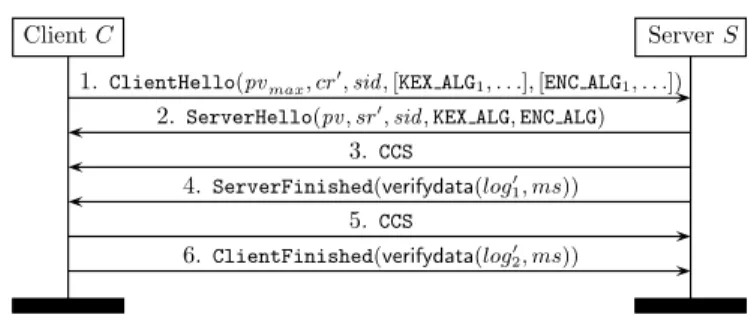
Fig. 2. Abbreviated TLS Handshake
instead of a certificate. In DH anon, both client and server remain anonymous, so the connection is protected from passive eavesdroppers but not from man-in-the-middle attackers. IV-B THE RECORD PROTOCOL. Once established, a TLS connection provides two independent channels, one in each direction; the record protocol protects data on these two channels, using the authenticated-encryption scheme and keys provided by the handshake. Application data is split into a stream of fragments that are delivered in-order. There is no correlation (at the TLS level) between the two directions. When the client or server wishes to terminate the connection, it sends aclose_notifyalert to signal the end of its writing stream, and it may wait for the peer’sclose_notifybefore closing the connection. If both peers perform this graceful closure, they can both be sure that they received all data. However, this is seldom the case in practice.
There are several attacks on the confidentiality of the record protocol [e.g. 5]; attacks on integrity are less common [e.g. 15]. IV-C SESSION RESUMPTION. Full handshakes involve mul-tiple round-trips, public key operations, and (possibly) certificate-revocation checks, increasing latency and server load [54]. In addition, abbreviated handshakes enable clients and servers that have already established a session to quickly set up new connections. Instead of establishing a new master secret, both parties reuse the master secret from that recent session (cached on both ends), as shown in Figure 2.
The format of the cached session data depends on the TLS implementation, but [50] recommends that it contains at least the master secret, protocol version, ciphersuite, and compression method, along with any certificate.
The client sends a client hello, requesting the server to resume the session sid, with a new client nonce cr0. If the
server has cached this session, it may then respond with a server hello with a new server nonce sr0 and the same sid
and algorithms as in the initial handshake. The server then immediately sends its CCS and finished message, computed as a MAC for the abbreviated handshake log. The client responds with its own CCS and finished message, computed as a MAC of the whole resumption log. The computation of keys and verify data are as follows, wherelog0
1consists of the messages
1 and 2, while log0
ms =[cached for(S,sid)]
keys =prf(ms,“key expansion”, sr0|cr0)
svd=prf(ms,“server finished00,hash(log10))
cvd =prf(ms,“client finished00,hash(log20))
The completion of an abbreviated handshake implicitly confirms to each participant that they share the same session master secret. Hence, if both peers are honest, they must have matching session parameters—those negotiated in the initial handshake. Because of its efficiency, resumption is aggressively used on TLS connections. It is supported by default in all major web browsers and web servers. A recent TLS extension enables servers to store their cached sessions at the client within encrypted tickets [50]; this mechanism makes it possible for clients to maintain long-lived sessions with stateless server farms, at little cost to the servers.
We use the term session resumption when the same TLS session is used on multiple connections, but the abbreviated handshake may also be used on an existing TLS connection to refresh keys and reset sequence numbers. At the end of each handshake, we say that the connection enters a new epoch. IV-D RENEGOTIATION: CHANGING EPOCHS. A client or a server may request a new handshake on an established TLS connection, e.g. to renegotiate the session parameters. The handshake proceeds as described above, except that its mes-sages are exchanged on the encrypted TLS connection. When the handshake completes, both parties share a new session, and their connection enters a new epoch, switching to the keys derived from the new session.
There are many reasons why an application may want to renegotiate a TLS session when it already has a working TLS connection. The first is client authentication. On some servers, client authentication is required only when accessing protected resources. For instance, Apache triggers renegotiation and requires a client certificate on first access to a protected directory. This design improves user experience and helps protect privacy by requesting authentication only when needed, and prevents the client certificate being sent in the clear during the initial handshake. Other reasons may be to upgrade the ciphersuite or replace an expiring certificate [49, §5]. Even in this case, the server may need to provide a new certificate that supports, say, ECDSA signing instead of RSA. Consequently, in many renegotiations, the client and server certificates and identities after renegotiation may differ from those of the pre-vious handshake. Without additional protections, such identity changes can lead to impersonation attacks.
Renegotiation Attack Protecting the renegotiation under the keys of the previous handshake is not enough to prevent man-in-the-middle attacks. An active network attacker can intercept an initial handshake from a client to a server and forward it as a renegotiation within an existing TLS connection between the attacker and the server. As a result, any data that the attacker sent before the renegotiation gets attributed to the client, leading to a powerful impersonation attack [45].
In response to this attack, a new ‘mandatory’ TLS extension has been proposed and deployed for all versions of TLS [49].
This extension includes the verify data of the previous hand-shake within the client and server hello messages of the renegotiation handshake, thereby cryptographically binding the two handshakes (and, recursively, any preceding handshake on the same connection). As a result, as each handshake completes, both peers can be confident that they agree on all epochs on their connection. Informally, the principals at each endpoint must remain the same, even if the certificates change. As shown in §V, this countermeasure still does not suffice to eliminate renegotiation attacks acrossseveralconnections. IV-E IMPLEMENTATIONS ANDAPIS. There are several pop-ular implementations of TLS, including OpenSSL, GnuTLS, NSS, JSSE, and SChannel. Here, we briefly discuss the miTLS verified reference implementation [15], whose API is distinc-tive in the detailed connection information that it offers to its applications. As such, miTLS is an ideal experimental tool on which to evaluate attacks and implement countermeasures.
The miTLS API consists of functions to initiate and accept connections, send and receive data, and instigate session re-sumption, re-keying, and renegotiation. Each of these functions returns a connection handle and a ConnectionInfo structure, which details the current epoch in each direction (they can differ). For each epoch, it includes the nonces and verify data and points to a SessionInfostructure with the epoch’s session parameters (including ciphersuites and peer identities). It also points to the previous epochs on the connection (if any).
The API encodes the security assumptions and guarantees of TLS as pre- and post-conditions on the connection state. The application cannot send or receive data unless the con-nection is in the Open state, which means that a handshake has successfully completed with an authorized peer. When a handshake completes at an endpoint, the API guarantees that, if all the principals mentioned in the ConnectionInfo are honest, then there is exactly one other endpoint that has a matching ConnectionInfo and keys. Every application data fragment sent or received is indexed by the epoch it was sent on, which means that miTLS will never confuse or concatenate two data fragments that were received on different epochs; it is left to the application to decide whether to combine them. If the connection uses the renegotiation indication extension, the application gets an additional guarantee that the new epoch is linked to the old epoch. If at any point in a connection, miTLS receives a fatal alert or raises an error, the connection is no longer usable for reading or writing data. If the connection is gracefully closed, miTLS guarantees that each endpoint has received the entire data stream sent by its peer. Otherwise, it only guarantees that a prefix of the stream has been received.
V. A MAN-IN-THE-MIDDLETLS PROXYSERVER
Consider the following scenario. An honest TLS clientC ac-cidentally (or willingly) connects to a TLS serverAcontrolled by the attacker. A then connects to an honest TLS server S, and acts as a man-in-the-middle proxy between C and S. If C correctly validates A’s certificate and if the user at C is observant, she will know that she is speaking withA, and will not send any sensitive data meant forS. To foolC,Awould need to obtain a certificate in S’s name, or to stealS’s private
8
key. While such events can be interesting to consider [19, 53], we do not address such powerful attackers in this paper.
In this scenario, one may think that the bestA can achieve is to be an application-level proxy, ferrying data between C andS over independent TLS connections. However, what ifA could establish the same keyson both connections, so that C uses a key that it believes it shares only withA, while it is in fact also used between A andS? Now, A can inject data on both connections, then step out of the way, allowingC andS to continue talking directly to one another, withAno longer in the middle. This makes the man-in-the-middle attack difficult to detect, even with sophisticated timing measurements [9].
The possibility of this kind of key synchronization is perhaps surprising, but not new. In the cryptographic key-exchange literature, it is called an unknown key-share attack [17, 34], whereby two honest parties share a key but one of them does not realize with whom it shares its key; their mutual belief in the shared secret is violated [55]. By themselves, these theoretical attacks do not break the basic authentication or confidentiality goals of key exchange. In Abadi’s terminol-ogy [3], they do not disrupt any access control goals based on responsibility, but they enable an attacker to takecreditfor an honest principal’s message. So, if the application-level protocol does not reliably confirm both peers’ identities, then more serious attacks become possible [36], as we will demonstrate in§VI.
In the rest of this section, we show how a malicious serverA can synchronize TLS keys with C and S. We exploit three independent weaknesses in the RSA handshake, the DHE handshake, and the abbreviated handshake, to build this mali-cious server. We do not make any assumption about application behavior, and use only standard mechanisms implemented by mainstream TLS libraries.
V-A SYNCHRONIZINGRSA. Suppose C sends a client hello toA offering an RSA ciphersuite. Athen forwards the client hello toS. WhenSresponds with the server hello,Aforwards it toC. Hence, the client and server noncescr,srand session identifier sid are the same for both connections.
Next, when S sends its certificate certS to A, A instead
sends its own certificate certA toC. Now,C generates a
pre-master secret pms, encrypts it under pkA, and sends it to A.
A decryptspms, re-encrypts it under pkS, and sends it toS.
Hence, both connections have the same pms and (since the nonces are equal) the same master secret and connection keys, all of which are now shared between C, S, and A. Finally, A completes the handshake on both connections, usingms to compute correct verify data. The messages tampered by Aare illustrated in Figure 3 (Connection 1).
At this point,CandScache the same session that they both associate withA(as represented bycertAonC, and optionally,
A’s client certificate on S). The new epochs on the two connections are distinguishable only by the client and server verify data, which differ on the two connections. However, messages from one connection can be freely forwarded to the other, since the keys match. Consequently, ifAstepped out of the way,C andS can continue exchanging messages without realizing that the principal on the other end has changed.
User ClientC
Attacker ServerA
Target ServerS
cr cr
sr,sid,certS,kexS sr,sid,certA,kexA
kexC,cvdCA kexC,cvdAS svdAS
svdCA New session:
sid, ms,anon→certA
Knows: sid, ms
New session: sid, ms,anon→certS New epoch:
sid,keys,cvdCA,svdCA
Knows: sid,keys
New epoch: sid,keys,cvdAS,svdAS Connection 1: Full Handshake
User ClientC
Attacker ServerA
Target ServerS
cr′,sid cr′,sid
sr′,sid,svd′
sr′,sid,svd′
cvd′ cvd′
New epoch: sid,keys′,cvd′,svd′
Knows: sid,keys′
New epoch: sid,keys′,cvd′,svd′
AppDataAC AppDataAS
cr′′,cvd′ cr′′,cvd′
sr′′,sid′,cvd′,svd′,certS,kex′
S sr′′,sid′,cvd′,svd′,certS,kex′
S
certC,kex′C,cvd′′ certC,kex′C,cvd′′ svd′′ svd′′
New session: sid′, ms′,certC→certS
New session: sid′, ms′,certC→certS New epoch:
sid′,keys′′,cvd′′,svd′′ Does not know:ms′,keys′′ sid′,keysNew epoch:′′,cvd′′,svd′′
AppDataCS
AppDataSC
Connection 2: Session Resumption and Renegotiation
Fig. 3. Triple handshake attack by a malicious server on client-authenticated TLS renegotiation: (1) RSA/DHE full handshake, (2) abbreviated handshake for session resumption, (3) secure (RFC 5746 [49]) renegotiation handshake
Variants and Mitigations The above trace is robust to vari-ations in the key exchange. If S demands a client certificate, A can provide its own certificate, and this does not affect the synchronization of the master secret or connection keys. If both C andS support RSA but prefer a different key exchange, say ECDHE,A can still force them both to use RSA by offering only RSA in its client and server hellos.
The RSA key exchange does not ensure different keys on different connections, and there is no standard mitigations that implementations can employ to prevent it. This behavior would not surprise a cryptographer or protocol expert, since only C contributes to the key exchange. However, it is only occasionally mentioned in protocol specifications [48,§5] and continues to surprise protocol designers. As shown in§VI, such connection synchronizations can defeat the man-in-the-middle protection used in tunneled protocols like PEAP.
V-B SYNCHRONIZING DHE. Suppose that C (or S) refuses RSA ciphersuites, but accept some DHE ciphersuite. We show
that A can still synchronize the two connections, because the DHE key exchange allows the server to pick and sign arbitrary Diffie-Hellman group parameters, and any client that accepts the server certificate and signature implicitly trusts those parameters.
In this scenario,Asubstitutes its own certificate forS’s (as with RSA), then changes the Diffie-Hellman group parameters in the server key exchange message, and finally changes the client’s public key in the client key exchange message.
Suppose S offers a prime p, generator g, and public key PS = gKS modp. A replaces p with the non-prime value
p0=P
S(PS−1)and signs the parameters with its own private
key. WhenCsends its own key exchange message with public keyPC=gKCmodp0, the attacker replaces it with the public
key gand sends it to S. Our choice ofp0 ensures thatP
S has
order 1 in the groupZp∗0, or equivalently∀x, PSx=PSmodp0.
Other values of the formp0=q(P
S−1)also lead toPShaving
a low order inZp∗0. Upon receiving this message,Ccomputes
pms =PKC
S modPS(PS−1)
=PSmodPS(PS−1)
=PS (with leading 0s stripped)
while S computes pms =gKS modp=P
S. Finally, both
connections share the samepms,ms, and derived keys. Variants and Mitigations The authenticated Diffie-Hellman key exchange is not intrinsically vulnerable to a man-in-the-middle, as long as both parties use the same, well chosen group. The key to this attack is that the attacker is able to make C accept a group with a non-prime order. In fact,p0 above is always even (and may cause errors with implementations that rely on Montgomery reduction for modular exponentiation) but it is easy to find odd non-primes that work just as well.
The attack fails if C checks thatp0 is prime. Yet, none of
the mainstream TLS implementations perform a full primality check because it is deemed too expensive. A probabilistic primality check could help, but may not guarantee that the attacker cannot find ap0 that defeats it. An alternative
mitiga-tion would be to standardize a few known good Diffie-Hellman groups for use in TLS. Indeed, this is the approach taken in protocols like IKEv2 and in TLS variants like SRP.
Even when clients and servers use known groups, care must be taken to validate the public key received from the peer. Otherwise, they may become vulnerable to small subgroup attacks [see e.g. 7, 46] which have been exploited in previous TLS attacks [56, 38]. Barker et al. [11] define a procedure for checking public keys, but we found that many TLS implementations do not implement it. We analyzed TLS clients and servers to check whether they accept degenerate public keys (with small orders) like 0,1, and −1; these keys always lead to pms ∈ {0,1,−1}. While 0 and 1 are rejected by most implementation (to mitigate [38]), we found that NSS, SChannel, and JSSE do accept −1. On the web, we found that all web browsers and about 12% of DHE-enabled servers of the top 10,000 Alexa list also accept−1. Such clients and servers are vulnerable to our key synchronization attack, since the pms can be forced to be the same on both connections
(with high probability), even if these clients and servers only accept known primes and correctly sample their keys.
The elliptic curve version of DHE (ECDHE) allows servers to offer arbitrary curves, and so theoretically suffers from the same attack, but all the TLS implementations we tested only support well-known named curves standardized by NIST. V-C SYNCHRONIZING ABBREVIATED HANDSHAKES. Sup-poseC,A, andShave synchronized sessions and connections, as described above. IfCattempts to resume the session withA over a new connection, A can then synchronize this new connection with a new connection to S. In fact, abbreviated handshakes are easier to synchronize than full handshakes.
WhenCsends its client hello requesting session resumption on a new connection,Asimply forwards the request toS, and forwards S’s response to C unchanged. C and S complete the handshake through A, re-using the master secret known to C, S, andA, as shown in the top half of Connection 2 in Figure 3. The resulting epochs on the two connections have the same keys, also shared with A. The new epochs are, in fact, more synchronized than the epochs on the original connection: the client and server verify data on these epochs are also the same. Hence, after resumption, the only noticeable difference between the two connections is that the C-A connection has a session with server identitycertA while theA-S connection
has a session with server identitycertS. All other differences
have been erased. This is important for the attacks in §VI. The ease with which resumed sessions can be synchronized exposes the weak authentication guarantees of the abbreviated handshake. It only ensures that the client and server share the same master secret, whereas applications may (and do) assume that they share the same session, which we show is not the case. To obtain stronger guarantees from this handshake, in§VII we propose a TLS extension, similar to [49], that links the resumption handshake to the original session.
VI. ATTACKS ONCLIENTAUTHENTICATION OVERTLS TLS is most commonly used in the anonymous-client mode, where only the server is authenticated. Consequently, appli-cations often deploy their own mechanisms and protocols to authenticate users after the TLS handshake has finished.
Previous work shows that layering a client authentication protocol within a server-authenticated secure channel is vul-nerable to generic man-in-the-middle attacks [8, 41]. The TLS renegotiation attack is also an instance of this pattern [45]. If an attacker A can see application-level protocol messages between C and S, it can tunnel these messages through its own connection with S, thereby impersonatingC atS.
This attack is possible in three scenarios. First, if the client C uses the same application-level credentials on en-crypted and unenen-crypted channels. Second, if C uses the same credentials on different servers, one of which could be malicious. Third, if C fails to correctly validate the server identity and confuses a malicious server A with an honest server S. In all these cases, the application-level protocol should guarantee that the credentials released byCtoAcannot not be used by AatS.
10
A common pattern to enforce this guarantee is to crypto-graphically bind the (inner) application authentication to the (outer) underlying TLS channel [8, 6, 49]. This binding helps only inasmuch as the inner protocol employs strong keys (public or secret) or a passphrase-based challenge-response scheme resistant to dictionary attacks. Bearer tokens cannot be protected. In this section, we discuss four such binding mechanisms, and show how to break their guarantees using the synchronizing TLS proxy of§V.
VI-A THETRIPLEHANDSHAKEATTACK. SupposeAhas an anonymous-client TLS connection toS. WhenAtries to access a user-protected resource, Striggers a renegotiation to require A to authenticate as a valid user, with a client certificate or some other credential (PSK, SRP, etc.). This pattern is enabled, for example, on the Apache web server, when a client tries to access a protected directory.
Awants to authenticate toSasC(withoutC’s credentials). More generally, even if A has previously authenticated to S, it wants to change its authenticated identity toC.
Before explaining our attack, it is useful to recall the 2009 renegotiation attack [45] and countermeasure [49], which cryptographically binds each handshake on a connection to the preceding one, by passing the verify data of the previous handshake (if there was one) in the client and server hellos of the new handshake. Therefore, ifA initiates a full handshake with S, but later tries to forward C’s handshake to S as a renegotiation, the verify data inC’s hello would not matchA’s handshake, prompting the server to reject the renegotiation.
What if a session is resumed on a new connection? The first handshake now is an abbreviated handshake; it only authenticates the session master secret, not the whole session. Thus, the renegotiation countermeasure does nothing to bind the new connection to the old session. This re-enables the man-in-the-middle impersonation attack it was meant to fix.
Assume the adversary A has set up synchronized sessions and connections withC andS. IfCresumes the session on a new connection, A can resume the same session on a new connection to S. As discussed in §V-C, at the end of the abbreviated handshake, the verify data on both connections is the same. Now, if C orS initiates a client-authenticated TLS renegotiation,Acan simply forward all messages fromCtoS and back, making no changes. The client and server hellos will refer to the verify data from the abbreviated handshake and thus be accepted by both parties. This triple handshake across two connections is depicted in Figure 3.
At the end of the renegotiation, from TLS’s viewpoint, C andSshare a new mutually-authenticated session.Adoes not have the keys to this new session, but it may have injected data in both directions before the renegotiation, and this data may now be mistakenly attributed by C toS, and vice versa. In other words, the TLS peer on the connection has changed, and the application may not realize it, defeating the purpose of the secure renegotiation extension.
Preconditions and Variations The attack above works
re-gardless of whether the renegotiation uses client certificates, PSK, or SRP to authenticate the client, and even if the initial handshake also used client authentication.
The main precondition is that the client be willing to use the same authentication credentials onAandS. This is reasonable for public-key certificates, which are often used as universal identity assertions when issued by trusted CAs. For SRP or PSK credentials, this may not seem as likely, but these key exchanges are typically used to provide both server and client authentication, and hence, they both offer several ciphersuites that do not use server certificates at all.
The second precondition is that the client and server should be willing to accept new mutual identities during renegotiation. Accepting a change of client identity (or client authentication on an anonymous session) is one of the purposes of renegoti-ation, but accepting a change of server may seem unusual. We experimentally tested a wide variety of TLS client applications, including mainstream browsers, popular HTTPS libraries such as CURL, serf, and neon, version control systems, VPN clients, mail clients, etc. We found that a vast majority of themsilently accept a change of server identity during renegotiation, and thus are vulnerable to our impersonation attack.
Why does this not contradict proofs of the TLS handshake? Most proofs [e.g. 35, 32] ignore renegotiation and resumption; [14] supports resumption but not renegotiation; [29] considers renegotiation but not resumption; [15] supports both and relies on the application to correctly handle epoch changes.
Web Exploit and Mitigation As a concrete example, we
implemented the above attack as a web server acting as a synchronizing proxy between a browser C and an honest website S. After proxying the initial handshake and session resumption,A can tamper with the connection in many ways, before instigating renegotiation:
• A can send a POST message to S which will get subsequently attributed toC after renegotiation.
• Acan send a page with JavaScript toC, so that the script gets executed later, in the client-authenticated session.
• Acan source a client-authenticated page fromS in one frame atCwhile reading its contents from another frame sourced at A, bypassing the same origin policy (XSS). All of these attacks can be used to subvert both user authentica-tion on the server and same-origin protecauthentica-tions on the browser. Protections like CSRF tokens and Content Security Policy do not help since the page’s origin is no longer reliable.
We have disclosed this vulnerability to a number of browser vendors. The easiest mitigation is for web browsers to refuse a change of server identity during renegotiation (since their UI can hardly convey a HTTPS mashup of several origins); some of them have already made this change in response to our report. For web servers and other HTTPS applications, we believe that restricting peer certificate changes would be a good default as well, with a careful review of the UI and API design in the cases when the identity is expected to change. VI-B BREAKING COMPOUND AUTHENTICATION IN TUN
-NELED PROTOCOLS. Wireless authentication protocols such as EAP-TLS [51], PEAP [42] and EAP-TTLS [27] are par-ticularly susceptible to man-in-the-middle attacks even over TLS [8] because of the ease with which other wireless devices and rogue access points can fool naive clients into connecting to them [19]. To protect against such attacks,
some of these protocols adopted new compound authentication mechanisms [44] that cryptographically bind the inner EAP authentication protocol with the outer TLS tunnel.
In PEAP, when the inner protocol is MSChapv2 [1] for example, the inner protocol generates a session key (ISK) that is combined with a tunnel key (TK) generated from the outer TLS connection’s master secret (and client and server randoms) to derive a compound authentication key (CMK) and encryption key (CSK) for subsequent use between the wireless device and access point. The idea is that these keys will only be known to devices that participated both in the outer TLS handshake and the inner EAP authentication.
TK=prf(ms,“client EAP encryption”, cr|sr)
CMK|CSK=prf0(TK,ISK)
PEAP also features fast reconnect, an API for TLS session resumption. As it moves from one wireless access point to another and needs to reconnect, the client simply resumes its TLS session and skips the inner authentication protocol. In this case, ISK is set to 0s so the compound authentication and encryption keys depend only on TK. This mechanism presumes that the tunnel key is unique on every connection; our synchronizing TLS proxy breaks this assumption and leads to a new attack.
As usual,Asets up synchronized connections withCandS and forwards the untampered MSChapv2 exchange to let C authenticate toS, negotiateISK, combine it withTK, and derive CMKandCSK. SinceAonly knowsTK, he cannot read or tamper with any messages after the authentication. Nonetheless, ifA uses fast reconnect to resume the TLS session withS, the inner EAP authentication is skipped, and the new compound keys are only derived fromTK. Yet,Sstill associates the connection with C, resulting in a complete impersonation byA, without any involvement from C.
Preconditions and Mitigations To make the attack work,
the malicious access point must convince the user to trust its certificate, which can be achieved in a number of cases [19].
The mitigation for tunneled protocols is not straightforward. At the TLS level, a more general mitigation would be to change the master secret computation, as we discuss in§VII. In PEAP, one possibility is to change the tunnel key computation to include the server’s identity, represented by the server’s certificate or its hash:
TK=prf(ms,“client EAP encryption”, cr|sr|certS)
VI-C BREAKING TLS CHANNEL BINDINGS. Channel bind-ings [57] are a generic protocol composition mechanism, whereby a transport-level cryptographic protocol such as IPsec, SSH, or TLS can expose specific session and connection parameters to applications, most notably to bind authentication mechanisms to the underlying secure channel. Their stated goal is to establish that “no man-in-the-middle exists between two end-points that have been authenticated at one network layer but are using a secure channel at a lower network layer”. TLS implementations expose three channel bindings to applications [6]; we consider one of them here and another (tls-server-end-point) in the online material. The
‘tls-unique’ channel binding for a given TLS connection is defined as the first finished message in the most recent handshake on the connection. If the most recent handshake is a full handshake, this value is the client verify data cvd; if it is an abbreviated handshake, it is the server verify data
svd. The intent is thattls-uniquebe a unique representative of the current epoch, shared only between the two peers who established the epoch. Our synchronized session resumption breaks it by establishing different connections with honest peers that have the sametls-uniquevalue.
To see how this can be concretely exploited, consider the SCRAM-SHA-1-PLUS protocol [39] used in the SASL and GSS-API families of authentication mechanisms in a variety of applications like messaging (XMPP), mail (SMTP, IMAP), and directory services (LDAP). SCRAM is a challenge-response protocol where the client and server store different keys (CKp,SKp) derived from a user’s password (p), and use
them to authenticate one another. When used over TLS, the first two messages contain client and server nonces and the tls-unique value for the underlying TLS connection. The last two messages contain MACs over these values, for authentication and channel binding:
1. C→S: u, cn,tls-unique
2. S→C: cn, sn, s, i
3. C→S: cn, sn,ClientProof(CKp, log1,2,3)
4. C→S: cn, sn,ServerSignature(SKp, log1,2,3)
In our attack,Cestablishes, then resumes a session withA, who synchronizes a connection with S to have the same
tls-unique value. A then forwards the SCRAM messages between C and S. Since the server identity is not part of the exchange and thetls-uniquevalues match, the SCRAM authentication succeeds, enabling A to impersonateC atS.
A precondition for the attack is that Cbe willing to accept A’s certificate, and this is already considered a security risk for SCRAM-like protocols, since they then become vulnerable to dictionary attacks. However, the tls-uniqueprotection is meant to protect users from impersonation even if the TLS protocol uses an anonymous key exchange [39,§9]. Our attack shows that this is not the case.
To prevent this attack without impacting TLS, we recom-mend significant changes to the specification of tls-unique
in§VII. With such modifications, tls-uniquemay possibly become truly unique across connections.
VI-D BREAKING CHANNEL-BOUND TOKENS ON THE
WEB. Channel ID is a TLS extension [10], implemented by Chrome and all Google servers, that aims to bind web au-thentication tokens such as cookies to a cryptographicchannel between a client and a server, without the need for client certifi-cates. A channel can be long-lived (at least as long as cookies) and consists of many TLS sessions and connections. Channel ID is a follow-up to the previously published origin-bound certificates proposal [24], which was considered impractical to implement and deploy.
A TLS client that supports Channel ID generates and stores a public-private elliptic curve key pair (pkcid,S,skcid,S)
![Fig. 3. Triple handshake attack by a malicious server on client-authenticated TLS renegotiation: (1) RSA/DHE full handshake, (2) abbreviated handshake for session resumption, (3) secure (RFC 5746 [49]) renegotiation handshake](https://thumb-us.123doks.com/thumbv2/123dok_us/8426248.2241276/8.918.483.853.88.655/handshake-malicious-authenticated-renegotiation-handshake-abbreviated-resumption-renegotiation.webp)

