Journal of Accounting Perspectives, Vol 2, December 2009, 64-78 ISSN 1985-7136
Leading an Internal Audit Function for The 21
StCentury – Experience of Telekom Malaysia
Hashim Mohammed
Abstract
Whilst the management philosophy and strategic thrusts in building an effective internal audit (IA) function are becoming clearer to most CAEs, the future must-win battle is really in Talent Management, as the competition from both outside and inside the company for key talent has intensified. The future sustainability of an IA function and value creation will depend on key individuals with mastery in not just accounting and internal auditing, but in general management skills,
deep rooted business knowledge, leadership and the ability to create
value. The traditional way of managing talent is not going to work in the future. How well managers and leaders understand the people’s personal aspirations and plans, and matching them with the company and function strategic needs will define the success of leading and transforming an IA function.
Keywords: Internal Audit Function, Audit Management
1. Introduction
Telekom Malaysia Berhad (TM), Malaysia’s leading integrated information and communications group, offers a comprehensive range of communication services and solutions in broadband, data and fixed-line. As a market leader in the broadband and fixed-line businesses, TM is driven to deliver value to its stakeholders in a highly competitive environment. The Group places emphasis on continuing customer service quality enhancements and innovations. Its 2008 revenue was USD3.3 billion and it has 23,000 employees.
2. Discussion
During Hashim’s first two weeks in September 2002 in the job of Group Chief Internal Auditor (GCIA) of TM, he was confronted with three main challenges. These, he figured out after having met the key stakeholders, performed several analyses, and made some benchmarkings. The challenges were twofold:
Leading an Internal Audit Function for the 21St Century – Experience of Telekom Malaysia
transforming the internal audit practices, the governance operating model and structure of the internal audit function, and creating a new culture of excellence and high performance. Whilst the first and second challenges could be fixed fairly quickly, the strategic challenge was to work with people and bring about a change in their mindset. To bring about these changes, his management style had to change from that of an incremental process improver to that of a change transformation leadership. He needed to be professional, objective, and independent in order to win the trust of both the Board as well as the management. Ultimately, having a seat on the senior management team providing advice and gaining insights would enable true effectiveness to be achieved. He thought that the GCIA should be involved in oversight committees. The true measure of effectiveness is when the internal audit function is a strategic player, critical and important to the success of the company. Hence, he felt it was critical to meet the changing needs of the various stakeholders – the needs of the Board, Board Audit Committee (BAC) and senior management. To meet these needs, his behaviour, and approach had to be adaptive, and be able to cultivate high-level boardroom relationships. Hence, he had to position himself, to provide group-wide leadership to all internal auditors. He also had to craft the Internal Audit Charter, strategies, policies and procedures that support the Group strategic goals in a changing and competitive business environment. He also realized that the internal audit function needed to represent corporate standards, and had to gain wide support, credibility and respect. These identified corporate standards included COSO, ERM, Code of Ethics, eTOM, Interim Financial Reviews, Management Control Reviews, Assurance Letters, Internal Control Incidents, and Statement on Internal Control. After numerous syndications of his thoughts and plans with the BAC, senior management, internal auditor and also external auditors, five broad strategies were formulated and became the strategic thrusts for the internal audit function business plan for 2003 to 2007. These were as follows:
a. Right People: through the recruitment and retention of the right people. Competent and skilful auditors and a well-balanced multi discipline team. b. Right Direction: through clear strategic direction and positioning of the role
of the internal auditor.
c. Properly Equipped: right methodology, tools and knowledge management. d. Quality Assurance Programme: QA Reviews and monitoring that assess
compliance with the IIA Standards and provide feedback to the BAC. e. Governance: Internal Audit Charter, BAC operating model and centralization
of IA functions.
(a) Right People
The first priority was really about recruiting the right people. Hence, the focus was on recruiting, retaining and developing multi-disciplined auditors drawing talent internally from finance, operations, IT, marketing and external talent from
Hashim Mohammed
Big 4 accounting firms – primarily sucking in talent to meet the new nature of services that the department aspired to perform. Drawing on his expertise and experiences from his previous posts, he attempted to use the ‘Currently Estimated Potential (CEP) model for recruitment – a model that evaluates a person’s potential based on a certain set of behavioural criteria. He hoped that with this screening method he would be able to select “hidden gems” who have potential to be the top leaders in the Group in 10 to 15 years time. The recruitment and retaining approach were centred on people who see IA as a career enhancement platform and for a small group who see themselves as core professional internal auditors.
The positioning of the IA function was as a centre of excellence for those with high potential, to whom exposure was given to develop management skills and leaderships. He envisaged that this could only be achieved if he re- tuned himself, and allocated more of his time in coaching his recruits, and, in particular, the “superstars” and “stars”. The ultimate game plan was to produce ten superstars and have them transplanted in key strategic businesses. Hashim defined superstars and stars as those who have the ability to change things and can create tremendous value for the company. The focus was to develop structured functional and developmental management training programmes for his team. A structured 5-day case study based audit training programme was developed and conducted annually, and was held at different offsite locations. The “Jumpstart Programme” was based on actual business situations involving control failures in TM and included a combination of theory, role-plays, simulated audit fieldwork, report writing, presentation and teamwork. The programme was usually highly intense and intellectually stimulating. It was used by the GCIA to identify his next batch of mentees for coaching. The GCIA and his faculty of superstars and stars who have developed mastery in coaching and training conducted this programme.
Initially, for two years in 2003 and 2004, a general management programme was developed with a renowned university professor, and all audit managers were required to attend to fast track their management skills. Internal auditors were also encouraged to take up MBA, CIA, CISA and accounting qualifications, such as ACCA. Applications for reimbursement and scholarships were actively supported. There was also a lot of focus on motivating and rewarding high performers. Active intervention was also made to rotate off those ‘wrong people” from the department – those who do not quite fit with the new vision, strategies and were not willing to change.
(b) Right Direction
The next sequence of action was to craft a strategic direction, re-position the IA shop and create a new branding. The key question that everyone was asked was “where do we see ourselves now and in the future?” The ideology that was created with his team is really about adding value. “To be a best practice assurance provider of internal controls, risk management and governance processes,
Leading an Internal Audit Function for the 21St Century – Experience of Telekom Malaysia
including providing assurance on the current and future health of the company to respond to the changes in its environment”. Essentially, the strategic planning for the IA function took the approach to running it like a business unit, with a vision, mission, strategic objectives, strategies, risk profiles, action plans, human capital management, financial resources, which were documented in the annual business plans and audit plans approved by the BAC. With this approach, the mystery surrounding the way the IA function was directed and managed disappeared and trust was built. The business and audit plans were shared with management, where the audit approaches were explained, and audit engagement opening meetings were used as opportunities to increase the visibility and profile of the IA function and the internal auditors. Over the years, this visibility programme has been built to promote a positive image of the internal auditors and the IA function. This strong branding has continued to pull a number of young, bright and talented graduates from the world’s top universities to GIA. They, however, posed a challenge to the leadership, as clever people do not like to be led (Goffee and Jones 2007). External expectations were identified through environmental scanning and also from the knowledge gained through networking with the Institute of Internal Auditors. It was noted that there were strong shifts from internal controls to risk management and governance. Internally it was identified that the BAC requires internal auditors to be governance partners, advisors and risk centric. BAC also wanted the IA to focus more on performance rather than just conformance – the need to advise management to improve effectiveness and efficiency in business processes and operations. There was also a push for internal auditors to play some role in advocating good ethics and in detecting potential unethical breaches in view of the procurement risks. These expectations placed new demands on the type of skillsets required of the new age internal auditors. It was envisaged that internal auditors need to develop strategic thinking capabilities, business and process improvements, ethics advocates, fraud detection; risk based auditing and information technology on top of the basic traditional accounting and auditing skills. The strategic objectives of the IA function crafted, essentially focused on providing the BAC with the comfort and assurance that the Group system of internal controls was satisfactory, and assisting them in performing its overall oversight role.
The secondary roles of IA focused on the identification of the continuous process and business improvements, including opportunities to improve the effectiveness and efficiency of the Group operations. There is a clear statement that the audit work performed is in accordance with the IIA Standards and evaluation of the risk and control issues are performed within the business context. Emphasis was also placed on prompt communication of the engagements results and highlighted areas with value adding opportunities, particularly risk related issues that impact the achievement of the business objectives.
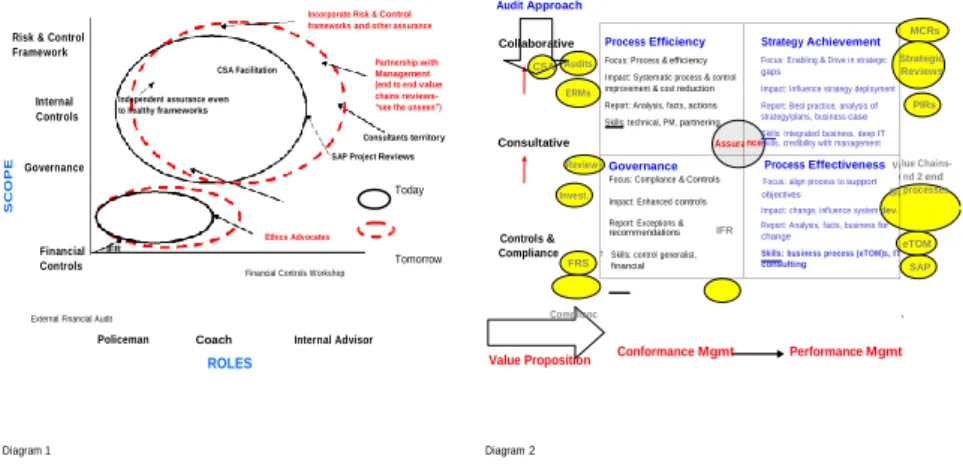
Two main analyses were performed – what are the current and future roles
of the internal auditors? And, what is the nature of audit work and services? (See
Process Efficiency
Focus: Process & efficiency
Impact: Systematic process & control improvement & cost reduction
Report: Analysis, facts, actions
Skills: technical, PM, partnering
Assura
Strategy Achievement
Focus: Enabling & Drive in strategic gaps
Impact: Influence strategy deployment Report: Best practice, analysis of strategy/plans, business case Skills: Integrated business, deep IT
nceskills, credibility with management s Governance
Focus: Compliance & Controls
Impact: Enhanced controls
Report: Exceptions & recommendations IFR e Skills: control generalist,
financial
Process Effectiveness Va Focus: align process to support e Biz Impact: change, influence system dev. Report: Analysis, facts, business for change
Skills: business process (eTOM)s, IT consulting ng S C O PE Hashim Mohammed
Diagram 1 & 2). Using these two analyses, it was apparent that, first, the internal auditors needed to be adaptive and to wear multiple hats – policing, coaching and as internal advisor. Hence, a re-positioning of their roles and scope of coverage was necessary. Second, they needed to re-position themselves towards creating value, whilst performing their primary assurance work. Value creation could only be achieved when the nature of the audit engagements move towards the “process effectiveness” and “strategy achievement” quadrants.
Risk & Control Framework
Internal Controls
Governance
CSA Facilitation
Independent assurance even to healthy frameworks
Incorporate Risk & Control frameworks and other assurance
Partnership with Management (end to end value chains reviews- “see the unseen”)
Consultants territory SAP Project Reviews
Today
Audit Approach
Collaborative
CSA Audits
ERMs Consultative Review Invest. objectives MCRs Strategic Reviews PIRs lue Chains- nd 2 end processes
Financial Controls
IFR
Ethics Advocates
Financial Controls Workshop Tomorrow Controls & Compliance FRS eTOM SAP
External Financial Audit
Policeman Coach ROLES Internal Advisor Complianc Value Proposition ,
Conformance Mgmt Performance Mgmt
Diagram 1 Diagram 2
Moving towards the future would require change management, and to ensure that the journey is successful, a series of sequential steps were crafted
in terms of the Transformation Road Map (see Diagram 3). This road map was
used as a means to measure and track progress. The transformation framework encompasses a change in structure, process and culture. Hence, the sequence of activities and initiatives address each of these elements. After a successful run on the first roadmap from 2002 to 2005, a second road map addressing the journey from 2006 to 2009 was developed.
Transformat ion Roadm ap 1
C ul ture & Va l ues N ew Str ucture
Succes s i o n
QAR & Improv e me nts
St ruct ure
A udi to r De v & Tra i ni ng
& A s s ura nce
Assu ranc e Le tte r Role of othe r
Inte rna l Co ntro l Inc ide nt Inte rna l Q ua lity Progra m & Asse ssme n t
Prof ic ie nc y & Prof e ssional ism
Process Cult ure
R i s k ba s ed
A udi t To o l s & Metho do l o g y
assura nc e prov ide rs ( Comp lianc e , R MU ) Str uc ture d Trai ni Ne w Role of IA ( c ons ult ing) Compe te nc y prof ili ng & ladde ring Coac hi ng & De v e lopme nt of 10 Top Ta le nt
co ntro l s Ne w Audi t tool s & K no wle dge database Pe e r Re v ie w
C o ntro l Sel f ERM A s s ess m ent
Ne w Audi t proc e ss & Man ual
Alig ne d G IA se rv ic e s Risk & Co ntrol s Polic y Riske d Ba se d Aud it Pla ns KPIs
IA Sc ore c ard i nc . Cu stome r f e e dbac ks
Q 1 2 00 2 Q 4 2 00 2 Q 1 -2 20 0 3 Q 3 2 0 0 3 Q 1 2 00 4 Q 4 2 00 5
D iagram 3
Leading an Internal Audit Function for the 21St Century – Experience of Telekom Malaysia
One of the major breakthrough approaches in changing the culture and mindset of the internal auditors was to design a set of vital key performance indicators (KPI) and measures for the internal auditors that were aligned to the five (5) strategic thrusts of the IA function. The process undertaken was rather rigorous. Hence, care was taken to align the IA shop balance scorecard with the audit strategy for the year. A dashboard approach was taken in which the KPIs for the GCIA were shared with the audit account managers and also the internal auditors. These linkages ensured that what was on the GCIA dashboard was similar to what was on the internal auditors’ dashboard. The KPI enabled focus and contributed to significant improvements in the performance of individuals and the department as a whole.
(c) Methodology
The third imperative was about building the right methodology, tools and knowledge management. Frameworks, such as the COSO model for internal control was introduced in 2002, which was embedded in the way the audit engagements were approached and the results of the audit reports were communicated. Internal auditors began to think in a structured manner using the model, and viewed risks and controls in a new perspective. The audit engagement process was also revamped and standardized throughout the Group. This standard process enabled internal auditors to perform engagements in different companies and countries using the same standard approach. This process included performing planning work well in advance – drafting terms of reference, risk assessment matrix, interviews schedules and notifying auditees in advance become the standard rigours. Audit planning was then approached based on risk based with a spin on ‘real time’ in which the BAC and senior management request and risk impact arising from new management initiatives were immediately taken up. The development of auditable subjects were based on understanding and analysis of the current business and its future directions. These business changes included new business environments, new strategies, business model, initiatives, process, systems and IT plans. Major risk and control issues from ERMs and CSA were also considered. Issues from BAC, management request, external audit issues and lessons from internal control incidents were considered.
An industry best practice end-to-end business process-mapping model called enhanced Telecoms Operation Map (eTOM) was also used to identify auditable subjects. Other methods used included identifying departments, products, services and systems. Before the audit plans are finalized various syndications are carried out with the Line of Business Heads, Corporate Centre and CEO, and then approved by the BAC. This active involvement of management in the audit planning process, which takes place twice a year, allows a rapid response to changes and requests by management to view high-risk areas fairly quickly. The use of eTOM has been identified as one of the breakthrough approaches
Hashim Mohammed
in reviewing the effectiveness of controls as the company is often driven along functional lines, and the internal auditors are amongst the very few in the Group that review the value chains. Hence, the internal auditors are able to “see the unseen”. This approach enables internal auditors to improve business processes and adds significant value to the management.
With the Global Audit Network in place in 2005 onwards, global audit programmes were developed, and focused on the engagement of general reviews of the controls of the major subsidiaries overseas and also locally. The GCIA took the audit lead in performing management controls reviews, as in most instances the auditees were the CEOs of the major subsidiaries in Sri Lanka, Bangladesh and Indonesia. These included Interim Financial Reviews on the quarterly financial statement principally to give assurance concerning the quarterly financial results in accordance with FRS 134. The approach taken was to focus reviews on a particular individual subject matter, such as on revenue, expenses/accruals, and fixed assets, and debtors for different quarters. This work contributes towards reliance by the external auditors for the year-end financial statutory review.
Control Self-Assessment (CSA) was also actively promoted. Internal auditors were trained by external consultants in facilitation skills as part of the transition to the coaching roles. Using the “tell me” approach instead of the “show me” approach has built trust with management, and gained their respect. Assurance letters were also introduced in 2005 as part of the internal process to evaluate the state of the system of internal controls for the directors to disclose in the annual report. The CEO/CFO of the subsidiaries, Line of Business VPs/ COOs and Corporate Centre Chiefs, were required to answer questions regarding the spectrum of risk management, internal controls and governance, and sign off the internal control assurance letters. Internal control incidents or fraud incidents were also compiled as lessons learnt were disseminated throughout the Group. Management was also encouraged to improve and enhance the voluntary reporting of Internal Control Incidents, but, at the same time, efforts were undertaken to coach them on how to review and report the incident in a timely manner. Key lessons were identified for lateral learning to prevent recurrence. To encourage lateral learning more widely with management, financial control workshops were conducted at locations besides HQ, and attended by finance and business managers.
The audit approaches over a period of 4 years, from 2004 to 2007, underwent several stages and sequences. In 2004 the key focus was to understand the audit universe, and the audit strategy was to create awareness, visibility for IA and to perform an “overall health check” by “sweeping across” the Group for high risk activities and processes. With the lessons from 2004, the potential “health problem” areas were identified and the subsequent approach in 2005 was to “drill deep” in the activities of departments and business units. This was followed by a more “focused” approach in 2006, covering broad processes, such as sales management, and revenue assurance. From 2007 onwards, there were already
Leading an Internal Audit Function for the 21St Century – Experience of Telekom Malaysia
strong buy-ins from management for audits and advisories performed, hence confidence levels among the auditors were high, and coupled with new auditors with deep insights of the business drawn into IA, major end-to-end value chain
control reviews of strategic value were introduced (See Appendix 1 for nature of
work in 2008). Emerging strategic reviews focus mainly on future risks arising from the company strategy to implement High Speed Broadband (HSBB) and Internet Protocol TV (IPTV). Hence, the future internal audit approach will focus on delivering advisory on designs of controls for new processes, IT systems and products, and assurance on management of these major capital projects.
An audit management system was put in place to increase the efficiency and productivity of the entire audit process, including risk assessment, scheduling, planning, execution, review, report generation, storage and monitoring of audit issues. The need for knowledge management was also assessed, and a culture of learning, enquiring and sharing was inculcated. Furthermore, a common data warehouse consisting of dedicated servers for all auditors to save and share common documents and knowledge, such as presentation materials, training materials, best practices templates and risk assessments was installed in 2003. This ‘self-serve” approach of accessing and reusing of information has enabled rapid multiplication of knowledge and sharing amongst auditors resulting in shortened lead times for audit engagements and production of audit reports.
(d) Quality Assurance Programme
The fourth imperative was about maintaining a quality assurance review programme. The thrust of this was really about “raising the bar” and ensuring that the internal audit work conformed to the IIA International Standards for the Professional Practice of Internal Auditing (ISPPIA). The approach taken included three prongs, focusing internal reviews, internal quality assurance review and independent external quality assurance review. Essentially the internal reviews consist of a supervisory review by the IA team leader and the account manager. On completion of the engagement, peer reviews were conducted by the internal auditors who are specialists in their respective disciplines, such as finance, marketing, technical, information technology, and revenue assurance. Internal QARs were conducted annually on the IA and also on the major subsidiaries, which have an internal audit functions. These QARs were led by Certified Internal Auditors (CIAs), and benchmarked against the Tool 12-19 of the IIA Quality Assessment manual. An independent QAR was only conducted in 2005 after completion of the major initiatives as per the Transformation Roadmap 1. The QAR conducted by an international accounting firm found that GIA internal audit practices generally conformed to the IIA ISPPIA. Benchmarking with GAIN was also carried out and the GIA was rated above the mean against participating global companies, mostly in the USA and UK.
Hashim Mohammed
(e) Governance
An Internal Audit Charter was created during the early days of the transformation, and was seen as the bulletproof vest for the internal auditors. The purpose, independent organization reporting, responsibility and authority of the internal audit function were clearly defined. This was communicated to senior management and approved by the BAC.
In 2005, the initial operating governance model was that of a “loose federation” based on the “network” concept with a total staff strength of 82 internal auditors. The GCIA did not have direct control over the Head of Internal Audit of the subsidiaries and associates. The reporting existed along dotted “functional” lines, in which the GCIA and IA functions provided advice on guidance concerning Group internal auditing standards, competency development and sharing of resources. These included companies, such as Celcom, VADS, Dialog Sri Lanka, TMI Bangladesh and XL Indonesia, for which TM had management control. For associate companies, the GCIA operated in an advisory role capacity. Alignment of internal audit governance existed to hold the Group together and to ensure consistency of implementation in policies, structure, process, systems, procedures, values, business principles and ethics through periodic reporting. Reporting was made quarterly for key strategic and control issues by the Head of Internal Audit of the subsidiaries to the GCIA. This was a structured formal mechanism to ensure systematic reporting of major control and strategic issues on a periodic basis. Although this worked well for most subsidiaries, there was an issue of obtaining timely reports from some Internal Audit functions. After completion of a Governance Review the Board approved the new TM BAC
governance model (see Diagram 4) in 2006 to facilitate the flow of strategic
information on risks and controls to the BAC. This governance model remains even after the demerger in April 2008.
TM Board
TM BAC GIA
Subsidiary Board
Subsidiary CEO
Subsidiary
BAC Diagram 4
Leading an Internal Audit Function for the 21St Century – Experience of Telekom Malaysia
The guiding principle of GIA restructuring was based on the concept of “centralization”. GIA provided representation at the subsidiary BAC. GIA has the authority and ability for placement of internal audit resources throughout the TM Group. The Head of Internal Audit at the subsidiary and GCIA escalates and informs TM BAC immediately on urgent matters. With the centralized concept the GCIA and the subsidiary BACs are responsible for the provision of oversight and assurance to the TM BAC. The key to success is to ensure that the flow of information to TM BAC is efficient. This model remains functioning post demerger even with fewer Group companies and reduced staff strength.
The strategy to create a credible deterrent force in the form of investigative, intelligence gathering and prosecution was first crafted in 2003 and a small team of special investigators headed by a General Manager led the unit, separate from the IA function and operated as the Chief Ethics Officer (Mohammed, 2004). This investigation unit has played a significant role in providing independent assurance, that there are ethical practices, and that all employees within the TM Group maintain values of integrity. Through intensive investigation, intelligence gathering and prosecutions of high profile cases, several senior people departed the company. GCIA also took the advisory role in driving the ethical and cultural change in 2004 with the formulation and launch of the TM Code of Business Ethics. As a follow through, he went on to advocate the implementation of the code in the overseas subsidiaries.
3. Talent Management – the secret to sustaining transformation
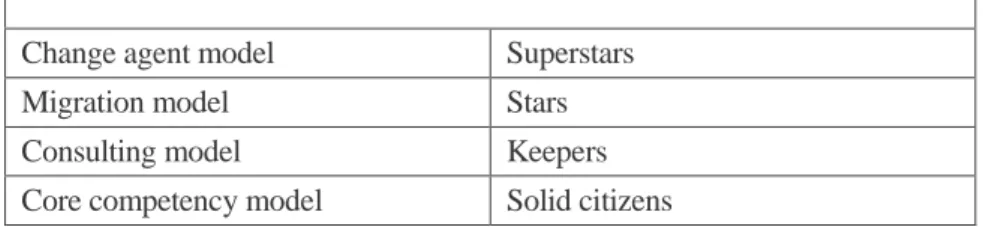
Hashim adapted the talent management model from Berger L. & Berger D. (2004), based on the superstar focus as he needed more change agents to transform the internal audit function. This model required him to identify a small group with high potential. He used the Shell CEP model to hand pick young talent from the company talent pool. He also classified each of the internal auditors according
to their potential, performance and professional competence (See Table 1). The
“investments” in these classes are differentiated.
Table 1: Resource Classification and Investment
Change agent model Superstars
Migration model Stars
Consulting model Keepers
Core competency model Solid citizens
Hashim Mohammed
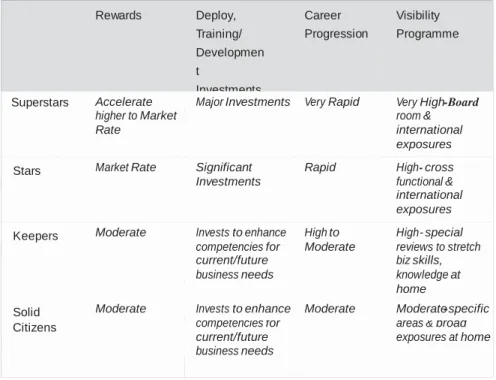
The Superstars or those with top management potential were personally coached and mentored by the GCIA. They were developed and deployed through extensive exposure to group wide operations to obtain a helicopter view of the business. Most were given stretched assignments to test their capabilities and capacities. These included short high profile assignments at major companies operations overseas, which involved interactions with Board members and top management. The formal training provided included a step-by-step competency building to address the gaps. Training included short programmes by visiting professors from Harvard, senior management programme and international conferences. These superstars were rewarded not just through normal financial remuneration, but were recognized through visibility and exposure in the boardroom to develop a boardroom presence. They were usually called to attend the BAC meetings, and interact with board members.
The “stars” on the other hand, comprised those not in the talent pool, but were spotted by GCIA through social contacts and internal advertisements and were considered “hidden gems”. Since the potential and performance of some of these individuals were not proven, they were given challenging assignments to test their true limits and potential. Their CEP was assessed through regular coaching and contacts with the GCIA. They were often deployed to subsidiary companies and required to interact with board members. Some of these auditors were posted to countries, such as Indonesia and Bangladesh, to set up the internal audit functions, and become the eyes and ears of the GCIA and BAC. This “swim with the sharks and trial by fire” approach enabled them to gain both
experience and context (McCall & Hollenbeck, 2002). It quickly transformed
ordinary talent into “stars” within a very short period. Although “stars” underwent similar training and development as the “superstars”, they usually required more intensive development. “Stars” were also encouraged to develop professionally. However, these emerging “stars” did not tend to stay very long in GIA, as they soon realized their market value and demanded promotion or migrated to MNCs. Hence, regular one-on-one discussion was necessary to assess their changing personal aspirations and value propositions. Once proven, stars were rewarded through rapid career progression.
The “Keepers” included a cadre of diverse auditors from multi discipline backgrounds from the business – finance, technical, IT, marketing, law, and some from Big 4 accounting firms. They were deployed as audit managers, and developed into audit consultants/advisors. They were specialists in their own chosen fields with in-depth knowledge of the business or technical matters. They see themselves as professionals, and, often, would like to remain as professionals in certain disciplines. Some developed themselves into internal audit professionals by taking up CIA certification. They tended to stay longer in the IA function, and became the core of the internal team. Training included structured general management and leadership training. Intensely specialized functional training, such as SAP, FRS, Technical and IT were provided. Professional certification and
Leading an Internal Audit Function for the 21St Century – Experience of Telekom Malaysia
networking were encouraged. The reward, career path and visibility exposure were considered moderate for this group, as their expectations were lower than the stars. “Solid citizens” encompassed a class of internal auditor who saw themselves as seasoned audit professionals who remained in IA for an extended period, and sought to develop professionalism in internal auditing. Some saw internal audit as a professional career and worked hard to get certified as CIA or CISA. They constitute the workhorses of the function, and continuous support was provided to develop their functional competence. They were also developed through exposure to different audits besides the areas they specialize in. Some developed mastery in using techniques, such as ACL and Audit Management System.
There have been a number of internal auditors who were able to move from one class to another as they improved their personal mastery. In most instances, these came about as a result of managing investments and providing exposure,
rewards, recognition and career progression. See Table 2. To make this happen
Hashim also realized that he needed to provide protection and air cover to his mentees from the reality of corporate office politics. More than a dozen GIA superstars have migrated to strategic business in TM, and some are leading PLCs and regional MNCs as CAEs.
Table 2: Managing Investments
Rewards Deploy, Training/ Developmen t
Investments
Career Progression
Visibility Programme
Superstars Accelerate Major Investments Very Rapid Very High-Board
higher to Market room &
Rate international
exposures
Stars Market Rate Significant
Investments
Rapid High- cross
functional & international exposures
Keepers Moderate Invests to enhance
competencies for
High to Moderate
High- special reviews to stretch
current/future biz skills,
business needs knowledge at
home
Solid Moderate Invests to enhance Moderate Moderate-specific
Citizens competencies for
current/future
areas & broad exposures at home business needs
Hashim Mohammed
4. Conclusion
Hashim realised that the future sustainability of GIA depended on key individuals with mastery in not just accounting and auditing, but in general management skills, deep-rooted business knowledge, leadership and the ability to create value. At the same time, he needed to maintain balance and chemistry with his team of young high performers. The key question that remained in his mind is how to attract, deploy and retain his best people – the superstars and stars – and, at the same time, continue to provide sufficient rewards and challenges to his keepers and solid citizens, and work out progressive releases of people to key management positions as part of their career planning and succession. This is indeed, a delicate balance to achieve.
References
Berger L. & Berger D. (2004). The Talent Management Handbook, McGraw-Hill
Companies, New York
Goffee R. & Jones G. (March 2007). Leading Clever People, Harvard Business
Review, Boston
McCall, M. & Hollenbeck G. (2002). Developing Global Executives, The Lessons
of International Experiences, Harvard Business School Press, Boston
Mohammed, Hashim, (2004). Internal Audit Practices in Malaysia, Pearson
Malaysia and the Institute of Internal Auditors Malaysia, 21-31.
Note
The author is the Group Chief Internal Auditor and Secretary to the Board Audit Committee of Telekom Malaysia Berhad. Prior to that, he spent 21 years in Shell holding diverse management positions. Hashim is the President on the Board of IIA Malaysia and is a Chartered Fellow. He is also a member of the Australian Institute of Company Directors.
Leading an Internal Audit Function for the 21St Century – Experience of Telekom Malaysia
Appendix 1
Hashim Mohammed