R E S E A R C H A R T I C L E
Open Access
Development and validation of the quality
care questionnaire
–
palliative care
(QCQ-PC): patient-reported assessment of
quality of palliative care
Young Ho Yun
1,2,3*†, Eun Kyo Kang
1†, Jihye Lee
2, Jiyeon Choo
3, Hyewon Ryu
4, Hye-min Yun
4, Jung Hun Kang
5,
Tae You Kim
6, Jin-Ah Sim
3and Yaeji Kim
3Abstract
Background:In this study, we aimed to develop and validate an instrument that could be used by patients with cancer to evaluate their quality of palliative care.
Methods:Development of the questionnaire followed the four-phase process: item generation and reduction, construction, pilot testing, and field testing. Based on the literature, we constructed a list of items for the quality of palliative care from 104 quality care issues divided into 14 subscales. We constructed scales of 43 items that only the cancer patients were asked to answer. Using relevance and feasibility criteria and pilot testing, we developed a 44-item questionnaire. To assess the sensitivity and validity of the questionnaire, we recruited 220 patients over 18 years of age from three Korean hospitals.
Results:Factor analysis of the data and fit statistics process resulted in the 4-factor, 32-item Quality Care Questionnaire-Palliative Care (QCQ-PC), which covers appropriate communication with health care
professionals (ten items), discussing value of life and goals of care (nine items), support and counseling for needs of holistic care (seven items), and accessibility and sustainability of care (six items). All subscales and total scores showed a high internal consistency (Cronbach alpha range, 0.89 to 0.97). Multi-trait scaling analysis showed good convergent (0.568–0.995) and discriminant (0.472–0.869) validity. The correlation
between the total and subscale scores of QCQ-PC and those of EORTC QLQ-C15-PAL, MQOL, SAT-SF, and DCS was obtained.
Conclusion: This study demonstrates that the QCQ-PC can be adopted to assess the quality of care in patients with cancer.
Keywords: Quality of care, Questionnaire, Palliative care, Validation
Background
Despite advances in cancer therapy for cancer, most pa-tients with cancer still suffer due to the disease itself, as well as its treatment [1–3]. Patients with cancer have fa-tigue, pain, loss of appetite, depression, and social and
spiritual distress [1]. Considering these various aspects, the definition of quality of life (QOL) in cancer patients is included personal insights of cancer patients’ symp-toms, including physical, mental, social, and cognitive functions [4]. As attention to QOL in oncologic care throughout the cancer trajectory has increased, palliative care is being better integrated into oncologic care at earlier stages, than in the past [1–3].
The World Health Organization (WHO) defines pal-liative care as “an approach that improves the QOL of patients and their families facing the problems associated
* Correspondence:[email protected]
†Equal contributors
1
Department of Family Medicine, Seoul National University Hospital, 103 Daehak-ro, Jongno-GU, Seoul 03080, Republic of Korea
2Department of Biomedical Informatics, Seoul National University College of
Medicine, Seoul, South Korea
Full list of author information is available at the end of the article
with life-threatening illness, through the prevention and re-lief of suffering by means of early identification and impec-cable assessment and treatment of pain and other problems, physical, psychosocial, and spiritual”. Recently, it was demonstrated that early palliative care resulted in not only a significant improvement in QOL [5–7], but also lon-ger survival among patients with cancer [5,8].
Because palliative care is one of the factors that in-fluences the patient’s QOL, it is also important that the patient is provided with palliative care of good quality defined by two crucial, humane dimensions: high quality of care, and full acceptance of the pa-tient’s intentions so that care is provided in a humane and culturally appropriate manner [9].
To design palliative care intervention strategies tailored to the patient, it is crucial to identify patients at a high risk for poor quality care by using a valid assessment tool. However, most instruments measure quality of care in pa-tients at end of life (EOL) [10–15]. There are few assess-ment tools focusing on quality of care in patients with cancer receiving palliative care [16,17], and there are limi-tations in that most of the current palliative care assess-ment tools did not include spiritual and cultural domains, and there are few tools to assess the EOL care experience reported by the patient [18]. In addition, most of the pal-liative care assessment tools developed so far measure the QOL of the patient, not the quality of care [19–23].
Therefore, in the present study, we aimed to develop a new instrument to assess quality of palliative care and report on the validation of the developed tool, which is called Quality of Care Questionnaire-Palliative Care scale (QCQ-PC).
Methods Study design
QCQ-PC includes four stages of development proposed by the European Organization for Research and Treat-ment of Cancer Quality of-Life Group [24]: 1) item gen-eration and reduction; 2) scale construction; 3) pilot testing; and 4) field testing. The study was approved by the Institutional Review Board of the Seoul National University Hospital, Korea. Suitable patients signed in-formed consent forms. The requirements for the recruit-ment of patients were as follows: (1) 18 years old or older; (2) diagnosed with cancer (cancer was confirmed by oncologists); (3) able to read and comprehend Ko-rean, be able to fill in the questionnaire; and (4) aware of cancer diagnosis.
Phase I: Item generation and reduction
Phase I was intended to gather a list of relevant quality of palliative care questionnaires and previous palliative care clinical guidelines. We performed an extensive lit-erature review using PUBMED and other databases
searching the keywords ‘palliative care’,‘end of life care’, and ‘quality of care’. We conclusively reviewed and adopted End of Life Quality Standards (2013) published by The National Institute for Health and Care Excellence (NICE) in the United Kingdom, Clinical Practice Guide-lines for Quality Palliative Care (3rd Ed. 2013) released by National Consensus Project (NCP) in the United States and A National Framework and Preferred Prac-tices for Palliative and Hospice Care Quality issued by National Quality Forum (NQF) in the United States.
We also considered the quality of care index of the prior study. We investigated and used the Assessment of Chronic Illness Care (ACIC) questionnaire and the Pa-tient Assessment of Chronic Illness Care (PACIC)
ques-tionnaire translated by National Evidence-based
Healthcare Collaborating Agency (NECA) in a previous study, which was a study of the performance evaluation methods of sub-categories in the management of chronic disease patients in a community by the primary health care center (2015). In addition, the FAMCARE Patient Scale developed by Kristjanson (1993) and verified with respect to validity and reliability was used. Based on the literature, we constructed a list of items for the QCQ-PC from 104 quality care issues divided into 14 scales.
We discussed these 104 items in semi-structured inter-views with 31 health care professionals in November 2016 and December 2016. The health care professionals participating in the survey included physicians, nurses, and social workers who worked in university hospitals and were engaged in palliative care. The semi-structured interviews did not include patients because the items built by healthcare professionals were intended to be pilot-tested separately. The survey was conducted twice in total, and the respondents evaluated the validity and feasibility of the developed items by scoring them on a scale from 1 to 5. In the second investigation, the aver-age score of all respondents for each item was compared with the score given by them, and the score changed when the respondent’s evaluation changed. The items that did not meet the following criteria in both the pri-mary and secondary surveys were deleted (in the case of validity, if the respondent average score was three or more, or the respondent score was less than three points in less than 25% of the respondents; in the case of feasi-bility, the respondent average score is 2.5 or more, or less than three points in less than 30% of the total re-spondents). Thirteen items (12.5% of the developed items) that did not meet the criteria were deleted; there-fore, a total of 91 items were included in the final index.
Phase II: Scale construction
the patients were asked to answer. The 48 items that were excluded were the items that directly asked the medical staff to evaluate the quality of care. For the scor-ing format, we selected a four-point Likert scale for all of 43 items to evaluate in phase III (Strongly Agree, Agree, Disagree, Strongly Disagree–see Additional file1: Appendix B).
Phase III: Pilot testing
We conducted pilot tests to find possible administration problems, such as miss-phrasing, and to determine which items should be modified or removed. Before field testing, a total of 15 cancer patients responded to the QCQ-PC questionnaire and debriefed the questionnaire. The mean age of the 15 patients was 60.6 years, with 7 males and 8 females. Regarding educational level, most subjects had more than college or university education. All 15 patients were collected from Seoul National Uni-versity Hospital. All 15 patients were collected from Seoul National University Hospital. The questionnaire designed for debriefing included which questions were misleading, whether the respondents were offended, or whether they were unable to respond. After the ques-tionnaire, we received comments on the questionnaire. Taking into consideration the responses of these debrief-ing questionnaires, we clarified and simplified the items that were difficult to understand or answer. We also added one item to reflect the needs of the respondents.
Phase IV: Field testing
To confirm reliability and validity, we performed a field test with the QCQ-PC questionnaire.
Because the most patients group receiving palliative care are patients diagnosed with cancer, we performed this field testing for the QCQ-PC questionnaire to cancer patients. To obtain a heterogeneous sample by cancer type, patients were recruited to include various primary sites of cancer; these patients were registered at four university hospitals in Korea. We included pa-tients under curative treatment as well as papa-tients under palliative treatment. This study used factor ana-lysis with varimax rotation to analyze construct valid-ity, and performed multi-trait scaling analysis to examine the extent to which QCQ-PC items could be combined into a more controlled multi-item set. For validation, we applied ten rules, for which at least five respondents were required per item [25, 26]. Since we had a total of 44 questions, 220 respondents were ne-cessary for the validation process.
We investigated the correlation between each question and the scale that included that question, and estimated the convergent validity of the QCQ-PC items.In verify-ing discriminant validity, we assessed the magnitude of the correlation of an item with its own scale as
compared to other scales. We considered the convergent validity of items by analyzing correlations that were≥0.4, and corrected for overlap, as confirmation of validity [27]. We identified scaling errors as cases in which an item correlated significantly less with its own scale as compared to its correlation with other scales. To test the reliability of QCQ-PC, we estimated Cronbach alpha, a degree of internal consistency of responses. An alpha
≥0.70 was generally regarded as acceptably high for the collection of responses into a single score [28].
Furthermore, fit statistics (INFIT/OUTFIT) analysis was performed to evaluate the fitness of the item re-sponse, and it was interpreted as a good response when the fit was between 0.7 and 1.3 [29]. The slope was checked to confirm the discrimination of the items. In the case of a fit value less than 1.5, the dis-crimination of the items was considered unsuitable (see Additional file 1: Appendix A).
Additional evaluation
We asked the respondents to fill in additional ques-tionnaires on previous validated scales. The following
questionnaires were included: The European
Organization for Research and Treatment of Cancer Quality of Life Questionnaire Core-15 item palliative
care (EORTC QLQ–C15-PAL) measuring
patient-reported QoL [30], the McGill Quality of Life Ques-tionnaire (MQOL) constructed by physical symptoms, psychological symptoms, existential well-being, and support [31], the Smart Management Strategy for
Health Assessment Tool – Short Form (SAT-SF) for
self-management strategies assessments [32], and the Decisional Conflict Scale (DCS) - assesses the level of ‘decisional conflict’ that patients experience while making health care decisions [33].
Data analyses were conducted using WINSTEP ver-sion 4.0 for item-fit analysis, and SPSS verver-sion 24.0 for other statistical analyses.
Results
A total of 220 patients under curative or palliative therapy were enrolled in this study during the 2-month survey period. Most patients (96.4%) com-pleted the questionnaire, but eight patients were ex-cluded from the analysis because they did not answer more than three items. The remaining 212 patients included in the analysis responded to all questions.
Factor analysis
We conducted factor analysis on the total sample of re-spondents (n= 220). We initially had four significant fac-tors with 44 items; twelve items were discarded through the fit statistics process. Upon reanalysis of the remaining 32 items, the items were classified according to four significant factors. Table2lists the item-to-factor correlations for the 32 items and four factors–factor 1: appropriate communication with health care profes-sionals (ten items); factor 2: discussing value of life and goals of care (nine items); factor 3: support and counsel-ing for needs of holistic care (seven items); and factor 4: accessibility and sustainability of care (six items). We attained similar of factor analysis results with both mul-tiple and simple imputations.
Reliability
Table 3 shows the mean and reliability of the QCQ-PC subscale. In all four scales, the degree of reliability was
high, with good internal consistency (Cronbach alpha range: 0.889–0.973).
Validity: Multi-trait scaling analysis
When item-to-self scale correlations were tested, all item-convergent validity exceeded 0.4. Other scales were also compared through item-discriminant validity, and no scaling error was observed.
Additional evaluation Additional evaluationMQOL
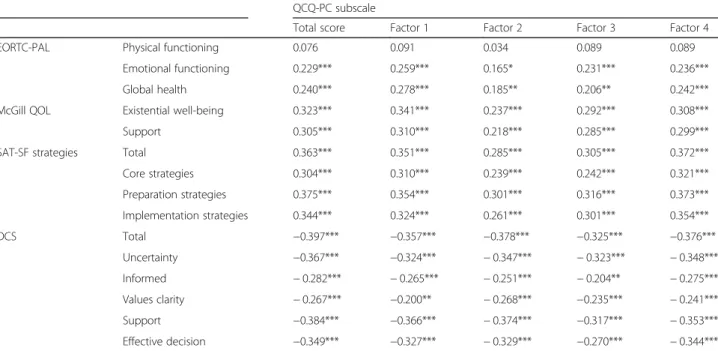
We obtained the correlation between total and subscale scores of QCQ-PC and EORTC QLQ-C15-PAL and MQOL (see Table4). Both total and subscale scores sig-nificantly correlated with the emotional functioning and global health scores of EORTC QLQ-C15-PAL (Pearson correlation [r] range 0.165–0.278). Existential well-being and support scores of MQOL significantly correlated with both the total and subscale scores of QCQ-PC (Pearson correlation [r] range 0.218–0.341, p< 0.001). However, total and subscale scores of QCQ-PC did not correlate with physical functioning.
Comparisons with SAT-SF (smart management strategy for health assessment tool–Short form) scores
SAT is a tool to identify self-management strategies of cancer patients. We used the short form of SAT to exam-ine the association with the QCQ-PC score. As expected, there was a significant correlation between the SAT total score and the QCQ-PC score (Pearson correlation [r] range 0.285–0.372,p< 0.001). Compared to each subscale of SAT, significant correlation was observed (Pearson cor-relation [r] range 0.239–0.375,p< 0.001).
Comparisons with DCS
QCQ-PC scores showed correlation with the DCS total score and subscale score (Pearson correlation [r] range 0.325–0.397, 0.200–0.384). DCS is scored in the opposite direction; the higher the score, the higher the decision conflict.
Discussion
The 32-item QCQ-PC is patient-reported and has excel-lent psychometric properties. The QCQ-PC consists of four factors that focus on communication with health care professionals, discussing value of life and goals of care, support and counseling for holistic care needs, and accessibility and continuity of care, all of which are cen-tral issues in palliative care. Our results are consistent with the findings of many previous studies and recom-mendations [1, 3, 6], but diverge in terms of quality of care at EOL [10–15]. The factors are unique and differ-ent from standard oncology care [6].
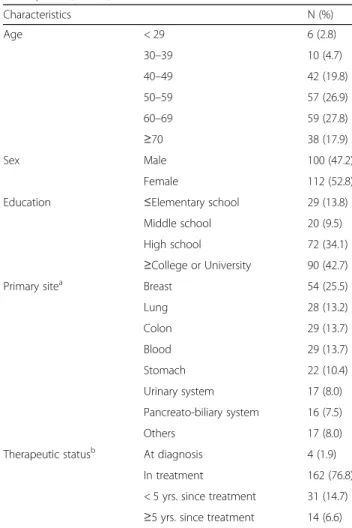
Table 1Demographic and clinical characteristics of the Participants (N=212)
Characteristics N (%) Age < 29 6 (2.8)
30–39 10 (4.7) 40–49 42 (19.8) 50–59 57 (26.9) 60–69 59 (27.8)
≥70 38 (17.9) Sex Male 100 (47.2)
Female 112 (52.8) Education ≤Elementary school 29 (13.8)
Middle school 20 (9.5) High school 72 (34.1)
≥College or University 90 (42.7) Primary sitea Breast 54 (25.5)
Lung 28 (13.2) Colon 29 (13.7) Blood 29 (13.7) Stomach 22 (10.4) Urinary system 17 (8.0) Pancreato-biliary system 16 (7.5) Others 17 (8.0) Therapeutic statusb At diagnosis 4 (1.9)
In treatment 162 (76.8) < 5 yrs. since treatment 31 (14.7)
≥5 yrs. since treatment 14 (6.6)
a
Primary site of cancer
b
This study suggests that QCQ-PC has excellent psy-chometric properties, such as high construct validity and internal consistency. That QCQ-PC exhibited less cor-relation with EORTC QLQ-C15-PAL than with MQOL, and does not have significant correlation with physical functioning, suggesting that QCQ-PC more measures
the emotional, social, and spiritual aspects of care in pal-liative settings rather than symptom control. Addition-ally, most correlations of QCQ-PC subscales with QOL subscales were below 0.4, suggesting that QCQ-PC may differentiate aspects of palliative care from those ad-dressed by the QOL assessment tools. Therefore,
QCQ-Table 2Factor analysis of 32 QCQ-PC Items
QCQ-PC items Factorb
Noa Questions Factor 1 Factor 2 Factor 3 Factor 4 3 I am satisfied with the careful manner of medical staff 0.767 0.164 0.334 0.148 6 I am satisfied with the way of communication of medical staff 0.755 0.212 0.350 0.118 2 I was able to receive adequate care from medical staff 0.742 0.163 0.219 0.149 7 I have heard and understood an accurate description of the progress of my disease 0.734 0.304 0.105 0.186 11 The medical staff explained terms that I was curious about 0.662 0.245 0.326 0.219 4 I was able to receive the healthcare service I demanded 0.634 0.378 0.106 0.370 9 The medical staff support my decision on care plan 0.601 0.446 0.091 0.495 8 I have heard and understood an accurate description of my care plan 0.600 0.441 0.026 0.433 43 I was able to have a conversation with medical staff in a relaxed atmosphere 0.583 0.222 0.581 0.119 25 The medical staff paid attention to various symptoms I felt and adjusted them well 0.580 0.097 0.446 0.300 13 I was able to discourse with medical staff about the value of my life 0.305 0.737 0.375 0.044 14 I was able to recall what is important to achieve the values and goals of my life while
discoursing with medical staff
0.250 0.709 0.432 0.032 16 I was able to express what my family and I expected from care 0.310 0.704 0.229 0.289 18 My care plans included the things I was able to try myself 0.141 0.684 0.115 0.336 19 I was able to receive adequate help from medical staff, while I was having difficulties in
setting up specific goals related to care
0.196 0.683 0.324 0.358 17 My family and I received an education that is helpful to care 0.246 0.670 0.333 0.226 21 The medical staff suggested an adequate care plan in consideration of values of my life 0.303 0.599 0.289 0.434 22 I was able to modify my plan when my demand for treatment changed 0.279 0.557 0.274 0.395 12 The medical staff managed intermediate checkups to verify whether I could execute my goals 0.509 0.544 0.180 0.284 44 I was able to receive outpatient care and telephone counseling with plenty of time 0.325 0.293 0.702 0.123 30 The medical staff provide support to me and my family to solve spiritual concerns 0.043 0.360 0.647 0.225 29 The medical staff provided support to me and my family to overcome social crisis 0.224 0.451 0.620 0.262 33 The medical staff knew what I wanted 0.257 0.187 0.619 0.382 28 The medical staff communicated smoothly with me and my family 0.291 0.255 0.592 0.380 41 Outpatient care and telephone counseling were done at the appointed time without delay 0.483 0.138 0.524 0.078 27 My family and I received psychological support from medical staff 0.242 0.299 0.508 0.424 35 Services needed for my care are provided by experts in their respective fields 0.148 0.228 0.367 0.706
36 I was able to get care services at the locations I wanted 0.237 0.293 0.404 0.669
38 Medical care is immediately provided in a state of crisis 0.315 0.228 0.340 0.552
23 The medical staff periodically confirmed my goals and plans toward care 0.275 0.482 0.341 0.540
10 The decision on a healthcare plan was reflected by my family and my opinions 0.485 0.419 0.009 0.517
5 I understand the goal of care 0.429 0.450 0.151 0.503
Results from orthogonal (varimax) rotation analysis. Bold type indicates loading > 0.5
a
The number of each item is its number in the QCQ-PC questionnaires
b
PC is recommended for use together with a QOL assess-ment tool, such as EORTC QLQ-C15-PAL, in order to more accurately to measure the quality of care.
In this study, QCQ-PC had significant negative correl-ation between the total and subscale scores and the DCS scores. Lack of communication with healthcare profes-sionals and discussing value of life and goals of care may cause patient dissatisfaction with respect to care during cancer treatment, and lead patients to choose interven-tions that physicians believe are inappropriate. In addition, it is particularly crucial for healthcare providers to support and counsel on holistic care needs, to deliver continuous palliative care for patients with cancer, to maintain good interpersonal relationships with them,
and to relieve their decisional conflict [1, 2, 6, 10]. We can improve their decision conflicts by recognizing high risk groups in quality care and providing palliative care.
Perhaps the most interesting finding of this study is that QCQ-PC appears to be sensitive to health manage-ment in palliative care settings. Using a conceptual model, self-health management with cancer can be influ-enced by quality care including communication with health care professionals, discussing value of life and goals of care, support and counseling for holistic care needs, and accessibility and continuity of care. Our find-ings showing that the QCQ-PC scales were associated with strategy scales for health management support this conceptual model.
Table 3Descriptive statistics and subscale reliability results for QCQ-PC items
Subscales Number of Items
Range of Scores
Mean(SD) Reliability Cronbach’sα
Convergent Validity
Discriminant Validity
Scaling Success
Scaling Errors (%) Total 32 0–100 2.813
(0.555) 0.973 Factor 1: Appropriate communication with
healthcare professionals
10 0–100 3.036 (0.576)
0.940 0.699–0.858 0.527–0.760 40/40 0 Factor 2: Discussing value of life and goals
of care
9 0–100 2.688 (0.616)
0.935 0.691–0.852 0.514–0.740 36/36 0 Factor 3: Support and counseling for needs
of holistic care
7 0–100 2.673 (0.597)
0.889 0.568–0.839 0.472–0.721 28/28 0 Factor 4: Accessibility and sustainability of
care
6 0–100 2.866 (0.602)
0.896 0.655–0.885 0.512–0.869 24/24 0
Abbreviations: QCQ-PCQuality Care Questionnaire–Palliative Care,SDStandard deviation
Table 4Pearson correlations of QCQ-PC with other validated questionnaires (EORTC QLQ-C15-PAL, MQOL, SAT-SF, DCS)
QCQ-PC subscale
Total score Factor 1 Factor 2 Factor 3 Factor 4 EORTC-PAL Physical functioning 0.076 0.091 0.034 0.089 0.089
Emotional functioning 0.229*** 0.259*** 0.165* 0.231*** 0.236*** Global health 0.240*** 0.278*** 0.185** 0.206** 0.242*** McGill QOL Existential well-being 0.323*** 0.341*** 0.237*** 0.292*** 0.308*** Support 0.305*** 0.310*** 0.218*** 0.285*** 0.299*** SAT-SF strategies Total 0.363*** 0.351*** 0.285*** 0.305*** 0.372*** Core strategies 0.304*** 0.310*** 0.239*** 0.242*** 0.321*** Preparation strategies 0.375*** 0.354*** 0.301*** 0.316*** 0.373*** Implementation strategies 0.344*** 0.324*** 0.261*** 0.301*** 0.354*** DCS Total −0.397*** −0.357*** −0.378*** −0.325*** −0.376***
Uncertainty −0.367*** −0.324*** −0.347*** −0.323*** −0.348*** Informed −0.282*** −0.265*** −0.251*** −0.204** −0.275*** Values clarity −0.267*** −0.200** −0.268*** −0.235*** −0.241*** Support −0.384*** −0.366*** −0.374*** −0.317*** −0.353*** Effective decision −0.349*** −0.327*** −0.329*** −0.270*** −0.344***
Abbreviation: EORTC QLQ-C15-PALEuropean Organization for Research and Treatment of Cancer Quality of Life Questionnaire Core-15 item palliative care,McGill QOLMcGill Quality of Life Questionnaire,SATSmart Management Strategy for Health (SMASH) Assessment Tool,DCSDecisional Conflict Scale
Study limitations
This study has several limitations. First, since our re-search was conducted only in Korea, cross-cultural val-idation studies are necessary for generalizations toother countries. Second, we did not assess test-retest. As QOL and quality of care among cancer patients can frequently change, test-retest may not be feasible and may not limit the psychometric properties of this QCQ-PC. Finally, as this study relied exclusively on patients with cancer, our findings might not be generalizable to non-cancer pa-tients who need palliative care. Furthermore, our study included not only incurable cancer patients, but also pa-tients who had received treatment more than 5 years previously. However, to assess the quality of early pallia-tive care as well, it may be preferable to include all can-cer patients rather than only those with incurable cancan-cer for constructing the questionnaire. We suggested that it is necessary to investigate further research on the pa-tients of early palliative care and palliative care with this QCQ-PC questionnaire. Though, some modification of items among the QCQ-PC might be applied to patients with other advanced diseases.
Conclusion
In conclusion, we believe that this QCQ-PC, a self-reported assessment tool with proper psychometric properties, can be effectively used to identify patients with cancer at high risk, and to evaluate the efficacy of trials, such as palliative care with the QOL assessment tool.
Additional file
Additional file 1:Appendix A. Factor analysis (Item discrimination, slope, and factor loading) and fit statistics (INFIT/OUTFIT) analysis; Table describing the result of factor analysis and fit statistics of 44 items.
Appendix B. Quality Care Questionnaire–Palliative Care (QCQ-PC); Palliative care quality questionnaire validated in this paper. (DOCX 50 kb)
Abbreviations
CI:Confidence interval; DCS: Decisional conflict scale; EOL: End of life; EORTC QLQ-C15-PAL: European Organization for Research and Treatment of Cancer Quality of Life Questionnaire Core-15 item palliative care; MQOL: The McGill quality of life questionnaire; OR: Odds ratio; QCQ-PC: Quality care
questionnaire-palliative care; QOL: Quality of life; SAT-SF: Smart management strategy for health assessment tool–short form
Acknowledgments
Not applicable.
Funding
This research was supported by a grant of the Korea Health Technology R&D Project through the Korea Health Industry Development Institute (KHIDI), funded by the Ministry of Health & Welfare, Republic of Korea (grant number: HC15C1391).
Availability of data and materials
The dataset can be obtained on request from the first author, Young Ho Yun ([email protected]).
Authors’contributions
YHY and EKK participated in designing the study and interpreted the analyses, and drafted the manuscript. JL, JC, HY collected and assembled the study materials and study data. JAS and YK performed the statistical analysis, and helped draft the manuscript. HR, JHK and TYK participated in building the design of the study, provided the study materials, provided and informed patients of the study to be enrolled into the study. All authors have read and approved the final manuscript.
Ethics approval and consent to participate
The patient data reported in this study were derived from a survey approved by the Institutional Review Board of Seoul National University Hospital, and patients signed appropriate informed consent forms (IRB number 1703–157-840).
Consent for publication
Not applicable.
Competing interests
The authors declare that they have no competing interests.
Publisher’s Note
Springer Nature remains neutral with regard to jurisdictional claims in published maps and institutional affiliations.
Author details
1Department of Family Medicine, Seoul National University Hospital, 103
Daehak-ro, Jongno-GU, Seoul 03080, Republic of Korea.2Department of Biomedical Informatics, Seoul National University College of Medicine, Seoul, South Korea.3Department of Biomedical Science, Seoul National University
College of Medicine, Seoul, South Korea.4Department of Internal Medicine,
Chungnam National University Hospital, Daejeon, South Korea.5Department of Internal Medicine, Postgraduate Medical School, Gyeongsang National University, Jinju, South Korea.6Department of Internal Medicine, Seoul
National University Hospital, Seoul, South Korea.
Received: 14 September 2017 Accepted: 27 February 2018
References
1. Greer JA, Jackson VA, Meier DE, Temel JS. Early integration of palliative care services with standard oncology care for patients with advanced cancer. CA Cancer J Clin. 2013;63(5):349–63.
2. Parikh RB, Kirch RA, Smith TJ, Temel JS. Early specialty palliative care—translating data in oncology into practice. N Engl J Med. 2013; 369(24):2347–51.
3. Ferrell BR, Temel JS, Temin S, Alesi ER, Balboni TA, Basch EM, Firn JI, Paice JA, Peppercorn JM, Phillips T. Integration of palliative care into standard oncology care: American Society of Clinical Oncology clinical practice guideline update. J Clin Oncol. 2017;35(1):96–112.
4. Bottomley A. The cancer patient and quality of life. Oncologist. 2002;7(2):120–5. 5. Temel JS, Greer JA, Muzikansky A, Gallagher ER, Admane S, Jackson VA,
Dahlin CM, Blinderman CD, Jacobsen J, Pirl WF. Early palliative care for patients with metastatic non–small-cell lung cancer. N Engl J Med. 2010; 363(8):733–42.
6. Zimmermann C, Swami N, Krzyzanowska M, Hannon B, Leighl N, Oza A, Moore M, Rydall A, Rodin G, Tannock I. Early palliative care for patients with advanced cancer: a cluster-randomised controlled trial. Lancet. 2014; 383(9930):1721–30.
7. Temel JS, Greer JA, El-Jawahri A, Pirl WF, Park ER, Jackson VA, Back AL, Kamdar M, Jacobsen J, Chittenden EH. Effects of early integrated palliative care in patients with lung and GI cancer: a randomized clinical trial. J Clin Oncol. 2016;35(8):834–41.
8. Bakitas MA, Tosteson TD, Li Z, Lyons KD, Hull JG, Li Z, Dionne-Odom JN, Frost J, Dragnev KH, Hegel MT. Early versus delayed initiation of concurrent palliative oncology care: patient outcomes in the ENABLE III randomized controlled trial. J Clin Oncol. 2015;33(13):1438–45.
9. Brook RH, McGlynn EA, Shekelle PG. Defining and measuring quality of care: a perspective from US researchers. Int J Qual Health Care. 2000;12(4):281–95. 10. Yun YH, Kim S-H, Lee K-M, Park SM, Lee CG, Choi YS, Lee WS, Kim S-Y, Heo
and validation of quality care questionnaire–end of life (QCQ–EOL). Eur J Cancer. 2006;42(14):2310–7.
11. Mayland CR, Williams EM, Ellershaw JE. Assessing quality of care for the dying: the development and initial validation of a postal self-completion questionnaire for bereaved relatives. Palliat Med. 2012;26(7):897–907. 12. Heckel M, Bussmann S, Stiel S, Weber M, Ostgathe C. Validation of the German
version of the quality of dying and death questionnaire for informal caregivers (QODD-D-Ang). J Pain Symptom Manag. 2015;50(3):402–13.
13. Mayland CR, Lees C, Germain A, Jack BA, Cox TF, Mason SR, West A, Ellershaw JE. Caring for those who die at home: the use and validation of
‘care of the dying evaluation’(CODE) with bereaved relatives. BMJ Support Palliat Care. 2014;4(2):167–74.
14. Mystakidou K, Tsilika E, Kouloulias V, Parpa E, Katsouda E, Kouvaris J, Vlahos L. The" palliative care quality of life instrument (PQLI)" in terminal cancer patients. Health Qual Life Outcomes. 2004;2(1):8.
15. Lo C, Burman D, Swami N, Gagliese L, Rodin G, Zimmermann C. Validation of the QUAL-EC for assessing quality of life in patients with advanced cancer. Eur J Cancer. 2011;47(4):554–60.
16. Shimizu M, Fujisawa D, Kurihara M, Sato K, Morita T, Kato M, Miyashita M. Validation study for the brief measure of quality of life and quality of care: a questionnaire for the National Random Sampling Hospital Survey. Am J Hosp Palliat Med. 2017;34(7):622–31.https://doi.org/10.1177/1049909117693576. 17. Gonçalves F. Initial assessment of patients without cognitive failure
admitted in palliative care. Am J Hosp Palliat Med. 2014;31(1):33–7. 18. Aslakson RA, Dy SM, Wilson RF, Waldfogel J, Zhang A, Isenberg SR, Blair A,
Sixon J, Lorenz KA, Robinson KA. Patient- and Caregiver-Reported Assessment Tools for Palliative Care: Summary of the 2017 Agency for Healthcare Research and Quality Technical Brief.J Pain Symptom Manage. 2017;54(6):961–72. e916
19. Zhang L, Wang N, Zhang J, Liu J, Luo Z, Sun W, Woo SM-L, Chen C, Zhang K, Miller AR. Cross-cultural verification of the EORTC QLQ-C15-PAL questionnaire in mainland China. Palliat Med. 2016;30(4):401–8. 20. Hu L, Li J, Wang X, Payne S, Chen Y, Mei Q. Prior study of cross-cultural
validation of McGill quality-of-life questionnaire in mainland mandarin Chinese patients with cancer. Am J Hosp Palliat Med. 2015;32(7):709–14. 21. Zeng L, Bedard G, Cella D, Thavarajah N, Chen E, Zhang L, Bennett M,
Peckham K, De Costa S, Beaumont JL. Preliminary results of the generation of a shortened quality-of-life assessment for patients with advanced cancer: the FACIT-pal-14. J Palliat Med. 2013;16(5):509–15.
22. Henoch I, Axelsson B, Bergman B. The assessment of quality of life at the end of life (AQEL) questionnaire: a brief but comprehensive instrument for use in patients with cancer in palliative care. Qual Life Res. 2010;19(5):739–50. 23. Hearn J, Higginson I. Development and validation of a core outcome
measure for palliative care: the palliative care outcome scale. Palliative care core audit project advisory group. Qual Saf Health Care. 1999;8(4):219–27. 24. Group EQoL: Guidelines for developing questionnaire modules. In.: European
Organisation for Research and Treatment of Cancer (EORTC), Brussels; 2002. 25. Hong S, You S. Developmental research: theory, method, design and
statistical analysis. In: Handbook of complementary methods in education research; 2006. p. 207.
26. Cochran WG. Sampling techniques. Chichester: Wiley; 2007. 27. Fayers PM, Machin D. Quality of life: the assessment, analysis and
interpretation of patient-reported outcomes. Chichester: Wiley; 2013. 28. Tavakol M, Dennick R. Making sense of Cronbach's alpha. Int J Med Educ.
2011;2:53–5.
29. Smith AB, Rush R, Fallowfield LJ, Velikova G, Sharpe M. Rasch fit statistics and sample size considerations for polytomous data. BMC Med Res Methodol. 2008;8(1):33.
30. Shin DW, Choi JE, Miyashita M, Choi JY, Kang J, Baik YJ, Mo HN, Park J, Kim H-J, Park EC. Cross-cultural application of the Korean version of the european organization for research and treatment of cancer quality of life questionnaire-Core 15-palliative care. J Pain Symptom Manag. 2011;41(2):478–84.
31. Cohen SR, Mount BM, Tomas JJ, Mount LF. Existential well-being is an important determinant of quality of life: evidence from the McGill quality of life questionnaire. Cancer. 1996;77(3):576–86.
32. Yun YH, Jung JY, Sim JA, Choi H, Lee JM, Noh DY, Han W, Park KJ, Jeong SY, Park JW. Patient-reported assessment of self-management strategies of health in cancer patients: development and validation of the smart management strategy for health assessment tool (SAT). Psycho-Oncol. 2015;24(12):1723–30. 33. O'Connor AM. Validation of a decisional conflict scale. Med Decis Mak. 1995;
15(1):25–30.
• We accept pre-submission inquiries
• Our selector tool helps you to find the most relevant journal
• We provide round the clock customer support
• Convenient online submission
• Thorough peer review
• Inclusion in PubMed and all major indexing services
• Maximum visibility for your research Submit your manuscript at
www.biomedcentral.com/submit