Open Access
Methodology
A comparison of missing data methods for hypothesis tests of the
treatment effect in substance abuse clinical trials: a Monte-Carlo
simulation study
Sarra L Hedden*
1,2,3, Robert F Woolson
1and Robert J Malcolm
2Address: 1Department of Biostatistics, Bioinformatics and Epidemiology, Medical University of South Carolina, 135 Cannon Place, Charleston,
SC 29425, USA, 2Department of Psychiatry and Behavioral Research, Medical University of South Carolina, 67 President Street, Charleston, SC
29425, USA and 3Department of Mental Health, Johns Hopkins Bloomberg School of Public Health, 2213 McElderry St., Suite 400, Baltimore,
MD 21205, USA
Email: Sarra L Hedden* - [email protected]; Robert F Woolson - [email protected]; Robert J Malcolm - [email protected] * Corresponding author
Abstract
Background: Missing data due to attrition are rampant in substance abuse clinical trials. However, missing data are often ignored in the presentation of substance abuse clinical trials. This paper demonstrates missing data methods which may be used for hypothesis testing.
Methods: Methods involving stratifying and weighting individuals based on missing data pattern are shown to produce tests that are robust to missing data mechanisms in terms of Type I error and power. In this article, we describe several methods of combining data that may be used for testing hypotheses of the treatment effect. Furthermore, illustrations of each test's Type I error and power under different missing data percentages and mechanisms are quantified using a Monte-Carlo simulation study.
Results: Type I error rates were similar for each method, while powers depended on missing data assumptions. Specifically, power was greatest for the weighted, compared to un-weighted methods, especially for greater missing data percentages.
Conclusion: Results of this study as well as extant literature demonstrate the need for standards of design and analysis specific to substance abuse clinical trials. Given the known substantial attrition rates and concern for the missing data mechanism in substance abuse clinical trials, investigators need to incorporate missing data methods a priori. That is, missing data methods should be specified at the outset of the study and not after the data have been collected.
Background
Treatment delivery for substance abuse has evolved from inpatient care to intensive outpatient care [1]. Although outpatient settings have increased the population of par-ticipants able to receive treatment, attrition is substantial
in outpatient substance abuse treatment settings. Recent studies of substance abuse treatment clinical trials dem-onstrate considerable drop-out after first dose of treat-ment [2-6].
Published: 3 June 2008
Substance Abuse Treatment, Prevention, and Policy 2008, 3:13 doi:10.1186/1747-597X-3-13
Received: 1 November 2007 Accepted: 3 June 2008
This article is available from: http://www.substanceabusepolicy.com/content/3/1/13 © 2008 Hedden et al; licensee BioMed Central Ltd.
The high percentage of study participant attrition docu-mented in substance abuse research interferes with the effectiveness of treatment programs and calls into ques-tion the validity of study analyses. Furthermore, poor out-comes are associated poor treatment retention [7]. Although missing data are rampant, it is often ignored in the presentation of clinical trials [4,8] and statistical methods of longitudinal data analysis often used in the substance abuse literature, such as data deletion or single imputation, may be biased or otherwise invalidated in the presence of substantial missing data and/or when missing data that is not missing completely at random [8]. This is particularly true in substance abuse clinical trials where missing data in outcomes at a particular point in time may be dependent upon previous outcomes. For example, a participant is likely to drop out of a substance abuse treat-ment clinical trial at the time of relapse.
The statistical literature details many methods of longitu-dinal data analysis that handle missing data; many have demonstrated robustness to assumptions of the missing data mechanism. These methods include, but are not lim-ited to, multiple imputation [9,10], pattern mixture mod-els [11], selection modmod-els and stratified summary statistics (SSS) [12-16]. This article describes one of the methods, SSS, which may be used specifically for hypothesis testing of the treatment effect.
We first provide an overview of summary statistic and SSS methods. Next, we discuss modification and expansion of the SSS method using some of the methods often used in the statistical literature for data combination. Compari-sons of these methods are made under different assump-tions for the missing data – both mechanism and rate of attrition. Finally, we conclude by describing some of the strengths and limitations of SSS methods.
Summary Statistic Methods of Longitudinal Data Analysis and Missing Data
The summary statistic method of longitudinal data analy-sis is a technique by which each participant's multivariate outcome is reduced to a scalar summary measure. Com-parisons of the scalar summary measures between treat-ments may then be analyzed using a variety of univariate statistical techniques [12,15,17-19]. For example, a sum-mary statistic (e.g. mean, slope) is calculated for each indi-vidual over time. Then the average summary statistic response for each treatment group is calculated and com-pared using an independent t-test.
As with any type of longitudinal data analysis, the sum-mary statistic approach may need to be modified for losses to follow-up. Dawson and Han [14] studied the effect of missing data mechanism on summary statistics. For example, when the slope is used as a summary statistic
and the missing data mechanism is considered to be com-pletely random (MCAR) the variance of the slopes varies dependent on the amount of outcome data available [14]. However, if the missing data mechanism is missing at ran-dom or nonignorable (MNAR) and/or the trend is nonlin-ear then the mean of the slopes may vary dependent upon the amount of information available per individual.
If the missing data patterns differ between treatment arms, the summary test statistic approach may be invalid [20]. A method proposed by Dawson [12-16] may be applied to a variety of summary statistics whereby each participant's summary response is stratified according to their missing data pattern. This method is called Stratified Summary Statistic (SSS) as one stratifies the analysis according to missingness patterns. This 'stratification by missingness pattern' may be appropriate when the mean and/or vari-ance of the summary statistic is dependent upon the amount or timing of the outcome [12-16].
The computation of SSS as described by Dawson [13] is detailed below.
Stratified Summary Statistic Calculations
(1) Define an appropriate scalar measure (summary statis-tic) of the multivariate outcome (e.g. slope, mean,) and compute the summary statistic for each individual over time. For example, when an outcome is expected to line-arly increase or decrease over time, a slope may be a good selection of a summary statistic [13]. Statistically, the slopes, Ssj may be calculated for each participant over time, s = 1,..., t in each treatment group, j = 1, 2.
(2) Stratify participant slopes by the missing data pattern; slopes are stratified by the timing of each participant's dropout, s = 1,..., t. For example, slopes in which subjects had two observations over time will be placed in one stra-tum; whereas, slopes in which subjects had three observa-tions over time will be placed in a separate stratum, etc
(3) Compute stratum-specific test statistics, e.g., a t-test comparing average treatment differences. Suppose that the null hypothesis of interest is to test whether the distri-bution functions of Ss1 and Ss2 are equal, Ho: Fs1 (s) = Fs2
has a t-distribution
with ns1 + ns2 - 2 degrees of freedom.
(4) Weight each stratum-specific test statistic by the amount of data available. Dawson proposes a weight that will increase with the number of participants, ns1 and ns2, within stratum and with the number of observations per person in a given stratum, gs [13].
For example, Table 1 demonstrates the number of subjects in each treatment arm for each stratum, where strata are defined by the number of visits each subject accumulates until dropout occurs (for this particular example, 22 sub-jects had 1 visit before drop-out, 17 subsub-jects had 2 visits before drop-out, etc.). A weight for stratum 4 would be computed as
.
Whereas, a weight for stratum 8 is computed as
. The weight for stratum 8 is
greater than that of stratum 4 because stratum 8 consists of a greater number of subjects (78 versus 20) as well as a larger number of longitudinal time points (8 versus 4) per subject until drop-out.
(5) Combine weighted test statistics into an aggregate sta-tistic (Dawson, 1994).
The aggregate statistic in equation (a) is a weighted sum of the stratum specific test statistics where the weight, ws is defined in Step 4 and the test statistic, ts is defined in Step 3. This aggregate statistic is then compared to a standard normal distribution [12].
Modified SSS
The SSS aggregate statistic as contributed by Dawson [13] may need to be slightly modified when a t-test rather than a z-test is chosen for the stratum specific test. That is, the aggregate statistic may need to adjust for the degrees of freedom for each stratum specific t-test. One modification of SSS is to multiply each stratum specific t-test by the inverse variance of the linear combination of the t-test sta-tistics.
Then the aggregate statistic is:
The variable vs is the number of degrees of freedom asso-ciated with each stratum specific t-test statistic.
Fisher's Combination of Probabilities from Independent Tests of Significance
The stratified summary statistic procedures described above are an example of combining independent test sta-tistics. The statistical literature has supported many meth-ods of combining independent data and includes combining estimates, test statistics or p-values [12,21-26]. A popular method for combining one-sided p-values was proposed by Fisher in 1950 which defines the following test statistic
where ps is the p-value for each stratum, s = 1,..., t. The test statistic is then compared to a chi-square with 2t degrees of freedom.
The sum of s = 1,..., t independent random variables where each variable has a chi-square distribution is also a
ran-ts
ns ns
ns ns S s S s
Sis S s S js S s
j ns i = +
(
−)
−(
)
+(
−)
= ∑ = 1 21 2 1 2
1 1 2 2 2 2
1 2 1 n ns ns ns 1
1 2 2 ∑
+ −
w s g sns ns
ns ns
=
+1 2 1 2
w s g sns ns w
ns ns
g n n
n n
= +1 2 ⇒ = + = + =
1 2
4 41 42 41 42
4 15 5 15 5
4 * * 3 87.
w8= 8 38 4038 40* +* =18 97.
( )a Z , ,..., .t
w t w s s s t s s t = = = =
∑
∑
1 2 1 1 s( )b Z , ,
w st s s
t
w s Var t s s
t
w st s s
t
w s v s v s s t = = = = ∑
( )
= ∑ = ∑ − = ∑ 1 2 1 1 2 2 1 1 s ...., .t( )c ln ps
s t
T=−
( )
=∑
2 1 Table 1: Example of Subject Stratification for SSS, Rows Indicate
the Treatment Arms, Columns Indicate Strata and Cell Values Indicate the Number of Participant
Strata
Treatment 1 2 4 5 8
Placebo 10 7 15 14 38
Drug 12 10 5 14 40
dom variable that is distributed chi-square. The 'degrees of freedom' for the summed random variable is calculated by summing the degrees of freedom of each of the s inde-pendent random variables. Using equation c, let
where TS is distributed . Given TS are
inde-pendent: . In order to combine data using
Fisher's method, values must be one sided. Two sided p-values may be divided by two. Without loss of generality, the Fisher's approach would always use P(T > t*) [22]. Fisher's statistic has the advantage over Dawson's SSS in that the combined p-values will follow a chi-square distri-bution. Combinations of test statistics will depend upon the distribution of the test-statistics themselves, for exam-ple when combining t-test statistics the test may need to be modified to account for the degrees of freedom associ-ated with each test as demonstrassoci-ated above.
The Z Transformation Test and the Weighted Z Test One disadvantage of the Fisher test is an asymmetrical transformation of p-values making it sensitive to data that reject the common null in contrast to data which support the null [24]. The z-transform test does not have this sen-sitivity [24]. The test transforms (one to one) the one-sided p-values from independent tests (s = 1,..., t) into a z-value, zs, from the standard normal distribution. The fol-lowing statistic is then derived from the s, z-values
Under the null hypothesis, the test statistic is then com-pared to a standard normal distribution.
Furthermore, the Z-transformation test may be weighted according to the power of each individual test [25]. This weighted Z method has the following test statistic
If each test has equal power and is given an equal weight, then the weighted z-transform test reduces to the z-trans-form test. A proposed ws for the test includes weights that are proportional to the inverse of the error variance of each test [25]. If t-tests are used then proposed weights are the degrees of freedom for each t-test, i.e. ws = vs [25].
The standard normal deviate, zs, corresponds to each one tailed p-value, ps. Also, the zs will have the same sign if the effects are in the same direction but different signs if effects are in opposite directions. That is, each zs should have the same sign as the corresponding t-value for each test [24,25]. Once the normal deviates are computed and combined the resulting p-value of the aggregate test may be converted to either one or two sided.
Methods
A Monte Carlo study incorporating the general design of outpatient substance abuse clinical trials was used to assess the Type I error and power of hypothesis tests of the treatment effect. Assumptions of the simulated dataset were as follows: outcome is assumed to follow a multivar-iate normal distribution and within unit (subject) varia-tion was assumed to follow a compound symmetry structure. A common correlation coefficient of 0.6 was estimated from the complete cases of previous substance abuse clinical trials [27]. Outcome was assumed to follow a linear trend, with participants in both treatments groups having similar outcome at the beginning of the study and then decreasing over time. For simulations of Type I error we let Fplacebo (y) = Ftreatment (y). Data was simulated as mul-tivariate normal with mean vector [17 16 15 14 13 12 11 10] and σ(yj) = 20 for j = 1,..., 8. For simulations of power we let Fplacebo (y) ≠ Ftreatment (y), the treatment effect was assumed to increase over time, i.e. the mean vector for treatment arm was set at [17 15.05 13.1 11.15 9.2 7.25 5.3 3.35] such that the power for the SSS analysis was approx-imately 80%. Since this is a study of longitudinal data analysis, each participant was assumed to have at least two measurements. A total sample size of n = 100 was assessed.
Missing data patterns were assumed monotonic; i.e. each subject was observed and data was recorded until with-drawal from the study and those who withdrew were not observed for the remainder of the study [28]. Missing data patterns in which subjects miss a visit and are lost thereaf-ter are described as monotonic [27]. This complete 'loss to follow-up' gives rise to the probability that the missing data mechanism is not random and may be dependent upon observed and unobserved values of the outcome.
Several missing data mechanisms defined by their dependence on observed and unobserved values of the outcome have been classified by Rubin [9]. The specific case of monotonic missing data mechanisms for multivar-iate/longitudinal data has been further described by Schafer and Graham [29]. If we assume that the outcome variable, Yij, can be measured for each individual, i = 1,...,
n at several points in time, j = 1,..., t as defined by the design of the longitudinal study, missing data that are classified as missing completely at random (MCAR) are
T Ts
s t
= = ∑
1 X2
2
Ts s
t
X t
= ∑
1 2
2
∼
Z
z s s
t
t
= =
∑ 1 .
( )d Zw .
w sz s s
t
w s s
t
= =
∑
= ∑ 1
independent of any outcome variables and any covariates of interest. Missing at random [30] means that Yij may be dependent on any of the outcomes observed until the time of the missed visit, for j = m, i.e. the missing data are dependent on outcomes Yi1,..., Yi(m-1). Missing not at ran-dom (MNAR) means that Yim may be dependent on any outcome not observed due to missed visits. If m is defined as the time at which a subject drops out of a study and does not return, then the missing data may be dependent on any of the unobserved outcomes, Yim,..., Yit.
Missing data due to withdrawal were tested under three missing data assumptions; i.e., missing data may be con-sidered either MCAR, MAR or MNAR with respect to out-come. In order to simulate the missing data mechanism a complete data set was simulated. The probability of drop-out was assumed to follow a logistic regression model [31-33] and was used to simulate the missing data in the com-plete dataset.
For example, missing data that are MAR in a longitudinal dataset are dependent on outcomes observed prior to the dropout. If we let the function hk (y1,..., yk) where k = 1,...,(t
- 1) be a covariate in a logistic regression model on the probability of drop-out we will have the following logit
model: , where α is the
intercept and βis the slope of the logit.
The function hk, can be defined as the latest observed measurement, i.e. hk (y1,..., yk) = yk. Using the latest obser-vation in substance abuse trials may have validity since, much of the drop-out observed may be due to relapse or no change in response. Therefore, observed positive tests or high levels of cocaine (benzoylecognine) may be pre-dictive of drop-out and the missing data mechanism can be classified as MAR. Using this function, the probability of dropout for each time point may be computed,
. If β = 0, then the missing data
mecha-nism is MCAR.
In order to simulate a 10% missing data percentage with a MAR missing data mechanism under the null, we set α13 = -106, α14 = -105, α15 = -104, α16 = -103, α17 = -102, α18 = -101 and β= 2. For a 40% missing data percentage param-eters were set as follows: α13 = -70, α14 = -69, α15 = -68, α16 = -67, α17 = -65, α18 = -64 and β= 2.
However, if the missing data mechanism is not ignorable then the logit model for each time point may be defined
as: where time is
defined j = 1,..., t and time before the last observation is defined k = 1,..., (t - 1) [31,34]. If γ= 0 for each time point then the dropout model is MAR; whereas, if γ≠ 0 for each time point then the missing data mechanism is MNAR. That is, unobserved outcome may be predictive of drop-out and the missing data mechanism may be MNAR.
To simulate a 10% missing data percentage with a MNAR missing data mechanism under the null, we set α13 = -106, α14 = -105, α15 = -104, α16 = -103, α17 = -102, α18 = -101, β = 0 and γ= 2. For a 40% missing data percentage with a MNAR missing data mechanism parameters were set as follows: α13 = -70, α14 = -69, α15 = -68, α16 = -67, α17 = -65, α18 = -64 β= 0 and γ= 2. In order to simulate 40% missing data with a combination of MAR and MNAR missing data mechanisms, we set α13 = -105, α14 = -104, α15 = -103, α16 = -102, α17 = -101, α18 = -100 β= 2 and γ= 2.
Two thousand simulations were preformed for each method for missing data percentages of 10% and 40% and missing mechanisms of MCAR, MAR, a combination of both MAR and MNAR, and MNAR. To meet the stand-ards of computation-based analysis, the optimal number of simulations was calculated using the coverage probabil-ity of 95% around the estimated Type I error probabilprobabil-ity of .05 [35]. Using this method, the simulation sample size was approximately 2,000. This simulation size also results in both Type I error estimates and power estimates which had standard errors less than or equal to .01.
Several methods of combining independent data were used to analyze each data set. Specifically, participants were stratified into mutually exclusive missingness catego-ries. Stratum specific independent t-tests were computed using slope means for each treatment arm. Each t-statistic or value was weighted. Stratum specific t-statistics or p-values were then combined into an aggregate statistic and compared to the standard normal distribution. Empirical size and power for each method of analysis was compared over 2000 simulations.
Choice of Weights
For a t-test, power should be maximized when ws is pro-portional to the noncentrality parameter of the distribu-tion of each stratified test statistic, Zs, for a given model [12,16,36]. A general weight that is proportional to the
non-centrality parameter is .
A variety of weights may be chosen to increase the power of the test. Estimates of population weights may also be logit
( )
pk =log1−pkpk = +α βhkpk e
hk
e hk
= +
+ +
α β α β 1
logit pjk p jk hk yj
p jk
( )
=log1− = +α β +γutilized [11]. The population weights for each stratum can
be defined: , where . The population
weights will weight the t-tests produced from a larger pro-portion of the sample heavier than those with smaller sample size. Choice of weights will affect the power of the test, any weight that weights a more efficient estimate heavier than a less efficient estimate will produce a more powerful test.
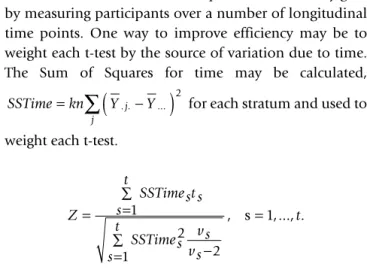
Another weight may incorporate the Sum of Squares for Time. Generally t-tests are uniformly most powerful tests; however, the t-tests do not incorporate the efficiency gain by measuring participants over a number of longitudinal time points. One way to improve efficiency may be to weight each t-test by the source of variation due to time. The Sum of Squares for time may be calculated,
for each stratum and used to
weight each t-test.
Results
Overall the results demonstrate nominal Type I error probabilities for Fisher's Method, the Weighted Z-Trans-form Test and Modified SSS compared to SSS (using stra-tum specific t-tests) under a variety of assumptions. However, SSS produced larger Type I errors compared to the other methods. Further, the modified SSS which
cor-rects for the degrees of freedom associated with the t-tests produced tests of nominal size. Type I error probabilities showed little variation for a 10% missing rate compared to a 40% missing rate.
Table 2 demonstrates the Type I error probability under a variety of missing data percentages (10% and 40%) and mechanisms (MCAR, MAR, a combination of MAR and MNAR as well as MNAR) for all methods. Simulations for this particular table assumed a small sample size of 100, a common correlation coefficient of .6 and a simulation number of 2000. For all conditions, the Type I error prob-abilities of SSS are larger than those of the other methods compared. The Fisher method produces the most conserv-ative results in terms of Type I Error; however, the differ-ences are negligible. Finally, little variation is observed in the Type I error probabilities between the different miss-ing data percentages and/or mechanisms.
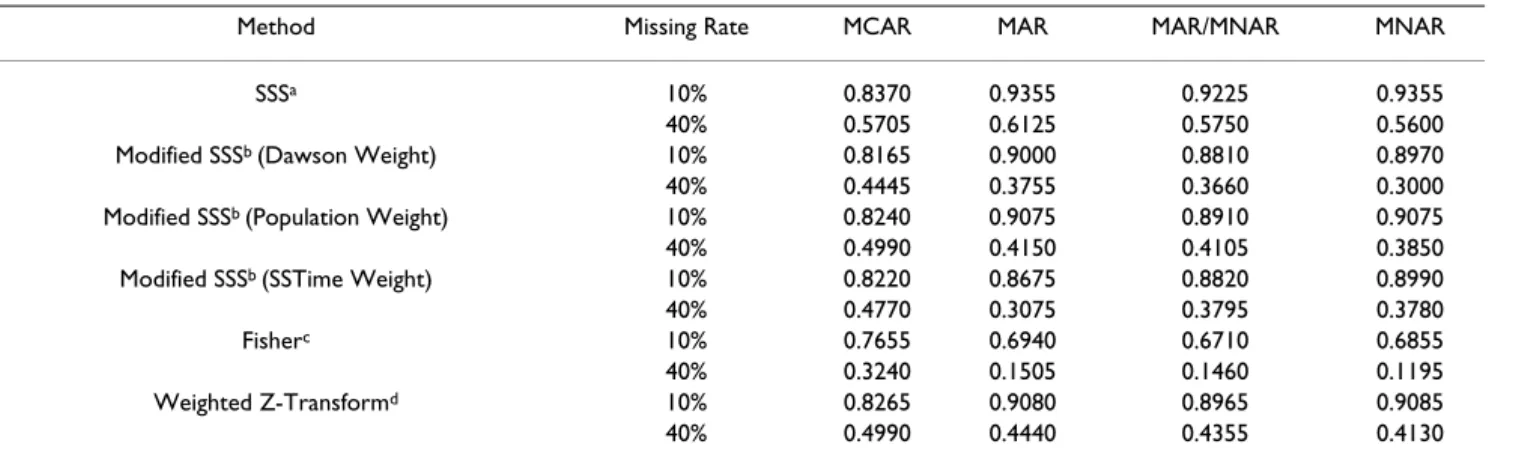
Power for each test differed dependent on the method used as well as the missing data percentage and mecha-nism assumed. Table 3 demonstrates the power under a variety of missing data percentages (10% and 40%) and mechanisms (MCAR, MAR, a combination of MAR and MNAR as well as MNAR) for all methods. Simulations for this particular table assumed a small sample size of 100, a common correlation coefficient of .6 and a simulation number of 2000. Results for Table 2 demonstrate that power was generally greater for SSS compared to all other methods; however, this may be due to the inflated Type I error probabilities as previously discussed. Power was comparable across methods for the 10% missing data per-centage. However, Fisher's method demonstrated a reduc-tion in power for the 40% missing data percentage compared to modified SSS and the Weighted Z-Transform Test. Second only to SSS, the weighted Z-transform test demonstrated robustness in power for all missing data percentages and mechanisms.
ws = nsN ws
s t
= =
∑
11
SSTime kn Y j Y
j
=
∑
(
. .− ...)
2Z t
SSTime st s s
t
SSTime s v s v s s
t
= = =
∑
− =
∑ 1
2 2 1
1 , s ,..., .
Table 2: Type I Error Probabilities of Methods for Missing Data Percentages (10% and 40%) and Mechanisms
Method Missing Percentage MCAR MAR MAR/MNAR MNAR
SSSa 10% 0.0920 0.0895 0.0875 0.0895
40% 0.0945 0.1035 0.1050 0.1115 Modified SSSb (Dawson Weight) 10% 0.0615 0.0580 0.0580 0.0585
40% 0.0525 0.0520 0.0495 0.0555 Modified SSSb (Population Weight) 10% 0.0600 0.0585 0.0585 0.0585
40% 0.0535 0.0520 0.0535 0.0540 Modified SSSb (SSTime Weight) 10% 0.0615 0.0590 0.0575 0.0590
40% 0.0540 0.0535 0.0575 0.0525
Fisherc 10% 0.0495 0.0555 0.0495 0.0510
40% 0.0495 0.0445 0.0505 0.0460 Weighted Z-Transformd 10% 0.0575 0.0595 0.0580 0.0570
40% 0.0545 0.0550 0.0525 0.0530
For all methods, power is decreased at least 35% for a missing data percentage of 10% versus 40%. Power is dra-matically decreased for the Fisher method given a missing data percentage of 40% and a missing data mechanism of MAR or MNAR. In general, power fluctuations are observed for each missing data mechanism.
Conclusion
The statistical literature has an abundance of methods of analysis for longitudinal datasets with missing data. This paper focuses on missing data methods which can be used for hypothesis tests of the treatment effect when the miss-ing data pattern is monotonic. Specifically, Dawson's stratified summary statistic and several other methods of combining data were assessed and developed for analysis with missing data due to their robustness to the missing data mechanism. That is, stratifying data by the missing data pattern, computing stratum specific statistics and aggregating these statistics produces tests which have nominal Type I Error and optimal power even in the pres-ence of nonignorable missing data [12-16]. These hypoth-esis tests of the treatment effect which are robust to the missing data mechanism may be applicable to the analy-sis of substance abuse clinical trials because missing data in substance abuse trials are predominately due to relapse and therefore the missing data may be nonignorable or dependent upon previous outcomes.
In this article, we have focused on two missing data per-centages, a 10% rate and a 40% rate, with each treatment arm having similar amounts of missing data. In many clinical trials, the missing data percentage and/or mecha-nism may vary across treatment arm. Shih and Quan (21) demonstrate that Type I Error may be inflated when the missing data percentage differs between treatment arm and the missing data mechanism is MAR. Further simula-tion studies may want to focus on these variasimula-tions and
their effects on the Type I Error and power of hypothesis tests of the treatment effect.
This article demonstrates the impact that attrition can have on some of the statistical methods which are used for longitudinal data analysis. It should be noted that analy-sis should not be limited to these methods. These meth-ods focus on testing hypotheses of the treatment effect. If the focus of a trial is on parameter estimation, a modeling approach of the missing data such as a pattern mixture or selection model may be more appropriate [11].
Furthermore, the stratified summary statistic methods possess a 'post hoc' quality. That is, we stratify on the pat-tern of missing data, which is not known until the data have been collected. In statistics we propose separation of the design from the analysis, i.e. the study design and analysis are specified in advance of data collection.
Although we will not know the exact pattern of missing data until all subject outcomes have been collected, it is well-known that substance abuse clinical trials are prone to high rates of attrition. Therefore, the use of missing data methods may be planned in advance of the study and may be specified in the study protocol. Furthermore, any reports of results from these analyses should be tempered with the knowledge that the analysis was dependent on the missing data pattern, which could not be fully dis-cerned a priori.
The weighting schemes used in this paper are 'precision-based', and they weight stratum statistics with a larger amount of participants and/or more time point more than those with less. These methods seem to suggest that 'treatment works for those who work for it'. That is, we are weighting those subjects who perform better in the clini-cal trial more than those who perform worse (those that Table 3: Power of Methods for Missing Data Percentages (10% and 40%) and Mechanisms
Method Missing Rate MCAR MAR MAR/MNAR MNAR
SSSa 10% 0.8370 0.9355 0.9225 0.9355
40% 0.5705 0.6125 0.5750 0.5600 Modified SSSb (Dawson Weight) 10% 0.8165 0.9000 0.8810 0.8970
40% 0.4445 0.3755 0.3660 0.3000 Modified SSSb (Population Weight) 10% 0.8240 0.9075 0.8910 0.9075
40% 0.4990 0.4150 0.4105 0.3850 Modified SSSb (SSTime Weight) 10% 0.8220 0.8675 0.8820 0.8990
40% 0.4770 0.3075 0.3795 0.3780 Fisherc 10% 0.7655 0.6940 0.6710 0.6855
40% 0.3240 0.1505 0.1460 0.1195 Weighted Z-Transformd 10% 0.8265 0.9080 0.8965 0.9085
40% 0.4990 0.4440 0.4355 0.4130
tend to drop-out due to relapse). However, these methods are preferred to 'complete case' analysis which drops sub-jects with any missing data. Also, results from this simula-tion study and several other studies demonstrate that these methods are robust to the missing data mechanism in terms of hypothesis testing of the treatment effect [12-16].
Further studies should investigate the robustness in Type I error and power of stratified summary statistics as well as bias and precision of the estimates of the treatment effect for these methods. Also, future studies may want to use other weighting schemes including 'bias-based' weights [37]. However, use of bias-based weights would need to be justified a priori by determining the cause and direc-tion of the bias incurred due to attridirec-tion in substance abuse clinical trials. Given the known history of attrition in substance abuse clinical trials where much of the attri-tion may be contributed to relapse; bias based weighting schemes may be justifiable in this setting.
The simulations for the comparisons of missing data could also be further generalized. For these particular sim-ulations, missing data rates were set at 10% and 40%. We chose a missing data percentage of 40% because of the known high prevalence of missing data in longitudinal substance abuse clinical trials [2-6]. However, these meth-ods can be generalized to more intermediate missing data percentages in order to demonstrate changes in Type I error and power with a variety of missing data rates.
No matter how well-designed a clinical trial, these high attrition rates can bias the analysis of a clinical trial. Valid-ity in the presence of missing data is often dependent upon the method of analysis selected. Specifically, inap-propriate methods may produce hypothesis tests of the treatment effect without appropriate size and/or power. Therefore, it is imperative that substance abuse clinical tri-als prepare for inevitable missing data due to attrition. That is, this paper demonstrates the need for policy devel-opment for evidence based practice specific to the analysis of longitudinal substance abuse clinical trials in the pres-ence of substantial drop-out. For example, given the wide variety of methods used for analysis of substance abuse clinical trials, we may want to specify that missing data methods be incorporated into the design and analysis given the unique properties of this research paradigm.
Authors' contributions
SH conceptualized the study, carried out the Monte Carlo simulation studies and drafted the manuscript. RW partic-ipated in the statistical methods of the study, added to and edited the manuscript. RM participated in the clinical applicability of the study and edited the manuscript.
Acknowledgements
The authors would like to acknowledge NIDA 1 R01 DA016368 & NCRR RR01070.
References
1. Veach LJ, Remley TP Jr., Kippers SM, Sorg JD: Retention predictors related to intensive outpatient programs for substance use disorders. American Journal of Drug & Alcohol Abuse 2000, 26(3):417-428.
2. McRae A Hedden, S., Carter, R., Malcolm, R. and Brady, K.: Charac-teristics of cocaine- and marijuana-dependent subjects pre-senting for medication treatment trials. Addictive Behaviors 2006, In Press:.
3. Edwards AG, Rollnick S: Outcome studies of brief alcohol inter-vention in general practice: the problem of lost subjects. Addiction 1997, 92(12):1699-1704.
4. Nich C, Carroll KM: Intention-to-treat meets missing data: implications of alternate strategies for analyzing clinical tri-als data. Drug Alcohol Depend 2002, 68(2):121-130.
5. Howard KI, Cox WM, Saunders SM: Attrition in substance abuse comparative treatment research: the illusion of randomiza-tion. NIDA Res Monogr 1990, 104:66-79.
6. Mattson ME, Del Boca FK, Carroll KM, Cooney NL, DiClemente CC, Donovan D, Kadden RM, McRee B, Rice C, Rycharik RG, Zweben A: Compliance with treatment and follow-up protocols in project MATCH: predictors and relationship to outcome. Alcohol Clin Exp Res 1998, 22(6):1328-1339.
7. Higgins ST, Budney AJ: From the initial clinic contact to after-care: a brief review of effective strategies for retaining cocaine abusers in treatment. NIDA Res Monogr 1997, 165:25-43.
8. Figueredo AJ, McKnight PE, McKnight KM, Sidani S: Multivariate modeling of missing data within and across assessment waves. Addiction 2000, 95(3):.
9. Rubin DB: Multiple imputation for nonresponse in surveys. Edited by: Sons JW. New York ; 1987.
10. Rubin DB: Multiple Imputation After 18+ Years. Journal of the American Statistical Association 1996, 91:473-489.
11. Hedeker D Gibbons, R.D.: Application of Random Effects Pat-tern Mixture Models for Missing Data in Longitudinal Stud-ies. Psychological Methods 1997, 2(1):64-78.
12. Dawson JD: Stratification of summary statistic tests according to missing data patterns. Statistics in Medicine 1994, 13(18):1853-1863.
13. Dawson JD: Comparing Treatment Groups on the Basis of Slopes, Areas-Under-the-Curve, and Other Summary Meas-ures. Drug Information Journal 1994, 28:723-732.
14. Dawson JD, Han SH: Stratified tests, stratified slopes, and ran-dom effects models for clinical trials with missing data. Jour-nal of Biopharmaceutical Statistics 2000, 10(4):447-455.
15. Dawson JD, Lagakos SW: Analyzing laboratory marker changes in AIDS clinical trials. Journal of Acquired Immune Deficiency Syn-dromes 1991, 4(7):667-676.
16. Dawson JD, Lagakos SW: Size and power of two-sample tests of repeated measures data. Biometrics 1993, 49(4):1022-1032. 17. Frison L, Pocock SJ: Repeated measures in clinical trials:
analy-sis using mean summary statistics and its implications for design.[see comment]. Statistics in Medicine 1992, 11(13):1685-1704.
18. Matthews JN, Altman DG, Campbell MJ, Royston P: Analysis of serial measurements in medical research.[see comment]. Bmj 1990, 300(6719):230-235.
19. Pocock SJ: Clinical Trials: A Practical Approach. New York , Wiley; 1983.
20. Wu MC, Bailey KR: Estimation and comparison of changes in the presence of informative right censoring: conditional lin-ear model.[erratum applin-ears in Biometrics 1990 Sep;46(3):889]. Biometrics 1989, 45(3):939-955.
21. Stouffer SA, Suchman EA, Devinney LC, Star SA, Williams RM: The American Soldier. Volume 1. Princeton , Princeton University Press; 1949.
22. Fisher RA: Statistical Methods for Research Workers. Edited by: 11 . Edinburgh , Oliver and Boyd; 1950.
Publish with BioMed Central and every scientist can read your work free of charge
"BioMed Central will be the most significant development for disseminating the results of biomedical researc h in our lifetime."
Sir Paul Nurse, Cancer Research UK
Your research papers will be:
available free of charge to the entire biomedical community
peer reviewed and published immediately upon acceptance
cited in PubMed and archived on PubMed Central
yours — you keep the copyright
Submit your manuscript here:
http://www.biomedcentral.com/info/publishing_adv.asp
BioMedcentral 24. Rice WR: A consensus combine p-value test and family-wide
significance of component tests. Biometrics 1990, 46(2):303-308. 25. Whitlock MC: Combining probabilities from independent tests: the weighted Z method is superior to Fisher's approach. Journal of Evolutionary Biology 2005, 18:1368-1373. 26. Westberg M: Combining Independent Statistical Tests. The
Statistician 1985, 34(3):287-296.
27. Malcolm R, LaRowe S, Cochran K, Moak D, Herron J, Brady K, Hed-den S, Woolson R, Halushka P: A controlled trial of amlodipine for cocaine dependence: a negative report. J Subst Abuse Treat 2005, 28(2):197-204.
28. Mori M, Woolson RF, Woodworth GG: Slope estimation in the presence of informative right censoring: modeling the number of observations as a geometric random variable. Bio-metrics 1994, 50(1):39-50.
29. Schafer JL, Graham JW: Missing data: our view of the state of the art. Psychol Methods 2002, 7(2):147-177.
30. Schafer JL, Olsen MK: Multiple imputation for multivariate missing-data problems: A data analyst's perspective. Multivar-iate Behavioral Research Vol 33(4) 1998, 545-571 1998.
31. Diggle PJ Heagerty, P., Liang, K.Y., Zeger, S.L.: Analysis of Longitu-dinal Data. second edition. New York , Oxford University Press; 2003.
32. Shih WJ, Quan H: Stratified testing for treatment effects with missing data. Biometrics 1998, 54(2):782-787.
33. Ridout MS: Testing for random dropouts in repeated meas-urement data. Biometrics 1991, 47(4):1617-9; discussion 1619-21. 34. Molenberghs G, Thijs H, Jansen I, Beunckens C: Analyzing incom-plete longitudinal clinical trial data. Biostatistics 2004, 5(3):445-464.
35. Hoaglin DC Andrews, D.F.: The Reporting of Computation-Based Results in Statistics. The American Statistician 1975, 29(3):122-126.
36. Puri ML: On the Combination of Independent Two Sample Tests of he General Class. Review of the international Statistical insti-tute 1965, 33(2):229-241.