UNITED NATIONS INDUSTRIAL DEVELOPMENT ORGANIZATION Trade Capacity-building Branch
A R
oadm
ap to Qua
lity—
V
o
lume 2
An e-learning Manual for Implementing
Total Quality Management
Contents
Unit summary 3
Learning tools
The RADAR questions 6 The 6-Point Structure 6
Texts
10.1 QC Circle activities 7
10.2 The human dimension to QC Circles 10 10.3 Introducing QC Circle activities in your
company 12
10.4 How many employees in the company should take part in QC Circles 14
10.5 Select QC Circle leaders; roles of leaders and members 15
10.6 The QC Story 17 10.7 QC Circle meetings 18 10.8 QC Circle assemblies 20
10.9 Evaluation of QC Circle activities 23 10.10 The basic procedures for QC Circle
activities 25
10.11 QC Circle training 27
10.12 Planning future QC Circle Activities 29 10.13 Create the right environment for QC Circle
activities: the role of the CEO 31 10.14 The role of middle management 33 10.15 Set up a company-wide organisation to
promote QC Circle activities 36 10.16Hold QC Circle exchanges with other
companies 38 Test 40
A QC Circle is a small group of frontline employees who meet regularly to try to improve the quality of their work. QC Circle activities are at the core of TQM. They can play a major role in creating a dynamic atmosphere in the workplace.
Please note that some of the texts in this unit will only become useful when you have actually set up QC circles in your company. Note also that several of the charts referred to contain a level of detail that you may feel is not relevant to your company.
10.1 QC Circle activities
QC Circles normally take a problem-based approach to improving the quality of their work. They identify problems in their workplace, usually related to product quality and referred to as “themes”, and together they set about finding a solution. They use quality control concepts and techniques, and try to be creative in seeking solutions.
10.2 The human dimension to QC Circles
We all have an innate desire for personal growth. In the right conditions we get a lot of satisfaction from improving our skills, and from using our new skills together with our co-workers to achieve meaningful targets. QC Circles provide the right conditions.
10.3 Introducing QC Circle activities in your company
Be both sensitive and creative in introducing QC Circles in your company, especially since their aims are to encourage the development of employees. Make sure that you take an approach that suits the working environment, and the character and climate of your company.
10.4 How many employees in the company should take part in
QC Circles?
Although all employees should take part in QC Circle activities, as these are a component of TQM, some companies allow departments and sections to opt out. A key decision you have to take is the scale of participation within your company.
10.5 Select QC Circle leaders; roles of leaders and members
The QC Circle leaders will be the driving force behind the activities. Select people who can show leadership, who can get members to cooperate in meetings, can gather ideas, and can create an atmosphere where everyone will feel free to express their opinion.
10.6 The QC Story
QC Circles use a 7-step procedure to solve problems related to the five priorities of QCDSM: quality (Q), costs (C), deadlines and productivity (D), safety (S), and morale (M). This procedure uses methods based on facts and data, and aims to prevent the recurrence of problems by identifying the causes and implementing recurrence prevention measures.
10.7 QC Circle meetings
QC Circle meetings help members to work together towards the same goals. Members exchange ideas and information, get to know each other, and develop a spirit of
cooperation and a sense of solidarity. But if the meetings are poorly managed, the activities will stagnate and members will become de-motivated.
10.8 QC Circle assemblies
After a QC Circle has completed a theme, it holds a meeting, referred to as a QC Circle assembly or a QC Circle conference, to re-appraise the methods that have been used, and to confirm the circle’s sense of achievement. Members give presentations of key points from their problem resolution activities and achievements: their methods, their difficulties, and their creative ideas. A very effective way of doing this is the QC Story (See also Unit 9).
10.9 Evaluation of QC Circle activities
Regular and appropriate evaluation of QC Circle activities will help to motivate members and to revitalize activities. It will identify where improvement is needed, and indicate the corrections that should be made. There are two forms of evaluation: self-evaluation by members, and evaluation by managers.
10.10 The basic procedures for QC Circle activities
Once QC Circles have been set up, there are a wide range of procedures to follow.
10.11 QC Circle training
QC Circle training is aimed at achieving a workplace full of employees who are motivated, creative, and good at solving problems. Training focuses on the value of QC Circle activities, on raising quality consciousness, and on using QC methods.
10.12 Planning future QC Circle activities
Facilitators should prepare plans for desirable QC Circle activities for the future, and
promote these as a component of TQM. These plans should prescribe the level of QC Circle activities, their targets, and concrete measures for achieving the targets. In doing so, they should look carefully at the present state of QC Circles and should respect the intentions of work superiors. Such plans are important in energising and consolidating QC Circle
activities.
10.13 Create the right environment for QC Circle activities: the
role of the CEO
QC Circles can only flourish in the right environment. CEOs, middle managers, promotional staff members, and personnel managers must gain a good understanding of QC Circle activities and create such an environment. The CEO has a key role to play.
10.14 The role of middle management
Middle managers should help establish a working environment in which QC Circle members are allowed to take on a management role in their own work and make improvements on their own initiative, in which their willingness to contribute is respected, and in which they can use their abilities to the full.
10.15 Set up a company-wide organisation to promote QC Circle
activities
Set up a company-wide organization to promote and facilitate QC Circle activities. This should include a promotional committee and a promotional secretariat.
10.16 Hold QC Circle exchanges with other companies
When QC Circles always remain within their own work places, members’ perspectives may become limited, and their ideas lose freshness. Organize meetings periodically with other circles both within the company and outside. Members of different circles can visit each other, have discussions, and study QC Circle management together, and thereby stimulate each other to further development.
Unit 10 - QC Circles A Roadmap to Quality6
The RADAR questions
As you read each text you will discuss how it could be applied in your company. The RADAR questions will help you to focus this discussion:
R- Are these ideas relevant to my company?
A - How would I applyeach of them in my company?
D - What difficultiesmight I meet and how would I overcome them?
A - Are there any additionalactions that I might take that are not mentioned in the text? R - What resourceswould be needed, what would these cost, and how could they be acquired?
There will of course be some discussion points where not all of these questions will be applicable.
The 6-Point Structure
After you have discussed the ideas in the text, you write an action plan in which you present practical proposals for implementing the conclusions you have reached in your discussion. The 6-Point Structure will help you to write your action plan:
1. Problems: Problems you have in your company in the area you have just discussed. 2. Proposals: Your proposals for improvement.
a. Be specific and concrete.
b. Include an implementation plan, with a time schedule and minimum and optimal implementation targets.
c. Refer to any forms, charts, tables etc. that you would use, and include samples in an appendix.
3. Obstacles:Obstacles to implementation in employee attitudes, company organization and culture etc., and how these could be overcome.
4. Resources:
a. The resources required: funds, equipment, materials, man-hours, expertise etc. b. The resources available within the company.
c. Any resources that would have to be found outside the company. d. Alternatives that could be used to cover any shortfall in resources.
5. Assessment:Ways of assessing the results of implementing these proposals. 6. Benefits: The benefits your proposals would bring.
1. A QC Circle is a small group of frontline employees who meet regularly to try to improve the quality of their work. In general their approach is problem-based. They identify problems in the workplace, usually related to product quality and referred to as “themes”, and together they set about finding a solution. They use quality control concepts and techniques, and try to be creative in seeking solutions. Broadly, their agenda is to continually improve and maintain the quality of products, and to constantly strive towards self-development and group development. Through the QC activities, they develop quality consciousness, problem consciousness, a willingness to make
improvements, and a sense of quality management. Ultimately their activities will lead to increased customer satisfaction.
2. The quality of any product or service is determined by the front-line employees. In the manufacturing industry this will be the employees who prepare blueprints, procure materials, manufacture parts and products, and sell these to the customer. In the service industry, quality depends on those who provide the services, and those who sell the services to customers. In the indirect departments (departments that provide services to other departments and to the company as a whole), quality is determined by those who provide services to other employees. The criteria against which such improvements can be measured are the standards which have been established to meet customer
requirements.
3. The QC Circle problem-solving approach seeks to find and remove the root cause of problems through the four stages of the PDCA Cycle – draft plans (plan), implement the plans (do), confirm the results of the implementation (check), and carry out any
necessary follow-up action (action) – Plan, Do, Check and Act: the PDCA cycle. (For more details on the PDCA cycle see Unit 3.10.3)
Figure 1.5a PDCA Cycle
4. The QC Circle approach, and quality management in general, is based solidly on facts. This means first of all getting the facts, and then, wherever possible, converting those facts into numerical values. When they are in numerical form it is easier to analyze them objectively and accurately, and to reach a sound judgement. This data-processing procedure is:
a. Convert facts into numerical values, as far as possible. b. Distinguish causes from results.
c. Analyze results in a stratified manner (where data is divided according to its sources, e.g. stratified by employees, by machines etc.).
d. Prioritize items for consideration.
e. Pay attention to dispersion (How the different items of data are scattered in relation to how they are supposed to be, i.e. in relation to the standard or target values. See Text 9.7.)
Unit 10 - QC Circles A Roadmap to Quality8
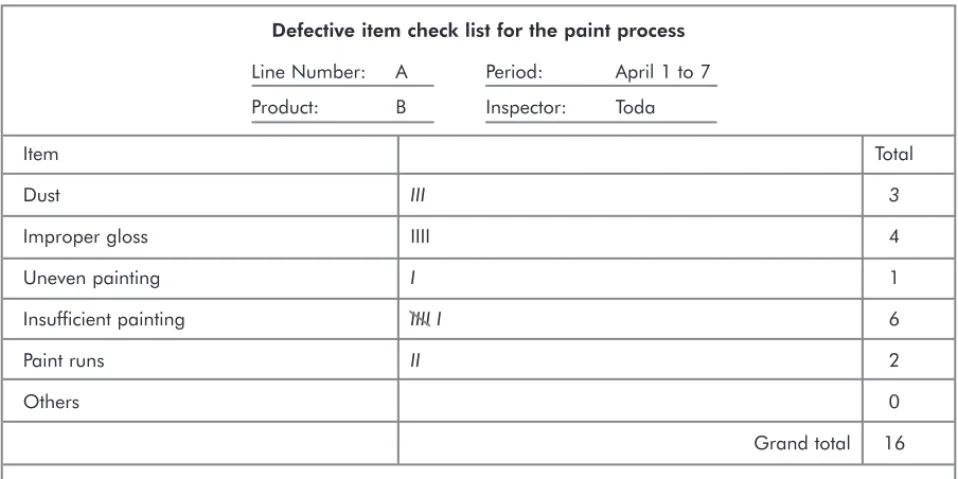
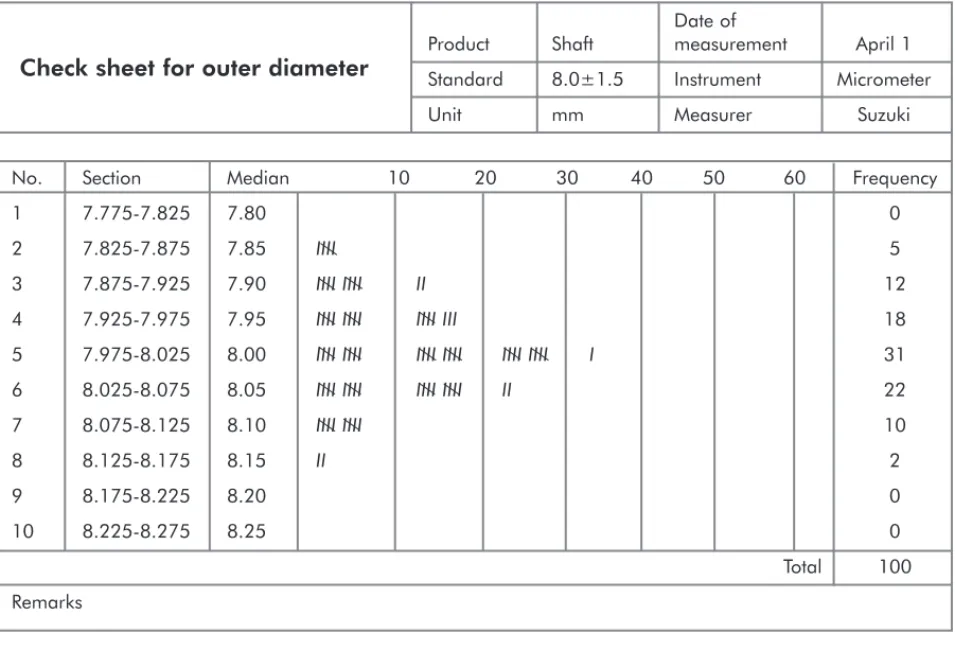
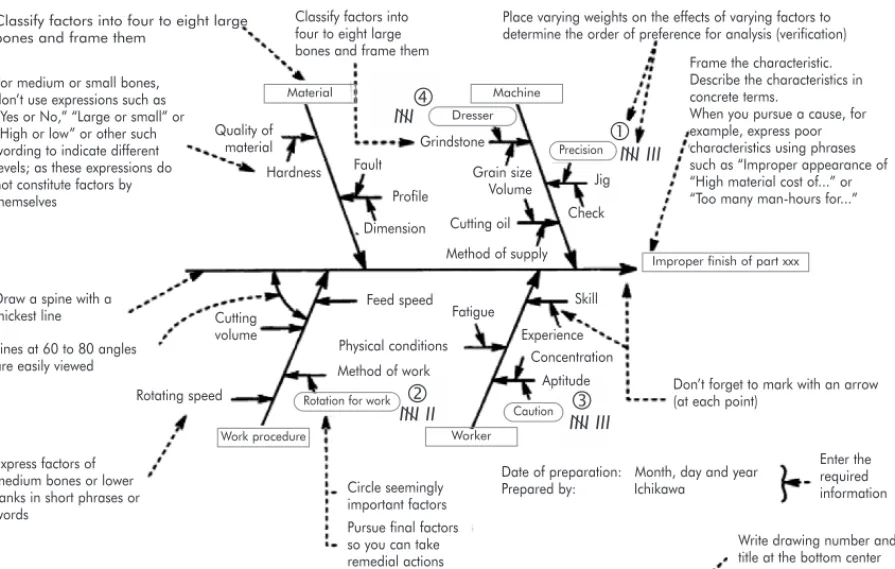
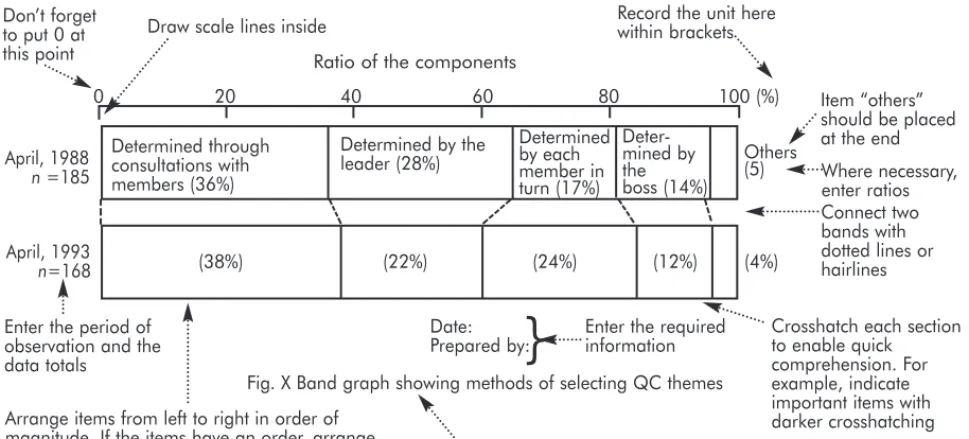
5. The methods that QC Circles use include: a. Procedures for problem resolution. b. The QC Seven Tools.
c. The New QC Seven Tools.
d. Other statistical methods as well as IE (industrial engineering) and VA (value engineering).
When employees start using these methods they will find it easy to understand this approach to improvement. (See Unit 11 and Text 16.6 for descriptions of the QC tools.) 6. QC Circles are also about the quality of our working life. We all have a natural desire to
develop our latent abilities and display them to good effect. QC Circle activities give employees the opportunity to fulfil this desire by gaining knowledge, solving problems, and achieving goals. Discussions at QC Circles also help us understand our co-workers better, to develop good relationships, and, in all, to make our work place more
pleasant, more cheerful and more dynamic.
Figure 10.1aMechanism of QC Circles
A Group of People who Share a Work Place
Sufficient Knowledge of and Experience in Actual Job Assignments A Group of People Who Know Each Other Well Desire to Keep on Good Terms with Everyone
Sufficient Discussions
Attempt to Think What is Best for the Work Place Teamwork A Cheerful Work place A Sense of Accomplishment Improvement of Corporate Efficiency Resolution of Problems Examination of Countermeasures Analysis of
Key Factors for Causes. Elucidation of the Structure of Problems Selection of Items for Improvement Clarification of Problems Various Problems at the Work Place
Broad Perspective Positive Attitude Property
Display of Creativity Growth as Human Being Acquisition of the
Ability to solve Problems Scientific Perspective Use of Learned Methods
Scientific Problem Resolution Desire to Improve as a
Human Being. Desire to Perform Better at Work
Study of QC Methods
Item
W
eight
Discussion
The following questions ask you to think about how the ideas in the text could be applied in your company. Some of these ideas may not be relevant to you. Concentrate on those that are relevant. Keep notes of your conclusions – you will need them to prepare your action plan afterwards. Where appropriate ask yourself the RADAR questions.
Note:Always include in your discussion any figures referred to in the text, if you feel these are relevant to your company.
a. Parag. 1: To what extent would you say that employees in your company have a sense of quality consciousness, problem consciousness, are willing to make
improvements, and have a sense of quality management. What benefits can these qualities in employees bring?
b. Parag. 2: Who are the frontline employees in your company? In what ways is the quality of your products or services determined by the front-line employees? Give one or two examples.
c. Parags. 3, 4 and 5: These paragraphs give a preliminary outline of what QC Circles involve. Some of the terminology will not be familiar to you yet, and more detail will follow in later texts. For the moment consider in general terms how feasible and how useful these ideas would be for your company. How systematic is the approach to problem solving in your company?
d. Parag. 6: Do you agree with this perception of human nature which underlies the QC Circle approach? Give reasons for your opinion.
Action plan
When you have discussed several texts, take the ideas you have found useful in them, and in your discussion, and present them in a well-structured action plan for your company. You might like to follow the 6-Point Structure.
Unit 10 - QC Circles A Roadmap to Quality10
1. We all have an innate desire for personal growth. In the right conditions we get a lot of satisfaction from studying, from improving our skills, and from using our new skills with our co-workers to achieve meaningful targets. QC Circles provide the right conditions. 2. The aims of QC Circle activities are to:
a. Fully bring out our latent capabilities. Everyone has considerable ability. As long as we continue to learn, this ability will continue to develop. QC Circle activities provide a framework for learning and developing together with our fellow workers.
b. Create a happy workplace. Members of QC Circles respect each other, and allow each to display their abilities. When we learn to see things from other people’s viewpoint, our relationships with them improve, and the work environment becomes a pleasant place where everyone has a sense of purpose.
c. Contribute to the improvement and development of the enterprise. QC Circles have become part of the corporate front line. Many companies have entrusted them with the task of determining the quality level of the products and services they provide to customers. They know that if employees find their jobs worthwhile, find their work environment pleasant, and can exercise their abilities to the fullest, then the companies they work for can only improve and grow.
3. To make the most of the opportunities that QC Circle activities provide, we should resolve to:
a. Bring out our potential abilities through self-development.
b. Act with good will, and transform ourselves into capable workers.
c. Seek opportunities to further our development as a group, and to broaden our outlook.
d. Work together: make sure information is shared with everyone, and leave to the side any personal biases we may have.
e. Encourage everyone to participate in the group, and show what a force it can be. f. Do our best to create a dynamic work environment.
g. Come up with creative ideas to bring improvements to our work - achieve a work environment that is continually moving forward.
h. Cultivate quality consciousness, problem consciousness, and a willingness to make improvements.
i. Make effective use of QC methods to resolve problems, to prevent problems recurring, and to prevent potential problems emerging.
j. Work towards the goals of TQM.
Discussion
The following questions ask you to think about how the ideas in the text could be applied in your company. Some of these ideas may not be relevant to you. Concentrate on those that are relevant. Keep notes of your conclusions – you will need them to prepare your action plan afterwards. Where appropriate ask yourself the RADAR questions.
Note:Always include in your discussion any figures referred to in the text, if you feel these are relevant to your company.
a. Parag. 1: What do you think of this perspective on people, especially in the work context?
b. Parag. 2: Discuss these aims of QC Circles activities. If QC Circles can achieve what is described here how useful would they be in your company?
c. Parag. 3: Would it be realistic to expect the employees in your company to make such resolutions? How valuable would it be they did, and acted on them? Look at each recommended resolution in turn.
Action plan
When you have discussed several texts, take the ideas you have found useful in them, and in your discussion, and present them in a well-structured action plan for your company. You might like to use the 6-Point Structure.
Unit 10 - QC Circles A Roadmap to Quality12
1. Be both sensitive and creative in introducing QC Circles in your company, in particular since their aims are to encourage the development of employees. Make sure that you take an approach that suits the working environment, and the character and climate of your company.
2. Those who are promoting QC Circles should find out how employees feel about the circles before they introduce them. If any are opposed, they should listen carefully to their reasons and take time to get their consent. Management should not force QC Circles onto employees, but should rather encourage their spontaneous formation. 3. There are three principal ways to introduce QC Circles:
a. Introduce them simultaneously in all the work places: offices, manufacturing plants, and departments. This method prompts a sense of togetherness within the
organization and encourages QC Circles to work hard in friendly rivalry. Some companies hold a ceremony on the inauguration day and invite the president, plant director, or department manager to announce their introduction.
b. Form pilot circles: supervisors who have been designated to become leaders form pilot QC Circles. The pilot circles follow the typical procedures: they examine
common problems at work and use QC methods to resolve them; they compile their experiences into a QC Story, and after two or three meetings, present their story at a conference. Through these pilot circles the supervisors will gain the leadership confidence to form other QC Circles, to promote their activities and to provide guidance. These pilot circles should be maintained for three to six months. c. Inauguration of circles by volunteers (model circles): willing volunteers form QC
Circles, and from these, QC Circles gradually spread to other workplaces. These pioneering circles are called model circles because they serve as models for others. After spending three to six months on problem resolution, the model circles hold a meeting and present their achievements to a large number of people. This method encourages others to believe that they too may be able to achieve the same results. This is a process of popularizing QC activities.
All three ways of introducing QC Circles require supervisors and promoters to constantly monitor circle activities and to provide assistance whenever it is needed.
Figure 10.3a Procedure for introducing QC Circle activities and the roles of those involved.
Discussion
The following questions ask you to reflect on the ideas in the text and consider how you could apply them to bring improvements in your company. Where appropriate ask yourself the RADAR questions.
10.3 Introducing QC Circle activities in
your company
Note:Always include in your discussion any tables or charts referred to in the text, if you feel these are relevant to your company.
a. Parag. 2: How do you think the employees in your company would feel about QC Circle activities? Would those assigned to promote QC Circles be wiling to taking this sensitive approach? How could they be encouraged to do so?
b. Parag. 3: Examine these three different ways of introducing QC Circles, and discuss which approach would be most suitable for your company. You may find it useful to apply the RADAR questions to each approach.
Action plan
Take the ideas you have found useful in the text, and in your discussion, and present them in a well-structured action plan for introducing improvements in your company. You might like to follow the 6-Point Structure. Alternatively you may choose to prepare one action plan when you have discussed further texts.
Unit 10 - QC Circles A Roadmap to Quality14
1. Although all employees should take part in QC Circle activities, as these are a
component of TQM, some companies allow departments and sections to opt out. A key decision you have to take is the scale of participation within your company.
2. There are three modes of participation in QC Circle activities:
a. Participation by all the departments and sections: manufacturing, quality management and inspection, facility and maintenance, general affairs and accounting, procurement and materials, sales and services, design and testing, computer, marketing, research and development, technical services etc.
b. Participation by everyone in the same workplace: ordinary employees (including long-term and short-term employees and part-timers, and those hired by partner companies), supervisors, subsection and section chiefs and department managers, all take part in the activities.
c. Participation only by those sections that actually form QC Circles: members attend meetings, expresses their opinions, and performs their assigned roles.
3. Participation by all employees will make them feel good, and give them a sense of confidence and unity. It will allow those in the same work place to display their solidarity and their combined range of abilities. Companies that exempt certain departments, (e.g. the research and development department), should aim to eventually involve all the front-line employees in every department and section.
Figure 10.4a Written report of QC Circle activities
Discussion
The following questions ask you to think about how the ideas in the text could be applied in your company. Some of these ideas may not be relevant to you. Concentrate on those that are relevant. Keep notes of your conclusions – you will need them to prepare your action plan afterwards. Where appropriate ask yourself the RADAR questions.
Note:Always include in your discussion any figures referred to in the text, if you feel these are relevant to your company.
a. Parags. 2 and 3: Apply the RADAR questions to these modes of participation in QC Circle activities, and try to decide what form of participation would be most suitable for your company.
Action plan
Take the ideas you have found useful in the text, and in your discussion, and present them in a well-structured action plan for introducing improvements in your company.
10.4 How many employees in the company
should take part in QC Circles?
Introduction
1. The QC Circle leaders will be the driving force behind the QC activities. Select people who can show leadership, who can get members to cooperate in meetings, can gather ideas, and can create an atmosphere where everyone will feel free to express their opinion.
Selecting leaders
2. Different ways of selecting leaders will be appropriate at different stages of introducing and establishing QC Circles:
a. During the inauguration phase foremen in the workplace are the most suitable leaders. Unless workplace leaders are at the forefront of this process, quality management will not reach the rank-and-file employees and will not become established in the work places.
b. Once QC Circle members become used to the activities, they should select as team leader a person with leadership abilities rather than simply accept someone
appointed by their superiors.
c. When activities are well advanced, large QC Circles should divide themselves into sub-groups to tackle separate themes. These sub groups can hold QC Circle
meetings on their own or jointly with other sub-groups, and select their own leaders. 3. Points to consider when selecting leaders:
a.
that a member with no leadership abilities becomes leader. Such a leader could really slow down the progress of activities.
b. QC Circle members who have participated for two or three years, and have gained a sound understanding of the activities and methods, should be made theme-specific leaders. They will be known as theme leaders. They can thus develop leadership skills and lead circles in the future.
The role of leaders
4. The primary role of QC Circle leaders is to keep up the dynamic of the circles, to encourage members to use their abilities to the full, and to support them in doing so. They should:
a. Find out what improvements their members would like to see in the working environment, identify specific problems, decide how to approach them, and select targets.
b. Get a good idea of the qualities and skills of the circle members, assign them roles that will allow them to put these to good use, and create an atmosphere that will motivate them to do so.
c. Introduce ways that members can acquire the knowledge and skills needed to carry
10.5 Select QC Circle leaders; roles of
leaders and members
Unit 10 - QC Circles A Roadmap to Quality16
d. Train successors: demonstrate how leaders should act, and train members to take over from them.
e. Find out what superiors expect from the circles, and then discuss with members how to incorporate these expectations into the activities.
Support from members
5. QC Circle members should support the leaders by carrying out their assigned roles diligently and by acquiring the skills and experience that will enable them to improve the quality of their work and of the work environment. They should:
a. Give active assistance to the leaders and participate in teamwork. b. Attend meetings and speak forthrightly from their own experience.
c. Carry out the roles assigned to them within the given time frame, including the roles of secretary or of presenter at meetings.
d. Study engineering technology and quality control and broaden the range of roles they can perform.
Discussion
The following questions ask you to think about how the ideas in the text could be applied in your company. Some of these ideas may not be relevant to you. Concentrate on those that are relevant. Keep notes of your conclusions – you will need them to prepare your action plan afterwards. Where appropriate ask yourself the RADAR questions.
Note: Always include in your discussion any figures referred to in the text, if you feel these are relevant to your company.
a. Parag. 1: How difficult do you think it might be to identify such leaders in your company?
b. Parags. 2 and 3: How feasible do you think these ways of selecting a leader would be in your company?
c. Parag. 4: How challenging do you think it will be for QC Circle leaders in your company to carry out these actions? How do you think they should go about doing so?
d. Parag. 5: How willing do you think employees in your company would be to carry out these functions. How much encouragement and support would they need to do so? How could this be provided?
Action plan
Take the ideas you have found useful in the text, and in your discussion, and present them in a well-structured action plan for introducing improvements in your company. You might like to follow the 6-Point Structure. Alternatively you may choose to prepare one action plan when you have discussed several texts.
1. QC Circles use the QC Story to solve problems related to the five priorities of QCDSM: quality (Q), costs (C), deadlines and productivity (D), safety (S), and morale (M). This procedure uses methods based on facts and data, and aims to prevent the recurrence of problems by identifying the causes and implementing recurrence prevention measures. 2. A QC Story consists of the following eight steps:
a. Select a theme to work on.
b. Clarify the problem and set targets.
c. Get a clear understanding of the effects that the problem has caused. d. Investigate the causes: analysis.
e. Devise and implement recurrence prevention measures. f. Confirm the effects of these measures.
g. Standardize the new methods.
h. Reflect on the problems left unsolved and consider future recurrence prevention measures.
You will find detailed guidelines on using the QC Story in Texts 9.9, 9.10 and 9.11.
Unit 10 - QC Circles A Roadmap to Quality18
1. QC Circle meetings help members to work together towards the same goals. Members exchange ideas and information, get to know each other, and develop a spirit of cooperation and a sense of solidarity. But if the meetings are poorly managed, the activities will stagnate and members will become demotivated.
2. If meetings are to be effective: a. They should be well planned. b. All members should attend.
c. Roles should be distributed: moderator, secretary, presenter and others. d. The purpose of the meeting should be agreed.
e. Brainstorming sessions should be held to generate new ideas. f. All members should give their opinions.
g. Minutes should always be taken.
3. To plan meetings, you need to decide on their duration, frequency, timing and place: a. Duration: The length of meetings will vary according to such factors as work place
conditions, the agenda, and their frequency. However the average meeting will last for 30 to 60 minutes.
b. Frequency: The number of meetings per month will vary according to their average duration. However, they should take place at least twice a month. It is best to set a target number of meetings to be held in the next one-month period and try to keep to this target.
c. Timing: The times when meetings are held will vary according to work requirements and the other demands on QC Circle members’ time. When they meet during regular working hours, they must obtain the approval of a manager in advance. It is advisable to:
i. Include QC Circle meetings in the monthly operational schedule. ii. Set up specific dates for meetings.
iii. Use a message board to determine when all members can meet. d. Place: Meetings should be held in one of the following places:
i. The work place.
ii. Conference rooms near the work place. iii. Dining rooms or rest areas.
iv. Outdoor locations within the factory grounds.
v. Locations away from work, such as recreational areas, coffee shops, and educational facilities.
Figure 10.7a Form for minutes of QC Circle meetings
Discussion
The following questions ask you to think about how the ideas in the text could be applied in your company. Some of these ideas may not be relevant to you. Concentrate on those that are relevant. Keep notes of your conclusions – you will need them to prepare your action plan afterwards. Where appropriate ask yourself the RADAR questions.
Note:Always include in your discussion any figures referred to in the text, if you feel these are relevant to your company.
a. Parag. 1: Describe briefly the worst meeting you have ever participated in, and the best. What made them so bad and so good?
b. Parag. 2: What obstacles could be met in trying to conduct meetings in this way and how could they be overcome?
c. Parag. 3: Apply the RADAR questions to these guidelines for arranging QC Circle meetings.
Action plan
Take the ideas you have found useful in the text, and in your discussion, and present them in a well-structured action plan for introducing improvements in your company. You might like to follow the 6-Point Structure. Alternatively you may choose to prepare one action plan when you have discussed several texts.
Unit 10 - QC Circles A Roadmap to Quality20
10.8 QC Circle assemblies
1. After a QC Circle has completed a theme, it holds a meeting, referred to as a QC Circle assembly or a QC Circle conference, to re-appraise the methods that have been used, and to confirm the circle’s sense of achievement. Members give presentations of key points from their problem resolution activities and achievements: their methods, their difficulties, and their creative ideas. An effective way of doing this is the QC Story, which is described in detail in Unit 9.
2. When a QC Story is being presented the following should be included:
a. Introduction – introduce your company, your work place, and your QC Circle. b. Outline – give a brief outline of the tasks you carried out, and their relationship to
preceding and subsequent tasks.
c. Reasons for selecting a theme - give the reasons for selecting a particular problem, and the circumstances surrounding it, etc.
d. The situation – describe the state of the problem at the time using data. e. The targets – describe the targets selected and the basis for selecting them. f. Action plan – present the action plan including the assignment of roles.
g. Analysis of key factors – present your hypothesis on the key factors, your data-based analysis, and your verification of the hypothesis.
h. Present the recurrence prevention measures that were taken and how they were implemented.
i. The effectiveness of the recurrence prevention measures – compare the situation before and after the recurrence prevention measures, the level of target
achievement, and also the intangible and secondary effects. j. Standardization – the items and methods that were standardized.
k. Reviews and future plans – summarize the points that needed effort, the points that were raised in reflection, the lessons that were learned, your circle’s aspirations and its future plans.
3. Presenters must:
a. Rehearse their presentations so that they will be able to give them confidently. b. Use pauses in their speech to highlight the objectives and the development of the
QC Story.
c. Speak clearly and avoid ambiguous expressions.
d. Allow the audience time to take in any charts and tables that they present. e. Keep their listeners engaged.
4. Advisors must keep their comments after the presentation brief, usually about two minutes. The question and answer session should also be about two minutes. They should touch briefly on the good points and on the points that could be improved, point out to the audience the lessons to be learned, and show their appreciation of the
presenters and give them encouragement. It is important that they clearly indicate the points that need to be corrected.
5. QC Circle assemblies are an occasion for mutual development. They offer lessons both to the QC Circles that make presentations, and to those who listen to them.
a. Presenters and the QC Circles they represent:
i. Learn to express their ideas clearly, improve their communication skills, and gain confidence in giving presentations.
ii. Become skilled at organising ideas and information so that people can easily understand what is being presented.
iii. Experience the sense of satisfaction that comes from public acknowledgment. b. Listeners:
i. Learn about dynamic activities in other work places and expand their own horizons.
ii. Learn the practical applications of QC methods, creative thinking, and ways of organising information and ideas.
iii. Learn that creative ideas that emerge in QC Circles can be applied again in the future.
6. After the presentations, managers and facilitators* (in the case of in-house conferences), and advisors and members of the screening committee (in the case of external
conferences) review the presentations. They should pay attention to the following: a. Disregard monetary achievements, and stress achievements that improved work
processes.
b. Consider whether achievements are based on the principle of quality first as a component of TQM.
c. Consider willing participation as the most important point for evaluation.
d. Consider whether all the circle members participated with a sense of awareness. e. Examine how presentations related to the higher policies of the company.
f. Appraise QC Circles according to their degree of growth.
Figure 10.8a Detailed check sheet for QC Circle conference experiences
* The term “facilitator” is used with a broad meaning. It may be in anyone in the company who is helping to organise QC circle activities.
Discussion
The following questions ask you to think about how the ideas in the text could be applied in your company. Some of these ideas may not be relevant to you. Concentrate on those that are relevant. Keep notes of your conclusions – you will need them to prepare your action plan afterwards. Where appropriate ask yourself the RADAR questions.
Note:Always include in your discussion any figures referred to in the text, if you feel these are relevant to your company.
a. Parag. 2: If you have already examined the QC Story in Unit 9, take the theme you chose there and decide how you would present it.
b. Parag. 3: How important do you think each of these guidelines are for giving a presentation? Are there any others that you would add to the list?
Unit 10 - QC Circles A Roadmap to Quality22
c. Parag. 4: Why do you think these particular points are emphasised? Are there any other points that you would add?
d. Parag. 5: Look at each of these lessons to be learned from QC Circle assembly presentations. How valuable do you think each lesson is to the presenters and listeners, and to the company? Can you think of any other lessons that may be learned?
e. Parag. 6: Do you agree that each of these points is important? Why?
Action plan
Take the ideas you have found useful in the text, and in your discussion, and present them in a well-structured action plan for introducing improvements in your company. You might like to follow the 6-Point Structure. Alternatively you may choose to prepare one action plan when you have discussed several texts.
1. Regular and appropriate evaluation of QC Circle activities will help to motivate members and to revitalize activities. It will identify where improvement is needed, and indicate the corrections that should be made. Evaluation should address the following questions:
a. Are QC Circle activities in line with the action plans and targets? b. How are the activities being conducted?
c. What abilities are employees developing? d. Are the activities achieving satisfactory results?
e. How do the activities of this circle compare with those of other QC Circles? There are two forms of evaluation:
a. Self-evaluation by the members themselves. b. Evaluation by managers.
2. Self-evaluation by QC Circle members:
a. Self-evaluation after a problem has been resolved: QC Circle members reflect on all the steps they have taken to resolve the problem, evaluate them, recognise any unsatisfactory points, and try to identify and correct the causes.
b. Self-evaluation of all QC Circle activities at the end of the term and the year: QC Circles are ongoing – when they have solved one problem, they start planning to solve a new one. At the end of the term and the year, the members should review and evaluate all their activities.
c. Limits of self-evaluation: QC Circle leaders and members can be expected to evaluate their activities willingly. However, self-evaluations tend to produce liberal ratings. To establish a greater sense of objectivity, QC Circles should also be
evaluated by managers and facilitators. These evaluations will give members a better understanding of their problems and the direction they should take.
3. Evaluation by managers and facilitators:
a. Evaluate activities: immediate superiors at work must receive written or oral reports on QC Circle activities, evaluate these reports, and give the circles appropriate instructions and advice as each step of the problem resolution procedure is completed. Their instructions should be appropriate to the level of the circles, and should be encouraging. The purpose is to help members to appreciate the things they are doing well, and improve those that could be better.
b. Evaluate presentations at QC Circle presentation days and conferences: these are key events to promote QC Circle activities.
c. Evaluate all QC Circle activities for the term and the year: managers evaluate all QC Circle activities over the past year or for a fixed period and give recognition to the circle’s accomplishments. This is the most important type of evaluation because of the emphasis on continuity in QC Circle activities.
Unit 10 - QC Circles A Roadmap to Quality24
4. While they are giving instructions on the development of QC Circle activities, CEOs, managers, and facilitators should not forget to show appreciation of the hard work that the members put in, and to praise their achievements:
a. After they have given evaluations, they should reflect on the instruction methods they have been using, and make improvements to these.
b. They should recognise that evaluations and public acknowledgments give QC Circle members a sense of achievement and satisfaction, making them more highly
motivated and more competitive in relation to other circles.
c. They should reflect on the problems addressed by QC Circles and re-evaluate their own day-to-day management procedures.
d. They should try to take a broad view of the problems that QC Circles are tackling and the improvements they are introducing.
Figure 10.9a Check list for evaluation of QC Circle activities (for themes) Figure 10.9b Check list for evaluation of QC Circle activities (year round) Figure 10.9c QC Circle activity evaluation table (for management organization) Figure 10.9d Table of QC Circle activity scores
(Please note that all of these tables are very detailed. You may prefer to examine them when you have completed all the texts in this unit.)
Discussion
The following questions ask you to think about how the ideas in the text could be applied in your company. Some of these ideas may not be relevant to you. Concentrate on those that are relevant. Keep notes of your conclusions – you will need them to prepare your action plan afterwards. Where appropriate ask yourself the RADAR questions.
Note:Always include in your discussion any figures referred to in the text, ifyou feel these are relevant to your company.
a. Parag. 1: Are there any other questions that you feel evaluation should address? b. Parag. 2: How willing would your employees be to carry out such self-evaluation?
How competent would they be to do so? Apply the RADAR questions to introducing these guidelines for self-evaluation by members.
c. Parag. 3: Apply the RADAR questions to these guidelines for evaluation by managers. d. Parag. 4: How willing and able would your CEOs and managers be to follow these
guidelines? How could they be encouraged to do so?
Action plan
Take the ideas you have found useful in the text, and in your discussion, and present them in a well-structured action plan for introducing improvements in your company. You might like to follow the 6-Point Structure. Alternatively you may choose to prepare one action plan when you have discussed several texts
1. Once QC Circles have been set up, there are a wide range of procedures to follow. These are presented in Figure 10.10a. These procedures involve quite a commitment by the company and by the QC Circle leaders and members. To maintain a good level of motivation and keep QC Circles going, the basic requirements are that:
a. Leaders understand the basics of QC Circle activities. b. Leaders actively exercise the function of leadership.
c. Members are guided to an awareness of the need for QC activities and are willing to participate.
d. An environment is created that encourages the willing participation of employees. e. Leaders and members keep the objectives of activities in mind as they carry them
out.
f. Members study QC methods.
g. The leader finds a good point at which to bring a meeting to a close. h. Members carry out a self-evaluation of their activities.
Discussion
The following questions ask you to think about how the ideas in the text could be applied in your company. Some of these ideas may not be relevant to you. Concentrate on those that are relevant. Keep notes of your conclusions – you will need them to prepare your action plan afterwards. Where appropriate ask yourself the RADAR questions.
Note: Always include in your discussion any figures referred to in the text, ifyou feel these are relevant to your company.
a. Parag. 1: How important do you think each of these guidelines would be for keeping QC Circles going in your company? Are there any others you would add?
b. Figure 10.10a: This list of procedures for QC Circle activities is very comprehensive. Read through it and tick any points that could be difficult to implement in your company. Discuss how these difficulties could be overcome. Then apply the RADAR questions to how you would use this list in your company.
c. When you have read and discussed all the texts in this unit, come back to the list in Figure 10.10a, read through it again and decide how much of it to incorporate in your final action plan for introducing QC Circles in your company. (See the action plan after Text 10.16.)
10.10 The basic procedures for QC Circle
activities
Unit 10 - QC Circles A Roadmap to Quality26
Figure 10.10a Basic procedure for QC Circle activities
No. Procedure Items for Checking
1 Formation of P As a rule, people sharing a job assignment at the same work place form
Groups groups.
P Depending on the problems, people belonging to different sections form cross-sectional groups.
P Select group leaders.
P Workers are allowed to divide a group into sub-groups and to select different themes for them.
2 Registration of P Groups should be registered with the in-house secretariat. Groups
3 Discovery of P Select themes that improve job performance, by making jobs easier or Themes quicker to perform.
P Hold discussions with superiors at work to make sure that the themes correspond with their policies and targets.
Authorization P Obtain authorization from superiors at work and register themes and targets and Registration with the secretariat.
of Themes and Targets
Preparation of P Clarify the roles of each member.
Plans P Prepare such plans that enable the PDCA (plan-do-check-action) cycle to be completed in four to six months.
4 Group Meetings P In principle, groups should meet at least twice a month.
P Limit each meeting to one hour when possible. Make effective use of meetings at work places.
Morning and P Primarily designed for reports on the progress of group activities, Evening explanations, and the enhancement of group consciousness.
Meetings P Limit the duration to five to ten minutes. Use five-minute meetings in the morning and other available occasions.
Activities P Make concrete management and improvement activities connected with Other than daily work.
Meetings P Compile data using breaks during working hours.
P Plan and execute events and study sessions aimed at boosting harmony among members and stepping up teamwork.
5 Intermediate P Superiors at work check on the progress of group activities between Checks processes and propose better methods to members.
P Leaders examinant activities for themselves.
Confirmation P Confirm the achievement and effectiveness of each and every of Achievement countermeasure.
P Compile both tangible and intangible effects. Tangible effects refer to achievements that can be translated into numerical figures, intangible effects refer to accomplishments that cannot.
P Carry out standardization, make achievements known to everyone, and prepare a check sheet as a preventative countermeasure.
P Attempt horizontal penetration of each countermeasure to similar product items and similar operations.
Action P Review activities and incorporate them into the next action plan.
P Compile activities, achievements, and points for improvement in the form of written reports, and submit the reports to the secretariat via superiors at work.
P Make reports at in-house conferences and offer reference data to other circles.
Checking
Implementation
1. QC Circle training is aimed at achieving a workplace full of employees who are
motivated, creative, and good at solving problems. Training focuses on the value of QC Circle activities, on raising quality consciousness, and on using QC methods.
2. Members and leaders should be trained in:
a. An understanding of the basic ideas behind QC Circle training:
i. The objectives and value of company wide efforts to promote QC Circle activities. ii. QC perspectives and ways of thinking.
b. Management methods for QC Circle activities: i. Procedures for advancing QC Circle activities. ii. The roles of QC Circle leaders and members. iii. How to run effective meetings.
c. Methods for improving problem resolution:
i. The steps involved in problem resolution, the methods used at each step, and how to apply them to actual problem resolution in the work place.
ii. The Seven QC Tools: Pareto Diagram, Cause and Effect Diagram, Check Sheet, Histogram, Control Chart, Scatter Diagram, Stratification. (See Unit 11, Statistics) iii. The VE method (value engineering), IE method (industrial engineering), and
others. 3. Methods of study:
a. For participating in QC Circle activities:
i. Read books and learn from them: textbooks on QC Circle activities, magazines, and other publications.
ii. Listen to others and learn from them at QC Circle conferences, lectures, seminars, and other occasions.
iii. Learn from discussions at meetings held at the work place, study sessions, and other places.
b. For advancing and managing QC Circle activities:
i. Read books and learn from them: textbooks describing how to run meetings, and to select and present themes, and magazines and other publications.
ii. Learn from past activities, including QC Circle conferences, presentations, documented cases, meetings to exchange experiences and ideas, and other concrete examples.
iii. Learn from practice: experience is often the best teacher for QC Circles. Circles should develop ingenuity in making improvements.
Figure 10.11a Training plans
Unit 10 - QC Circles A Roadmap to Quality28
Discussion
The following questions ask you to think about how the ideas in the text could be applied in your company. Some of these ideas may not be relevant to you. Concentrate on those that are relevant. Keep notes of your conclusions – you will need them to prepare your action plan afterwards. Where appropriate ask yourself the RADAR questions.
Note:Always include in your discussion any figures referred to in the text, ifyou feel these are relevant to your company.
a. Parag. 1: How does your workplace at present compare with this rather ideal description? How challenging do you think it will be for QC Circle training to achieve these objectives in your workplace?
b. Parag. 2: Apply the RADAR questions to these guidelines for QC Circle training. c. Parag. 3: Apply the RADAR questions to these guidelines for study related to QC
Circle activities.
Action plan
Take the ideas you have found useful in the text, and in your discussion, and present them in a well-structured action plan for introducing improvements in your company. You might like to follow the 6-Point Structure. Alternatively you may choose to prepare one action plan when you have discussed several texts.
1. Facilitators should prepare plans for desirable QC Circle activities for the future, and promote these as a component of TQM. These plans should prescribe the level of QC Circle activities, their targets, and concrete measures for achieving the targets. In doing so, they should look carefully at the present state of QC Circles and should respect the intentions of work superiors. Such plans are important in energising and consolidating QC Circle activities.
2. To draft the plans:
a. Clearly define the type of QC Circle to be developed, based on the fundamental principles of the company, department or section.
b. Consider problems that currently exist within the company, department or section. c. Decide the target level of QC Circle activities over a given period (short-term,
mid-term or long-mid-term), as well as target figures, and the concrete steps to be taken. d. Prepare plans based on these concrete factors.
3. Points to pay attention to:
a. Get a good understanding of the present situation, and make sure that the plans can be implemented and inspected.
b. Make sure that the plans cover all the QC Circle activities including management, studies, and the resolution of problems in work places.
c. Make sure that the plans correspond with the characteristics of the company, department or section. Sample characteristics include operating on a shift basis, automated work places, and having employees with different educational backgrounds working together.
d. Make sure that the plans correspond to management plans: show how they relate to corporate, departmental or sectional policies.
e. Clarify the relationship between the plans and TQM promotion plans in the company.
f. Establish targets on a solid foundation. For example, prior to introducing activities, planners should study past activity records, training courses, conferences, exchange-meetings, and reference materials, and especially the situation in other companies. g. Identify concrete ways of achieving the target figures.
h. Fix management inspection items that can be checked to see if the target has been achieved, and the methods for inspecting these.
Figure 10.12a Procedure for QC Circle activity promotion plans, and examination and confirmation items
Discussion
The following questions ask you to think about how the ideas in the text could be applied in your company. Some of these ideas may not be relevant to you. Concentrate on those that are relevant. Keep notes of your conclusions – you will need them to prepare your action
Unit 10 - QC Circles A Roadmap to Quality30
Note:Always include in your discussion any figures referred to in the text, ifyou feel these are relevant to your company.
a. Parag. 1: Why are these plans important in energising and consolidating QC Circle activities?
b. Parags 2 and 3: Apply the RADAR questions to these guidelines for drafting promotion plans for QC Circle activities.
Action plan
Take the ideas you have found useful in the text, and in your discussion, and present them in a well-structured action plan for introducing improvements in your company. You might like to follow the 6-Point Structure. Alternatively you may choose to prepare one action plan when you have discussed several texts.
1. QC Circles can only flourish in the right environment. CE0s, middle managers,
promotional staff members, and personnel managers, must gain a good understanding of QC Circle activities, and of their own roles in supporting them. The CEO has a key role to play.
2. CEOs must clearly indicate what they expect of QC Circles, and their position within the company. They should:
a. Indicate their policies on TQM and implement these policies.
b. See the value of introducing the activities in realising corporate principles,
implementing long-term management plans and furthering company-wide quality management (TQM).
c. Clarify the company’s policy for introducing QC Circles and announce it to all the employees.
d. Position QC Circle activities clearly within the company.
e. Take an interest in the introduction of QC Circle activities and get a good understanding of what they are doing.
f. Establish an organization to promote QC Circle activities, and indicate the direction that this promotion could take. (See Text 10.15.)
g. Ensure that regulations are drawn up for QC Circle activities, for evaluation and merit acknowledgment, for QC Circle conferences, and for inter-company QC Circle meetings to exchange experiences and ideas.
h. Ensure that company-wide training is provided in QC Circle activities for CEOs, managers, and circle leaders and members.
i. Ensure that an education budget is established and meeting facilities are provided. j. Ensure that a system is set up to evaluate and present awards for QC Circle
activities.
k. Ensure that employees who are willing to do so are encouraged to take part in external activities (conventions outside their companies, exchange-meetings with circles from other companies and seminars).
l. Be pro-active in providing instruction and assistance to QC Circles.
Figure 10.13a Roles of QC Circle members and management personnel. (This table gives a detailed summary of the roles of all those involved. You may prefer to examine it later when you have completed all the texts of this unit.)
Discussion
The following questions ask you to think about how the ideas in the text could be applied in your company. Some of these ideas may not be relevant to you. Concentrate on those that are relevant. Keep notes of your conclusions – you will need them to prepare your action
10.13 Creating the right environment for
Unit 10 - QC Circles A Roadmap to Quality32
Note:Always include in your discussion any figures referred to in the text, ifyou feel these are relevant to your company.
a. Parag. 1: How feasible do you think it will be to get all these people in your company to take an interest in QC Circle activities? How would you go about gaining their interest?
b. Parag. 2: Apply the RADAR questions to these actions to be taken or initiated by the CEO.
Action plan
Take the ideas you have found useful in the text, and in your discussion, and present them in a well-structured action plan for introducing improvements in your company. You might like to follow the 6-Point Structure. Alternatively you may choose to prepare one action plan when you have discussed further texts.
10.14 The role of middle management
1. Middle managers should help establish a working environment in which QC Circle members are allowed to take on a management role in their own work and to make improvements on their own initiative, an environment in which their willingness to contribute is respected, and in which they can use their abilities to the full.
2. Middle managers should:
a. Practise management control activities for TQM.
b. Respect QC Circle activities where members are willing to contribute, and create a supportive atmosphere.
c. Keep up to date with the status of QC Circles, and provide instructions and advice as the activities progress.
d. Get a good understanding of the company’s policy on introducing the circles, and communicate it accurately to their subordinates.
e. Get a good understanding of QC Circle activities. f. Support the promotional organization.
g. Implement the promotional plans through team efforts.
h. Try to grasp and resolve the problems presented by the introduction of QC Circles. i. Inform CEOs of the status of QC Circle activities and help them to appreciate the
value of the activities.
j. Inform their subordinates of introduction courses that CEOs have decided on, and of the related policies that their department will adopt.
k. Set up educational programmes to provide members with the knowledge and skills they need to conduct QC Circle activities.
l. Allow as much time as is needed for giving instruction and assistance:
i. Actively provide advice and instruction on QC Circle formation, management, themes, and action plans.
ii. Take an interest in the progress of circle activities, especially when there is stagnation or delay, and take whatever action is necessary.
iii. Exercise ingenuity and consideration in finding time for meetings, and take part in meetings whenever necessary.
m. Generate opportunities for members to work together to achieve development. n. Evaluate QC Circle activities.
o. Practise quality management activities themselves.
3. The involvement of middle managers changes as QC Circles develop. Figure 10.14a shows how (page 35).
Figure 10.14b Assistance from middle managers and facilitators provided at each step (This is a very detailed list of the functions of middle managers and facilitators in assisting QC Circles.)
Unit 10 - QC Circles A Roadmap to Quality34
Discussion
The following questions ask you to think about how the ideas in the text could be applied in your company. Some of these ideas may not be relevant to you. Concentrate on those that are relevant. Keep notes of your conclusions – you will need them to prepare your action plan afterwards. Where appropriate ask yourself the RADAR questions.
Note:Always include in your discussion any figures referred to in the text, if you feel these are relevant to your company.
a. Parag. 1: How challenging do you think it would be for middle managers in your company to give encouragement and support to QC Circles? What support would the managers themselves need in doing this?
b. Parags. 2: Apply the RADAR questions to this list of functions of middle managers. c. Figure 10.14a: This table describes the typical progress of QC Circles and the
changing involvement of middle managers. How would you apply it in your company? Apply the RADAR questions
Figure 10.14a The involvement of middle managers in QC Circles
Period Introductory Development period: Stabilization period: period:newly QC Circles undergoing fully developed QC
inaugurated QC development; a certain Circles, a full sense of Circles; middle degree of initiative is group initiative is managers take developed. established. the initiative.
Leaders Responsible Responsible individuals Leaders could change individuals in in work places or their on a rotation basis. work places. deputies.
Themes Familiar easy-to- Familiar problems Most problems are resolve problems. in work places. Problems linked with original
related to original tasks tasks in work places. in work places. Few familiar problems in
work places. Methods for Primarily Elementary QC methods Seven QC tools, IE problem discussions (study (Pareto diagram, cause (industrial engineering), resolution and application and effect diagram and VE (value engineering), of elementary others). new QC seven tools. QC methods).
Attitude taken Middle managers Middle managers direct Middle managers by middle take the initiative QC Circle members to distance themselves managers and provide themes that correspond from QC Circles and
instructions and to the capacity of provide advice only assistance to their circle and help them when a problem arises. QC Circles. to develop spontaneity.
Independence of Weak. Grows stronger. Fully established. QC Circles
d. Figure 10.14b gives a much more detailed description of the assistance that middle managers can give to QC Circle activities. If you feel it would be useful to do so, examine it and consider how you would apply it in your company.
Action plan
Take the ideas you have found useful in the text, and in your discussion, and present them in a well-structured action plan for introducing improvements in your company. You might like to follow the 6-Point Structure. Alternatively you may choose to prepare one action plan when you have discussed several texts.
Unit 10 - QC Circles A Roadmap to Quality36
1. A company-wide organization should be set up to promote and facilitate QC Circle activities. Since the activities are conducted as a component of TQM, it is important to establish three systems:
a. A top-down system, by which corporate policies and TQM policies are communicated accurately to QC Circle members.
b. A bottom-up system, by which the various problems that QC Circles confront are communicated accurately to management.
c. A system by which QC Circles receive the instructions and assistance they need in order to conduct their activities correctly and energetically.
2. To set up the promotional organisation:
a. Establish a QC Circle promotional committee, chaired by a top executive and staffed by department managers.
b. Establish a QC Circle promotional secretariat within the TQM promotional secretariat.
c. Establish voluntary operational organizations for QC Circle activities (such as QC Circle leaders’ councils).
d. Establish in-house registration and reporting systems for QC Circles.
e. Draft company-wide or operation-wide plans for promoting QC Circle activities. Figure 10.15a Organisational chart for promoting QC Circle activities
Figure 10.15b Concrete roles of QC Circle facilitators (This table provides very detailed guidelines.)
Role of the QC Circle Promotional Secretariat
3. The QC Circle promotional secretariat:
a. Prepares the mechanism for getting QC Circle activities going within the company. b. Communicates with external parties and collects and disseminates information. c. Conveys the policies and decisions of CEOs and the promotional committee to
employees, and in language that is easy to understand.
d. Gets a good understanding of the policy for introducing QC Circle activities and prepares detailed, concrete plans to implement it.
e. Gets a good understanding of QC Circle activities.
f. Together with the QC Circles, tries to grasp and resolve the problems presented by the introduction of QC Circles.
g. Keeps up to date with QC Circle activities, provides whatever assistance is required, and reports on the status of activities to management.
h. Helps to prepare an environment conducive to QC Circle development, and assists circles to achieve their goals.
10.15 Set up a company-wide organisation
to promote QC Circle activities
i. Performs administrative duties for QC Circle committees and meetings. j. Plans and supports QC Circle education.
k. Prepares in-house reference materials, including handbooks and educational texts. l. Publishes QC Circle news and other relevant public relations materials.
m. Performs administrative duties for the appraisal of QC Circles and the acknowledgment of meritorious service.
n. Provides indirect assistance by offering advice to managers, and to QC Circle leaders and members.
Figure 10.15c This table gives a very detailed set of roles and tasks of the secretariat.
Discussion
The following questions ask you to think about how the ideas in the text could be applied in your company. Some of these ideas may not be relevant to you. Concentrate on those that are relevant. Keep notes of your conclusions – you will need them to prepare your action plan afterwards. Where appropriate ask yourself the RADAR questions.
Note: Always include in your discussion any figures referred to in the text,if you feel these are relevant to your company.
a. Parags. 1 and 2: Apply the RADAR questions to these guidelines for establishing a company-wide organization to promote and facilitate QC Circle activities.
b. Parag. 3: Apply the RADAR questions to this list of functions of the QC Circle promotional secretariat.
Action plan
Take the ideas you have found useful in the text, and in your discussion, and present them in a well-structured action plan for introducing improvements in your company. You might like to follow the 6-Point Structure. Alternatively you may choose to prepare one action plan when you have discussed several texts.