M¨alardalen University Licentiate Thesis
No.95
Internet Traffic Management
Henrik Abrahamsson
November 2008
School of Innovation, Design and Engineering
M¨alardalen University
Copyright cHenrik Abrahamsson, 2008 ISSN 1651-9256
ISBN 978-91-86135-08-9
Printed by Arkitektkopia, V¨aster˚as, Sweden Distribution: M¨alardalen University Press
Abstract
Internet traffic volumes continue to grow at a great rate. For network opera-tors it is important to understand and manage the traffic behaviour in order to meet service-level agreements with their customers and to give end-users good communication performance.
This thesis considers three aspects of Internet traffic management: web traffic modelling, bandwidth allocation to TCP flows, and traffic engineering. The areas all have in common the need to understand and handle Internet traffic behaviour. For web traffic modelling the goal of the work itself is to understand traffic behaviour and to be able to generate realistic traffic in simulations and lab experiments. For traffic engineering and bandwidth allocation to TCP flows the purpose is to develop methods to steer and control the traffic.
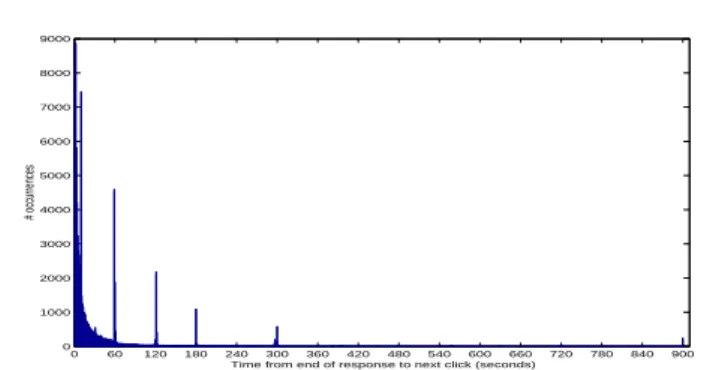
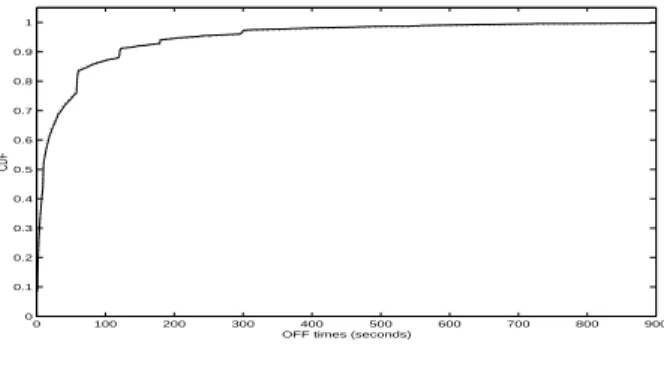
The web is one of the most popular Internet applications. In order to un-derstand how aggregated Internet traffic behaves and to be able to generate realistic traffic for simulations and lab experiments it is important to under-stand web traffic behaviour. This thesis presents a simple model of web client traffic. Starting from a packet trace of web traffic, we derive empirical prob-ability distributions describing session lengths, time between user requests for web pages, and the amount of data that is transferred due to a single user re-quest. Using these probability distributions we implement a web-client traffic generator and show that the generated traffic has the same characteristics as the original web traffic, including the traffic variability (self-similar properties).
TCP is the predominant Internet transport protocol. TCP is used by many popular applications including the web and it is used for transporting 80-90% of the Internet traffic. The second aspect of traffic management in this the-sis is dynamic allocation of bandwidth to TCP flows. TCP provides a reliable flow of data between two hosts and adapts its rate to the available capacity. Network technologies such as Dynamic synchronous Transfer Mode (DTM) provides channels with dynamically adjustable capacity. The issue is to
ii
tively allocate bandwidth to TCP flows, when both TCP and the bandwidth allocation scheme can react to changes in the network load. We use simula-tion to investigate the behaviour of a bandwidth allocasimula-tion scheme, its effect on TCP flows and on a network that can vary its capacity. The results show that the bandwidth allocation scheme usually works well for TCP flows but we also highlight a scenario where packet loss makes the feedback mechanisms interact in an unfavourable way.
The objective of traffic engineering is to avoid congestion in the network and to make good use of available resources by controlling and optimising the routing. The challenge for traffic engineering in IP networks is to cope with the dynamics of Internet traffic demands. This thesis propose l-balanced routings that route the traffic on the shortest paths possible but make sure that no link is utilised to more than a given level l, if possible. L-balanced routing gives efficient routing of traffic and controlled spare capacity to handle unpredictable changes in traffic. We present an l-balanced routing algorithm based on multi-commodity flow optimisation. We also present a heuristic search method for finding l-balanced weight settings for the legacy routing protocols OSPF and IS-IS. We show that the search and the resulting weight settings work well in real network scenarios.
Acknowledgements
First of all, I would like to thank my advisor Mats Bj¨orkman. Without his en-couragement, guidance and support this thesis would never have been finished. I am also very grateful to Adams Dunkels for his generosity and enthusiasm and for all the inspiring and helpful discussions we have had; first as fellow PhD students and then with Adam as my co-advisor.
I also want to thank Bengt Ahlgren for giving me the opportunity to work in the NETS group and to do research at SICS. I did my first research work and wrote the first paper under Bengts supervision and I learned a lot from that.
I also want to thank Anders Gunnar for many interesting discussions on all aspects of Internet traffic management and for great collaboration on many research papers and countless project deliverables.
Many thanks also to the other co-authors of the papers in this thesis: Ian Marsh, Olof Hagsand, Juan Alonso and Per Kreuger.
I also want to thank Bj¨orn Gr¨onvall, Laura Feeney, and Javier Ubillos in the NETS group, and all other colleagues at SICS for their support and for creating a stimulating work environment.
Contents
I
Thesis
1
1 Introduction 3
1.1 Internet – a network of networks . . . 3
1.2 Internet traffic characteristics . . . 5
1.3 Internet traffic management . . . 5
2 Research Issues 9 2.1 Characterizing web traffic and generating synthetic traffic . . . 9
2.2 Dynamic allocation of bandwidth to TCP flows . . . 10
2.3 Robust traffic engineering . . . 10
2.4 Contributions . . . 11
3 Summary of the Papers and Their Contributions 13 3.1 Paper A . . . 13 3.2 Paper B . . . 14 3.3 Paper C . . . 15 3.4 Paper D . . . 16 3.5 Paper E . . . 16 4 Related Work 19 4.1 Characterizing web traffic and generating synthetic traffic . . . 19
4.1.1 Methods for collecting information about web traffic . 19 4.1.2 Investigated characteristics of web traffic . . . 20
4.1.3 Web traffic generators . . . 21
4.2 Dynamic allocation of bandwidth to TCP flows . . . 21
4.3 Traffic engineering in IP networks . . . 23
5 Conclusions 27
vi Contents
Bibliography 31
II
Included Papers
39
6 Paper A:
Using Empirical Distributions to Characterize Web Client Traffic
and to Generate Synthetic Traffic 41
6.1 Introduction . . . 43
6.2 Analyzing web traffic . . . 44
6.2.1 The HTTP protocols . . . 44
6.2.2 The packet trace . . . 45
6.2.3 Detecting user clicks . . . 47
6.2.4 User sessions . . . 49
6.2.5 Data analysis . . . 50
6.3 Empirical distributions . . . 50
6.3.1 OFF times . . . 50
6.3.2 Amount of data transferred due to a single user click . 51 6.4 Generating traffic . . . 52
6.4.1 The traffic generator . . . 52
6.4.2 Evaluation . . . 53
6.5 Related work . . . 53
6.6 Conclusions and future work . . . 55
Bibliography . . . 56
7 Paper B: TCP over High Speed Variable Capacity Links: A Simulation Study for Bandwidth Allocation 59 7.1 Introduction . . . 61
7.2 Dynamic Synchronous Transfer Mode . . . 62
7.2.1 TCP Rate Estimation and DTM Capacity Allocation . 62 7.3 Simulation Tests . . . 64
7.3.1 Two Flows Per Channel and Small Router Buffers . . 67
7.4 Related Work . . . 71
7.5 Conclusions . . . 72
7.6 Acknowledgements . . . 74
Contents vii
8 Paper C:
A Multi Path Routing Algorithm for IP Networks Based on Flow
Optimisation 77
8.1 Introduction . . . 79
8.2 Architecture . . . 80
8.3 Optimisation . . . 82
8.3.1 Desirable Solutions . . . 83
8.3.2 How to Obtain Desirable Solutions . . . 84
8.3.3 The Result . . . 85 8.3.4 A Generalisation . . . 86 8.3.5 Quantitative Results . . . 86 8.4 Multi-Path Forwarding . . . 87 8.5 Related Work . . . 88 8.6 Conclusions . . . 89 Bibliography . . . 89 9 Paper D: Traffic Engineering in Ambient Networks: Challenges and Ap-proaches 93 9.1 Introduction . . . 95
9.2 Ambient Networks . . . 96
9.3 Traffic Engineering . . . 97
9.3.1 Classification of Traffic Engineering Methods . . . 98
9.3.2 Previous Work . . . 99
9.4 Challenges for Traffic Engineering in Ambient Networks . . . 100
9.5 Summary . . . 102
9.6 Acknowledgments . . . 103
Bibliography . . . 103
10 Paper E: Robust Traffic Engineering using L-balanced Weight-Settings in OSPF/IS-IS 107 10.1 Introduction . . . 109
10.2 Traffic Engineering in IP networks . . . 110
10.3 Related work . . . 111
10.4 L-balanced solutions . . . 112
10.4.1 Optimal l-balanced routing . . . 112
viii Contents
10.4.3 How to determine weight increments for a link? . . . . 115
10.4.4 How to determine ECMP weight settings? . . . 116
10.4.5 Increment weight on a less utilised link in a path . . . 117
10.5 Evaluation . . . 117
10.5.1 Method . . . 117
10.5.2 Static scenario: Evaluating the search method . . . 118
10.5.3 Dynamic scenario: Evaluation of robustness . . . 119
10.6 Conclusions . . . 119
I
Thesis
Chapter 1
Introduction
1.1
Internet – a network of networks
The Internet is a worldwide communication network that connects hundreds of millions of hosts and Internet users [1, 2]. It is a giant infrastructure of optical fibres, copper wires and wireless connections that via packet switches connect a wide variety of end-hosts: ranging from traditional web servers, PC:s and laptop computers, to cell phones and smaller devices embedded in our homes, in cars and in the environment around us. The Internet is also an infrastruc-ture that supports a diversity of applications like the web, mail, file sharing, telephony, radio, video and TV distribution, games, banking and commerce of many kinds; and where new applications constantly are developed and de-ployed.
Taken as a whole the Internet is a very complex system. To get some struc-ture in this, one could notice two things: First, the Internet is a network of networks. It consists of a large number of smaller and independently managed networks. Secondly, the protocols that define how Internet communication is done are structured into layers with different functionality.
The Internet is a network of interconnected heterogeneous networks of different sizes, different capacities, and under different administrations. The hundreds of thousands of networks that constitute the Internet are connected together in a loose hierarchy. At the top there are a small number of tier-1 operators with large international high-capacity networks. The tier-1 networks directly connect to each other and the operators have peering agreements that allow data to flow between the networks without charging each other for the
4 Chapter 1. Introduction
data transmitted. A tier-2 network is typically a regional or national network. It can have peering agreements with other tier-2 networks to exchange traffic but it is also a customer to one or more tier-1 operators and need to buy transit to reach some parts of the Internet. At the bottom of the network hierarchy are the access networks that connects the end hosts to the Internet. These are typ-ically local telephone companies, university or company networks that in turn are customers to upper-tier networks to be able to communicate worldwide.
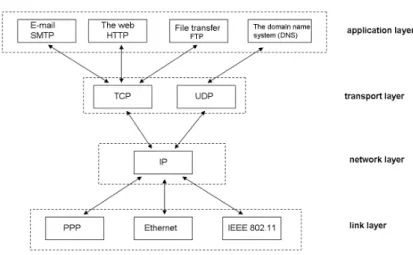
The Internet protocols are arranged in layers, each having a different re-sponsibility. The TCP/IP protocol suite used for Internet communication fol-lows a 4-layer model with different protocols at these layers. Figure 1.1 illus-trates the layered architecture with example protocols at the different layers. At the top is the application layer which includes many different protocols for
Figure 1.1: Layers with example protocols
handling the details of particular applications. For instance the Simple Mail Transfer Protocol (SMTP) for transferring electronic mail messages and the HyperText Transfer Protocol (HTTP) for requests and transfers of web pages.
The transport layer provides a flow of data between two hosts. TCP (Trans-mission Control Protocol) and UDP (User Datagram Protocol) are the two pre-dominant transport layer protocols. TCP provides a connection-oriented, reli-able, byte stream service to the application layer. It keeps track of the packets sent and retransmits packets that are lost in the network. TCP also provides flow control and congestion control that adapts the transmission rate to what
1.2 Internet traffic characteristics 5
the endhosts and the network can handle.
The network layer contains the Internet protocol (IP) that defines the IP packet as the unit of information passed across the Internet. The network layer handles the movement of packets around the network using routing and for-warding mechanisms. Routing determines the paths that packets should take through the networks from sender to receiver. Routing protocols are used to create forwarding tables. Routers then use the tables to forward packets to-wards the receiver based on the destination IP-address in the packet. The net-work layer and the IP protocol interconnect the many different netnet-works that constitute the Internet and provide communication across many kinds of link layer technologies.
1.2
Internet traffic characteristics
How to best model and describe Internet traffic is still an open area of research. The traffic characteristics depend on when and where on the Internet the traffic is investigated. The traffic behaviour in a large backbone network differ from that in a small company network, and the traffic characteristics changes with new applications, new types of networks and with changing user behaviour.
Ten years ago, measurements on the Internet backbone showed that 70-75% of the traffic was web traffic [3]. Since then the total traffic volumes have increased a lot, the share of web traffic is still high in many networks [4, 5, 6] but now often file sharing is the application that dominates the traffic [7, 8]. Also, TV and video distribution over IP are becoming widespread and produce increasing traffic volumes.
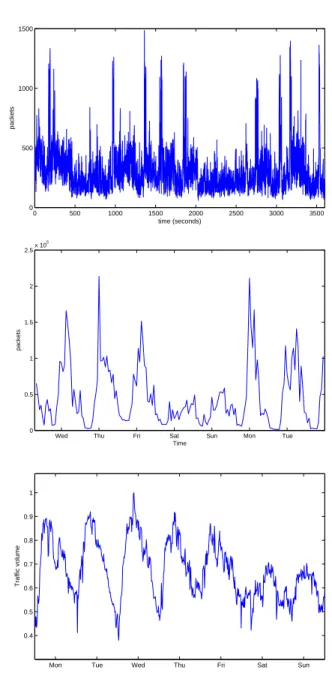
Figure 1.2 shows examples of Internet traffic behaviour. On short time scales up to seconds the traffic is very bursty and on longer timescales there are often predictable daily and weekly cycles and in between there can be unpre-dictable shifts and changes in traffic demand.
1.3
Internet traffic management
Internet traffic management means handling the traffic situation in the net-works; avoiding congestion and making good use of available network re-sources.
Traffic management involves both the end hosts and the network operators. It involves the end hosts in that they for many applications run TCP congestion control and adapt the send rate to what the network can handle. TCP increases
6 Chapter 1. Introduction 0 500 1000 1500 2000 2500 3000 3500 0 500 1000 1500 time (seconds) packets
Wed Thu Fri Sat Sun Mon Tue
0 0.5 1 1.5 2 2.5x 10 5 Time packets
Mon Tue Wed Thu Fri Sat Sun
0.4 0.5 0.6 0.7 0.8 0.9 1 Traffic volume
Figure 1.2: Example of Internet traffic behaviour. Top: Packets per second during one hour in a company network. Middle: Web traffic per hour during one week in a company network. The traffic data is described in paper A [9]. Bottom: Total traffic in a backbone network during one week (normalised). Traffic data from the Geant network [10].
1.3 Internet traffic management 7
the send rate to find out the available network capacity. When a packet is lost this is interpreted as network congestion and the transmission rate is decreased. From a network operator perspective traffic management involves monitoring and understanding the traffic behaviour in the network. It also includes traffic engineering where the routing of traffic through the network is adapted to the current traffic situation.
For network operators it is important to manage the traffic situation in the network and meet service level agreements (SLAs) made with their customers. The traffic demands in a network may fluctuate and changes over time. Traffic engineering mechanisms can then be used to adapt to the changes in traffic de-mand and distribute traffic to benefit from available network resources. Today, the main alternative for traffic engineering within an IP network is to use dif-ferent methods for setting the link costs (and so decide upon the shortest paths) in the routing protocols OSPF (Open Shortest Path First) and IS-IS (Interme-diate System to Interme(Interme-diate System). These are both link-state protocols and the routing decisions are based on link costs and a shortest (least-cost) path calculation. With the equal-cost multi-path (ECMP) extension to the routing protocols the traffic can also be distributed over several paths that have the same cost. These routing protocols were designed to be simple and robust rather than to optimise the resource usage. They do not by themselves consider network utilisation and do not always make good use of network resources. The traffic is routed on the shortest path through the network even if the shortest path is overloaded and there exist alternative paths. It is up to the operator to find a set of link costs that is best suited for the current traffic situation and that avoids congestion in the network.
Network operators today have different strategies for coping with traffic variability: ranging from just over-dimensioning network capacity a lot, to occasionally tuning the link costs in OSPF to postpone upgrades of network equipment, to more active use of traffic monitoring and traffic engineering mechanisms to manage the traffic situation.
Chapter 2
Research Issues
This thesis presents work on three aspects of Internet traffic management: traf-fic engineering, web traftraf-fic modelling, and bandwidth allocation to TCP flows. The areas all have in common the need to understand and handle Internet traffic behaviour. For web traffic modelling the goal of the work itself is to understand traffic behaviour and to be able to generate realistic traffic in simulations and lab experiments. For traffic engineering and bandwidth allocation to TCP flows the purpose is to develop methods to control and steer the traffic.
2.1
Characterizing web traffic and generating
syn-thetic traffic
Surfing the web is one of the most popular Internet applications. Ten years ago, measurements on the Internet backbone showed that 70-75% of the traffic was web traffic [3]. Since then the total traffic volumes have increased a lot, other applications like file sharing now often dominates the traffic, but the share of web traffic is still high in many networks [4, 5, 6]. It is therefore important to measure and model web traffic in order to understand and manage the be-haviour of aggregated Internet traffic, and to be able to generate realistic traffic in simulations and lab experiments.
The research issues are to collect web traffic, extract and model the im-portant characteristics from the collected data, and from the model generate realistic synthetic traffic.
A direct method to collect information about web traffic is to use a packet
10 Chapter 2. Research Issues
trace. But we do not want to model the number, size and inter-arrival times of packets. These packet level characteristics depend on the TCP flow control and congestion control algorithms and reflects the conditions in the network at the time the trace was taken. To be able to generate realistic traffic for different levels of network utilisation we want a higher level model on top of TCP.
In paper A we present a simple model of web client traffic. We start with a packet trace of web traffic and use a heuristic method to identify when a user clicks on a link to retrieve the next web page. From this we derive empirical probability distributions describing session lengths, time between user clicks, and the amount of data that is transferred due to a single user click. Using these probability distributions we implement and evaluate a web-client traffic generator.
2.2
Dynamic allocation of bandwidth to TCP flows
TCP is the predominant Internet transport protocol. TCP is used by many popu-lar applications including the web and it is used for transporting approximately 80-90% of the Internet traffic [4, 6, 7, 5].
TCP is a reliable end-to-end transport protocol that adapts its rate to the available capacity. Network technologies such as Dynamic synchronous Trans-fer Mode (DTM) provides channels with dynamically adjustable capacity. The issue here is to adaptively allocate bandwidth to TCP flows, when both TCP and the bandwidth allocation scheme can react to changes in the network load. In paper B, we do a simulation study in ns-2 and investigate the behaviour of a bandwidth allocation scheme, its effect on TCP flows and on a network that can vary its capacity.
2.3
Robust traffic engineering
The objective of traffic engineering is to avoid congestion in the network and to make better use of available resources by adapting the routing to the current traffic situation. The main challenge for traffic engineering is to cope with the dynamics of traffic demands and topology. Traffic is often bursty and there can be unpredictable changes and shifts in traffic demand, for instance due to hotspots and flash crowds, or because a link goes down, there are changes in the inter-domain routing, or because traffic in an overlay is re-directed. For future networks more variability in traffic demands is also expected due to mobility of nodes and networks and more dynamic on-demand service level agreements.
2.4 Contributions 11
The traffic variability means that, even if we could measure the current traffic situation exactly, it would not always correctly predict the near future traffic situation. Traffic engineering mechanisms need to be robust and able to handle traffic variability and uncertainties in input traffic data.
The papers C, D and E in this thesis cover different aspects of robust traffic engineering.
2.4
Contributions
The contributions of the web traffic work are the heuristics for detecting user clicks in a packet trace, a simple empirical web client model (describing ses-sion lengths, time between user clicks, and the amount of data that is trans-ferred due to a single user click), and a realistic web client traffic generator.
For studying dynamic allocation of bandwidth to TCP flows we imple-mented a simulation environment in ns-2. The contribution of this work is the performance evaluation of an estimation algorithm, which measures the rate of TCP flows and allocates capacity on a DTM network.
We show that the measurement-based bandwidth allocator usually works well for TCP flows but we also identify a scenario where packet loss makes the feedback mechanisms interact in an unfavourable way and where the band-width allocator could be improved. If the bandband-width allocator somehow fails to assign enough capacity and packets are dropped then TCP decreases its rate. The measurement-based estimator then decreases rather than increases the al-located bandwidth.
For robust traffic engineering we propose l-balanced routings as a way for an operator to handle traffic variability and uncertainties in input traffic data. An l-balanced solution routes the traffic on the shortest paths possible but makes sure that no link is utilised to more than a given level l. The con-tributions are an l-balanced routing algorithm based on multi-commodity flow optimisation and a heuristic search method for finding l-balanced weight set-tings for the legacy routing protocols OSPF and IS-IS.
L-balanced routing gives the operator possibility to apply simple rules of thumb for controlling the maximum link utilisation and control the amount of spare capacity needed to handle sudden traffic variations. It gives more controlled traffic levels than other cost functions and more efficient routing for low traffic loads when there is no need to spread traffic over longer paths.
Chapter 3
Summary of the Papers and
Their Contributions
The thesis is a collection of five papers. Paper A about web traffic charac-terisation, paper B about bandwidth allocation to TCP flows, and paper C-E on different aspects of robust traffic engineering. Paper A, B and C are all published at refereed international conferences. Paper D was published at the Swedish National Computer Networking Workshop and paper E is submitted for publication.
3.1
Paper A
Using Empirical Distributions to Characterize Web Client Traffic and to Generate Synthetic Traffic. Henrik Abrahamsson and Bengt Ahlgren. In
Proceedings of IEEE Globecom:Global Internet, San Francisco, USA, Novem-ber 2000.
Summary:
This paper presents a simple model of web client traffic. The paper describes how the model is derived, some characteristics of web traffic, and how the model is used to implement a traffic generator.
A packet trace with HTTP traffic data captured at SICS is analysed to ob-tain the traffic characteristics of web clients. A heuristic method is used to identify user clicks in the packet trace and from this empirical probability dis-tributions are derived describing session lengths, time between user clicks, and
14 Chapter 3. Summary of the Papers and Their Contributions
the amount of data that is transferred due to a single user click. Using these probability distributions a web-client traffic generator is implemented and eval-uated.
Contribution:
The contributions of this work are the heuristics for detecting user clicks in a packet trace (based on the work by Mah [11]), a simple empirical web client model and a realistic web client traffic generator.
My contribution:
I performed the work and wrote the paper under supervision of Bengt Ahlgren. I analysed the packet traces, came up with the heuristic method used, and de-rived the empirical probability distributions that make up the model. I imple-mented and evaluated the traffic generator. I wrote most of the paper except for parts of introduction and conclusions. I later also implemented the traffic generator in the ns-2 network simulator and used it for network dimensioning in an industrial project with Teracom AB.
3.2
Paper B
TCP over High Speed Variable Capacity Links: A Simulation Study for Bandwidth Allocation. Henrik Abrahamsson, Olof Hagsand and Ian Marsh.
In Proceedings of Protocols for High-Speed Networks (PfHSN 2002), Berlin,
Germany, April 2002.
Summary:
This paper presents a simulation study of bandwidth allocation to TCP flows. Dynamic synchronous Transfer Mode (DTM) is a gigabit network technology that provides channels with dynamically adjustable capacity. TCP is a reliable end-to-end transport protocol that adapts its rate to the available capacity. Both TCP and the DTM bandwidth can react to changes in the network load, creating a complex system with inter-dependent feedback mechanisms.
In this work we create a simulation environment using ns-2. We investigate the behaviour of a bandwidth allocation scheme, its effect on TCP flows and on a network that can vary its capacity. The results indicate that the bandwidth allocation scheme usually works well for TCP flows. But the paper also high-light a scenario where packet loss make the feedback mechanisms interact in an unfavourable way and where the allocation scheme could be improved.
Contribution:
3.3 Paper C 15
for TCP flows on variable capacity technologies. For evaluating the bandwidth allocator we implemented a simulation environment in ns-2.
My contribution:
This work was done in collaboration with Ian Marsh and Olof Hagsand. To-gether with Ian Marsh, I implemented the ns-2 simulation environment, planned and ran the experiments and analysed the results. I co-authored the paper.
3.3
Paper C
A Multi Path Routing Algorithm for IP Networks Based on Flow Optimi-sation H. Abrahamsson, J. Alonso, B. Ahlgren, A. Andersson and P. Kreuger.
In Proceedings of Third COST 263 International Workshop on Quality of
Fu-ture Internet Services(QoFIS 2002), Zurich, Switzerland, October 2002.
Summary:
Intra-domain routing in the Internet normally uses a single shortest path to forward packets towards a specific destination with no knowledge of traffic de-mand. We present an intra-domain routing algorithm based on multi-commodity flow optimisation which enable load sensitive forwarding over multiple paths. It is neither constrained by weight-tuning of legacy routing protocols, such as OSPF, nor requires a totally new forwarding mechanism, such as MPLS. These characteristics are accomplished by aggregating the traffic flows des-tined for the same egress into one commodity in the optimisation and using a hash based forwarding mechanism. The aggregation also results in a reduction of computational complexity which makes the algorithm feasible for on-line load balancing. Another contribution is the optimisation objective function which allows precise tuning of the tradeoff between load balancing and total network efficiency.
Contribution:
There are two contributions in this paper: the modelling of the problem as an optimisation problem, and the definition of an optimisation objective function for l-balanced solutions.
In the modelling of the optimisation problem we aggregate all traffic des-tined for a certain egress into one commodity in a multi-commodity flow opti-misation. It is this definition of a commodity that both makes the computation tractable, and the forwarding simple.
L-balanced solutions allows the network operator to choose a maximum
desired link utilisation level. The optimisation will then find the most efficient solution, if it exists, satisfying the link level constraint. Our objective function
16 Chapter 3. Summary of the Papers and Their Contributions
thus enables the operator to control the trade-off between minimising the net-work utilisation and balancing load over multiple paths.
My contribution:
This is joint work with Bengt Ahlgren, Juan Alonso, Anders Gunnar and Per Kreuger. Juan Alonso did most of the mathematical work for this paper. In discussion with Juan I contributed to the idea of only looking at the destination of the traffic when formulating the optimisation problem. I co-authored the paper.
3.4
Paper D
Traffic Engineering in Ambient Networks: Challenges and Approaches
H. Abrahamsson and A. Gunnar. In Proceedings of Second Swedish National
Computer Networking Workshop (SNCNW), 2004, Karlstad, Sweden.
Summary:
This paper identifies the requirements and challenges for traffic engineering in a dynamic environment. We give a short introduction to the Ambient Networks project which aims to provide a novel mobile communication platform beyond 3G. Further, a framework for classification of traffic engineering methods is introduced to facilitate the analysis and identification of challenges and alter-natives for traffic engineering in Ambient Networks.
Contribution:
The contribution of this paper is in the identification of and reasoning about requirements, challenges and alternatives for traffic engineering in a dynamic environment.
My contribution:
I did this work in cooperation with Anders Gunnar. I wrote about half of the paper.
3.5
Paper E
Robust Traffic Engineering using L-balanced Weight-Settings in OSPF/ISIS
H. Abrahamsson and M. Bj¨orkman. Submitted for publication September 2008.
Summary:
The focus of this work is on robust traffic engineering for the legacy routing protocols OSPF and IS-IS. The idea is to use the L-balanced solutions pro-posed in paper C to make sure that there are enough spare capacity on all links
3.5 Paper E 17
to handle sudden hotspots and traffic shifts. Search heuristics are used to find the set of weights that avoid loading any link to more than L and the resulting routings are evaluated using real topologies and traffic scenarios.
Contribution:
The contributions are the idea of l-balanced weight-settings for robust traf-fic engineering, the search heuristics for finding such weight-settings, and the evaluation of how different cost functions (including l-balanced) manage to handle faults in input traffic data due to traffic hotspots.
My contribution:
The idea of using the l-balanced solution for robust weight-settings was mine. I implemented the search heuristics and did the evaluations and wrote most of the paper.
Chapter 4
Related Work
4.1
Characterizing web traffic and generating
syn-thetic traffic
In paper A from 2000 we model web client traffic and implement a traffic gen-erator with the purpose of creating realistic background traffic in simulations and lab experiments.
Two approaches can be used to generate network traffic that imitates real web traffic. The first is simply to replay packet traces of real web traffic. But, because of TCP’s congestion control the timing of packets in a trace reflects the condition in the network when the trace was taken and this timing would not be the same in another context. The better alternative, as argued by Paxson and Floyd [12], is to gather information about and model those aspects of the web traffic that one believe is most important and from this model generate traffic.
4.1.1
Methods for collecting information about web traffic
To get information about web traffic three different approaches have been widely used: server logs, client logs and packet traces. Server logs cannot easily be used to describe the client side since a client usually accesses many different web servers.
To capture the client accesses between multiple servers, client logs can be used. This approach requires that browsers can log their requests, that the source code for the browser is available so that logging can be added, or
20 Chapter 4. Related Work
that some other way to log the clients behaviour is available. Catledge and Pitkow [13], Cunha et al. [14] and Crovella and Bestavros [15] used instru-mented versions of the Mosaic web browser and in Barford et al. [16] HTTP proxies were used to track all documents referenced by unmodified Netscape Navigator clients. Later work that use this method include the tool Carena [17] which together with the Mozilla web browser can be used to capture and replay browsing sessions.
The third approach of gathering data, and the method we use in [9], is to analyse packet traces taken from a subnet carrying HTTP traffic. This method was used by Stevens [18] to analyse the traffic arriving at a server, and by Mah [11] to model the client side of the HTTP traffic. A further step is taken by Anja Feldmann [19] when extracting full HTTP level as well as TCP level traces via packet monitoring. The method of investigating packet traces is also used by Choi and Limb [20], Smith et al. [21], Molina et al. [22], and Tran et al. [23]. Recently Cao et al. [24], Weigle et al. [25] and Vishwanath and Vahdat [26] all use packet traces from a single point in the network to characterise and generate traffic.
Simpson et al. [27] use the NETI@home [28] software to collect statistics from end-systems. The approach here is to sniff packets sent to and from the host (that is running the software) and infer statistics based on these observed packets. The dataset used in [27] to investigate web traffic includes 1700 users in 28 nations.
4.1.2
Investigated characteristics of web traffic
Different studies of web traffic look at different properties of the traffic. The two most common characteristics to investigate (and what we modelled in pa-per A) is user OFF times and response sizes. User OFF time (sometimes called user view time or user think time) is the time from when a download of a web page is completed to the next request. Response sizes are the number of bytes that is downloaded in response to a web request.
Mah [11] investigate user OFF times and response sizes but also request sizes, number of files per page, number of consecutive document from the same server and web server popularity. Barford and Crovella [16] look at request and response sizes, number of files per page, user OFF times, the popularity of web pages, and temporal locality (meaning the likelihood that once a file has been requested, it will be requested again in the near future). Smith et al. [21] analyse request and response sizes. Choi and Limb [20] look at web request and response sizes, number of objects per page, user viewing time and web
4.2 Dynamic allocation of bandwidth to TCP flows 21
page caching. Molina et al. [22] investigate response sizes, user think times, and also number of TCP connections used to download a page. Simpson et al. [27] examine bytes sent and bytes received, user think time, and the frequency distribution of contacting specific destinations.
4.1.3
Web traffic generators
One of the most well-known web traffic generators is SURGE [16]. The tool generates traffic matching distributions of request and response sizes, number of files per page, user OFF times, the popularity of web pages, and temporal locality. Also, the web models described by Mah [11] and Choi and Limb [20] has been used to generate synthetic traffic.
More recent work on traffic generators include the tools PackMime-HTTP [24], Tmix [25] and Swing [26].
4.2
Dynamic allocation of bandwidth to TCP flows
Lundqvist [29] evaluates different algorithms for bandwidth allocation for DTM channels transporting IP traffic. The algorithms were assessed with respect to throughput, delay and bandwidth changes per second. TCP rate adjustment is done by placing the incoming packets into a buffer and adding and removing slots if the level of the buffer exceeds continuously maintained threshold val-ues. He concludes that adaptive strategies are recommended for TCP, however too frequent changes can be undesirable in a DTM network due to the process-ing cost. The main conclusion from this work is that the choice of algorithm can play a significant role in the performance. This work is similar to ours in that the goal is a slot allocation for TCP traffic over DTM. It differs from ours in that we measure the rate of each TCP flow, whilst he looks at the outgoing buffer length as a sign to increase or decrease the number of slots.
Krishnan and Sterbenz investigate TCP over load-reactive links [30, 31]. They use a hysteresis control mechanism for capacity allocation. Buffer levels are monitored (as in [29]) and if the occupancy is greater than a threshold the capacity is increased and vice versa. Their scheme is dependent on keeping buffers occupied all the time, otherwise the link capacity will fall and hence the throughput. A single TCP flow is simulated and the authors state that the control parameters should be carefully chosen. Poor parameter choice can have the opposite effect, resulting in TCP not being able to operate. The work re-sembles ours in that a method is presented to react to network load and allocate
22 Chapter 4. Related Work
bandwidth for TCP accordingly. It differs in that we measure the throughput of individual flows and allocate bandwidth from this measurements, where they use the buffer length as a measure of the load.
Clark and Fang propose a framework for allocating bandwidth to different users during congestion [32]. The focus of the work is TCP bulk-data transfers. The authors attempt to keep TCP flows in congestion avoidance in the best case, and fast recovery phase in the worst case, by avoiding dropping several packets of the same flow in the same RTT. The work resembles ours in that they attempt to allocate bandwidth between different flows in a fair manner. It differs from ours in that we assume that the network can change its offered bandwidth and we focus on maximising TCP throughput, rather than trying to maintain a TCP state in the face of adverse network conditions. In addition, we allocate bandwidth to flows not only when the network is congested but also in normal situations as well.
Comprehensive studies have been done related to the performance of TCP on ATM networks [33, 34]. The main conclusions of the works are similar, the traffic classes of ATM are poorly suited to the bursty needs of TCP, due to the traffic contracts needed by ATM classes. The conclusion in Bonaventure [33] is that the complexity of choosing traffic parameters for ABR is not in proportion to the benefits of carrying TCP/IP traffic. The CBR class is too simple for TCP, as only the peak rate is specified.
TCP can also interact with routing decisions and traffic engineering done by operators on the network layer. TCP and traffic engineering work indepen-dently of each other, but both try to avoid congestion and make good use of network resources.
Gao et.al [35] study the interaction between TCP and a route control mech-anism for multihomed networks that selects egress link based on performance measurements. They show that the route selection often can improve TCP throughput and that the two mechanism interact well given that the route con-trol react on longer timescales than TCP.
Anderson and Anderson [36] study the interaction between the feedback mechanisms of adaptive routing and congestion control. They argue that adap-tive routing can be designed to be stable in conjunction with congestion control. He et.al [37, 38] model the interaction between TCP congestion control and traffic engineering in a network. They show through simulation that the mechanisms are stable and work effectively together.
4.3 Traffic engineering in IP networks 23
4.3
Traffic engineering in IP networks
Traffic engineering by finding a suitable set of weights in OSPF/IS-IS is a well studied area of research and it is described in recent textbooks in the area [39, 40]. When we in paper E revisit the weight setting approach to traffic engineering we are most inspired by the pioneering works by Fortz and Tho-rup [41, 42] and Ramakrishnan and Rodrigues [43], in that we use a piece-wise linear cost function and search heuristics to find suitable weight settings.
Several studies [41, 44, 45, 46] have shown that even though we limit the routing of traffic to what can be achieved with weight-based ECMP shortest paths, and not necessarily the optimal weights but those found by search heuris-tics, it often comes close to the optimal routing for real network scenarios. How the traffic is distributed in the network very much depends on the objectives, usually expressed as a cost function, in the optimisation. An often proposed objective function is described by Fortz and Thorup [41]. Here the sum of the cost over all links is considered and a piece-wise linear increasing cost function is applied to the flow on each link. The basic idea is that it should be cheap to use a link with small utilisation while using a link that approaches 100% utilisation should be heavily penalised. The l-balanced cost function used in paper C and E is similar in that it uses a piecewise linear cost function to ob-tain desirable solutions. Additionally, it gives the operator the opportunity to set the maximum wanted link utilisation. Cost functions for traffic engineering is further investigated by Balon et.al [47]
Paper E add to existing work on weight settings by focusing on robust-ness and the objective of achieving a controlled spare capacity for handling unpredictable traffic shifts. For robust traffic engineering much of the focus is on handling multiple traffic matrices and traffic scenarios [42, 48, 49, 50, 51] and handling the trade-off between optimising for the common case or for the worst case. Nucci et.al [52] investigate link weight assignments that take into account SLA requirements and link failures.
Xu et.al [53] describe a method to jointly solve the flow optimisation and the link-weight approximation using a single formulation resulting in a more efficient computation. Their method can also direct traffic over non-shortest paths with arbitrary percentages. Their results should also be directly appli-cable to our problem of providing robustness to changes, by just substituting their piece-wise linear cost function with our cost function. In a continuation on this work Xu et.al [54] propose a new link-state routing protocol. The pro-tocol splits traffic over multiple paths with an exponential penalty on longer paths and achieves optimal traffic engineering while retaining the simplicity of
24 Chapter 4. Related Work
hop-by-hop forwarding.
The advantage of optimising the weights in OSPF and IS-IS is of course easy deployment of the traffic engineering mechanism. However, the disad-vantage is the difficulties and constraints imposed by using legacy routing. Much of the research also start to take a clean slate approach, not limited to what can be achieved with todays protocols and argue that future protocols should be designed with optimisation and manageability in mind from the be-ginning [55]. The general problem of finding the best way to route traffic through a network can be mathematically formulated as a multi-commodity flow (MCF) optimisation problem. In paper C we present a routing algorithm based of multi-commodity flow optimisation. By aggregating the traffic flows destined for the same egress into one commodity in the optimisation we reduce the computational complexity. The same approach is used by Fu et.al [56]. They use multi-commodity flow optimisation for centralised traffic engineering combined with a scheme to quickly recompute routing paths when the topol-ogy changes. MCF optimisation is also used by many other research groups to address traffic engineering problems including [41, 45, 57]. See also the book by Pioro and Medhi [39] and references therein.
Most traffic engineering methods (including the weight-setting and optimi-sation methods described above) need as input a traffic matrix describing the traffic demand between each pair of nodes in the network. With this network-wide information the routing can often come close to optimal. But the draw-back is that it is difficult to react quickly to changes without too much traffic overhead. With local traffic engineering on the other hand the individual nodes can quickly react to changes in traffic but can possibly create routing loops and overload elsewhere in the network. An attempt to localise and distribute the routing decisions is Adaptive Multi-path routing (AMP) [58]. In AMP in-formation on the traffic situation on links is only distributed to the immediate neighbours of each router. Hence, AMP relies on local information in neigh-bouring routers to calculate next hop towards the destination. The Multi-Path Routing with Dynamic Variance (MRDV) [59] combined with a Loop Avoid-ance Protocol (LAP) [60] is another approach to localised traffic engineering. In this approach no load information is exchanged between routers. Instead the cost of each path towards the destination is weighted by a variance factor which reflect load on the next hop. Hence, traffic is shifted from heavily loaded links to links with less load. A related approach is introduced by Vutukury et.al [61]. Here the routing decision is divided into two steps. First, multiple loop-free paths are established using long term delay information. In the second step the routing parameters along the precomputed paths are adjusted using
4.3 Traffic engineering in IP networks 25
only local short-term delay information.
Local versus network-wide traffic information and novel routing mecha-nisms versus optimising legacy routing are two ways of categorising traffic engineering methods. A detailed taxonomy of traffic engineering methods can be found in RFC 3272 [62] .
Chapter 5
Conclusions
Internet traffic volumes continue to grow at a great rate, now pushed on by video and TV distribution in the networks. Increasing traffic volumes and the introduction of delay and loss sensitive services makes it crucial for operators to understand and manage the traffic situation in the network. More traffic also necessitate upgrades of network equipment and new investments for operators, and keep up-to-date the question of over-dimensioning network capacity versus using traffic engineering mechanisms for better handling the traffic.
This thesis approaches Internet traffic management on different levels: we investigate web client behaviour and web traffic characteristics on the applica-tion layer; we study bandwidth allocaapplica-tion to TCP flows on the transport layer; and traffic engineering mechanisms for adapting the routing to the current traf-fic situation on the network layer.
The thesis presents a simple model of web client traffic and based on this model a traffic generator used for generating realistic traffic in simulations and lab experiments. The traffic generator has also been implemented in the ns-2 simulator and used in an industrial project for dimensioning and investigation of how many web users a given network can handle.
This work, presented in paper A, was done in the year 2000. Since then many new applications have appeared. Today, even though web traffic still contribute to a large part of the total traffic in some networks, one would also need to model other applications like file sharing to get a representative mixture of traffic.
Also, the web itself has developed a lot and the use of the web has changed during the last eight years. Web surfing is no longer a sequential transfer of
28 Chapter 5. Conclusions
static webpages consisting of a html document and a few images. Web pages today are often much more complex, dynamic and interactive with videos and advertisements. Downloading a commercial web page can involve communi-cating with ten different servers including content delivery networks and ad-vertising companies. The distribution of transfer sizes would look different today.
Web users also often have many concurrent tabs and web browser windows running at the same time; for instance having a music video running in the background (over port 80), and at the same time reading email and clicking on links on other web pages. This means that the simple heuristic for detecting user clicks in paper A no longer would work; and it would be difficult to model the user behaviour using only packet traces.
If the purpose is to generate realistic traffic based on packet traces then an alternative [25, 26] is to have a more abstract model of transfers above TCP. This type of model can include off times and response sizes but does not nec-essarily capture the high level user and application behaviour; i.e how often the user clicks on links or how the application involves communication with many different server.
The thesis also study dynamic allocation of bandwidth to TCP flows. We evaluate an estimation algorithm, which measures the rate of TCP flows and al-locates capacity to channels in a DTM network. We use simulation to study the interaction between the TCP congestion control mechanism and the bandwidth allocation scheme which both react to changes in network load.
Paper B shows that the measurement-based bandwidth allocator usually works well for TCP flows but it also highlight a scenario where packet loss make the feedback mechanisms interact in an unfavourable way.
The traffic demands in a network change over time and there can be un-predictable changes and shifts, for instance due to hotspots, or because a link goes down, or because traffic in an overlay is re-directed. For future networks (as discussed in paper D) more variability in traffic demands is also expected due to mobility of nodes and networks and more dynamic on-demand service level agreements (SLA:s). This means that a network operator can not rely only on long-term network planning and dimensioning that are done when the network is first built. Robust traffic engineering mechanisms are needed that can adapt to changes in traffic demand and distribute traffic to benefit from available resources.
This thesis propose l-balanced routings as a way for an operator to handle traffic variability and uncertainties in input traffic data. An l-balanced routing algorithm based on multi-commodity flow optimisation was presented in
pa-29
per C. A heuristic search method for finding l-balanced weight settings for the legacy routing protocols OSPF and IS-IS was presented in paper E.
L-balanced routing gives the operator possibility to apply simple rules of thumb for controlling the maximum link utilisation and control the amount of spare capacity needed to handle sudden traffic variations. It gives more controlled traffic levels than other cost functions and more efficient routing for low traffic loads when there is no need to spread traffic over longer paths. Paper E shows that the search and the resulting weight settings work well in real network scenarios.
Bibliography
[1] Internet domain survey host count. On–line: http://www.isc.org. Internet Systems Consortium.
[2] Internet world stats. http://www.internetworldstats.com/stats.htm. [3] G. J. Miller K. Thompson and R. Wilder. Wide-area traffic patterns and
characteristics (extended version). IEEE Network, 11(6):10–23, 1997. [4] Richard Nelson, Daniel Lawson, and Perry Lorier. Analysis of long
dura-tion traces. SIGCOMM Computer Communicadura-tion Review, 35(1):45–52, 2005.
[5] Chuck Fraleigh, Sue Moon, B. Lyles, C. Cotton, M. Khan, D. Moll, R. Rockell, T. Seely, and Christophe Diot. Packet-Level Traffic Mea-surements from the Sprint IP Backbone. IEEE Network, 2003.
[6] Abilene network usage report.
On–line:http://netflow.internet2.edu/weekly/. [7] CAIDA Internet Data – Realtime Monitors.
On–line:http://www.caida.org/data/realtime/index.xml.
[8] Wolfgang John, Sven Tafvelin, and Tomas Olovsson. Trends And Differ-ences in Connection Behavior within Classes of Internet Backbone traffic. In Prooceedings of the 9th Passive and Active Measurement Conference, Cleveland, USA, 2008.
[9] Henrik Abrahamsson and Bengt Ahlgren. Using empirical distributions to characterize web client traffic and to generate synthetic traffic. In
Proceedings of IEEE Globecom: Global Internet, San Francisco, USA,
November 2000.
32 Bibliography
[10] S. Uhlig, B. Quoitin, S. Balon, and J. Lepropre. Providing public in-tradomain traffic matrices to the research community. ACM SIGCOMM
Computer Communication Review, 36(1), January 2006.
[11] B. A. Mah. An empirical model of HTTP network traffic. In Proceedings
of INFOCOM ‘97, Kobe, Japan, April 1997.
[12] V. Paxson and S. Floyd. Why we don’t know how to simulate the Internet. In Proceedings of the 1997 Winter Simulation Conference, Atlanta, GA, USA, 1997.
[13] L. D. Catledge and J. E. Pitkow. Characterizing browsing strategies in the World Wide Web. In Proceedings of the third International World
Wide Web Conference on technology, tools and applications, Darmstadt,
Germany, April 1995.
[14] C. R. Cunha, A. Bestavros, and M. E. Crovella. Characteristics of WWW client-based traces. Technical Report Technical Report BU-CS-95-010, Computer Science Department, Boston University, July 1995.
[15] M. E. Crovella and A. Bestavros. Self-similarity in World Wide Web traffic: Evidence and possible causes. IEEE/ACM Transactions on
Net-working, 5(6):835–846, 1997.
[16] P. Barford, A. Bestavros, A. Bradley, and M. Crovella. Changes in Web client access patterns: Characteristics and caching implications. World
Wide Web, 2:15–28, 1999. Special issue on Characterization and
Perfor-mance Evaluation.
[17] I. J. Nino, B. de la Ossa, J.A Gil, J. Sahuquillo, and A. Pont. CARENA: A tool to capture and replay web navigation sessions. In Proceedings of
IEEE/IFIP Workshop on End-to-End Monitoring Techniques and Services (E2EMON 2005), Nice, France, 2005.
[18] W. R. Stevens. TCP/IP illustrated, Vol. 3, TCP for Transactions, HTTP,
NNTP, and the UNIX Domain Protocols. Addison-Wesley, 1996.
[19] A. Feldmann. BLT: Bi-Layer Tracing of HTTP and TCP/IP. In
Proceed-ings of 9th International World Wide Web Conference, Amsterdam, May
Bibliography 33
[20] H. Choi and J. O. Limb. A behavioral model of web traffic. In
Pro-ceedings of the Seventh International Conference on Network Protocols (ICNP’99), Toronto, Canada, 1999.
[21] F. D. Smith, F. H. Campos, K. Jeffay, and D. Ott. What TCP/IP protocol headers can tell us about the web. In Proceedings of ACM SIGMETRICS
2001, Cambridge, Massachusetts, USA, 2001.
[22] M. Molina, P. Castelli, and G. Foddis. Web traffic modelling exploiting TCP connections temporal clustering through HTML-REDUCE. IEEE
Network, 14, 2000.
[23] D. N. Tran, W. T. Ooi, and Y. C. Tay. SAX: A tool for studying congestion-induced surfer behavior. In Proceedings of Passive and Active
Measurement Workshop (PAM 2006), Adelaide, Australia, March 2006.
[24] J. Cao, W. S. Cleveland, Y. Gao, K. Jeffay, F. D. Smith, and M. Wei-gle. Stochastic models for generating synthetic HTTP source traffic. In
Proceedings of IEEE INFOCOM, 2004.
[25] M.C. Weigle, P. Adurthi, F. Hernandez-Campos, K. Jeffay, and F.D. Smith. Tmix: A tool for generating realistic TCP application workloads in ns-2. ACM SIGCOMM Computer Communication Review, 36(3), July 2006.
[26] K. V. Vishwanath and A. Vahdat. Realistic and responsive network traffic generation. In Proceedings of ACM SIGCOMM’06, Pisa, Italy, September 2006.
[27] C.H. Simpson, D. Reddy, and G.F. Riley. Empirical models of TCP and UDP end-user network traffic from NETI@home data analysis. In
Prooceedings of 20th IEEE/ACM/SCS Workshop on Principles of Ad-vanced and Distributed Simulation (PADS 2006), Singapore, May 2006.
[28] NETI@home. On–line: http://neti.gatech.edu. Georgia Institute of Tech-nology.
[29] Henrik Lundqvist. Performance evaluation for IP over DTM. Master’s thesis, Link ¨oping University, Link ¨oping, 1998.
[30] Rajesh Krishnan and James Sterbenz. TCP over load-reactive links. In
34 Bibliography
[31] Rajesh Krishnan. TCP over load-reactive links. Technical Memorandum 1281, BBN, February 2001.
[32] D. Clark and W. Fang. Explicit allocation of best-effort packet delivery service. IEEE/ACM Transactions on Networking, 6(4), August 1998. [33] O. Bonaventure. Integration of ATM under TCP/IP to provide services
with minimum guaranteed bandwidth. PhD thesis, University of Liege,
1998.
[34] E. Chan, V. Lee, and J. Ng. On the performance of bandwidth allocation strategies for interconnecting ATM and connectionless networks. ACM
Computer Communications Review, 26(1):29–38, January 1996.
[35] R. Gao, D. Blair, C. Dovrolis, M. Morrow, and E. Zegura. Interactions of Intelligent Route Control with TCP Congestion Control. In Proceedings
of IFIP Networking, May 2007.
[36] E.J Anderson and T.E Anderson. On the stability of adaptive routing in the presence of congestion control. In Proceedings of IEEE INFOCOM, April 2003.
[37] Jiayue He, Mung Chiang, and Jennifer Rexford. Can Congestion Control and Traffic Engineering Be at Odds? In Proceedings of IEEE
GLOBE-COM, San Francisco, USA, December 2006.
[38] Jiayue He, Ma’ayan Bresler, Mung Chiang, and Jennifer Rexford. To-wards Robust Multi-layer Traffic Engineering: Optimization of Conges-tion Control and Routing. IEEE Journal on Selected Areas in
Communi-cations, June 2007.
[39] M. Pi´oro and D. Medhi. Routing, Flow, and Capacity Design in
Comm-munication and Computer Networks. Morgan Kaufmann, 2004.
[40] J. Rexford. Route optimization in IP networks. In Mauricio G.C. Resende and Panos M. Pardalos, editors, Handbook of Optimization in
Telecom-munications. Springer Science+Business Media, 2006.
[41] B. Fortz and M. Thorup. Internet traffic engineering by optimizing OSPF weights. In Proceedings IEEE INFOCOM 2000, pages 519–528, Israel, March 2000.
Bibliography 35
[42] B. Fortz and M. Thorup. Optimizing OSPF/IS-IS weights in a changing world. IEEE Journal on Selected Areas in Communications, 20(4):756– 767, May 2002.
[43] K.G. Ramakrishnan and M.A. Rodrigues. Optimal routing in shortest path data networks. Lucent Bell Labs Technical Journal, 6(1), 2001. [44] A. Gunnar, H. Abrahamsson, and M. S¨oderqvist. Performance of Traffic
Engineering in Operational IP-Networks: An Experimental Study. In
Proceedings of 5th IEEE International Workshop on IP Operations and Management, Barcelona, Spain, October 2005.
[45] A. Sridharan, R. Gu´erin, and C. Diot. Achieving Near-Optimal Traffic Engineering Solutions for Current OSPF/IS-IS Networks. In IEEE
Info-com, San Francisco, March 2003.
[46] David Applegate and Edith Cohen. Making Intra-Domain Routing Ro-bust to Changing and Uncertain Traffic Demands: Understanding Funda-mental Tradeoffs. In Proceedings of ACM SIGCOMM, Karlsruhe, Ger-many, August 2003.
[47] S. Balon, F. Skivee, and G. Leduc. How Well Do Traffic Engineering Objective Functions Meet TE Requirements? In Proceedings of IFIP
International Networking Conference, Coimbra, Portugal, May 2006.
[48] C. Zhang, Z. Ge, J. Kurose, Y. Liu, and D. Townsley. Optimal Rout-ing with Multiple Traffic Matrices: Tradeoffs between Average Case and Worst Case Performance. In Proceedings of ICNP 2005, Boston, USA, November 2005.
[49] C. Zhang, Y. Liu, W. Gong, J. Kurose, R. Moll, and D. Townsley. On Op-timal Routing with Multiple Traffic Matrices . In Proceedings of Infocom
2005, Miami, USA, March 2005.
[50] H. Wang, H. Xie, L. Qiu, Y. R. Yang, Y. Zhang, and A. Greenberg. Cope: Traffic engineering in dynamic networks. In Proceedings of ACM
SIG-COMM, Pisa, Italy, September 2006.
[51] Anders Gunnar and Mikael Johansson. Robust routing under bgp reroutes. In Proceedings of Globecom 2007, Washington, DC, USA, 2007.
[52] Antonio Nucci, Supratik Bhattacharyya, Nina Taft, and Christophe Diot. IGP Link Weight Assignment for Operational Tier-1 Backbones.
IEEE/ACM Transactions on Networking, 15(4), August 2007.
[53] Dahai Xu, Mung Chiang, and Jennifer Rexford. DEFT: Distributed exponentially-weighted flow splitting. In IEEE Infocom, Anchorage, Alaska, USA, May 6–12, 2007.
[54] Dahai Xu, Mung Chiang, and Jennifer Rexford. Link-state routing with hop-by-hop forwarding can achieve optimal traffic engineering. In IEEE
Infocom, Phoenix, Arizona, USA, April 2008.
[55] J. Rexford. Network Protocols Designed for Optimizability. In Proc.
Conference on Information Sciences and Systems, March 2006.
[56] Jing Fu, Peter Sj¨odin, and Gunnar Karlsson. Traffic engineering and rout-ing in IP networks with centralized control. May 2008. IFIP Networkrout-ing 2008.
[57] D. Mitra and K. G. Ramakrishnan. A Case Study of Multiservice, Mul-tipriority Traffic Engineering Design for Data Networks. In Proceedings
of Globecom’99, Brazil, 1999.
[58] I. Gojmerac, T. Ziegler, and P. Reichel. Adaptive Multipath Routing Based on Local Distribution of Link Load Information. In Proceedings
of QofIS 2003, pages 122–131, Stockholm, Sweden, Oct 2003.
[59] J. Andres-Colas, F. J. Ramon-Salguero, A. Molins-Jimenez, and J. Enriquez-Gabeiras. Multipath Routing with Dynamic Variance. COST 279 Technical Report TD02043, 2002.
[60] M. A. Callejo-Rodriguez, J. Andres-Colas, G. Garcia de Blas, F. Javier Ramon-Salguero, and J. Enriquez-Gabeiras. A Decentralized Traffic Management Approach for Ambient Networks Environments. In 16th
IFIP/IEEE International Workshop on Distributed Systems: Operations and Management (DSOM 2005), Barcelona, Spain, October 2005.
[61] S. Vutukury and J.J. Garcia-Luna-Aceves. A Simple Approximation to Minimum Delay Routing. In Proceedings of ACM SIGCOMM’99, Cam-bridge, Massachusetts, September 1999.
[62] D. Awduche, A. Chiu, A. Elwalid, I. Widjaja, and X. Xiao. Overview and principles of Internet traffic engineering. Internet RFC 3272, May 2002.
II
Included Papers
Chapter 6
Paper A:
Using Empirical
Distributions to Characterize
Web Client Traffic and to
Generate Synthetic Traffic
Henrik Abrahamsson and Bengt Ahlgren.
In Proceedings of IEEE Globecom: Global Internet, San Francisco, USA, November 2000.
Abstract
We model a web client using empirical probability distributions for user clicks and transferred data sizes. By using a heuristic threshold value to distinguish user clicks in a packet trace we get a simple method for analyzing large packet traces in order to get information about user OFF times and amount of data transferred due to a user click. We derive the empirical probability distributions from the analysis of the packet trace. The heuristic is not perfect, but we believe it is good enough to produce a useful web client model.
We use the empirical model to implement a web client traffic generator. The characteristics of the generated traffic is very close to the original packet trace, including self-similar properties.
6.1 Introduction 43
6.1
Introduction
Measurements on the Internet backbone [1], [2] show that HTTP comprises approximately 70-75 % of the total traffic. To understand the behavior of the aggregated traffic, it is therefore important to understand how the HTTP traffic behaves. We have the goal of implementing a traffic generator which can be used to generate realistic best-effort background traffic in lab networks. When introducing multiple traffic classes, as in diffserv, the background best-effort traffic will to some extent disturb higher priority traffic, such as voice, depend-ing on queue management and scheduldepend-ing algorithms. To be able to make realistic lab experiments with traffic classes, we need a web traffic generator.
We start with a packet trace of web traffic. But we do not want to model the number, size and inter-arrival times of TCP packets since these quantities are governed by the TCP flow control and congestion control algorithms. The timing of a connection’s packets as recorded in a trace reflects the conditions in the network at the time the connection occurred. Due to this adaptation to the network done by TCP, a trace of a connection’s packets cannot easily be reused in another context, because the connection would not have behaved the same way in the new context [3]. Instead we use the packet trace to characterize the behavior at a higher level rather than at the packet level.
We base our web client model on user clicks and statistics of the amount of data transferred as a result of each click. In the packet trace we detect when a user clicks on a link to get the next web page and from that we deduce how much data that was transferred in response from the web server, as well as the time between the end of the transfer to the next click. This time of silence preceding a click is here called user OFF time. The packet trace analysis uses heuristics to deduce user clicks without the need to parse HTTP requests. This makes it possible to analyze very large traces and traces which only has the packet headers recorded.
We use the empirical model to implement a web client traffic generator. We show that the resulting aggregated traffic from many sources have the same properties, including self-similarity, as the traffic in the original trace.
The contributions of this paper include heuristics for detecting user clicks in a packet trace, a simple empirical web client model and a realistic web client traffic generator.
The remainder of the paper is organized as follows. Section 6.2 gives a brief introduction to the HTTP protocols, a description of the packet trace and the method used to extract information from the trace. The resulting empirical distributions are presented in Section 6.3 and synthetic traffic generation using