A Fully Conservative Parallel Numerical Algorithm
with Adaptive Spatial Grid for Solving Nonlinear Diffusion
Equations in Image Processing
Andrey D. Bulygin1,2, Denis A. Vrazhnov2,3
c
The Author 2019. This paper is published with open access at SuperFri.org
In this paper we present simple yet efficient parallel program implementation of grid-difference method for solving nonlinear parabolic equations, which satisfies both fully conservative property and second order of approximation on non-uniform spatial grid according to geometrical sanity of a task. The proposed algorithm was tested on Perona–Malik method for image noise filtering task based on differential equations. Also in this work we propose generalization of the Perona– Malik equation, which is a one of diffusion in complex-valued region type. This corresponds to the conversion to such types of nonlinear equations like Leontovich–Fock equation with a dependent on the gradient field according to the nonlinear law coefficient of diffraction. This is a special case of generalization of the Perona–Malik equation to the multicomponent case. This approach makes noise removal process more flexible by increasing its capabilities, which allows achieving better results for the task of image denoising.
Keywords: Perona–Malik method, nonlinear Schr¨odinger equation, fast parallel algorithm, fully conservative numerical scheme.
Introduction
In recent years applications of mathematical physics methods in image processing have been of great interest. One of such state-of-the-art approaches is Perona–Malik method used for image denoising as numerical solution of partial differential equations (PDEs) [1]. This method was further developed in many works, e.g. [2–4]. The idea of this method is relatively simple: authors suggest to numerically solve PDE (for instance stationary diffusion equation) with image being denoised as initial conditions. This is equivalent to image blurring with Gaussian filter and has deep connection with other methods of denoising filters constructions based on application of Green function for PDEs [5]. For example, Gaussian filter is a Green function for diffusion equation. Thus, we can say that usage of diffusion equation in Perona–Malik approach for given image is equivalent to convolution of this image with Gaussian filter. It should be mentioned that application field of PDEs in image processing is not only denoising, but also broken image restoration, known as inpainting process [6]. Development of denoising methods based on solution of PDEs is troublesome because of heavy computational load. But usage of clusters and graphical processor units (GPUs) can overcome this shortage. That is why parallel implementation of algorithms based on Perona–Malik approach is very promising. In this paper we propose an algorithm for image denoising based on non-linear diffusion equation. Parallel implementation was done on FORTRAN 90 with MPI (Message Passing Interface) and Intel Fortran compiler. The solution of the given equation is based on implicit finite difference scheme of the second order.
1
V.E. Zuev Institute of Atmospheric Optics SB RAS, Tomsk, Russian Federation
2
Laboratory of Biophotonics, Tomsk State University, Tomsk, Russian Federation
1. Generalized Perona–Malik Approach
Let us consider the following PDE of the given form:
∂tψ+∇D(∇ψ)∇ψ= 0. (1)
Here ψ(x, y) is a field (generally speaking - complex numbered) corresponding to processed image being denoised. Parametert is evolutional one. In general case coefficientD(∇ψ) is com-plex numbered function [7]. Let as analyze specific form of D(∇ψ):
D= exp(−iϕ) exp(−(∇ψ/q)2). (2)
Here varph is a phase, tunable parameter whose inference on efficiency of generalized Perona–Malik approach is a subject of interest. With ϕ = 0 we get ordinal case of non-linear diffusion equation. With ϕ=π/2 we get non-linear Schr¨odinger equation (in generalized sense, because non-linear Schr¨odinger equation assumes non-linearity of third order of field).
2. Numerical Scheme
According to the given initial conditions we construct non-uniform grid with symmetry to the origin: xI=−xN+1−I =xI−1+hI wherehI=hI−1(I),I =N/2 + 1..N,N is the number
of grid nodes. In the case of axially symmetric xN/2+1=h0/2 and hN/2+1=h0. The symbol is
entered here ≤1 mesh heterogeneity parameter of the grid.
Similarly, we perform a partition of the orthogonal coordinate: yI. For the simplicity let us
assume, that there are equal number of points on each computational node.
We solve this task with alternative directions method [8], which allows to solve one-dimensional diffusion task on each half-step:
∂ ∂tψ=
∂ ∂x(D(ψ,
∂ ∂xψ, x)
∂
∂xψ) +F(x). (3)
The given equation is a non-linear one, and we solve it by Newton–Raphson method [8]. This leads to the necessity of solving a linear system of differential equations on each step. Condition of second order approximation of diffusion operator for scheme on non-uniform grid can be deduced from the condition of the following equations coherence:
∂
∂x(D(x)) ∂
∂xψ)j =αjψj−1+βjψj+γjψj+1+O(h
3). (4)
Again, for simplicity, let each processor have the same number of points ml=N/M, where M is the number of processors.
Global index J relates to local index j on processor with number q as follows: J = (q−1)∗
ml+j. The numerical implementation of the diffraction step will be implemented on a
To solve this system of algebraic equations, we will use generalized method of fast paral-lelization in complex case [9].
3. Results of Numerical Calculations
The following are examples (Fig. 1) of the original image of a noisy image and an example of the result of a partially noise-free image:
(a) Initial image (b) Noisy image (c) Denoised image
Figure 1. Examples of images
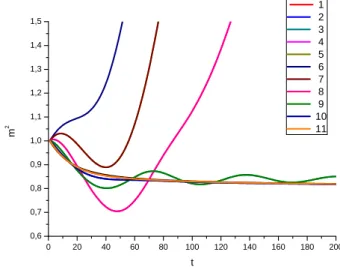
We propose to measure the quality of denoising by RMS error of difference between initial and noised image: m2(t) = (|ψ(t)| − |ψiso|)2. Bellow, graphics m2(t) (Fig. 2) acquired from
the solution of equations with Perona–Malik method 1 for different phase values in diffusion equation 2 are presented:
0 2 0 4 0 6 0 8 0 1 0 0 1 2 0 1 4 0 1 6 0 1 8 0 2 0 0 0 , 6
0 , 7 0 , 8 0 , 9 1 , 0 1 , 1 1 , 2 1 , 3 1 , 4 1 , 5
m
2
t
1 2 3 4 5 6 7 8 9 1 0 1 1
Figure 2.Dependance m2(t) of time for different valuesk,ϕ=kπ/6, where: k=1,2..11
Conclusion
In this paper we present fully conservative numerical scheme (in a weak sense), which allows to control correctness of the equation solution by tracing motion integrals and using this to correct evolution variable step. This numerical scheme was parallely implemented for complex generalization of Perona–Malik equation. It was shown, that this approach extends denoising abilities of the method, which allows to achieve better results for the image noise removal task. Thus, in particular, in the present study we show that complex parameter equals one is optimal for image denoising task when phase is equal ϕ= 2π/3.
Acknowledgements
The research is carried out using the equipment of the shared research facilities of HPC computing resources at Lomonosov Moscow State University.
The Siberian Branch of the Russian Academy of Sciences (SB RAS) Siberian Supercomputer Center is gratefully acknowledged for providing supercomputer facilities.
The reported research was funded by Russian Foundation for Basic Research and the gov-ernment of the Tomsk Region of the Russian Federation, grant No. 18-41-703004 \18.
The work was carried out under partial financial support of the Russian Fund of the Fun-damental Research grant No. 17-00-00186.
This work was performed within the frame of the Fundamental Research Program of the State Academies of Sciences for 2013-2020, line of research III.23.
This paper is distributed under the terms of the Creative Commons Attribution-Non Com-mercial 3.0 License which permits non-comCom-mercial use, reproduction and distribution of the work without further permission provided the original work is properly cited.
References
1. Perona P., Malik J.: Scale-space and edge detection using anisotropic diffusion. IEEE Trans-actions on pattern analysis and machine intelligence 12(7), 629–639 (1990)
2. Wei G.W. : Generalized Perona–Malik equation for image restoration. IEEE Signal Processing Letters 6(7), 165–167 (1999)
3. Wang N., et al.: A hybrid model for image denoising combining modified isotropic dif-fusion model and modified Perona–Malik model. IEEE Access 6, 33568–33582 (2018), DOI: 10.1109/ACCESS.2018.2844163
4. Maiseli B., et al.: Perona–Malik model with self-adjusting shape-defining constant. Informa-tion Processing Letters. 137, 26–32 (2018), DOI: 10.1016/j.ipl.2018.04.016
7. Tschumperl D., Deriche R.: Anisotropic diffusion partial differential equations in multi-channel image processing: framework and applications. Advances in Imaging and Electron Physics (AIEP), pp. 145–209, AcademicPress (2007)
8. Tadmor E.: A review of numerical methods for nonlinear partial differential equations. Bul-letin of the American Mathematical Society 49(4), 507–554 (2012), DOI: 10.1090/S0273-0979-2012-01379-4