Essay
TECNOSCIENZA
Italian Journal of Science & Technology Studies 8 (2) pp. 81-104 – ISSN 2038-3460
www.tecnoscienza.net 2017
Discovering the Data-driven City
Breakdown and Literacy in the Installation of
the Elm Sensor Network
Darren J. Reed
University of York (UK)
Abstract: In this article, we examine the role of environmental big data in the installation of an environmental sensor in a UK city. Taking the installation of the Elm sensor as an empirical case study, we understand the installation as incurring an instance of natural breakdown which reveals the contingent work-ings of the device, and places it in the context of the practices of normalisation and stabilisation of the device. We use this to ask questions about the taken for granted smoothing of outputs and the continual elaboration of use and design, alongside the constructive potential for disruptive digital literacies as a site of intervention. By following, empirically, the installation of the technology, we are led to combine, and re-examine, theoretical lines of reasoning about data competences and relationships, and in turn advocate a form of ‘material politics’.
Keywords: environment; big data; digital literacy; material politics; environmental sensors.
Submitted: October 15, 2016 – Accepted: November 15, 2017
Corresponding author: Darren J. Reed, Department of Sociology, University of York, Wentworth College, W/241, Heslington, YO10 5DD, United Kingdom. Email: [email protected]
1. Introduction
strategies of data manipulation of the device installers and the existing in-frastructures of the city. In response, it extends the arguments of Noortje Marres (2012), and her reasoning about the potential for political action in the real-world situation of engagement with environmental data, by advo-cating the nurturing of “new data literacies”, particularly those deemed “disruptive”, as a form of intervention based upon the creative engagement with the rich complexities of environmental data. The article rests on the history of work in Science and Technology Studies (STS), and the per-formativity of technology to effect new social relationships (Law and Sin-gleton 2000; see also Barry 2001). Rather than starting with an ideal partic-ipant, it follows the technology and the way the script (Akrich 1993, 206) of the competences and “geographies of responsibilities” are elaborated, to inform the potential for new forms of civic participation. There is a growing interest in smart cities in the social sciences (Kitchin 2014) and spatial data (Leszczynski and Crampton 2016). These are related to an emerging focus on environmental big data (Gabrys 2016; see the special issue of Big Data & Society, 2016) and the way they allow for an engage-ment with “practices, materialisations and contestations” within deploy-ment processes (Akrich 1993, 3). Such moves compledeploy-ment those that seek to engage big data as they are made meaningful in everyday life (Wilmot 2016; Pink et al. 2016).
The Elm sensor is a modular device developed by the American com-pany Perkin Elmer. At the time of writing, Perkins Elmer has handed over rights to the development of the device to the University of York, but its origins lie in an idealised notion of the potential for new environmental sensors and public participation. Jon DiVincenzo, President, Environmen-tal Health at Perkin Elmer had this to say about the sensor at its launch, “the Elm network is designed to create better awareness, empowering all of us to connect our understanding about the quality of our environment with its long-term impact on our health - helping cities and their popula-tions make smarter, more informed decisions” (http://ir.perkinel-mer.com/).
The position espoused in the above quotation is one based on a tech-nological deterministic line; the technology is characterised as effecting these positive outcomes without recourse to the social context of their in-stallation and use. The sociological approach to critical data studies (Iladis and Russo 2016), and in particular environmental devices and data, take a critically reflective stance to this position. As Kitchin (2014, 8) points out such technologies and the data they produce are inherently political and are not neutral, “[d]ata do not exist independently of the ideas, techniques, technologies, people and contexts that conceive, produce, process, man-age, analyze and store them”. And further, “data are inflected by social privilege and social values” (ibid).
contingent, and relational nature of such data, in its production, use, and effects. In Kitchin’s terms “[i]t is less well suited to contextualising such data or revealing the complex contingent and relational inner lifeworld of people and places” (2014, 9). In this article, we argue for an approach based on “new data literacies” as critical intervention, a deliberate re-fo-cussing on the potential for encouraging and supporting the meaningful agency of people in their relationship with environmental sensors and the data they produce by resisting efforts to ‘smooth’ the data before presen-tation. We mean this as a critical intervention. That is, we are not advocat-ing a return to an individual competence model or requirement for device functioning, but a ‘de-stabilising’, premised upon the possibilities for the redistribution of agency and formation of new actor-networks.
The University of York, became involved with the Elm sensors when it placed it at the centre of a research project called YorkSense. Subse-quently, the sensors have become central to two other research initiatives at York, the CAPACITIE project − an EU Initial Training Network for new Environmental Scientists, and the York City Environment Observa-tory (YCEO) − a pilot exercise to develop the city of York into a base for environmental sensing and stakeholder engagement (for more details see https://www.york.ac.uk/yesi/projects/yceo/). Both YorkSense and YCEO espouse a particular model of the data-driven city premised upon open data seen in the central involvement and use of the York Open Data plat-form (www.yorkopendata.org). These initiatives combine to plat-form a con-certed effort to establish York as a “data-driven city”, premised upon citi-zen access and active engagement.
The YorkSense project had the simple aim of installing 100 Elm sensors in York as a test bed for their use and development in other urban settings. The author was attached to this project as a sociologist concerned with stakeholder relations alongside positional deployment choices (new to schools etc. − see below).
are perspectival, premised − as they are − on the experiences of the instal-lation efforts by the researcher as part of the team. The provision of limited ethnographic ‘snapshots’ are a consequence of this participatory position. It is true that such a position runs the risk of undermining the agency of the research (as independent actor). At the same time, the features included were central concerns for the installation stakeholders; they key off the “sense-making practices” (Garfinkel 1967) within the installation process and are therefore true to the members’ sense-making practices, perspective and proximity to the process.
We first outline the key issues encountered by the installers, and then introduce sociological theory to help open up the process as a case study, drawing on foundational literature in Science and Technology Studies, spe-cifically the work of Akrich (1992, 205) and the “(de)scription of technical objects”.
We extend this idea by noting the ‘de-scription’ of the algorithm possi-ble through the ethnographic work, that is the unpacking of the manner of algorithm formation, and adaptation to an imagined (confused) user. Once understood in sociological terms, the issue of the materiality of these ob-jects as enacting and configuring new forms of political participation is de-tailed through the work of Marres (2012). This line of reasoning, led us to consider what we call “new digital literacies” based on work of Lankshear and Knobel (2008). We extend this line of reasoning with what Couldry et al. (2016, 118) call “real social analytics”. While these authors come from different scholarly traditions and represent different conceptual view-points, we rationalise their combination through the concerns of the de-signers and academics with “literacy and agency”. That is their coherence comes from a sensitivity to the research domain, rather than adherence to a particular position. The agency and experiences of the user as a social actor re-emergences as a central concern. From here, we speak to the po-tential for new ‘disruptive’ literacies and their place within a form of en-gaged citizenship based on critical and creative engagement with data.
2. The Case Study: The Deployment of the Elm Sensors
The Elm sensor was developed by Perkin Elmer, a large US company. The company partnered the University of York on a locally funded project in the Environment department called YorkSense, which had the explicit aim of installing 100 sensors in the city of York UK, between July and De-cember of 2015.
cloud storage. The results of which are then presented on the Elm websites1
(Williams et al. 2015).
The research team was comprised of academics from the departments of Environment, Chemistry, Computer Science, and Sociology at York University. In addition, technical support was supplied by members of the Electronics department. On the York Council side, various departments partnered the research, including those concerned with transport manage-ment, asset management (street lamps etc.) and the Business Innovation unit.
The author was attached to YorkSense as an ethnographer, which en-tailed following the installation process, and advising on the deployment locations, and researching the relationships between stakeholders. In good part, this entailed an appreciation of the likely users of the eventual net-work of devices, as well as giving advice on how the interface to the output data might be developed and refined (the author’s history in Human-Com-puter Interaction, and interaction design providing a foundation for such recommendations). The author attended planning meetings, viewed the sensors in place, and interviewed various stakeholders (members of the council, colleagues in the environment department) involved in the project. Central to these efforts, and the account given here, was a slow revealing of the underlying issues based upon unanticipated issues and problems. The article takes (theoretical) issue with the (empirical) decisions and
dis-cussion of the installation process. The script – as such – emerged from
these decisions and practices, and could be said to be unfinished from a design point of view (as the sensors are not yet deployed). The materials contained in this article come from notes taken in meetings, and informal discussions (with the researcher being part of the installation team). The quoted materials (graphs etc.) come from project presentations and emails discussions.
Key to the story is the unanticipated delays encountered in the simple technical functioning of the devices. Rather than being deployable ‘as is’, it was realised early in the process that the device was not ‘field ready’. Alongside other practical matters – such as finding a power supply for each unit, and accounting for and adapting to data transmission drop out (more below) – it was quickly realised that the readings from each unit were not only divergent (in that they gave different readings to one another) but, more importantly for our purposes here, some of the readings were judged to be inappropriate for a number of reasons. These are instances of “prac-tical meaning-making” in that the project partners anticipated that the us-ers of the system would read the outputs in negative ways. This implies a concern within the design and subsequent script of competence and liter-acy (or lack) of the user.
In what follows we will address three aspects of the Elm sensor deploy-ment that progressively emerged from the ethnographic fieldwork: data ve-racity and completeness; physical installation of the sensors; and usability, and anticipated response to the sensor readings. In detailing these three elements, we aim to move from a purely technical position, through a con-cern with the spatial aspects, to an appreciation of the social contexts of the sensor deployment exercise. We also reveal a “discovery narrative”, borne of following the actors (academic staff, installation staff, and council staff) and those actors reflecting on the process of technology configuration and deployment.
2.1 Technical Aspects: Data Veracity and Completeness
While the operating manual of the Elm sensor implies that there should be no data loss, because the sensor stores any information and transmits it when there is an adequate GSM connection (Williams et al. 2015), it was found in the testing of the sensors that data dropout was a common occur-rence. The issue of data loss became relevant when calculating the average readings from each sensor.
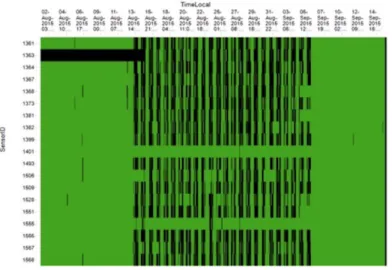
The following diagram shows the connectivity of 19 sensors over a 44-day period. It should be noted that the sensors were not installed in the city at this point, but were installed together on the roof of one of the university buildings. Put another way, the potential variability in signal strength and connectivity due to variation in GSM coverage and interference due to changing physical conditions (such as traffic density) was not seen in this early stage of the installation process.
In the above figure (Fig. 1) the black sections indicate hour-long peri-ods in which no data was transmitted. While certain periperi-ods, notably from the 2nd to the 13th of August, saw relatively uninterrupted connectivity (aside from one sensor − 1363 − that appeared to be offline) the period from the 13th August to the 6th of September saw a great deal of connec-tion loss.
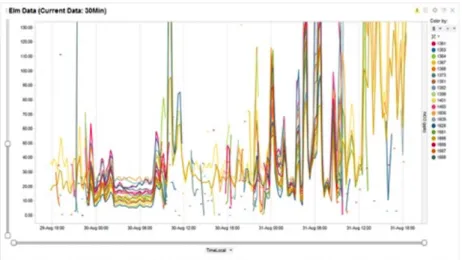
The sensors collect (and transmit) information every 20 seconds, so this means that in those periods coloured black, none of the three transmission points were successful. In the following figure (Fig. 2), we can see readings represented in units of six hours:
Figure 2 – Data transmission of the Elm Sensor array. Source: staff member.
The section between 30th of August, 1200 to 1800 hours has only two out of the 19 sensors transmitting continuous information. Such issues were dealt with pragmatically by the installers of the system. It was sug-gested that those periods in which there was data dropout would simply not be reported. Whether this would be indicated in the interface to the data was unclear (indeed, at this point the issue of data presentation took second place to data use, and calculation of an average figure).
2.2 Spatial Aspects: Location of Sensors
review of the city that combined lamp post positioning with the location of schools, care homes and businesses to figure through an optimum position-ing of sensors based on positionposition-ing them near vulnerable individuals and businesses.
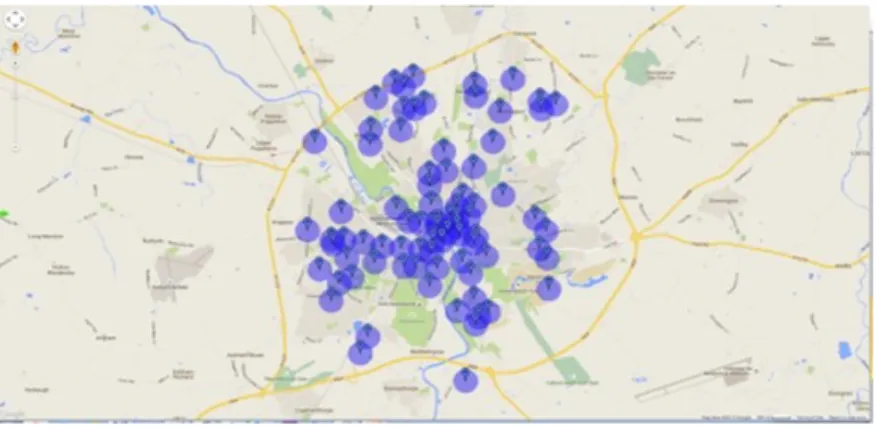
The following diagram (Fig. 3) shows the results of two of the mapping exercises.
Figure 3 – Location suggestions for the Elm Sensors. Source: staff member.
In figure 3, the lamp post suggested relates to the physical location of businesses, care homes and schools. In the following diagram (Fig. 4) the positioning of lampposts was set against “vulnerable subpopulations”. This was based on census data.
It should be stressed that this exercise was a provisional preparatory exercise, and in the actual deployment seen since the preparatory work the sensors have been installed on a piecemeal basis, related to targeting areas with a range of interesting features, such as a mixture of housing stock, in combination with a school and park areas. This research based reasoning foregrounded the need to show that the sensors worked within a pre-scribed physical ecology. It also addressed a broader issue of availability of sensor units. The large-scale strategy imagined that one hundred sensors would be available at the same time. Given the variance in readings across the units, it became clear that this availability would be at least curtailed, and potentially undermined, by faulty (or at least variably reporting) units.
The Elm sensor did not have a location in its initial design. As a unitary device that functions within a network of devices, the Elm sensor's design was concerned rather with its laboratory functioning, rather than its real-world functioning. This is often the case in technology design. A device developed in the R&D department of a company, rarely undergoes usabil-ity testing, except in terms of its simple interface functionalusabil-ity. It is not, in this sense, field tested or put into use in everyday settings; until, that is, it is released for sale. Recent instances of battery fires in the Samsung Note 7 (http://www.bbc.co.uk/news/business-37253742 – retrieved September 1, 2017), for example, stand as examples of this failure to consider the social context of use. Elm functioned appropriately under the ‘perfect condi-tions’ of the laboratory, but as we know such contexts are without extra-neous factors such as environmental conditions, imperfect GSM signal, or variable power supply.
higher readings would occur. However, taken too high and the comparabil-ity to pollution inhalation by a walking person would be obscured. It was decided that the seven up, ten down option (which assumed a position three metres above the ground) was inappropriate due to potential vandalism, and hence an independent structural analysis was undertaken. So here we can see a range of technical and social issues that intertwine and potentially impact each other. These are, therefore, socio-technical issues, neither merely social nor merely technical, but a combination of both.
Here then we have one key issue of social spatial and material configura-tion – the marrying of sensor posiconfigura-tion to the posiconfigura-tioning of human polluconfigura-tion receptors. The original script of “awareness”, “empowerment” and “in-formed decision” of the sensors (seen in the quotation above) was premised on the idea that they measured the pollutant levels experienced by a typical human − or at least within reasonable tolerances, but the material and prac-tical instantiation of the positioning threatened to undermine any such a script.
We can see then that such issues as power supply and height position-ing, while premised upon technical issues quickly became spatial and ma-terial concerns. Such elements of the installation were not part of the orig-inal design, and hence in a sense the devices were unprepared for real world deployment. What ensued in the case study was far from a simple matter of technical problem solving, instead it entailed contending with institutional and organisational factors, such as the rule and regulations governing lamp post maintenance, power supply payments, and ownership of the host systems. At one point, it seemed that the “lamp post depart-ment” (we never found out the correct name for whichever department was responsible) would veto our attempts to have the sensors installed. This reminds us that any technology is reliant upon the social and technical infrastructures already in place (Bowker et al. 2010; Dourish and Bell 2007).
2.3 Data Readings and Social Acceptance
Another apparently purely technical aspect of the Elm deployment was a comparison between the separate units. However, this quickly became a social issue, as the nature of the data variance was deemed to be giving an impression of dangerously high concentrations of pollutants. This is again an instance of projected sense-making, in that the project partners assumed they could put themselves in the place of the typical user, and anticipate their experiences and thoughts. As can be seen from the previous section on data dropout, each of the sensors transmits information separately. As part of the initial work done on the deployment, the sensors were located together to compare the reading that each was making against one another.
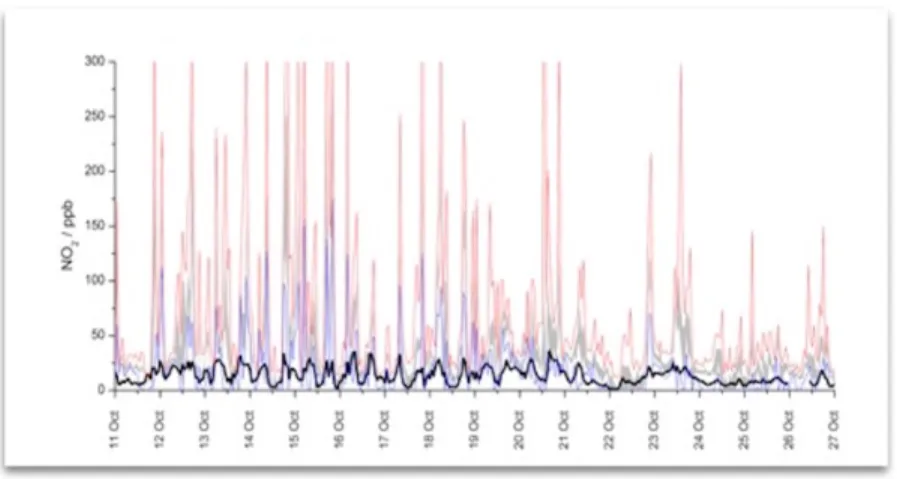
Figure 5 – Comparative readings from AURNAQM and 3 Elm sensors. Source: staff member.
The lower thick black line shows the readings of NO2 from the Auto-matic Urban and Rural Network (AURN) Air Quality Monitoring (AQM) station run by DEFRA (The UK Department for Environment Food and Rural Affairs). The lighter red, blue and green lines are taken from three co-located Elm sensors. Not only do these sensors’ readings show variance (although it should be noted they generally follow the same pattern of peaks and troughs), they also show readings that are a multiple of ten of those from the AURN station.
To put this in context, the hourly limits for NO2 are 200 µg/m3 (200 micrograms per metre cubed) according to EU and UK law, which relates to 106 ppb (parts per billion2). What this means is that the reading of 300
ppb given for some Elm sensors was nearly three times the requisite level. Upon enquiry, the reasons for this variance spanned three different logics: 1. device function (quality of device; difficulty in air sampling); 2. location and context (contingent features of location of device); 3. atmos-pheric variability.
In the discussions that ensued between the partners of the project, it was decided that such figures would upset users and give a poor impression of the efforts to reduce air pollution in the area (the local council, with whom the YorkSense were partnered, anticipated hosting the sensor infor-mation on their open data platform − www.yorkopendata.org (retrieved September 1, 2017).
The net result of this observed variance was an effort to normalise the readings and calibrate the device:
Normalisation involves transforming the data so that it is on a common scale. For example, if you have Elm and a reference unit data, you might transform both sets of data so they cover the scale 0 - 1. Calibration involves comparison of the Elm data with a reference instrument. Using the relationship obtained, you can add a correction to the Elm readings so that they give a sensible reading (personal email correspondence with project lead).
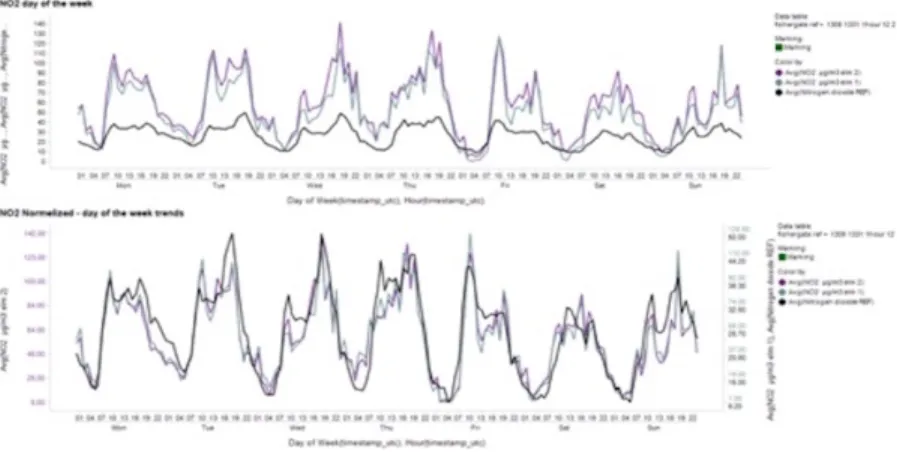
The following diagram (Fig. 6) shows the readings before and after the normalisation process occurred.
Figure 6 – Before and after normalisation of data. Source: staff member.
So, the sensor readings from the Elm sensors were manipulated so as to give more acceptable information. This is very common practice when shaping data such as this for public consumption. The idea that such read-ings might have been due to the functioning of the equipment, the location of the device, and atmospheric variance was not considered as an appro-priate line of information and engagement with the public. This, it was an-ticipated, would complicate matters, and would lead to disinformation and confusion.
We would like to take these three elements and consider them through contemporary social theory and the conceptual work within science and technology studies.
3. Theoretical Discussion
and elaborates a position in relation to social change afforded by technol-ogy – or what she calls the “partial reconstruction” of society and our knowledge of society − that takes neither a technologically deterministic nor social constructivist line. Instead it recognises that “technical objects participate in building heterogeneous networks that bring together actants of all types and sizes, whether human or nonhuman” by “mov[ing] con-stantly between the technical and the social” (ibid).
This is not easy to do, especially as such objects are commonplace and their workings are often hidden from view. She suggests the researcher should contend with a methodological problem, “if we want to describe the elementary mechanisms of adjustment, we have to find circumstances in which the inside and the outside of objects are not well matched. We need to find disagreement, negotiation, and the potential for breakdown” (1992, 207).
The Heideggerian notion of breakdown in phenomenology and hu-man-computer interaction (Koschmann et al. 1998) is instantiated when a technology does not perform the way expected, or anticipated. In ethno-methodology instances of breakdown become a “perspicuous setting” (Garfinkel 2002, 186) for understanding naturally occurring breaches in practices (Garfinkel 1967), which reveal their workings and the efforts by users to re-establish a sensible scenario. In the case of the Elm sensor this occurred as the sensor moved from one social context − and concomitant network of actants of designers, commercial interests, and environmental scientists − to another, involving the imagined users, consumers and pub-lics; and specifically, in the way the readings of the sensor were deemed ‘incorrect’ (the scare quotes are meant to convey the ambiguous nature of such a positioning) and inappropriate. This was during the deployment of the sensors. We treat this period as a naturalistic period of breakdown, and hence a methodological tool for revealing the workings of the device inter-woven with the understandings of the device by relevant actors.
While the Elm sensor is itself made up of component parts, each of which has previously been calibrated and tested, it was received by the University as a stabilised technology. Preparation for its deployment in a real-world setting, however, “de-stablised” the technology by introducing alternative relevant social groups, and foregrounding its “interpretive flex-ibility” (Bijker et al. 1987, xlii; Pinch and Bijker 1984).
3.1 Inscribing Design through Scripts
de-ployed and becomes a pre-scription for the technology’s use. “The tech-nical realization of the innovator’s beliefs about the relationships between an object and its surrounding actors is thus an attempt to predetermine the settings that users are asked to imagine for a particular piece of technology and the pre-scriptions (notices, contracts, advice, etc.) that accompany it” (1992, 208, emphasis added).
Key to Akrich’s formulation of scripts, however, is the potential for an ongoing and continual process of ascription. This is what sets it aside from classical conceptions of designed-in purposes, in that there is not an end to the characterisation of uses for a device or system. In this case, ongoing processes include not only the subsequent de-black-boxing (Latour 2005) that occurred during deployment (initiated by the researchers), but also the effects of the networks of heterogeneous actants, including people (from the council, technical installers, and academic researchers) and arte-facts (lampposts, power supplies) and materialities (streets, the city, and varying pollutants) detailed in section 2. This is what Woodhouse and Pat-ton (2004) call “design by society”.
Returning to Akrich (1992, 206), the script of a device not only delimits use, it also implicates responsibilities: “If most of the choices made by de-signers take the form of decisions about what should be delegated to whom or what, this means that technical objects contain and produce a specific geography of responsibilities, or more generally, of causes”.
Extending Akrich’s general point about design to this process of recon-figuration, we are interested in the shifting “geography of responsibilities” afforded by the configurational changes, particularly − as we will see − in relation to the competences (or lack of them) ascribed to imagined users of the informational outcomes.
This fits well with the notion of material participation of Marres (2012), especially as it relates to the political objective of civic engagement of the Elm sensor. In talking about the way environmental devices are explicitly implicated in forms of politics, Marres (2012, xii) comments, “material things are today deployed to enact a distinctive public form of engagement. In these cases, material objects, devices and setting are explicitly ascribed the capacity to enable political participation” they “wear their politics on their sleeve”.
In terms of Elm, its imagined user base and use context implicates a set of political arrangements, in which − as we saw from the quote from Perkin Elmer above − the device enables, but also requires, the participation of members of the public. Key is the ascription of competence (or lack of) and hence literacy. Elm certainly wears its politics on its sleeve. While shaped in terms of creating awareness, empowering, understanding, help-ing, make smarter, and informed decisions, it is not difficult to hear the responsibility placed on users to be aware, form an understanding, and make smarter decisions − in short be competent and skilled users. The pre-scripted “user” is clear.
devices such as Elm are presented as bringing about change without the need to consider social arrangements. Such language obscures not only the social context, but also the requisite competences and responsibilities that such devices implicate. As Barry (2001, 127) points out “active, responsible and informed citizens have to be made”. Grint and Woolgar (1997) talks about the “configuration of the user” through such processes. Configura-tion in this instance would seem to be oriented to an “informaConfigura-tional citi-zen”, who is aware, informed, and willing to make decisions. This in turn implicates a set of motivations, competencies, and behaviours. This fact leads us to consider issues of literacy.
Marres (2012) presents the history of efforts to engage the public in environmental concern, by first noting that it is apparent that the “infor-mational citizenry”, implicated in efforts to improve literacy, have largely failed to result in the recruitment of the requisite numbers of people. In-formational literacy campaigns do not address the complexities and con-textual aspects of social factors. Not only does informational literacy forget the contexts of technology installation and use, it also could be said that it is based on a “deficit model” of competence, in that it positions typical members of the public and lacking the requisite skills. The implication be-ing that to become an engaged citizen requires a re-education of members of the public (or in this case a ‘dumbing down’ of the information). We want to argue that this position is too one-sided. It is the case that there are various competences required, but it is also the case that there are existing competences that such perspectives forget. These play into potentials for heterogeneous and alternate actor networks.
Rather than rejecting this history outright, Marres (2012, 5-6) goes on to say that “material participation does not involve stripping participation of its foundational, linguistic or discursive components”, Instead, we would argue, literacy (and other discursive components) are interwoven with forms of action; a far more complicated scenario ensues in which read-ing information is mutually elaborative with design. Technologies simulta-neously perform a particular user, and are performed by those users. So, in the case of Elm, participation is reconfigured by “turning everyday material action into an index of public participation” (2012, 3).
Marres champions material participation as an undervalued oppor-tunity for new forms of public engagement. In relation to sensors this re-lates to not only the material agency of the particure-lates being measured, but also the material interaction with devices and systems by people them-selves. There is, of course, an additional material element, which completes this pairing, that is the materiality of the physical environment. Person-de-vice-environment form a triangle of relationships that in turn implicate a materially grounded and located set of activities. As Marres puts it an “in-terest in the role of material entities in the organization of citizenship” itself offers a renewed “sense of public engagement as an embodied activity that takes place in certain locations and involves the use of specific objects, technologies and materials” (2012, 7).
However, we would like to contend that such opportunities are poten-tially undermined if the operations of those materially-oriented technolo-gies are obscured and obfuscated. We argue therefore that if the contextual details of the sensors’ deployment (the necessity to choose installation points with lamp posts, the sensitivities of placement of the devices at cer-tain height, and proximity to traffic) and the adaptations and manipula-tions of the generated data (through calibration and normalisation) are ex-cluded.
In relation to Elm, we might say that Marres would be critical of efforts to remove the contingencies of their placement and the smoothing of read-ings through various data manipulations. Rather, we should see Elm as an opportunity to engender an “experimental site of material politics” (2012, 106) by allowing for questioning, knowledge development, and criticism of the devices and its outputs.
Building on the point of the mutual elaboration of technology and use, we turn to the educational literature of literacies to draw out, and critically engage with, the history of work on digital literacy. The plural form conveys the central theme of the perspective which dissuades us of a single under-standing of literacy and advocates a multiplicity of distinct but interrelated forms. Again, we should emphasise that we are not claiming an individual competence model. Rather this pluralisation opens up both the concept of literacy, and problematizes its simple application to human-device rela-tions. We agree with Marres’ criticism of the formation of the informational citizen, but seek to extend her inclusion of the discursive and linguistic readings in design and deployment.
3.2 Digital Literacies
linear conception of the more-or-less literate person. Such approaches have come under scrutiny through a concerted effort to engage with social con-cepts, especially in relation to the notions of practice and context, “we per-ceive literacy as a set of socially organised practices that make use of a sys-tem of symbols and of a technology to produce and disseminate it. Literacy is not simply knowing how to read and write a given text but rather the ap-plication of this knowledge for specific purposes in specific contexts. The nature of these practices including, of course, its technological aspects will determine the types of abilities associated with literacy” (Scribner and Cole 1981, 236, as quoted in Illera 2010, 51).
For Illera (2010, 50), practice and context implicate a processual ap-proach, and simplistic notion of literate and illiterate are avoided: “The idea of practice […] changes the focus of analysis: no longer solely con-cerned with results, it highlights the relationship between the cultural (and technological) context and the forms of specific use adopted by the sub-jects. […] The gradual nature of literacy recognises that it is a continuum, one of competence, in which there are many positions and not just two categories (literate/illiterate)”.
Yet for us, even these moves to situate practices of digital competencies don’t go far enough. They still retain (as one might expect from an educa-tional approach) a sense of (individual) measurement and deficit. One step towards an alternative is seen in the advocacy of the plural form of literacies (Lankshear and Knobel 2008; Illera 2010). The work on digital literacies not only reaches for the “myriad social practices and conceptions of engag-ing in meanengag-ing makengag-ing […] that are produced, received, distributed, ex-changes, etc., via digital codification” (Lankshear and Knobel 2008, 5), it also reveals the potential for competing literacies and the denigration of one type of literacy in the face of another. An example given by Lankshear and Knobel (2008, 8) is video game literacy, and they draw this out to im-plicate a far wider set of competing competences by speaking to the re-search cliché of “young people trapped in a literary remediation in schools whilst winning public esteem as fan fiction writers, AMV remixer, or suc-cessful gamers online”. From here we might add digital literacies of online shopping (Davies 2008), participating in social media communication (Knobel and Lankshear 2008) and the ability to promote and market small businesses (Efimova and Grudin 2008). Erstad (2008) points to music re-mixing as a denigrated, or our terms disruptive, form of digital literacy (see also Pegrum 2011).
actants (humans, devices, and software) whose place within any script is continual and challenging.
4. Experiencing Data
Couldry et al. (2016) sets out a phenomenologically situated position in relation to the agency of the algorithm and the human. He advocates a turn to an understanding of social analytics, the study of the practices of sense-making applied to contemporary forms of data analytics and presentation: “A social analytics approach − more precisely, a sociological treatment of how analytics get used by a range of social actors in order to meet their social ends − aims to capture how particular actors reflect upon, and adjust, their online presence and the actions that feed into it, through the use of ‘analytics’” (Couldry et al. 2016, 119).
What we get from such discussions is a sense of the agency of persons, and the crediting of them with a range of competences that could easily be denied and avoided. In addition, the obfuscation of various elements can lead to a one-sided visibility which blinkers the user and undermines her viewpoint.
As Couldry (2016, 120) points out, “while the mutual intertwining of human and material agency is hardly a new insight (Pickering 1995, 15-20), it acquires special bite when analytics’ operations are frequently opaque to non-experts and hard for them to control, even if they do see them at work; such tension is increased for those social actors who are orientated to goals that are distinctively social, such as community organizations, charities, and civil society actors”.
apparently disruptive literacies. This is meant as a resistive political posi-tion, as well as an optimistic directive for future technology developments. Such combinations of method and theory, therefore, are necessary when re-sponding to such complex, and embedded, contexts.
And so, what we have is a situation in which a commercially developed device, that has undergone testing in laboratory conditions, is deployed in a real world setting. The device is judged to be unfit for deployment due to inconsistent readings across individual units, and hence adjustments are made to the readings to ‘normalise’ them. In addition, knowledge of the real-world settings, which includes the placement of each device in a dif-ferent, yet specific, location requires further adjustments in relation to ac-counting for contextual features, such as the height off the ground, and the likely architectural features of the city which might produce distinctive en-vironmental conditions (such as the collection of particulates due to ‘ed-dies’ caused by building positions and tunnel like features of houses and shops).
The question becomes whether changing the data in this way is a nec-essary added step in the deployment of the sensors. On one side, we might say that we have revealed the processes of data production, what Ribes and Jackson (2013, 148) call a “complicated ontological choreography, as sci-entists and technicians work to make data ‘the same’ in a changing ecology of technologies, organisations, field sites, and institutional arrangement”. At the same time, we have revealed the obfuscation of those very processes in the attempt to produce a ‘perfect’ outcome based upon calibration and normalisation.
4.1 Opening up Creative Practices
The notion of error presupposes a perfect reading or outcome. As Lisa Gitelman (2013) and other point out in “raw data” is an oxymoron, far from there being a perfect objective outcome, objectivity is itself a product of situated practices within applied scientific disciplines.
In our case, the objectivity of the data is a key issue in relation to dealing with the positioning of the sensors in particular locations. The placing of the sensor on road side lamp posts introduced unwanted con-textual factors. It turns out that the data was never objective and never raw. We can see that such instances open up possibilities for alternative en-gagement with information, “Error, as errant heading, suggests ways in which failure, glitch, and miscommunications provide creative openings and lines of flight that allow for a reconceptualisation of what can (or cannot) be realised within existing social and cultural practices” (Nunes 2012, 3-4).
are advocating such notions as a means to characterise creative engage-ment, and by extension forms of participation and political action.
For example, Townsend (2013) combines big data with civic hackers into a conception of smart cities. In a wide-ranging commentary on the future of sensor enabled urbanscapes, he comments that “every civic labor-atory needs a physical and social support system for hackers and entrepre-neurs to experiment within” (2013, 301).
We argue here that far from an errant feature of an unscripted set of characteristics, the variance in readings that occurred with Elm could be a means to enable an engaged public.
First it can open up the functionality of the device. A realisation that each device can give different readings in the same setting, opens up the possibility of a series of artefacts that differ from one another. Far from a replica of another, and far from the possibility of true replication of com-ponents into a single possible outcome, the Elm sensor becomes a material artefact that is realised in a particular context at a particular time. We are not disturbed by such notions when we think of different individual humans perceiving the world in different ways (such as subjective notions of the weather being poor, or the temperature being too cold) so why should we not credit measuring devices with such a multiple and perspectival quality.
Second, such a perspectival quality opens up the notion of context. Where a device is placed, how it came to be there, and the conditions in which it finds itself are of course variable. Again, we have no problems in understanding the varying contexts of the city; for example, that certain streets will be more or less shielded from the effects of pollution, radiation, and precipitation. So why would we imagine that it is obviously the correct operational logic to remove such contextual aspects from the recording de-vice? Do we imagine that the general public do not understand, or appre-ciate, or indeed continuously work with and through such contextual fea-tures?
Third, by allowing for an appreciation of the perspectival and contex-tual nature of the devices, we are further allowed to appreciate the func-tionality of each device and its agentic qualities. Each device functions within a context to produce a series of readings which are imperfect, but meaningful. They are interpretations of the air quality (or should that be qualities) in their immediate surroundings. The device becomes an inter-preting machine and not a recording machine.
would enable a more creative and open engagement with the devices as socially situated technologies. We should maintain the data frictions, to use a term from Edwards et al. (2011) that recognises and embraces the ad hoc, incomplete, loosely structured, and mutable nature of data.
5. Conclusion
This article has used the case study an urban pollution sensor and its real-world installation to address key issues in relation to the contingencies of installation and the characterisation and taken for granted manipulation of the resulting data. By following the installation process, contextual fea-tures such as the requirement for infrastructural support for a power sup-ply, and the resulting positioning of the sensors close to pollution produc-ing vehicles, were used to describe the continuation of the design script of the sensors and argue for its extension into the practices of installation. Recognition of contingency by the installation team, and the variance in readings obtained led the team to manipulate the data, through standardi-sation, configuration and normalisation. Such processes were deemed nec-essary and indeed a requirement for future installation periods. We took an alternative view in relation to the experience of environmental data by potential users. Rather than smooth the data, we advocated a perspective premised upon opening up the physical, cultural and ecological context of use, so as to engender the emergence of new digital literacies. This line of reasoning recognises the changing nature of digital literacy, with the emer-gence of new competences and skills, and argues that nurturing such liter-acies could provide a means to engender a politically engaged participation in environmental data, and in turn lend a complement to the notion of data-driven cities − the creative engagement of data by citizens. In this way, we hope the article contributes the debates and discussion of the relationships between data and users in the city context.
References
Akrich, M. (1992) The De-scription of Technical Objects, in W. Bijker and J. Law (eds.), Shaping Technology/Building Society, Cambridge, Mass, MIT Press, pp. 205-224.
Barry, A. (2001) Political Machines: Governing A Technological Society, London, Athlone Press.
Bijker, W.E., Hughes, T.P. and Pinch, T.J. (1987) The Social Construction of Tech-nological Systems: New Directions in the Sociology and History of Technology, Cambridge, Mass, MIT Press.
Infrastructure Studies: Ways of Knowing in a Networked Environment, in J. Hunsinger, L. Klastrup and M. Allen (eds.), International Handbook of Inter-net Research, London & New York, Springer, pp. 97-117.
Couldry, N., Fotopoulou, A. and Dickens, L. (2016) Real Social Analytics: A Con-tribution Towards a Phenomenology of a Digital World, in “The British Jour-nal of Sociology”, 67 (1), pp. 118-37.
Davies, J. (2008) Pay and Display: The Digital Literacies of Online Shoppers, in C. Lankshear and M. Knobel (eds.), Digital Literacies: Concepts, Policies and Practices, New York, Peter Lang, pp. 227-48.
Dourish, P. and Bell, G. (2007) The Infrastructure of Experience and the Experi-ence of Infrastructure: Meaning and Structure in Everyday Encounters With Space, in “Environment and Planning B: Planning and Design”, 34 (3), pp. 414-30.
Edwards, P., Mayernik, M., Batcheller, A., Bowker, G. and Borgman, C (2011) ence Friction: Data, Metadata, and Collaboration, in “Social Studies of Sci-ence”, 41 (5), pp. 667-690.
Efimova, L. and Grudin, J. (2008) Crossing Boundaries: Digital Literacy in Enter-prises, in C. Lankshear and M. Knobel (eds.), Digital Literacies: Concepts, Pol-icies and Practices, New York, Peter Lang, pp. 203-226
Erstad, O. (2008) Trajectories of Remixing: Digital Literacies, Media Production, and Schooling in C. Lankshear and M. Knobel (eds.), Digital Literacies: Con-cepts, Policies and Practices, New York, Peter Lang, pp. 177-202.
Gabrys, J. (2016) Practicing, Materialising and Contesting Environmental Data, in “Big Data & Society”, 3 (2), pp. 1-7.
Garfinkel, H. (1967) Studies in Ethnomethodology, Cambridge, Polity Press.
Garfinkel, H. (2002) Ethnomethodology's Program: Working Out Durkheim's Aphorism, Oxford, Rowman and Littlefield Publishers.
Gaver, W., Boucher, A., Pennington, S. and Walker, B. (2004) Cultural Probes and the Value of Uncertainty, in “Interactions”, 11 (5), pp. 53-56.
Gitelman, L. (2013) “Raw Data” is an Oxymoron, Cambridge, Mass, MIT Press.
Grint, K. and Woolgar, S. (1997) Configuring the User: Inventing New Technolo-gies, in K. Grint and S. Woolgar (eds.), The Machine at Work. Technology Work and Organization, Cambridge, Polity Press.
Iliadis, A. and Russo, F. (2016) Critical Data Studies: An introduction, in “Big Data & Society”, 3 (2), pp. 2-7.
Kitchin, R. (2014) The Real-Time City? Big Data and Smart Urbanism, in “Geo-Journal” 79 (1), pp. 1-14.
Knobel, M. and Lankshear, C. (2008) Digital Literacy and Participation in Online Social Networking Spaces, in C. Lankshear and M. Knobel (eds.), Digital Lit-eracies: Concepts, Policies and Practices, New York, Peter Lang, pp. 249-78.
Koschmann, T., Kuutti, K. and Hickman, L. (1998) The Concept of Breakdown in Heidegger, Leont'ev, and Dewey and Its Implications For Education, in “Mind, Culture, and Activity”, 5 (1), pp. 25-41.
Lankshear, C. and Knobel, M. (2008) Digital Literacies: Concepts, Policies and Practices, New York, Peter Lang.
Latour, B. (2005) Reassembling the Social: An Introduction to Actor-network-the-ory, Oxford, Oxford University Press.
Law, J. and Singleton, V. (2000) Performing Technology's Stories, in “Technology and Culture”, 41, pp. 765-775.
Leszczynski, A. and Crampton, J. (2016) Introduction: Spatial Big Data and Eve-ryday Life, in “Big Data & Society”, 3 (2), pp. 1-6.
Marres, N. (2012) Material Participation: Technology, the Environment and Eve-ryday Publics, Basingstoke, Palgrave Macmillan.
MacKenzie, D. and Wajcman, J. (eds.) (1999) The Social Shaping of Technology, Buckingham, McGraw Hill Education / Open University.
Martin, A. (2008) Digital Literacy and the Digital Society, in C. Lankshear and M. Knobel (eds.), Digital Literacies: Concepts, Policies and Practices, Oxford, Pe-ter Lang, pp. 151-76.
Nunes, M. (2012) Error: Glitch, Noise, and Jam in New Media Cultures, New York, Bloomsbury Publishing.
Pegrum, M. (2011) Modified, Multiplied, and (re-)mixed: Social Media and Digital Literacies, in M. Thomas (ed.), Digital Education. Opportunities for Social Col-laboration, Basingstoke, Palgrave Macmillan, pp. 9-35.
Pinch, T.J. and Bijker, W.E. (1984) The Social Construction of Facts and Artefacts: Or How the Sociology of Science and the Sociology of Technology Might Ben-efit Each Other, in “Social Studies of Science”, 14, pp. 399-441.
Pink, S. Sumartojo, S. Lupton, D. and Heyes La Bond, H. (2017) Mundane Data: The Routines, Contingencies and Accomplishments of Digital Living, in “Big Data & Society”, 4 (1), pp. 1-12.
Singer, B. (2016) A Chronology of Tactics: Art Tackles Big Data and the Environ-ment, in “Big Data & Society”, 3 (2), pp.1-9.
Townsend, A.M. (2013) Smart Cities: Big Data, Civic Hackers, and the Quest for a New Utopia, New York, WW Norton & Company.
Williams, R., Kaufman, A and S. Garvey. (2015) PerkinElmer ELM. U.S. Environ-mental Protection Agency, Washington, DC, EPA/600/R-15/125 (NTIS PB2015-105136). https://cfpub.epa.gov/si/si_public_record_report.cfm?dir-EntryId=308265 (retrieved June, 1 2017).
Wilmott, C. (2016) Small Moments in Spatial Big Data: Calculability, Authority and Interoperability in Everyday Mobile Mapping, in “Big Data & Society”, 3 (2), pp. 2-16.