Cfd Analysis To Predict Heat Transfer Performance Of Louver
Fin Radiator With Water/Eg & Al
2o
3Nano Fluid
D.Srinivasu1, D.Santharao2, A.Ramakrishna3
1. P.G Student Bvc Engineering College, Odalarevu.
2. Department Of Mechanical Engineering, Bvc Engineering College Odalarevu. 3. Department Of Mechanical Engineering, Bvc Engineering College Odalarevu.
Abstract
In this paper study of heat transfer in louver fin radiator and nanofluids mixing with base fluid (water+EG) has enhanced. The fins of radiator setup were made with louvers by turbulence of air flowing over it and coolant of water based nanofluid has been compared to that of base fluid in an automobile radiator. Three different concentrations of nanofluids in the range of 1%, 3% & 5% of vol. % have been prepared by the addition of Al2O3nanoparticles into
the coolant flows through the radiator elliptical cross section of tubes and air makes a cross flow with constant speed & constant flow rate in radiator. The design of louver fin element in CATIA V5R20 and analysis was done by using ANSYS R14.5workbench. To predict heat transfer characteristics of a louver fin element, the microscopic analysis employs modeling of the detailed geometry of a fin element. Numerical models for the heat transfer rate derived from the microscopic analysis. Results demonstrate that louver fins element create more air turbulence Meanwhile, increasing the Vol. concentration of nanoparticles can improve the heat transfer performance can enhance heat transfer efficiency.
Key word:
Louver fin radiator, Nanofluids, Cross flow, Heat transfer Enhancement.
I. INTRODUCTION:
The thermal performance of a car radiator assumes a critical part in the execution of a car's cooling framework and all other related frameworks. For various years, this part has experienced little consideration with little changing in its assembling cost, operation and geometry. To improve effectiveness of a radiator, different studies have been done on the extra gadgets, for example, a rectangular blade [1], a plate [2, 3], a round tube [4, 5], a level tube [6], an elliptic tube [7] and a louver balance [8]. Among different sorts of radiators, louver fin radiators are regularly utilized as a part of commercial vehicles. A louver fin radiator gives a high heat transfer rate yet brings about a critical rubbing misfortune because of the perplexing coolant section. The louver balance radiator is described by two geometric components: complex stream sections to upgrade heat exchange and a vast contrast in geometric scales between the radiator and a balance component.
Enhancement in heat transfer is dependably sought after, as the operational velocity of cars relies on upon the cooling rate. New innovation and propelled liquids with more prominent potential to enhance the stream and heat transfer are two choices to improve the heat transfer rate and the present article manages the last alternative. Customary liquids, for example, refrigerants, water, motor oil, ethylene glycol etc. have poor heat transfer execution and hence high smallness and effectiveness of heat transfer frameworks are important to accomplish the required heat transfer. Among the efforts for improvement of heat transfer the use of added substances to fluids is more perceptible. Later advances in nanotechnology have permitted improvement of another classification of liquids termed nanofluids. Such liquids are fluid suspensions containing particles that are altogether smaller than 100 nm, and have a bulk solids thermal conductivity higher than the base fluids [9]. Nanofluids are framed by suspending metallic or non-metallic oxide nanoparticles in traditional heat transfer fluids. These purported nanofluids show great thermal properties contrasted and liquids ordinarily utilized for warmth exchange and liquids containing particles on the micrometer scale [10]. Pak and Cho [11] displayed an exploratory examination of the convective turbulent heat transfer qualities of nanofluids (Al2O3-water)
with 1-3 vol. %. The Nusselt number for the nanofluids increments with the expansion of volume fixation and Reynolds number. Veeranna sridhara and Lakshmi Narayan Satapathy [12] introduced Nanofluids are built by suspending nanoparticles with normal sizes below 100 nm in heat transfer liquids, for example, water, oil, diesel, ethylene glycol, and so on. Creative heat transfer liquids are delivered by suspending metallic or non-metallic nanometer-sized strong particles. the soundness of nanofluids, improvement of warm conductivities, thickness, and heat transfer qualities of alumina (Al2O3)- based
nanofluids. The Al2O3nanoparticles fluctuated in the
superior heat transfer performances of nanofluids [13].
Therefore, this study attempts to investigate the heat transfer characteristics of an louver fin automobile radiator using mixture of water based Al2O3 nanofluids as coolants. Thermal performance
of an automobile radiator operated with nanofluids is compared with a radiator using conventional coolants. The effect of volume fraction of the Al2O3
nanoparticles with base fluids on the thermal performance and potential size reduction of a radiator were also carried out.
II. Louver fin heat exchanger
In the present study, flow and heat transfer phenomena in a louver fin radiator shown in Fig. 1(a) were numerically dissected utilizing commercial CFD programming, ANSYS 15.0. The coolant heated by the engine enters the radiator from the upper pipe and is appropriated to tube sections. At that point, the temperature of the coolant is lessened by heat transfer to the ambient air. In a louver fin radiator, two strategies are utilized to upgrade heat move in the entries: (i) fin to expand the surface region, and (ii) louvers around the tubes to build stream unsteadiness. Among different types of louver fin radiator, the present study is engaged in the creased louver fin model with the rectangular channel. For a component of the creased louver blade radiator in Fig. 1(b), the sizes of the heat transfer rate and flow friction depend on upon a few geometric parameters as appeared in the figure. The corrugated fin with the pitch Fp,
length Fl, profundity Fdand thickness δf was situated
between tubes with the pitch Tpand profundity Td. In
the planar blade, the particular district with the pitch Lpand length Llwas turned with the point θ to frame
the inclined louver. The estimations of the geometric parameters are recorded in Table 1. The chose radiator is one of the models utilized as a part of the parametric study by Chang and Wang [14].
Louver angle
28° Louver pitch
Lp
1.42mm
Louver length Ll
17.18mm Fin thickness
δf
0.16mm
Fin pitch Fp 1.8mm Fin length Fl 19mm
Fin depth Fd 22mm Hydraulic
diameter Dh
3.041mm
Tube pitch
Tp
24mm Tube depth Td 22mm
Table (1) Louver fin radiator specifications
Fig (1) 3D model of Louver fin radiator element
Fig (2) Geometric parameters of Louver fin
Fig (3) Geometry of Louver fin radiator element
III. Nanofluid physical properties:
The test fluids are water based nanofluids which comprise of water and small amount (1-5 vol. %) of gamma alumina nanoparticle. The mean grain size of this gamma alumina is 60 nm and some different properties are appeared in Table 1. There was no dispersant or stabilizer added to nanofluid. This is because of the way that the expansion of any specialists might change the liquid properties [15] and the authors were intrigued to simulate the easiest actual condition experienced in the car radiator. Moreover, making exceedingly turbulent stream condition in the radiator tubes and associating channels ensures the adjustment of the nanoparticle in water.
Appearance White powder
Purity 99%
Grain size (nm) 60 nm Specific surface area (m2/g) 200 Silicon (Si) content (ppm) 3.5 Calcium (Ca) content (ppm) 1.6 Iron (Fe) content (ppm) 0.2 Cobalt (Co) content (ppm) 0.8
Table (2) characteristics of alumina nanoparticle.
S.No Properties Al2O3(nano
particle)
Water+Eth ylene Glycol 1 Density (Kg/m3) 3950 1024.78 2 Specific heat
(J/Kg-K)
873.336 3645.397
3 Thermal conductivity (W/m-K)
31.922 0.4129
Table (3) Thermo physical Properties of base Fluid and nanoparticles
The physical properties of Al2O3 nano particles and water+ Ethylene Glycol are taken from [16]. The molecule concentration can be viewed as uniform all through the sytem; the effective physical properties of the mixtures concentrated on can be assessed utilizing some traditional formulas as generally utilized for two stage liquids. These relations have been utilized to foresee nanofluid physical properties like density, specific heat, viscosity and thermal conductivity at different temperatures and concentrations [17]. In this paper, the accompanying connections were utilized to compute these physical properties of nanofluid:
=∅ + (1 − ∅) --- (1)
( )nf = ∅ + (1 − ∅)
--- (2)
Knf=
( ) ∅( )
( ) ∅
--- (3)
= (123∅ + 7.3∅ + 1)--- (4)
In the above equations, the subscripts "p", "w" and "nf" refer to the particles, water and nanofluid respectively. "n" is empirical shape element given by n=3/ψ, and ψ is the molecule sphericity,
characterized as the proportion of the surface range of a circle with volume equivalent to that of the molecule, to the surface territory of the molecule, and in this paper n thought to be 3.∅is volume division of the nanoparticle added to the water. The proportions of physical properties of the nanofluid to those of immaculate water as an element of Nanoparticle concentration. It is evident that the expansion of little measure of alumina nanoparticle can change pretty much all the physical properties of the base liquid.
VI. Calculation of heat transfer coefficient
The performance of the louver fin radiator is affected also by the operating conditions, the most important of which is the Reynolds number based on the louver pitch:
ReLp= --- (5)
Numerous past studies on heat exchangers utilized non-dimensionalized parameters to evaluate execution as far as the heat transfer rate and pressure drop. We utilize the Colburn j-element as a measure for the heat transfer rate and the Fanning f-element for the pressure drop. To characterize the Colburn j-component, taking after connections for the heat transfer rate are vital, To get heat transfer coefficient the accompanying strategy has been performed. By
Newton’s cooling law:
Q= h A∆ = h A (Tb-Tw) --- (6)
Heat transfer rate can be calculated as follows:
Q = m Cp∆ = = m Cp(Tin- Tout)
--- (7)
Equiating above two equations Conv. Heat transfer (h) is:
h = ( )
( ) --- (8)
With these relationships, the heat transfer coefficient h can be registered from the temperature values at the inlet, outlet and wall of the tubes. m is mass flow rate which is the result of thickness and volume flow rate of liquid, Cp is fluid specific heat
capacity, A is peripheral area of radiator tubes, Tin
and Toutare inlet and outlet temperatures of coolant,
Tbis bulk temperature which was assumed to be the
average values of inlet and outlet temperature of the fluid moving through the radiator element, and Twis
tube wall temperature which is the mean value by two surface of radiator is assuming as 3410K, Tin as taken as 3770K
In several previous studies on louver fin radiators, various empirical formulas heat transfer for the factor has been proposed. Among them, the j-factor (for 100< ReLp<3000) suggested by Chang and
Wang [14] is:
J = ReLp-0.49(θ/90)0.27(Fp/Lp)-0.14(Fl/Lp)-0.29 (Td/Lp)-0.23(Ll/Lp)0.68(Tp/Lp)-0.28(δf/Lp)-0.05
--- (9)
The empirical correlation of j-factor based on the 91 samples of louver fin radiator shows that the experimental data are correlated within ±15%.
As a measure for performance in terms of the pressure drop, the Fanning f-factor is defined as follows:
f =( ∆ ) --- (10) The j-factor and f-factor are influenced by the inlet velocity and louver fin geometry. Since these correlations are functions of the Reynolds number for fixed louver fin geometry, j- and f-factor can be expressed as:
= , --- (11)
= --- (12)
The coefficients of these correlations were obtained by a curve fitting method:
= 0.9461 . --- (13)
= 1.1112 . --- (14)
Reynolds number. The numerical consequence of the j-factor shows a superior concurrence with the empirical correlation than the f-factor. Subsequent to the observational connections were acquired by examinations with 91 and 45 diverse louver fin models, a distinction between the numerical and experimental relationships might exist. Another reason for the difference in the f-factor between the present study and Chang et al. [13] is a possible discrepancy in the velocity boundary conditions.
Graph (1) Comparison of the j-factor and f-factor from the microscopic analysis with the empirical correlations.
V. Results and Discussions:
5.1. Influence of volume fraction of Al2O3particles to thermal performance of an automobile radiator.
In the present paper thermal performance of the louver fin element at constant air flow of 40Kmph and constant flow rate (0.05L/min) has been carried out. With increase in the volume fraction of Al2O3
particles dynamic viscosity of nanofluid has been increased. The overall heat transfer coefficient based on the air side increase in the volume concentration of Al2O3 particles in the base fluid. An overall heat
transfer coefficient 296.71W/m2-K can be achieved for 5% Al2O3+mixture of water-EG (50% volume
concentration of Ethyl glycol) nanofluid compared 166.93W/m2-K for based fluid.
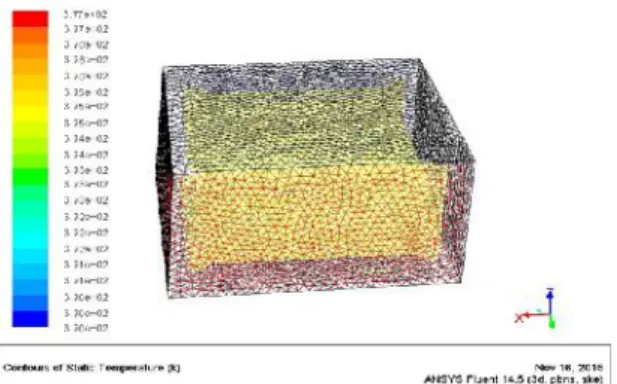
The CFD analysis of temperature variations of Different Vol. concentration of Al2O3
nanoparticles mixing with base fluid (water & EG). Are show bellows, here the temperature values are taken as mean values.
Fig (4) CFD analysis of louvers fin radiator model of water+EG as coolant of temperature variations.
Fig (5) CFD Analysis of louvers fin radiator model with Base fluid & Al2O3 (1%) as coolant of
Temperature variations
Fig (6) CFD analysis of louvers fin radiator model with Base fluid & Al2O3(3%) as coolant and air flow
of temperature variations.
Fig (7) CFD analysis of louvers fin radiator model with Base fluid & Al2O3(5%) as coolant and air flow
of temperature variations.
Graph(2). Effect of Al2O3 particles to Conv. heat
transfer Coefficient at constant air Reynolds number and constant mass flow rate.
Graph (2) shows that increased Convective heat transfer coefficient with increasing Vol. concentration of Al2O3& base fluid. The Convective
heat transfer coefficient is increased 77 % with comparing of without adding of nano particles to base fluid, In this process constant air Reynolds number (1046.8) and constant flow rate (0.05L/min.) This study also found that heat transfer is increased exponentially as the volume fraction of Alumina particles are increased as shown in Graph (3). This improvement is calculated using Eq. (6).
0 50 100 150 200 250 300 350
Al2O3-0% Al2O3-1% Al2O3-3% Al2O3-5%
Conv
. he
at
tr
ans
fe
r coe
ffi
ci
ent
(W
/m
2-
-K
Graph (3). Effect of Al2O3particles to Heat transfer
at constant air Reynolds number and constant mass flow rate.
Al2O3 nanoparticles increase volume
concentration of in the base Fluid at constant air Reynolds number and constant mass Flow rate. It increased heat transfer of the radiator element. It increased It shown in below graph (2).
Graph (4) Effect of Al2O3particles to Heat transfer at
constant air Reynolds number and constant mass flow rate.
Volumetric concentration of Al2O3 in base
fluid is increases the temperature difference of nanofluid inlet and outlet temperature. Graph (3) shows the variations of temperature of nanofluid at outlet with increasing the concentration of Al2O3. Validation:
To validate the louver fin element, of j-factor & f- j-factors of equations (9) & (10) results from the compared with the results from the experimental microscopic analysis. The computational domain and boundary condition for the experimentally in Sang Hyuk Lee, Nahmkeon Hur and Seongwon Kang [19]. Heat transfer of louver fin radiator is proposed by j-factor of equations (9) and (13) of values are approximately equal. Pressure drop of fanning f-factor of equations (10) and (14) of values are nearly equal.
VI Conclusion:
The CFD analysis was carried out by importing the louver fin radiator model into ANSYS
14.5 in CFD tool, the different volumetric concentrations of Al2O3nanoparticles are mixing with
water+EG base coolant at coolant inlet temperature of 3770K, constant velocity of air is 40Kmph, average wall temperature of 3410K and constant flow rate (0.05L/min.) and calculations of heat transfer coefficients variations and the following conclusions were made. Heat transfer is increased with increase in volumetric concentration of nanoparticles (like 0%, 1%, 3% & 5%). About 77% heat transfer enhancement was achieved with addition of 5% Al2O3particles with comparing of basefluid.
Future scope:
The design of louver fin radiator of louver angle and fin pitch changes to create air turbulence then increases the heat transfer of coolant. By changing the material of radiator with high thermal conductivity and different nanofluids are used to increases thermal performance then finally improving the efficiency of automobiles.
Nomenclature:
Ac : Cross-sectional area [m2] As : Surface area [m2]
cp : Specific heat capacity [J/Kg-K] F : Fanning f-factor
F : Fanning f-factor
Fd : Fin depth [mm] Fl : Fin length [mm] Fp : Fin pitch [mm]
h : Heat transfer coefficient [W/m2K]
j : Colburn j-factor
Lh : Louver height [mm] Ll : Louver length [mm] Lp : Louver pitch [mm]
ReLp : Reynolds number based on louver
Pitch
T : Temperature [0K]
Tb : Bulk temperature [0K] Tw : Wall temperature [0K] Td : Tube depth [mm] Tp : Tube pitch [mm] Q : Heat transfer rate [W]
V : Velocity [m/s] : Density [kg/m3] : Viscosity [kg/ms]
∅ : Vol. concentration of nanopartical : Louver angle [degree]
: Fin thickness [mm]
Subscript
bf : base fluid
nf : nano fluid
p : nano particle
in : Inlet
out : Outlet
References:
[1] H. S. Kang, Optimum performance and design of a rectangular fin, International Journal of Automotive Technology, 8(6) (2007) 705-711. [2] A. Witry, Thermal performance of Automotive aluminium plate radiator, Applied Thermal Engineering, 25 (2005) 1207-1218.
0 1 2 3 4 5 6 7 8 9 10
Al2O3-0% Al2O3-1% Al2O3-3% Al2O3-5%
He
at
T
ra
ns
fe
r (
W
at
t)
Volume fraction of alumina particles (%)
Heat transfer (Q) in Watt
373.5 374 374.5 375 375.5 376 376.5
O
ut
le
t t
em
pe
ra
tur
e
of
na
nof
lui
d
(
0K)
Volume fraction of Alumina particles (%)
[3] J. G. Paeng, K. H. Kim and Y. H. Yoon, Experimental measurement and numerical computation of the air side convective heat transfer coefficients in a plate fin-tube heat exchanger,
Journal of Mechanical Science and Technology, 23
(2009) 536-543.
[4] C. López del Prá, F. J. S. Velasco and L. E. Herranz, Aerodynamics of a gas jet entering the secondary side of a vertical shell-and-tube exchanger: Numerical analysis of anticipated severe accident SGTR conditions, Engineering Application of Computational Fluid Mechanics, 4 (1) (2010)
91-105.
[5] K. Bremhorst and M. Brennan,Investigation of shell and tube heat exchanger tube inlets wear by computational fluid dynamics, Engineering Application of Computational Fluid Mechanics, 5 (4)
(2011) 566-578.
[6] N.-H. Kim and S.-H. Kim, Dry and wet air-side performance of a louver-finned heat exchanger having flat tubes, Journal of Mechanical Science and
Technology, 24 (7) (2010) 1553-1561.
[7] K. Yakinthos, D. Missirlis, A. Sideridis, Z. Vlahostergios, O.Seite and A. Goulas, modelling operation of system of recuperative heat exchangers for aero engine with combined use of porosity model and thermo-mechanical model,
Engineering Applications of Computational Fluid Mechanics, 6 (4) (2012) 608-621.
[8] C.-T. Hsieh and J.-Y. Jang, 3-D thermal-hydraulic analysis for louver fin heat exchangers with variable louver Applied Thermal Engineering,26 (2006) 1629- 1639.
[9] D.Wen, Y. Ding, Experimental investigation into convective heat transfer of nanofluids at the entrance
region under laminar flow conditions, International Journal of Heat and Mass Transfer 47 (2004) 5181e5188.
[10] M.S. Liu, M.C.C. Lin, I.T. Huang, C.C. Wang, Enhancement of thermal conductivity with Cu-O for nanofluids, Chemical Engineering and Technology 29 (1) (2006) 72e77.
[11] B.C. Pak, I.Y. Cho, Hydrodynamic and heat transfer study of dispersed fluids with sub-micron metallic oxide particles, Experimental Heat Transfer 11(1998)151e170.
[12] Sridhara and Satapathy: Al2O3-based nanofluids: a review. Nanoscale Research Letters 2011 6:456.
[13] N.Bozorgan, M.Mafi and Hindawi Publishing Corporation Advances in Mechanical Engineering Volume 2012, Article ID 891382, 8 pages doi:10.1155/2012/891382.
[14] Y.-J. Chang and C.-C. Wang, A Generalized heat transfer correlation For louver fin geometry, International Journal of Heat and Mass
Transfer, 40 (3)(1997) 533-544.
[15] B.C. Pak, I.Y. Cho, Hydrodynamic and heat transfer study of dispersed fluids with sub-micron metallic oxide articles, Experimental Heat Transfer 11 (1998).
[16] Rahul A. Bhogare, B.S. Kothawale e SSN:2278-1684,p-ISSN:2320-334XVolume 11, Issue Ver. V (May- Jun.014), PP 23-30.
[17] S.M. Peyghambarzadeh, S.H. Hashemabadi, M. Seifi Jamnani, S.M. Hoseini 2011 Elsevier Ltd. All rights resered.doi: 10.1016/j.applthermaleng.
2011. 02.029.
[18] C.H.Song, D.-Y Lee and T.R.Sung,Cooling enhancement in an air-cooled finned heat exchanger by thin water film evaporation, International Journal
of Heat and Mass Transfer, 46 (7) (2003) 1241-1249.