107
PARTIAL RESULTS REGARDING THE INFLUENCE OF SOME
TECHNOLOGICAL ELEMENTS ON THE YIELD OF DRIED HERBA TO
THE PRIMULA OFFICINALIS HILL. SPECIES
NĂSTASE SORINA (NIȚU)1.2, HERMEZIU MANUELA1, GAVRILĂ MORAR2
1National Research Institute for Potato and Sugar Beet Brasov, 2 Fundaturii, Brasov 2University of Agricultural Sciences and Veterinary Medicine Cluj-Napoca, 3-5 Calea Manastur,
Cluj Napoca, Romania Corresponding author email: [email protected]
Keywords: Primula officinalis Hill., phytotherapy, technology, yield
ABSTRACT
Sustainable use of natural resources is one of the great challenges of our time. Thus, there is a return to nature, to homeopathic medicine and to phytotherapy. Primula officinalis Hill, has been used since ancient times in popular medicine due to its many healing properties. The main purpose of the study is the introduction into the culture of the species Primula officinalis Hill. The research started in 2016 by accumulating information on the existing genetic resources. The plants necessary for the establishment of the experiments were brought from the spontaneous flora of Brașov Country. The study aimed to establish the optimal breeding mode, the optimal planting time and nutrition space. These technological links influence the the plant yield but also on the content in active principles. The paper presents partial results regarding the elaboration of cultivation technology
INTRODUCTION
According to Richards (2003), the
Primula genus has its genetic centers,
mainly in the temperate or subalpine areas of the northern hemisphere, with the main center of species diversity in the Chinese-Himalayan region and secondarily, in the large mountain ranges of the Circumboreal region.
Primula officinalis Hill. is known as
an endemic plant, it grows spontaneously in our country, on poor, calcareous soils,
with southern exposure. Being an
endangered species, due to the irrational harvesting, it is necessary to be cultivate it areas of natural growth (Craciun et al., 1977, Păun, 1995).
This species is under partial legal protection in Poland. The plant can be harvested from areas where the species is widespread, in low hill areas and in lower mountain areas (Zajac and Zajac, 2001; Mirek et al., 2002).
Within the genus, the species
Primula officinalis Hill. has received a lot
of scientific attention, starting with Darwin's pioneering research (1877) on floral morphology and breeding biology of
the species Primula veris L, synonymous
with Primula officinalis Hill, Primula
vulgaris and Primula elatior (Darwin,
1877.)
In the Middle Ages Primula officinalis it was known as St. Peter's or
Petrella's plant, its leaves were
consumed as food, in various
preparations like salads or soups
(wikivisually.com). Popular names are: cowslip, eagle, angelina, five bells, goose-mole, goat's teat, sheep's-teat, (Kothe, 2013).
Ecology and biodiversity
conservation in Primula species have
been approached over time by
108
triterpenic saponins, phenolic glycosides and flavonoids. Phenolic glycosides and saponins are characteristic compounds of the Primula genus (Muller et al., 2005). In our country, the species is cultivated experimentally, being taken and introduced from spontaneous flora on
small surfaces, under controlled
conditions. In the context of an
sustainable agriculture, both from the point of view of cultivation and of use, based on the knowledge of the biological and morphological particularities of this species, the present paper intends to reach a complex of methods that will lead
to the elaboration of cultivation
technology.
MATERIAL AND METHOD
The studies were carried out at NIRDSB Brasov, within the Department of
Technology and Good Agricultural
Practices, in the Laboratory of medicinal and aromatic plants, between 2016 and 2019. The plants needed to establish the experience were brought from the spontaneous flora of Brasov Country. After a period of acclimatization, the plants were selected, choosing healthy plants, equal in height and an equal number of leaves/plant. The experience was established according to the method of subdivided plots, each variant having three rows in three replicates.
The length of one variant was 200
cm and the paths were 100 cm wide. Factor A - the distance between rows: 25 cm, 50 cm and 75 cm.
Factor B - the distance between plants in a row: 10 cm, 25 cm and 50 cm.
The dynamics of the emergence and growth of the foliar apparatus were followed until flowering, when three plants from each variant / repetition were harvested. For each plant harvested were made determinations regarding the dry herba mass. The average of the results
represented the average of the
experimental variants (photo 1).
In this paper are presented, by analysis of variance, results regarding the influence of the distance between rows and between plants in rows on dry herba yield (g/plant) average in 2017. For the analysis of the correlation coefficient "r" was used the model proposed by Hopkins (2013).
Figure 1. Aspects from field during the vegetation period 2017 (photo original)
RESULTS AND DISCUSSION
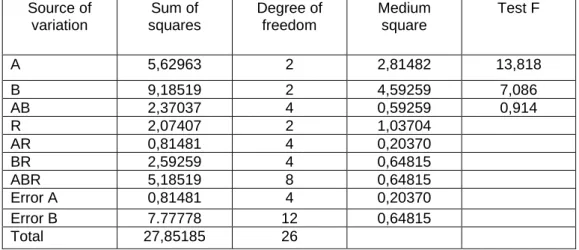
Table 1 analyzed the variance of influence regarding the distance between rows and between plants in rows on the dry herba yield.
109
ha) are real, true and are not the result of experimental errors.
Table 1
Analysis of the variance regarding the influence of the distance between rows (A) and between plants per row (B) on the average dry herba yield (g/plant) for the
species Primula officinalis in 2017
Analyzing the influence of factors A and B on the dry herba yield (g/plant) average in the experimental year 2017, it is found that the distance 50 cm between rows ensures higher yields with 0.67 g compared to control variant having significant values and that of 75 cm between rows differs significantly,
exceed ing the control by 1.11 g (table 2). Factor B (the distance between plants per row) has a distinctly significant influence on the density at 25 cm between plants, with an increase of 1.33 g, the plants at 50 cm per row ensuring only significant differences.
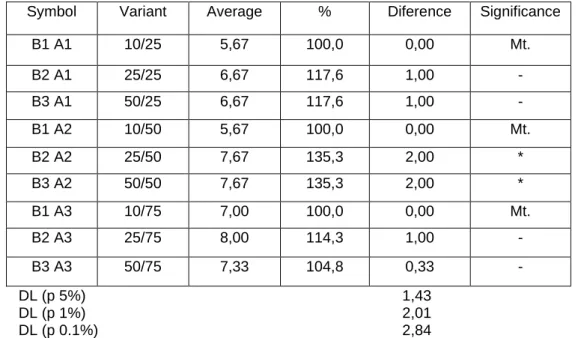
Table 2
The influence of the interaction between rows (A) and the distance between plants in row (B) on the dry herba yield (g/plant) (Brasov, 2017)
Influence of A factor Symbol Dist. between
rows(cm)
Average % Dif. Sign.
A1 25 6,33 100,0 0,00 Mt.
A2 50 7,00 110,5 0,67 *
A3 75 7,44 117,5 1,11 **
DL (p 5%) 0,59 DL (p 1%) 0,98 DL (p 0.1%) 1,83
Influence of B factor Symbol Dist. between plants
in row (cm)
Average % Dif. Sign.
B1 10 6,11 100,0 0,00 Mt.
B2 25 7,44 121,8 1,33 **
B3 50 7,22 118,2 1,11 *
DL (p 5%) 0,83 DL (p 1%) 1,16 DL (p 0.1%) 1,64
Following the interaction of the number of plants per row with the
distance between rows on the dry herba yield average (g / plant) in the first year of
Source of variation
Sum of squares
Degree of freedom
Medium square
Test F
A 5,62963 2 2,81482 13,818
B 9,18519 2 4,59259 7,086
AB 2,37037 4 0,59259 0,914
R 2,07407 2 1,03704
AR 0,81481 4 0,20370
BR 2,59259 4 0,64815
ABR 5,18519 8 0,64815
Error A 0,81481 4 0,20370
Error B 7.77778 12 0,64815
110
vegetation is observed that two variants provide significant differences (B2A2 and
B3A2), the others having insignificant values (Table 3).
Table 3
The influence of the interaction between no. of plants per row (B) and the distance between rows (A) on the dry herba yield (g/plant) (Brasov, 2017)
Symbol Variant Average % Diference Significance
B1 A1 10/25 5,67 100,0 0,00 Mt.
B2 A1 25/25 6,67 117,6 1,00 -
B3 A1 50/25 6,67 117,6 1,00 -
B1 A2 10/50 5,67 100,0 0,00 Mt.
B2 A2 25/50 7,67 135,3 2,00 *
B3 A2 50/50 7,67 135,3 2,00 *
B1 A3 10/75 7,00 100,0 0,00 Mt.
B2 A3 25/75 8,00 114,3 1,00 -
B3 A3 50/75 7,33 104,8 0,33 -
DL (p 5%) 1,43 DL (p 1%) 2,01 DL (p 0.1%) 2,84
The average dry herba yield in 2017 from the point of view of the interaction of factor A with factor B had positive significance only in the case of
variants A3B1 and A3B2, both with differences of 1.33 g, the other variants
registering insignificant differences
compared to the control variant (table 4).
Table 4
The influence of the interaction of distance between rows (A) and the distance between plants per row (B) on the dry herba yield (g/plant) (Brasov, 2017)
Symbol Variant Average % Diference Significance
A1B1 25/10 5,67 100,0 0,00 Mt.
A2B1 50/10 5,67 100,0 0,00 Mt.
A3B1 75/10 7,00 123,5 1,33 *
A1B2 25/25 6,67 100,0 0,00 Mt.
A2B2 50/25 7,67 115,0 1,00 -
A3B2 75/25 8,00 120,0 1,33 *
A1B3 25/50 6,67 100,0 0,00 Mt.
A2B3 50/50 7,67 115,0 1,00 -
A3B3 75/50 7,33 110,0 0,67 -
DL (p 5%) 1,31 DL (p 1%) 1,89 DL (p 0.1%) 2,83
111
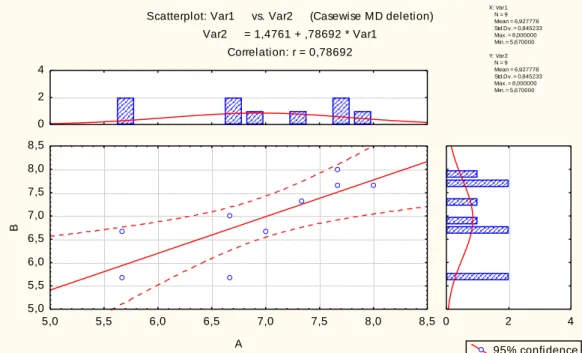
Analysis of the correlation
coefficient (r) regarding the interaction between the distance between rows (A) and the distance between plants per row (B) on the average of dry herba yield (g / plant) in 2017, shows the strong link between the two factors. The degree of
association of the points on the graph indicates a positive direction. The value r = 0.79 signifies the very high association of the two analyzed factors, the linear form being directly proportional to the value of the correlation coefficient (fig. 2).
Scatterplot: Var1 vs. Var2 (Casewise MD deletion) Var2 = 1,4761 + ,78692 * Var1
Correlation: r = 0,78692
0 2 4
5,0 5,5 6,0 6,5 7,0 7,5 8,0 8,5
A 5,0
5,5 6,0 6,5 7,0 7,5 8,0 8,5
B
0 2 4
95% confidence X: Var1
N = 9 Mean = 6,927778 Std.Dv. = 0,845233 Max. = 8,000000 Min. = 5,670000 Y: Var2 N = 9 Mean = 6,927778 Std.Dv. = 0,845233 Max. = 8,000000 Min. = 5,670000
Figure 2. Correlation of the interaction regarding the distance between rows (A) and distance between plants per row (B) on the average dry herba yield (g / plant) in
2017
The interaction regarding the
distance between rows (A) and the distance between plants per row (B) on the average dry herba yield (g / plant) generated an average of 6.93 g. Standard deviation (the value with which the
calculated average deviates from the average of the population from which the group was taken the measurements were made) had the value of 0.85 g, with a minimum amplitude on each variant of 5.67 g and a maximum of 8.00 g.
CONCLUSIONS
In the climatic and soil conditions of
NIRDPSB Brasov, Primula officinalis finds
good conditions for growth and
development.
If a high yield of dry herba is followed, a minimum distance between rows of 50 cm ensures to the plant an optimal nutrition space.
Yield of herba (g / plant) was very good to the variants planted at a distance of 50 cm and 75 cm between rows.
The statistical analysis regarding the interaction of the two factors (the distance between rows and the distance between plants in a row) demonstrated that the
distance between rows significantly
influences the dry herba yield (g/plant). Correlation coefficient (r) of the
interaction regarding the distance
112
association between the two analyzed factors, the linear form being directly
proportional to the value of the correlation coefficient.
ACKNOWLEDGEMENTS
The study was conducted as part of research PhD programme of the first author. The first author is thankful to NIRDPSB Brasov for support during PhD programme.
BIBLIOGRAPHY
1. Crăciun F., Bojor O., Alexan M.,
1977. Farmacia naturii, vol. II, Editura
Ceres, București, pp. 11
2. Darwin CR., 1877. The different forms of flowers and plants of the same
species. John Murray. London
3. Jiménez A, Mansour H, Keller B, Conti E., 2013. Low genetic diversity and high levels of inbreeding in the Sinai primrose (Primula boveana), a species on the brink of extinction. Plant Syst Evol
300:1199–208
4. Kothe,W.H., 2013. Lexicon der
Kräuter, KOMET Verlag GmbH, Köln,
ISBN 978-3-86941-072-2
5. Mirek Z, Piekos-Mirkowa H, Zajac A, and Zajac M., 2002. Flowering plants and pteridophytes of Poland. A checklist, 130. W. Szafer Institute of Botany, Polish Academy of Sciences, Kraków (in Polish and English)
6. Müller, A., Ganzera, M.,
Stuppner, H., 2005. Analysis of phenolic glycosides and saponins in Primula elatior and Primula veris by liquid,
chromatography, evaporative light
scattering detection and mass
spectrometry. J Chromatogr A 1112(-2),
218-23
7. Nishihiro J,Washitani I,
Thomson JD, Thomson BA., 2000. Patterns and consequences of stigma height variation in a natural population of
a distylous plant, Primula sieboldii.
Functional Ecology 14: 502–512
8. Păun. E., 1986. Tratat de plante medicinale și aromatice cultivate. Editura
Academiei Republicii Socialiste România,
București, pp. 10..
9. Richards, A.J., 2003. Primula.
Timber Press Portland, Oregon,USA (
Google Scholar)
10. Van Rossum F, Triest L., 2006. Within-population genetic variation in the distylous Primula veris: Does floral morph
anisoplethy matter in fragmented
habitats? Perspectives in Plant Ecology.
Evolution and Systematics 7: 263–73
11. Zajac A, and Zajac M., 2001. Distribution atlas of vascular plants in
Poland, 435. Pracownia Chorologii
Komputerowej Instytutu Botaniki,
Uniwersytet Jagiellon´ ski, Kraków (in
Polishand English)
http://compelmentarytraining.net/wp-
content/uploads/2013/10/Will-Hopkins-A-New-View-of-Statistics.pdf