364
THE CROPPING CHARACTERIZATION OF SOILS FROM VLADAIA
LOCALITY, DISTRICT MEHEDINTI
Popescu Cristian
University of Craiova, Faculty of Agronomy
Key words : soil profile, reddish preluvisoil, humus, pH, fertility, bonitation marks, favorability classes, fertility, reclaiming measures
ABSTRACT
The cropping characterization of soils is an operation of research for evaluating the fertility and suitability of soils for different crops and establishing the measures for their improving. In this respect, after field research and laboratory analyses there was identified as soil type the reddish preluvisoil with the following divisions: typical, middle eroded, luvic and, on small scale, aluvisoils with colluvic and gleysated divisions.
The laboratory analyses have emphasized an average and reduced fertility of these soils which can be improved through rational fertilization measures including fertilizers and manure, by special soil management practices for slope terrains, by amendment application, deep tillages and removing stagnant water.
The choosing of the most appropriate crops are a measure of improving these soils and that is why by bonitation there was established the suitability of several crops and ways of using of these soils. This way, on the typical preluvisoil the choose of crops include cereals and orchards due to their good results, while on eroded preluvisoil the most appropriate crop is vine, orchards (apricot tree) and pastures; these crops have obtained the highest bonitation marks (72, 65 and 46). The reddish luvic preluvisoil offers good conditions for pastures (64 points), wheat and barley (58 points) while on alluvisoil and colluvic glaysated alluvisoil the highest bonitation marks and growing conditions have been given by sugarbeet (63 points), hayfields (63 points) and pastures (64 points).
INTRODUCTION
The soil is a complex biological system home of endless life processes and transformations. By its mineral composition and processes during a long period of time the soil has gained its fundamental feature called fertility which is the ability to grow crops and to give yields.
Due to the fact that the land is limited as surface and the populace is continuing growing, nowadays there is focused the aspect of rational use of soil as source of raw materials and food as well as on increasing the yields by introducing in culture of the most productive and resistant crop kinds and hybrids closely correlated with the knowing of soil properties, of the factors that action positively or negatively on them as well as the way we can change the soil as a bio dynamic system in order to obtain higher yields and of better quality. All these facts are imposed by the fact that the soil, as shallow layer of Earth that has been continuously changed by the action of natural factors in specific conditions of geographic environment which it belongs is the natural environment where the roots grow allowing the access of water and nutrients for the plants in a continuous and uninterrupted way.
365
MATERIALS AND METHODS
The soil research has been made both in field and in laboratory according with the recommendations of the Institute for Pedology and Agrochemistry Bucharest.
For the identification of the soil types within the researched area and for their morphological description there were made soil profiles dug till the bedrock. There were described the main morphological features as: the thickness of horizons, their succession, the color, the texture, the structure, the porosity, the compactness, neo formations and inclusions for each horizon. From all soil profiles there were taken soil samples for laboratory analyses, including the size of particles, the structure, hydro physical parameters, and chemical parameters.
On the basis of the properties that were determined and in function of natural factors there has been made the bonitation operation in natural conditions.
RESEARCH RESULTS AND DISCUSSIONS
On the territory of Vladaia locality, District Mehedinti, after field researches and laboratory analyses there was identified as main soil unit the reddish preluvisoil with several vaieties: typical, eroded, luvic and on smaller surfaces, gleysated colluvic aluvisoil.
Within the paper there will be presented the physical and chemical parameters of preluvisoil from plain or low declined terrains, with a good drainage, of aluvisoil and the the bonitation marks and the suitability classes for all soil types that were identified within the researched area.
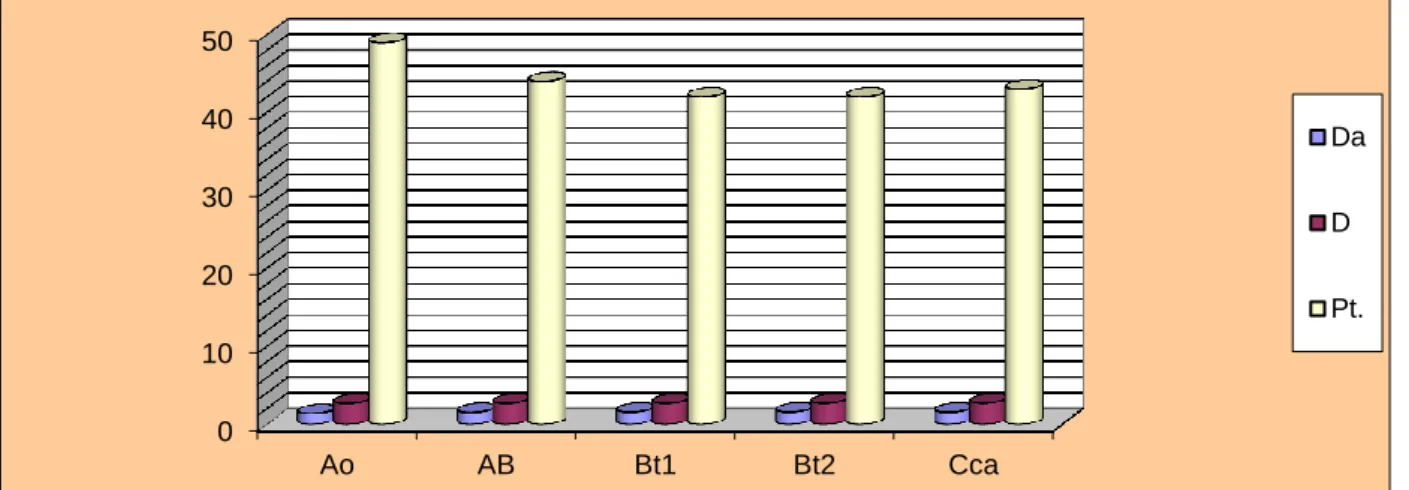
Making an interpretation of the resulted data on the size of soil particles (figure 1) there results that the soil has an average clay content that increases from 33.4% in Ao to 43.7% in Bt2. The bulk density increases from 1.39 g/cm3 in Ao till 1.56 g/cm3 in Bt2. The soil density has the extreme value of 2.65 g/cm3 in Ao and 2.70 g/cm3 Cca. The total porosity decreases from 48% till 42% which indicates a compacted soil in deeper horizons (figure 2).
Figure 1. The size composition of reddish preluvisoil nisip grosier
nisip fin praf
argilă
0 5 10 15 20 25 30 35 40 45
Ao AB
Bt1
Bt2
Cca
366
The hydro physical parameters of preluvisoil have average values that perfectly correlate with the clay and humus contents and increase till surface at Bt2 horizon where they reach maximal values (figure 3).
Figure 2. The hydro physical parameters of reddish preluvisoil
Figure 3. The hydro physical features of reddish preluvisoil
After determination of chemical parameters there resulted that the soil is average supplied by humus (figure 4), low supplied by total N and average supplied by soluble P and K (figure 5). The reaction is low acid, pH=6 in Ao horizon (figure 4).
.
Figure 4. The humus content and pH of reddish preluvisoil
0 10 20 30 40 50
Ao AB Bt1 Bt2 Cca
Da
D
Pt.
0 5 10 15 20 25
CH CO EU CU
A0 7.1 10.4 22.2 11.8
AB 7.7 11.3 23 11.7 Bt1 8.4 12.4 23.5 11.1 Bt2 9.5 14 24.4 10.4 Cca 7 10.3 23.3 13
0 1 2 3 4 5 6 7 8
A0 AB Bt1 Bt2 Cca
367
Figure 5. The content of nutrients of reddish preluvisoil
With the colluvisoil, that is found at the base of versants, where the eroded material was deposited by water from versants (colluvium), where the ground water is at low depth, has determined gleysation processes at the base of the profile, the size fractions have variable values on the soil profile. The thick sand is 4.5% in Ao horizon and in CGo it is 3.8%. With the case of fine sand there was recorded a decrease on soil profile, from 49.8% in A to 41.9% in AC, then it increases to 44.9% in CGo horizon. The loam decreases on the soil profile from 21.1% in Ao to 17.9% in CGo. The clay content increases on the soil profile from 24.6% in Ao to 33.4% in CGo (figure 6).
Figure6. The size composition of gleysated colluvic aluvisoil
The Hygroscopicity Coefficient increases on the soil profile from 7.1% in Ao horizon to 10.4% in CGo. The Wilting Point increases, too, along with the depth, from 10.4% in the first horizon to 15.3% in CGo. The Moisture Equivalent increases, too, from 23.5% in the first horizon to 28.4% in CGo horizon. The Available Water Capacity decreases from 11.5% in the first horizon to 9.5% in CGo horizon (figure 7).
Nt P K 0
20 40 60 80 100 120 140
Ao AB Bt1 Bt2 Cca Nt
P
K
nisip grosiernisip fin praf
argilă 0
10 20 30 40 50
Ao Ac CGo
nisip grosier
nisip fin
praf
368
Figure7. The hydro physical parameters of gleysated colluvic aluvisoil
The humus content decreases with the depth of the soil profile from 2.6% in the first horizon to 1% in CGo horizon (figure 8) and the total nitrogen, from 0.13% to 0.45%. the phosphorus decreases, too, from 20.93 ppm to 15.26 ppm. The potassium decreases, too, from 96.28 ppm to 86.32 ppm (figure 9). The pH has values over 6, so, the reaction is low acid (figure 8).
Figure 8. The humus content and pH values of gleysated colluvic aluvisoil
Figure 9. The nutrients content of gleysated colluvic alluvisoil
The sum of exchangeable bases increases with the depth from 24.6% me/100 g soil to 29.4 me/100 g soil. With the case of hydrolytical acidity there can be noticed a decrease with the depth, from 3.6 me/100 g soil in the first horizon to 2.7 me/100 g soil in CGo horizon. The bases saturation degree records increasing values on the soil profile, from 87% in the first horizon to 91% in CGo (figure 10).
0 5 10 15 20 25 30
CH% CO% EU% CU%
A0
Ac
CGo
0 1 2 3 4 5 6 7
Ao
Ac
CGo
Humus %
pH (H2O)
0 10 20 30 40 50 60 70 80 90 100
Ao Ac CGo
369
Figure 10. The chemical parameters of gleysated colluvic alluviosoil
After the establishing the bonitation marks and the suitability classes in natural conditions, for the soils of Vladaia locality, District Mehedinti, there can be noticed the folloing (table 1):
- the highest bonitation marks and favorability classes have been obtained by the reddish preluvisoil, followed by the gleysated colluvic alluviosoil and then by the luvic reddish preluvisoil and the lowest favorability classes and bonitation marks have been obtained by the eroded reddish preluvisoil;
The bonitation marks and the favorability classes with the soils from Vladaia locality, District Mehedinti
Table 1.
Crop
Reddish preluvisoil
Luvic reddish preluvisoil
Average eroded preluvisoil
Gleysated colluvic alluvisoil
NB CF NB CF NB CF NB CF
Pastures 58 V 64 IV 46 VI 64 IV
Hay fields 40 VII 37 VII 25 VIII 63 IV
Apple tree 58 V 47 VI 40 VII 19 IX
Pear tree 51 V 47 VI 28 VIII 36 VII
Plum tree 46 VI 65 IV 41 VI 13 IX
Apricot tree 65 IV 40 VII 35 VII 18 IX
Cherry tree 52 V 31 VII 15 IX 18 IX
Peach tree 36 VII 18 IX 9 X 16 IX
Vine for wine 72 III 65 IV 45 VI 45 VI
Vine for table 46 VI 46 VI 23 VIII 36 VII
Winter wheat 58 V 58 V 35 VII 54 V
Barley 58 V 58 V 35 VII 54 V
Maize 47 VI 47 VI 21 VIII 57 V
0 10 20 30 40 50 60 70 80 90 100
Ao Ac CGo
V %
T
SB
370
Sunflower 47 VI 42 VIII 14 IX 51 V
Potato 41 VI 29 VII 7 X 43 VI
Sugar beet 45 VI 36 V 9 X 63 IV
Soybean 52 V 52 V 23 VIII 54 V
Peas, beans 51 V 58 V 29 VIII 63 IV
Flax for oil 45 VI 52 V 24 VIII 57 V
Flax 38 V 52 V 31 VII 63 IV
Hemp 45 VI 47 VI 24 VIII 57 V
Alpha-alpha 51 V 52 V 32 VII 36 VII
Clover 52 V 47 VI 33 VII 50 VI
Vegetables 45 VI 36 VII 13 IX 63 IV
As regard the crops, there can be emphasized the following:
For the reddish preluvisoil, the best results were obtained by: plum tree (BM=65; FC-IV); pastures (BM=64; FC-IV) and the lowest results were given by peach tree (BM=18; FC- IX) and potato (BM=29; FC-VIII).
The best suitable crops and the highest bonitation marks for the average eroded preluvisoil have been given by the following crops: pastures (BM=46; FC-IX); vine for wine (BM=45; FC-VI).
Good results have been given by the following crops: vine for wine (BM=72; FC-III) and apricot tree (BM=65; FC-IV) for the luvic reddish preluvisoil and low results have been given by flax (BM=38; FC-V) and peach tree (BM=36; FC-VII).
Making an analysis for the fourth soil type, the gleysated colluvic alluvisoil, there can be said the following:
- the highest bonitation marks and the best favorability classes have been obtained by: pastures (BM=64; FC-IV); hay fields (BM=63; FC-IV) and the lowest results by plum tree (BM=13; FC-IX) and peach tree (BM=16; FC-IX).
After establishing the bonitation marks and the favorability classes with the soils of Vladaia locality, District Mehedint, there resulted that the best conditions for plant growing are offered by the following ways of usage: vine for wine, winter wheat, barley, plum tree, maize, pastures and hay fields.
The worst results have been given by peach tree and potato. There are not improper crops.
CONCLUSIONS
The territory of Vladaia locality is located in the S-E part of Mehedinti District. Geomorphologically, it is located at the limit between Getic Piedmont and Danube terraces. Within its territory there are plateau, versants with different slopes and wide valleys of 50-150 m.
The territory belongs to the clime index C.f.a.x. after Koppen and from the vegetation zone of oak.
371
The Vladaia locality, District Mehedinti has soils with an average and reduced fertility which need the following measures for improving their fertility:
- completion of nutrient deficiency by a rational fertility with organic and mineral fertilizers;
- proper soil management; - lime amendment on acid soils;
- all technology works to be made on contour lines and terraces where possible; - scarification on deep compacted zones;
- choosing the crops after favorability classes
BIBLIOGRAPHY
1.Cichi M., Popescu Ileana, Larisa Păun, Luminita Radu, Ciobanu A., 2009, The study of the reaction of Starkinson apple variety on different rootstoks in the south area of Oltenia, Analele Universității din Craiova, seria Agricultură-Montanologie-Cadastru, vol. XXXIX, pag.66-69.
2.Coteț, P., 1957, Câmpia Olteniei-Studii geomorfologice. Editura ştiinţifică, Bucureşti. 3.Glodeanu M., Popescu S., Alexandru T., Investigations concerning the possibility of converting the liquid flow into an electric parameter in order to automatize the working process for agricultural sprinkling machinery. Theird Conference Energy Eficiency and Agricultural Engineering, Bulgaria, pp 140-143, 2006.