Ⅰ Proceeding from “Humanity-Oriented and Sustainable” Concepts
Ⅱ Standards Based on “ Intelligence and Safety”
Ⅲ Creating “Convenient and Refined ”
Environment
It is our policy to reach Taipei City’s transportation goals of attaining a “humanity-oriented and sustainable” environment. The implementation of this practice in 2004 includes motorcycles withdrawing from corridors, the establishment of motorcycle on-street parking charges in The Xinyi Commercial Circle, construction of
pedestrian traffic signs with countdown display, testing
new crosswalk lines, bus shelter upgrade, BOT contract execution of The Taipei City Government Forwarding Station, and the holding of activities regarding the 2004 Taipei Car Free Day. In addition, we are continuing to plan Mass Rapid Transit network development and also the promotion of operational management activities. These projects are currently under construction with the intent of offering convenient transportation services, which will lead Taipei city into the era of being an international modern metropolitan.
Chapter 8
T
raffic and transportation in Taipei function under the four principles of: “Internationalization”, “Privatization”, “e-Management” and “Refinement”, as well as Caring for Life, and our general public appears to be satisfied with these fundamental concepts to date. Regarding “Internationalization” , during the past year, Taipei successfully completed bilingual traffic signs and tour guide maps while simultaneously, bus stations and stops also followed these bilingual trends. As a result foreigners are beginning to feel a sense of friendliness concerning Taipei’s communications and transportation. In the“Privatization” field, under the support of The Taipei City Council, the long debated private ownership of busing companies became a reality thus setting a classical example of increasing operational efficiency and
lowering government workloads. In the matter of “e-Management”, convenience stores are being connected
to the government central computer and people thus now have the option of paying for their traffic violation
tickets and other fees through this system. Concerning “Refinement”, Taipei city has initiated our first ever-increased-hourly road-parking measures as applied to cars and motorbikes. We took this action to provide more user-parking rates and also to instill among people the concept of “paying upon use”. Our city environment as a result is improving and as an added measure, we are also promoting the use of pollution-free bicycles. Our concepts of “caring for life”, “humanity” and “safety” are now deeply rooted through
execution of traffic laws, safety guides and engineering works improvements.
Ⅰ
Reviewing the past year, the goal of 0-30-60-90 (0% increase in the numbers of cars and motorbikes, average travel speed of 30kilometers, 60% public transportation usage and total deaths less than 90 persons) is admittedly producing transportation improvements; however, The Taipei City Government still looks forward to create a
“humanity-oriented and sustainable” top-class traffic system.
Creating a “Humanity-Oriented” Traffic Environment
1. Implementation of “Motorcycles No Parking on Corridors and Sidewalks”
In fiscal year 2004, we implemented this measure on 44 road sections, over a total road length of 23.87
km, in which 5,122 parking spaces for motor scooters became available. As a result, the Department currently provides unobstructed pavements for pedestrians and is also improving motorcycle-parking conditions, thus restoring the basic functions of corridors and sidewalks.
2. Implementation of Parking Charges for Motorcycles in Xinyi Business District
There are now over 1,010,000 motor scooters in Taipei City. Specifically each family holds an average
of 1.1 motorcycles with 383 motorcycles owned per thousand persons. Therefore, riding a motorcycle is the most important means of transportation for Taipei citizens. There is thus a very large traffic volume flowing into and out of Taipei City every day, which always results in traffic congestion. Moreover, since these
two-wheeled vehicles are compact and flexibe, riders often driver their motorcycles erratically on the road and
operate their scooters on corridors and sidewalks, thus impairing traffic safety. In addition, the pollution problem caused by motorcycle emissions is far more serious than that from other vehicles. For our city to address these public safety problems, we must urgently prepare and formulate a proper policy for administration of motorcycle parking. The Department has selected The Xinyi Business District since this ares indeed has high levels of vehicle emission pollution and a high level of motorcycles. Xinyi features a variety of business activities, convenience of mass transportation (Taipei City Hall Station of The MRT Blue Line and dozens of bus routes) and thus surging requirements for motorcycle parking and adequate larger vehicle parking spaces including public and private parking lots or street parking spaces. Xinyi is therefore a high-priority district for implementation of street parking charges for motorcycles. We consequently started this program on December 15th, 2004. 3. Promotion of “No Parking for Motorcycles on Nanyang Street” for Enhanced Public Safety and Improved Environment
To improve public safety and to rectify parking disorders, the Department has, since early 2005, begun to restore orderly transportation flows by enforcing its program of “No Parking of Motorcycles on Corridor”. We made this program known to our citizens by TV, radio, broadcast, and printed media in late 2004. In addition, the Department also held a cyber game event and distributed notice slips regarding parking management for motorcycles on Nanyang Street so that scooter riders, business workers, and residents would be aware of this information. According to a public survey conducted
by the “Taipei Society for Traffic Safety” (with the authorization of the Parking Management Office), over 80% of the respondents expressed satisfaction with this measure, which constitutes
tangible testimony that the majority of our citizens agree with this policy of enhancing public safety and parking order.
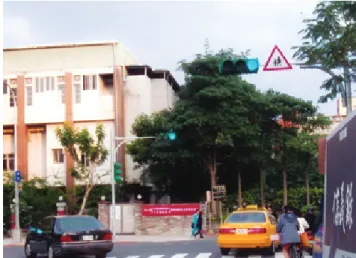
4. Pedestrian Signals Installed with Countdown Timer Displays The existing pedestrian signals installed with countdown timer displays are helpful in transferring messages effectively to tell walkers whether they can proceed through a road in time, thus enhancing public
safety. In fiscal year 2004, there were 137 intersections (including Bangka
Boulevard, etc.) with these facilities, and to date, we have installed this equipment at a total of 1,395 intersections throughout the city.
●Implementation of Motorcycle Parking Charges in The Xinyi Business District are improving traffic order.
●Promotion of “Motorcycles No Parking on Nanyang Street” for Enhanced Public Safety and General Environment.
●Pedestrian Signals Installed with Countdown Timer Displays.
5. Pedestrians Traffic Signs
Traffic Engineering Office of Taipei City Government has comprehensively reviewed the installation of
“Pedestrians Traffic Signs“ for those intersections with an excessive pedestrian and vehicle volume and thus with high potential for pedestrian-vehicle conflicts. Currently there are 83 intersections at which we have placed these signs and the total number is still increasing as we further review this situation. Additionally, to improve traffic
conditions at those intersections where pedestrians and vehicles compete for limited space and time, and to make it the norm for pedestrians to walk quickly through an intersection, we now regulate 320 intersections on 16 main streets in the city as a reference for pedestrians when they are walking through these crossroads. In this situation, the duration of the pedestrian green phase is set at 90 seconds for those intersections at which this elapsed time
previously exceeded 90 seconds . For 20 of these crossroads with a larger volume of vehicles and regular traffic
jams, we have reduced the duration of this pedestrian green phase to 60 seconds in order to facilitate traffic management and to prevent vehicles from being blocked by excessively large numbers of pedestrians.
6. New Pedestrian Crossing Trial Run
In Taiwan scooter riders always fall down at slippery pedestrian crossings on rainy days and this proliferation of tumbling two-wheeled vehicles is often caused by dangerous braking or worn treads due to
overuse of tires, etc., Traffic Engineering Office of Taipei City Government thus consistently refers to relevant
measures taken in the United States and Singapore and as a result we plan to draw two parallel lines as a substitute for pedestrian crossings all in order to enhance safety for scooter riders and drivers
on rainy days. The Office is selecting those intersections with larger
pedestrian and vehicle volumes, e.g. Zhongxiao East Road (from Guangfu South Road to Keelung Road), Zhongxiao East Road (from Dunhua South Road to Fuxing South Road) and Guangfu South and North Road (from Civil Boulevard to Xinyi Road) for trial runs. These results (including public surveys) will be submitted to The Ministry of Transportation and Communications as a reference for revision of applicable laws and regulations.
Creating a Sustainable Traffic System in Taipei
1. More comfortable waiting areas for bus passengers In order to prepare proper bus waiting areas for the public, we built eight double-seated bus shelters and 26 single-seated bus shelters in fiscal year 2004. Concerning these proposed sites, we initially prioritized outdated bus shelters for reconstruction, and also those locations, which were recommended by the public and approved by the Department of Transportation but which were
originally excluded from our street fixture program.
●New Pedestrian Crossing line Trial Run.
●In order to prepare more comfortable bus waiting areas, we constructed eight double-seated and 26 single-seated bus shelters built in 2004.
2. Neihu Technology Park Transit and Commuting Bus
There are 34 routes available on the main streets of the Neihu Technology Park and during peak hours there is a bus running through the Park every minute. For commuting workers within the Park, The Department of Transportation has prepared six routes of commuting and in addition transit and express buses. The Department also conducted a transportation capacity review in June 2004 and held a “Review Meeting of
Public Transportation in the Neihu Technology Park” on October 28th, 2004. At this conference the Department
examined the routes of commuting and Taipei City Buses, and aligned parts these routes to suit citizen’s practical needs. In the future, the Department will, on an unannounced basis, continue to observe transportation capacity and then review the necessity of regulating routes and frequencies to meet our public’s expectations. 3. BOT Taipei City Hall Transit Transfer Station
This case is the first station-related multi-functional development program pursuant to The Law for Promotion of Private Participation in Infrastructure Projects. This construction zone is located at the entrance of The Xinyi
Planning Area and has a site area of 1.628 hectares. In
accordance with the requirements of this multi-functional program, this site will be built both as a transit station and shopping malls. This facility will connect with The Taipei Metropolitan Rapid Transit lines and adjacent sites and it thus has high potential for business development. After negotiations lasting for over a year, The Taipei City Government issued
a commission letter to The Uni-President Enterprises Corp. on July 12th, 2004, the most qualified applicant,
which then separately founded a new firm known as “Uni-President Development Co., Ltd.“. On August
11th, 2004 The City Government officially contracted with and conferred on this company the right to build
and operate this establishment. This company is expected to obtain the necessary construction permit prior
to October 14th, 2005, acquire an occupancy permit by October 14th, 2007, with the station scheduled to commence operations before April 14th, 2008. As this project comes to fruition we will provide various
integrated services for more convenient public transportation. The construction costs equal approximately NT$6.6 billion (including capitalized yield) and will be 100% invested by the private sector. The government is entitled to development and operating and also income from leasing of the land without being involved in any fund investments.
4. D1 Construction of Taipei Main Station Temporary Transit Area
We have selected The D1 Temporary Transit of Taipei Main Station as a site for construction of a temporary transit bus stop. This decision will solve traffic problems, improve residential living quality, and reduce noise arising from concentrated long-distance bus stops in the peripheral areas of Taipei Main Station. Upon completion this temporary transit station will be designated as the alternative stop in the Jiau-Jiou area. The
site, with an area of 16,839 square meters, is situated at the southwestern conner of the crossroads of Civic
●Mayor Ma signing BOT contract with “Uni-President Development Co., Ltd.“ for Taipei City Hall Transit Transfer Station.
Boulevard and Chongqing North Road. According to our plans, this transit station will accommodate 14
passenger bus operators, 48 routes, and 2,000 daily bus runs. However, one serious problem is that use of this
station would entail high operating risks for bus operators because the site overlaps the revised Taipei-CKS Airport MRT Line operated by the Bureau of Taiwan High Speed Railway (BOTHSR). With these points in mind we downscaled our original plans to enable all of the original site occupants to be stationed altogether.
After this reprogramming, the area of the transit station was reduced to 13,402 square meters and as modified it will still accommodate 48 routes as originally projected. We reviewes the architectural design of this case
on July 21st, 2004 and the construction permit was issued on October 14th, 2004 with Taipei City Mayor Ma hosting the commencement ceremony for the construction on November 26th, 2004. When completed this facility is expected to provide a premium long-distance transportation service and bus-waiting environment in
The Taipei Main Station Designated Area in fiscal year 2005.
5. Cycling Popularity
The idea of a Car-Free Day originated as an activity called “In Town Without My Car” on September 22nd,
1998 in France, and it has since spread throughout Europe.
(1) Taipei’s 2004 Car-Free Day Activities
Department of Transportation of The Taipei City Government has began holding Car Free-Day activities in 2002, with a total of 11 cities and counties around Taiwan joining in these activities. Taipei is thus
the first city in Taiwan to take part in this movement. Actually 2004
represented the third time Taiwan celebrated with Taipei City leading the way. This was also the first time that activities concerning five different topics were held within one month. September 13th-19th was Effective Public Transportation Week, while we also held a themed
exhibition entitled Taipei Fantasy World September 17th-24th. In addition the Safer Without Cars
Bike-Fest took place on September 19th, a Car-Free Day conference was held on Car-Free Day (September
22nd) and the Walk to School Campaign was hosted October 4th-8th. Based on Taipei’s experience with
hosting Car-Free Day, we hope that the people of the city will become interested in and enthusiastic about the meaning and essence of the day thus raising social awareness about this topic. We also hope that this experience will bring to each city and county more extensive and diverse thinking about the meaning and
implications of the activities of Car-Free Day, inspiring people to realize the ideals of sustainable traffic.
(2) Xinyi Business District Bike Lanes
In coordination with the development of The Xinyi Planning Area, 10 and 20meter greenbelts and 5 and 15meter walkways have been built along Songgao, Songzhi, Songren, Songde and Xinyi Roads and in surrounding areas in the Xinyi District. Our purpose here is to encourage more citizens to use emission-free bicycles and to provide more diverse transportation services. Work on the bike lane network was
completed on May 29th, 2004, totaling 10.5 kilometers in all. This is Taipei’s first downtown bike lane
network, facilitating commuting and shopping.
●Safer Without Cars Bike-fest took place on Car-Free Day activities.
Crating an Intelligent Traffic System in Taipei
1. Intelligent Transportation System Projects carried out by The Department of Transportation in 2004:
(1) We installed a bus stop announcement
and display system on 3,750 Taipei City
buses using LED displays and voice announcements.
(2) Bus ETA display system: The first phase of this project focused on MRT Transfer Buses. We placed positioning devices on 500 MRT Transfer Buses,
created a control center together with 80
smart bus stop signs. We also instituted and an online and phone inquiry system was installed to provide commuters with information through the Internet or telephone, about the ETA of MRT Transfer Buses. In addition the smart bus stop signs display up-to-the-minute information about bus ETAs at bus stops and at the entryways of MRT stations. At the same time, bus companies can upgrade from manual to computerized dispatching, increasing their operating
efficiency. The Department of Transportation can check on the quality of bus services through the
real-time monitoring system (web-gis) and other statistical reports thus reducing manpower.
(3) In November of 2004, The Handicapped Services Minibus Management and Dispatch System installed digital driving recorders and GPS monitoring
systems on 20 newly leased Handicapped Services Minibuses, increasing dispatching efficiency and allowing The Department of Transportation access to immediate online supervision.
(4) The expressway traffic monitoring system
provides instant traffic information on Taipei’s
bridges, the Jianguo, Keelung, and Civic Boulevard Overpasses, Huandong Boulevard, the Zhoumei Expressway and the Nangang Software Park.
Ⅱ
Standard Based on “Intelligence and Safety”
●Taipei Parking Information System-real-time car positioning query. ●A bus stop announcement and display system to display shuttle bus arrival
(5) The real-time parking lot information system provides instant information about parking space availability in City-registered public and private parking lots and 39 other parking lots. It is available to the general public online.
2. Experimental Parking Data Guidance System for the Xinyi Development Zone
The parking lot data guidance system provides more integrated and efficient use of parking spaces, so that
motorists can use online or voice messaging services to learn about parking availability before starting their
journeys, or, after entering the parking area, use up-to-the-minute data quickly to find a parking spot. The Xinyi Development Zone parking data guidance system was completed on April 7th, 2003, and in 2004, counting
equipment was added to seven Civic Boulevard parking lots, with 13 display panels and other hardware added. Also the information centers of 55 parking lots underwent hardware and software upgrades.
3. Expansion of the EasyCard Payment System
Off-street parking lots run by The Taipei Parking Management Center now accept the EasyCard, which means that this convenient card can be used for the MRT, city buses and parking lots. By December 31st, 2004, the EasyCard system was up and running in 45 off-street parking lots, and the usage rate for this payment method has reached 66%.
4. Improve Taipei’s Traffic Monitoring System
(1) The Xinyi Development Zone Short-Term Traffic Monitoring System
The rapid development of Taipei’s Xinyi Business District and the popularity of the Taipei 101 Mall
call for efficient traffic monitoring to alleviate transportation burdens in the surrounding area. In 2004,
The Taipei Traffic Engineering Office installed high-resolution cameras at 10 intersections around the Keelung-Zhongxiao intersection in The Xinyi Planning Area to provide 24-hour real-time images of road
conditions. The Taipei Traffic Control Center and The Xinyi Branch installed computer workstations with ADSL remote control cameras, providing live video images to observe traffic conditions on major roads in The Xinyi Development Zone, for efficient monitoring and improved traffic in the area.
(2) Taipei Expressway Traffic Monitoring System
To gain instant knowledge of road conditions on Taipei’s expressways and bridges, The Taipei Traffic Engineering Office installed vehicle detectors, electronic signs and closed-circuit camera systems on Civic Boulevard, the Zhoumei Expressway and the Huandong Expressway. Real-time images and information provided by the cameras and vehicle detectors are posted online at the center’s website. This data can be used to change the electronic signs on the roads to provide users of Taipei’s roadways with instant
Creating a Safe Traffic System in Taipei
1. Traffic Improvements on Major Road Sections and Crossroads
(1) Ziqiang Tunnel Improvement Program
Because it is the primary channel between East Taipei Shihlin and Beitou, The Ziqiang Tunnel
experiences frequent traffic jams. Traffic accidents also frequently occur in the tunnel due to the enclosed
space, non-dimming of lights, and fast speeds of vehicles. For this reason, the Department reduced the
widths of sidewalks and built a new motorcycle lane in fiscal year 2004 to improve driving safety.
(2) Huanhe North Road (from Dunhuang Road to Minsheng West Road) Improvement Program
Huanhe North Road is an expressway in the western area of the city. This road was always considerably congested, because left-turns were available on to this road from Zhongjeng Road to Minzu
West. Road. In addition, traffic became relatively jammed due to more vehicles converging toward the newly built Zhoumei Expressway. To alleviate traffic delays on the crossroads along this road, The Traffic Engineering Office adjusted the distribution of center islands and canceled the establishment of center
islands between the south-to-north express route and urban roads. The department’s purpose in this case
was to increase road use efficiency and decrease left-turn vehicle volume from Jiuquan Street and Minzu West Road. A current review of traffic on these intersections and crossroads of Huanhe North Road and
Dunhuang Road, Jiuquan Street, Minzu West Road and Minsheng West Road has revealed a favorable
effect on transportation flows.
2. Traffic Educational and Promotional Campaigns
A total of 129 traffic accidents occurred in 2004 causing 95 deadths and 37 serious injuries. Causes for these
accidents include drunk driving, violating of traffic codes, not giving the right of way to pedestrians and not
paying attention to incoming traffic, cars at turning lanes not giving the right of way to cars on main roads etc. In
particular road safety for the elderly in Taipei is especially of concern.
(1) Traffic Safety Campaigns
Department of Transportation of The Taipei Taipei City Government is emphasizing “ no driving after drinking” “safety seats for cars with children” “respect safety of the elderly” “right of way for pedestrians” “stop, wait and go road manners” “motorist’s safety” “no speeding campaigns” “head lights for bicycles” etc. These activities all aim to ensure the orderliness of traffic conditions and safety of pedestrians.
(2) Helding “Pedestrian Safety Month” Activities
The “Pedestrian Safety Month” was launched in
July 2004. To demonstrate its firm resolution to defend
pedestrian safety, the Department held a press conference at the square of The Shin Kong Mitsukoshi Department Store (Taipei Station) on July 3rd, 2004 and invited Mayor Ma to reiterate the necessity of valuing pedestrian road-use safety and also to sign the proclamation: “Driving carefully to reassure public safety”. Strong media coverage, helped to promotion this event.
(3) Safe Bicycle Riding Training
On July 27th, 2004, The Taipei City Driver Training Center held a “2004 Bicycle training study in
Taipei”. After three sessions, 124 parents and students had completed this training. There have been a total
of 17 sessions since January 12th, 2004 with a total of 964 people participating.
3. Management of Mobile Advertising Trucks
To enhance the management of mobile advertising trucks, maintain smooth traffic flows, improve the
image of the city, and also to prevent obstruction of street parking, The Motor Vehicles Office of The Taipei City Government and The Taipei Parking Management Office announced a ban on mobile advertising trucks over 75 major roads and model street areas from 7a.m.-9p.m. (except for national holidays) from August 6th
to December 16th, 2004. Furthermore, starting January 1st, 2005, the Department began receiving mobile
advertising permit fees. By December 31st, 2004, The Department of Transportation altogether issued 2,802 mobile advertising permits, uncovered 7,257 illegal advertisements, revoked 221 permits, dismantled 148 illegal
advertisements, and hauled away 35 advertising trucks.
●Respecting care for the safety of elders.
Creating a Convenient Traffic System in Taipei
1. Construction of Taipei MRT Network
By the end of 2004, the initial stage of The Taipei MRT network
was 95.08% complete with the
Xiaobitan extension opening for service on September 22nd, 2004, Phase 2 of the Banqiao-Tucheng line,
and the Neihu line are 94.88% and 45.41% completed respectively. For the second stage programs of The Taipei MRT network, The Xinzhuang line and Luzhou Branch line were
41.58% complete by the end of 2004. The project from Kunyang Station to Nangang Station on the Nangang Eastern Extension began on December 5th, 2003; the project from Nangang Station to Taipei Nangang Exhibition Center Station started on October 12th, 2004 and is currently 14.16% complete. The Executive Yuan approved the
financial plans for The Xinyi and Songshan lines on October 22nd, 2004 and December 2nd, 2004 respectively.
(1) Planning The Taipei MRT
The routes, now being planned, include the Ankeng line; the Sanxia-Yingge Extension; the Wanda-Zhoughe-Sulin Extension; the Shezi-Shilin-Beitou Light Rail; and the Minsheng-Xizhi line, as well as the Danhai and Orbital lines. If these lines become fully operational by 2021 as planned, the Taipei MRT network will have a total length of around 250 kilometers and the average number of daily passenger trips on the entire network is expected to reach 3.6 million. By that time, the Taipei MRT will become an even more indispensable method of transportation with MRT stations within approximately 500 meters of walking distance in most of downtown areas.
(2) Implementing Development BOT Project of Parcel No. T9 on Taipei Main Station Special District.
The BOT contract for the development project of Plot No. T9, is based on the “Act for Encouraging Private Involvement in Transportation Construction” and has been awarded to Radium Life Tech. Co.
LTD. The plan for this project is to build a long-distance bus terminal, a shopping mall, office buildings,
apartment buildings, a hotel and many other facilities. The project is intended to become a city landmark and one of the most popular destinations for Taipei residents.
●Inauguration of the Taipei Main Train Station Shopping Mall.
●Executing a c o n t r a c t f o r BOT project regarding Plot No. T9 in the Ta i p e i M a i n Station Special District.
(3) Chiang Kai-shek International Airport Line in Taipei City
More than once The Department of Rapid Transit Systems (DORTS) has proposed to The Ministry of Transportation and Communications (MOTC) approval of underground construction regarding the Taipei City section of the Taipei-CKS International Airport MRT Line. DORTS made this proposal in order to integrate transportation systems and land development, and in consideration of the basic functions of The Chiang Kai-shek International Airport Line, including technical concerns, etc. According to the Ministry of Transportation and Communications’ resolution of October 6th, 2004 DORTS was authorized to implement the design and construction of civil works and electrical and mechanical systems with a total
cost of NT$7.58 billion. On October 12th, 2004 the MOTC designated DORTS as the responsible authority
to implement the land development project on the Taipei City section of the Taipei-CKS International Airport MRT Line.
2. Services and Management of Taipei Rapid Transit Corporation
The Taipei Metro System include seven lines making up a total length of 67 km with 61 stations. The
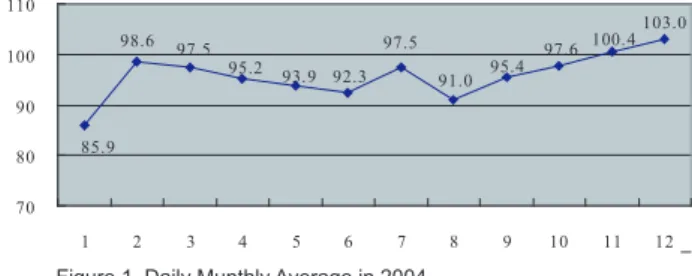
transport volume of Taipei Metro Systems grew tremendously in 2004, with an annual total of 350,140,000 trips
and a daily average of 956,672 trips/day. Compared with the daily average of 866,272 trips in 2003, there was
an increase of 10.4%. In November of 2004 the daily average exceeded one million trips for the first time to reach 1,004,160 trips and in December of the same year, a record of 1,030,218 trips was set. (Please refer to the
(1) Elevating “Service Quality”
Pursuant to our objective that “Passengers Come First and Quality Supersedes All Priorities”, TRTC
established the first “24-hour Passenger
Service Center” in the transport business on July 29th, 2004. The center aims to shorten the processing time and to respond promptly to passenger’s requests.
(2) Promoting Bicycling Policies
To advocate proper leisure activities for the public and to encourage them to utilize non-polluting means of transportation, two policies were successfully launched in 2004 to promote bicycling: The “Open-door Policy of Passengers Taking Bikes on the Metro” and “Installation of Double-Decked Bike
Racks.” The former policy was implemented on January 17th, 2004 and passengers were allowed to bring
along bikes on the Metro on Saturdays, Sundays and public holidays. The original plan was to have a
trial run until October 17th, 2004, but it was received with such enthusiasm that we extended it. The first
double-decked bike rack was installed in Taiwan at Beitou Station on December 23rd, 2004, providing 32 sets with 64 parking spaces. More racks will be installed at other stations in 2005 and 2006, and depending on the space available at each station, these racks can
provide 30% to 120% more parking spaces than the current available areas.
Figure 1 Daily Munthly Average in 2004.
●Mayor Ma Himself Experiencing Taking a Bike on the Metro.
●Inauguration of the First Double-Decked Bike Racks at Beitou Station of The Danshui Line.
(3) LED Monitor Making its First Broadcast
A 236-inch high resolution LED panel was installed at both Zhongxiao Fuxing Station and Taipei
Main Station on July 29th, 2004, allowing passengers to have access to prompt and diversified information
while waiting for the train. (4) Other Services
A. Installation of Train Passenger Information System (TPIS) on Heavy-capacity Transit System
B. Expansion of the underground wireless telecommunication services to allow uninterrupted mobile phone reception on all lines
C. Execution of the project for broadband network construction to provide passengers access to the internet
D. Inauguration of the linking passage of The Pacific Sogo Department Store and The MRT station, the first of its kind within The Taipei Metro System to provide convenient connections between the station and this department store
E. Noise Reduction Construction on The Danshui Line, in hopes of improving the quality of life among residents along the line.
F. These actions are meant to meet passenger’s needs for quality service, to creat an impeccable public transportation environment and to upgrade Taipei resident’s quality of life.
(5) Elevating Taipei Metro System’s Reliability
We executed the project of “Incident Reduction by Half” commencing in 2004, aiming to reduce year-round incidents of more
than 5-minute delays to half of 83
incidents of 2003. Based on all of our TRTC colleague’s efforts, there were 34 incidents of delays for more than 5
minutes. Compared with 83 incidents
in 2003, there was a reduction of 49 incidents, a reduction rate of 59%. The project’s objective of less than
41 incidents was reached, and in the process Taipei metro system’s reliability was greatly elevated. Moreover, the car-km between two incidents reached 1.511 million car-km (the higher the average car-km, the safer the
systems), a significant advancement from last year’s figure of 615,000 car-km. Compared with members of
international associations such as NOVA and CoMET, this accomplishment ranked second among worldwide major cities, lesser only than Tokyo’s metro systems.
●Inauguration of the Linking Passage of the Pacific Sogo Department Store and the MRT Station.
To strengthen the control of our system’s operational safety and service quality, TRTC introduced
The ISO 9001 quality control system in 1998 and established five quality management systems in succession. From the year 2004 TRTC actively carried out the integration of these five ISO 9001 quality
control systems into one network. In November, 2004 TRTC was inspected and evaluated by The Bureau of Standards, Metrology and Inspection, M.O.E.A. and was accredited with ISO 9001 certification on December 23rd, indicating the completion of this integration procedure.
To prevent accidents and to reduce subsequent casualties and property losses, TRTC not only properly maintains but also ameliorates its facilities in order to advance operational stability. Furthermore, TRTC
organized 18 extensive drills in 2004 to reinforce the abilities of its staff to handle various contingencies.
To ensure passenger’s safety on the platforms, TRTC performed an evaluation and analysis of installing doors on the platforms of the Heavy-capacity Transit System and proceeded with the development of installing “Sensors for Detection of Passengers approaching too Closely to the Platform Edges.”
(6) Activities of “Ride the Metro and Win Prizes” were Held
To show our appreciation to the passengers and to attract more people to take the metro, we held the
event “Ride the Metro and Win Prizes” between August 8th and September 4th, 2004. A total of 476 prizes
were given out.
(7) Enriched and Diversified Activities at the Metro
To coincide with public holidays or with theme activities held by other organizations, activities such as “Taipei Season of Culture” “The Metro and Around the World,” “2004 Taipei Animal Season” and “Caring for Women and Children’s Safety” were held. The latter,
held on December 17th, 2004, was meant to
express TRTC’s concerns for women’s safety, especially when taking the metro and to publicize precautionary measures and facilities for protecting women.
Creating a Refined Traffic System in Taipei
1. Renewal of Traffic Signs with LED Signals and Aluminum Light Cases
LED display features the advantages of low power consumption and durability. It requires only 22 watt
(vs. 165 watt for incandescent lamps), saving power consumption by 80%, with duration 10 times as much as
that for incandescent lamp’s. The LED illumination system may confine identifiable signals to some specific areas, which can prevent drivers from misjudging the traffic conditions at a forked intersection. Taipei Traffic
Engineering Office of The Taipei City Government accomplished this work at 231 intersections on main
boulevards or avenues (e.g. Zhongxing South Road),
and up to now we have been completed a total of 973
intersections the city.
2. Bilingual Traffic Sign Boards
To provide foreigners with integral traffic information,
promote the development of tourism in the city, and to facilitate the internalization and promote the reputation
of the city, The Traffic Engineering Office of The Taipei
City Government has established bilingual road-name (place-name) signs as well as other traffic sign boards such as “Stop”, “Give Way”, “Slow Down” and warning markings at schools, hospitals, and “No Parking” warning
signs. In fiscal year 2005, the Office will gradually change all downtown traffic signs and boards as bilingual notices.
3. Balancing parking supply and demand
In 2004, The Parking Management Office of The Taipei City Government completed seven new parking lots, providing
1,599 parking spaces for cars and 809 for motorcycles (see
attached chart), partially alleviating demand for parking spaces. Unfortunately this is not enough to catch up with the rapid growth in the number of cars and motorcycles in Taipei. The Taipei Parking Management Office will continue upholding this policy, creating more parking spaces in order to improve the parking situation.
●Renewal of Traffic Signs with LED Signals and Aluminum Light Cases.
●Bilingual Traffic Sign Boards.
Table 1 Parking Lots Created by the Taipei Parking Management Office in
Name of parking lot Opening date Parking Spaces
1 Wanhua District Administrative Center Underground Parking Lot 3/21/2004 215 0 2 Lane 284 Wuxing St. Ground-Level Parking Lot 3/15/2004 51 18
3 Neihu Ruiguang Market Ground-Level Parking Lot 4/21/2004 169 0
4 Beitou Mingde Road Ground-Level Parking Lot 6/15/2004 28 0
5 Yongsheng Park Underground Parking Lot Annex 6/24/2004 220 74 6 Chunguang Park Underground Parking Lot Annex 8/30/2004 213 71 7 Longmen Junior High School Athletic Field Underground Parking Lot 10/15/2004 703 646
Total 1, 599 809 Car Motorcycle