Draft Local Government Performance
Reporting Framework & Indicators
Working Paper
CONTENTS
1. PURPOSE OF THIS PAPER ... 4
2. OBJECTIVE AND GUIDING PRINCIPLES ... 6
3. SERVICE PERFORMANCE ... 8
4. FINANCIAL PERFORMANCE ... 11
5. SUSTAINABILITY ... 13
6. WHAT ELSE NEEDS TO BE DONE? ... 16
APPENDIX A SERVICE PERFORMANCE INDICATORS ... 17
APPENDIX B FINANCIAL PERFORMANCE INDICATORS ... 32
1.
Purpose of this paper
This working paper is intended to be used as a basis for providing feedback on the draft Local Government Performance Reporting Framework (LGPRF) and more specifically the draft indicators. It sets out the overall objective of the LGPRF, guiding principles and frameworks for the development of indicators and outlines draft indicators. It builds on the key features discussed in the Directions Paper released by Local Government Victoria in December 2012 and should be read in conjunction with that paper1.
Stage 1 of the project is nearing completion. Local Government Victoria has worked collaboratively with a broad range of technical and advisory groups involving over 70 local government, academic and subject matter experts to develop a draft performance reporting framework and indicator set. Local Government Victoria is undertaking an active program of engagement over May and June 2013 to continue to refine the draft framework and indicators so that it is a robust and useful framework for assessing local government performance. Refinement and validation of the draft framework and indicators will continue into the pilot program phase commencing in July 2013.
How you can contribute
A number of opportunities are provided for interested stakeholders to contribute to the refinement of the LGPRF. A series of regional workshops are being convened during May 2013 targeted at local government officers, managers and coordinators with relevant expertise and/or responsibility for organisational performance reporting.
The objective of the workshops is to:
obtain feedback on the draft framework and indicators;
build understanding of the LGPRF and how it will affect councils; and
promote involvement in the pilot program.
Full details of the regional workshops can be found on Local Government Victoria’s
website at www.dpcd.vic.gov.au/localgovernment/performance-reporting
A community workshop will also be held in Melbourne on Tuesday 28 May from 2.00pm to 4.00pm. This workshop is open to members of the community who have an interest in the LGPRF.
Local Government Victoria will also be meeting with local government CEOs, Councillors, Mayors and Special Interest Groups via existing regional network meetings over the coming months.
Comments on this paper are welcome until Friday 14 June 2013 and can be emailed to [email protected]
2.
Objective and guiding principles
2.1
Objective of assessing performance
The primary objective of the LGPRF is to provide comprehensive performance information that meets the needs of stakeholders. This is an ambitious objective that seeks to balance the needs and expectations of a number of audiences. In meeting this objective:
councils will have information to support strategic decision making and continuous improvement;
communities will have information about council performance and productivity;
regulators will have information to monitor compliance with relevant reporting requirements; and
State and Commonwealth Governments will be better informed to make decisions that ensure an effective, efficient and sustainable system of local government.
To provide a comprehensive picture of council performance, indicators have been developed across three thematic areas: service performance, financial performance and sustainability. An objective for assessing performance against each thematic area has been established to inform the development of performance indicators. These are outlined below.
Table 1: LGPRF indicator sets and objectives
Service performance To provide relevant information about the effectiveness and efficiency of local government services.
Financial performance To provide relevant information about the effectiveness of financial management in local government.
Sustainability To provide relevant information about whether local governments have the capacity to deliver services, absorb changes and shocks and make decisions in the best interests of the community over the long term.
2.2
Guiding principles of LGPRF
Guiding principles have been established in consultation with the technical working groups to assist in the development and selection of indicators to measure local government performance. Principles relating to the reporting of performance information will be considered separately.
Indicators should be ‘SMART’
The construction of specific indicators should seek to adhere to the SMART principles, that is, indicators should be:
specific to the service, activity and/or dimension of performance being measured;
based on measurable factors that can be observed, documented and verified (either by audits or other mechanisms);
aligned with objectives;
relevant to the service, activity and/or dimension of performance being measured; and
Indicators should build a balanced picture of performance
A range of performance indicators should be developed to cover different aspects of performance. A single indicator is typically not able to provide a balanced picture of performance; therefore a suite of indicators, measuring different aspects of performance should be pursued.
Indicators should be understandable to a broad audience
Performance indicators must be understandable to a broad audience. They should be clear and unambiguous so that stakeholders can draw meaningful conclusions about the performance of councils. A balance should be struck between performance indicators being understandable to the community, useful to councils to support continuous improvement and instructive to other levels of government. Performance indicators must also measure what they claim to measure. Proxy indicators should be clearly identified as such.
Indicators should align with other reporting requirements
Use of acceptable (albeit imperfect) performance indicators that are already in use in other reporting arrangements should be pursued where appropriate. Adopting existing indicators can ensure consistency with other, relevant reports where this adds value, lowers the cost of data collection and avoids delays in reporting. Performance indicators should also be developed with national standards and reporting regimes in mind to allow for inter-jurisdictional analysis as the framework develops. Indicators should be comparable across councils and consistent over time
Each indicator must be clearly defined with counting rules and measurement standards established to facilitate a valid measure of performance and aid reasonable comparisons. Indicators should also allow for consistent comparisons of performance over time. This requires that performance indicators be well designed and robust from the outset and remain broadly stable over time.
The benefit of collecting information should outweigh the collection costs
The costs associated with collecting information needs to be balanced against the benefits of collecting that information.
3. Service
performance
A Service Performance Technical Working Group (Services Working Group) was established by Local Government Victoria to advise on the development of a set of draft service performance indicators for local government in accordance with the guiding principles and conceptual model developed for this purpose. Members were appointed via a targeted expression of interest process to the LGPro Corporate Planners Network and LGPro Corporate Services Special Interest Group. To ensure a diversity of views, appointments took into account geographical representation as well as individual experience and expertise.
3.1
Service Performance Indicator Framework
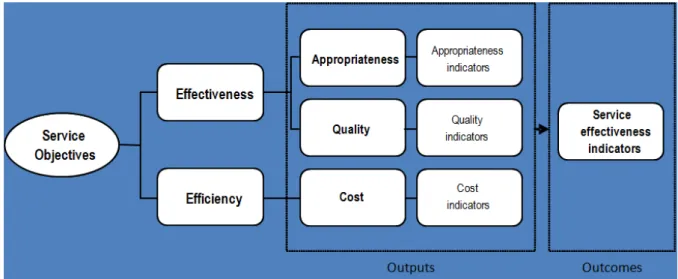
One of the early tasks of the Services Working Group was to agree on a Service Performance Indicator Framework (the Service Framework). The Service Framework outlined in Figure 1 has been adapted from the Productivity Commission’s Report on Government Services and reflects the service process through which local governments transform inputs into outputs and outcomes in order to achieve desired service objectives.
Figure 1. Services Framework
The Service Framework takes the objective of each service and measures it in terms of effectiveness and efficiency being the two overarching dimensions of performance. The effectiveness indicators measure how well the outcomes of a service achieve the stated objectives of that service and the efficiency indicators measure how well resources (inputs) are used to produce outputs.
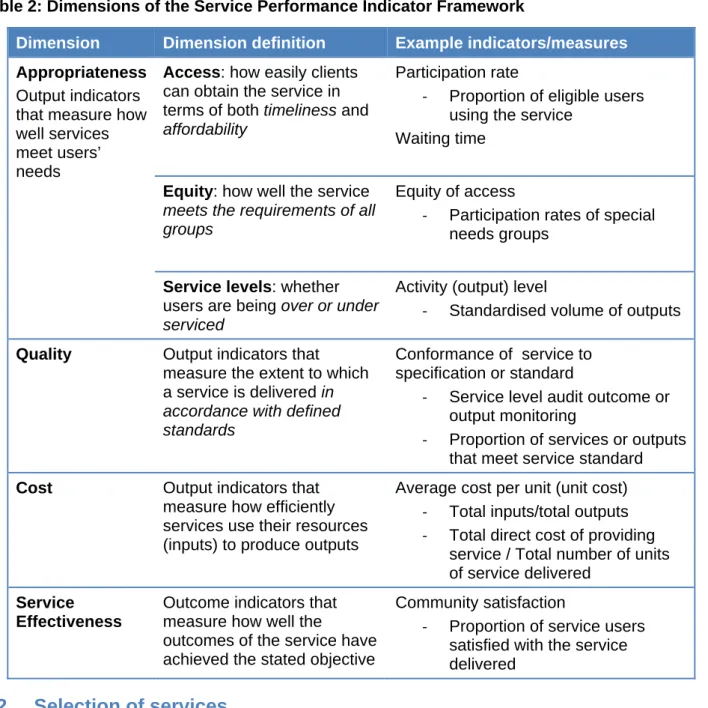
The overarching dimension of effectiveness is measured according to appropriateness and quality output indicators and the overarching dimension of efficiency is measured by cost. The Service Framework includes outcome indicators of service effectiveness that measure how well the outcomes of the service have achieved the stated objective. Dimensions are further defined in Table 2 below.
Table 2: Dimensions of the Service Performance Indicator Framework
Dimension Dimension definition Example indicators/measures Appropriateness
Output indicators that measure how well services meet users’ needs
Access: how easily clients can obtain the service in terms of both timeliness and affordability
Participation rate
‐ Proportion of eligible users using the service
Waiting time
Equity: how well the service meets the requirements of all groups
Equity of access
‐ Participation rates of special needs groups
Service levels: whether users are being over or under serviced
Activity (output) level
‐ Standardised volume of outputs Quality Output indicators that
measure the extent to which a service is delivered in accordance withdefined standards
Conformance of service to specification or standard
‐ Service level audit outcome or output monitoring
‐ Proportion of services or outputs that meet service standard Cost Output indicators that
measure how efficiently services use their resources (inputs) to produce outputs
Average cost per unit (unit cost) ‐ Total inputs/total outputs ‐ Total direct cost of providing
service / Total number of units of service delivered
Service Effectiveness
Outcome indicators that measure how well the
outcomes of the service have achieved the stated objective
Community satisfaction
‐ Proportion of service users satisfied with the service delivered
3.2
Selection of services
Common local government services have been identified for inclusion in the LGPRF with an emphasis on selecting a small group of services that all councils provide. A comprehensive range of service areas were initially considered and progressively refined to a total of 14 common local government services. The following factors were considered for inclusion of service areas in the draft framework:
commonality of services across all councils;
councils have primary control and/or statutory responsibility for delivery of selected services;
resource intensiveness (that is, overall significance within the range of services provided by councils);
the services should be viewed as important to the community; and
Services included in the draft framework are not designed to be a judgement on what council activities are most important. Insights gained from developing indicators will be progressively applied to additional services over time. Councils can also voluntarily develop indicators for further service areas.
3.3 Selection
of
indicators
An extensive range of sources were reviewed to identify suitable indicators for inclusion in the LGPRF services indicator set. Key steps taken include:
Review of the service indicators developed by the Essential Service Commission;
Analysis of indicators supplied by Service Working Group members;
Validation of shortlisted indicators in consultation with relevant state departments and agencies; and
Validation of shortlisted indicators in consultation with relevant subject-matter experts within local government.
A total of 76 service indicators and measures have been shortlisted for inclusion in the LGPRF. Draft definitions, objectives, indicators and measures for service performance are outlined at Appendix A.
4. Financial
performance
A Financial Performance Technical Working Group (Finance Working Group) was established by Local Government Victoria to advise on the development of a set of draft financial performance indicators for local government in accordance with the guiding principles and conceptual model developed for this purpose. Members were appointed via a targeted expression of interest process to members of Local Government Finance Professionals. To ensure a diversity of views, appointments took into account geographical representation as well as individual experience and expertise.
4.1
Financial Performance Indicator Framework
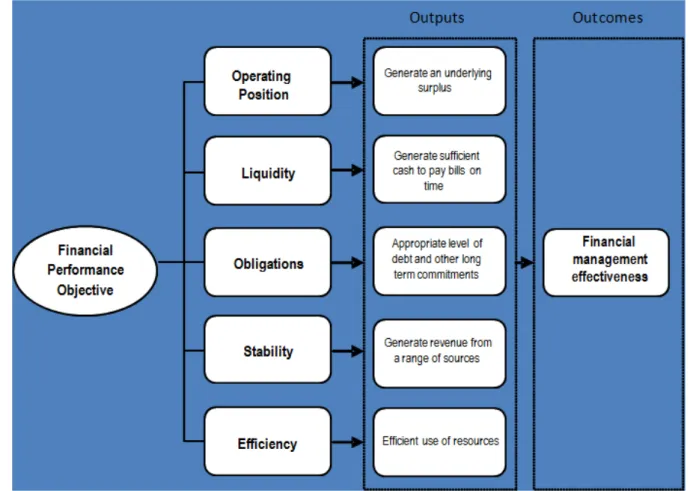
The Financial Performance Indicator Framework (the Financial Performance Framework) outlined in Figure 2 was agreed by the Finance Working Group to be an appropriate framework for measuring financial management effectiveness in local government. It establishes the objective of the indicator set and measures performance through a range of output and outcome indicators.
Figure 2. Financial Performance Framework
The Financial Performance Framework takes the key objective of effective financial management and assesses this in the context of five overarching dimensions – operating position, liquidity, obligations, stability and efficiency. Each dimension is measured with lag indicators, described as outputs. When taken together, these output indicators provide an overall picture of financial management effectiveness. Each dimension is defined in table 3 below.
Table 3: Dimensions of the Financial Performance Framework
Dimension Definition
Operating position Measures whether a council is able to generate an underlying surplus Liquidity Measures whether a council is able to generate sufficient cash to pay
bills on time
Obligations Measures whether the level of debt and other long term commitments is appropriate
Stability Measures whether a council is able to generate revenue from a range of sources
Efficiency Measures whether a council is using resources efficiently
4.2 Selection
of
indicators
A comprehensive review of existing financial reporting frameworks and indicators was undertaken in order to shortlist potential financial performance indicators for inclusion in the LGPRF. Indicators were trialled by the Finance Working Group using data from audited council financial statements and budgets.
As a result of this process, 12 draft measures across 5 dimensions of financial performance have been identified for inclusion in the LGPRF. The draft indicators, measures and definitions are set out at Appendix B.
5. Sustainability
A Sustainability Working Group was established by Local Government Victoria to advise on the development of a set of draft sustainability indicators for local government. A broad spectrum of practitioners, observers, academics and subject matter experts were appointed to the Sustainability Working Group.
Given the considerable existing knowledge base and literature in regards to local government sustainability, a literature review and discussion paper was produced by Local Government Victoria to inform the work of the Sustainability Working Group
5.1 Defining
“Sustainability”
To ensure a consistent understanding of what sustainability means in the context of the LGPRF, it was necessary to define the term sustainability within the local government context. The
Sustainability Working Group agreed on the definition outlined in Box 2.
5.2
Sustainability Indicator Framework
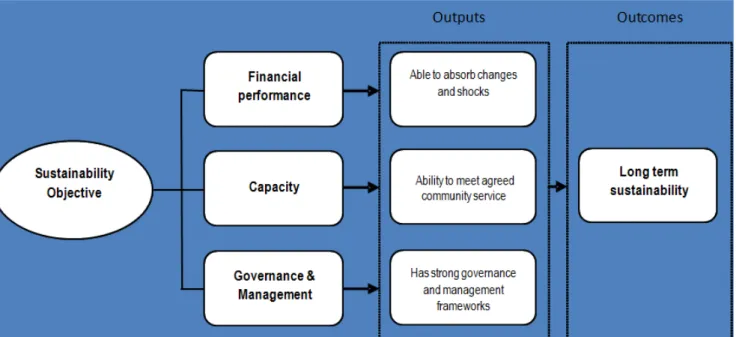
The Sustainability Indicator Framework outlined in Figure 3 was agreed by the Sustainability Working Group to be an appropriate framework for measuring long term sustainability in local government. The Sustainability Indicator Framework establishes the objective of the indicator set and measures it through a range of output and outcome indicators.
Box 1. Definition of Sustainability
Sustainability is about having the capacity to deliver services, absorb changes and shocks and make decisions in the best interests of the community over the long term. This includes:
Meeting the agreed service needs of the community
Absorbing foreseeable changes and unexpected shocks without having to make disruptive revenue or expenditure adjustments
Having strong governance and management frameworks in place covering community engagement, planning, monitoring, reporting and decision making.
Figure 3. Sustainability Indicator Framework
The Sustainability Indicator Framework takes the objective of sustainability and assesses this in the context of three dimensions – financial performance, capacity and governance and management. Each of these dimensions is measured in terms of lead indicators described as outputs. When taken together, these outputs enable a judgement about long term sustainability to be made. Each dimension is defined in Table 4 below.
Table 4. Dimensions of the Sustainability Framework
Dimension Definition
Financial performance The council must be able to absorb foreseeable changes and unexpected shocks without having to make disruptive revenue or expenditure adjustments
Capacity The council must be able to meet the agreed service needs of the community.
Governance and management
The council must have strong governance and management frameworks in place covering community engagement, planning, monitoring, reporting and decision making.
5.3 Selection
of
indicators
A comprehensive review of existing measures of financial performance, capacity and governance and management was undertaken in order to shortlist potential sustainability indicators for inclusion in the LGPRF.
From this analysis, it was evident quantitative measures of financial performance and capacity are well established. For governance and management, a qualitative self-assessment checklist was determined to be the most practical approach given the inherent difficulties in determining output and outcome measures for this area. Where established, accepted standards and guidelines will be used to guide the self-assessment process.
12 quantitative measures across the dimensions of financial performance and capacity have been identified for inclusion in the LGPRF, along with 26 qualitative measures across the dimension of governance and management. Draft indicators, measures and definitions across the three dimensions are set out at Appendix C.
6.
What else needs to be done?
6.1 Indicator
specifications
The development of standard indicator definitions, numerators, denominators, computations and counting rules will be key inputs to next stage of the process. ‘Specifications’ will be developed for each indicator to ensure a consistent interpretation of indicators - an essential element of comparative reporting.
6.2
Identification of data collection sources
Identification of existing reporting that can be leveraged into the LGPRF is already well progressed. Further consultation with data owners needs to occur throughout the pilot period to understand existing reporting arrangements.
6.3 Reporting
format
The LGPRF will form part of the Performance Statement and be subject to audit by the Victorian Auditor-General’s Office. The form and content of the Performance Statement will be developed in the next stage of the project. The current Performance Statement will be used as a template for developing a standard reporting format and will include an opportunity for councils to provide contextual information and commentary on variances in results.
6.4 Pilot
program
All councils are encouraged to use the performance reporting framework in the pilot period, commencing in July 2013. Local Government Victoria will work more intensively with a representative group of councils throughout this period to examine council information management systems, capacity to report against the framework and to understand data collection and implementation issues. Expressions of interest for participation in the pilot program will be sought in early June 2013.
6.5
Reducing the reporting burden
Work in relation to the streamlining and reduction in reporting burden to offset the work required to implement the LGPRF is ongoing. Over the past 12 months, Local Government Victoria has been leading a whole-of-government exercise to identify existing local government reporting requirements, with view to streamlining and removing unnecessary reporting burdens.
Through this process, about 100 existing reporting requirements have been identified. Over a third of these reporting requirements have been identified by Departments for streamlining or removal. The Government intends to make an announcement in the coming months in relation to the extent of this reduction in reporting burden.
6.6 Enabling
legislation
The LGPRF will be mandatory from 1 July 2014. Legislation to enable the LGPRF and modernise and simplify the overall regime of planning and reporting within the Local Government Act 1989 and Local Government (Finance and Reporting) Regulations 2004 will be brought before Parliament in early 2014.
APPENDIX A Service performance indicators
The draft service performance indicators should be read in conjunction with Table 2. Sometimes the terms used in performance measurement have different meanings for different people. In general, the LGPRF uses a standard terminology to provide consistency in interpretation. The following list contains standard definitions of common terms used in LGPRF service performance framework:
Definition – a description of the service, the intended service recipient and what is included in the service for the purposes of the LGPRF
Objective – the desired outcome from the provision of the service Indicator – the concept to be measured
1. Governance
DefinitionProvision of good governance to the community including processes for making and implementing decisions with reference to community engagement, policy frameworks and practice and in compliance with relevant legislation. Objective
To make and implement decisions in the best interests of the community. Relevant Legislation
Local Government Act 1989 External Reporting
Community Satisfaction Survey – Local Government Victoria (LGV) Local Government Investigations and Compliance Inspectorate (LGI)
Dimension Indicator Measure Data Source Comments
Appropriateness Transparency
Engagement
1. Number of confidential council meeting items classified under s89(2)(h) “Any other matter” of the Local Government Act 1989 / Total number of council meeting agenda items
2. Number of notices of motions / Total number of ordinary council meetings
3. Number of submissions received under s223 / Number of s223 submission opportunities Council Council Council Quality Attendance Decision Making
4. Councillors attendance at council
meetings and special committees / Total eligible council and special committee meetings
5. Number of council resolutions “for noting” / Total number of council agenda items
Council
Council
Cost Service cost 6. Direct cost of governance / Total
municipal population
Council
Service Effectiveness
Compliance 7. Number of LGI full investigations that lead to a prosecution
8. Number of applications for councillor conduct panels
9. Number of probity auditor appointments 10. Number of councillor suspensions/forced
leave of absences
11. Community satisfaction with community engagement
12. Community satisfaction with council decision making LGI LGV LGV LGV LGV LGV New community satisfaction survey measure to be established for council decision making
2. Statutory Planning
DefinitionProvision of land-use and development assessment services to applicants and the community including advice, determination of applications.
Objective
To make planning application decisions which are consistent with the local planning scheme. Relevant Legislation
Planning and Environment Act 1987 External Reporting
Planning Permit Activity Reporting System – Office of Planning Performance (OPP) Victorian Civil and Administrative Tribunal (VCAT)
Dimension Indicator Measure Data Source Comments
Appropriateness Timeliness 13. Median net days to make a planning decision OPP Users include applicants and other parties Quality Service standard
14. Number of planning decisions completed within sixty days/ Total number of planning decisions made
OPP
Cost Service cost 15. Direct cost of service / Total planning applications decided
Council Direct cost does not include management or corporate overheads Service Effectiveness
Compliance 16. Number of VCAT decisions in favour of council / Total number of VCAT referrals
VCAT
3. Economic Development
DefinitionProvision of support and advice to businesses and industry including lobbying, partnership opportunities, networking and training programs.
Objective
To stimulate local economic activity.
Relevant Legislation External Reporting
Australian Business Register - Australian Taxation Office (ATO)
Dimension Indicator Measure Data Source Comments
Appropriateness Participation 17. Number of active businesses / Total number of businesses Council Active businesses are those participating in at least one Council business development program Quality Service standard
18. Number of business development events held / Total number of planned business development events
Council
Cost Service cost 19. Direct cost / Total number of active businesses
Council Direct cost includes staff resources and support programs. It excludes management and corporate overheads Service Effectiveness Business activity
20. Number of new businesses / Total number of businesses ATO
4. Roads
DefinitionProvision of a network of sealed local roads2 under the control of the municipal council to all road users. Objective
To provide a well maintained and renewed local road network that is safe and efficient. Relevant Legislation
Road Management Act 2004 External Reporting
Local Government Infrastructure survey – Local Government Victoria (LGV) Community Satisfaction Survey – Local Government Victoria (LGV)
Council annual returns – Victoria Grants Commission (VGC) Transport Accident Commission (TAC)
Dimension Indicator Measure Data Source Comments
Appropriateness Service level 21. Number of kilometres of local roads renewed /
Total kilometres of local roads 22. Number of kilometres of local roads
maintained /
Total kilometres of local roads
Council
Council
Quality Condition 23. Number of kilometres of local roads with a Pavement Condition Index =or> 4 / Total kilometres of local roads
LGV Pavement Condition Index methodology to be confirmed Cost Cost of renewal/ maintenance
24. Renewal expenditure on local roads / Total kilometres of local roads renewed 25. Maintenance expenditure on local roads /
Total kilometres of local roads maintained LGV, Council LGV, Council Service Effectiveness Satisfaction Safety
26. Community satisfaction with local roads 27. Number of serious injuries/deaths on
local roads / Total kilometres of local roads LGV TAC Footpaths to be removed from LGV Satisfaction Survey
5. Libraries
DefinitionProvision of print and digital based resources to the community in a variety of formats including collection services, e-services, research tools and interactive learning programs.
Objective
To provide free, accessible and well utilised print and digital based resources. Relevant Legislation
Local Government Act 1989 External Reporting
Standards and Guidelines for Australian Public Libraries – Australian Library Information Association (ALIA) Annual Survey of Public Libraries – Public Libraries Victoria Network (PLVN)
Dimension Indicator Measure Data Source Comments
Appropriateness Participation 28. Number of active library members / Total eligible municipal population
ALIA Eligible members are those over 5 years of age Quality Resource standard
29. Number of collection items published in last 5 years / Total number of collection items
ALIA / PLVN
Cost Service cost 30. Direct operating cost / Total number of active library members
31. Expenditure on library materials / Total municipal population ALIA / PLVN ALIA / PLVN Direct cost does not include library materials, management or corporate overheads Service Effectiveness Satisfaction Utilisation
32. User satisfaction with library service 33. Number of library visits / Total number of
active library members
ALIA PLVN
6. Waste collection
DefinitionProvision of kerbside and disposal waste collection services to the community. Objective
To minimise the amount of waste diverted to landfill. Relevant Legislation
National Environment Protection (Used Packaging Materials) Measure (the NEPM) External Reporting
Local Government Annual Survey – Sustainability Victoria (SV)
Dimension Indicator Measure Data Source Comments
Appropriateness Service level 34. Additional bin requests / Total number of collection households
Council
Quality Service
standard
35. Number of bins missed / Total number of bin lifts
Council
Cost Service cost 36. Direct cost of garbage service / Total number of garbage bin lifts
37. Direct cost of recyclables service / Total number of recyclables bin lifts
SV SV Direct cost does not include management corporate overheads or revenue Service Effectiveness Waste diversion
38. Weight of all waste types (excluding garbage) collected /
Total weight of all waste types and methods of collection SV
7. Pools
DefinitionProvision of indoor and outdoor pools to the community and visitors for water safety, sport and recreation. Objective
To provide safe, accessible and well utilised facilities. Relevant Legislation
Public Health and Wellbeing Act 2008
Public Health and Wellbeing Regulations 2009 External Reporting
Community Satisfaction Survey – Local Government Victoria (LGV)
Dimension Indicator Measure Data Source Comments
Appropriateness Participation 39. Number of visits to facilities / Total municipal population
Council
Quality Safety 40. Days lost due to water quality / Total available days of operation
41. Number of water safety incidents / Total number of visits to the facility
Council
Council
Cost Service cost 42. Net operating cost of service / Total visits
Council Net operating cost includes user income but does not include management or corporate overheads Service Effectiveness
Satisfaction 43. Community satisfaction with pools LGV Community Satisfaction survey to be amended to include specific question on pools
8. Sports grounds
DefinitionProvision outdoor sports grounds including, playing surfaces, on-ground infrastructure to local sporting groups and casual users for structured activities.
Objective
To provide accessible and well utilised facilities. Relevant Legislation
External Reporting
Dimension Indicator Measure Data Source Comments
Appropriateness Participation 44. Total municipal population / Total number (or sqm) of sports grounds
Council
Quality Condition 45. Number of sports grounds rated equal to or greater than the agreed standard/ Total number (or sqm) of sports grounds
Condition standard to
be
established
Cost Service cost 46. Net operating cost of service /
Total number (or sqm) of sports grounds
Council Net operating cost includes
user income but does not include management or corporate overheads Service Effectiveness
Utilisation 47. Number of structured activities / Total number (or sqm) of sports grounds
Council
9. Street sweeping
DefinitionProvision of street sweeping services to the community including removal of litter and debris from local roads. Objective
To provide clean local roads while minimising environmental and flooding risks. Relevant Legislation
External Reporting
Dimension Indicator Measure Data Source Comments
Appropriateness Service level 48. Number of street cleaning requests / Total number of local road households
Council
Quality Service
standard
49. Number of kilometres of local roads swept according to agreed frequency / Total kilometres of local roads
Council
Cost Service cost 50. Direct cost of service / Total kilometres of local roads swept (or sqm)
Council Direct cost does not include management or corporate overheads Service Effectiveness
Flooding risk 51. Number of local road pits requiring reactive cleaning / Total number of local road pits Council
10. Animal management
DefinitionProvision of animal welfare and responsible pet3 ownership services to the community including monitoring, registration, enforcement and education.
Objective
To protect the health and safety of animals humans and the environment. Relevant Legislation
Domestic Animals Act 1994
Infringement (Reporting and Prescribed Details and Forms) Regulations 2006 Prevention of Cruelty to Animals Act 1986
External Reporting
Infringement Reporting – Department of Justice (DoJ)
Domestic Animal Management Plan – Department of Environment and Primary Industries (DEPI) Magistrate Court prosecutions - Department of Justice (DoJ)
Dimension Indicator Measure Data Source Comments
Appropriateness Service level 52. Number of nuisance animal reports / Total number of registered pets
Council
Quality Service
standard
53. Number of registrations / Total number of households
Council
Cost Service cost 54. Direct cost of service / Total number of registered pets
Council Direct cost does not include management or corporate overheads Service Effectiveness Health and safety
55. Number of nuisance animals
prosecutions proven / Total number of registered pets DoJ
11. Food safety
DefinitionProvision of food safety services to the community including registrations, education, monitoring, inspections and compliance.
Objective
To protect the health and safety of consumers.
Relevant Legislation Food Act 1984
Infringement (Reporting and Prescribed Details and Forms) Regulations 2006 External Reporting
Infringement Reporting – Department of Justice (DoJ) Food Act Annual Report – Department of Health (DoH)
Dimension Indicator Measure Data Source Comments
Appropriateness Service level 56. Number of Food Act orders issued for compliance / Total number of registered premises
Council
Quality Service
standard
57. Number of registered food premises that receive a compliance assessment annually / Total number of registered premises that require an annual safety assessment
58. Number of registered food premises that receive statutory food sampling annually / Total number of registered premises gazetted for food sampling
Council
Council
Cost Service cost 59. Direct cost of service / Total number of registered premises
Council Direct cost does not include management or corporate overheads Service Effectiveness Health and safety
60. Number of food borne disease outbreaks / Total number of registered businesses
DoH
12. Home and community care (HACC)
DefinitionProvision of support to frail older people, those with disabilities living at home and their carers whose capacity for independent living is at risk including needs assessment and provision of home care, personal care, respite care, home maintenance, meals and transport services.
Objective
To support people to live independently and safely in their own community and home environment. Relevant Legislation
Home and Community Care Act (Commonwealth) 1985 External Reporting
HACC minimum data set – Department of Health (DoH)
Dimension Indicator Measure Data Source Comments
Appropriateness Participation 61. Number of people receiving HACC service / Target population for HACC services
62. Number of eligible service recipients on waiting list / Total number of current service recipients
DoH
Council
Quality Service
standard
63. Rating of good or higher against the National Service Standards Instrument
DoH Collected as part of 3
yearly audit
Cost Service cost 64. Direct cost of domestic assistance service / Total number of hours of domestic assistance service provided
DoH Domestic assistance includes home care, personal care and respite care. Direct cost does not include management or corporate overheads Service Effectiveness
Satisfaction 65. User satisfaction with HACC service DoH Collected as part of 3 yearly audit
13. Maternal and child health (M&CH)
DefinitionProvision of universal access to health services for children from birth to school age (3.5 years) and their families including early detection, referral, monitoring and recording child health and development, and providing information and advice
Objective
To promote healthy outcomes for children and their families. Relevant Legislation
The Child Wellbeing and Safety Act 2005 External Reporting
M&CH services annual report – Department of Education and Early Childhood Development (DEECD) Victorian Child and Adolescent Monitoring System (VCAMS) – Department of Education and Early Childhood Development (DEECD)
Dimension Indicator Measure Data Source Comments
Appropriateness Participation 66. Number of infants receiving M&CH service home consultation / Total eligible infants
67. Number of children attending the 3.5 year ages and stages visit / Total eligible children DEECD DEECD VCAMS indicator 30.3 VCAMS indicator 30.5 Quality Service standard
68. Number of infants enrolled at M&CH service / Total eligible infants
DEECD VCAMS indicator 30.4
Cost Service cost 69. Direct cost of service / Total number of hours of service delivered
Council Direct cost does not include management or corporate overheads Service Effectiveness
Satisfaction 70. User satisfaction with M&CH service Council
14. Immunisation
DefinitionProvision of vaccinations against preventable diseases to eligible infants, children and adolescents. Objective
To minimise the incidence of vaccine preventable disease. Relevant Legislation
Public Health and Wellbeing Act 2008 External Reporting
Australian Childhood Immunisation Register (ACIR) – Department of Human Services (Commonwealth) (DHS) Victorian Child and Adolescent Monitoring System (VCAMS) – Department of Education and Early Childhood Development (DEECD)
Schools Immunisation Program – Department of Health (DoH)
Notifiable Infectious Disease Surveillance System - Department of Health (DoH)
Dimension Indicator Measure Data Source Comments
Appropriateness Participation 71. Number of eligible children who are fully vaccinated / Total number of eligible children
72. Number of secondary school consent cards returned / Total eligible secondary school children DHS DoH VCAMS indicator 3.1a – counts both council and GP administered vaccines ‘Eligible’ refers to children registered with Medicare Quality Program delivery 73. Number of children (12-15, 24-27 60-63 months) fully vaccinated / Total eligible children
74. Number of eligible children in Years 7 and 10 who are fully vaccinated / Total eligible children DoH Council administered vaccines only VCAMS indicator 3.1b
Cost Service cost 75. Direct cost of service / Total number of vaccinations administered
Council Direct cost does not include management or corporate overheads Service Effectiveness Notification of disease
76. Rate of notification of vaccine preventable diseases
DoH VCAMS indicator 3.2
APPENDIX B Financial performance indicators
1. Operating position
Definition
Measures whether a council is able to generate an underlying surplus
Indicator Definition Measure Data Source Comments
1. Operating
result Measures whether revenues exceed
expenses.
Underlying result / Underlying revenue
Financial statements
Underlying revenue and expenditure do not include: non-cash contributions
non-recurrent grants (including capital grants) capital contributions (from other sources)
other large items and/or adjustments that are not in the ordinary course of business (e.g. unfunded super, grants commission timing, asset write-off/ recognition)
Expected band for this measure is 0% - 5%
2. Liquidity
Definition
Measures whether a council is able to generate sufficient cash to pay bills on time
Indicator Definition Measure Data Source Comments
2. Working capital
Measures the ability to pay existing liabilities in the next 12 months
Current assets / Current liabilities Financial statements
No adjustment is to be made to current liabilities for long service leave (LSL) expected to be paid in the next 12 months
Expected band for this measure is 120% - 200%
3. Unrestricted cash
Measures the proportion of current liabilities that can be
Unrestricted cash / Current liabilities Financial statements
Unrestricted cash does not include:
Cash and financial assets that is not discretionary (e.g. conditional grants, statutory reserves)
paid from unrestricted cash
Cash on hand that will be used to fund carry forward capital works in the following year
No adjustment to be made for change to treatment of LSL current portion
Expected band for this measure is 50% - 100%
3. Obligations
Definition
Measures whether the level of debt and other long term commitments is appropriate
Indicator Definition Measure Data Source Comments
4. Indebtedness Measures the
proportion of rates that is required to underwrite existing debt
Interest-bearing loans and borrowings / Total rates
Financial statements
Rates includes all municipal rates and charges such as municipal charges, garbage charges etc
Expected band for this measure: 20% - 60% 5. Debt repayments Measures the capacity to service current debt
Interest and principal repayments on interest-bearing loans and borrowings / Total rates
Financial statements
The measure includes both interest and principal payments
Rates includes all municipal rates and charges such as municipal charges, garbage charges etc
Expected band for this measure is 0% - 5%
6. Long term
obligations
Measures the proportion of own sourced revenue that is required to meet non-current liabilities
Non-current liabilities / Own sourced revenue
Financial statements
Own-source revenue is total revenue excluding: Revenue which is not under the control of council
(e.g. government grants, non-cash contributions)
No adjustment is to be made to current liabilities for LSL expected to be paid in the next 12 months
Expected band for this measure is 10% - 40%
7. Asset renewal Measures the ability to meet asset
Actual (or budget) asset renewal expenditure / Planned asset
Financial statements
is a proxy) Asset management plans
Upgraded or new assets
Planned asset renewal is expenditure set out in the relevant Asset management Plan for that year. Depreciation can be used as the denominator in the absence of Asset Management Plans
Expected band for this measure is 90% - 110%
4. Stability
Definition
Measures whether a council is able to generate revenue from a range of sources
Indicator Definition Measure Data Source Comments
8. Rates concentration
Measures the concentration of revenue sources and reliance on rates
Rates / Total underlying revenue Financial statements
Rates includes all municipal rates and charges such as municipal charges, garbage charges etc
Underlying revenue does not include: Non-cash contributions
non-recurrent grants (including capital grants) Capital contributions (from other sources)
Other large revenue items and/or adjustments that are not in the ordinary course of business (e.g. grants commission timing, asset recognition) Expected band for this measure:
50% - 80%
9. Rating effort Measures the
amount of rates raised per $ of property valuation
Rates / Total Capital Improved Value (CIV) Financial statements Annual budget (following year)
Rates includes all municipal rates and charges such as municipal charges, garbage charges etc
Capital Improved Value (CIV) is measured at the end of the year and includes all valuation adjustments e.g. supplementary valuations.
10. Rates level Measures the
average residential rate per assessment
Residential rates / Total residential assessments
Financial statements
Rates includes all municipal rates and charges such as municipal charges, garbage charges etc
Annual budget (following
year)
Residential assessments is the number of assessments at the end of the year and includes all property
adjustments e.g. supplementary valuations from new or deleted assessments
5. Efficiency
Definition
Measures whether a council is using resources efficiently
Indicator Definition Measure Data Source Comments
11. Expenditure efficiency
Measures the efficient use of council resources per assessment
Underlying expenditure / Total assessments
Financial statements
Underlying expenditure does not include:
other large items and/or adjustments that are not in the ordinary course of business (e.g. unfunded super, asset write-off) 12. Rate collection Measures the council’s ability to collect rates
Outstanding rates and charges / Total rates
Financial
statements Outstanding rates and charges does not include: Provision for doubtful debts
Rates includes all municipal rates and charges such as municipal charges, garbage charges etc.
Expected band for this measure: 95% - 100%
APPENDIX C Sustainability indicators
1. Financial performance
Definition
The council must be able to absorb foreseeable changes and unexpected shocks without having to make disruptive revenue or expenditure adjustments
OPERATING POSITION
Indicator Definition Measure Data Source Comments
1. Operating result
Measures whether revenues exceed expenses
Underlying result / Underlying revenue
Financial statements
Strategic resource plan
Underlying revenue and expenditure do not include: non-cash contributions
non-recurrent grants (including capital grants) capital contributions (from other sources)
other large items and/or adjustments that are not in the ordinary course of business (e.g. unfunded super, grants commission timing, asset write-off/ recognition) Expected band for this measure is 0% - 5%
LIQUIDITY
2. Working capital
Measures the ability to pay existing liabilities in the next 12 months
Current assets / Current liabilities Financial statements
Strategic resource plan
No adjustment is to be made to current liabilities for LSL expected to be paid in the next 12 months
Expected band for this measure is 120% - 200%
3. Unrestricted cash
Measures the proportion of current liabilities that can be paid from
unrestricted cash
Unrestricted cash / Current liabilities Financial statements
Strategic resource plan
Unrestricted cash does not include:
Cash and financial assets that is not discretionary (e.g. conditional grants, statutory reserves)
Cash on hand that will be used to fund carry forward capital works in the following year
No adjustment to be made for change to treatment of LSL current portion
OBLIGATIONS
4. Indebtedness Measures the
proportion of rates that is required to underwrite existing debt
Interest-bearing loans and borrowings / Total rates
Financial statements
Strategic resource plan
Rates includes all municipal rates and charges such as municipal charges, garbage charges etc
Expected band for this measure: 20% - 60% 5. Debt repayments Measures the capacity to service current debt
Interest and principal repayments on interest-bearing loans and borrowings / Total rates
Financial statements
Strategic resource plan
The measure includes both interest and principal payments
Rates includes all municipal rates and charges such as municipal charges, garbage charges etc
Expected band for this measure is 0% - 5%
6. Long term
obligations
Measures the proportion of own sourced revenue that is required to meet non-current liabilities
Non-current liabilities / Own sourced revenue
Financial statements
Strategic resource plan
Own-source revenue is total revenue excluding: Revenue which is not under the control of council (e.g.
government grants, non-cash contributions)
No adjustment is to be made to current liabilities for LSL expected to be paid in the next 12 months
Expected band for this measure is 10% - 40%
7. Asset renewal Measures the ability to meet asset renewal demand
Actual (or budget) asset renewal expenditure / Planned asset renewal expenditure (Depreciation is a proxy) Financial statements Strategic resource plan Asset management plans
Asset renewal does not include: Upgraded or new assets
Planned asset renewal is expenditure set out in the relevant Asset management Plan for that year. Depreciation can be used as the denominator in the absence of Asset Management Plans
2. Capacity
Definition
The council must be able to meet the agreed service needs of the community
REVENUE EFFORT
Indicator Definition Measure Data Source Comments
8. Own source revenue
Measures the amount of own source revenue raised from the community
Own source revenue / Total Capital Improved Value (CIV)
Financial statements Strategic resource plan Annual budget (following year)
Own-source revenue does not include:
Revenue which is not under the control of council (e.g. government grants, non-cash contributions)
Capital Improved Value (CIV) is used as a proxy for capacity to pay in the absence of easily obtainable information on community income and is measured at the end of the year and includes all valuation adjustments e.g. supplementary valuations.
CIV could also be shown as a per capita measure to show the revenue raising capacity of the community.
9. Recurrent grants
Measures the amount of recurrent grants sourced from government
Recurrent grants / Total municipal population Financial statements Strategic resource plan ABS POPULATION 10. Population size - services Measures population size as a driver of service costs
Underlying expenditure / Total municipal population
Financial statements
ABS
Underlying expenditure does not include:
Large items and/or adjustments that are not in the ordinary course of business (e.g. unfunded super, asset write-offs)
11. Population size - infrastructure Measures population size as a driver of infrastructure costs
Infrastructure / Total municipal population
Financial statements
ABS
Infrastructure does not include: Land
Plant and equipment
12. Population density
Measures population density as a driver of service costs
Population / Total kilometres of local roads
Road
management Plan
ABS
The road network is used as the denominator to
recognise remote councils which may have large tracts of uninhabited or un-serviced land
3. Governance and Management
DefinitionThe council must have strong governance and management frameworks in place covering community engagement, planning, monitoring, reporting and decision making
Note
The following list is a self-assessment checklist. Where established, accepted standards and guidelines will be used to guide the self-assessment process
Requirement Definition
COMMUNITY ENGAGEMENT
1. Community engagement policy Policy adopted by Council outlining its commitment to engaging with the community on matters of public interest 2. Community engagement guidelines Guidelines approved by management to assist officers in determining when and how to engage with the community PLANNING
3. Council Plan Plan adopted by Council outlining the Council’s objectives and strategies for at least the next 4 years 4. Strategic Resource Plan Plan adopted by Council outlining the resources and funding required for at least the next 4 years 5. Annual Budget
Plan adopted by Council setting out the activities and initiatives to be undertaken over the next 12 months and the resources and funding required
6. Asset Management Plans Plans adopted by Council that set out the asset maintenance and renewal needs for at least the next 10 years 7. Rating Strategy
Plan adopted by Council setting out the rating structure adopted by council to raise rates and charges including a justification taking into account the key rating principles
8. Risk Policy Plan adopted by Council outlining its commitment and approach to minimising business risk 9. Fraud Policy Plan adopted by Council outlining its commitment and approach to minimising the risk of fraud
10. Emergency Management Plan
Plan adopted by Council identifying the municipal resources and other resources available for use in the municipal district for emergency prevention, response and recovery
11. Business Continuity Plan
Plan approved by management setting our the actions that will be undertaken to ensure that key services continue to operate in the case of a disaster
12. Disaster Recovery Plan
Plan approved by management setting out the actions that will be undertaken to recover and restore and business capability (e.g. IT systems)
MONITORING
13. Risk Management Framework Plan approved by management outlining the organisation’s approach to monitoring business risk
14. Audit Committee
Advisory committee of Council who’s role is to focus on financial reporting, the entity's processes to manage business and financial risk and for compliance with significant applicable legal, ethical, and regulatory requirements
15. Internal Audit Independent accounting professionals engaged by the Audit
at improving the organization's governance, risk management and management controls
16. Performance Reporting Framework A set of indicators approved by management measuring the services delivery and financial performance 17. REPORTING
18. Council Plan reporting Six monthly report to Council of the strategic indicator results measuring achievement of its Council Plan objectives 19. Financial reporting Three monthly report to Council comparing actual and budget financial results 20. Risk reporting
Six monthly report to Council of strategic business risks, their likelihood and consequence and risk minimisation strategies
21. Performance reporting Six monthly report to Council of indicators measuring service delivery and financial performance 22. Annual Report
Twelve monthly report to the Community containing a report of operations and audited standard, financial and
performance statement(s)
DECISION MAKING
23. Code of Conduct
Policy adopted by Council setting out the conduct principles and the dispute resolution processes to be followed by all Councillors
24. Delegations An instrument adopted by Council setting out the powers, duties and functions that have been delegated to members
of staff
25. Meeting Procedures A Local Law adopted by Council governing the conduct of meetings of Council and special committees
26. Council Committees
Special or advisory committees approved by Council consisting of Councillors, staff or other persons with either responsibilities for making decisions on behalf of Council (delegated) or providing advice (undelegated)