CORRECTING FACTUAL MISPERCEPTIONS: HOW SOURCE CUES MATTER
Emily M. Wager
A thesis submitted to the faculty of the University of North Carolina at Chapel Hill in partial fulfillment of the requirements for the degree of Master of Arts in the Department of Political Science, concentration in American Politics.
Chapel Hill 2017
ABSTRACT
EMILY M. WAGER: Correcting Factual Misperceptions: How Source Cues Matter (Under the direction of Pamela J. Conover.)
TABLE OF CONTENTS
LIST OF TABLES . . . v
LIST OF FIGURES . . . vi
INTRODUCTION . . . 1
APPENDIX . . . 31
Appendix A: Treatment . . . 31
Appendix B: Question Wording of the Dependent Variable . . . 32
Appendix C: Frequency Distribution of Survey Responses . . . 33
LIST OF TABLES
Table
LIST OF FIGURES
Figure
1 Effect of Outparty Correction on Beliefs about Immigrants and Crime . . . 14 2 Effect of Inparty Correction on Beliefs about Undocumented Immigrants’
Welfare Benefits . . . 15 3 Effect of Peer Correction on Beliefs about Undocumented Immigrants’
Welfare Benefits . . . 17 4 Effect of Peer Correction and Institutional Trust on Beliefs about
INTRODUCTION
A substantial amount of scholarship has been dedicated to examining the extent to which citizens can participate meaningfully in politics. Scholars tend to agree that the typical American is neither very interested nor informed about politics, though some argue such shortcomings may not be all that consequential to the democratic process (Lupia and Mc-Cubbins 1998). More recently, however, researchers have sought to explain the origins and implications of amisinformedcitizenry. While the uninformed may admit to their own ig-norance, misinformed individuals display much more certainty and resilience, and in turn present a greater risk in influencing policy debates and even political outcomes.
Given the political costs that factual misperceptions pose, scholars have just recently begun to examine the ways in which they can be effectively corrected. The purpose of this study is to broaden our understanding of the conditions under which factual mispercep-tions may be successfully corrected by examining how social identities shape receptivity to information. Specifically, I argue that the source of the corrections should shape how re-ceptive individuals are to corrective information, and that ingroup members—particularly, co-partisans and peers—should be more successful than outgroup members in reducing misperceptions about immigration in the U.S, particularly among those who strongly iden-tify with the group.
Correcting Factual Misperceptions
hold on to them so tenaciously. Most of the literature examining the causes of individual misperceptions focuses on motivated reasoning (Nyhan and Reifler 2010; Flynn, Nyhan and Reifler 2016). When citizens engage in motivated reasoning, they tend to readily accept evidence that confirm their predispositions, actively argue against incongruent evidence and seek out information that supports their worldview (Taber and Lodge 2006). In effect, motivated reasoners, particularly those most passionate and knowledgeable about certain issues, are unable to escape the pull of their own prior beliefs (Taber and Lodge 2006). Strong beliefs in false claims, therefore, may not be easily corrected among those for who they sit comfortably in their worldview.
Can misperceptions be effectively corrected? The results are mixed. Kuklinski, Quirk, Jerit, Schwieder and Rich (2000) find that asking subjects how much of the federal budget was spent on welfare, then immediately providing the correct answer, resulted in signifi-cantly more liberal attitudes toward welfare. They conclude that the most successful cor-rections are those performed bluntly, in a way that “hits them between the eyes”(Kuklinski et al. 2000). Their study encourages optimism that voters are receptive to facts, but it con-flates whether specific misperceptions or general policy attitudes (or both) were altered.
However, it is important to remember that outside of the experimental setting, political in-formation is hardly ever reported without some type of source inin-formation. And indeed, an extensive body of work suggests that source cues shape how voters interpret messages and form attitudes about politics, particularly via the level of credibility that they signal (Druckman 2001; Eagly and Chaiken 1993; Zaller 1992). Despite this, researchers study-ing misperceptions have yet to fully explore how various source cues, and most importantly the degree of identification with the source, can shape receptivity to corrective information.
The Importance of Source Cues
Research on source cues suggests that information is better received when the recipient perceives the source as credible, meaning more trustworthy and convincing (Eagly and Chaiken 1993). Limited work on correcting misperceptions demonstrates that source cues do matter. For example, Nyhan and Reifler (2013) find that conservatives who incorrectly believed Barack Obama had raised taxes were more likely to correct their misperception if they received the same factual information from conservatives than from liberals. They argue that shared ideology communicates source credibility, and therefore sources that are similar ideologically to the recipient should be more persuasive.
ostensible resistance to facts that has been left unanswered.
Additionally, given that non-partisan groups had little success in debunking the Oba-macare death panel rumor, Berinsky’s findings also highlight the potential limits of cor-rections provided by experts. While extant work on misperceptions has almost exclusively focused on how elites and experts shape opinion, little is known about how individuals respond to corrections from members of their own social groups.
Theory and Hypotheses
While the evidence is mixed on how successful factual corrections can be, research on source cues suggests the identity of the correcting source should matter. However, not much is known about the extent to which people’s political or social ingroup members may be ef-fective correctors in contrast to politicians, journalists or experts. Healthcare researchers have begun to seek effective ways to counter common misperceptions that appear resis-tant to expert opinion. For example, Attwell and Freeman (2015) take a social identity approach to correcting misperceptions about the safety of vaccinations in Australia. They find that a pro-vaccination campaign priming shared “alternative lifestyle” identity and ide-ology encouraged alternative lifestyle parents to feel more positively toward vaccinating their children. The campaign’s approach suggests two features—shared ideological world-view and membership in a mutual or similar social circle—effectively communicate source credibility.
Social identities, such as race, class and gender, color the lens through which people view public affairs and can guide political thought. Social Identity Theory (SIT) posits that social identity is derived from group membership and that group members strive to achieve or maintain a positive social identity to boost their self-esteem (Tajfel and Turner 1986). The theory entails that people will feel a psychological attachment to their group and have ingroup favoritism. As Brewer (1997) notes, group boundaries develop with a sense that ingroup members will adhere to social norms and rules, including cooperation and reciprocal trust. Indeed, trust within groups is the rule of intergroup behavior (Schopler and Insko 1992). It is this perception of ingroup member trustworthiness that acts as a cue for credibility and in turn shapes how receptive group members are to information from other members. However, it is important to remember that group identification, not simple group membership, is the key to how social groups guide political thinking (Conover 1988). Thus, I expect that the more one strongly identifies with a group, the more likely that individual will be positively receptive to information from another ingroup member.
Partisanship in the U.S. not only provides a perceptual screen through which people view political events and figures (Bartels 2002), but also constitutes a highly salient so-cial identity (Huddy 2001; Green, Palmquist and Schickler 2004). Therefore, individuals, particularly strong partisans, should perceive their co-partisans as more trustworthy, and in turn more credible, than outpartisans. Thus, the stronger one’s partisanship, the more likely factual corrections provided by a co-partisan should reduce misperceptions than those pro-vided by an outpartisan (H1). My approach departs from Berinsky (2015) and Nyhan and Reifler (2013), who exclusively looks at party members. Here I expect thatstrengthof party identification matters in shaping individuals’ receptivity to the source cue, where specifi-cally strong partisans should be most trusting of their co-partisans.
of political experts (Popkin 1995), some argue that being knowledgeable is not sufficient criteria for voters to place their faith in experts; perceptions of integrity and benevolence matter as well (Hendriks, Kienhues and Bromme 2015). Accumulating evidence demon-strates the substantial political influence that peers or social group members may have on each other (Gerber and Rogers 2009; Klar 2014). Indeed, scholarship across the social science disciplines consistently shows that for one person to influence another, the two should share some level of social connectedness. For example, in her examination of the significance of political discussion within local communities, Walsh (2004) convincingly argues that because such social group members readily identify with one another, they are less likely to discount what a peer might say even if it diverges from their own opinions. Therefore, in addition to copartisans, peers within one’s social community, particularly a community he or she strongly identifies with, also represent another meaningful and salient social ingroup. Thus I posit that the more one identifies with their social community, the more likely that corrections provided by a peer will be effective than those provided by an elite (H2).
Data and Measures
Data. To evaluate the effectiveness of corrective information provided by ingroup mem-bers (specifically co-partisans and peers) versus outgroup memmem-bers (outpartisans and elites) on reducing political misperceptions, I designed a survey experiment using undergraduate students at University of North Carolina at Chapel Hill. While perhaps student samples are not ideal, they still resemble the mass public on many non-demographic factors (Druckman and Kam 2011). An online survey with an embedded experiment was used by Qualtrics and administered to students enrolled in a large introductory course where they receive course credit for participation. A follow-up survey was then sent out to be completed a week later. One hundred and seventy four students opted to participate in the first survey. All respon-dents were reasonably representative of the American adult population both in terms of gender (54.8 % female) and race (24.5% non-white).
Independent Variables. To begin the first survey, respondents completed a battery of
po-litical and social predispositions. Democrats, Republicans, and Independents were grouped with a standard 7-point partisanship scale. Partisans include strong and weak partisans.1
Also, given that how strongly individuals identify with certain groups shapes the way they interpret the political world, two questions were asked to gauge partisanship as a social identity: (1) “Being a (Democrat/Republican) is important to my sense of what kind of person I am.” and (2) “I have a strong attachment to other people who are (Democrat-s/Republicans).” Responses are scored on 7-point scales from “strongly agree” to “strongly disagree” with a neutral midpoint (α= .86, M=3.28, SD = 1.43).
To determine how much subjects identified with their immediate social community (in this case, the university the students attend) they were asked the same two social identity questions from above in reference to being a university student. Responses were coded so that higher values indicate stronger group identity (α= .77, M=5.74, SD = 1.01). There are both benefits and drawbacks to identifying the university as a peer group. While this group
is both large and broad, it provides a guaranteed common peer group for all subjects— whether they choose to strongly identify with the group or not, they areallmembers. On the other hand, there are potential limits to generalizability of such a peer group. For example, there may be something inherently unique to being a student at UNC Chapel Hill that does not exist in other university communities or peer groups. Despite these limits, the university provides an identifiable, immediate social group for all subjects and appears sufficient for the purpose of this study.
Trust in various groups were each gauged with a 4-point item, running from “no trust at all” to “a lot of trust”, and recoded where higher values indicate more trust. Institutional trust is an additive index of three items indicating how much trust subjects have in the (1) federal government, (2) media, and (3) public authorities (α= .56, M=2.38, SD = .46).2
Dependent Variables. Respondents were then asked 14 questions which they were told
was intended to gauge their general knowledge about politics. Nine of the items were standard political knowledge questions (Delli Carpini and Keeter 1996) where respondents were given a series of options to choose from with only one correct answer, and were in-cluded to obscure the true nature of the study to subjects. Of the 14 political knowledge items in the questionnaire, four are the primary points of interest. These four items were assertions regarding immigration in the U.S., including (a) “Undocumented immigrants are able to receive government welfare benefits like food stamps and housing benefits.” (b) “The majority of immigrants do not learn to speak English, (c) “Immigrants are more likely to become criminals than native born citizens.”(d)“In contrast to previous administrations, the Obama administration had a record high number deportations of undocumented immi-grants.” Immigration represents a highly contentious issue that is tied to partisanship and has been subject to various rumors and misperceptions in national political discourse. Of the four statements, all are false except the item about Obama’s deportations. These statements focus on broad misperceptions, rather than specific numbers or figures, which the average voter is typically poor at estimating (Lawrence and Sides 2014). The first three statements
also represent misperceptions that collectively touch on both the perceived cultural and economic threats that immigration poses to many Americans. Since the Democratic party is on average more sympathetic to immigrants, the statement about Obama’s deportations was included for ideological balance. While these may not be the most prominent rumors circulating political discourse today, they are certainly prevalent among the contemporary American public (Weeks, 2015).3
Factual beliefs about immigration were tapped with a 7-point item, fromextremely con-fident is truetoextremely confident is false, with a neutral midpoint (“unsure/ don’t know”).4
All responses were recoded where higher values indicate stronger misperceptions. The sur-vey also included an additional false statement about immigration (“Undocumented immi-grants do not pay taxes.”), which was not addressed in the treatment in order to determine if misperceptions changed without explicit corrections. After completing the political knowl-edge survey, respondents completed a distractor task followed by the actual experiment, where they were asked to read an article about an important news topic of the day, which serves as the corrective treatment. They then completed a political knowledge survey iden-tical to the one they had filled out before the treatment.
In total there are four dependent variables, one for each item in the article about immi-gration. Because I am interested in actual change in reported factual beliefs from before to after corrections, the dependent variable was calculated by subtracting each subject’s pre-treatment score from his or her post treatment score. Positive values therefore indi-cate change in the accurate direction following the treatment, while negative values signal change in the inaccurate direction (“backfire effect”), and a score of zero means no change
3It is also worth noting that these items may be more relevant to actual attitudes towards immigration than other misperceptions that have been the focus of prior research. For example, Hopkins, Sides and Citrin (2016) find that correcting political innumeracy about the number of immigrants in the U.S. at the local and national level did not change immigration attitudes. This might be because people are more likely to have concerns about the degree to which immigrants integrate into American culture (Citrin, Lerman, Murakami and Pearson 2007) or perceived personal economic effects, such as beliefs about immigrants paying taxes or their access to government services (Gerber, Huber, Biggers and Hendry 2017). The four items about immigration were chosen for this study because it is likely that theymatterto Americans’ attitudes toward immigration.
at all took place.5 Therefore it is important to note that in the context of this study, if subjects have “reduced misperceptions” this could mean a shift from strongly accepting a falsehood to strongly rejecting it, but it could also mean shifting from having strong to weak confidence in their (incorrect) factual beliefs. Either way, I define any movement in the positive direction on this scale as movement toward strongly accepting the facts.
Treatment. The article subjects saw appeared to be a letter to the editor about immi-gration, embedded with factual information that directly corrected the aforementioned false statements (see appendix). For the treatment, respondents were randomly assigned into to one of five conditions: (1) a controlgroup, where the article had no author, which serves as the baseline, (2) a Republican elite condition, where the author was Mitch McConnell (R), (3) a Democratic elite condition, where the author was Chuck Schumer (D), (4) a Republican peer condition, where the author was a university student and self identified Republican and (5) aDemocratic peercondition where the author was a university student and self identified Democrat. The name of the author was identical across peer treatments and gender neutral (e.g., Taylor Anderson). In total, this survey took subjects about 15 min-utes to complete. As a manipulation check, after subjects filled out the surveys they were asked to identify the affiliation of the article’s author.
Dummy variables were created to represent whether the source of the correction was from the political party subjects identified with or not. If, for example, a self-reported Republican saw an article that was attributed to Chuck Schumer, that combination would be coded as “outparty” and “elite”. This coding excludes true Independents who did not lean toward one party, participants associated with a third party, or those who did not respond to political affiliation question. This coding does include party leaners, who are typically closet partisans with affective attachments to a single party (Petrocik 2009). Of the 174 subjects who participated in the experiment, 11 of them are classifed as true Independents. Follow-up survey. Approximately one week after the experiment, subjects were asked to complete another short survey measuring political knowledge. This questionnaire included
the same fourteen knowledge items, including those on immigration that they answered in the first wave. Some evidence suggests that a portion of individuals who had been success-fully corrected eventually fell back toward their predispositions over time (Berinsky 2015). The purpose of the follow-up survey is to determine if the effects of the corrections are only ephemeral or actually persist beyond the experimental setting. Responses to each of the statements about immigration from the first wave (post treatment) and second wave were collapsed and recoded into one of three groups: “Accept falsehood”, “Reject falsehood”, or “Don’t know”. Since any movement between the two waves on the original 7-point Likert scale would be more likely due to measurement error than actual change in beliefs, collaps-ing subjects’ responses into either simple acceptance or rejection of false statements aims to account for this. Out of the 174 subjects who completed the first survey, 133 completed the second.
Results
I proceed by summarizing first how subjects generally responded to corrections about immigration, then whether this varied by the source cue of the correction and finally, how these cues interact with identity strength and institutional trust.
One of the most striking findings from this experiment is how much responses shifted following the treatment. For example, while only 9% of all respondents reported that they were “strongly confident” that undocumented immigrants do not receive welfare benefits before seeing the article, this figure jumps to 53% post treatment. A similar trend is ob-served with respect to the three other dependent variables. A simple frequency distribution of the 7-point scale for each of the four items, pre and post treatment, can be seen in the appendix. As the figures illustrate, all items saw substantial movement. At the highest end, over 70% of subjects moved one or more points in the positive direction on the scale for welfare benefits. On the lowest end, 40% of subjects moved one or more points in the positive direction for the statement about immigrant criminality.
Table 1:Factual Beliefs Before Corrections
Commit Obama’s Receive Welfare Speak Do Not Pay Crimes Deportations Benefits English Taxes
Reject Falsehood 74.2 24.5 50.3 74.8 36.2
Don’t Know 16.6 14.7 19.6 12.9 14.7
Accept Falsehood 9.2 60.7 30.1 12.2 49.1
Total 100% 100% 100% 100% 100%
N=163. Note: The top three rows present the percentage of respondents that rejects, accepts or is unsure about each statement about immigration. This is presented for each of the five items.
Table 2:Factual Beliefs After Corrections
Commit Obama’s Receive Welfare Speak Do Not Pay Crimes Deportations Benefits English Taxes
Reject Falsehood 84.0 66.9 80.4 90.8 26.4
Don’t Know 11.0 8.5 7.3 6.1 17.8
Accept Falsehood 4.9 23.9 12.3 3.1 55.8
Total 100% 100% 100% 100% 100%
N=163. Note: The top three rows present the percentage of respondents that rejects, accepts or is unsure about each statement about immigration. This is presented for each of the five items.
before to after being exposed to corrective information, I collapsed responses on the seven point scale into one of three categories: reject falsehood, don’t know and accept falsehood. The percent of subjects whose responses fell into each of these categories is presented in Table 1 and Table 2. As shown in the two tables, all four dependent variables experienced considerable movement following the correction. In contrast, the statement about undoc-umented immigrants paying taxes, which was not addressed in the treatment, saw little change. In fact it is the only item in which the percent of subjects who reject the falsehood actually increases following the treatment.
Party Cues
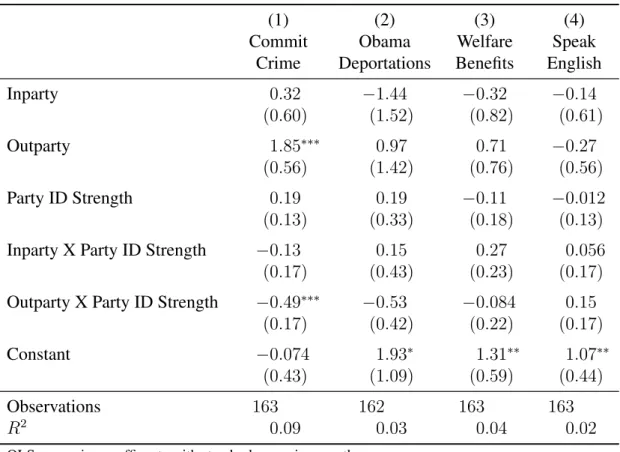
mispercep-tions about the criminality of immigrants (p < 0.01) on the scale by about 1.85 points on average. This result initally appears to run counter to my expectations.
Table 3:Effect of Party Cues and Party Identity Strength on Factual Beliefs
(1) (2) (3) (4)
Commit Obama Welfare Speak
Crime Deportations Benefits English
Inparty 0.32 −1.44 −0.32 −0.14
(0.60) (1.52) (0.82) (0.61)
Outparty 1.85∗∗∗ 0.97 0.71 −0.27
(0.56) (1.42) (0.76) (0.56)
Party ID Strength 0.19 0.19 −0.11 −0.012
(0.13) (0.33) (0.18) (0.13)
Inparty X Party ID Strength −0.13 0.15 0.27 0.056
(0.17) (0.43) (0.23) (0.17)
Outparty X Party ID Strength −0.49∗∗∗ −0.53 −0.084 0.15
(0.17) (0.42) (0.22) (0.17)
Constant −0.074 1.93∗ 1.31∗∗ 1.07∗∗
(0.43) (1.09) (0.59) (0.44)
Observations 163 162 163 163
R2 0.09 0.03 0.04 0.02
OLS regression coefficents with standard errors in parentheses.
∗p <0.10,∗∗p <0.05,∗∗∗p < .01
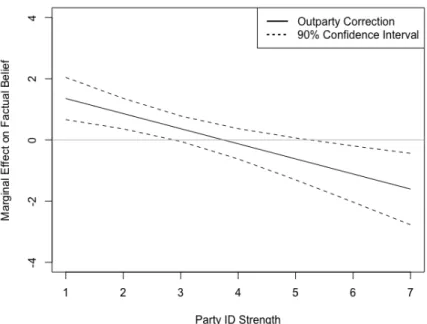
However, as stated earlier, my first hypothesis is that strengthof party identity should be a mediating variable between source cues and changes in beliefs. The interaction term in Model 1 between outparty and identity strength is significant at the p < 0.01 level, suggesting the effect of the source cue does vary by identity strength. Since interaction terms can be difficult to interpret, I have plot the estimated marginal effect of the correction from Model 1 and the 90% confidence interval over the range of party identity strength in Figure 1.
them-Fig. 1:Effect of Outparty Correction on Beliefs about Immigrants and Crime
Estimated marginal effect by strength of party identity. Higher values of party identity strength indicate greater party attachment. Positive values on the y-axis signify change in factual beliefs in the positive direction.
selves as having moderate identity strength. Although, for those who had weak attachment to their party, the outparty correction is statistically significant and positive. Therefore, while it would first appear that outparty members are superior correctors to inparty mem-bers, the story is much more nuanced. Strength of party identification matters, where weak partisans will be receptive to information from outparty members but for strong partisans, these corrections will backfire, strengthening misperceptions.
Fig. 2:Effect of Inparty Correction on Beliefs about Undocumented Immigrants’ Welfare Benefits
Estimated marginal effect by strength of party identity. Higher values of party identity strength indicate greater party attachment. Positive values on the y-axis signify change in factual beliefs in the positive direction.
Peer and Elite Cues
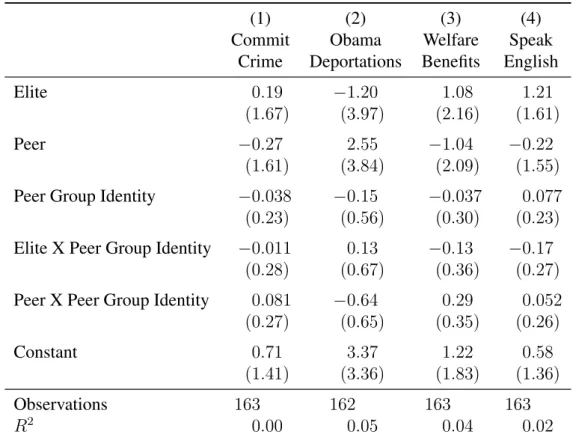
In order to test my second hypothesis, I regressed change in each of the four factual beliefs on the source cue (peer or elite) dummies and strength of peer group identity. The results of the four regression models are shown in Table 4. At first glance, no statistically significant relationships appear in the models. It is unclear why corrections from elites and peers do not elicit significantly different responses. It is possible that while party cues are able to send strong signals and have the potential to be divisive, the contrast between elites and peers does not pack quite the same punch. Another possibility is that the university community as a whole is not as meaningful as the subcommunities within it.
Table 4:Effect of Peer/Elite Cues and Peer Group Identity on Factual Beliefs
(1) (2) (3) (4)
Commit Obama Welfare Speak
Crime Deportations Benefits English
Elite 0.19 −1.20 1.08 1.21
(1.67) (3.97) (2.16) (1.61)
Peer −0.27 2.55 −1.04 −0.22
(1.61) (3.84) (2.09) (1.55)
Peer Group Identity −0.038 −0.15 −0.037 0.077 (0.23) (0.56) (0.30) (0.23)
Elite X Peer Group Identity −0.011 0.13 −0.13 −0.17 (0.28) (0.67) (0.36) (0.27)
Peer X Peer Group Identity 0.081 −0.64 0.29 0.052 (0.27) (0.65) (0.35) (0.26)
Constant 0.71 3.37 1.22 0.58
(1.41) (3.36) (1.83) (1.36)
Observations 163 162 163 163
R2 0.00 0.05 0.04 0.02
OLS regression coefficients with standard errors in parentheses.
∗p <0.10,∗∗p <0.05,∗∗∗p < .01
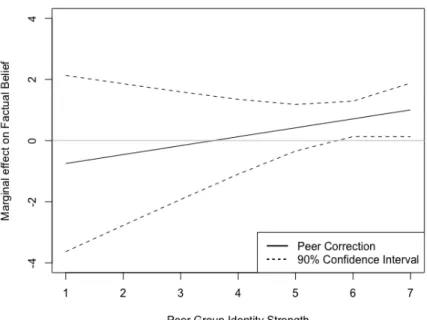
Fig. 3:Effect of Peer Correction on Beliefs about Undocumented Immigrants’ Welfare Benefits
Estimated marginal effect by strength of peer group identity. Higher values of peer identity strength indicate greater attachment to peer group. Positive values on the y-axis signify change in factual beliefs in the accurate direction.
Institutional Trust and Source Cues
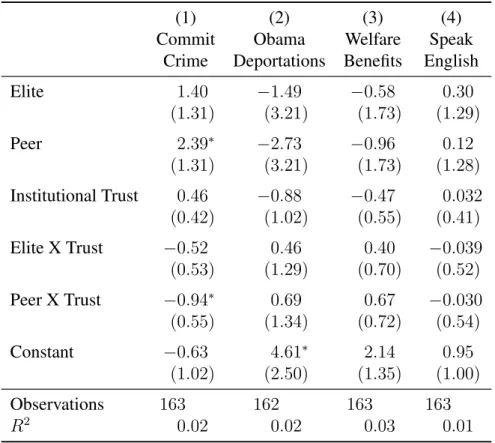
To test my final hypothesis that peers are especially successful correctors among those with low levels of institutional trust, I regressed the same four dependent variables on elite/peer dummy variables, interacting them with institutional trust. The results of the four models, shown in Table 5, indicate there are no significant relationships between institu-tional trust and peer/elite source cues on changes in factual beliefs with one exception. For the first model, the interaction term between peer cue and trust is significant at thep < 0.10
Table 5:Effect of Peer/Elite Cues and Institutional Trust on Factual Beliefs
(1) (2) (3) (4)
Commit Obama Welfare Speak
Crime Deportations Benefits English
Elite 1.40 −1.49 −0.58 0.30
(1.31) (3.21) (1.73) (1.29)
Peer 2.39∗ −2.73 −0.96 0.12
(1.31) (3.21) (1.73) (1.28)
Institutional Trust 0.46 −0.88 −0.47 0.032 (0.42) (1.02) (0.55) (0.41)
Elite X Trust −0.52 0.46 0.40 −0.039 (0.53) (1.29) (0.70) (0.52)
Peer X Trust −0.94∗ 0.69 0.67 −0.030 (0.55) (1.34) (0.72) (0.54)
Constant −0.63 4.61∗ 2.14 0.95
(1.02) (2.50) (1.35) (1.00)
Observations 163 162 163 163
R2 0.02 0.02 0.03 0.01
OLS regression coefficients with standard errors in parentheses.
∗p <0.10,∗∗p <0.05,∗∗∗p < .01
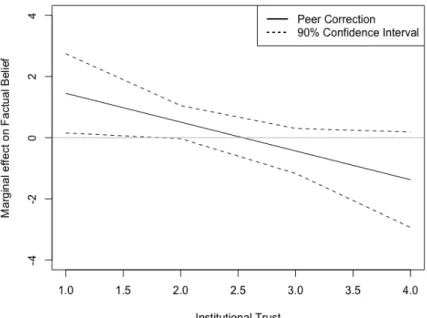
To illustrate this interactive relationship, the estimated marginal effect of the peer cor-rection and the 90% confidence interval over the range of institutional trust in shown in Figure 4. In line with my expectations, for individuals with low levels of institutional trust (less than 2 on a 4-point scale), peer corrections had a positive and significant marginal effect, moving subjects’ factual beliefs about welfare in the accurate direction.
Fig. 4:Effect of Peer Correction and Institutional Trust on Beliefs about Immigrants and Crime
Estimated marginal effect by strength of peer group identity. Higher values of institutional trust signify greater reported trust. Positive values on the y-axis signify change in beliefs in the accurate direction.
Follow-Up Survey
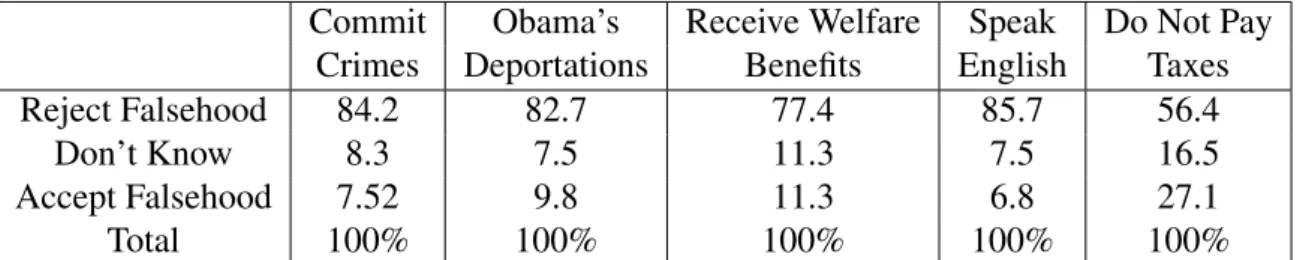
Lastly, a follow-up survey was distributed in order to determine if the power of correc-tions held up over time. A simple illustration of the percent of those in the second wave who accept, reject or were unsure about each item is shown in Table 6. Overall, the distri-butions in Table 6 are fairly similar to those observed following the corrections in the first wave (Table 2) with a couple of standout exceptions. First, there was about a 15% jump in those who reported that the Obama administration had a record number of deportations6 from the first wave to the second wave. In other words, subjects were more likely to an-swer correctly a week after the experiment than directly following it. It is unclear why this is, but it is possible that some subjects were skeptical of the article during the experiment, but encountered confirmatory information before taking the follow-up survey. A similar trend was found with respect to the item about undocumented immigrants paying taxes,
Table 6:Factual Beliefs: Wave Two
Commit Obama’s Receive Welfare Speak Do Not Pay Crimes Deportations Benefits English Taxes
Reject Falsehood 84.2 82.7 77.4 85.7 56.4
Don’t Know 8.3 7.5 11.3 7.5 16.5
Accept Falsehood 7.52 9.8 11.3 6.8 27.1
Total 100% 100% 100% 100% 100%
N=133. The top three rows present the percentage of respondents that rejects, accepts or is unsure about each statement about immigration in the week following the experiment. This is presented for each of the five items.
where from the first to the second wave there was a 30-point jump in the number of subjects who rejected the falsehood. Since this was the only statement that subjects were not given corrective information about, it is possible that subjects sought out the facts on their own.
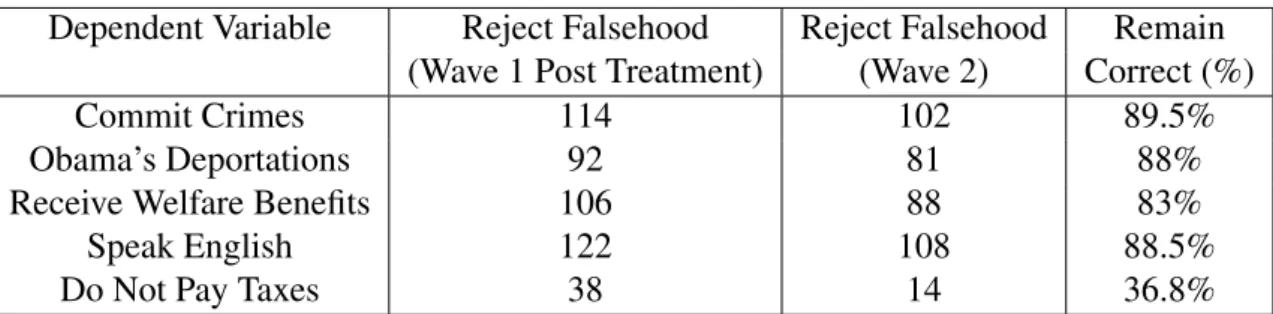
Table 7:Accurate Responses Across Two Survey Waves
Dependent Variable Reject Falsehood Reject Falsehood Remain (Wave 1 Post Treatment) (Wave 2) Correct (%)
Commit Crimes 114 102 89.5%
Obama’s Deportations 92 81 88%
Receive Welfare Benefits 106 88 83%
Speak English 122 108 88.5%
Do Not Pay Taxes 38 14 36.8%
N = 133. Remain correct was calculated by dividing the number of correct responses in the second wave by the number of correct responses in the first wave (post treatment). Correct responses in the second wave include only those who answered correctly in the first and second waves.
Discussion
The experiments in this paper help us understand how factual beliefs about politics can be changed by manipulating the source of the corrections. I find that responses to corrections from peers and co-partisans differ significantly according to subjects’ group identity and trust in institutions. As a result, the corrections about immigration are most successful among those that strongly identify with the group the source is a member of, whether a co-partisan or peer.
My findings contribute to the literature on correcting misperceptions in several respects. First, while prior corrections research has exclusively used a between-subjects design to circumvent the possibility that people feel grounded in their responses before receiving correction to after (Nyhan & Reifler, 2010), this study employed a within-subjects design in order to establish how subjects actuallychangetheir factual beliefs. Indeed, my findings demonstrate that substantial movement in reported factual beliefs does happen following corrections and that these beliefs typically hold over time.
members. Therefore, while the literature on the impact of ideological source cues on cor-recting misperceptions has offered inconsistent findings (Nyhan and Reifler 2013; Berinsky 2015), the results in this paper demonstrate that not all Republicans and Democrats respond uniformly to corrections—strength of group identification matters. While I theorize that perceived credibility of ingroup and outgroup members is the causal mechanism at work, it would be valuable to directly study how individuals evaluate various sources on key char-acteristics (trustworthiness, knowledge, etc.,). This would allow social scientists to gain a better understanding of specifically why certain sources are successful and others are not.
While research on source cues in political science has largely focused on partisan cues, these findings also contribute to our understanding of how voters respond to information from elites and peers. In accordance with my expectations, I find some evidence that peers are more successful correctors than elites, especially among those who strongly identify with their peer group and among those have weak trust in institutions. These findings add to existing work (Attwell and Freeman 2015) seeking to understand how social groups can promote accuracy in cases when experts or elites appear ineffective. Future work should further explore how voters evaluate the credibility of elites and peers differently, and what other individual-level factors might explain why certain people are more receptive to polit-ical information from peers than elites. It would also be valuable to replicate these findings on peer groups other than university students or use real peers that are not fabricated. Lastly, while peer cues in this experiment did not have the substantial impact on factual beliefs that were expected across all four statements, they should not be concluded as irrelevant. Walsh (2004) illustrates the importance of face-to-face interactions among small peer groups in political thinking. It is possible that factual corrections in the context of these sort of peer interactions are effective, and scholars should aim to understand the significance of such interactions in the real world.
of beliefs and actual confidence in beliefs. For example, it could be possible that a peer correction could just make subjects more confident in their already (correct) beliefs, and not actually encourage a switch from acceptance to rejection of a false statement. Subsequent studies should unpack these distinctions.
APPENDIX
Appendix A: Treatment
Understanding the Realities of Immigration — (Author)
Many Americans are simply misinformed about immigration in this country. Such mis-understandings have turned our political discourse over immigration into a battle of false-hoods. To have a civil debate about both legal and illegal immigration in the U.S., we all must be on the same playing field when it comes to the facts.
For example, I consistently hear that undocumented immigrants are able to receive gov-ernment benefits created for citizens. But the fact is that the under the Personal Respon-sibility and Work Opportunity Reconciliation Act of 1996, undocumented immigrants are prohibited from receiving such benefits, including: welfare, food stamps, unemployment or disability compensation, public housing, and non-emergency health coverage.
Also, I often hear that a vast majority of immigrants do not learn to speak English. This simply is not true: only seven percent of second generation Latinos use Spanish as their main language. Likewise, some claim that immigrants are more likely to become criminals than native-born citizens. But, numerous researchers have found that immigrants are much less likely to commit crimes and be incarcerated than the average population. Lastly, some claim that under the Obama administration, immigration policies were lax and deportations declined. This was not the case. President Obama carried out more deportations than previous presidents, setting a record of more than 2.4 million formal removals.
Appendix B: Question Wording of the Dependent Variable
Undocumented immigrants are able to receive government welfare benefits like food stamps and housing benefits.
Appendix C: Frequency Distribution of Survey Responses
Fig. 5:Frequency Distribution of Responses Pre and Post Treatment
REFERENCES
Attwell, Katie and Melanie Freeman. 2015. “I Immunise: An evaluation of a values-based campaign to change attitudes and beliefs.”Vaccine33(46):6235–6240.
Bartels, Larry M. 2002. “Beyond the running tally: Partisan bias in political perceptions.” Political Behavior24(2):117–150.
Berinsky, Adam J. 2007. “Assuming the costs of war: Events, elites, and American public support for military conflict.”Journal of Politics69(4):975–997.
Berinsky, Adam J. 2015. “Rumors and health care reform: experiments in political misin-formation.”British Journal of Political Sciencepp. 1–22.
Brewer, Marilynn B. 1997. “The social psychology of intergroup relations: can research inform practice?”Journal of Social Issues53(1):197–211.
Bullock, John G, Alan S Gerber and J Seth. 2015. “Partisan Bias in Factual Beliefs about Politics.”Quarterly Journal of Political Science10(4).
Citrin, Jack, Amy Lerman, Michael Murakami and Kathryn Pearson. 2007. “Testing Hunt-ington: Is Hispanic immigration a threat to American identity?”Perspectives on Politics 5(01):31–48.
Conover, Pamela Johnston. 1988. “The role of social groups in political thinking.”British Journal of Political Science18(1):51–76.
Delli Carpini, Michael X and Scott Keeter. 1996. What Americans know about politics and why it matters. Yale University Press.
Druckman, James. 2001. “On the limits of framing effects: Who can frame?” Journal of Politics63(4):1041–1066.
Druckman, James and Cindy Kam. 2011. “Students as Experimental Participants: A De-fense of the Narrow Data Base.”Cambridge Handbook of Experimental Political Science pp. 41–57.
Flynn, DJ. N.d. “The Scope and Correlates of Political Misperceptions in the Mass Public.” . Forthcoming.
Flynn, DJ, Brendan Nyhan and Jason Reifler. 2016. “The Nature and Origins of Misper-ceptions: Understanding False and Unsupported Beliefs about Politics.”Advances in Pol. Psych.
Gaines, Brian J, James H Kuklinski, Paul J Quirk, Buddy Peyton and Jay Verkuilen. 2007. “Same facts, different interpretations: Partisan motivation and opinion on Iraq.”Journal of Politics69(4):957–974.
Gerber, Alan S, Gregory A Huber, Daniel R Biggers and David J Hendry. 2017. “Self-Interest, Beliefs, and Policy Opinions: Understanding How Economic Beliefs Affect Immigration Policy Preferences.”Political Research Quarterly70(1):155–171.
Gerber, Alan S and Todd Rogers. 2009. “Descriptive social norms and motivation to vote: Everybody’s voting and so should you.”Journal of Politics71(1):178–191.
Green, Donald P, Bradley Palmquist and Eric Schickler. 2004. Partisan hearts and minds: Political parties and the social identities of voters. Yale University Press.
Hartman, Todd K and Christopher R Weber. 2009. “Who said what? The effects of source cues in issue frames.”Political Behavior31(4):537–558.
Hendriks, Friederike, Dorothe Kienhues and Rainer Bromme. 2015. “Measuring laypeoples trust in experts in a digital age: The Muenster Epistemic Trustworthiness Inventory.”PloS one10(10):13–93.
Hetherington, Marc and Cindy Kam. N.d. “Institutional Cue-giving and persuasion: Enlist-ing the military as an enviornmental protector.”.
Hochschild, Jennifer L and Katherine Levine Einstein. 2015. “Do facts matter? Information and misinformation in American politics.”Political Science Quarterly130(4):585–624.
Hopkins, Daniel J, John Sides and Jack Citrin. 2016. “The muted consequences of correct information about immigration.”.
Klar, Samara. 2014. “Partisanship in a social setting.”American Journal of Political Science 58(3):687–704.
Kuklinski, James H, Paul J Quirk, Jennifer Jerit, David Schwieder and Robert F Rich. 2000. “Misinformation and the currency of democratic citizenship.”Journal of Politics 62(3):790–816.
Lawrence, Eric D and John Sides. 2014. “The consequences of political innumeracy.” Research & Politics1(2):1–8.
Lupia, Arthur and Mathew D McCubbins. 1998. The democratic dilemma: Can citizens learn what they need to know? Cambridge University Press.
Naef, Michael and Jurgen Schupp. 2009. “Measuring Trust: Experiments and Surveys in Contrast and Combination.”SOEP Working paper 167, DIW Berlin.
Nyhan, Brendan. 2011. “The limited effects of testimony on political persuasion.”Public Choice148(3-4):283–312.
Nyhan, Brendan and Jason Reifler. 2010. “When corrections fail: The persistence of polit-ical misperceptions.”Political Behavior32(2):303–330.
Nyhan, Brendan and Jason Reifler. 2013. “Which Corrections Work? Research results and practice recommendations.”New America Foundation Media Policy Initiative Research Paper.
Petrocik, John Richard. 2009. “Measuring party support: Leaners are not independents.” Electoral Studies28(4):562–572.
Popkin, Samuel L. 1995. “Information shortcuts and the reasoning voter.” Information, participation and choice: An economic theory of democracy in perspectivepp. 17–35.
Schopler, John and Chester A Insko. 1992. “The discontinuity effect in interpersonal and intergroup relations: Generality and mediation.”European Review of Social Psychology 3(1):121–151.
Taber, Charles S and Milton Lodge. 2006. “Motivated skepticism in the evaluation of political beliefs.”American Journal of Political Science50(3):755–769.
Tajfel, H and JC Turner. 1986. “The social identity theory of intergroup behavior.” The Psychology of Intergroup Relations.
Thorson, Emily. 2017. “Identifying and Correcting Policy Misperceptions.” Presented at Midwest Political Science Conference, Chicago, IL. April 8, 2017..
Walsh, Katherine Cramer. 2004.Talking about politics: Informal groups and social identity in American life. University of Chicago Press.
Weeks, Brian. 2015. “Emotions, partisanship, and misperceptions: How anger and anxiety moderate the effect of partisan bias on susceptibility to political misinformation.”Journal of Communication65(4):699–719.