Review Article
A review of significant aspects contributing to curriculum development
Savita Rajurkar
1, Kalidas D. Chavan
2*, Sushil G. Kachewar
3, Purushottam A. Giri
4INTRODUCTION
Curriculum may be perceived presently as a foundation of the broader area known as education. The history of curriculum development has been characterized and a series of crises with the pendulum shifting between traditionalists’ call for getting back to the basics and progressives’ focus on the learner.1 While commissioning
curriculum development (CD), definition of curriculum and development have their own strategic accountabilities. It may be reasonable to explore various perspectives of definition of curriculum. It is consequential before the execution of the task of
development of curriculum for the curriculum developer to assess the concerned needs, define and refine the concept of education.2 In fact a research would be
encouraged for the single simple answer to the straight forward description of these terminologies which would indicate their orientation and outcomes.
Medical subject headings of electronic databases and internet search engines PubMed, PubMed central, Google scholar, Medknow, Science direct and textbooks until 2017 were searched as review materials. Authentic literatures on the curriculum development in the form of research papers, reports, books published were retrieved.
1Chair, Lead faculty, Research Investigator, (Helfgott Reserach Institute) Ayurved Program, National University of
Natural Medicine, USA
2Registrar, Maharashtra University of Health Sciences (MUHS), Nashik, Maharashtra, India
3Department of Radio-diagnosis, Dr. Vitthalrao Vikhe Patil Foundation’s Medical College, Ahmednagar, Maharashtra,
India
4Department of Community Medicine, IIMSR Medical College, Badnapur, Jalna, Maharashtra, India
Received:14 December 2018
Accepted: 18 December 2018
*Correspondence:
Dr. Kalidas D. Chavan,
E-mail: [email protected]
Copyright: © the author(s), publisher and licensee Medip Academy. This is an open-access article distributed under the terms of the Creative Commons Attribution Non-Commercial License, which permits unrestricted non-commercial use, distribution, and reproduction in any medium, provided the original work is properly cited.
ABSTRACT
Curriculum is an essentially signified foundation of an academic arena. The master key of the treasure curriculum is anchored in its development. The basic and progressive aspects are the prominent spectrums of curriculum in navigating the stakeholders. Empowerment of curriculum by augmenting its development has been a topic of ongoing discussion in the enrichment of the educational field. By reviewing selected past and present relevant articles, this review article is aimed to provoke and fortify insights for the due perfection, systematization, and standardization in the futuristic aspects towards curriculum development. This is a sincere effort to present the versatile role of the concept of curriculum development and validate its significant aspects by keeping the various stakeholders in mind. It is hoped that this article would help motivate elder and newer generations of curriculum developers, academicians and researchers for expounding the process, for recognizing the intrinsic and upcoming challenges in the field of curriculum development for recognizing needs to refresh, update technology and upgrade pedagogics, for standardizing curriculum at the global application and for instigating an urge to research various aspects of this topic to bring in the due change, advancement and standardization.
Keywords: Curriculum, Curriculum development, Curriculum developers, Education
The key words used for the literature search included curriculum and curriculum development. A total twenty-five relevant authentic articles were identified. After examining the abstracts, contents, and subject matter, the significant nineteen articles were considered for this review.
Aspects Significant to the Consideration of Curriculum and Curriculum Development and the needs of the Curriculum, the experiences of learning have been emphasized for any curriculum.3,4 To provide proper
learning experience, those involved in CD process should pay attention to what students need and to what attracts and engages them in learning.5
Propitious educational experiences constitute to making students passionate learners. Hence an appropriate planning of objectives and strategies of teaching and outcomes of learning are the prerequisites. The common need for all the CD models is identified and it states that the subject, the students and the society should be taken into consideration. Proper philosophy at macro, meso, and micro levels is therefore needed for CD.6
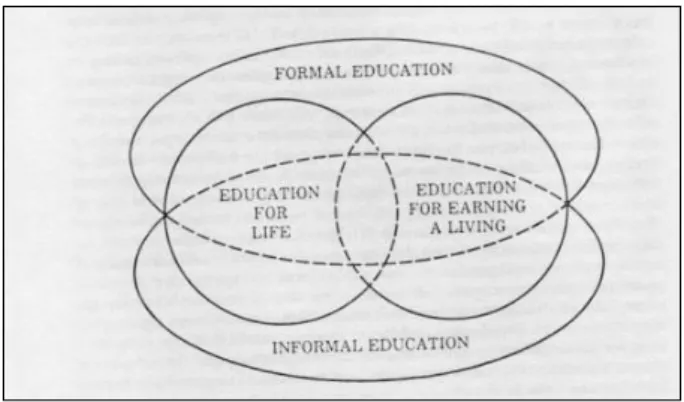
Contemporary Paradigm of Education, in summarizing the contemporary paradigm of education, it reflects that the education comprises of two basic elements, viz. Formal education and informal education. Formal is the one that occurs in a more structured setting. Completing organizational activities as a career oriented planned educative process within outlined intentions, premises, recognition and monetary involvement, can be representatives of this element. Informal education often called as non-formal education and involves the aspects of education typically not part of the planned educative process.
Central to this element is that education extends beyond four walls of premises and educator’s directions. Part-time voluntary activities can be its examples. In both the spheres of formal and informal, education encompasses a great portion of one’s life and the extent of one’s participation tends to correspond to their capability to perform various roles in real life.7 Superimposed on the
formal and informal elements are the two categories contributing to the broad goals of education. The two types of education may be referred to as an education for life and education for earning a living.
Whether the experience is preparation for life or for earning a living, education may be provided through formal or informal means. The informal education serves as an important contributor to the outcomes of education. Kelly’s model of curriculum types includes formal and informal curriculum which reflects these elements are significant to curriculum.8
With reference to Figure 1, authors have taken forward the conceptual understanding of education to the definition of curriculum. The description represents a vast
array of teach which not merely specific class sessions are or courses but extend to or through the entire educational spectrum of a particular school or schools. Within this context, curriculum may be perceived as being rather global in nature.
Figure 1: Conceptual understanding of education.
Thus, curriculum may be defined as the sum of the learning activities and experiences that a student has under the auspices or direction of the school. Acceptance of this generic definition commits the curriculum developer to accept two additional supporting concepts, viz. the central focus of the curriculum is the student and the breadth of learning experiences and activities associated with a curriculum.
Accepting the foregoing implies that we must consider a curriculum as encompassing general (academic) education as well as career and technical education. The concepts also support the notion that a curriculum should focus on developing the whole person.
It is not enough to have the curriculum include courses and experiences that are exclusively related to career and technical education. General studies are clearly a part of every curriculum as they serve to provide the student with a broad knowledge base both for life and for earning a living. Likewise, the curriculum builder must keep in mind how general and career and technical studies are intertwined.
Thus, as the curriculum is being designed and implemented, consideration must be given to how these two content areas may be closely integrated rather than segregated from each other.7
Defining Curriculum, Curriculum Development, Instruction and Instructional Development
experiences. More specifically, instruction may be perceived as the planned interaction between instructors and students. Curriculum development focuses primarily on content and areas related to it. It encompasses the macro or broadly-based activities that impact on a wide range of programs, courses, and student experiences. In fact, the curriculum should define the institution's mission and goals.
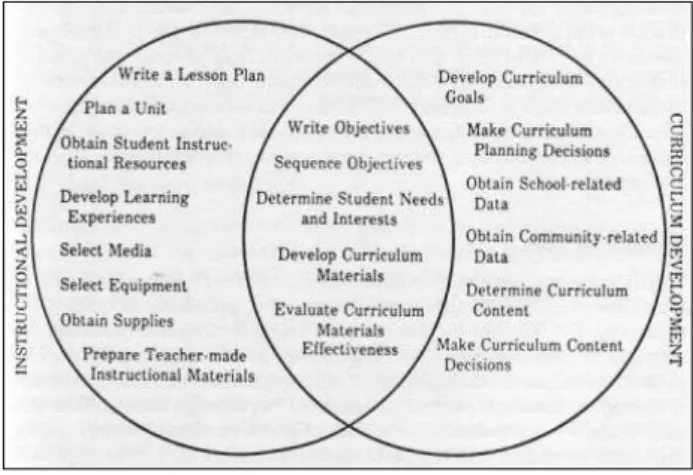
Curriculum activities are typically conducted prior to and at a higher level than instructional development. In contrast, instructional development is mere of a micro activity that builds curriculum development through planning for and preparation of specific learning experiences within courses.7
Figure 2: Possible shared and unique aspects of instructional and curriculum development.
Figure 2 provided a visual description of possible shared unique areas associated with instructional development and curriculum development. Although each area focuses on several rather unique concerns, many aspects of development could be classed as either curriculum or instruction. The shared aspects of curriculum and instructional development sometimes become unique to one area or the other based on the person or persons involved in the development process as well as those who will eventually benefit from this development.
The distinguishing differences between these two areas become the scope of the development process and the extent of generalizability. If the development process involves several professionals and the product of this effort will be usable by several the processes, then it is more correctly termed as curriculum development. Instructional development is best viewed as usually involving one professional (typically an instructor) in the process of preparing for his or her own classes.
Although the distinctions between curriculum development and instructional development are not as clear as many would like them to be, they serve well to identify each process. In any field of higher education, all would agree that curriculum implies a lot more than
merely the subjects that are taught.8 So it is important to
know what is being taught and to what end it is being taught i.e. the target of this teaching should also be clear. Hence what is to be taught depends much on what result is to be expected from this exercise. Curriculum therefore is a blueprint for learning created keeping in minds the expected outcomes by the deciding authority.
Curriculum is a roadmap describing about various learning activities focused on measurable outcomes that are aimed to be undertaken by students who can then be tested by proper methods to document whether the intended result is achieved or not.9
Current scenario and working model of curriculum development shows some difference from its original meaning. In the seminal text, Franklin Bobbitt offers two definitions for curriculum:
• It is the entire range of experience, both undirected and directed, concerned in unfolding the abilities of the individual,
• It is the series of consciously directed training experiences that the schools use for completing and perfecting the unfoldment.” Bobbitt ex-plains, our profession uses the term usually in the latter sense.8
More recently, the field of curriculum development (or simply curriculum) has been broadened to include investigations into the former definition, focusing on the hidden curriculum (i.e. implicit lessons that students receive during their educational experience). Thus, contemporary studies in the curriculum often analyze the school experience in terms of gender, race, or politics, just to name a few. Phillip Jackson describes within the single tradition of curriculum specialist as advice giver to practitioners.8
Eisner EW elaborates three types of curriculum.10
• Explicit curriculum-as suggested by the name, it includes a well-designed master plan that is made public and can be implemented at local, regional, national or even universal level. This plan has properly framed learning objectives and describes the topics to be taught under different subjects, specifies the people who would be teaching it, the materials that they would be using and ways in which the effectiveness will be tested so that a conclusion can be made whether the intended change has been brought or not. Curriculum in schools or colleges falls in this category.
• The Null curriculum simply means the curriculum that is not taught. It is interesting to note that even after careful planning and implementation, there will always be some aspects of a specific topic which would not be covered due to whatever reason and these then fall under null curriculum.
The earlier discussion of elements of education, viz. formal and informal, is clearly expected to get incorporated in curriculum. Kelly divides curriculum into seven types: the formal curriculum, the informal curriculum, the planned curriculum, the received curriculum, the educational curriculum, the total curriculum and the hidden curriculum (Figure 3, 4).11
Figure 3: Types of curriculum elaborated by Eisner.
Figure 4: Types of curriculum stated by Kelly.
The three pillars of CD are planning, conducting and evaluation. Irrespective of traditional or contemporary classification of curriculum, CD mainly concentrates on the type of knowledge to be transferred, exact depth of knowledge, what would be the appropriate skills and qualifications expected in the teachers as well as learners as pre-requisites for receiving it and hence what needs to be taught and appropriate means and strategies to teach and assess them. Thus, it is not merely an act of teaching but involves a whole set of careful planning, thorough designing and perfect implementation.12 Richards has
therefore put forth six essential steps of curriculum development:
• Needs analysis, • Goal setting, • Syllabus design, • Methodology, • Testing, • Evaluation.
As shown in this model the goals occupy the central place due to their highest significance. The work done under the umbrella of goals needs to be properly evaluated to identify the success of any curriculum. Therefore, circle or boundary of evaluation is drawn around various activities under CD. Components of CD have been summed up by Brown JD as needs analysis, objectives, testing, materials, teaching and evaluation.13 These are
almost similar to the ones put forth by Richards and can be expressed diagrammatically (Figure 5).
Macalister and Nation proposed a different CD module that has one inner and three outer circle, three sub-circles exist within the inner circle (Figure 6).14
Figure 5: Brown`s model for systematic approach for curriculum designing.
Figure 6: Macalister and Nation`s model of the parts of the curriculum design process.
However, it is often observed that evaluation happens to be the most neglected component of any CD. After reviewing various models of curriculum and its influencing factors, a brief outline of the process of CD is enumerated below. Curriculum development is a dynamic process. Ten steps are described which need to be Types of
curriculum elaborated by Eisner
Explicit curriculum
Null curriculum Implicit curriculum
Types of curriculum stated by Kelly Formal Informal
Plannned
Recieved Total
followed by curriculum developers. They can be summarized as:
• Finalize the aims of a given subject curriculum. Assess the efforts required and resources provided by concerned department to achieve these.15
• Select appropriate model in accordance with educational philosophy for CD.
• Provide rationale for the approved plan and emphasize the relevance of subject or curriculum unit for the learners.3
• Enlist goals of CD preferably in alignment with those of the geopolitical scenario.
• Identify the needs of the curriculum with special emphasis on the needs of the students, society, and the subject is a must.15
• Finalize the instructional goals i.e. targets and the instructional objectives i.e. behavior or outcome that is expected to at the end of course.3
• Recognize, plan and recruit various approaches and strategies for instruction. These should ensure meaningful learning.3
• Conduct adequate and periodic assessment of the instruction using various available tests.3
• Regular curriculum evaluation needs to be done as education is a dynamic process. One way to do this is by assessing the results of various tests.16
• If the evaluation indicates or when there is a demand of new changes then rebuilding curriculum is recommended not only for the classroom needs, but also for the institutional needs. The national needs also must be kept in mind.3
After an overview of significant aspects of CD and its various components and models, let us now explore how this process is affected by different stake holders. Social acceptance of curriculum is vital to education. Students, their parents, their recruiters are the key members to enhance curriculum acceptance in the community. Numerous geopolitical forces influence CD across the world.
In any given location, CD is immensely influenced by the attitude and upbringing of the dominant section of society in that region. In the present century, diversity of population and participants in the program, cosmopolitan culture, spiritual practices and dominant religion strongly influence CD.17 Philosophical ideologies that run-in
societies reflect impacts on the CD.3
Those who are a bit conservative (essentialists) are keen to bring CD within the framework of their cultural heritage while modernists (progressives) would like to sum up not only the social but also the existent and emerging political and economic concepts to shape the CD. To get accepted in the mainstream, the CD may pretend to be woven around the local culture so that it can be internalized.18 Standard of education is intrinsic to the
curriculum development. Since curriculum is considered as the foundation of the empire of education, the
curriculum needs to fulfil the expectations of education to meet the standards set for the education at various levels like institutional, national, international.
Availability of proper students, availability of subject specialists, availability of school with the strong philosophy, co-existent psychology of learning amongst students and teachers and the enthusiastic initiative of teachers themselves influence CD.3
Regarding the standard of education, the method of education is perceived. All around the globe there has always been a tussle between the traditional and progressive education. In traditional method, student was completely submissive, obedient and passive as it was believed that what was being taught was the only thing that mattered so that all should be alike in skills and knowledge. This method ensured that the same system continues perpetually without any questions. In contrast, progressive education enables students to be independent to develop their own new skills day by day.4
In this system not only, the teachers imparted knowledge but the students too shared new areas that they explored. This newly acquired knowledge is processed by mind and organized in different complexity level to bring internal change in the student called as cognitivism. Thus, new knowledge is built upon previous knowledge called as restructuring and reconstructing process.12 Thus,
whatever preexistent knowledge and beliefs are there in an individual, it interacts with new knowledge and beliefs under the ambit of every day interactions and thereby leads to constructivism of the learner.19
At the macro level, the CD standard and plan are finalized as per guidelines by ministry of education. The state, district and towns educational authorities are at meson level and teachers, principals and deans are at the micro level. Each one has a voice as per the power and accountability they possess.
CONCLUSION
Curriculum is a foundation of a broader arena of education which should focus on developing the whole person. Therefore, curriculum development is an embodiment of its standards which can be extended from an interpersonal, institutional, to the social, national and international levels. Curriculum development is a modus operand for the elements of education. Subject, students, and society being the needs of curriculum, standard of education, society, and decision makers show remarkable impact on CD.
conceptual understanding of needs of curriculum, definition of education, its elements, definitions of curriculum, instruction, instructional development and curriculum development, essential steps to CD, types, pillars and process of CD, influences of society, standard of education, and decision makers on CD and elucidate the geopolitical forces, social and national needs catered by their outcomes and the vision of decision makers which may set up the harmony amongst all the stakeholders. In nutshell, CD is a dedicated process that needs to be deployed at different levels and requires thorough understanding about the significant aspects of the CD. Moreover, it is a dedicated duty and moral responsibility jointly to be shared by all the stakeholders.
Funding: No funding sources Conflict of interest: None declared Ethical approval: Not required
REFERENCES
1. Plate R. The evolution of curriculum development in the context of increasing social and environmental complexity. Creative Education. 2012;3(08):1311.
2. NAU. UCC. Curriculum development: an overview, 2017. Available at: http://oak.ucc.nau.edu/mr/cte592/module_1/curricul um_development_an_overview.html. Accessed on 18 March 2018.
3. Tyler RW. Basic principles of curriculum and instruction. In: Flinders DJ, Thornton SJ, eds. Curriculum Studies Reader. 2nd ed. Routledge;
2013:60-68.
4. Dewey J, eds. Experience and Education. New York: Touchstone; 1997.
5. Seaman J, Nelsen PJ. An overburdened term: dewey's concept of “experience” as curriculum theory. Education and Culture. 2011;27(1):5-25. 6. Oliva PF, eds. Developing the Curriculum. 6th ed.
Boston: Pearson; 2005.
7. Wiggins GP, and McTighe J, eds. Understanding by Design. Virginia: ASCD; 2006.
8. Granell CG, Salvador CC. When we talk about constructivism. J of Pedagogy. 1994;221:8-10. 9. Finch CR, Crunkilton JR. Curriculum development
in career and technical education. 1999;3-22.
10. Eisner EW. The educational imagination: on the design and evaluation of educational programs. New York, NY: Macmillan. 1979;1985(1994):2002. 11. Kelly AV, eds. The curriculum: theory and practice.
Sage; 2009.
12. Richards JC, eds. Curriculum development in language teaching. Ernst Klett Sprachen; 2001. 13. Brown JD. The elements of language curriculum: A
systematic approach to program development. Heinle & Heinle Publishers, 20 Park Plaza, Boston, MA 02116.; 1995.
14. Nation IS, Macalister J. Language curriculum design. Routledge; 2009.
15. Kurasha P, Chabaya RA. Curriculum development and implementation: factors contributing towards curriculum development in Zimbabwe higher education system. Euro Social Sci Res J. 2013;1(1):55-65.
16. Hussain A, Dogar AH, Azeem M, Shakoor A. Evaluation of curriculum development process. Inter J Humanities Social Sci. 2011;1(14):263-71. 17. Barbour C and Barbour N. Education.com.
Retrieved from Pearson Allyn Bacon Prentice Hall.
Available at:
www.education.com/reference/article/forces-affect-education-twenty-first-century. Accessed 10 July 2017.
18. Aristizábal M, Calvache CL, Gloria J, Castro B, Fernández F, Lozada O, et al. Appraisal and Critical Concept of the Curriculum. J Edu Rese Netw. 2005;1:10-2. Available at: http://revista.iered.org/v1n2/pdf/maristizabal.pdf 19. Soler E. Constructivism, innovation and effective
teaching. Equinox Publishing Caracas; 2006:162.
Available at:
https://www.iberlibro.com/Constructivismo- Innovaci%C3%B3n-Ense%C3%B1anza-Efectiva-Soler-Fern%C3%A1ndez/1271579249/bd
Cite this article as: Rajurkar S, Chavan KD,