UDC: 811.111'367.3:347.78.034 DOI: 10.22190/JTESAP1704687S
THE EFFECT OF CLASSROOM GAMES
ON THE DEVELOPMENT OF SYNTACTIC STRUCTURES
Malavika Sharma Pillai College of Engineering, India Phone: 9821771141, E-Mail: [email protected]
Abstract. Motivating students to write is a major concern for language teachers. It is observed that the undergraduate students of Engineering tend to ignore this skill. With the growth of technology, the importance assigned to this skill has further weakened. Writing is limited to attempting examination questions, and evaluators assess the answers from the perspective of the acquisition of technical concepts and most often overlook the linguistic incompetence of the student. It is obvious that as second language learners of English, technical students have very little exposure to the English language and specifically to the skill of writing. In an attempt to develop appropriate writing strategies in students, an experiment was conducted in which tasks were designed to serve as a stimulus to generate writing in the classroom. The tasks designed were in the form of games, role-play activities which engaged the learners’ interest and at the same time helped them to relax while learning. This study aims to investigate the syntactic structures students are capable of producing as a result of introducing such activities and games. Thus, these are analyzed and categorized from Entry level to Exit level of the experiment. The method of analysis of syntactic structures adopted is based on the approach of Kellogg Hunt (1969).
Key words: classroom, games, role-play activities, syntactic structures
1.INTRODUCTION
Writing is one of the important parameters to determine the development of the acquisition of language. For the second language learners of English in India, writing is an important aspect for their academic achievement as well as for their professional growth. Over the years writing has been taught through grammar (Mellon 1969; Elley 1976; Hillocks 1986a; Tsang and Wong 2000), sentence combining (O‟Hare, 1972; Faigley, 1979; and Morenburg et.al. 1978), model composition (Stein and Trabasso 1982), scales or guided revision, (Sager, 1973; Coleman, 1982), inquiry (Hillocks 1979, 1982; Troyka 1987) and free writing (Ganong, 1975; Gauntlett, 1978). The most important aspect in teaching writing is what the teacher intends to test and what aspects the teacher expects to improve in the learners‟ writing. Teachers tend to focus on different aspects of second language learner‟s competencies and teach them in ways that would help learners acquire that competency (Cumming, 2001; Hyland, 2002). Testing the learner‟s syntactic complexity has been one of the major areas for measuring the writing competency. The following section highlights the review in the area of syntactic complexity as one of the indexes to measure writing proficiency.
Submitted August 10
2.LITERATURE REVIEW
Lourdes Ortega (2003) defines syntactic complexity as “the range of forms that surface in language production and the degree of sophistication of such forms”. Testing writing competency in terms of analyzing the syntactic complexity of students in writing compositions was initiated by Kellogg Hunt (1965) whose concept of minimal terminal units or „T‟ units is based on Chomsky‟s manifestation of the innate structure. Hunt terms this as a simple sentence. In his study, Hunt used the T-unit as the main measuring device to examine the syntactic development in the free writing of his subjects. The findings reveal that English-speaking children learn to use larger number of sentence-combining transformations per main clause in their writing. Hunt‟s concept was further used by O‟Donnell, Griffin and Norris (1967), Mellon, (1969),; O‟Hare, (1973); Combs, (1976); Daiker, et al. (1978); Morenberg,, et al. (1978), Faigley, (1979); Haswell, (1981); and Hudson, (2009). Hunt‟s study was also used as an impetus to analyse essays, poems and dialogues. Cynthia L. Hallen and Jennifer Shakespear (2002) adopted Kellogg Hunt‟s T-unit to analyse the poems of Emily Dickinson. The concept of T- unit has also been used as an important measure of testing writing proficiency in second language research (Arthur, 1979, Celce-Murcia and Santos, 1979; Perkins, 1980; Ferris and Politzer 1981; Foster & Tavakoli, 2009; Stockwell & Harrington, 2003; Ellis & Yuan, 2004; Beers & Nagy, 2009; Norrby 2007; Lu 2011; Haiyang Ai and Xiaofei Lu 2013; Wang and Slater, 2016.
Until recently this area was left unexplored in India. In 2015, Jennifer D‟Souza investigated the quality of the difference between the written performance in English of students at standard V, VI and VII in terms of T-units. The students selected for her study were “average” IQ students learning English at English medium schools in Mumbai whose mother tongue was Marathi. These students mainly used Marathi and Hindi outside school. The writing tasks assigned to these students were discursive in nature, which provided scope for the students to use a variety of grammatical rhetorical patterns. She found that there was an increase in the mean length of single clause T-units from V to VI, but not from Standard VI to VII. The study further investigated the quality of the T-units produced in standard VI in terms of complexity. It was found that students at standard VI produce T-units with adverbial clauses more often than noun clauses and adjective clauses. The aim of this paper is to take the idea of analyzing the syntactic development in terms of T-units further and explore the writing composition of the undergraduate students of Engineering. In order to test the grammatical structures acquired by the learners the researcher has devised games, role play activities to motivate the learners to write.
encourages learners to bond with others, think collectively, and focus on their goal. Games become challenging for learners as it includes the element of competition and in the process of attempting to win, they learn that hard work, concentration and dedication is necessary to accomplish success.
3.GAMES
The researcher has used a variety of games in order to develop an interest in the learners, keep them engaged in the activity as well as develop their syntactic development in writing. Such games included identifying the problem and finding solution to the given problem, an object which had to be modified, a set of pictures which had to be connected, a scene that had to be keenly observed and identified, a topic where students were expected to frame sentences to form a unified whole. These types of games were used as tools to help the learners develop their strategies of generalizations, description, analysis, narration, arguments as well as develop their fluency in writing. The same type of games was used during the course of experimentation with different data to develop the writing skill of the learners. The questions asked in the study are whether it is possible for students to improve in writing compositions when they are exposed to the target language without being conscious of learning the language? And secondly, whether it is viable to introduce games as a teaching methodology for the undergraduate students of Engineering?
4.HYPOTHESES
1. There will be a significant difference in the number of error-free T-units produced between Experimental group and Control group from the Pre-test to the Post-test. 2. Experimental group exposed to games that enable them to acquire the strategies of
generalization, description, analysis, narration and argument will produce more adverbial clauses of reason in writing in comparison with Control group.
5.METHODOLOGY
Lukmani‟s (1982) taxonomy of cognitive skills involved in reading, namely Identification, Interpretation and Analysis. The Analysis of Variance (ANOVA), a statistical test, was conducted on the results to determine whether the students of the five colleges were at the same level of English ability. The ANOVA results indicated that there was a significant difference in the levels of the students in four of the five Engineering colleges which are here called Colleges A, B, C, and D. The results of College E, however, indicated that the students were at the same level as those of College A, and thus, both colleges A and E could be used in the experiment (see Table 1).
Table 1 Comparative analysis of reading test
College A College E
N=135 Total scores Mean scores N=135 Total scores Mean scores F-value
1001 7.41 1002 7.42 0.002*
Two matched groups were needed for the study. Two hundred and twenty students were randomly chosen from the First Year of College A and E to constitute the Experimental group. Another 220 students were randomly drawn, specifically from the First Year of Engineering from College E to constitute the Control group. Because of irregularity in attendance, and in the case of some students dropping out of the course altogether, the number of students which could be used in the final analysis got reduced. Thus, the number of students in Experimental and Control Groups were reduced to 201 each.
The F value is the ratio of the two sources of variance-between-groups variance over within-group variance. If the observed value of F is equal to or larger than the critical value which is shown in the Table, it indicates that there is a difference in the two groups. Likewise, if the observed value of F is less than the critical value, it indicates that there is no difference in the groups. In Table 1 the observed value of F is 0.002, which is less than the critical value of F that is 6.85 at the .01 level of significance. It can be concluded that there is no difference in Colleges A and E.
5.1. Data analysis
The students were exposed to two hours every week of game-based learning, that is, 20 hours in all. At the end of the experiment, a writing activity was conducted for the students for the purpose of data collection. This activity was timed, unlike the other writing activities conducted in the class, where some amount of relaxation was given while completing the activities. They were given five minutes to organize their ideas before the commencement of the activity. Some of the topics given included „Favourite book‟, „Holiday trip‟, „Indian festivals‟, etc.
The data was then analysed in terms of T- units. A T- unit as seen earlier is defined as „the main clause plus subordinate clauses attached to or embedded in them‟. For the purpose of this study only those T-units were considered that were grammatically and lexically correct and free from incorrect spellings.
mean length of T-unit, and mean length of clause. The third group included the analysis of dependent clauses, coordinate phrases, subordinate phrases and complex nominals per clause produced. The fourth group consisted of the analysis of the adverbial clauses used. The specific indices are discussed in the following section. Tests in written mode were given at the beginning and end of the course dealing with the selected parameters for Experimental Group and Control Group.
5.2. The statistical test used
The Analysis of Variance test was the main statistical tool used in the comparison of mean scores. The performance of Experimental Group and Control Group were compared on the categories of grammar selected for the analysis, on the basis of their mean scores. This was done both at the pre-test and post-test. Their mean scores at the beginning of the course were compared to their mean scores at the end of the course to test the extent of their progress.
5.3. Results
Result of error-free T-units, subordinating and coordinating structures In this group the syntactic complexity indicators include:
The number of main clauses per sentence, (MC/S), The number of main clauses per T-unit, (MC/T), Dependent clauses per sentence, (DC/S), Dependent clauses per T-unit, (DC/T), T-units per sentence, (T/S),
Number of simple sentences per T-unit, (SS/T),
Number of compound sentences per T-unit, (Comp S/T), Number of complex sentences per T-unit, (CXS/T), and
The number of compound/complex sentences per T-unit (Comp/CXS/T).
The total number of words produced by Experimental Group and Control Group at the Entry and Exit point in writing was (19424 Entry, 22441 Exit) and (19421 Entry, 9069 Exit) respectively. Tables 2 and 3 show the comparison of means of Experimental Group and Control Group at the Pre- and Post-tests respectively.
Table 2 Comparison of performance of experimental and control group written language production pre-test
Subordinate and coordinate syntactic complexity
N=201 Exp. grp.
S.D N=201 Control grp.
S.D F-value
Main clauses per Sentence (MC/S) 7.05 3.35 4.46 1.84 92.62*
Dependent Clauses per Sentence (DC/S) 3.21 2.25 1.14 1.16 134.53*
Main Clauses per T-unit (MC/T) 3.58 2.6 4.24 1.83 8.70*
Dependent Clauses per T –unit (DC/T) 1.61 1.71 1.07 1.09 14.08*
T-units per Sentence (T/S) 4.73 2.66 4.50 2.04 0.97
Simple Sentences per T-unit (SS/T) 2.74 2.24 2.44 1.52 2.44
Compound sentences per T-unit (CompS/T) 0.67 0.85 0.25 0.56 33.69*
Complex sentences per T-unit (CXS/T) 1.13 1.17 0.80 0.88 15.60*
Compound/ Complex Sentences per T-unit (Comp CXS/T)
0.18 0.48 0.60 0.81 40.84*
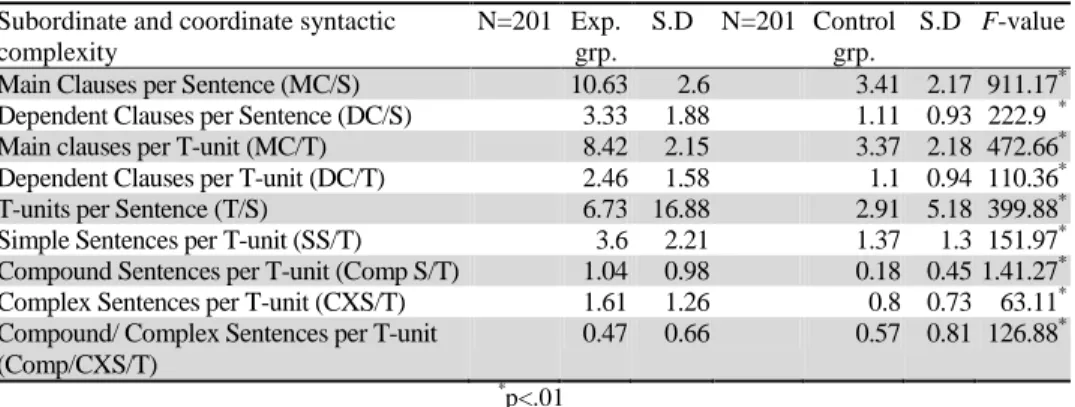
Table 2 shows that the Experimental group produced an average of 4.73 T-units and Control group produced an average of 4.50 T-units. There is no difference in the number of T-units produced in the Pre-test as indicated by the ANOVA test with an F value of 0.97 which is less than the critical value (F=6.70). A comparison of the T/S in the Post-test (Table 3) indicates that the Experimental group has shown an improvement from the Pre- to the Post-test (Mean=4.73, Pre-test, Mean=6.73, Post-test). This is not the case with Control group where the mean of T/S have dropped from 4.50 in the Pre-test to 2.91 in the Post-test.
Table 3 Performance of experimental and control group written language production post-test
Subordinate and coordinate syntactic complexity
N=201 Exp. grp.
S.D N=201 Control grp.
S.D F-value
Main Clauses per Sentence (MC/S) 10.63 2.6 3.41 2.17 911.17*
Dependent Clauses per Sentence (DC/S) 3.33 1.88 1.11 0.93 222.9 *
Main clauses per T-unit (MC/T) 8.42 2.15 3.37 2.18 472.66*
Dependent Clauses per T-unit (DC/T) 2.46 1.58 1.1 0.94 110.36*
T-units per Sentence (T/S) 6.73 16.88 2.91 5.18 399.88*
Simple Sentences per T-unit (SS/T) 3.6 2.21 1.37 1.3 151.97*
Compound Sentences per T-unit (Comp S/T) 1.04 0.98 0.18 0.45 1.41.27*
Complex Sentences per T-unit (CXS/T) 1.61 1.26 0.8 0.73 63.11*
Compound/ Complex Sentences per T-unit (Comp/CXS/T)
0.47 0.66 0.57 0.81 126.88*
* p<.01
The differences in the number of T-units produced by Experimental group from the Pre- to the Post- tests in Tables 2 and 3 show that there is a statistical significance as indicated by the ANOVA test with an F value of 74.53. This indicates the syntactic development of the Experimental group. The first hypothesis which says that there will be a significant difference in the number of error-free T-units produced by Experimental Group from the Pre-test to the Post-test in comparison to the Control group is supported.
of subordination and coordination, the Experimental group use more of subordination as well as coordination in comparison with Control group. The significant difference in subordination and coordination indicates that with game-based learning the complexity of sentence structure increases.
Results of syntactic length units
The length units in syntactic complexity measurement include Mean Length of Sentence (MLS),
Mean Length of T-unit (MLT), Mean Length of Clause (MLC),
Mean Length of Simple Sentences (MLSS),
Mean Length of Compound Sentences (MLComp.S), Mean Length of Complex Sentences (MLCXS), and
Mean Length of Compound/Complex Sentences (MLComp/CXS).
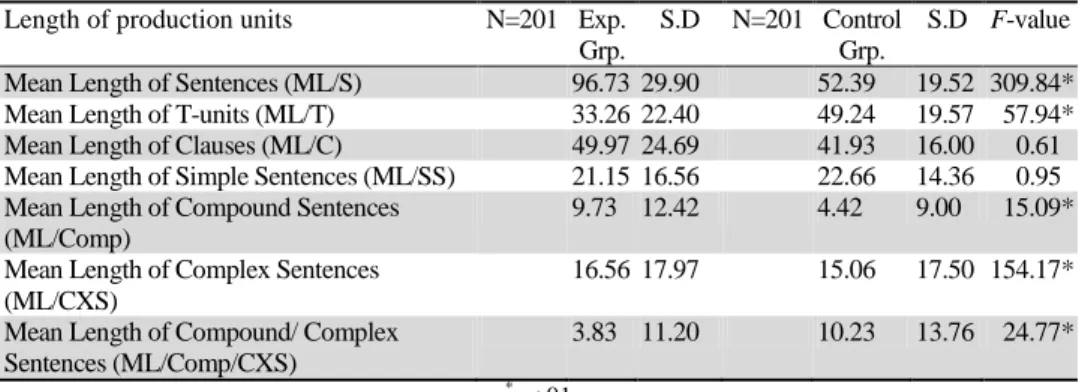
Table 4 shows the analysis of length of production units of the Experimental and Control group at the Pre-test. Out of the total syntactic complexity indicators to measure syntactic lengths, the average length of sentences, the average length of compound sentences and the average length of complex sentences produced by Control group students is much lower as compared to Experimental group, and the differences have statistical significance as indicated by the ANOVA, test, with a F value of 309.84, 15.09, 154.17 respectively.
However, in the parameters of mean length of T- units and the mean length of Compound /Complex sentences produced, Control Group have scored higher over the Experimental Group at the Entry point. In the other parameters both the groups are at the same level with an F value of 0.61 (ML/C) and 0.95 (ML/SS) which is not significant.
Table 4 Performance of experimental and control group written language production pre-test
Length of production units N=201 Exp.
Grp.
S.D N=201 Control Grp.
S.D F-value
Mean Length of Sentences (ML/S) 96.73 29.90 52.39 19.52 309.84*
Mean Length of T-units (ML/T) 33.26 22.40 49.24 19.57 57.94*
Mean Length of Clauses (ML/C) 49.97 24.69 41.93 16.00 0.61
Mean Length of Simple Sentences (ML/SS) 21.15 16.56 22.66 14.36 0.95 Mean Length of Compound Sentences
(ML/Comp)
9.73 12.42 4.42 9.00 15.09*
Mean Length of Complex Sentences (ML/CXS)
16.56 17.97 15.06 17.50 154.17*
Mean Length of Compound/ Complex Sentences (ML/Comp/CXS)
3.83 11.20 10.23 13.76 24.77*
* p<.01
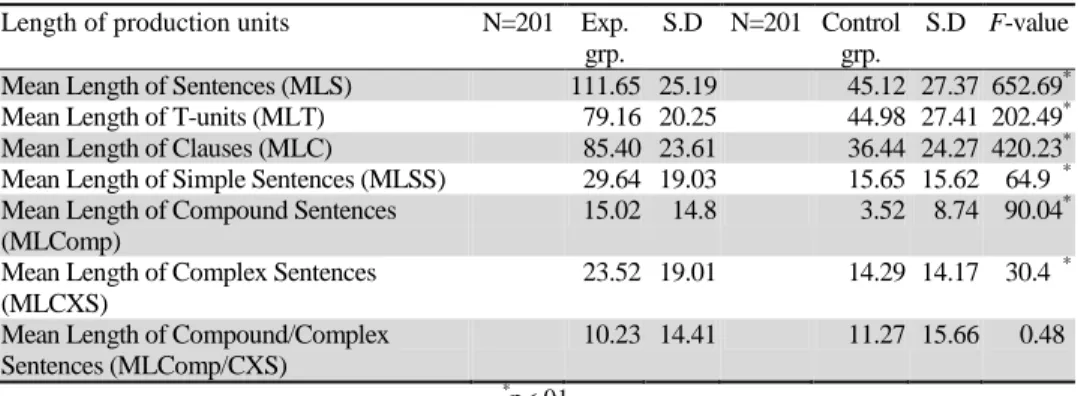
of 652.69, 202.49, 420.33, 64.9, 90.04, 30.04 respectively. There are also differences between the average length of compound/complex sentences produced, but with an F value of 0.48, where there is no statistical difference.
Interestingly, in the average length of compound/complex sentences produced from the Pre-test to the Post-test, the Experimental group has shown a significant difference as indicated in their mean scores (3.83 Pre-test, 10.23 Post-test), as well as the ANOVA test with an F value of 26.18.
Table 5 Performance of experimental and control group written language production post-test
Length of production units N=201 Exp.
grp.
S.D N=201 Control grp.
S.D F-value
Mean Length of Sentences (MLS) 111.65 25.19 45.12 27.37 652.69*
Mean Length of T-units (MLT) 79.16 20.25 44.98 27.41 202.49*
Mean Length of Clauses (MLC) 85.40 23.61 36.44 24.27 420.23*
Mean Length of Simple Sentences (MLSS) 29.64 19.03 15.65 15.62 64.9 * Mean Length of Compound Sentences
(MLComp)
15.02 14.8 3.52 8.74 90.04*
Mean Length of Complex Sentences (MLCXS)
23.52 19.01 14.29 14.17 30.4 *
Mean Length of Compound/Complex Sentences (MLComp/CXS)
10.23 14.41 11.27 15.66 0.48
* p<.01
Results of dependent clauses, phrases and complex nominals
Tables 6, 7, 8 and 9 show the analysis of phrases and clauses respectively. An analysis of coordinate and subordinate phrases shows that students of Control group produce lower number of coordinate and subordinate phrases than Experimental group from the Pre- to the Post-tests and this difference has statistical significance as indicated by ANOVA where the calculated value of F value is more than the critical value of F as shown in Tables 6 and 7.
Table 6 Comparison of performance of experimental and control group written language production pre-test
N=201 Exp. Grp.
S.D N=201 Control Grp.
S.D F-value
Mean Coordinate Phrases (MCP) 3.08 1.90 1.75 1.52 59.96*
Mean Subordinate Phrases (MSP) 2.40 1.89 1.14 1.17 64.21*
Mean Complex nominal (MCN) 1.11 1.51 1.23 1.35 0.76
Mean Adverbial Clauses (MAdvC) 0.82 1.01 1.84 1.39 0.62
Mean Adjective Clauses (MAdjC) 0.24 0.52 0.17 0.44 1.74
Mean noun Clauses (MNC) 0.40 0.69 0.46 0.75 0.69
Table 7 Performance of experimental and control group written language production post-test
N=201 Exp. grp.
S.D N=201 Control grp.
S.D F-value
Mean Coordinate Phrases (MCP) 4.02 1.75 1.25 1.22 260.89*
Mean Subordinate Phrases (MSP) 3.8 1.83 1.11 0.91 294 *
Mean Complex Nominals (MCN) 1.89 1.84 3.07 2.01 37.56*
Mean Adverbial Clauses (MAdvC) 0.74 1.02 0.35 0.59 573.61*
Mean Adjective Clauses (MAdjC) 0.37 0.66 0.59 0.69 11.2 *
Mean Noun Clauses (MNC) 0.59 0.8 0.13 0.36 54 *
* p<.01
Tables 8 and 9 show the comparison of adverbial clauses at the Pre- and Post-tests respectively. Experimental group produce more number of adverbial clauses of reason and result than Control group from the Pre- to the Post-test. The differences show statistical significance as indicated by ANOVA test where the calculated value of F is more than the critical value of F (reason F=25, result F=10). This is an example of complexity where the use of adverbial clause of reason and result is indicative of an ability to analyze, logically arrange information as well as conclude information. The second hypothesis is supported which says that Experimental Group will produce more adverbial clause of reason in writing at the Post-test in comparison to Control group.
Table 8 Performance of experimental and control group written language production pre-test
N=201 Exp. Grp.
S.D. N=201 Control Grp.
S.D. F- value
Mean Adverbial Clauses of Time (MAdvCTime)
0.28 0.6 0.12 0.16 10.8 *
Mean Adverbial Clauses of Place (MAdvCPlace)
0.01 0.1 0.06 0.26 5
Mean Adverbial Clauses of Comparison (MAdvCComparison)
0.01 0.1 0.06 0.24 5
Mean Adverbial Clauses of Condition (MAdvCondition)
0.16 0.44 0.03 0.17 16.55*
Mean Adverbial Clauses of Purpose (MAdvCPurpose)
0.01 0.14 0.005 0.07 2
Mean Adverbial Clauses of Concession (MAdvCConcession)
0.01 0.1 0 0 0
Mean Adverbial Clauses of manner (MAdvCManner)
0.10 0.33 0.25 0.53 10.45*
Mean Adverbial Clauses of Result (MAdvCResult)
0.03 0.17 0 0 3
Mean Adverbial Clauses of Reason (MAdvCReason)
0.16 0.41 0.19 0.48 0.6
Mean Adverbial Clauses of Frequency (MAdvCFrequency)
0.005 0.07 0 0 1.0
Mean Adverbial Clauses of Opposition (MAdvCOpposition)
0.01 0.1 0.010 0.1 0
Mean Adverbial Clauses of Contrast (MAdvCContrast)
0.005 0.07 0.005 0.007 0
There is also an increase in the number of adverbial clauses of condition produced by the Experimental group from the Pre-test to the Post-test in comparison to the Control group, but the difference is not significant.
Table 9 Performance of experimental and control group written language production post-test
N=201 Exp. group
S.D N=201 Control group
S.D F-value
Mean Adverbial Clauses of Time (MAdvCTime)
0.43 0.68 0.21 0.51 1.54
Mean Adverbial Clauses of Place (MAdvCPlace)
0.11 0.41 0.03 0.17 7.1 *
Mean Adverbial Clauses of Comparison (MAdvComparison)
0.04 0.22 0.02 0.14 0.5
Mean Adverbial Clauses of Condition (MAdvCondition)
0.24 0.65 0.05 0.07 38.2 *
Mean Adverbial Clauses of Purpose (MAdvCPurpose)
0.06 0.24 0 0 12 *
Mean Adverbial Clauses of Concession (MAdvCConcession)
0.01 0.10 0 0 2
Mean Adverbial Clauses of Manner (MAdvCManner)
0.27 0.59 0.05 0.22 25.2 *
Mean Adverbial Clauses of Result (MAdvCResult)
0.13 0.44 0.005 0.07 16.8 *
Mean Adverbial Clauses of Reason (MAdvCReason)
0.46 0.75 0.02 0.14 66.41*
Mean Adverbial Clauses of Frequency (MAdvCFrequency)
0 0 0 0 0
Mean Adverbial Clauses of Opposition (MAdvCOpposition)
0.04 0.21 0 0 10
Mean Adverbial Clauses of Contrast (MAdvCContrast)
0.02 0.12 0 0 3.13
* p<.01
6.DISCUSSION
Wang & Slater, (2016) compared writing tasks of English proficient users and second language Chinese speakers in English. The findings revealed that Chinese students‟ produced an average length of 22.23 sentences, an average length of 19.33 T-units and an average length of 10.34 clauses. This is in contrast with the native speakers where MLS is 26.94, MLT is 22.60 and MLC is 12.34. Wang and Slater found a significant difference in the mean length of sentences and the mean length of clauses produced by the proficient learners of English. The study however, failed to find a significant difference in the mean length of T-units produced. In the present study, a significant difference was found as indicated by the F value, in the mean length of sentences, the mean length of T-units and the mean length of clauses produced by Experimental group from the Pre to the Post-tests, who were trained with game-based learning (F=29.74, F=464.70 and F=15.93). This finding is in accordance with previous studies Wolfe-Quintero et.al. (1998). But Lu, (2011) argues that the best length measure to distinguish L2 writing proficiency is MLC, the second being MLS, and the third being MLT. The data from the present study shows that the MLS of Experimental group is the index that most distinguished them from Control group, the second difference is MLC and the third difference is MLT. The results are therefore not consistent with the results of Lu, (2011) and Xu, (2013), who also studied syntactic complexity. That is, in terms of length indices the more proficient users tend to produce longer sentences, longer clauses as well as longer T-units. Wang and Slater also reports of an increase in the number of dependent clauses /T-unit and dependent clauses/clause in non-native Chinese writers. This is in accordance to the present study where Experimental group produce more number of dependent clauses/sentence as well as T-unit.
Jennifer D‟Souza, (2016) analyzed the writings of VI grade non-native (Marathi) students in terms of T- units. Her findings are very close to the findings of the present study for Experimental group in writing compositions (an average of 9.5 T- units/ 6.72 T-units Exp. grp. in the present study, an average of 7 single clause T- units/ 3.6 single clause T- units in Exp. grp, an average of 2.5 two clause T- units/ 1.04 two clause T- units in Exp. Grp., an average of 1 three clause T- units/ 2.08 three clause T- units in Exp. Grp. in the present study).
7.CONCLUSION
REFERENCES
Ai, Haiyang, & Lu, Xiaofei. A corpus-based comparison of syntactic complexity in NNS and NS university students writing. 2013. In Nicolas Ballier, Ana Díaz-Negrillo, and Paul Thompson (Eds.), Automatic Treatment and Analysis of Learner Corpus Data (pp. 249-264). Amsterdam: John Benjamins.
Bahrami, Farid, et.,al. A comparison of the effectiveness of game-based and traditional teaching on learning and retention of first grade math concepts. European Journal of Experimental Biology. 2 (6):2099-2102, 2012.
Beers, S. F., & Nagy, W. Syntactic Complexity as a Predictor of Adolescent Writing Quality: Which Measures? Which Genre? Reading and Writing: An Interdisciplinary Journal. 22. 185-200, 2009.
Bradford Arthur. Short-Term Changes in EFL Composition Skills. In Yorio, Carlos A., Ed.: and Others On TESOL „79: The Learner in Focus, 1979.
Coleman James Samuel, Hoffer Thomas, Kilgore Sally. High school achievement: Public, Catholic, and private schools compared. National opinion research center, 1982.
Cynthia L. Hallen, Jennifer Shakespear. The T-Unit as a Measure of Syntactic Complexity in Emily Dickinson’s Poems, The Emily Dickinson Journal 11.1 91-103. 2002.
Cumming Alister. Learning to write in a Second Language: Two Decades of Research. International Journal of English Studies. Vol 1 (2), 2001, pp 1-23.
D‟ Souza, Jennifer. A categorization of syntactic/rhetorical features acquired at a specific grade level, unpublished Ph. D thesis, 2015.
D‟ Souza, Jennifer. Exploring the Sentence Structure at a Particular Grade Level. Research Journal of English Language and Literature (RJELAL), Vol.4.Issue 1 (January-March), 2016: 291-297.
Ellis Rod. & Yuan Fangyuan. The Effects of Planning on Fluency, Complexity, and Accuracy in Second Language Narrative Writing, 2004. In Studies in Second Language Acquisition. 26 (01). 59-84. DOI: 10.1017/S0272263104026130
Elley, W., Barham, L., Lamb, H., & Wyllie, M. The role of grammar in a secondary school English curriculum. New Zealand Journal of Educational Studies, 10, 26-42. Reprinted in Research in the Teaching of English, 10, 5-21, 1976.
Faigley, Lester. Maturity, Complexity and Growth in College Writing. Paper presented at the Annual Meeting of the Conference on College Composition and communication (30th, Mirineapolis, Minnesota, April 5-7.), 1979.
Ferris, M. Roger; Politzer, Robert L. Effects of Early and Delayed Second Language Acquisition English Composition Skills of Spanish- Speaking Junior High School Students, TESOL Quarterly, Vol. 15, No 3, pp. 263-74, 1981.
Ganong, F. L. Teaching writing through the use of a program based on the work of Donald M. Murray. Unpublished doctoral dissertation, Boston University School of Education, Boston, MA. 1974.
Gauntlett, J. F. Project WRITE and its effect on the writing of high school students. Unpublished doctoral dissertation, Northern Arizona University, Flagstaff, AZ. 1978. Gee, J. P. What video games have to teach us about learning and literacy. New York:
Palgrave/Macmillan, 2003.
Hillocks G. Jr. The Interaction of Instruction, Teacher Comment, and Revision i Teaching the Composing Process. RTE 16. 261-78. 1982.
Hillocks G. Jr. Research on Written Composition: New Directions for Teaching. Urban III, ERIC Clearinghouse on Reading and Communication Skills and the National Conference on Research in English. 1986a.
Hudson, R. Measuring Maturity. In. R. Beard, Riley, J., Myhill, D. & Nystrand, M. SAGE Handbook of Writing Development (pp. 349-362). London: Sage. 2009. Hunt, K. Grammatical Structures Written at three Grade Levels. NCTE. 1965.
Huyen, Nguyen and Khuat Thi Thu Nga, Learning Vocabulary through Games. The Effectiveness of Learning Vocabulary Through Games, Asian EFL Journal, Vol. 5, Issue 4, pp. 1-15, 2003.
Ilona Leki, Alister Cumming, and Silva Tony. A Synthesis of Research in Second Language Writing in English. Routledge: NY and London. 2008.
Kam, M., Kumar, A., Shirley, J., Mathur, A., & Canny, J. Improving literacy in rural India: Cellphone games in an after-school program. Proceedings of IEEE/ACM Conference on Information and Communication Technology and Development (ICTD ‟09), Doha, Qatar, April 17-19. IEEE Press Piscataway, NJ, USA, 139-149, 2009. Kim, P. et al., A comparative analysis of a game-based mobile learning model in
low-socioeconomic communities of India. Int. J. Educ. Dev., doi:10.1016/j.ijedudev. 2011.05.008, 2011.
Lintunen. Pekka, Mäkilä Mari. Measuring Syntactic Complexity in Spoken and Written Learner Language: Comparing the Incomparable, Research in Language. Vol.12:4, DOI: 10.1515/rela-2015-0005. pp 377-396. 2014.
Lu, X. A corpus-based evaluation of syntactic complexity measures as indices of college-level ESL writers’ language development. TESOL Quarterly. 45(1). 36-62. 2011. Lukmani, Yasmeen. The Communicational Testing of Reading. ELT Journal. 36(4).
217-225. 1982.
Max Morenberg, Donald Daiker and Andrew Kerek, Sentence combining at the College Level: An Experimental Study. In Research in the Teaching of English, published by National Council of Teachers of English, Vol. 12, No. 3, pp. 245-256, 1978.
Mellon, John. C. Transformational Sentence Combining - A Method for Enhancing the Development of Syntactic Fluency in English Composition, Champaign: NCTE. 1969. Nezworski T, Stein NL, Trabasso T. Story structure versus content in children’s recall,
Journal of Verbal Learning and Verbal Behavior. 21: 196-206. DOI: 10.1016/S0022-5371(82)90561-8. 1982.
Norrby, C. & Hakansson, G. The interaction of complexity and grammatical processability: The case of Swedish as a foreign language. International Review of Applied Linguistics, 45, 45-68. 2007.
O‟ Hare Frank. Sentence – Combining: Improving Student Writing Without Formal Grammar Instruction, Research Report No. 15. Urbana, Illinois: National Council of Teachers of English. 1973.
Ortega, Lourdes. Syntactic Complexity Measures and their Relationship to L2 Proficiency: A Research Synthesis of College‐level L2 Writing. In Applied Linguistics 24 (4):492-518.
2003.
Prensky, Marc. Students as Designers and Creators of Educational Computer Games Who else?British Journal of Educational Technology, 39 (6), pp. 1004-1019, 2007. Sager, Carol. Improving the Quality of Written Composition through Pupil use of Rating
scale, Paper presented at the Annual Meeting of the National Council of Teachers of English (63rd, Philadelphia, Nov. 22-24). 1973.
Shaffer, Williamson, D. et. al. Video Games and the Future of Learning, Phi Delta Kappan, vol. 87, Issue 2, pp-105-111. DOI: https://doi.org/10.1177/003172170508700205, 2005. Stockwell Glenn and Harrington Michael. The Incidental Development of L2 Proficiency
in NS-NNS Email Interactions. CALICO Journal, 20 (2), p-p 337-359. 2003.
Sue Wang & Tammy Slater. Syntactic Complexity of EFL Chinese Students Writing, In English Language and Literature Studies; Vol. 6, No. 1, 2016, 81-86.
Squire, K. D. Changing the game: What happens when video games enter the classroom? Innovate, 1(6). 2005, 1-8.
Tavakoli, P. and Foster, P. Task design and second language performance: the effect of narrative type on learner output. Language Learning 58 (2): 439 -473. 2008.
Troyka, Lynn Quitman. Defining Basic Writing in Context. A Sourcebook for Basic Writing Teachers. Ed. Theresa Enos. New York: Random House, 2–15. Print. 1987. Wenger, E. Communities of practice: Learning, meaning, and identity. Cambridge, UK:
Cambridge University Press. 1998.