DOI 10.13069/jacodesmath.79879
Journal of Algebra Combinatorics Discrete Structures and Applications
New extremal binary self-dual codes of length 68
Research Article
Abidin Kaya
1∗, Bahattin Yildiz
1∗∗1. Department of Mathematics, Fatih University, 34500, İstanbul, Turkey
Abstract: In this correspondence, we consider quadratic double and bordered double circulant construction methods over the ring R := F2+uF2+u2F2, where u3 = 1. Among other examples, extremal
binary self-dual codes of length 66 are obtained by these constructions. These are extended by using extension theorems for self-dual codes and as a result 8 new extremal binary self-dual codes of length 68 are obtained. More precisely, codes with β=117, 120, 133 in W68,1 and withγ = 1,β=49, 57,
59 and codes with γ=2,β=69, 81 inW68,2 are constructed for the first time in the literature. The
binary generators of these codes are available online at [7]. In addition to these, some known codes are reconstructed via this extension. The results are tabulated.
2010 MSC:94B05, 94B60, 94B65
Keywords: Extremal codes, Codes over rings, Gray maps, Quadratic double-circulant codes
1.
Introduction
The theory of self-dual codes, especially the so called extremal ones, has attracted a lot of research in the coding theory community. The connection of self-dual codes with many different fields of study such as designs, lattices and cryptography has made them of interest to many researchers. The theoretical background for extremal binary self-dual codes has been established in [1,2,9] and the references therein. In the aforementioned works, among other things, it was established that extremal binary self-dual codes can only have certain weight enumerators. Much of the research in the study of self-dual codes has been towards finding extremal self-dual codes with new weight enumerators.
Starting with [3], the use of quadratic residues has been part of the armory for constructing binary self-dual codes. The method, which combines quadratic residues with the well-known methods of double circulant and bordered double circulant constructions has successfully been used to obtain many new extremal binary self-dual codes in [6] and [8]. In doing so, rings other than the binary field, which are endowed with duality and distance preserving Gray maps were used.
In this work we consider the construction method described above for the ringR:=F2+uF2+u2F2,
where u3= 1. This is a non-chain extension of the binary field. We describe a Lee weight and a related
∗
E-mail: [email protected] ∗∗
distance-preserving Gray map for the ring. Unlike many of the rings studied before, the Gray map is not duality-preserving. However we establish the conditions for the Gray image to be self-dual. Using quadratic double and bordered double circulant constructions over the ring R, we find extremal binary dual codes of length 66. Applying extensions to these codes we find eight new binary extremal self-dual codes of length 68. More precisely, codes withβ=117, 120, 133 inW68,1 and withγ= 1, β=49, 57,
59 and codes with γ=2, β=69, 81 inW68,2 are constructed for the first time in the literature.
The rest of the work is organized as follows. Section 2 includes a general overview on the ring R
and self-dual codes. In Section 3, we consider projections, lifts and duality conditions. Section 4 contains the quadratic double and bordered double circulant constructions over the ring R and some extremal self-dual examples including codes of length 66. In Section 5, codes of length 66 are extended, using extension theorems, to obtain new extremal binary self-dual codes of length 68. The paper ends with some concluding remarks and comments.
2.
Preliminaries
2.1.
The structure of the ring
F
2+
u
F
2+
u
2F
2with
u
3= 1
The ringF2+uF2+u2F2defined by the relationu3= 1is isomorphic toF2[x]/
x3−1. Throughout the text the ringF2+uF2+u2F2is denoted by Rand it is easily observed thatR∼=F2×F4. The ring
R is not a local ring because its ideal structure is given byI0⊂Iu+u2, I1+u+u2 ⊂R where;
I1+u+u2 = 1 +u+u2
=0,1 +u+u2 , Iu+u2 = (1 +u) =0, u+u2,1 +u,1 +u2 .
However, it is a Frobenius ring as can easily be seen by the isomorphismR∼=F2×F4. The units in the
ringR are given by
1, u, u2 and the non-units are
u+u2,1 +u,1 +u2,1 +u+u2 .
The ring R has two primitive idempotent elements u+u2,1 +u+u2 . Every element of the ring R
can be written in a unique way as a+bu+cu2= 1 +u+u2
(a+b+c) + u+u2
(a+c+ (b+c)u). A linear code C of length nover the ring R is anR-submodule ofRn and has a generating matrix that is permutation equivalent to
G=
Ik1 A B C
0 u+u2
Ik2 0 u+u2
D
0 0 1 +u+u2
Ik3 1 +u+u2
E
.
We define a Gray map as follows;
ϕ : Rn→F32n
a+bu+cu2 7→ a, b, c.
Definition 2.1. The Lee weight of an elementx=a+bu+cu2∈Ris the Hamming weight of its Gray
image, i.e. wtL a+bu+cu2=wtH(a) +wtH(b) +wtH(c). An element is called even if its Lee weight is even and odd otherwise.
So, the elements in idealIu+u2 are even and1, u, u2,1 +u+u2are the odd elements. The Lee weight
of a codeword is defined to be the sum of the Lee weights of its components. The minimum Lee weight of a codeC is denoted bywtL(C)and defined aswtL(C) = min{wtL(c)|c∈ C}.
The duality is understood in terms of the Euclidean inner product;a◦b=Paibi. The dual ofCis defined as C⊥ ={y ∈Rn |y◦x= 0for allx∈ C}.A codeC is said to be self-orthogonal ifC ⊆ C⊥ and self-dual ifC =C⊥. A self-dual binary code is said to be Type II if all codewords have weight divisible by 4 and Type I otherwise.
The minimum distancedof a binary self-dual code of lengthnis bounded above asd≤4 [n/24] + 6
ifn≡22 (mod 24)andd≤4 [n/24] + 4, otherwise ([1,9]). A self-dual code is called extremal if it meets the bound.
2.2.
Quadratic double circulant codes
Quadratic double circulant (QDC) codes are a generalization of quadratic residue codes and have been introduced in [3]. Letp be an odd prime andQp(a, b, c) be the circulant matrix with first rowr
based on quadratic residues modulo pdefined as r[1] = a, r[i+ 1] = b if i is a quadratic residue and
r[i+ 1] =cifiis a quadratic non-residue modulop. We state the special case of the main theorem from [3] wherepis an odd prime;
Theorem 2.3. ([3]) Letpbe an odd prime and let Qp(a, b, c)be the circulant matrix witha, b andc as
the elements of the ring R. Ifp= 4k+ 1then
Qp(a, b, c)Qp(a, b, c)T = Qp
a2+ 2k b2+c2
,2ab−b2+k(b+c)2,2ac−c2+k(b+c)2
If p= 4k+ 3then
Qp(a, b, c)Qp(a, b, c)T = Qp(a2+ (2k+ 1) b2+c2
, ab+ac+k b2+c2
+ (2k+ 1)bc, ab+ac+k b2+c2
+ (2k+ 1)bc).
Definition 2.4. ([3])The code generated by Pp(a, b, c) = Ip Qp(a, b, c)
over the ring R is called a quadratic pure double circulant code and is denoted by Pp(a, b, c). In a similar way, the code generated
by
Bp(a, b, c| λ, β, γ) =
Ip+1
λ β×1
γ×1T Qp(a, b, c)
,
where1is the all1 vector of lengthp, is called a bordered quadratic double circulant code and is denoted by Bp(a, b, c| λ, β, γ).
3.
Projections, lifts and duality conditions
Since the Gray map introduced in Section 2 does not preserve orthogonality, we start with de-termining the conditions when the binary image of a code over the ring R is self-orthogonal. Then, a projection and related lift will be defined. The extended quadratic residue codes of parameters[24,12,8]2
and [48,24,12]2 which are unique up to equivalence are constructed as lifts of self-dual double circulant binary codes.
The following example indicates that the Gray image of a self-orthogonal code over the ringRis not necessarily a self-orthogonal binary code.
Example 3.1. Let us consider the codeC over the ringR of length3 generated by
1 +u,1 +u2, u+u2
We may easily observe that the code is self-orthogonal since
(1 +u)2+ 1 +u22
+ u+u22
= 1 +u2+ 1 +u+u+u2= 0.
On the other hand, its binary image is the code generated by
G=
1 1 0 1 0 1 0 1 1 0 1 1 1 1 0 1 0 1 1 0 1 0 1 1 1 1 0
and it is not self-orthogonal since distinct rows of Gare not orthogonal to each other.
Definition 3.2. A vectorx=a+bu+cu2 over the ring Rcan be expressed as
x= 1 +u+u2
a+b+c
+ u+u2
a+c+ b+c u
.
a+b+c anda+c+ b+c
uare called F2 andF4-components ofx, respectively.
Definition 3.3. A matrix over the ring Ris said to be free of uif all its entries are of the form a+bu2
with a, b∈F2.
Lemma 3.4. The Gray images of two vectorsx=a+bu+cu2andy=d+eu+f u2 inRn are orthogonal
to each other if their F2-components are orthogonal and the product of theirF4-components is free ofu.
Proof. If theF2-components of the vectorsxandy are orthogonal we have
a+b+c
◦ d+e+f
=a◦d+a◦e+a◦f+b◦d+b◦e+b◦f+c◦d+c◦e+c◦f = 0 (1)
and if the inner product of theirF4-components a+c+ b+c
u
◦ d+f+ e+f u
is free of uwe have a◦e+a◦f+b◦d+b◦f+c◦d+c◦e= 0, which impliesa◦d+b◦e+c◦f = 0 by (1). Hence
ϕ(x)◦ϕ(y) = 0.
We would like to determine when the Gray image of a code is self-dual. Much like ring elements and vectors, a matrixGoverR can also be expressed as
G = G1+uG2+u2G3
= 1 +u+u2
(G1+G2+G3) + u+u2(G1+G3+ (G2+G3)u)
where G1, G2 and G3 are binary matrices. G1+G2+G3 is calledF2-component of Gand denoted by
GF2 andG1+G3+ (G2+G3)uis called F4-component ofGand denoted byGF4.
The following theorem characterizes codes over the ring Rwith self-orthogonal binary images:
Theorem 3.5. Let Cbe the code generated by Gover the ringR. Thenϕ(C)is a self-orthogonal binary
code if GF2GT
F2= 0 andGF4G T
F4 andGF4(uG) T
F4 are matrices over the ringR which are free ofu.
Proof. LetG=G1+uG2+u2G3 thenGF2G T
F2 = 0implies
(G1+G2+G3) GT1 +GT2 +GT3
= 0. (2)
The matrix GF4GTF4= (G1+G3+ (G2+G3)u) GT1 +G3T+ GT2 +GT3
uis free ofuimplies
G1GT2 +G1GT3 +G3GT2 +G2GT1 +G2GT3 +G3GT1 = 0
then this together with equation (2) implies
Similarly, if GF4(uG)T
F4 = (G1+G3+ (G2+G3)u) G T
3 +GT2 + GT1 +GT2
u
is free ofuthen we have
G1GT1 +G1GT2 +G3GT1 +G2GT3 +G2GT2 +G3GT3 = 0 then this together with equation (3) gives
G1GT2 +G3G1T +G2GT3 = 0. (4)
Now consider the Gray imageϕ(C)ofCwhich is generated by
G∗=
ϕ(G)
ϕ(uG)
ϕ u2G
=
G1 G2 G3
G3 G1 G2
G2 G3 G1
.
By equations (3) and (4) we haveG∗(G∗)T = 0which impliesϕ(C)is a self-orthogonal binary code.
Example 3.6. The code generated by the matrix
G=
1 0 1 +u u
0 1 u 1 +u
is a free self-dual code over the ring R but its Gray image is not self-dual. We may easily observe that GF2 =
1 0 0 1 0 1 1 0
and it generates a binary self-dual code. On the other hand, GF4 = G and
(uG) F4=
u 0 1 1 +u
0 u 1 +u 1
. The matrixGF4(uG)T F4 =
1 +u+u2 1 +u+u2
1 +u+u2 1 +u+u2
is not free ofu.
IfC is self-orthogonal over the ringR then some of the conditions of Theorem3.5may be relaxed.
Lemma 3.7. Let C be a self-orthogonal code over the ring R andG be a generator matrix of C. Then
ϕ(C)is a binary self-orthogonal code if GF4GT
F4 andGF4(uG) T
F4 are free of u.
Proof. LetG= 1 +u+u2GF2+ u+u2GF4 be a generator matrix for a self-orthogonal code over
R. ThenGGT = 0which impliesG
F2G T
F2 = 0. The result follows by Theorem3.5.
An immediate consequence of Lemma3.7 is;
Lemma 3.8. LetGbe a generator matrix of a self-dual code C over the ringR. Thenϕ(C)is a binary
self-dual code if GF4GTF
4 andGF4(uG) T
F4 are free of u.
Lemma 3.9. A self-orthogonal codeC over the ringR is an even code.
Proof. Let C be a self-orthogonal code of length n over the ring R and x be an arbitrary codeword in C. Let x=a+bu+cu2 where a, b andc ∈
Fn2 then x◦x=a◦a+ (c◦c)u+ b◦b
u2 = 0 implies
a◦a= 0 = b◦b =c◦c. Then, wtH(a), wtH b
and wtH(c) are even since a self-orthogonal binary vector has even weight. Hence, wtL(x) =wtH(a) +wtH b
+wtH(c)is even.
We define a projection π:R→F2 as;
π(r) =
1 0
ifris odd ifris even.
The projection π is extended componentwise and denoted by Π. For a matrix G over the ring R the projection of the matrix is its F2-component;Π (G) =GF2.
Moreover,πis a ring homomorphism. So, the following result follows;
Lemma 3.10. Let C be a linear code over the ring R generated by matrix G then C is an even code if
Definition 3.11. LetC be a code of lengthnover the ringR. The codeCis said to be a lift of the binary code D ifΠ (C) =D. The code Dis called the projection ofC.
Note that the projection of a self-dual code is a binary self-orthogonal code. On the other hand a lift of a self-dual code may not be self-dual. In the following example we construct the extended binary Golay code as a lift of the[8,4,4]2 extended Hamming code.
Example 3.12. Take the following generator matrix of the[8,4,4]2 extended Hamming code
G=
I4
0 1 1 1 1 0 1 1 1 1 0 1 1 1 1 0
.
We liftGto a matrix G∗ over the ringR by keepingI4 as it is and lifting0 to an even element and1 to
an odd element. Let C∗ be the code generated by
G∗ =
I4
u+u2 1 +u+u2 1 1
1 u+u2 1 +u+u2 1 1 1 u+u2 1 +u+u2
1 +u+u2 1 1 u+u2
.
G∗
F2=Gand
G∗F 4 =
I4
1 0 1 1 1 1 0 1 1 1 1 0 0 1 1 1
, (uG)
∗
F4 =
uI4
1 +u 0 u u u 1 +u 0 u u u 1 +u 0 0 u u 1 +u
GGT = 0andG∗F4 uG∗F4T is4×4circulant matrix with first row (1,0,1,1)and hence is free ofu. Thus by Theorem 3.5ϕ(C∗)is self-dual, which turns out to be the[24,12,8]
2 extended binary Golay code.
Example 3.13. The binary code generated by G = (I8 | A) where A is the circulant matrix with first
row rA= (0,1,0,0,0,1,0,1)is a self-dual [16,8,4]2-code. Consider a lift
rA0 = 1 +u, u2, u+u2,1 +u,0,1 +u+u2, u+u2,1 +u+u2
of rA. Then the code generated byG0 = (I8 | A0)where A0 is the circulant matrix with first row rA0 has
a self-dual binary image that is the unique self-dual [48,24,12]2-code.
Example 3.14. The double circulant binary code generated by G = (I11 |A) where A is the 11×11
circulant matrix with first rowrA= (1,1,1,0,0,0,1,0,0,1,0)is a self-dual [22,11,6]2-code. Let
rA0 = 1,1,1,1 +u2,1 +u2,1 +u2,1,1 +u2, u+u2,1,1 +u2
be a lift of rA andC be the code over the ring R generated byG0 = (I11 | A0) where A0 is the circulant
matrix with first rowrA0. The binary imageϕ(C)ofC which we denote by C66,0 is an extremal self-dual
binary code of lengh 66.
4.
Quadratic Double Circulant codes over
R
Theorem 4.1. Letp≡3 (mod 8)be an odd prime. ThenPp 0,1 +u2,1 +u+u2 and
Pp 1 +u2, u,1 +u
are codes over the ring R with self-dual binary images.
Proof. A generator matrix ofPp 0,1 +u2,1 +u+u2
is given by
G= Ip Qp 0,1 +u2,1 +u+u2 .
ThenGF2= Ip Qp(0,0,1)and by Theorem2.3we have
Qp(0,0,1)Qp(0,0,1)T =Qp(1,0,0) =Ip.
SoGF2(GF2)T = 0. Analogously,GF4 = Ip Qp(0, u,0)
by Theorem2.3we have
Qp(0, u,0)Qp(0, u,0)T =Qp u2,0,0
=u2Ip.
Therefore, GF4(GF4)T = 1 +u2Ip which is free of u. Now, we need to show that GF4(uG)TF
4 is also
free ofuwhere(uG)
F4 = uIp Qp(0,1 +u,0)
. We have
Qp(0, u,0)Qp(0,1 +u,0) T
= uQp(0,1,0) (1 +u)Qp(0,1,0)
= u+u2Ipby Theorem2.3,
which implies GF4(uG)T
F4 = uIp+ u+u
2
Ip = u2Ip which is free of u. Hence, by Theorem 3.5 the
binary image ofPp 0,1 +u2,1 +u+u2
is self-orthogonal. SincePp 0,1 +u2,1 +u+u2
= 8pit has a self-dual binary image. The same can be done for Pp 1 +u2, u,1 +u
.
Theorem 4.2. Letpbe a prime with p≡3 (mod 8). Then the code
Bp 1, u+u2,1 +u+u2 | 0,1,1
is a self-dual code over the ring R and its Gray image is a binary self-dual Type II code.
Proof. Letbi denote thei-th row of the matrix
G=Bp 1, u+u2,1 +u+u2 |0,1,1
=
Ip+1
0 1
1T Qp 1, u+u2,1 +u+u2
.
Thenb1◦b1= 0sincepis odd. Ifp= 8k+ 3then for2≤i≤p+ 1we have
b1◦bi= 1 +
p−1 2 u+u
2
+p−1
2 1 +u+u
2
= 1 + (4k+ 1) = 0.
So by Theorem2.3we have
Qp 1, u+u2,1 +u+u2
Qp 1, u+u2,1 +u+u2T
= Qp 1 +u+u2+ 1 +u+u2, u+u2+ 1 +u+u2+ 0, u+u2+ 1 +u+u2+ 0
= Qp(0,1,1),
which implies bi◦bj = 0 for 2 ≤ i ≤ j ≤ q+ 1. Hence the code is self-dual. On the other hand,
the binary code generated by GF2 = Π (G) =Bp(1,0,1|0,1,1)generates a self-dual binary code since Qp(1,0,1)Qp(1,0,1)T =Qp(0,1,1). So, GF2(GF2)T = 0. GF4 =Bp(1,1,0 |0,1,1) is a binary matrix and moreover GF4(GF4)T = 0sinceQp(1,1,0)Qp(1,1,0)
T
=Qp(0,1,1).
(uG) F4=
uIp+1
0 u1
u1T Qp(u, u,0)
=u(GF4)
and GF4(uG)TF
4 =uGF4(GF4) T
=u0 = 0. Hence by Theorem 3.5 the binary image of the code is self-dual. In addition,wt(b1) = 8k+ 4and wt(bi) = 3 + (4k+ 1) 2 + (4k+ 1) 3 = 20k+ 8for2≤i≤q+ 1
An extremal self-dual binary code of length66has a weight enumerator in one of the following forms ([2]):
W66,1 = 1 + (858 + 8β)y12+ (18678−24β)y14+· · · ,0≤β ≤778,
W66,2 = 1 + 1690y12+ 7990y14+· · ·
andW66,3 = 1 + (858 + 8β)y12+ (18166−24β)y14+· · · ,14≤β≤756.
Recently, 24 new codes in W66,3 are constructed in [6]. For a list of known codes we refer to [6] and
references therein. The code C66,0 in Example3.14has weight enumeratorβ = 0in W66,1. We complete
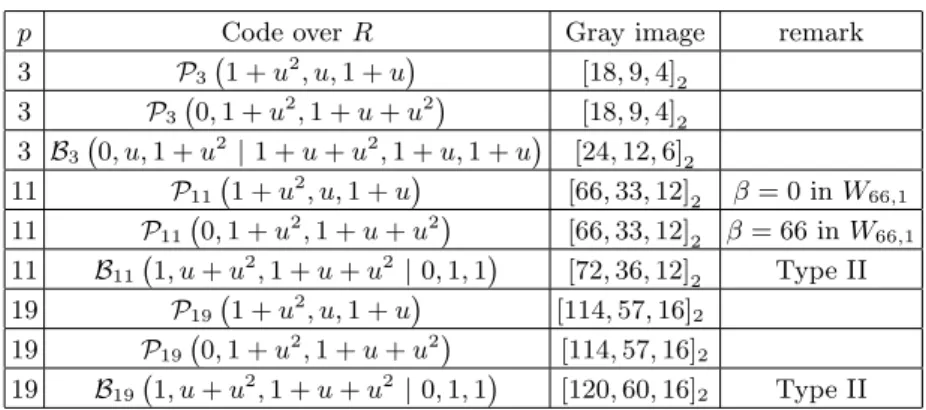
this section by giving some examples of QDC codes over the ringRin Table1. The binary images of two of the codes are extremal self-dual binary codes with weight enumerators β= 0and66in W66,1.
Table 1. Examples of quadratic double circulant codes over the ring R
p Code overR Gray image remark
3 P3 1 +u2, u,1 +u [18,9,4]2
3 P3 0,1 +u2,1 +u+u2
[18,9,4]2
3 B3 0, u,1 +u2|1 +u+u2,1 +u,1 +u
[24,12,6]2
11 P11 1 +u2, u,1 +u
[66,33,12]2 β= 0inW66,1
11 P11 0,1 +u2,1 +u+u2 [66,33,12]2 β= 66inW66,1
11 B11 1, u+u2,1 +u+u2 |0,1,1
[72,36,12]2 Type II 19 P19 1 +u2, u,1 +u
[114,57,16]2
19 P19 0,1 +u2,1 +u+u2
[114,57,16]2
19 B19 1, u+u2,1 +u+u2 |0,1,1
[120,60,16]2 Type II
5.
New extremal binary self-dual codes of length
68
An efficient method to construct self-dual binary codes of lengthn+ 2is to extend a self-dual binary code of length n. Such an extension method for an arbitrary generator matrix of the code is used in [5]. Such extension methods for binary rings are introduced in [8] and a substantial number of new extremal binary self-dual codes of length68are obtained. In this section, extension is used for extremal self-dual binary codes of length66which were constructed in sections3and4. As a result, we were able to obtain eight extremal self-dual binary codes of length 68with new weight enumerators.
The weight enumerator of an extremal binary self-dual code of length 68 is characterized in [2] as follows:
W68,1 = 1 + (442 + 4β)y12+ (10864−8β)y14+· · · ,104≤β≤1358,
W68,2 = 1 + (442 + 4β)y12+ (14960−8β−256γ)y14+· · ·
where0≤γ≤11and14γ≤β≤1870−32γ. Tsai et al. constructed new extremal self-dual binary codes of lengths 66and68in [10]. Together with the codes obtained in [10] the existence of codes inW68,1 are
with these, codes exists forW68,2 when
γ = 0, β= 44, . . . ,154or β∈ {2m|m=17, 20, 88, 102, 119, 136 or78≤m≤86};
γ = 1, β= 60, . . . ,160or β∈ {2m|m=27, 28, 29, 95, 96 or81≤m≤89};
γ = 2, β= 65,68,71,77,159 orβ∈ {2m|37≤m≤68, 70≤m≤81} or
β ∈ {2m+ 1|42≤m≤69, 71≤m≤77};
γ = 3, β= 101,117,123,127,133,137,141,145,147,149,153,159,193 or
β ∈ {2m|m=44,45,48,50,51,52,54,. . .,58,61,63,. . .,66,68,. . .,72,74,77,. . .,81,88,94,98};
γ = 4,β ∈ {2m|m=51, 55, 58, 60, 61, 62, 64, 65, 67,. . .,71, 75,. . ., 78, 80} and
γ = 6withβ∈ {2m|m=69, 77, 78, 79, 81, 88}.
We construct codes with weight enumerators γ = 1and β =49, 57, 59, 67, 69, 71 and codes with weight enumeratorsγ= 2andβ=69, 81 inW68,2 that are given in Table3 and Example5.2.
The following is an extension theorem that is true for all commutative rings Aof characteristic2.
Theorem 5.1. ([8]) Let C be a self-dual code over A of length n and G = (ri) be a k×n generator
matrix forC, whereri is thei-th row ofG,1≤i≤k. Letc be a unit inA such thatc2= 1and X be a vector in An withX◦X= 1. Letyi=ri◦X for1≤i≤k. Then the following matrix
G∗=
1 0 X y1 cy1 r1
..
. ... ...
yk cyk rk
,
generates a self-dual code C∗ overAof length n+ 2.
Example 5.2. When we apply the extension in Theorem5.1 toC66,0 in Example3.14 with
X = (000101000011111010001111011100110101001110001101101011001111111111)
in other words, when we consider the code generated by
1 0 X
y1 y1
..
. ... ϕ(G0)
y33 y33
we obtain an extremal binary self-dual code of length 68 with an automorphism group of order 10 and weight enumeratorγ= 1,β = 49inW68,2. Note that this is the first extremal binary self-dual code with
this weight enumerator.
In a similar way, the extension is applied to the Gray image ofP11 1 +u2, u,1 +uin Table1and
seven new extremal self-dual binary codes of length68are obtained. These are listed in tables2 and3.
Remark 5.3. Recently, in [6] by using a different method codes with weight enumerators γ = 1 and
β = 67,69,71 in W68,2 are constructed for the first time in literature. Since the method used here is
different we list them in Table 3.
6.
Conclusion
Table 2. Extremal binary self-dual codes in W68,1 as extensions of ϕ P11 1 +u2, u,1 +u
X β
011011011011011001001110100111000100000110010000010000000011100111 117 011011001001011000010101111011101111010101011011010110100011111011 120 011100000001010000000001111011101111001011111010100001100101110100 133
Table 3. Extremal binary self-dual codes in W68,2 as extensions of ϕ P11 1 +u2, u,1 +u
X γ β
100010010101000101110011011111100101100000000001011010000100111111 1 57 000010001001100101011111101000110001100010010111111111011011110001 1 59 001010111001001111111010010100100010101000001010110101010101001010 1 67 001100101010011110110111001000000111101110100111100101110101001111 1 69 111000000010100001010000101001101110101011100110110011101110001100 1 71 100010101100011000011001101100100101110110101111001011111001101001 2 69 000111000010101101101111110010001000100011010010110101101100110101 2 81
extremal self-dual binary codes of length 66 obtained from the ringR we were able to find eight new extremal self-dual binary codes of length68updating the list of all known such codes. The methods we have used have proven to be useful in many works in the literature of self-dual codes. We believe they could be applied to other rings and structures such asZ4.
Acknowledgements
The authors would like to thank Prof. İrfan Şiap for his suggestions and the anonymous referees for their remarks which improved the manuscript considerably.
References
[1] J. H. Conway, N. J. A. Sloane,A new upper bound on the minimal distance of self-dual codes, IEEE Trans. Inform. Theory, 36(6), 1319-1333, 1990.
[2] S. T. Dougherty, T. A. Gulliver, M., Harada, Extremal binary self dual codes, IEEE Trans. Inform. Theory, 43(6), 2036-2047, 1997.
[3] P. Gaborit,Quadratic double circulant codes over fields, Journal of Combinatorial Theory Series A, 97(1), 85-107, 2002.
[4] W.C. Huffman, V. Pless,Fundamentals of error correcting codes, Cambridge University press, 2003. [5] J.-L. Kim, New extremal self-dual codes of lengths 36,38 and 58, IEEE Trans. Inf. Theory, 47(1),
386-393, 2001.
double circulant codes overF4, available online at http://arxiv.org/abs/1405.7147
[7] A. Kaya, B. Yildiz,Binary generator matrices of new extremal self-dual binary codes of length 68, available online at http://www.fatih.edu.tr/~akaya/binary/68u31.txt
[8] A. Kaya, B. Yildiz,Extension theorems for self-dual codes over rings and new binary self-dual codes, available online at http://arxiv.org/abs/1404.0195.
[9] E. M. Rains,Shadow Bounds for Self Dual Codes, IEEE Trans. Inf. Theory, 44(1), 134-139, 1998. [10] H.-P. Tsai, P.-Y. Shih, R.-Y. Wuh, W.-K. Su, C.-H. Chen, Construction of self-dual codes, IEEE