Dr Prof. N. K. Rajendran et al JMSCR Volume 06 Issue 07 July 2018 Page 437
The Value of DNS1 Antigen for Early Detection of Dengue Infection in
Children: The Changing Sensitivity
Authors
Dr Prof. N. K. Rajendran
1, Dr K. Sanjeevi (Associate Prof.)
2, Mrs. Neetu Thomas
31,2
Dept. of Pediatrics, Karuna Medical College, Vilayodi, Palakkad
3
Statistician, Karuna Medical College, Vilayodi, Palakkad
Abstract
Introduction: The recent epidemics of dengue in India have highlighted that presentation of Dengue is confusing and higher percentage of severe forms of dengue are affecting children.
Aim and Objectives: To re-evaluate the role of DNS1 Antigen in the detection of dengue infection early in the symptomatic stage and assess the severity earlier.
Materials and Methods: It is a retrospective study done in a tertiary care hospital by analyzing dengue positive 150 children from a total 312 children admitted here for suspected dengue fever. They were clinically categorized according WHO criteria. The findings were tabulated and correlations and significance of various parameters were looked for with latest version of SPSS.
Results: More number of male children had dengue. Most of the DNS1 positive cases were seen within 3 days. Mild forms were more than severe variety and more of the younger groups had mild infection. Many older children had NS1 titer values >11, which is statistically significant.
Conclusion: Our study affirms that DNS1 Ag is still very useful to detect the dengue infection early but could not recognize the severity.
Keywords: Dengue Fever, DNS1 Ag, Titre value, Severity, Sensitivity.
Introduction
Dengue fever is a mosquito born viral infection, caused by dengue virus, that has four different serotypes - DEN 1, DEN 2, DEN 3, DEN 4[1]. Global incidence of dengue infection has dramatically increased from 1970 when only 9 countries had dengue, to the present day where more than 100 have the epidemics, including India. Dengue virus infection may be asymptomatic or present like a non-specific flu-like illness, and high index of suspicion, especially during epidemics, is highly rewarding in diagnosing the infection early because a good majority develop serious
complications like effusion and culminates in severe forms of dengue infection leading to high mortality. During dengue outbreaks NS1Ag does not indicate severity[2]. The natural history of dengue infection and warning signs are enough for early diagnosis. The affected children develop lifelong immunity but if infected with a different serotype they develop severe dengue. According to WHO, Dengue is suspected when high fever is accompanied by 2 of the following symptoms -- severe headache, retro orbital pain, myalgia, arthralgia, nausea, or skin rash and severe dengue when plasma leaking, fluid accumulation, respiratory distress, severe bleeding
www.jmscr.igmpublication.org Impact Factor (SJIF): 6.379
Dr Prof. N. K. Rajendran et al JMSCR Volume 06 Issue 07 July 2018 Page 438 or other organs are impaired. Usually severe dengue
follows when infected with another serotype, but occasionally dengue becomes severe in the primary infection itself. RT-PCR was done to identify the serotype.
Several papers were published regarding the number of dengue cases and dengue incidence rate since 1982[3][4]. There is a trend of increasing cases of dengue and all age groups, gender and ethnicity get infected, with male predominance over the years. The reported mortality rate of dengue viral infection is around 2.5 to 5.4%. Since there is no specific treatment and effective prevention for dengue infection, it is very important that early detection and access to proper medical care will lower the fatality rate below 1%. To facilitate early detection, the health workers perform screening tests which detects all 4 serotypes. Dengue Non-structural 1 antigen (DNS1 Ag) units is calculated in human serum or plasma. Elevation in specific DNS1 Ag levels occurs from day 1 illness onwards. The clinical symptoms and signs along with positive serological tests will help to confirm the diagnosis earlier.
WHO recommends Immunization with vaccine "Dengue Vaxia" (CYD-TDV) only in areas with a high burden of disease.
Aims and Objectives
1 This study was undertaken to ascertain the role and reliability of serological NS1 antigen assay in the early diagnosis of dengue infection in children. 2 To discuss the need for other strategies to improve the early diagnosis of severity.
Materials and Methods
This was a hospital based retrospective observational study done at Karuna Medical College, situated in a rural area, near Palakkad, Kerala, where majority of the children coming for treatment are from nearby villages and semi urban places. Ethical committee approval was taken before starting the study. The study period was 5 months from May 2017 – September 2017. Completed case files of around 312 children
admitted and treated in wards and PICU for clinical suspicion of dengue between 1 and 16 years were analysed and data were recorded on a structured proforma with all details of the children's demography, clinical findings, and all investigations like Complete blood count and other investigations like RFT, LFT, bleeding parameters, electrolytes, special tests etc. were done according to the clinical situations warranted. Dengue serology for IgG antibodies for secondary infection and IgM antibodies for primary infection were performed on the same children using ELISA assay.
Among 312 children admitted for suspected dengue fever, 150 were confirmed with serological tests to be positive for dengue infection. These children who fulfilled the WHO clinical criteria and DNS1 antigen positive were included in the study. Other children with clinical features of dengue infection but negative serology for dengue and having other infection were excluded from this study.
NS1 antigen ELISA was tested using the kit Dengue NS1 Ag Microlisa, J. Mitra & CO. Pvt .Ltd., New Delhi. This kit detects all 4 serotypes. The test was interpreted as DNS1 Ag Titre of >11 being strongly positive, Titre 9-11 being equivocal and Titre value < 9 being negative. This test claims to have 98% sensitivity.
The collected data were analysed using SPSS (IBM SPSS statistics 20). The selected variables were presented using the frequencies and percentages tables. Association analysis were performed using the chi-square test. Statistically significant was considered at 5% alpha level.
Results
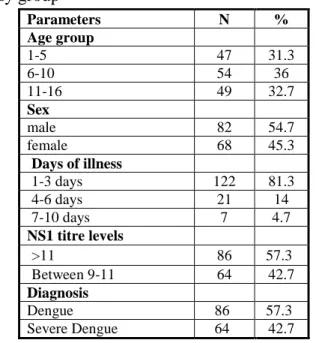
Different parameters like age group of children, gender, day of illness and number of patients according to different age groups, DNS1 Ag titre levels and total patients for values >11 and 9-11, and clinical diagnosis with total children are shown in table 1.
Dr Prof. N. K. Rajendran et al JMSCR Volume 06 Issue 07 July 2018 Page 439 the age group of 11 to 16 years. Age group wise all
children are almost equally affected.
In the gender wise distribution, total 82 male and 68 female children came under the study, with percentage of 54.7 male and 45.3 female. Here male children seem to have been infected more than female children.
Table 1: Distribution of variables according to study group
Parameters N % Age group
1-5 47 31.3
6-10 54 36
11-16 49 32.7
Sex
male 82 54.7
female 68 45.3
Days of illness
1-3 days 122 81.3
4-6 days 21 14
7-10 days 7 4.7
NS1 titre levels
>11 86 57.3
Between 9-11 64 42.7
Diagnosis
Dengue 86 57.3
Severe Dengue 64 42.7
Under parameter day of illness, children admitted between 1 and 3 days after onset of fever were 122 in number. 21 were admitted after 4th day and only 7 got admitted between 7th and 10th day. The percentage were accordingly 81.3, 14 and 4.3. The day of illness looks significant because many infected with dengue were positive within the first 3 days.
The 4th parameter shows the distribution of children with DNS1 Ag levels with percentage. 86 children (57.3%) came with a positive value of more than 11. 64 patients (42.7%) had values between 9-11. Here more children had titre values above 11.
The last parameter in table 1 is the clinical diagnosis as dengue and severe dengue. Here a total of 86 (57.3%) patients had dengue and 64 (42.7%) had severe dengue. Mild dengue population are slightly more than severe dengue.
Table 2: DNS1 Antigen positive cases according to age group and titre levels
Age group in years
NS1 titre levels p value
>11 Between 9-11
.088
N % N %
1-5 26 55.3 21 44.7
6-10 26 48.1 28 51.9
11-16 34 69.4 15 30.6
NS1 Ag positive cases according to age and titre values along with 'P' value are shown in table 2. In 1 - 5 years 26 (55.3%) children had titres > 11, 21 (44.7%) children had values 9-11. In 6 -10 years 26 (48.1%) children had titres >11 and 28 (51.9%) had 9-11 values. In 11-16 years 34 (69.4%) children had titres >11, and 15 (30.6%) had titres 9-11. The strongly positive higher values of >11 were slightly more in age groups above 11 years; 69.4% and 30.6%. But the P value is 0.88 which is not significant.
Table 3: Association between Days of illness and diagnosis
Days of illness
Diagnosis p value
Dengue Severe dengue N % N %
.901
1-3 days 69 56.6 53 43.4
4-6 days 13 61.9 8 38.1
7-10 days
4 57.1 3 42.9
Dr Prof. N. K. Rajendran et al JMSCR Volume 06 Issue 07 July 2018 Page 440 Table 4: Association between NS1 titre levels and
diagnosis
NS1 titre levels
Diagnosis p value Dengue Severe dengue
N % N %
.035
>11 43 50 43 50
Between 9-11 43 67.2 21 32.81
The relationship between dengue titre values and clinical diagnosis (table 4) shows DNS1 Ag units more than 11 in 43 (50%) dengue and in 43 (50%) severe dengue patients. While 43 (67.2%) had dengue with units 9-11, severe dengue patients were only 21 (32.81%). So as per this analysis using dengue titre values of >11, both dengue and severe dengue children were equally affected; 50%. Based on units between days 9-11, more children had dengue and lesser percentage had severe dengue. Here the 'P' value is significant, 0.035.
Table 5: Association between age group and diagnosis
Age group
Diagnosis p value
Dengue Severe Dengue N % N %
.318
1-5 30 63.8 17 36.2
6-10 32 59.3 22 40.7
11-16 24 49 25 51
The association between age and clinical diagnosis showed, as in table 5, that the 1-5 age group had 30 (63.8%) dengue and 17 (36.2%) severe dengue illness. 6-10 years age group had 32 (59.3%) dengue and 22 (40.7%) severe dengue cases. Between 11 and 16 years dengue affected 24 (49%) and severe dengue 25 (51%) children. The 'P' value is 0.318 which is not significant. However the age and severity table clearly shows that the younger children below 5 years get the dengue in a milder form and severe dengue are less, when compared with the age groups more than 6 years. Older children had no significant relation with clinical severity. In our study, the number of children mild dengue is higher than the number of children with severe dengue, even though statistically not significant.
Discussion
Dengue has become common in tropical and sub tropical countries. Epidemics are frequently seen[5] in different parts of India especially after the onset of the rainy season. When estimating the prevalence rate of dengue infection towards the end of 20th century and now, it is seen that the rate of severe dengue has gone high [6]. Since dengue results in high morbidity and mortality rates during the later stages of the infection, it is very crucial to identify the illness earlier at the beginning of infection itself. So the delay in diagnosing the dengue infection must be avoided. The methods used to detect the infection early are by testing the serum for DNS1 antigen, anti-dengue IgM antibodies and RT-PCR. The NS1 Antigen becomes positive with shorter duration of illness, from day 1 onwards, and will help to confirm the diagnosis earlier. To identify the severity earlier, the NS1 antigen is not valid. No RT-PCR tests or viral culture are done due to cost effectiveness and non-availability of facilities[7]. So NS1 Ag is the only useful tool which can be used by all health care workers with facilities ranging from minimum to highly sophisticated. In our study we looked for other parameters which could identify the illness and severity earlier to prevent the complications and death.
In our findings higher number of boys are affected than girls; but not helpful in diagnosing the infection early. The age wise study also is not helpful in detecting the infection early because almost same percentage were affected in the various age groups. So in our study to know the severity we looked for the correlation of day of illness, age group, and titre values with the clinical diagnosis of dengue infection.
Dr Prof. N. K. Rajendran et al JMSCR Volume 06 Issue 07 July 2018 Page 441 when days advance most of them develop severity
with complications. Overall findings in this study again confirms that NS1 Ag test is useful in diagnosing dengue virus infection during the early symptomatic phase, the same is observed by Suleman. M.[9] and Mahapatra D[10]. But the correlation with early detection is not useful to identify severity. As early markers, Solanke VN[11] used three techniques rapid NS1 Antigen, NS1 early Elisa and RT-PCR in serum samples of suspected dengue children and found them to be useful. Many NS1 negative cases were found to be positive for IGM antibodies and some IGM negative cases were found to be positive for NS1 Ag. In IGM negative cases RT-PCR is useful. So combining the NS1 and IGM is helpful[12] and can be used as an early marker of infection. In a work done by Datta S, Wattal. C.[13], the authors claim that combining NS1 Ag and MAC-ELISA significantly improved the diagnosis. Palanivel. H.[14] finds that combination of clinical findings and rapid NS1Ag and IGM dengue helps in confirming the diagnosis. Although in our present study the serum were tested for IGM antibodies also, it is not included in the analysis in order to prevent deviation from our main objective.
It is not possible to detect the severity from the day of positivity of DNS1 Ag. Also some children developed severe dengue earlier, while others had severity only later in the course of illness. In a study by Mishra S.[15], various laboratory parameters were measured to identify the severity. Surangrat who worked on scoring systems, gives points to find out severity[16]. Symptoms and signs alone were used in a meta analysis by H. Zhang[17] for prediction of severe dengue disease. So to predict the severity of infection, positive serological NS1 antigen test along with the clinical symptoms and signs is the probable simple method[18].
Also this study shows many children with fever had dengue like symptoms but NS1 antigen negative. This again indicates either the emergence of new strains, the 5th serotype identified recently, or a different serotype predominating in a dengue season or a change in NS1 antigenicity so that the
sensitivity has become low. The fairly low sensitivity is demonstrated by Chithbaram also. This necessitate the need for a new DNS1 Ag test kit with improved and added serotypes.
Conclusion
Our study confirms that till now DNS1 Ag test is useful for early detection of dengue infection but with a little lower sensitivity. But to identify the severity this test is not reliable. So to know the severe forms of dengue we have to depend on clinical presentation only.
Conflict of interest - None. Funding - None.
Ethical Approval: Institutional Human Ethical Committee /02/2018.
We like to thank Dr. A. Madhav, faculty reviewer of Clinical Paediatrics by Aruchamy Lakshmnaswamy, for reading the article and making necessary corrections.
References
1. http://www.who.int/en/news-room/fact-sheets/detail/dengue-and-severe-dengue. February 2018.
2. Pothapregada S. The Dilemma of Reactive NS1 Antigen test in Dengue Fever. Indian Pediatrics. 2015 october 15; volume 52 p.906-907.
3. Cheah WK, Ng KS, Marzilawati AR, Lum LC. A review of dengue research in malaysia. The Medical journal of Malaysia. 2014 Aug;69:59-67.
4. Mathew N, Rajahamsan J, Sahira H, Rani B, Ramani B. J.T. Study on Prevalence of Dengue Fever in a Tertiary Care Hospital, South Kerala. Journal of Medical Science and Clinical Research. January 2017; Volume 05 Issue 01.
Dr Prof. N. K. Rajendran et al JMSCR Volume 06 Issue 07 July 2018 Page 442
6. Guha-Sapir D, Schimmer B. Dengue fever: new paradigms for a changing epidemiology. Emerging themes in epidemiology. 2005 Dec;2(1):1.
7. Cheah WK, Ng KS, Marzilawati AR, Lum LC. A review of dengue research in malaysia. The Medical journal of Malaysia. 2014 Aug;69:59-67.
8. Chithambaram NS, Shah KD. To evaluate the role of NS1 antigen for early detection of dengue fever. Journal of Evolution of Medical and Dental Sciences. 2014 Dec 18;3(71):14463-9.
9. Suleman M, Faryal R, Alam MM, Sharif S, Shaukat S, Aamir UB, Khurshid A, Angez M, Umair M, Sufian MM, Arshad Y. NS1 antigen: A new beam of light in the early diagnosis of dengue infection. Asian Pacific journal of tropical medicine. 2016 Dec 1;9(12):1212-4.
10.Mahapatra D, SARAnGI G, Mahapatra A, Paty BP, Das P, Chayani N. NS1 antigen capture ELISA an effective method for diagnosis of early dengue infection-Report of an outbreak at Angul district, Odisha, India. Journal of clinical and diagnostic research: JCDR. 2014 Aug;8(8):DC08.
11.Solanke VN, Karmarkar MG, Mehta PR. Early dengue diagnosis: role of rapid NS1 antigen, NS1 early ELISA, and PCR assay. Tropical Journal of Medical Research. 2015 Jul 1;18(2):95.
12.Anand AM, Sistla S, Dhodapkar R, Hamide A, Biswal N, Srinivasan B. Evaluation of NS1 antigen detection for early diagnosis of dengue in a tertiary hospital in Southern India. Journal of clinical and diagnostic research: JCDR. 2016 Apr;10(4):DC01.
13.Datta S, Wattal C. Dengue NS1 antigen detection: A useful tool in early diagnosis of dengue virus infection. Indian Journal of Medical Microbiology. 2010 Apr 1;28(2): 107.
14.Palanivel H, Nair S, Subramaniyan A, Ratnam PV, Kanungo R. Dengue virus
infection: Need for appropriate laboratory tests for diagnosis and management of the condition in children during an outbreak. Indian Journal of Pathology and Microbiology. 2015 Jul 1;58(3):328.
15.Mishra S, Ramanathan R, Agarwalla SK. Clinical profile of dengue fever in Children: A study from Southern Odisha, India. Scientifica. 2016;2016.
16.Pongpan S, Wisitwong A, Tawichasri C, Patumanond J, Namwongprom S. Development of dengue infection severity score. ISRN pediatrics. 2013 Nov 12;2013.
17.Zhang H, Zhou YP, Peng HJ, Zhang XH, Zhou FY, Liu ZH, Chen XG. Predictive symptoms and signs of severe dengue disease for patients with dengue fever: a meta-analysis. BioMed research international. 2014;2014.