Original Research Article
A comparative study to assess drinking expectancy and functioning in
alcohol dependent patients with and without co-morbid depression
Anu Mary Mani
1*, K. Srinivasan
2, Priya Sreedaran
2INTRODUCTION
The presence of co-morbid conditions, such as alcohol dependence (AD) and major depression (MD), has important implications for patient functioning and prognosis, including difficulties in case identification, treatment effectiveness, compliance, altered pharmacokinetics and increased chronicity of both conditions.1 Depression and alcoholism are associated
with considerable morbidity, disability, and mortality, and co-occur more commonly than expected by chance.2-6
Alcohol outcome expectancies can be defined as beliefs that people have about the affective, cognitive and
behavioural effects of drinking alcohol.7 Many studies
have been done on assessment of outcome expectancies associated with alcohol use.8,9 Researchers have found
differences in expectations about alcohol between children of alcoholics and children of non alcoholics.10
Even in preschool, children of alcoholics have more knowledge about alcohol than their peers. For example, they are better able to identify alcoholic beverages visually.11 Recent studies continue to confirm earlier work showing that expectations about alcohol predict future alcohol use. From an expectancy perspective, the reason people begin drinking, maintain drinking, sometimes abuse alcohol, and even become alcohol dependent is because they expect to get a desired
1Department of Psychiatry, Amala Institute of Medical Sciences, Amala Nagar, Thrissur-680 555, Kerala, India 2Department of Psychiatry, St. Johns Medical College, Bengaluru, Karnataka, India
Received: 08 July 2020
Accepted: 13 July 2020
*Correspondence:
Dr. Anu Mary Mani,
E-mail: [email protected]
Copyright: © the author(s), publisher and licensee Medip Academy. This is an open-access article distributed under the terms of the Creative Commons Attribution Non-Commercial License, which permits unrestricted non-commercial use, distribution, and reproduction in any medium, provided the original work is properly cited.
ABSTRACT
Background: Alcohol dependence syndrome (ADS) and major depressive disorder are highly prevalent. Much less is known about the expectancy of alcohol use in depressed patients with ADS. Few studies had compared the expectancy of alcohol use in ADS patients with and without co-morbid depression. Assessing the above factors may help to formulate effective prevention strategies. This study was designed to assess the difference in expectancy of alcohol use and functioning in patients with ADS with and without co-morbid depression.
Methods: The difference in expectancy of alcohol use in 96 alcohol dependent patients, of which 24 had co-morbid depression and 72 without co-morbid depression was studied using drinking expectancy questionnaire. In addition, we compared the difference in functioning between the two groups using GAF.
Results: Prevalence of depression in alcohol dependent patients was 25%. ADS patients with co-morbid depression had less expectancy about alcohol use for sexual enhancement and had lower level of functioning compared to ADS patients without depression.
Conclusions: Less expectancy on sexual enhancement in patients with ADS and co-morbid depression could be possibly due to reduced libido in depressed patients. The observed lower functioning in ADS patients with co-morbid depression despite no difference in severity of alcohol use may be possibly explained by the added burden of both the diseases.
Keywords: Alcohol dependence syndrome, Co-morbidity, Depression, Drinking expectancy
outcome from alcohol consumption.7 Much less is known
about the expectancy of alcohol use in depressed patients with ADS. Few studies had compared the expectancy of alcohol use in ADS patients with and without co-morbid depression. Assessing the above factors may help to formulate effective prevention strategies. It will be helpful to prevent relapses among patients with ADS. Hence, this study was designed to assess the difference in expectancy of alcohol use and functioning in patients with ADS with and without co-morbid depression.
METHODS
Study design and sample size
A cross-sectional study with sample comprising of consecutive alcohol dependent patients admitted in Department of Psychiatry, St. John’s Medical College, Bangalore for deaddiction treatment were approached for one year study period from September 2013 to September 2014. Male patients between the age of 18-65 years, fulfilling the diagnostic criteria of alcohol dependence syndrome alone or alcohol dependence syndrome with current or lifetime diagnosis of depression according to MINI PLUS. Informed consent was obtained from the patients. The study procedure was approved by institutional ethics committee. Patients with severe medical illness, mental retardation, co-morbid psychiatric illness like dementia, bipolar affective disorder, obsessive compulsive disorder, psychosis or substance use disorders other than alcohol and nicotine were excluded from the study.
Sample size was calculated as 84 with 80% power and 95% confidence interval based on the prevalence of depression of 30% in alcohol dependence patients.Ethical clearance was obtained from the institutional ethics review board (IERB) before starting the study.
Study procedure
Patients were interviewed by the primary investigator and a self-designed semi-structured proforma was used to record the socio-demographic details. Diagnosis of alcohol dependence and major depressive episode was made according to MINI PLUS, The Mini-International Neuropsychiatric Interview (M.I.N.I.) a structured diagnostic interview used to assess Axis I psychiatric illness. HMSE, Hindi mental state examination, an Indian version of the MMSE developed by Indo-US cross National dementia epidemiology study was used to screen subjects for cognitive impairment functioning. The Clinical Institute Withdrawal Assessment – Alcohol revised (CIWA - Ar) was used to assess withdrawal symptoms.
Severity of dependence on alcohol was assessed using Alcohol Use Disorders Identification Test and severity of depressive symptoms was rated on Hamilton Rating Scale for Depression (HDRS). Expectancy of alcohol use
was measured usingDrinking Expectancy Questionnaire (DEQ). A sixth factor, dependence, is more general and relates to perceived level of alcohol involvement. Global assessment of functioning (GAF) was used to assess the difference in functioning of alcohol dependent patient with and without co-morbid depression. They were administered HMSE to rule out cognitive impairment and CIWA Ar to quantify withdrawal on day 3 of the admission. Patient’s having an HMSE score of >19 and CIWA score of <15 were included in the study. If patient had HMSE<19 or CIWA score of >15 or if he coded >1 for orientation and sensorium item, he was reassessed after 72-96hours for the same. Later patients were interviewed with MINI PLUS. After applying diagnostic criteria patients were grouped into three groups. Group A, alcohol dependence only; Group B, alcohol dependence with life time diagnosis of major depression and Group C, alcohol dependence with current depression.
All patients were administered with drinking expectancy questionnaire (DEQ), Alcohol use disorders identification test (AUDIT) and Global assessment of functioning (GAF). Group B and C patients were, in addition, administered the Hamilton rating scale for depression (HAM D). Group C patients were reassessed on day 14 with HAM D. Those who continued to have depression (i.e., HAM D score on day 14 of at least half of day 3 score) were grouped under group B and those who no longer reported depression (i.e., HAM D score of less than half of day 3 score) were recategorized under group A. The groups were renamed as group 1 having ADS with depression (Group B and Group C who continued to have depression on Day 14) and group 2 with ADS only (Group A and Group C who did not have depression on Day 14).
Statistical analysis
Data collected was analyzed using Statistical Package for Social Sciences (SPSS) version 20.0. Data distributions were examined for normality. Categorical variables are expressed as numbers and percentages. The non-normal data were reported using median and inter-quartile range. Categorical variables were compared using Pearson chi-square/Fishers exact test. To test the difference between each group t tests and Mann-Whitney U Test were used. Statistical significance was assumed for p ≤0.05.
RESULTS
alcohol dependent patients with and without co-morbid
depression.
Majority of subjects were married, Hindus had education at intermediate level or more in both the groups Majority of the subjects in both the groups had monthly income of more than Rs.16,020. There was no significant difference between two groups in socio-demographic profile in terms of marital status, religion, education and income except for Group 1 having more farmers and subjects having clerical work and Group 2 with more Skilled and Semiskilled workers within the group (Table 1). Socioeconomic status was compared after classifying according to Kuppuswamy’s classificatory system. Majority of Group 1 subjects (54.17%) and Group 2 subjects (56.94%) belonged to upper and upper middle socioeconomic status and no significant difference observed between groups.
Figure 1: Distribution of percentage of subjects in Group 1 and 2.
Table 1: Comparison of demographics of the study groups.
Variable Category
Group 1 ADS+DEP N (%)
Group 2 ADS N (%)
p value
Marital status Single and separated 5 (20.83) 11 (15.28) 0.364
Married 19 (79.17) 61 (84.72)
Religion Hindu 17 (70.83) 49 (68.06) 0.507
Others 7 (29.17) 23 (31.94)
Education
Above intermediate 11 (45.83) 31 (43.06)
0.879
High school 6 (25) 16 (22.22)
Middle school 7 (29.17) 25 (34.72)
Income
>16,020 11 (45.83) 36 (50)
0.920
8010-16019 8 (33.33) 21 (29.17)
<8009 5 (20.84) 15 (20.83)
Occupation
Professional, Semi professional 6 (25) 14 (19.44)
0.008*
Clerical, Farmer 13 (54.17) 18 (25)
Skilled, Semiskilled 5 (20.83) 40 (55.56)
SES Upper, Upper middle 13 (54.17) 41 (56.94) 0.498
Lower, Lower middle 11 (45.83) 31(43.06)
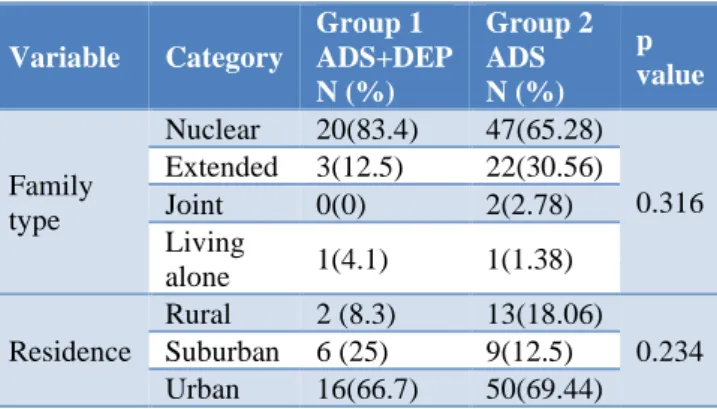
Table 2: Comparison of family type and residence of the study groups.
Variable Category
Group 1 ADS+DEP N (%)
Group 2 ADS N (%)
p value
Family type
Nuclear 20(83.4) 47(65.28)
0.316 Extended 3(12.5) 22(30.56)
Joint 0(0) 2(2.78) Living
alone 1(4.1) 1(1.38)
Residence
Rural 2 (8.3) 13(18.06)
0.234 Suburban 6 (25) 9(12.5)
Urban 16(66.7) 50(69.44)
Majority of Group 1 subjects (83.4%) and Group 2 subjects (65.28%) lived in nuclear family and belonged predominantly to urban back ground with Group 1, 66.7% against 69.44 in Group 2 (Table 2). There was no significant difference between the two groups in terms of socioeconomic status, type of family and residence.
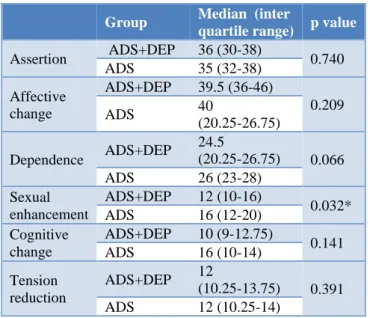
When comparing the expectancies of alcohol use among alcohol dependent patients with and without co-morbid depression, there was no significant difference between the two groups in terms of assertion, affective change, dependence, cognitive change and tension reduction. But there was a significant difference in the expectancy of sexual enhancement in both the groups with median score of 12 in Group 1 and 16 in Group 2 (Table 3).
1
25%
2
75%
GROUP 1: ADS+DEP
Table 3: Comparison of drinking expectancy of the
study groups.
Group Median (inter
quartile range) p value
Assertion ADS+DEP 36 (30-38) 0.740 ADS 35 (32-38)
Affective change
ADS+DEP 39.5 (36-46)
0.209
ADS 40
(20.25-26.75)
Dependence ADS+DEP
24.5
(20.25-26.75) 0.066 ADS 26 (23-28)
Sexual enhancement
ADS+DEP 12 (10-16)
0.032* ADS 16 (12-20)
Cognitive change
ADS+DEP 10 (9-12.75)
0.141 ADS 16 (10-14)
Tension reduction
ADS+DEP 12
(10.25-13.75) 0.391 ADS 12 (10.25-14)
Comparison of Global assessment of functioning showed a significant difference between the two groups. Patients with alcohol dependence with co-morbid depression were had poorer overall functioning compared to patients with alcohol dependence syndrome (Table 4).
Table 4: Comparison of global assessment of functioning.
Group Media
n 1st quartil e 2nd quartil e p valu e GAF score s ADS+DE
P 66 60 69 0.03
4
ADS 68 65 70
There were no significant differences in AUDIT scores between alcohol dependence only group and alcohol dependence with co-morbid depression group.
Table 5: Comparison of audit scores of the study groups.
Group Median (inter
quartile range) p value Audit total
scores
ADS+DEP 32 (27.25- 34.75)
0.124 ADS 30 (25.00 -33.00)
DISCUSSION
Results of this study found that comparing expectancy of alcohol use in ADS patients with and without co-morbid depression has found a significant difference in that patients with co-morbid depression are less likely to use alcohol for sexual enhancement. There were no significant differences observed in any of the other parameters linked to expectancy of assertion, affective change, dependence, cognitive change and tension
reduction in this study. Amy et al.12 among undergraduate
students using drinking expectancy questionnaire to compare the difference in alcohol expectancies between depression only group, social anxiety group and a control group showed that in depression only group there was a greater tension reduction expectancy than control group and greater sexual enhancement expectancies than both control group and social anxiety group. This study findings are different from the above study where in there was no difference in expectancies of tension reduction between both the groups and that there was a lower expectancy for sexual enhancement in depressed group. Lower sexual enhancement expectancy in the depressed group is possibly linked to reduced libido, which is a core biological symptom of depression.13 In addition, it is
possible that the negative cognitions of helplessness, hopelessness, personal inadequacy etc. in patients with depression may play a role in impacting positive expectancy linked to alcohol use and should be addressed in future studies. A 3 year follow-up study done among college students by Werner et al,showed students who became problem drinkers during college had significantly higher positive outcome expectation scores at college entry and end of their junior year and developed less concern for negative outcomes by the end of their junior year.14 Study done by Werner et al, among college
students showed that students' expectations of positive outcomes and their subjective evaluations of both positive and negative outcomes from drinking were significantly correlated with drinking and alcohol-related health problems indices.15 Heavier-drinking students and
those reporting more health problems expected more positive effects on their sociability and sexuality and were less concerned about cognitive and behavioural impairment as a result of drinking. Students with more health problems were less concerned that drinking would lead to risk-taking or aggressive behaviour. Thus positive and negative outcome expectancies and their subjective evaluations accounted for a significant portion of the variability in drinking and alcohol-related health problems.15
In this study there was no significant difference observed in terms of drinking severity as per AUDIT scores. The Task Force on College Drinking, commissioned by the National Institute on Alcohol Abuse and Alcoholism (NIAAA), designated alcohol expectancy challenges (ECs) as a recommended treatment strategy to reduce alcohol use among college students (NIAAA).16 Thus
modifying alcohol expectancies should be an important component of a successful relapse prevention program.
with and without DSM-IV co-morbid anxiety and/or
depression) were significantly less disabled and also drank significantly less alcohol on an average drinking occasion than at baseline. Despite this, the co-morbidity group remained more disabled and drank more heavily than the non-co-morbid group at follow-up.17 In this
study the lower functioning in the depressed group may be due to added burden of both the diseases rather than due to increased severity of drinking as there was no significant difference in severity of alcohol use observed among our study groups.
There are some limitations of this study. The study is done on a clinical sample. Hence, authors cannot generalize the above findings to general population. Additional information about the age of onset of alcohol use in dependence pattern and family history of alcohol dependence and depression or any other psychiatric illness among the two groups would have helped to compare and understand the above factors between both the groups.
Strengths of the study includes various points. This study although limited to alcohol dependent patients admitted to a tertiary care center has important findings that fill lacunae in research linked to expectancy of alcohol use in patients with major depression compared to patients of ADS without co-morbid depression. In addition, we carefully categorized and established a diagnosis of depression in patients with alcohol dependence syndrome. We specifically included only those subjects in the co-morbid group where depressive symptoms persisted beyond the period of withdrawal symptoms. Specifically focusing on the expectancy of alcohol use in both the groups may help identify factors linked to relapse prevention in both the groups and better treatment outcomes
CONCLUSION
ADS patients with co-morbid depression had lower alcohol expectancy on sexual enhancement compared to ADS only patients whereas no difference in expectancy was observed in terms of tension reduction, affective change, cognitive change and assertion. They also had lower functioning despite no difference in severity of alcohol use, could be due to added burden of both the diseases.
ACKNOWLEDGEMENTS
The authors acknowledge the valuable help of Dr. Ajith TA, Professor, Department of Biochemistry, Amala Institute of Medical Sciences, Thrissur, Kerala, India during the preparation of this manuscript.
Funding: No funding sources Conflict of interest: None declared
Ethical approval: The study was approved by the Institutional Ethics Committee
REFERENCES
1. Enns MW, Swenson JR, McIntyre RS, Swinson RP, Kennedy SH. Clinical guidelines for the treatment of depressive disorders. VII. Comorbidity. Can J Psychiatry. 2001;46:77S-90S.
2. Spaner D, Bland, RC, Newman SC. Major depressive disorder. Acta Psychiatr Scand. 1994;77:7-15.
3. Grant BF, Harford TC. Comorbidity between DSM-IV alcohol use disorders and major depression: results of a national survey. Drug Alcohol Depend. 1995;39:197-206.
4. Ross HE. DSM-III-R alcohol abuse and dependence and psychiatric comorbidity in Ontario: results from the mental health supplement to the Ontario Health Survey. Drug Alcohol Depend. 1995;39:111-28. 5. Kessler RC, Nelon CB, McGonagle KA, Liu J,
Swartz M, Blazer DG. Comorbidity of DSM-III-R major depressive disorder in the general population: results from the US National Comorbidity Survey. Br J Psychiatry. 1996;168:17-30.
6. Lynskey MT. The comorbidity of alcohol dependence and affective disorders: treatment implications. Drug Alcohol Depend. 1998;52:201-9. 7. Blane HT LK, editor. Goldman MS, Brown SA, Christiansen BA. Expectancy theory: thinking about drinking. In Psychological Theories of Drinking and Alcoholism. New York: Guilfor; 1987:181-226. 8. Stacy AW. Memory activation and expectancy as
prospective predictors of alcohol and marijuana use. J Abnorm Psychol. 1997;106:61-73.
9. Wiers RW, Van Woerden N, Smulders FT, De Jong PJ. Implicit and explicit alcohol related cognitions in heavy and light drinkers. J Abnorm Psychol. 2002;111:648-58.
10. Sher KJ, Wood MD, Wood PK, Raskin G. Alcohol outcome expectancies and alcohol use: a latent variable cross-lagged panel study. J Abnorm Psychol. 1996;105:561-74.
11. Zucker RA, Kincaid SB, Fitzgerald HE, Bingham CR. Alcohol schema acquisition in preschoolers: Differences between children of alcoholics and children of non-alcoholics. Alcohol Clin Exp Res. 1995;19:1011-7.
12. Amy KB, Hilary GC. Poster presentation. 8th Annual Samuel B Guze symposium on Alcoholism. University of Arkansas. 2008.
13. Sidney HK. Core symptoms of major depressive disorder: Relevance to diagnosis and treatment. Dialogues Clin Neurosci. 2008;10:271-7.
14. Werner MJ, Walker LS, Greene JW. Relation of alcohol expectancies to change in problem drinking among college students. Arch Pediatr Adolesc Med. 1995;149:733-9.
16. Labbe AK, Maisto SA. Alcohol expectancy
challenges for college students: a narrative review. Clin Psychol Rev. 2011;31:673-831.
17. Burns L, Teesson M, O'Neill K. The impact of comorbid anxiety and depression on alcohol treatment outcomes. Addiction. 2005;100:787-96.