THE IMPORTANCE OF SHIPPING TO A GLOBAL LNG BUSINESS
Anita OdedraVice President, Global Shipping Business BG Group plc
KEYWORDS: LNG, shipping, safety, flexibility, cost competitiveness, ship design ABSTRACT
BG Group has built an industry-leading, low cost, flexible liquefied natural gas (LNG) portfolio of supply and market access. Additional value is delivered through a combination of flexible supply contracts, access to multiple markets, control of shipping, low cost infrastructure and the skills and experience to capture global marketing opportunities. This agile approach enables BG Group to access high-value markets, wherever and whenever they occur.
BG Group's LNG shipping strategy is to secure and operate a safe, flexible and competitively priced LNG shipping portfolio with sufficient capacity to meet our expected LNG transportation requirements. This is undertaken through control of a LNG fleet meeting short, medium and long-term commitments.
The paper explores how BG Group has developed this strategy of safety, flexibility and competitiveness over time. It also addresses key industry issues and opportunities and possible responses.
With regard to safety, BG Group recognises the importance of individual actions and responsibilities in ensuring asset integrity, competency development and assurance through the development of both vessel crews and shore based operations staff.
In terms of flexibility, BG Group has incorporated ship design features and equipment that provide improved vessel safety, greater trading flexibility and enhanced operating economics. The paper describes BG Group's approach to the evolution in LNG ship technology application and design improvements.
For competitiveness, BG Group seeks LNG ship designs that lower operating costs, including fuel and natural boil-off, while reducing capital costs. The paper discusses the drivers of competitiveness that are necessary to ensure future success.
INTRODUCTION
BG Group utilises a combination of resource identification and market led strategies – knowing that with gas, identifying a market and understanding its economics is just as important as having hydrocarbon reserves in the ground. The Group’s underlying strategy is to connect low-cost resources to high-value markets. With a market led strategy, the Group locates high value markets where there is demand, then looks for resources that can be connected, either by pipeline or tankers, economically to those markets.
In line with this strategy, and based on the fact that the demand requirements of markets can change over time, BG Group has developed its global LNG business based on a portfolio of flexible supply volumes. A flexible LNG portfolio allows BG Group to divert cargoes at short notice to respond to changes in demand patterns and customer requirements.
Value is achieved through a combination of flexible supply contracts, access to multiple markets, low cost infrastructure, the skills and experience to capture global marketing opportunities, and control of shipping. This control is critical in ensuring short, medium and long-term commitments are met efficiently and effectively.
2 LNG SHIPPING STRATEGY
The shipping strategy takes into account economic, project risk and market conditions, and is aligned with the overall LNG marketing strategy, which is focused on securing the maximum value for BG Group’s existing LNG supply portfolio and also securing the necessary market positions required to launch new LNG supply projects. In order to meet its expected LNG transportation requirements, BG Group’s LNG shipping strategy focuses on securing and operating a safe, flexible and competitively priced portfolio of vessels with sufficient capacity.
i. Safety
Ensuring adequate control over shipping provides a greater ability to manage risks and quality, as well as influence change. BG Group’s Marine Quality Assurance Standards are applied to all ships in its portfolio. The Asset Integrity and Competence Assessment tools are key risk mitigations for the Group’s owned shipping operations. Finally,
BG Group’s shipping procurement strategy is underpinned by strict adherence to the Group’s Health, Safety, Security and the Environment (HSSE) standards.
ii. Flexibility
Flexibility in the shipping fleet creates significant value for BG Group’s LNG business and one of the Group’s competitive advantages has been the ability to work with customers to find creative supply and delivery solutions using its fleet flexibility. This fleet flexibility is created by securing options to extend charter terms at pre-agreed rates. Maintaining a sizeable chartering position (for mid-term and spot deals) allows BG Group to build relationships in the shipping industry as well as remaining immersed in the market to build up knowledge of market fundamentals.
iii. Cost competitiveness
Including some owned or long-term chartered ships in a portfolio is premised on an understanding that there can be a certain portion of the fleet under which are no regrets of committing to long-term shipping. Strategic coverage through such term shipping can help reduce the exposure to LNG shipping market volatility and provides the opportunity to develop BG Group’s technical and operational competencies, allowing us to benchmark vessel and crew efficiencies.
BG Group ensures delivery of these three key factors by focusing on:
Continuous monitoring of trading and marketing patterns to determine firm ship requirements; Actively managing the overall fleet composition, which includes a mix of owned and chartered ships,
a range of charter terms and options, see Photo 1;
Continuous monitoring of the charter and new-build markets to determine the optimal solution and timing to fill additional shipping requirements; and
Ensuring that the Group’s shipping portfolio is procured and operated to best practice standards, regardless of whether ships are owned or chartered.
This paper will now consider each of the three key factors in more detail. 1. Safety
Safety in shipping comprises the HSSE capability of the vessels and the crews. To this end, BG Group has developed two projects which focus on safety for BG Group owned vessels and their crews:
— Asset Integrity (AI) Management System and Enhancement Project — Competence Assurance Management System (CAMS)
Asset Integrity Management System and Enhancement Project
The aim of this project is to enhance the existing plant, processes, systems and documentation of ship managers that manage and operate LNG carriers owned by BG Group.
In so doing, this project aims to ensure that systems are robust enough to be successfully audited against the requirements of BG Group’s Asset Integrity Standard. This involves producing an auditable trail covering everything from the formal identification of credible threats to major accident hazards. In doing this, all barriers, safety critical systems, safety critical elements, and safety critical procedures are identified. This information is then captured in what BG Group refers to as The Safety Case.
The Safety Case demonstrates the safety aspects of BG Group owned vessels (assets) and shows that a series of formal assessments have been made to ensure that the selected asset design and operational arrangements are consistent with the requirement for safe and responsible operation. It is the means of ensuring and demonstrating that suitable and sufficient measures are in place to prevent a major accident occurring and to reduce the effects of these events, should they occur.
The occurrence of a major accident requires the failure of one or more physical barriers, often within complex scenarios. Achieving AI requires that suitable barriers are put in place, and that their ongoing suitability is managed throughout the asset life cycle such that they perform as intended when required to do so.
The existence of the physical barriers is not, in itself, sufficient to prevent major accidents. The effectiveness of the barriers is dependent upon numerous underlying common elements, such as well managed organisational practices and individual competencies, which are essential at every life cycle stage in achieving the initial provision and ongoing suitability of the barriers.
The risk of major accidents can never be completely mitigated. However, a systematic risk-management process which is correctly executed throughout the various life-cycle stages will significantly reduce the likelihood and impact of a major incident.
Copyright: BG Group.
Photo1, Methane Lydon Volney, one of BG Group’s core fleet of LNG carriers, at Elba Island terminal, USA.
4 Competence Assurance Management System (CAMS)
This system has been developed to ensure that any ship staff member involved in carrying out any safety critical task has the knowledge and capability to carry out this task.
In order to do this, a review is carried out to identify who is performing each task. This information is then transferred to a system which includes all names of staff, rank and training to record what has been done and when their next session is required.
For BG Group’s owned vessels, a review of the safety critical task matrix was conducted. It identified that over 20,000 assessments would need to be carried out on staff working on ships. Assessments are conducted in two parts; the first part tests the knowledge and the second part tests the capability ‘tell me then show me’.
The CAMS project went live onboard BG Group vessels in October 2011. To date, 45% of all assessments have been completed with the main focus being on the Chief Officer and Second Engineer. It is anticipated that all ship staff will have been assessed by September 2014.
Both the AI and CAMS projects require dedicated resources and planning over a long period of time. Dedication and diligence are critical to the success of both projects and there are no quick fixes to ensure that in the long-run, both the vessels and their crews achieve the highest HSSE standards to achieve BG Group’s aggressive target of zero harm.
Industry Initiatives
The industry recognises that the global shortage of qualified, experienced and certificated officers to sail on LNG vessels has been magnified by the rapid increase in the numbers of LNG vessels and new operators into the LNG sector. BG Group has worked with a broad range of other companies in the oil and gas industry on initiatives which ensure that there is no negative impact on safety, reliability and efficiency.
Some of these initiatives include:
- International Maritime Organisation (IMO) – Standards, Training, Certification and Watch-keeping (STCW); and
- Society of International Tanker and Terminal Operators (SIGTTO).
International Maritime Organisation (IMO) – Standards, Training, Certification and Watch-keeping (STCW)
Major revisions to the STCW Convention and its associated Code were adopted by the IMO at a Diplomatic Conference in Manila in June 2010, to ensure that the necessary global standards were in place to train and certify seafarers to operate technologically advanced ships for some time to come.
The amendments, which came into force on 1 January 2012, aim to bring the Convention and Code up to date with developments, since they were initially adopted in 1978 and further revised in 1995, and to enable them to address issues that are anticipated to emerge in the foreseeable future.
These amendments will be known as The Manila amendments to the STCW Convention and Code. Amongst the amendments adopted, there are a number of important changes to each chapter of the Convention and Code which affect BG Group’s fleet.
These include new requirements:
relating to training in modern technology;
for training in leadership, management and teamwork; for personnel serving on liquefied gas tankers; for security training, including piracy awareness; and for marine environment awareness training.
Society of International Gas Tankers and Terminal Operators (SIGTTO)
SIGTTO is a non-profit company, formed to promote high operating standards and best practices in gas tankers and terminals throughout the world. It provides technical advice and support to its members and represents their collective interests in technical and operational matters.
Three key guidance notes prepared by SIGTTO are:
Crew Safety Standards and Training for Large LNG Carriers. This guide to current best industry practice is for ship owners and operators who may be entering LNG ship operation for the first time. It is also of use to existing LNG operators who are training new crews due to expansion.
LNG Steamship Suggested Competency Standards for Engineers. These non-mandatory standards will form the default minimum for best practice and SIGTTO believes that they can and should be built upon by operators, who are encouraged to develop additional appropriate standards for their own operations and ships.
LNG/LPG Officer Experience Matrix. This offers transparent guidance to the assessment of the risk profile in relation to the officer complement by balancing thresholds of experience in ranks. The experience matrix considers a number of elements, including length of sea service, experience in rank, experience in LNG/LPG operations and training assessment.
In addition, at the end of 2011, SIGTTO set up a working group entitled Human Factors and Training. This addresses concern over the significant difference between the certified training systems and a lack of consistency across certifying authorities. It also addresses the lack of common requirements for training systems to assure competence after training is received and no requirement for continual improvement. Some certifying authorities appear to require comprehensive systems where others are taking a more relaxed view. Further there is no requirement for certifying authorities to report to SIGTTO on individual companies that they have certified. Accordingly the working group focuses on:
Developing guidelines for bodies certifying systems as being in compliance with SIGTTO competency standards;
Evaluation systems;
Shore based staff training; and Learning from others.
Through AI, CAMS and industry initiatives, BG Group aims to ensure a fleet that adheres to the Group’s HSSE standards and industry best practices.
2. Flexibility
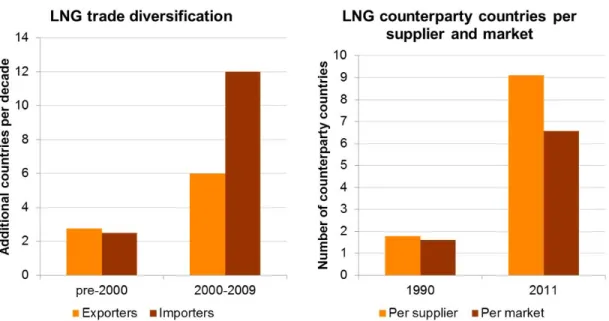
As the LNG trade has globalised over the past decade, BG Group has not only seen a rapid expansion in LNG trade, but also an increasing diversification of trade routes and an increasing variability of trade volumes. During the period of industry growth up to 1990, the global LNG trade saw supply grow at an average of 2.75 exporting countries added per decade, while markets were added at an average of 2.5 importing countries per decade. Throughout this time, trade was primarily regional and volumes largely locked into specific trade routes. Since the turn of the century, there has been a rapid rise in the number of exporters and importers joining the industry – six exporting countries and 12 importing countries joined between 2000 to 2009 – resulting not only in the addition of new players, but also in many new trade routes.
6
With over 30 countries now looking at LNG imports and new supply prospects emerging in, for example, the US, Canada and East Africa, continued diversification of trade appears to be a trend that is likely to continue. As the LNG trade has diversified, the number of counter-party countries each supplier and buyer deals with has increased accordingly. In 1990, suppliers had, on average, 1.8 markets (by country), and markets had on average 1.6 suppliers (by country). In 2011, this had increased to 9.1 markets and 6.6 supply countries, respectively. Suppliers and markets were both holding much more diversified trade portfolios, see Figure 1.
Figure 1. LNG trade diversification
During that time, BG Group has also seen an increasing variability of trade patterns, as the global LNG trade picture has been influenced by a growing range of local market fundamentals. LNG demand, and thus trade flows, is now influenced by hydro-levels in South America, Naphtha prices in India, the price of gas in the UK markets, pipeline supply levels in Turkey, weather in Asia, among others, in a wide range of factors. In particular, in recent years the industry has experienced rapid increases in demand created by the earthquakes in Japan in 2007 and 2011 and subsequent decline in use of nuclear energy as well as the rapid reduction in demand caused by the global economic downturn in 2009.
In addition to shorter-term weather events and exogenous market shocks, the LNG trade has also had to accommodate longer-term (multi-season) cycles in supply and demand, in part, as the planning lead-time between supply and demand elements has become increasingly miss-aligned.
While LNG supply projects still take many years to plan and implement, import projects – courtesy of fast-track Floating Storage and Regasification Units (FSRU) infrastructure – can be put in place much more rapidly. This has led to a number of markets seeking ‘bridging’ supplies in the form of volumes reallocated from existing trades. In particular this has been observed in Asia recently, where strong demand growth has outpaced first regional supply and more recently global supply.
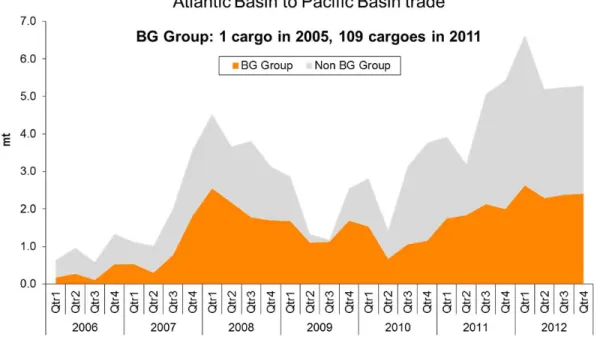
Atlantic Basin supply volumes into Asia have risen from just 3.5 million tonnes in 2006, to an estimated 22.4 million tonnes in 2012 as Asia has relied on flexible Atlantic Basin volumes to balance its markets. As the chart below shows, BG Group has played an important role in this component of the LNG trade, see Figure 2.
Figure 2. Atlantic Basin to Pacific Basin trade flows 2006 to 2012
Furthermore, to manage the flexibility that is demanded by our diverse trading requirements, BG Group has used ship design techniques to enhance operating efficiencies, such as fitting reliquefaction plants onto the Group’s 170,000m3 Tri Fuel Diesel Electric (TFDE) ships which are designed to operate most efficiently at high speeds that are suited well to a point-to-point liner trade but not always achievable when operating a trading portfolio. Hence the boil-off that would otherwise be wasted owing to the lower average speeds will be reliquefied rather than sent to the gas combustion unit. Changes in ship design are discussed in more detail in the following section.
To be able to meet these growing customer demands and market changes, BG Group has operated a flexible shipping portfolio accessing short, mid and long-term shipping dynamically and in step with the evolution of our LNG trading strategy.
3. Cost competitiveness
Obviously, negotiating competitive charter rates and ship build prices – both with valuable optionality – are key components of being cost competitive. However, after taking into account the capital or lease costs, the next cost to target is operating expenditure and this is where vessel efficiency becomes critical. This section focuses on some of the recent key developments and potential areas for continued improvement in ship and engine design.
LNG carriers have seen very few major step changes in the vessel design and their operations since they first came into service over forty years ago. In the last ten years, however, there have been some major changes with regard to propulsion options, vessel size and trading patterns.
LNG vessels were traditionally built with a reliable, but not very efficient, steam-turbine propulsion system, as boilers were the only means of consuming boil-off gas. Boil-off gas was generally viewed as waste gas that would be used as fuel. Within the last ten years, the introduction of Dual Fuel Diesel Electric (DFDE) propulsion systems (ships able to burn both diesel oil and gas) has created a jump in vessel efficiency. In real terms, a 145,000m3 steam vessel may have a total energy consumption, at the design speed and draught, of around 180 tonnes per day, whereas a DFDE equivalent would only need approximately 130 tonnes, representing an improvement of around 25-30%.
8
TFDE vessels – those able to burn heavy fuel oil, diesel oil and gas – offer much better operating flexibility and ability to optimise efficiency at various speeds. Despite some teething issues, this type of vessel is proving to be very reliable. The recent focus for TDFE designs has been on optimising of the engine sizing and arrangement to suit the vessel variable operating speeds. Matching generator sizes so they operate at their sweet spot will further reduce the vessel fuel consumption and can be very beneficial for operating at a range of speeds.
For steam propulsion and now DFDE/TFDE, design efficiency improvements have continued to improve the overall propulsion plant efficiency; however, compared to the huge improvements in the last decade, the rate of improvement is now a little slower although there is still much work underway to continue to strive for additional efficiency optimisation.
With the large Qatari ships utilising traditional slow speed engines for propulsion, and reliquefaction plants to handle the boil-off gas, renewed interest has arisen to find a solution to run slow speed engines on gas. This has seen solutions being developed by the engine makers in the form of high pressure slow-speed gas-injection (ME-GI) engines or low-pressure slow-speed gas engines. This change takes advantage of the improved efficiency of the slow speed diesel cycle over a medium speed diesel engine.
Take the case of a 170,000m3 LNG carrier. If one assumes that the vessel is operating at design speed, fully laden in gas mode; an ME-GI vessel will consume approximately 15-20% less fuel than the same vessel with a TFDE propulsion system.
However, the challenges currently being reviewed, and that need to be overcome, for ME-GI engines are the way the fuel gas is delivered to the main engines and how the cargo condition is being maintained en route. The standard method of high pressure liquid vaporisation means that the natural boil-off gas needs to be reliquefied separately. The addition of the reliquefaction plant takes away a high proportion of the efficiency gains of an ME-GI vessel over a TFDE vessel – which becomes more significant at operating speeds between the design speed and the natural boil-off speed of the vessel.
Operating two, direct-drive, slow-speed engines removes some of the operator’s ability to optimise engine load over a range of speeds although that is unlikely to be a major issue for most LNG carriers. Taking a high-level view; slow-speed engines, whether ME-GI, low pressure injection, or both; ME-GI vessels appear to be a very good option, especially for point-to-point liner trades and higher operating speeds. Although emissions compliance for these slow speed engines, on certain fuels when LNG is not available, may be the biggest hurdle to overcome.
The next step change in propulsion plant efficiency, whilst maintaining fuel and speed flexibility, is not clear. A possibility is a hybrid system. However, the marine industry has traditionally not favoured high complexity systems, with high capex, as these have to be reliable, maintained and will be out of touch of shore support for most of the time. Fortunately, there are many other aspects of LNG carriers that can be made more efficient, such as hull form and wake flow into the main propulsor and rudder.
Shipyards have traditional optimised the hull form around the ship build contractual guarantee value at 19.5 knots when the vessel is laden. As a consequence, the yards compete at this figure and designs are evaluated at this point. The 19.5 knots figure is a legacy from liner trades and when vessels had higher boil-off rates. It is now the minimum standard to which nearly all LNG carriers are built as it is the figure in the industry-standard Time Charter Party (TCP) agreement for LNG vessels (ShellLNGTime1). Independent LNG carrier owners typically specify a higher design speed (19.9 knots for example), partly to ensure that they have enough margin to meet TCP requirements, especially when carrying out maintenance on one generator engine at sea.
There is of course an issue here – one size cannot be suitable for all. However at the very least there needs to be a recognition that an LNG carrier typically operates at a ballast draught for 50% of its time, not always in calm weather conditions and at varying speeds. The bulbous bow, as one obvious example, may optimise a fully loaded vessel at 19.5 knots, but will not necessarily be the best for 16 knots in ballast.
BG Group has been studying the effect of hull form on weighted average fuel consumption in both laden and ballast conditions, over a range of agreed speeds (12.0 to 19.5 knots). What this can mean is a 1% increase in daily fuel consumption at 19.5 knots laden could mean a 15% reduction in consumption in the ballast condition at 16 knots. By looking at the whole operating profile of the ship, BG Group has been able to work with the shipyards and significantly reduce the weighted average fuel oil consumption (FOC) of a LNG vessel taking into account BG Group’s typical operating profile at each speed. More work needs to be done in this area to find the best hull form that reduces FOC over the whole operating range of the ship and BG Group believes further reduction over the current average may be possible,
There has been a dramatic increase in vessel size from the almost standard 125,000m3 to 135,000m3 sizes built in the nineties and early two thousands, to the massive Q-Flex and Q-max ships ordered for Qatar which delivered only a couple of years ago. This increase in size has also brought about its own problems with regards to boil-off rates and the means of handling this, such as onboard reliquefaction. BG Group now sees the standard LNG ship on order in the 160,000m3 to 175,000m3 range. This increase in vessel size has brought its own problems that were not encountered with the older smaller LNG ships, that of too much boil-off gas for propulsion. The owners and shipyards are becoming victims of their own success, in reducing the power needed by the vessel and improving the efficiency of the propulsion systems. Therefore, it is becoming increasing important to reduce boil-off rates of the cargo insulation system, if the owner does not want to employ other means of maintaining the cargo such as a reliquefaction plant. Additionally, in contrast to the traditional view of boil-off as waste gas, traders have a different view. Boil-off gas is potentially lost value depending on the price of alternative Heavy Fuel Oils (HFO) or distillate fuels.
10
Copyright: BG Group.
Photo 2. Three of BG Group’s LNG vessels; Methane Patricia Camilla, Methane Becki Anne and Methane Mickie Harper at various stages of construction at the
Samsung Heavy Industries Yard, Geoje Island, South Korea
Most existing DFDE vessels have natural boil-off speeds in excess of over 18 knots. Whenever the ship sails at speeds below this speed, excess boil-off gas has to be incinerated and wasted. This was the main driver for BG Group to fit a re-liquefaction unit to its SHI-built 170,000m3 ships delivered in 2010.
BG Group and others have been working with the yards and the containment system licences to look at improving the boil-off rate of their containment systems. This has resulted in an impressive reduction of 30% in the boil-off rate figures that were used in LNG ships built prior to 2012. In real terms, for a 170,000m3 ship, this equates to approximately 110 tonnes of LNG, with a boil-off rate of 0.15%, compared to approximately 75 tonnes, with a boil-off rate of 0.10%, that has to be handled by the propulsion system.
BG Group is continuing to work with yards and containment licensors to further reduce the vessel boil-off rate by improving insulation and looking at means of preventing heat ingress into the tanks to reduce this figure further. This struggle to avoid installing re-liquefaction plant on-board is a particular challenge for specific vessel size and operating profiles. Whilst re-liquefaction provides operational flexibility, but a passive solution with zero opex cost is often the preferred choice.
LNG ships have seen a technology shift with the advent of alternative propulsion options such as DFDE, slow speed with reliquefaction and ME-GI. This has spurred engine / turbine makers to continue to develop alternative options for LNG ships and we now have at least four options from improved efficiency turbines, TFDE, slow speed with re-liquefaction and slow speed gas injection from more providers. Each of these systems and options has its strengths and weaknesses. When considering the propulsion choice, careful consideration is needed in selecting an option and will depend on many variables such as route, fuel availability, allowable maintenance periods, system reliability, liner versus portfolio or spot trades, speed operating range and vessel size. BG Group values trading flexibility and requires its vessels, see Photo 2, to
call at any number of terminals and will operate them a variety of speeds. This may mean a solution which is optimised for a portfolio player like BG Group may not be as efficient as one optimised for a project-specific liner trade on a dedicated schedule.
CONCLUSION
The paper discusses the three pillars of BG Group’s shipping strategy – safety, flexibility and cost competitiveness – and how each has evolved in time. As the industry and BG Group’s trading strategy continues to evolve, so will the Group’s shipping strategy.
BG Group’s LNG traders will continue to seek more innovative commercial structures whilst the constant challenge to match supply and demand will require that the Group’s shipping procurement strategies will require resetting at regular intervals. Flexibility will, therefore, remain key to the success to both the LNG and the freight trader.
With the number of ships entering the LNG shipping industry, no one can afford to lose focus on the flawless HSSE record to date. Aspects of BG Group’s AI and CAMS initiatives are mirrored in other companies under different acronyms and it behoves the industry as a whole to collaborate on lessons learned and joint initiatives such as the DFDE owners club and the Mark III owners club; where owners openly share challenges and solutions in an effort to keep the industry safe and reliable.
As technology marches on in the never ending search for vessel efficiency as well as efforts to reduce greenhouse gas emissions, LNG crews will constantly need to be retrained and their ability to manage more complex systems safely and still meet ever changing trading patterns will be testament to the long-term success of the oil and gas industry.
This remains an exciting business, rich in nuance and dynamic in nature, and which if understood and reacted upon in a careful and managed approach, will bear fruit for many seasons to come.