Research Article
a
August
2017
Computer Science and Software Engineering
ISSN: 2277-128X (Volume-7, Issue-8)
Secular Form to Affiliation Rule Mining Employing P-tree
and T-tree
Aparna Agrawal
Lecturer Deptt of Computing, Middle East College, Muscat, Oman
Deevyankar Agarwal
Lecturer, Deptt of Engineering, Higher College of Technology, Muscat, Oman
DOI: 10.23956/ijarcsse/V7I8/0146
Abstract: The real commercialisminformation often demonstrates temporal feature and time varying behavior. Temporal affiliation rule has thus got an active area of explore. A calendar part such as months and days, clock parts such as hours and seconds and differentiated units such as business days and academic years, act a major role in a wide range of information system applications. The calendar-based form has already been proposed by explorers to restrict the time-based association ships. This paper advises a novel algorithmic program to determine association rule on time dependent data employingeffective T tree and P-tree data structures. The algorithm complicates the significant advantage in terms of time and memory while comprising time dimension. Our approach path of scanning based on time-intervals yields littlerinformation set for a given valid interval thus cutting down the processing time. This approach is enforced on a synthetic data-set and result shows that temporal TFP tree collapses better performance over a TFP tree access.
Keywords: temporal, P-Tree and T-Tree
I. INTRODUCTION
Effective algorithm for determination frequent forms has been one of the key success stories of data mining. The Apriori algorithm [1] by Agrawal et al is founded on support-confidence example. It commences with counting the affirm of each and every item of transaction table. It constitutes of two phases; (1) Candidate contemporaries in all possible compounding. (2) The information scanning and counting of all deals for each item set. The process covers as long as frequent item is available. There are some apt questions which can be raised like - What about mining the
Associationship in all forms of a certain type throughout a specific time interval. Associationship in all forms of a certain type with a specific periodicity.
Associationship in all forms of certain type with a particular periodicity throughout a specific time interval.
All these argumentsindicate that data is contingent upon time. Time acts ansignificant role in real information set. In various business concern setups such as stock market and share market time is most significant dimension In existing algorithmic programs like Apriori [1] and Fp-growth [7] when time expression is demanded in the information set, it provides useful information for business, but it increases the time complexity because it is needful to scan the information for every valid specific interval. Though Fp-growth is one of the well-known approaches for detecting frequent item set, but it performs miserably when the nature of data is sparse. Sparse data produces large number of clients and if temporal dimension is also comprised on information set, it again increases the branches of tree and is thus unmanageable to fit in memory. In such case Apriori outperforms Fp-growth approach.
Our suggested approach is aimed at devising an effective algorithm for mining as-association rule in time-based information set by using effective data storage mechanism- Temporal T-tree.
Definition 1:
A temporal rule is a triplet <form, periodicexp, interval exp>, where rule is a general form which may be a trend, a categorization rule, an association a causal relationship etc. Periodicexp is a periodic time expression or a special symbolize p_null with φ (p_null) being {T} and intervalexp is a general interval formula or a special symbol I_null with φ (p_null) being {T}. It expresses that form hold during each interval in φ (periodicexp 0 intervalexp). T is the time domain. [10]
Given a time-stamped information set D over a time domain T, the problem of mining temporal form of a certain type is to discover all form of the form <form, peri-odicexp, intervalexp> in D which satisfy all the user defined threshold with respect to described minimum ratiomin_f% with some given condition.
Three attributes of the algorithm are of interest when considering its performance: The number of information access required
The no. of computational step commanded in counting subset of records The memory necessities.
ISSN(E): 2277-128X, ISSN(P): 2277-6451, DOI: 10.23956/ijarcsse/V7I8/0146, pp. 155-160 The rest of the paper is organized as follows: Section 2 discusses some related works. In section 3 defines temporal association rule in term of calendar outline. In Section 4 elaborate the proposed work, section 5 demonstrates the experimental study and section 6 elaborates conclusion and future works and section 6 furnishes application of above investigation.
II. RELATED WORK
The conception of association rule was brought in as Apriori algorithm [1]. Its execution was improved by spreading frequent-form growth approach [7]. In paper [6] the omission of the time dimension in association rule was very clearly observed. A temporal aspect of association rule was given by Juan [5]. According to this the transactions in the information are time stamped and time interval is assigned by the user to divide the data into disjoint segments, like month, days, and years. Further the cyclic association rule was acquainted by Ozden [6] with lower limit support and high confidence. Using the definition of cyclic association rule, it may not have high support and assurance for the entire transactional information. A nice bibliography of temporal data mining can be detected in the Roddick literature [8]. Rainsford and Roddick presented extension to association rules to adapt temporal semantics. According to [9] logic the technique first explores the associationship than it is wont tocomprise-rate temporal semantics. It can be applied in point based and interval based example of time simultaneously [9]. A Frequent formaccess for mining the time sensitive data was brought in in [4] where the formratio history under a tilted-time window example is used to answer time-sensitive queries. A collection of item forms along with their ratio histories are compacted and stored using a tree structure similar to FP-tree are updated incrementally with entering transactions [4]. Li et. al. addresses the calendar based association rule problem [11], the result demonstrates temporal Apriori is 5 to 22 times faster than direct Apriori, for fuzzy match temporal Apriori is 2.5 to 12 times faster than direct Apriori and the execution time extremely decreases with respect to precise match or fuzzy match.
III. PROBLEM DEFINITIONS 3.1 Association Rule
The conception of association rule, which was prompted by market basket psychoanalysis and was originally demonstrated by Agrawal [1]. Given a set of T of deal, an association rule of the form X Y is aacquaintanceamong the two disjoint item sets X and Y. An association rule meets some user-given demands. The support of an item set by the set of deal is the fraction of transaction that contains the item set. An item set is said to be large if its support exceeds a user-given threshold minimum support. The confidence X Y over T is a transaction comprising X and also comprising Y. Due to complex candidate generation in the data set Jiewai Han invented a new proficiency of FP-growth method for mining frequent form without candidate generation [7]. In our opinion this mining association ship will become more utile if we include the time factor in to it.
3.2 Temporal Association Rule
Definition 2: The ratio of an item set over a time period T is the number of transactions in which it happens divided by total number of transaction over a time period. In the same way, confidence of a item with another item is the transaction of both items over the period divided by first item of that period.
Support (A) = Ratio of occurrences of A in specified time interval / Total no of Tuples in specified time interval Confidence (A =>B[Ts,Te] ) = Support_count(A U B) over Interval / occurrence of A in interval
T
s indicate the valid start time and Te indicate valid time according to temporal data.
3.3 Simple Calendar Based Form
When temporal information is applied in terms of date, month, year and week they form the term calendar outline. It is introduced in temporal data mining. A calendar outline is a relational outline (in the sense of relational information’s) R = (f
n : Dn, Fn-1: Dn-1,………F1 :d1) together with a valid constraint. A calendar outline (year: {1995,1996,1997…..},
month: {1,2,3,4,……12}, day: {1,2,3…..31} with the constraint is valid if that evaluates (yy, mm, dd) to True only if the combination gives a valid date. For example <1955, 1, 3> is a valid date while <1996, 2, 31> is not.
In calendar form, the branch e cover e’ in the same calendar outline if the time interval e’ is the subset of e and they all follow the same form. If a calendar form<d
n, dn-1, dn-2……..d1> covers another form<d’n, d’n-1;, d’n-2 ……..d1> if and only
if for each I, 1 <= i <= n or d
i = d’i. Now our task is to mine frequent form over arbitrary time interval in terms of
calendar formoutline.
IV. PROPOSED WORK
The support of information set in the data warehouse can be maintained by dividing it into dissimilarintervals. The support of a item in interval t1 cannot be the same in interval t2. An infrequent or less support item in interval t1 can be frequent item in interval t2.
ISSN(E): 2277-128X, ISSN(P): 2277-6451, DOI: 10.23956/ijarcsse/V7I8/0146, pp. 155-160 size of information set and increases the performance and efficiency of algorithm. It can solve following queries: (1) what are the frequent set over the interval t
1 and t2? (2) What are the period when (a, b) item are frequent? (3) Item which
are dramatically changed from t4 to t1.
Fig. 1.Frequent form in different interval
4.1 Partial Activity
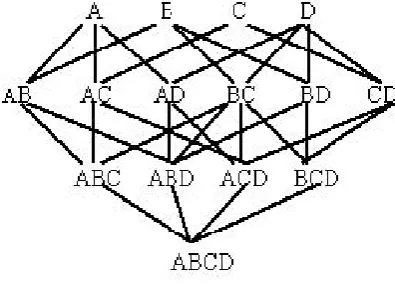
Most of the existent methods described above proceed fundamentally on each information pass by defining some candidate set and then analyzing each record to identify all the members of the candidate set that are subsets of the record, incrementing a support-count for each. The computational cost of these gainswith the density of information in information records, i.e. when the average number of attributes demonstrate in a re-cord is high, leading to an exponential increase in the number of subsets to be considered, and when candidate sets are large. In principle, however, it is possible to reduce this cost of subset- counting by exploiting the relationships between sets of items. For example, in the simplest case, a record containing the attribute set ABD will cause incrimination of the support-counts for each of the sets ABD, AB, AD, BD, A, B and D. Strictly, however, only the first of them is necessary, since a level of support for all the subsets of ABD can be inferred subsequently from the support-count of ABD.
Fig. 2.Lattice of item {A, B, C, D}
Let i be a subset of the set I (where I is the set of n attributes represented by the information). We fixPi, the partial support for the set i, to be the number of records whose capacities are identical with the set i. Then Ti, the total support for the set i, can be determined as:
= ---(1)
This allows us to contend a general algorithm for computing total supports. Let P be the set of partial support considersPi corresponding to sets i which appear as records in the information, and T be the set of total support counts in which we are concerned (however this is defined). With the members of P and T initialized to zero.
Algorithm A
Inputs: Transaction DS, countset P
Output: Returns P and T counting sets in DS Method:
A1: ∀ Records j in DS do begin add 1 to Pj
insert j to P end;
A2: ∀ j in P do begin .i in T, i ⊆. j do begin add Pj to Ti
ISSN(E): 2277-128X, ISSN(P): 2277-6451, DOI: 10.23956/ijarcsse/V7I8/0146, pp. 155-160 For aninformation of m records, stage 1 of the algorithm (A1) executesm support-count accuses in a single pass, to compute a total of m partial supports, for some m’≤ m. The second stage of the algorithm (A2) demands, for each of these, the investigation of subsets which are members of the target set T. In an exhaustive interpretation of the method acting, T will be the full set of subsets of I. Computing via summation of partial supports, however, offers three potential
advantages. Firstly, when n is small (2
n
<< m), then A2 involves the accumulation of a set of counts, which is significantly smaller than a summation over the whole information. Secondly, even for large n, if the information contains a high degree of duplication (m’ <<m) then the stage 2 summation will again be significantly faster than a full information pass, especially if the duplicated records are densely-populated with attributes. Finally, and most generally, we may use the stage A1 to organize the partial counts in a way which will help a more effective stage 2 computation, exploiting the structural relationships inherent in the lattice of partial supports.
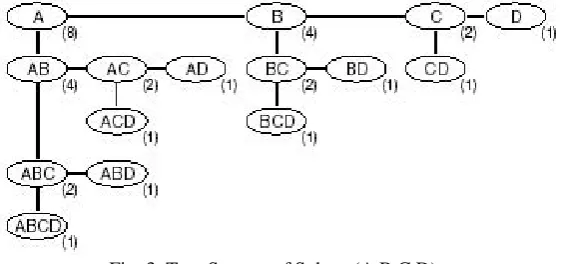
Fig. 3.Tree Storage of Subset (A,B,C,D)
Figure 3 demonstrates an alternative representation of the sets of subsets of I , for I = {A, B,C, D}, in the form of Rymon’s [13] set numbering tree. In this structure, each subtree contains all the supersets of the root node, which follow the root node in lexicographic order.
4.2 Algorithm for Giving Calendar Based Temporal Association Rule Employing TFP Tree
The proposed algorithmic program first extract the data of particular interval from whole data set and apply the TFP Mining approach path to find frequent itemset on that specific intervals.
Input: A Transaction Information D, Specified calendar form<dd, mm,yy>
Output: Frequent item set, Temporalinformation table TDB
Method:
Step (1) Set pointer to first record of information
Step (2) Scan the Information one by one and follow the Step(3) Step (3) {
Step (4) If data ∈<dd,mm,yy>
Step (5) Send the data into Temporalinformation Table TDB Step (6) }
Step (7) set K = 1
Step (8) Build level K in the T -tree.
Step (9) “Walk” the P-tree, applying algorithm TFP to add interim sup-ports associated with individual P-tree nodes to the level K nodes established in (2).
Step (10) Remove any level K T-tree nodes that do not have an adequate level of support. Step (11) Increase K by 1.
Step (12) Repeat steps (8) through (11); until a level K is reached where no nodes are adequately Supported.
In above algorithm step (1) to step (5) used to find out the itemset, which occurs on valid time period specified by calendar outline. Step (7) to step (12) used for min-ing frequent item set from TFP tree.
V. EXPERIMENTAL REFLECTIONS
ISSN(E): 2277-128X, ISSN(P): 2277-6451, DOI: 10.23956/ijarcsse/V7I8/0146, pp. 155-160
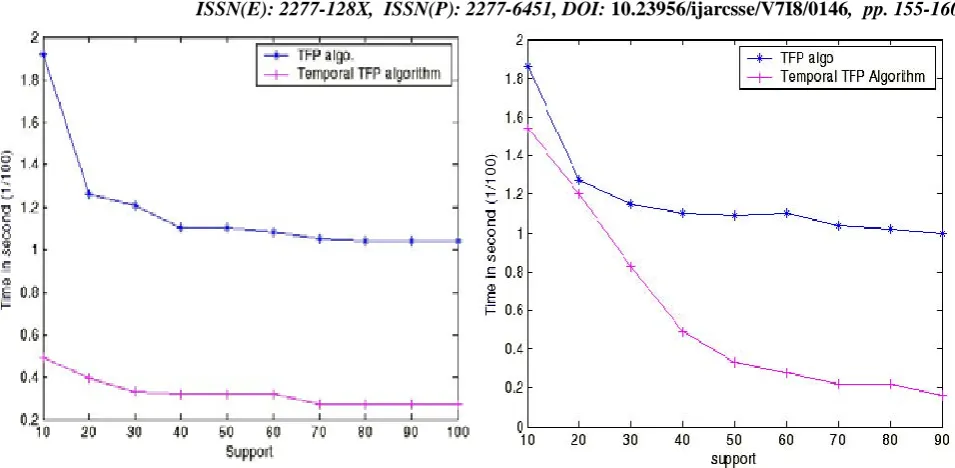
Fig. 4.Relative graph of TFP tree and Temporal TFP tree
VI. CONCLUSIONS AND FUTURE WORK
In real world data the knowledge used for mining is always time changing. Real transactional information’sparticularly exhibit temporal characteristic and time varying behavior. For example, in Telecommunication Data Analysis, the calling form may vary with time. Similarly for Market Basket Analysis the associationships among various items may alter with time and also that this transaction Information may have either sparse or dense information. In this paper we have adopted time sensitive approach and demonstrated an algorithm for mining frequent itemset on specified time interval employing TFP approach. Frequent items generated for specific time interval have great impact from the information’s. It has the capability to affect all aspects of behaving business in today’s world. It will empower decision makers with realistic results and that too with more accuracy and reduced time lag. It will thus help in more realistic and relevant decision-making. An inherent advantage of using P- tree and T- tree structure is in having branches which can be considered severally and therefore the structures can be rapidly adapted for use in parallel / distributed Association Rule Mining.
REFERENCES
[1] R. Agrawal and R. Srikant , R : Fast algorithm for mining association rule. In VLDB’94 Chile , Sept (1994) ,pp –487-499.
[2] Coenen, F.P., Goulbourne, G. and Leng, P.H. (2001). Computing Association Rules Using Partial Totals. In de Raedt, L. and Siebes, A. (Eds), Principles of Data Mining and Knowledge Discovery, Proc PKDD 2001, Spring Verlag LNAI 2168, pp 54-66.
[3] FransCoenen, Paul Leng, and Shakil Ahmed, Data Structure for Association Rule Min-ing T-tree and P- Tree, IEEE transaction on Knowledge Discovery and Data Engineer-ing, Vol 16, No 6 ,(2004).
[4] Chris Giannella_, JiaweiHany, JianPeiz, XifengYany, Philip S. Yu R: Mining Frequent Forms in Data Streams at Multiple TimeGranularities, pg 191 – 210, H. Kargupta, A. Joshi, K. Sivakumar, and Y. Yesha (eds.), Next Generation Data Mining, (2003).
[5] Juan M .Ale, Gustavo H. Rossi R: An approach to discovering temporal association rules, ACM SIGDD March 1..21,(2002).
[6] BanuOzden , Sridhar Ramaswamy , AviSilberschatz R: “Cyclic Association Rule” ,In Proc. Of forteenth International conference on Data Engineering (1998), pp 412-425.
[7] Jian Pei, Jiawei Han, Yiwen Yin and Running Mao R : Mining Frequent Form without Candidate GenerationProc. ACM-SIGMOD Int’l Conf. Management of Data, pp. 1-12, (2000).
[8] John F. Roddick, Kathleen Hornsby, Myra Spiliopoulou: An Updated Bibliography of Temporal, Spatial, and Spatio-temporal Data Mining Explore. TSDM 2000: pp147-164.
[9] Chris P. Rainsford, John F. Roddick R: Adding Temporal semantics to association rule, 3rdInternational conference KSS Springer 1999, pp 504-509.
ISSN(E): 2277-128X, ISSN(P): 2277-6451, DOI: 10.23956/ijarcsse/V7I8/0146, pp. 155-160 [11] Yingjiu Li, PengNing, X. Sean Wang ,SushilJajodia. Discovering calendar- based temporal association rules,
Data and Knowledge Engineering volume 4,Elesvier publisher, Volume 44 pp– 193-214 ,(2003).
[12] FransCoenen, Paul Leng, and Shakil Ahmed , Data Structure for Association Rule Mining : T-tree and P- Tree, IEEE transaction on Knowledge Discovery and Data Engi-neering, Vol 16, No 6 ,(2004).