Research Article
a
April
2018
Special Issue: National Conference on Emerging Trends in Engineering 2018
Conference Held at Sri Venkatesa Perumal College of Engineering & Technology, Puttur, A.P., India
Computer Science and Software Engineering
ISSN: 2277-128X (Volume-8, Issue-4)
Design and Implementation of Image Fusion Using Edge
Preserving Decomposition
M. Hema1, Dr. N. Sudhakar Reddy2, Dr. D. Gowri Sankar Reddy3
1
Assistant Professor, Department of Electronics and Communication Engineering, Sri Venkatesa Perumal College of Engineering & Technology, Puttur, Andhra Pradesh, India
E-mail:[email protected] 2
Professor, Department of Electronics and Communication Engineering, Sri Venkatesa Perumal College of Engineering & Technology, Puttur, Andhra Pradesh, India
E-mail:[email protected] 3
Associate Professor, Department of Electronics and Communication Engineering, Sri Venkateswara University, Tirupati, Andhra Pradesh, India
E-mail:d.durgamgmail.com
Abstract: Image fusion is a very important tool in image processing basically it’s applications with in the areas of medical image processing, remote sensing. Image fusion is introduced basically due to the reason of less clarity images because in several situations image processing requires high spatial and high spectral resolution in a single image. The image fusion output is single image which gives more informative and accurate than any single source image and it consists of all the necessary information. In this paper three different types of filters are used in edge preserving decomposition technique image fusion are taken and finding the best methodby using image quality metrics parameters. Experimental results demonstrate that the projected methodology will get progressive performance for fusion of same sensing element images, completely different sensing element images.
Key Words: Gaussian Filter, Sharpening Filter, Laplacian Filter, Laplace Gaussian Filter
I. INTRODUCTION
Data fusion is a process dealing with data and information from multiple sources to achieve refined information for decision making. Image fusion is the combination of two or more different images to form a new image by using a certain algorithm. The purpose of image fusion is not only to reduce the amount of data but also to construct images that are more appropriate and understandable for the human and machine perception but most of the available equipment is not capable of providing such data convincingly because of that reason only Image fusion techniques are introduced which allow the integration of different information sources. Then finally gives fused image can have complementary spatial and spectral resolution characteristics. However, the standard image fusion techniques can distort the spectral
information of the multispectral data while merging. Finally the consolidated output of single image contains the high
spectral and spatial data in several conditions. The distinctiveness between Spectral resolution and also the spatial resolution may be balanced by the image fusion.
Categorization of image fusion techniques:
1. Signal level fusion. 2. Pixel level fusion. 3. Feature level fusion. 4. Decision-level fusion
Different types of image fusion:
1. Multi view fusion 2. Multi modal Fusion 3. Multi focus fusion 4. Multi spectral fusion
Sensors employed in Medical Diagnosis: In medical diagnostics and treatment common term used is Image fusion. For the purpose of providing additional information multiple images of a patient are registered and overlaid or merged. By using multiple images from the same imaging modality or by combining information from multiple modalities created a fused image.
Different types of modalities in medical diagnostics namely magnetic
diagnosing and treating cancer. With the advent of these new technologies, radiation oncologists can take full advantage of intensity modulated radiation therapy (IMRT). Being able to overlay diagnostic images into radiation planning images results are more accurate IMRT target tumor volumes.
MULTI VIEW IMAGE FUSION: Images of the same modality, taken at the same time but from different places or under different conditions or from different viewpoints.
II. DIFFERENT TYPES OF FILTERS:
Filtering: This is a technique for modifying or enhancing an image. For example, by filter an image to emphasize certain features or remove other features. Image processing operations implemented with filtering include smoothing, sharpening, and edge enhancement.Image filtering can be grouped in two depending on the effects:
1. Low pass filters (Smoothing): Objectives: Reduce noise in the image
Low pass filtering is employed to remove high spatial frequency noise from a digital image. The low-pass filters usually employ moving window operator which affects one pixel of the image at a time, changing its value by some function of a window of pixels. The operator moves over the image to affect all the pixels in the image.
Low pass filters are mainly two types:
Linear filters:
• Mean filter • Triangle filter • Gaussian filter
Non-linear filters:
• Median filter • Kuwahara filter
2.High pass filters (Edge Detection, Sharpening):
A high-pass filter can be used to make an image appear sharper. These filters emphasize fine details in the image. Sharpening an image increases the contrast between bright and dark regions to bring out features. Most of digitized images need correction of sharpness. Human perception is highly sensitive to edges and also fine details in image so Image sharpening is used to highlights edges and fine details in an image. Image sharpening is widely used in printing and photographic industries for increasing the local contrast and sharpening the images.
Sharpening filters namely: • Laplace filter • Unsharp mask • High boost filter • Gradient mask
• Sharpening image with MATLAB.
III. FILTERS USED IN IMAGE FUSION: 1. Gaussian filter:
The Gaussian smoothing operator is a 2-D convolution operator that is used to remove detail and noise. In this sense it is similar to the mean filter, but it is a point-spread function uses a different kernel that represents the shape of a Gaussian hump. It is very similar to the optimal smoothing filter for edge detection under the criteria used to derive the Canny edge detector.
2. Sharpening filter:
Sharpening an image increases the contrast between bright and dark regions to bring out features. The sharpening process is basically the application of a high pass filter to an image.
3. Laplacian filter:
Laplacian filter is a second derivative edge detector operator. Laplacian is more sensitive to noise than sobel and prewitt. Laplacian calculate the difference of center point to the surrounding pixels.
Spatial filter-laplacian guassian filter:
ISSN(E): 2277-128X, ISBN: 978-93-87396-07-4, pp. 168-174
There are different ways to find an approximate discrete convolution kernel that approximates the effect of the Laplacian. A possible kernel is
This is called a negative Laplacian because the central peak is negative. It is just as appropriate to reverse the signs of the elements, using -1s and a +4, to get a positive Laplacian. It doesn't matter.
To include a smoothing Gaussian filter, combine the Laplacian and Gaussian functions to obtain a single equation:
The LoG operator takes the second derivative of the image. Where the image is basically uniform, the LoG will give zero. Wherever a change occurs, the LoG will give a positive response on the darker side and a negative response on the lighter side. At a sharp edge between two regions, the response will be
Zero away from the edge
Positive just to one side
Negative just to other side
Zero at some point in between on the edge itself
IV. TECHNIQUE EMPLOYED FOR FUSION: EDGE PRESERVING DECOMPOSITION:
It is mainly used in medical or satellite imaging the edges is influential features and thus must be preserved sharp and undistorted in smoothing. Mainly to limit the smoothing designed Edge-preserving filters at “edges” in images measured, e.g., by high gradient magnitudes.
Edge preserving algorithmic contains mainly 2 key observations:
(1) Detail (even if high-contrast) is characterized by an oversized density of native extremal;
(2) Salient edges (even if low-contrast) area unit characterized by an oversized variation in their neighboring extremal values.
Smoothing:
Extract detail by subtracting a smoothened image, that we have a tendency to decision the mean, from the input.
Our smoothing algorithmic rule consists of 3 steps:
1. Finding image minimum and image maximum; 2. Computation of the smoothened mean M
The detail layer is obtained as D = I −M.
Multi scale decomposition:
A single smoothing operation of I yields a detail image, D1, which contains the finest-scale native oscillations and a mean, M1, which represents a coarser trend. By get detail pictures D1, D2, ...,Dn at increasing scales of coarseness and a residual mean image:
I(P) = (D1+D2+D3+----Dn) +I
V. OBJECTIVE FUSION ANALYSIS METRICS
Structural similarity index metric can show similarity in the small structures between the original and reconstructed images, PSNR, RMSE, Normalized Cross Correlation, Normalized Absolute Error, and Structural Content by using above image fusion metrics evaluate the best filter for preserving edges.
VI. RESULTS
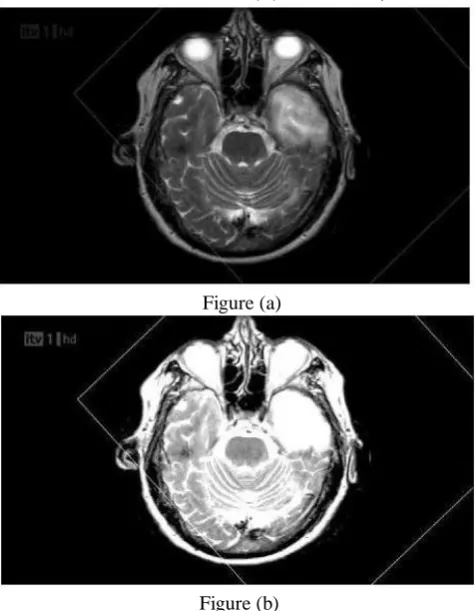
Figure (a)
Figure (b)
Figure a, b represents Input images of same sensors
GUASSIAN FILTER:
Figure (c)
Figure (d)
ISSN(E): 2277-128X, ISBN: 978-93-87396-07-4, pp. 168-174
Figure (f)
Figure (c), (d) represents edge decomposition base layer, detail layer combined image, finally figure (e) fused image using Gaussian filter and figure (f) SSIM of images (a), (b).
SHARPENING FILTER:
Figure (g)
Figure (h)
Figure (i)
Figure (j)
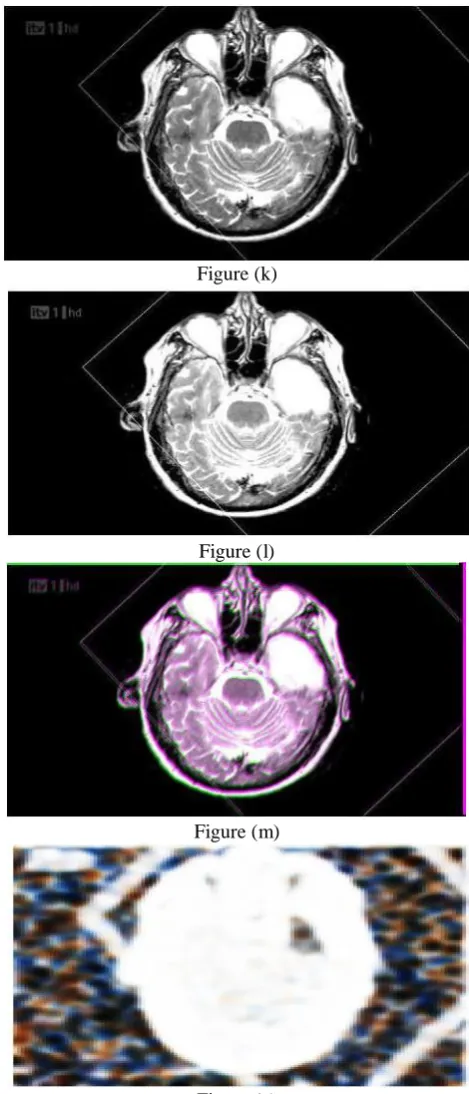
Figure (k)
Figure (l)
Figure (m)
Figure (n)
Figure (k), (l) represents edge decomposition base layer, detail layer combined image, finally figure (m) fused image using Gaussian filter and figure (n) SSIM of images (a), (b).
Image fusion quality metrics comparison:
Edge preserving decomposition by using different filters of same sensor images: Gaussian
filter
Laplacian gaussian filter
Sharpening filter MSE 9.8287e+05 3.5615e+05 5.7285e+05 SNR 15.4067 13.1908 13.9599 PSNR 20.4974 20.4727 20.2318 SSIM 0.7795 0.6581 0.6987
ISSN(E): 2277-128X, ISBN: 978-93-87396-07-4, pp. 168-174
SC 1.0173 1.0087 1.0171 NCC 1.0074 1.0072 1.0082 NAE 0.0114 0.0114 0.0121
VII. CONCLUSION
The fusion was performed on same sensor images. Image fusion metrics were developed to review the fused image quality. The quality evaluation based on the image metrics. By observing the results, PSNR has been improved and MSE has been decreased. The quality of the image also has been improved.
VIII. FUTURE SCOPE
Although various image fusion and objective performance evaluation methods have been proposed, at present time, there are still many unlimited problems in different applications. In this section, the future trends in different application domains.
In this situation, precise registration is challenging due to the significant resolution and spectral difference among the source images. At last, due to the fast development of medical diagnosis , developing novel algorithms for fusion of images will be a hot research topic.
REFERENCES
[1] Shutao Li a ,∗, Xudong Kang a , Leyuan Fang a , Jianwen Hu b , Haitao Yin c “Pixel-level image fusion: A survey of the state of the art” ©2016 Published by Elsevier B.V. S. Li et al. / Information Fusion 33 (2017) 100–112
[2] B.A. Olshausen , J.F. David , Emergence of simple-cell receptive field proper- ties by learning a sparse code for natural images, Nature 381 (6583) (1996) 607–609 .
[3] R. Rubinstein, A. Bruckstein, M. Elad, Dictionaries for sparse representation modeling, Proc. IEEE 98 (6) (2010) 1045–1057 .
[4] T. Mertens , J. Kautz , F.V. Reeth , Exposure fusion, in: Proceedings of Pacific Conference on Computer Graphics and Applications, 2007, pp. 382–390 .