Available on-line at: www.oapub.org/edu
Copyright © The Author(s). All Rights Reserved.
doi: 10.5281/zenodo.1964322 Volume 5 │ Issue 2 │ 2018
THE EFFECT OF MANAGERIAL AND PARTICIPATIVE LEADERSHIP
STYLES DISPLAYED BY RECREATION LEADER IN PARTICIPATION
OF THE SPORTS ACTIVITIESIN RECREATION AREAS OF
BEYKOZ MUNICIPALITY, TURKEY
Özlem Üstün1,
M. M. Yorulmazlar2i
1Marmara Üniversitesi, Sağlık Bilimleri Enstitüsü,
İstanbul, Türkiye 2Marmara Üniversitesi, Spor Bilimleri Fakültesi,
İstanbul, Türkiye
Abstract:
The aim of our study is to determine the effect of participative and transformational leadership styles exhibited by activity leaders of participator in recreational activities on their participation in recreation activities. In this way, Beykoz Municipality is able to determine new methods in the planning and implementation of sports activities in the recreation areas. Our study is designed for relational screening model. In our study, the relationship between the satisfaction levels of the participants and the leadership styles of the recreation leaders were investigated. The managerial leadership style of recreation leaders has a 76.4% effect on the satisfaction of those participating in recreational activities irrespective of the transformational leadership. The 23.6% effect is represented by other variables. 266 subjects were included in our study. The sample was determined by a single sample t-test which represented the universe uniformly and homogeneously. The normality test was applied at 0.05 significance level in order to determine whether the data were distributed normally. It was determined that the data did not show normal distribution. Demographic characteristics of sample individuals were determined by frequency analysis. The relationship between the satisfaction of the participants and the leadership styles of the recreation leaders during the activity was determined by the correlation analysis at the significance level of 0,01. The effect of leadership styles displayed by recreation leaders on customer satisfaction was determined by regression analysis at a level of 0,01 significance level. As a result of our study, individuals, who participate in sports activities in recreation areas of Beykoz Municipality, determined that recreation leaders involved in the activities of recreation
activities increased the level of the managerial leadership styles demonstrated. Since the impact of managerial leadership and productive recreation leaders on the satisfaction levels of consumers consuming recreational sports products is 76.4%, the improvement of the production of recreation products in accordance with the managerial leadership style will increase the satisfaction level.
Keywords: municipality, recreation, recreation leadership
1. Introduction
The aim of our study is to determine the effect of participative and transformational leadership styles exhibited by activity leaders of participator in recreational activities on their participation in recreation activities. In this way, Beykoz Municipality is able to determine new methods in the planning and implementation of sports activities in the recreation areas. Our suggestion is that the leadership styles of recreation leaders have an impact on the participation of individuals benefiting from this service.
The human being is born with the power to receive sensations, perceives, senses, separates, combines, stores or animates simple sensations that combine these senses. It compares these compositions with each other and catches the common and separate points. It identifies all these objects and marks them easily to create new combinations. Human beings use this power in its relations with similar individuals. In addition, people, after the first development of the same power, with the tools they have achieved a number of inventions. If this development is examined in terms of its results in relation to the crowds of individuals living together at the same time, it shows the progress tables of human intelligence. This progress depends on the same laws seen in the individual development of our forces. Because, at the same time, it is the result of this development in many individuals united in a community. This table is a historical picture because it has undergone various changes. It occurs by observing the human communities coming in separate cycles (Kepoğlu, 2018).
users and the basic expectations of the plant management have an important place (Bulgurcuoğlu; Küçük; Kepoğlu, Yorulmazlar; Özçalı, 2018)
2.Industrialization, Leisure Time, Recreation and Individual
In today's nations, which have reached industrial production and trying to move to industrial production and which are behind the industrial production, It is observed that the consciousness of leisure time becomes proficient. It is known that the individuals who have the possibility of employment have more free time and their desire to keep their property in their own right. Individuals want to continue to increase their free time opportunities provided by technical knowledge and to be competent with all kinds of activities. In today's conditions, developing nations give this right to their individuals (Karaküçük, 2003).
The individual needs a healthy environment in order to maintain his or her life. He/she needs nature to feed again. The response to nutritional deprivation is again in nature. Mankind has explored the way to cope with nature for centuries and regarded nature as a reality where It will produce the desired raw material and process it. Nature has been constituted and used by the industry as a benign factor. The consciousness of the fact that nature's ability to cleanse itself is limited and that the malfunctioning nature balance may disappear if not recovered too late. These environmental differences have naturally influenced recreational activities and the free time activities of the individual. (Okuyucu, Ramazanoğlu and Tel, 2006).
2.1Recreation, Recreation Activities
The recreation is derived from the Latin word called as crereatio, which means correcting and re-occurrence. The Turkish equivalent is widely used for evaluating free time. It also includes the meaning of relaxing and entertaining activities in which both individuals and social groups act in their free time (Tezcan, 1993).
2.2Local Administrations and Recreation
progress, recreation, imagination and humanitarian needs of the citizens living within their borders (Huang, 2004).
In our homeland, municipalities have different models according to the amount of population they serve. Due to rapid urbanization, the number of municipalities has increased in such a way that they cannot create impressive and efficient service. All the towns having 2000 populations have been municipalities. This situation resulted neither in the prevention of waste of public resources nor in the provision of efficient service by the municipalities that generate income according to the population. For this reason, the conditions of being a municipality have been introduced from the beginning with the Law No. 5747.
It is necessary to underline that the local administrations and the other state units at all levels are of vital responsibility in the progression of all citizens' vitality, integrity, confidence, education, and quality of life. People have time on which a plan was not done for an important period except for the time required for the purpose of working, education, and life. A well-rounded and efficient lifestyle in all its scope should include beautiful, generative and logical recreation and free-time expansions. However, a large part of the population does not engage in activities that are served due to age and bodily inability. Indirectly, a state manager should also strive to empower the state of life of all persons. Recreation, parks and free time services should be considered in this direction (Dinç, 2003).
In our age, in every part of the world and in every field of the sports industry, change is happening. The understanding of efficiency in sports management makes the differences in the organizations and management of sports enterprises inevitable. For the economic field, differentiating sport goods production setup, the change in property in production, the rapid change in the means and relations of sports product production also affect the sports enterprises. As a result of the positive change of sports habits in the social and cultural field, the level of consumption of sports products in general increases and the needs, expectations, and relationships of people's sports products differ (Kepoğlu, 2017).
3. Leadership Styles in Recreation Activities
3.1Transformational Leadership Theory
The transformational leader is an individual who gives a fresh form to the cluster, and in other words, transform the requirements of the cluster into beliefs. The transformational leader is the leader who creates modern tasks and provokes to have new explanations and ideas. This leadership style brings a new direction to an organization, handles problems in different ways and drives them to inform the members of the cluster. The transformational leader empowers vital missions. First of all, it is necessary to understand the organizational purpose and the importance of these aims very well. Secondly, the transformational leader should establish a vision for the future of the organization, and organize the set-up in the direction of this vision and derive organizational differentiations in a way that is based on this vision. The leader is obliged to ensure that the tactics developed are coordinated with the tactical management process of the organization (Krausz, 1986).
Transformational leaders transform old methods and policy equipment with new ones by identifying areas of innovation requirement rather than consensualization in the organizational structure. In other words, a process of metamorphism in the structure of the organization comes to life with the aim of moving the organization and creating enthusiasm (Örücü, 2006).In order to be successful in this process of transformation, there are various attitudes that the leader must have. These attitudes are; charisma, encouraging motivation, individual interest, and mental incentive. Transformational Leadership Extension: Transformational leadership extension in recreational leadership coverage is described as a role model for the instructors and coaches who are the recreation leaders, and as a source of inspiration before they speak to their senses. The spiritual relationship that the leader develops together with the athletes whom he/she has trained raises the level of participation of the athletes in the recreation activities and the joy they feel from the leader (Hang, 2004).
3.2Managerial leader
It is the leader who, in a particular form, determines what kinds of awards the staff wishes and determines the desired performance measures in order to reach awards in this direction. There is a process of changing. If the staff reaches a certain target, they receive the reward. The administration is suitable for men. Thus, the concept of administrative leadership works (Bateman, Cari, Zeithalm; 1993).
decisions. In the perception of managerial leadership, even if the staff give personal support, the power is still in the leaders and the leader will guide, give information and give advice. The leader teaches his staff how the job should be, and then observes his staff until they are qualified to do what they can do on their own.
In the sense of managerial leadership, it is essential to train and develop staff rather than control the work. Here, the leader contributes to group work by adding the necessary opportunities instead of demanding work by transforming the work into a continuous learning process. The managerial leadership style can be used as a training method that enables the continuous development and learning of people.
The stages of managerial leadership process are as follows: Selection of the conditions under which the steering activity will be implemented, creation of resources, creation of an appropriate environment for management, empowering the cooperation between the manager and the staff in the process of learning, considering the manager and staff about the implementation plan, identifying and monitoring development.
Managerial Leadership Dimension: within the scope of recreational leadership, the dimension of managerial leadership is related to the coach who determines how the participants expect awards and determine the desired performance standards in order to reach the awards. There is an exchange process here. If the athletes reach the specified standards, they win the award. At this point, recreational activities are carried out according to objectives and managerial sense of leadership works. Recreation activities increase the participants' level of participation in activities and their satisfaction with the leader (Huang, 2004).
4.Method
Demographic characteristics of sample individuals were determined by frequency analysis. The relationship between the satisfaction of the participants and the leadership styles of the recreation leaders during the activity was determined by the correlation analysis at the significance level of 0,01. The effect of leadership styles displayed by recreation leaders on customer satisfaction was determined by regression analysis at a level of 0,01 significance level.
5.Findings
5.1Frequency Analysis of Demographic Variables of Individuals
Table1: Gender of Individuals
Frequency %
Female 74 27,8
Male 192 72,2
Total 266 100,0
Of the participants, 72.2% of the individuals were male and 27.8% were female.
Table 2: Age Groups of Individuals
Frequency %
18-23 83 31,2
24-32 97 36,5
32-40 64 24,1
41 and Above 22 8,3
Total 266 100,0
It was observed that 36.5% of the participants were in the age of 24-32, 31.2% of the participants were in the age of 18-23, 24.1% of the participants were in the age of 32-40 and 8.3% of the participants were in the age of 41 and above.
Table 3: Education Levels of Individuals
Frequency %
Primary School 12 4,5
High School 71 26,7
Bachelor’s 156 58,6
Master’s 27 10,2
Total 266 100,0
Table 4: Marital Status of Individuals
Frequency %
Single 188 70,7
Married 66 24,8
Widow/Widower 4 1,5
Divorced 8 3,0
Total 266 100,0
70.7% of the participants are single, 24.8% are married, 3% are divorced and 1.5% are widowed.
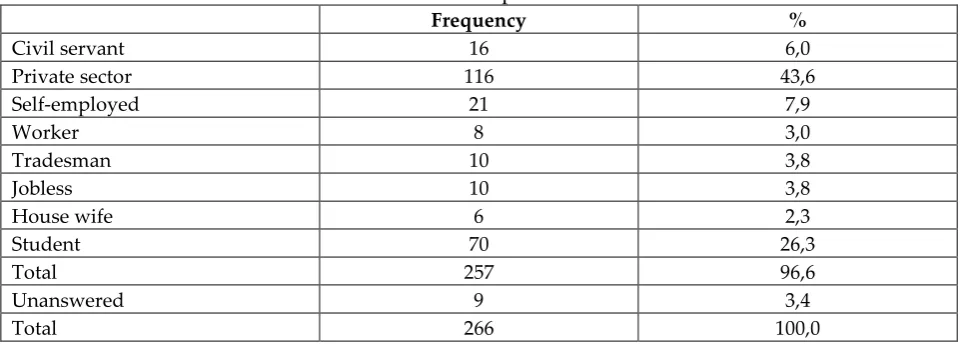
Table 5: Professional Occupations of Individuals
Frequency %
Civil servant 16 6,0
Private sector 116 43,6
Self-employed 21 7,9
Worker 8 3,0
Tradesman 10 3,8
Jobless 10 3,8
House wife 6 2,3
Student 70 26,3
Total 257 96,6
Unanswered 9 3,4
Total 266 100,0
45.1% of the participants are private sector employees, 27.2% are students, 8.2% are self-employed, 6.2% are civil servants, 3.9% are tradesmen and unself-employed, 2% and %3 were housewives.
Table 6: Income Levels of Individuals
Frequency %
750- 52 19,5
751-1000 13 4,9
1001-1500 23 8,6
1501-2500 71 26,7
2501+ 107 40,2
Total 266 100,0
Table 7: Do you regularly do sports?
Frequency %
Yes 217 81,6
No 49 18,4
Total 266 100,0
It was seen that 81.6% of the respondents said yes and 18.4% said no.
Table 8: How many days do you do sports?
Frequency %
1-2 days 56 21,1
3-4 days 145 54,5
5-6 days 56 21,1
7 days 9 3,4
Total 266 100,0
54.5% of participants spend 3-4days, 21.1% spend 1-2days and 5-6 days, 3.4% spend 3-4 days in sports.
Table 9: Daily time for sports of an individual
Frequency %
30 min 2 ,8
31 min-1 hr 18 6,8
1-1.5 hr 120 45,1
1.5-2 hr 95 35,7
2-2,5 hr 23 8,6
2,5-3 hr 7 2,6
3 + hr 1 ,4
Total 266 100,0
45.1% of the participants spend 1-1.5 hours, 35.7% spend 1.5-2 hours, 8.6% spend 2-2.5 hours, 8% spend 30 minutes, 6.8%spend 31 minutes-1 hour, 4% spend 3 hours and more, 2.6% spend 2.5-3 hours in sports.
Table 10: Levels of Interest of Sports to Individuals
Frequency %
I do sports regularly 154 57,9
I do sports frequently 55 20,7
I am an active athlete 7 2,6
I do sports occasionally 49 18,4
I never do sports 1 ,4
Total 266 100,0
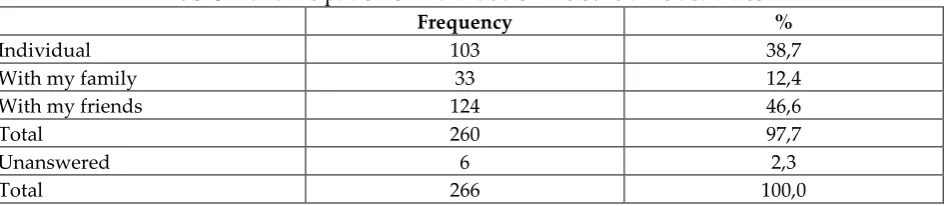
Table 11: Participation of individuals in leisure time activities
Frequency %
Individual 103 38,7
With my family 33 12,4
With my friends 124 46,6
Total 260 97,7
Unanswered 6 2,3
Total 266 100,0
47,7% of the participants spend their leisure time with their friends, 39,6% spend their leisure time as individual and 12,7% spend their leisure time with their with my families.
Table 12: A single sample t-test of the sample representing an equal and homogeneous universe
Single-sample test
t sd p
Satisfaction with the leader 58,458 265 ,000
The individuals who participated in our study represent all of the individuals who participated in the activities of Beykoz Municipality in an equal and homogeneous way (p <0.05).
Table 13: Kolmogorov-Smirnov Test for Normal Distribution of Data
Normality Test
Kolmogorov-Smirnova
t sd p
Managerial leadership ,138 265 ,000
Transformational leadership ,148 265 ,000
Satisfaction from the leader ,174 265 ,000
The data did not show normal distribution (p> 0.05).
Table 14: General Satisfaction Level of Individuals from Recreation Leadership
N Weighted
average
Standard deviation
Satisfaction Level of the Leader 266 3,7895 1,05725
Participants are highly satisfied with their leaders.
Table 15: The Opinions of the Recreational Leader about the Management Style of Individuals
N A. Ort. Std. Sapma
Transformational leadership style 266 3,9135 ,91324
Managerial leadership style 265 3,9698 ,94900
Participants of the study observe that their leaders show their managerial leadership style in recreation activities. On the other hand, transformational leadership style is close to managerial leadership style.
Table 16: Regression Analysis of the Satisfaction Levels of the Participants in the Recreational Activities of the Managerial and Transformational Leadership Styles
Exhibited by the Recreation Leaders During the Activities
Modal Summaryb
Model R R2 Residual R2 Estimated Standard Error
1 ,862a ,743 ,741 2,58790
a. Independent variables: transformational leadership, managerial leadership b. Dependent variable: satisfaction with the leader
Table 17: Correlation Analysis for Relationship Between the Satisfaction Levels of the Participants, Participating in Recreation Activities, from the Leader and
Leadership Styles exhibited by Leaders During the Activity
Transformational Leadership
Managerial Leadership
Level of Satisfaction from the Leader
Pearson Correlation ,814** ,861**
P ,000 ,000
N 266 265
There is a strong positive relationship between the satisfaction levels and the leadership styles of the participants in the recreation activities (p <0.05). According to the finding obtained from the analysis, there is a stronger interest among the managerial leadership style, (861) in recreation activities and satisfaction from the recreation leader.
Table 18: Anova Test for Relationship Between the Satisfaction Levels of the Participants, Participating in Recreation Activities, from the Leader and Leadership Styles
exhibited by Leaders During the Activity
ANOVAa
Model Sum2 sd A.Mean2 F p
1 Regression Residual 5076,773 2 2538,387 379,020 ,000b 1754,676 262 6,697
Total 6831,449 264
a. Dependent variable: satisfaction with the leader
b. Independent variables: transformational leadership, managerial leadership
Table 19: Regression Coefficients Regarding the Effect of Management and Transformational Leadership Styles of Recreation Leaders during Activities
on the Satisfaction Levels of Participants in Recreation Activities
Coefficientsa
Model Non-standard Coefficient Standard Coefficient t p
B Standard Error Beta
1 (Independent variables) -,291 ,703 -,413 ,680
Managerial leadership ,538 ,058 ,764 9,217 ,000
Transformational leadership ,088 ,070 ,105 1,260 ,209 a, Dependent variable: satisfaction with the leader
The managerial leadership style displayed by the recreation leader during the activity has a 76.4% effect on the satisfaction level of the participants in the recreational activities (p <0.01). On the other hand, the transformational leadership style has no effect on the level of satisfaction with recreation leaders.
6. Results and Suggestions
Participants who joined the survey are highly satisfied with their leaders. Participants in the study mainly observe that their leadership in recreation activities exhibits managerial leadership style. On the other hand, transformational leadership style is close to managerial leadership style. There is a strong positive relationship between the satisfaction levels and the leadership styles of the participants in the recreation activities (p <0.05). According to the finding obtained from the analysis, there is a stronger interest among the managerial leadership style, (861) in recreation activities and satisfaction from the recreation leader. There are differences in terms of the average of satisfaction level between the satisfaction levels of the participants, participating in recreation activities, from the leader and leadership styles exhibited by leaders during the activity (p<0,05). Participants are more satisfied with the style of managerial leadership. The managerial leadership style displayed by the recreation leader during the activity has a 76.4% effect on the satisfaction level of the participants in the recreational activities (p <0.01). On the other hand, the transformational leadership style has no effect on the level of satisfaction with recreation leaders.
As a result of our study, individuals, who participate in sports activities in recreation areas of Beykoz Municipality, determined that recreation leaders involved in the activities of recreation activities increased the level of the managerial leadership styles demonstrated. Recreation leadership in terms of production of recreation activities is to direct and control the production of a productive and well-designed recreation product that basically brings about knowledge, attitude, main identities, risk processes.
the interrelated structure, which includes both service management and customer based production. According to our findings, since the effect of management leadership and productive recreation leaders on the satisfaction levels of consumers consuming recreational sports products is 76.4%, the improvement of the production of recreation products in accordance with the managerial leadership style will attract higher levels of satisfaction.
First of all, it should be able to prevent the production of recreation product with its rotational leadership style and leaders in this style should be identified and in-service training on managerial leadership should be provided. Then the sports activity in recreation areas should be transformed into a customer-centered structure. This structure changes in the recreation areas of Beykoz Municipality in the sporting activities section. Together with the new structure, the participants/customers should be included in this structure. There should not be many hierarchical levels in this structure. As a requirement of acting with a customer-centric strategy, the structure of the sports activity production in the recreation areas should be ready to take responsibility for the participants/customers and have the authority to serve them. Therefore, the structure of the sports activity production in the recreation areas should be adjusted so that the level between the participant/customer and the senior management is as low as possible. Recreation leaders, who are in direct communication with the participant/customer and who produce recreation products, should ensure that some values are created for the participant/customer. The other staff within the sports activity production structure in the recreation areas support the interaction between the Beykoz Municipality and the sports department in the recreation areas. This support ensures the continuity of the participant/customer relations.
References
Başoğlu U. (2011). İstanbul İli, Bahçelievler Belediyesi Sorumluluğundaki Spor Salonlarının Rekreasyon Sporları ve Rekreasyon Liderleri Açısından Geliştirilmesi ve Faydalılık Durumu, Doktora, Marmara Üniversitesi, İstanbul, Bateman T., S., Zeithalm, C.P. (1993); Management, Second Edition, Invin Publishing,
Boston,s.429,.
Bulgurcuoğlu, A.N., Küçük, V., Kepoğlu, A., Yorulmazlar, M., Özçalı, Ü. (2018). An Analysis of Satisfaction Levels of Soccer Spectators in Terms of Gender on Socio-Cultural Activities Being Held in Stadiums, İnternational Journal of Sports and Physical Education (IJSPE), Volume 4, Issue 2, pp 13-27
Dinç, A. (2003). Boş Zaman- Rekreasyon Yönetimi, Detay Yayıncılık, Ankara. Hacıoğlu, N. (2003). BoĢ Zaman – Rekreasyon Yönetimi, Detay Yayıncılık, Ankara. Huang M.J. (2004). A Study of the Leadership Style of Recreational Sports Club Leaders
Karaküçük, S. (2003). Rekreasyon, Bağırgan Yayınevi, Ankara Karaküçük, S. (2005). Rekreasyon, Gazi Kitabevi, Ankara.
Karasar, N. (2016). Bilimsel Araştırma Yöntemi, Kavramlar,İlkeler,Teknikler, 32.Baskı, Nobel Akademik Yayıncılık Eğitim Danışmanlık Tic.Ltd.Şti,Ankara
Kepoğlu, A. (2017), “Türklerde Spor İşletmeleri Yönetiminde Organizasyon Yapısı”, Spor Yönetiminde Seçme Konular I, s.3-23, Ege Reklam Basım Sanatları San. Tic. Ltd. Şti, ISBN: 978-605-030-506-7, İstanbul
Kepoğlu, A. (2018), Göktürk Devletinde Spor Yönetimi ve Organizasyonu, Lambert Academic Publishing,ISBN:978-613-6-91644-6,
Kepoğlu, A., Bayansalduz, M., Bulgurcuoğlu, A.N., (2017), “Spor İşletmelerinde İnsan Kaynakları Yönetimi”, Spor Yönetiminde Seçme Konular I, s.57-80, Ege Reklam Basım Sanatları San. Tic. Ltd. Şti, ISBN: 978-605-030-506-7, İstanbul
Krausz R.R. , (1986), " Povver and Leadership in Organizations", Transactional Analysis Journal, v: 16, N: 2, s. 86.
Krausz, R.R. , (1986), " Povver and Leadership in Organizations", Transactional Analysis Journal, v: 16, N: 2, s. 86
Örücü, E. (2006). Kalite Yönetimi Çevresinde Bankalarda Çalışan Personelin İş Tatmini ve İş Tatmini Etkileyen Faktörlerin İncelenmesine Yönelik Bir Araştırma, Celal Bayar Üniversitesi, İstanbul.
Örücü, E. (2006). Kalite Yönetimi Çevresinde Bankalarda Çalışan Personelin İş Tatmini ve İş Tatmini Etkileyen Faktörlerin İncelenmesine Yönelik Bir AraĢtırma, Celal Bayar Üniversitesi, İstanbul
Tezcan, M. (1993). Sosyolojiye Giriş, Temel Kavramlar, Ankara
Ülker, G., (1997), Yönetici ve Lider « 21.yüzyılda Liderlik Sempozyumu » Bildiriler Kitabı Cilt 1, DHO Basımevi, s. 183, İstanbul.
Creative Commons licensing terms