R E S E A R C H A R T I C L E
Open Access
Application of principles of exercise training
in sub-acute and chronic stroke survivors:
a systematic review
Bernadette C Ammann
1,2†, Ruud H Knols
1†, Pierrette Baschung
1,2,3†, Rob A de Bie
2†and Eling D de Bruin
2,4,5*†Abstract
Background:There is increasing evidence for the beneficial effects of exercise training in stroke survivors. In order to reach the desired training effects, exercise training principles must be considered as this ensures the prescription of adequate exercises at an adequate dose. Moreover, exercise training interventions must be designed in a way that maximizes patients’adherence to the prescribed exercise regimen. The objectives of this systematic review were (1) to investigate whether training principles for physical exercise interventions are reported in RCTs for sub-acute and chronic stroke survivors, (2) to evaluate whether the RCTs reported the prescription of the FITT components of the exercise interventions as well as (3) patients’adherence to this prescription, and (4) to assess the risk of bias of the included studies.
Methods:We performed a systematic review of RCTs with exercise training as the primary intervention and muscular strength and/or endurance as primary outcomes. The Cochrane library’s risk of bias (ROB) tool was used to judge the methodological quality of RCTs.
Results:Thirty-seven RCTs were included in this systematic review. Eighteen studies (48.7%) focused on aerobic, 8 (21.6%) on resistance and 11 (29.7%) on combined interventions of aerobic and resistive strength exercise. Twenty-nine studies (78.4%) included only chronic stroke survivors, 5 studies (13.5%) only sub-acute stroke survivors whilst 3 studies (8.1%) included both. In terms of principle of exercise training, 89% reportedspecificity, 75.7%progression, 48.7%overload, 37.8%initial values, 32.4%reversibilityand 13.5%diminishing returns. One RCT described all principles of physical exercise training and 19 (51.4%) all FITT components. Patients’adherence to exercise prescription was accounted for in 3 studies (8.1%). Failure to report blinding in patients and participants and failure to report allocation concealment were the most prevalent methodological shortcomings.
Conclusions:Incomplete and inconsistent reporting of (1) training components, (2) underlying exercise training principles and (3) patient adherence together with (4) a broad variation in the methodological quality of the included RCTs limit both the utility and reproducibility of physical exercise programs in stroke patients.
Keywords:Stroke, Cerebrovascular accident, Aerobic exercise, Resistance exercise, Training principles, Training components
* Correspondence:[email protected] †Equal contributors
2Department of Epidemiology, CAPHRI School for Public Health and Primary
Care, Maastricht University, PO Box 616, 6200 MD Maastricht, the Netherlands
4Department of Health Sciences and Technology, Institute of Human
Movement Sciences and Sport, ETH Zurich, Wolfgang-Pauli-Str. 27, 8093 Zurich, Switzerland
Full list of author information is available at the end of the article
Background
Stroke is one of the leading causes of disability and death worldwide [1]. Due to demographic shifts in the global population, the number of affected people will increase, even with stable stroke incidence rates from approximately 1.1 million per year in 2000 to 1.5 million per year by 2025 [2,3]. The difference by 2025 will be ± 150 000 stroke events when compared with stable rates [3]. Approximately 50-70% of persons with stroke regain functional independence, but 15-30% of the stroke survivors are left with permanent disability [4]. Disability -manifested by impairment of body function or body structure, activity limitation and/or participation restric-tion [5] - results in poor physical fitness, defined as“the ability to carry out daily tasks with vigor and alertness, without undue fatigue, and with ample energy to enjoy leisure-time pursuits and respond to emergencies”[6].
Physical fitness includes health-related (cardiorespiratory endurance, muscular endurance, muscular strength, flexibility and body composition) and skill-related com-ponents (agility, coordination, balance, speed, reaction time and power) [6]. All of these render the develop-ment of exercise training programs for stroke rehabilita-tion a complex enterprise. Although several exercise recommendations have been published [7-9], the complex interactions present in stroke rehabilitation preclude the definition of specific, detailed exercise prescriptions. Still, several systematic reviews and meta-analyses provide evi-dence that aerobic exercise and resistive strength training are beneficial to improve aerobic capacity, walking distance, muscular strength and physical function in stroke survivors without increasing pain or tone in the paretic limbs [10-17]. Thus, the available literature suggests that impaired physical fitness is partly responsible for the disability evi-dent in stroke survivors.
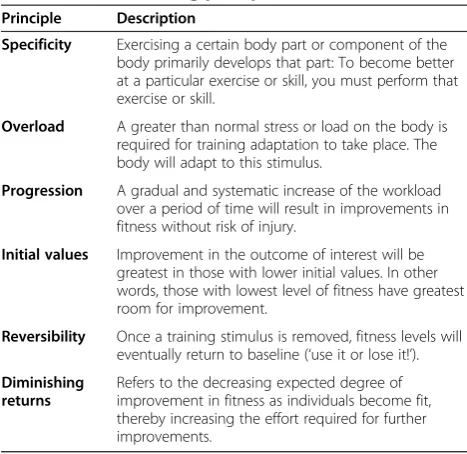
When reporting the results of an exercise intervention, it is important that the precise principles of the exercise training are consistently and accurately reported [18,19]. Recognised principles are specificity, overload, progres-sion, initial values, reversibility and diminishing returns (Table 1) [18-20]. Their application in the design of an exercise intervention ensures that the dose and type of exercise is planned such that benefits for the recipient are maximized. Furthermore, it seems fair to assume that when principles of exercise training are applied to the development of exercise protocols, clinicians in practical settings can have greater confidence that non-significant research findings reflect deficiencies in exercise efficacy rather than deficiencies in exercise prescription [18].
However, a perfectly planned intervention adopting all the principles of exercise training is almost useless when it is not reported in sufficient detail to permit interven-tion replicainterven-tion and results interpretainterven-tion. Therefore, the
prescription of the components of the exercise program and participants’ adherence to that exercise prescription should ideally be reported according to the so-called FITT components (Frequency, Intensity,Timeand Typeof exer-cise) (Table 2) [21]. FITT represents components of physical conditioning programs that determine effect on cardiorespiratory endurance, muscular strength and/or en-durance and flexibility. Furthermore, participants’ adher-ence to each of the prescribed FITT components should be reported. Detailed reporting of the dose of exercise pre-scribed (and received) allows for an adequate interpretation of results–including possible dose–response effects–and provides information about the tolerability and safety of the intervention. Without detailed information on both the type and dose of exercise that is prescribed and actually re-ceived, developing optimally designed and dosed exercise prescriptions for a desired level of benefit (i.e., response) remains difficult, thus limiting the implementation of evidence-based training programs.
Well-designed randomized controlled trials (RCTs) provide the best evidence regarding the effectiveness of health care interventions. Trials with inadequate meth-odological approaches may overstate treatment effects and bias results. Critical appraisal of the quality of clin-ical trials is possible only if the design, execution and analysis of RCTs are described thoroughly and accurately [22,23]. Thus, in order to properly interpret the results of an RCT, it is important to know the principles under-lying the prescribed exercises, the FITT components of the intervention, the adherence to these components and the methodological quality of a trial.
The objectives of this systematic review were (1) to in-vestigate whether training principles for physical exercise Table 1 Exercise training principles
Principle Description
Specificity Exercising a certain body part or component of the body primarily develops that part: To become better at a particular exercise or skill, you must perform that exercise or skill.
Overload A greater than normal stress or load on the body is required for training adaptation to take place. The body will adapt to this stimulus.
Progression A gradual and systematic increase of the workload over a period of time will result in improvements in fitness without risk of injury.
Initial values Improvement in the outcome of interest will be greatest in those with lower initial values. In other words, those with lowest level of fitness have greatest room for improvement.
Reversibility Once a training stimulus is removed, fitness levels will eventually return to baseline (‘use it or lose it!’).
Diminishing returns
interventions are reported in RCTs for sub-acute and chronic stroke survivors, (2) to evaluate whether the RCTs reported the prescription of the FITT components of the exercise interventions as well as (3) patients’ ad-herence to this prescription, and (4) to assess the risk of bias of the included studies.
Methods
Search strategy
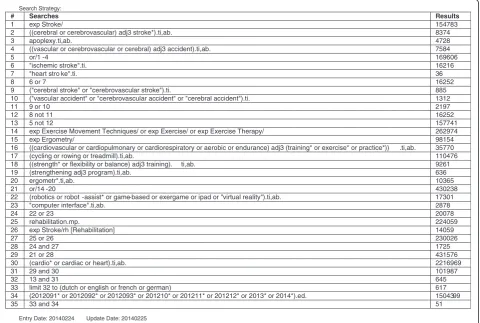
An electronic search strategy was developed and performed by a librarian of Zurich University, using the databases Medline, OvidSP, EMBASE, CINAHL, PsycInfo and the Cochrane Library (Figure 1). The search was restricted to English language literature from inception of the databases up to February 2014. Combinations of the following medical subject headings (MeSH) and free text words were used: stroke (cerebral stroke, vascular accident, brain
vascular accident, apoplexy, cerebrovascular apoplexy, cere-brovascular stroke, cerecere-brovascular accident) and exercise (cardiovascular training, cardiopulmonary training, cardio-respiratory training, aerobic training, endurance training, exercise, endurance exercise, ergometry, resistive strength training, physical exercise principles, specificity, over-load, progression, initial values, reversibility, diminish-ing returns).
Eligibility criteria
Studies were eligible for inclusion if they: (1) were RCTs (2) evaluated the effects of aerobic physical exercise training or resistive strength training alone or in com-bination, (3) included adult (> 18 years) sub-acute or chronic stroke survivors, and (4) included aerobic cap-acity and/or aerobic endurance and/or muscle strength as primary outcome measurement. The sub-acute phase Table 2 FITT components applied to physical conditioning programs
Frequency Intensity Time Type
The number of times an exercise or activity is performed generally expressed in sessions, episodes or bouts per week.
Refers to how much work is being performed or the magnitude of the effort required performing an activity or exercise.
The length or duration in which an activity or exercise is performed, usually expressed in minutes.
E.g. running/swimming for cardio respiratory endurance; free weights/ resistance machines for muscular strength or endurance.
Search Strategy:
# Searches Results
1 exp Stroke/ 154783
2 ((cerebral or cerebrovascular) adj3 stroke*).ti,ab. 8374
3 apoplexy.ti,ab. 4728
4 ((vascular or cerebrovascular or cerebral) adj3 accident).ti,ab. 7584
5 or/1 -4 169606
6 "ischemic stroke".ti. 16216
7 "heart stro ke".ti. 36
8 6 or 7 16252
9 ("cerebral stroke" or "cerebrovascular stroke").ti. 885 10 ("vascular accident" or "cerebrovascular accident" or "cerebral accident").ti. 1312
11 9 or 10 2197
12 8 not 11 16252
13 5 not 12 157741
14 exp Exercise Movement Techniques/ or exp Exercise/ or exp Exercise Therapy/ 262974
15 exp Ergometry/ 98154
16 ((cardiovascular or cardiopulmonary or cardiorespiratory or aerobic or endurance) adj3 (training* or exercise* or practice*)) .ti,ab. 35770
17 (cycling or rowing or treadmill).ti,ab. 110476
18 ((strength* or flexibility or balance) adj3 training). ti,ab. 9261
19 (strengthening adj3 program).ti,ab. 636
20 ergometr*.ti,ab. 10365
21 or/14 -20 430238
22 (robotics or robot -assist* or game-based or exergame or ipad or "virtual reality").ti,ab. 17301
23 "computer interface".ti,ab. 2878
24 22 or 23 20078
25 rehabilitation.mp. 224059
26 exp Stroke/rh [Rehabilitation] 14059
27 25 or 26 230026
28 24 and 27 1725
29 21 or 28 431576
30 (cardio* or cardiac or heart).ti,ab. 2216969
31 29 and 30 101987
32 13 and 31 645
33 limit 32 to (dutch or english or french or german) 617 34 (2012091* or 2012092* or 2012093* or 201210* or 201211* or 201212* or 2013* or 2014*).ed. 1504399
35 33 and 34 51
Entry Date: 20140224 Update Date: 20140225
was defined as the range between 15 and 180 days after initial stroke, thus all RCTs with a mean or median within this time range were considered a sub-acute population. Chronic stroke was defined as the open-ended time period starting 180 days after initial stroke and characterised by generally slow or no clinical pro-gress [24].
Study selection
After removal of duplicates, the search results were screened for eligibility by two teams of two reviewers (BA/PB and RK/EDB), sharing the retrieved citations. In case of disagreement within one team, a reviewer from the other team served as referee.
Data collection process
Using existing systematic reviews that evaluated the ef-fects of exercise interventions in cancer patients [18,19], BA created a purpose-designed data collection sheet to include information about each included RCT regarding (1) the reporting of exercise training principles, (2) the description of the exercise training components, (3) par-ticipants’ adherence to the training plan according the FITT components, and (4) further quality characteristics of the included studies (risk of bias (ROB)). Correspond-ing authors of selected trials were contacted by email to retrieve unpublished data. Three reviewers (BA, PB and RK) independently collected and rated these data.
Rating of the reporting of exercise training principles
For each exercise principle, three rating categories were used: reported (+), not reported (−) and unclear or in-consistently reported (?).
Rating of the description of exercise training components and participants’adherence to the training plan
Corresponding to the rating of the training principles, we judged the description with (+) if the component of the exercise prescription was reported; (−) if the compo-nent was not reported and (?) if it was unclearly or in-consistently reported. Participants’ adherence to the exercise prescription was judged with (+) if the adher-ence of each component to the exercise prescription was reported; (−) if the adherence was not reported and (?) if it was unclearly or inconsistently reported.
Rating of risk of bias in individual studies
Two reviewers (BA and PB) independently applied the Cochrane Collaboration’s tool for assessing ROB to as-sess the risk of over- or under-estimating the effects of an intervention [25]. The five bias domains (selection, performance, detection, attrition and reporting bias) were judged as: low ROB (+), unclear ROB (?) or high ROB (−). Rating (+) is unlikely to alter the results
seriously, (?) raises some doubt about the results and (−) seriously weakens confidence in the results. With un-clear information on an item, the score given was (?). The arbitration of a third reviewer (RK) was used in the event of any disagreement between the rating reviewers (BA and PB).
Data synthesis
All extracted data from the RCTs were transformed into percentages. The percentage agreement and Cohen’s kappa were calculated and interpreted in accordance with Landis and Koch’s benchmarks for assessing the agreement between raters: poor (≤0), slight (between 0.0 and 0.20), fair (between 0.21 and 0.40), moderate (be-tween 0.41 and 0.60), substantial (be(be-tween 0.61 and 0.80), and almost perfect (between 0.81 and 1) [26]. The PRISMA statement was followed for reporting items of this systematic review [27,28].
Results
Study selection
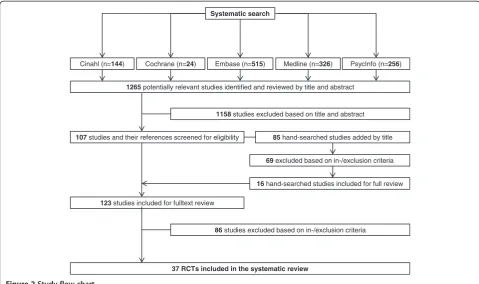
The systematic search provided a total of 1599 citations. After automatic de-duplication, 1265 hits remained. From this total, 1158 titles and abstracts failed to meet the inclusion criteria and were thus excluded. The remaining 107 abstracts were retrieved as full texts and screened together with their references. Sixteen additional studies were considered after manually scanning the refer-ence lists of identified studies. After excluding another 86 studies based on in- and exclusion criteria, 37 studies were included in the final review (Figure 2).
Study characteristics
upper and lower extremities. No study focused on improve-ment of the upper extremity in the intervention group. The length of the exercise interventions ranged from 3 weeks [38] to 12 months [42,45]. Sixteen studies (43.2%) described follow-up measurements [29-34,36-38,41,47,51,54,58,61,62] in which the follow-up period ranged from 2 months [51] to one year [32,62].
Application of exercise principles
One study described all six principles of exercise training [32], one described 5 out of 6 [47], 11 described 4 out #of 6 [34,36,37,40,41,43,44,46,53,58,60] and 12 described three training principles [30,35,38,39,49,51,59,61-64] (Additional file 2: Table S1a-c). The remaining 12 stud-ies, representing 32.4% of the included studstud-ies, described just one [42,48,50,57] or two [29,31,33,45,52,54-56,65] of these. With respect to the specific training principles, 33 (89.2%) of the RCTs reportedspecificity[30,32,34-56, 58-65], 28 (75.7%) described progression[32-41,43,44,46, 47,49,51-53,55,56,58-65], 18 (48.7%) described overload [32,34-37,39,40,43,44,46,47,49,53,58-60,63,64], 14 (37.8%) described initial values [29-32,40,41,43-47,53,57,60], 12 (32.4%) described reversibility [29,31-34,38,41,47,51,54, 61,62] and 5 (13.5%) described diminishing returns [30,32,36,37,58]. Nineteen studies (51.4%) did not describe the initial values of their participants [34-37,39,42,48-51, 55,56,58,59,61-65] and 14 (37.8%) did not describe the principle ofoverload[29-31,33,42,48,50,51,54-56,61,65].
Seven studies (18.9%) were unclear in describing pro-gression [29-31,42,45,48,57], whilst 5 (13.5%) were un-clear with respect tooverload[38,41,52,57,62].
Prescription of the exercise training
The reporting of each FITT component of the exercise prescription is summarized in Figure 3. Details of the FITT component reporting of each study are presented in the Additional file 1. In general, Frequency was de-scribed in 35 studies (94.6%) [29-32,34-41,43-65], leaving 2 studies (5.4%) that were unclear in their reporting [33,42]. Twenty-two studies (59.5%) reported training Intensity[32-37,39-41,43-47,49,50,53,58,59,61,64,65], 6 studies (16.2%) did not report this item [42,51,54-57] whilst 9 studies (24.3%) reported it unclearly [29-31,38, 48,52,60,62,63]. Thirty-four studies (91.9%) reported the componentTime[29-32,34-48,50-52,54-65] and 35 RCTs (94.6%) reported Type [29-32,34-56,58-65] of physical exercise. Two studies (5.4%) did not report the Time dedicated to exercises [33,49] whilst two studies (5.4%) unclearly reported theTypeof each exer-cise bout [33,57]. Nineteen studies (51.4%) described all FITT components [32,34-37,39-41,43-47,50,58,59, 61,64,65], 15 (40.5%) reported 3 of 4 FITT components [29-31,38,48,49,51-56,60,62,63], two (5.4%) reported 2 out of 4 items [42,57], and one (2.7%) reported one of the 4 items [33].
Systematic search
Embase (n=515) Medline (n=326) PsycInfo (n=256) Cinahl (n=144) Cochrane (n=24)
1265potentially relevant studies identified and reviewed by title and abstract
1158studies excluded based on title and abstract
107studies and their references screened for eligibility 85hand-searched studies added by title
123studies included for fulltext review
86studies excluded based on in-/exclusion criteria
37 RCTs included in the systematic review
69excluded based on in-/exclusion criteria
16hand-searched studies included for full review
Adherence to the exercise training
Adherence to each FITT component of the exercise pre-scription is summarized in Figure 4. Twenty-one studies (56.8%) reported the item Frequency [30,32,36,37,40-42, 46-52,54-57,61,63,65], 5 studies (13.5%) reported the item Intensity of the activity [32,37,46,55,58], 7 studies (18.9%) reported the itemTimeduration of each exercise bout [32,37,40-42,55,56] and 9 studies (24.3%) reported the item Type of exercise [32,37,40,41,46,50,52,55,61]. Three studies (8.1%) unclearly reported adherence to the Typeof exercise [48,54,63] whilst 3 studies (each repre-senting 2.7%) unclearly reported the items Frequency [60], Intensity [63] and Time [46] of the intervention. Fifteen (40.5%) studies did not report the itemFrequency [29,31,33-35,38,39,43-45,53,58,59,62,64], 29 studies did not report the item Time (78.4%) [29-31,33-36,38,39, 43-45,47-54,57-65], 25 studies did not report theTypeof exercises completed (67.6%) [29-31,33-36,38,39,42-45, 47,49,51,53,56-60,62,64,65] and the item Intensity was not reported in 31 studies (83.8%) [29-31,33-36,38-45, 47-54,56,57,59-62,64,65]. Fifteen studies (40.5%) did not
report any of the FITT components [29,31,33-35,38, 39,43-45,53,59,60,62,64], 11 studies (29.7%) reported 1 out of 4 components [30,36,47-49,51,54,57,58,63,65] and 5 studies (13.5%) reported 2 out of 4 items [42,50, 52,56,61]. Three studies (8.1%) reported all four FITT items [32,37,55].
Methodological risk of bias
Methodological quality varied substantially across the studies (Additional file 3: Table S2a-c). All included studies had a low risk of selective reporting (reporting bias) [29-65], 19 (51.4%) had a low risk concerning the blinding of their outcome assessments (detection bias) [29,31,32,34-36,40,42,45,46,48-50,52,55,57,60,61,63], 21 studies (56.8%) had a low risk of incomplete outcome data (attrition bias) [32,34,35,40-42,46-50,52,54-57,59, 61-63,65], 19 studies (51.4%) had a low risk of selection bias concerning allocation concealment [32,33,35,38, 40-46,48,50,51,56,57,61-63] and 22 studies (59.5%) showed a low risk of selection bias regarding random se-quence generation [32,33,35-38,40-42,45,46,48,51,55-63].
Frequency (number of sessions per week)
Intensity (prescribed intensity and activity)
Correct reporting of the component of the exercise prescription
Unclear reporting of the component of the exercise prescription
Did not report the component of the exercise prescription Time (duration of each exercise bout)
Type (aerobic and/or resistance training) Frequency (number of sessions per week)
Intensity (prescribed intensity and activity)
Reporting of the adherence of each component of the exercise prescription
Unclear reporting of the adherence of each component of the exercise prescription
Did not report the adherence of each component of the exercise prescription
Figure 4Adherence to the FITT components.Review authors’judgments about the adherence of the study sample to the exercise prescription according to the FITT components presented as percentages across all included studies.
Reporting of the component of the exercise prescription
Unclear reporting of the component of the exercise prescription
Did not report the component of the exercise prescription Frequency (number of sessions per week)
Intensity (prescribed intensity and activity)
Time (duration of each exercise bout)
Type (aerobic and/or resistance training)
With the exception of one study [40], the blinding of par-ticipants and personnel (performance bias) was a weak point in all studies: 30 studies (81.1%) had an unclear risk [29-39,43,44,46,48-60,62,64,65] whilst the remaining 6 studies (16.2%) had a high risk of performance bias [41,42,45,47,61,63].
The inter-rater agreement of the 3 rating categories
“low, unclear, high ROB” of the quality assessment was substantial (Kappa: 0.71, SE of kappa: 0.04, 95%CI: 0.630-0.796). The number of observed agreements be-tween the two raters was 83.3% of the judgments.
Discussion
This systematic review evaluated the explicit reporting of the principles of (aerobic and/or resistance) exercise training in sub-acute and chronic stroke survivors. The results showed that these principles were inconsistently reported. This result impacts on the clinical reproduci-bility of trials, as clinicians cannot be confident whether non-significant findings are due to lack of efficacy or occur through limitations in treatment prescription. The risk of bias in the 37 studies depended on the bias do-main being judged.
In this review, specificity and progression were the most frequently applied (i.e., explicitly reported) training principles, in 89.2% and 75.7% of reviewed studies respect-ively. Accordingly, most exercise trials clearly outlined training progression and designed their intervention to be specific to the target population, thus warranting reproduci-bility with respect to these training principles. In contrast, initial valuesandoverloadprinciples were not described in 37.8% and 48.7% of the reviewed RCTs respectively. Without knowing the baseline fitness levels of studied participants, it is difficult to generalize the findings to a clinical setting. Moreover, it is impossible to verify whether the provided exercise program was of ad-equate intensity, which hinders the interpretation of results. This situation is further aggravated by the fact that only 59.5% of the included studies reported the Intensity of their exercise training. Unfortunately, it is not always feasible to accurately measure the intensity of an exercise due to lack of equipment to monitor en-ergy, work and/or power. In addition, a lack of know-ledge of the exact effort (in terms of energy, work and/ or power) that healthy subjects require to perform cer-tain exercises [66] further complicates the dosing of exercises in patient populations. Only in studies where the mechanical output of physical activity can be con-trolled, such as by using cycle ergometry [35,39] or leg press machines [49], is the required effort known. Yet even in light of these difficulties, it should always be possible to report the number of repetitions required in a certain exercise or the total time dedicated to exer-cise training. The latter was successfully described in
91.9% of the exercise trials included in this review. Fur-thermore, energy spent performing certain exercises might be assessed via proxy measures such as the Borg’s Rating of Perceived Exertion and Pain Scales [67]. Although perceived exertion is a subjective meas-ure, it may nonetheless provide a fairly good estimate of the actual heart rate during physical activity and hence the intensity of that activity. Indeed, practi-tioners generally agree that perceived exertion ratings of 12 to 14 on the Borg Scale suggest a moderate level of intensity of physical activity [67].
There is evidence of a positive relationship between the time dedicated for therapy and therapy outcomes, indicating a positive relationship between dose and re-sponse [68,69]. Lohse and colleagues [68] and Kwakkel et al. [69] both reported that the benefit of large in-creases in therapy volume is similar across a range of post-stroke times. That is, patients will benefit from an increase in therapy volume, regardless of whether their stroke occurred several months or several years ago. This finding also highlights the importance of exercise even after discharge from rehabilitation and reflects the training principle of reversibility: i.e. ‘use it or lose it’. Following the principle of diminishing returns – re-ported in only 13.5% of the studies–the effort required to achieve further improvements should increase over time. In line with the findings of the present systematic review, the principles ofdiminishing returns and revers-ibility were the least reported exercise principles in RCTs on physical training interventions in cancer survi-vors according to two recently published systematic reviews [18,19]. A possible explanation is related to the fact that the assessment of these training principles re-quires follow-up measurements, which would increase research expenses and heighten the burden on patients participating in the study. However, assessment and reporting of both principles are crucial to determine the volume, frequency and intensity required in an exercise intervention to achieve durable long-term benefits for stroke patients [20].
before replicating an intervention in a clinical setting. There are several reasons why exercise programs might not be performed as prescribed, including patient-related factors (e.g. fatigue or depression [70,71]; lack of motivation; stroke impairments [72,73]), environmental factors (e.g. lack of transportation) or health concerns (e.g. fear of falls [74]). For clinicians and researchers alike, addressing these perceived barriers to exercise training is crucial both for successful rehabilitation and for provision of replicable exercise training programs. Promising first steps in breaking down these perceived barriers to training might be to remove costs for trans-portation or to integrate patients’ relatives in the re-habilitation process [75]. In support of the latter, it has been found that social support is an important motivator in achieving and maintaining physical fitness [72].
The most prevalent methodological shortcoming of the included studies was the absence of blinding of par-ticipants and personnel in 97.3% of the included RCTs. This is in line with findings of other systematic reviews of stroke exercise training [10,16]. Such lack of blinding can cause overestimations of the treatment effect and therefore bias the study results. For example in a meta-epidemiological study by Wood et al. [76], estimates of treatment effects were exaggerated by 7% in non-blinded compared to blinded trials. Although blinding of partici-pants and personnel may not always be feasible, it may still be possible to blind the outcome assessments. In this review, 19 RCTs (51.4%) had a low risk concerning this form of blinding (detection bias). Objectively assessed out-comes are less susceptible to bias than subjectively assessed ones [76]. Therefore, efforts to minimize other forms of bias are particularly important when objective measure-ments are not feasible. Allocation concealment was am-biguous in 48.6% of studies whilst 15 studies (40.5%) had a high or unclear risk of selection bias regarding random se-quence generation. These findings are in line with those of other reviews [77]. Because concealment of allocation can lead to exaggeration of treatment effects [78], details of both sequence generation and concealment of allocation should always be clearly reported [22,23].
Through improving cardiovascular fitness and muscle strength, disability after stroke may be reduced [16]. This is an important aspect of training since regaining function and independence are important goals for patients. The benefits of aerobic exercise might even be broader: Converging evidence suggests that aerobic exercise is a valuable intervention for improving brain function [79,80] and promoting neuroplasticity by up-regulation of neurotrophins [81]. Aerobic exercise pro-grams after stroke have also been shown to improve blood pressure [82] and arterial function [83], as well as enhancing glucose regulation [84]. It is also highly plaus-ible that exercise could be an effective treatment for
fatigue [85], especially in combination with the treat-ment of the associated depressive symptoms of post-stroke fatigue (PSF) [86], even though it must be noted that there is insufficient evidence of an association between PSF and physical fitness to date [70]. Taken together, the total body of evidence clearly highlights the importance of maintaining physical fitness after stroke, as it greatly reduces the effort required to carry out daily tasks and therefore contributes to a more ac-tive and independent lifestyle [87]. Moreover, an opti-mal level of physical fitness decreases the risk of subsequent stroke, which is particularly significant in view of the fact that around 30% of stroke survivors will have recurrent stroke within their lifetimes, of which 18% will prove fatal [75]. Given the great re-storative potential of achieving and maintaining phys-ical fitness after stroke, the need for RCTs to properly report both exercise prescription and adherence to ex-ercise prescription–which would allow full replication of positive findings in clinical settings– becomes par-ticularly pressing.
Call for transparency to facilitate evidence-based practice
Limitations of the review
To the best of our knowledge, this systematic review is the first to investigate the application of exercise training principles for sub-acute and chronic stroke patients. The review focuses on the reporting of intervention content rather than on the actual intervention outcomes. In striving to achieve a robust systematic review, we devel-oped and documented the methods (e.g. a systematic search strategy and several worksheets for collecting and synthesizing the data) in advance. Due to the large num-ber of existing trials on stroke rehabilitation, we decided to focus exclusively on RCTs to ensure high external val-idity. Nevertheless, some limitations remain. Firstly, we limited our search to English language peer-reviewed journal literature. Hence clearly there is a possibility that important RCTs published in other languages were missed. Secondly, due to the scope of the review, we did not perform meta-analyses of RCT results and hence can-not make recommendations concerning preferable exercise interventions for sub-acute and chronic stroke survivors. For training recommendations based on best available evi-dence we refer to the literature [75,89]. Thirdly, although we included only RCTs in this review, the clinical and methodological diversity of the studies considered was still rather large. Finally, we exclusively focused on sub-acute and chronic stroke patients; thus our results cannot be gen-eralized to acute patient groups. The reason for not includ-ing this patient population is twofold: First, there is no consensus in the literature as to how early physical activity should begin after a stroke [90] and second, information on how to influence and evaluate aerobic capacity in severely affected individuals is lacking [10].
Conclusions
The present systematic review showed that RCTs on aerobic and/or resistance rehabilitation training in sub-acute and chronic stroke survivors incompletely and in-consistently reported the prescription of, and especially the adherence to, exercise prescriptions in investigated training programs. Allowing practitioners to use estab-lished training principles to guide the therapy process will help them to plan and implement their stroke ther-apy more efficiently and more effectively. Therefore it is of the utmost importance for researchers to plan and document investigated exercise interventions in as de-tailed a manner as possible. The consideration of all principles of exercise training and all FITT components in the development and reporting of exercise prescrip-tions is a course of action ideally fitted to this purpose.
Additional files
Additional file 1:Characteristics of included RCTs.
Additional file 2: Table S10.Application of Principles of Exercise Training. a: Aerobic exercise only (n = 18). b: Resistance exercise only (n = 8). c: Aerobic and resistance exercises (n = 11).
Additional file 3: Table S2.Rating of risk of bias in individual studies. a: Aerobic exercise only (n = 18). b: Resistance exercise only (n = 8). c: Aerobic and resistance exercises (n = 11).
Competing interests
The authors declare that they have no competing interests.
Authors’contributions
BA conceived the methodology and carried out data collection, quality assessment, data analysis and manuscript writing. RK supervised progress, participating in methodology conception as well as quality assessment, data analysis and manuscript writing & revision. PB helped with data collection, quality assessment and data analysis. RDB contributed in manuscript writing. EDB initiated the study, supervised progress, helped with methodology conception, data collection and manuscript writing & revision. All authors read and approved the final manuscript.
Acknowledgements
The authors thank Martina Gosteli for performing the search strategy. Further thanks go to Dr R van de Langenberg and to Dr Martin J Watson for proof reading the manuscript on English and structure. This work was partially supported by the REWIRE project (http://www.rewire-project.eu), funded by the European Commission under the FP7 framework with contract 287713.
Author details
1Directorate of Research and Education, Physiotherapy & Occupational
Therapy Research, University Hospital Zurich, Gloriastrasse 25, 8091 Zurich, Switzerland.2Department of Epidemiology, CAPHRI School for Public Health
and Primary Care, Maastricht University, PO Box 616, 6200 MD Maastricht, the Netherlands.3Department of Health, Institute of Physiotherapy, Zurich
University of Applied Sciences, Technikumstrasse 9, 8401 Winterthur, Switzerland.4Department of Health Sciences and Technology, Institute of
Human Movement Sciences and Sport, ETH Zurich, Wolfgang-Pauli-Str. 27, 8093 Zurich, Switzerland.5Centre for Evidence Based Physiotherapy,
Maastricht University, PO Box 6166200 MD Maastricht, the Netherlands.
Received: 14 April 2014 Accepted: 18 August 2014 Published: 22 August 2014
References
1. Koivusalo M, Mackintosh M:The World Health Report 2007. A Safer Future:
Global Public Health Security in the 21st Century, Development and Change
2008, Volume 39. Geneva: World Health Organization; 2007:1163–1169. 2. Go AS, Mozaffarian D, Roger VL, Benjamin EJ, Berry JD, Borden WB, Bravata
DM, Dai S, Ford ES, Fox CS, Franco S, Fullerton HJ, Gillespie C, Hailpern SM, Heit JA, Howard VJ, Huffman MD, Kissela BM, Kittner SJ, Lackland DT, Lichtman JH, Lisabeth LD, Magid D, Marcus GM, Marelli A, Matchar DB, McGuire DK, Mohler ER, Moy CS, Mussolino ME,et al:Executive summary: heart disease and stroke statistics–2013 update: a report from the American Heart Association.Circulation2013,127(1):143–152. 3. Truelsen T, Piechowski-Jozwiak B, Bonita R, Mathers C, Bogousslavsky J,
Boysen G:Stroke incidence and prevalence in Europe: a review of available data.Eur J Neurol2006,13(6):581–598.
4. Go AS, Mozaffarian D, Roger VL, Benjamin EJ, Berry JD, Borden WB, Bravata DM, Dai S, Ford ES, Fox CS, Franco S, Fullerton HJ, Gillespie C, Hailpern SM, Heit JA, Howard VJ, Huffman MD, Kissela BM, Kittner SJ, Lackland DT, Lichtman JH, Lisabeth LD, Magid D, Marcus GM, Marelli A, Matchar DB, McGuire DK, Mohler ER, Moy CS, Mussolino ME,et al:Heart disease and stroke statistics–2013 update: a report from the American Heart Association.Circulation2013,127(1):e6–e245.
5. WHO:International Classification of Functioning, Disability and Health.
Geneva, Switzerland: World Health Organization; 2001.
6. Caspersen CJ, Powell KE, Christenson GM:Physical activity, exercise, and physical fitness: definitions and distinctions for health-related research.
Public Health Reports (Washington, DC: 1974)1985,100(2):126–131.
8. Ramas J, Courbon A, Roche F, Bethoux F, Calmels P:Effect of training programs and exercise in adult stroke patients: literature review.Ann
Readapt Med Phys2007,50(6):438–444. 430–437.
9. Ivey FM, Hafer-Macko CE, Macko RF:Exercise training for cardiometabolic adaptation after stroke.J Mol Signal2008,28(1):2–11.
10. Stoller O, de Bruin ED, Knols RH, Hunt KJ:Effects of cardiovascular exercise early after stroke: systematic review and meta-analysis.BMC Neurol2012, 12(1):45.
11. Pang MY, Eng JJ, Dawson AS, Gylfadottir S:The use of aerobic exercise training in improving aerobic capacity in individuals with stroke: a meta-analysis.Clin Rehabil2006,20(2):97–111.
12. Veerbeek JM, Koolstra M, Ket JC, van Wegen EE, Kwakkel G:Effects of augmented exercise therapy on outcome of gait and gait-related activities in the first 6 months after stroke: a meta-analysis.Stroke2011,42(11):3311–3315. 13. van de Port IG, Wood-Dauphinee S, Lindeman E, Kwakkel G:Effects of
exercise training programs on walking competency after stroke: a systematic review.Am J Phys Med Rehabil2007,86(11):935–951. 14. Morris SL, Dodd KJ, Morris ME:Outcomes of progressive resistance
strength training following stroke: a systematic review.Clin Rehabil2004, 18(1):27–39.
15. Harris JE, Eng JJ:Strength training improves upper-limb function in individuals with stroke: A meta-analysis.Stroke2010,41(1):136–140. 16. Saunders DH, Sanderson M, Brazzelli M, Greig CA, Mead GE:Physical fitness training for stroke patients.Cochrane Database Syst Rev2013, 10:CD003316.
17. Smith AC, Saunders DH, Mead G:Cardiorespiratory fitness after stroke: a systematic review.Int J Stroke2012,7(6):499–510.
18. Campbell KL, Neil SE, Winters-Stone KM:Review of exercise studies in breast cancer survivors: attention to principles of exercise training.Br J
Sports Med2012,46(13):909–916.
19. Winters-Stone KM, Neil SE, Campbell KL:Attention to principles of exercise training: a review of exercise studies for survivors of cancers other than breast.Br J Sports Med2014,1(12):987–995.
20. Hoffman J (Ed):Physiological Aspects of Sport Training and Performance.
Champaign, Illinois: Human Kinetics; 2002.
21. Reimer DJ:Physical Fitness Training. InField Manual No 21–20, Volume 2. Edited by US-Army, vol 2. Washington DC: Headquarters Department of the Army; 1998:241.
22. Moher D, Hopewell S, Schulz KF, Montori V, Gøtzsche PC, Devereaux PJ, Elbourne D, Egger M, Altman DG:CONSORT 2010 Explanation and Elaboration: updated guidelines for reporting parallel group randomised trials.J Clin Epidemiol2010,2010(63):e1–e37.
23. Schulz K, Altman D, Moher D, the CONSORT Group:CONSORT 2010 Statement: updated guidelines for reporting parallel group randomised trials.BMC Med2010,8(1):18.
24. World Health Organization, health topics: chronic diseases. [http://www. who.int/topics/chronic_diseases/en/]
25. Higgins JP, Altman DG, Gøtzsche PC, Jüni P, Moher D, Oxman AD, SavovićJ, Schulz KF:The Chochrane Collaboration’s tool for assessing risk of bias in randomised trials.Br Med J2011,343:1–9.
26. Landis JR, Koch GG:The measurement of observer agreement for categorical data.Biometrics1977,33(1):159–174.
27. Liberati A, Altman DG, Tetzlaff J, Mulrow C, Gotzsche PC, Ioannidis JP, Clarke M, Devereaux PJ, Kleijnen J, Moher D:The PRISMA statement for reporting systematic reviews and meta-analyses of studies that evaluate health care interventions: explanation and elaboration.J Clin Epidemiol2009, 62(10):e1–e34.
28. Moher D, Liberati A, Tetzlaff J, Altman DG:Preferred reporting items for systematic reviews and meta-analyses: the PRISMA statement.J Clin
Epidemiol2009,62(10):1006–1012.
29. Barbeau H, Visintin M:Optimal outcomes obtained with body-weight support combined with treadmill training in stroke subjects.Arch Phys
Med Rehabil2003,84(10):1458–1465.
30. Kosak MC, Reding MJ:Comparison of partial body weight-supported treadmill gait training versus aggressive bracing assisted walking post stroke.Neurorehabil Neural Repair2000,14(1):13–19.
31. Visintin M, Barbeau H, Korner-Bitensky N, Mayo NE:A new approach to retrain gait in stroke patients through body weight support and treadmill stimulation.Stroke1998,29(6):1122–1128.
32. Globas C, Becker C, Cerny J, Lam JM, Lindemann U, Forrester LW, Macko RF, Luft AR:Chronic stroke survivors benefit from high-intensity aerobic
treadmill exercise: a randomized control trial.Neurorehabilitation and
Neural Repair2012,26(1):85–95.
33. Moore JL, Roth EJ, Killian C, Hornby TG:Locomotor training improves daily stepping activity and gait efficiency in individuals poststroke who have reached a“plateau”in recovery.Stroke2010,41(1):129–135.
34. Quaney BM, Boyd LA, McDowd JM, Zahner LH, He J, Mayo MS, Macko RF: Aerobic exercise improves cognition and motor function poststroke.
Neurorehabilitation and Neural Repair2009,23(9):879–885.
35. Lennon O, Carey A, Gaffney N, Stephenson J, Blake C:A pilot randomized controlled trial to evaluate the benefit of the cardiac rehabilitation paradigm for the non-acute ischaemic stroke population.Clin Rehabil2008,22(2):125–133.
36. Luft AR, Macko RF, Forrester LW, Villagra F, Ivey F, Sorkin JD, Whitall J, McCombe-Waller S, Katzel L, Goldberg AP, Hanley DF:Treadmill exercise activates subcortical neural networks and improves walking after stroke: a randomized controlled trial.Stroke2008,39(12):3341–3350.
37. Macko RF, Ivey FM, Forrester LW, Hanley D, Sorkin JD, Katzel LI, Silver KH, Goldberg AP:Treadmill exercise rehabilitation improves ambulatory function and cardiovascular fitness in patients with chronic stroke: a randomized, controlled trial.Stroke2005, 36(10):2206–2211.
38. Peurala SH, Tarkka IM, Pitkanen K, Sivenius J:The effectiveness of body weight-supported gait training and floor walking in patients with chronic stroke.Arch Phys Med Rehabil2005,86(8):1557–1564. 39. Potempa K, Lopez M, Braun LT, Szidon JP, Fogg L, Tincknell T:Physiological
outcomes of aerobic exercise training in hemiparetic stroke patients.
Stroke1995,26(1):101–105.
40. Bang D-H, Shin W-S, Kim S-Y, Choi J-D:The effects of action observational training on walking ability in chronic stroke patients: A double-blind randomized controlled trial.Clin Rehabil2013,27(12):1118–1125. 41. Carda S, Invernizzi M, Baricich A, Cognolato G, Cisari C:Does altering
inclination alter effectiveness of treadmill training for gait impairment after stroke? A randomized controlled trial.Clin
Rehabil2013,27(10):932–938.
42. Dean CM, Rissel C, Sherrington C, Sharkey M, Cumming RG, Lord SR, Barker RN, Kirkham C, O’Rourke S:Exercise to enhance mobility and prevent falls after stroke: The community stroke club randomized trial.Neurorehabil
Neural Repair2012,26(9):1046–1057.
43. Jin H, Jiang Y, Wei Q, Chen L, Ma G:Effects of aerobic cycling training on cardiovascular fitness and heart rate recovery in patients with chronic stroke.NeuroRehabilitation2013,32(2):327–335.
44. Jin H, Jiang Y, Wei Q, Wang B, Ma G:Intensive aerobic cycling training with lower limb weights in Chinese patients with chronic stroke: discordance between improved cardiovascular fitness and walking ability.Disabil Rehabil2012,34(19):1665–1671.
45. Mayo NE, MacKay-Lyons MJ, Scott SC, Moriello C, Brophy J:A randomized trial of two home-based exercise programmes to improve functional walking post-stroke.Clin Rehabil2013,27(7):659–671.
46. Tang A, Eng JJ, Krassioukov AV, Madden KM, Mohammadi A, Tsang MYC, Tsang TSM:Exercise-induced changes in cardiovascular function after stroke: a randomized controlled trial.Int J Stroke2013,. doi:10.1111/ijs.12156. 47. Flansbjer UB, Miller M, Downham D, Lexell J:Progressive resistance
training after stroke: effects on muscle strength, muscle tone, gait performance and perceived participation.J Rehabil Med2008, 40(1):42–48.
48. Yang YR, Wang RY, Lin KH, Chu MY, Chan RC:Task-oriented progressive resistance strength training improves muscle strength and functional performance in individuals with stroke.Clin Rehabil2006,20(10):860–870. 49. Ouellette MM, LeBrasseur NK, Bean JF, Phillips E, Stein J, Frontera WR,
Fielding RA:High-intensity resistance training improves muscle strength, self-reported function, and disability in long-term stroke survivors.Stroke
2004,35(6):1404–1409.
50. Kim CM, Eng JJ, MacIntyre DL, Dawson AS:Effects of isokinetic strength training on walking in persons with stroke: a double-blind controlled pilot study.J Stroke Cerebrovasc Dis2001,10(6):265–273.
51. Dean CM, Richards CL, Malouin F:Task-related circuit training improves performance of locomotor tasks in chronic stroke: a randomized, controlled pilot trial.Arch Phys Med Rehabil2000,81(4):409–417. 52. Clark DJ, Patten C:Eccentric versus concentric resistance training to
enhance neuromuscular activation and walking speed following stroke.
53. Lee NK, Kwon JW, Son SM, Kang KW, Kim K, Hyun-Nam S:The effects of closed and open kinetic chain exercises on lower limb muscle activity and balance in stroke survivors.NeuroRehabilitation2013,33(1):177–183. 54. Waldman G, Yang C-Y, Ren Y, Liu L, Guo X, Harvey RL, Roth EJ, Zhang L-Q:
Effects of robot-guided passive stretching and active movement training of ankle and mobility impairments in stroke.NeuroRehabilitation2013, 32(3):625–634.
55. Duncan P, Studenski S, Richards L, Gollub S, Lai SM, Reker D, Perera S, Yates J, Koch V, Rigler S, Johnson D:Randomized clinical trial of therapeutic exercise in subacute stroke.Stroke2003,34(9):2173–2180.
56. Duncan P, Richards L, Wallace D, Stoker-Yates J, Pohl P, Luchies C, Ogle A, Studenski S:A randomized, controlled pilot study of a home-based exercise program for individuals with mild and moderate stroke.
Stroke1998,29(10):2055–2060.
57. Salbach NM, Mayo NE, Wood-Dauphinee S, Hanley JA, Richards CL, Cote R: A task-orientated intervention enhances walking distance and speed in the first year post stroke: a randomized controlled trial.Clin Rehabil2004, 18(5):509–519.
58. Lee M, Kilbreath SL, Singh MF, Zeman B, Davis GM:Effect of progressive resistance training on muscle performance after chronic stroke.Med Sci
Sports Exerc2010,42(1):23–34.
59. Lee M-J, Kilbreath SL, Singh MF, Zeman B, Lord SR, Raymond J, Davis GM: Comparison of effect of aerobic cycle training and progressive resistance training on walking ability after stroke: a randomized sham exercise-controlled study.J Am Geriatr Soc2008,56(6):976–985.
60. Pang MYC, Eng JJ:Determinants of improvement in walking capacity among individuals with chronic stroke following a multi-dimensional exercise program.J Rehabil Med2008,40(4):284–290.
61. Mead GE, Greig CA, Cunningham I, Lewis SJ, Dinan S, Saunders DH, Fitzsimons C, Young A:Stroke: A randomized trial of exercise or relaxation.J Am Geriatr Soc2007,55(6):892–899.
62. Olney SJ, Nymark J, Brouwer B, Culham E, Day A, Heard J, Henderson M, Parvataneni K:A randomized controlled trial of supervised versus unsupervised exercise programs for ambulatory stroke survivors.Stroke
2006,37(2):476–481.
63. Pang MY, Eng JJ, Dawson AS, McKay HA, Harris JE:A community-based fitness and mobility exercise program for older adults with chronic stroke: a randomized, controlled trial.J Am Geriatr Soc2005,53(10):1667–1674. 64. Carr M, Jones J:Physiological effects of exercise on stroke survivors.Top
Stroke Rehabil2003,9(4):57–64.
65. Teixeira-Salmela LF, Olney SJ, Nadeau S, Brouwer B:Muscle strengthening and physical conditioning to reduce impairment and disability in chronic stroke survivors.Arch Phys Med Rehabil1999,80(10):1211–1218. 66. Kwakkel G:Impact of intensity of practice after stroke: issues for
consideration.Disabil Rehabil2006,28(13–14):823–830.
67. Borg G:Borg’s Rating of Perceived Exertion and Pain Scales.Champaign, IL: Human Kinetics; 1998.
68. Lohse KR, Lang CE, Boyd LA:Is more better? Using metadata to explore dose–response relationships in stroke rehabilitation.Stroke2014, 45(7):2053–2058.
69. Kwakkel G, van Peppen R, Wagenaar RC, Wood Dauphinee S, Richards C, Ashburn A, Miller K, Lincoln N, Partridge C, Wellwood I, Langhorne P:Effects of augmented exercise therapy time after stroke: a meta-analysis.Stroke
2004,35(11):2529–2539.
70. Duncan F, Kutlubaev MA, Dennis MS, Greig C, Mead GE:Fatigue after stroke: a systematic review of associations with impaired physical fitness.Int J Stroke2012,7(2):157–162.
71. Young CA, Mills RJ, Gibbons C, Thornton EW:Poststroke fatigue: the patient perspective.Top Stroke Rehabil2013,20(6):478–484.
72. Nicholson S, Sniehotta FF, van Wijck F, Greig CA, Johnston M, McMurdo ME, Dennis M, Mead GE:A systematic review of perceived barriers and motivators to physical activity after stroke.Int J Stroke2013,8(5):357–364. 73. Roth EJ, Heinemann AW, Lovell LL, Harvey RL, McGuire JR, Diaz S:
Impairment and disability: their relation during stroke rehabilitation.Arch
Phys Med Rehabil1998,79:329–335.
74. Tilson JK, Wu SS, Cen SY, Feng Q, Rose DR, Behrman AL, Azen SP, Duncan PW:Characterizing and identifying risk for falls in the LEAPS study: a randomized clinical trial of interventions to improve walking poststroke.
Stroke2012,43(2):446–452.
75. Billinger SA, Arena R, Bernhardt J, Eng JJ, Franklin BA, Johnson CM, MacKay-Lyons M, Macko RF, Mead GE, Roth EJ, Shaughnessy M, Tang A, American Heart
Association Stroke Council, Council on Cardiovascular and Stroke Nursing, Council on Lifestyle and Cardiometabolic Health, Council on Epidemiology and Prevention, and Council on Clinical Cardiology:Physical Activity and Exercise Recommendations for Stroke Survivors: A Statement for Healthcare Professionals from the American Heart Association/ American Stroke Association.Stroke2014,45(8):2532–2553. 76. Wood L, Egger M, Gluud LL, Schulz KF, Jüni P, Altman DG, Gluud C, Martin
RM, Wood AJG, Sterne JAC:Empirical evidence of bias in treatment effect estimates in controlled trials with different interventions and outcomes: meta-epidemiological study.BMJ2008,336(7644):601–605.
77. Clark L, Schmidt U, Tharmanathan P, Adamson J, Hewitt C, Torgerson D: Poor reporting quality of key Randomization and Allocation Concealment details is still prevalent among published RCTs in 2011: a review.J Eval Clin Pract2013,19(4):703–707.
78. Herbison P, Hay-Smith J, Gillespie WJ:Different methods of allocation to groups in randomized trials are associated with different levels of bias. A meta-epidemiological study.J Clin Epidemiol2011,64(10):1070–1075. 79. Kluding PM, Tseng BY, Billinger SA:Exercise and executive function in
individuals with chronic stroke: a pilot study.J Neurol Phys Ther2011, 35(1):11–17.
80. Rand D, Eng JJ, Liu-Ambrose T, Tawashy AE:Feasibility of a 6-month exercise and recreation program to improve executive functioning and memory in individuals with chronic stroke.Neurorehabil Neural Repair
2010,24(8):722–729.
81. Mang CS, Campbell KL, Ross CJ, Boyd LA:Promoting neuroplasticity for motor rehabilitation after stroke: considering the effects of aerobic exercise and genetic variation on brain-derived neurotrophic factor.Phys Ther2013,93(12):1707–1716.
82. Takatori K, Matsumoto D, Okada Y, Nakamura J, Shomoto K:Effect of intensive rehabilitation on physical function and arterial function in community-dwelling chronic stroke survivors.Top Stroke Rehabil2012, 19(5):377–383.
83. Rimmer JH, Rauworth AE, Wang EC, Nicola TL, Hill B:A preliminary study to examine the effects of aerobic and therapeutic (nonaerobic) exercise on cardiorespiratory fitness and coronary risk reduction in stroke survivors.
Arch Phys Med Rehabil2009,90(3):407–412.
84. Ivey FM, Ryan AS, Hafer-Macko CE, Goldberg AP, Macko RF:Treadmill aerobic training improves glucose tolerance and indices of insulin sensitivity in disabled stroke survivors: a preliminary report.Stroke2007, 38(10):2752–2758.
85. Tseng BY, Kluding P:The relationship between fatigue, aerobic fitness, and motor control in people with chronic stroke: a pilot study.J Geriatr
Phys Ther2009,32(3):97–102.
86. Wu S, Barugh A, Macleod M, Mead G:Psychological associations of poststroke fatigue: a systematic review and meta-analysis.Stroke2014, 45(6):1778–1783.
87. English C, Manns PJ, Tucak C, Bernhardt J:Physical activity and sedentary behaviors in people with stroke living in the community: a systematic review.Phys Ther2014,94(2):185–196.
88. Rosewilliam S, Roskell CA, Pandyan AD:A systematic review and synthesis of the quantitative and qualitative evidence behind patient-centred goal setting in stroke rehabilitation.Clin Rehabil2011,25(6):501–514. 89. Gordon NF, Gulanick M, Costa F, Fletcher G, Franklin BA, Roth EJ, Shephard
T:Physical activity and exercise recommendations for stroke survivors: an American Heart Association scientific statement from the Council on Clinical Cardiology, Subcommittee on Exercise, Cardiac Rehabilitation, and Prevention; the Council on Cardiovascular Nursing; the Council on Nutrition, Physical Activity, and Metabolism; and the Stroke Council.
Circulation2004,109(16):2031–2041.
90. Brethour MK, Nystrom KV, Broughton S, Kiernan TE, Perez A, Handler D, Swatzell V, Yang JJ, Starr M, Seagraves KB, Cudlip F, Biby S, Tocco S, Owens P, Alexandrov AW:Controversies in acute stroke treatment.AACN Adv Crit Care2012,23(2):158–172. quiz 173–154.
doi:10.1186/s12883-014-0167-2
Cite this article as:Ammannet al.:Application of principles of exercise training in sub-acute and chronic stroke survivors: a systematic review.