Volume 61 (2013)
Selected Revised Papers from the
4th International Workshop on
Graph Computation Models
(GCM 2012)
Graph Rewriting with Contextual Refinement
Berthold Hoffmann
20 pages
Guest Editors: Rachid Echahed, Annegret Habel, Mohamed Mosbah Managing Editors: Tiziana Margaria, Julia Padberg, Gabriele Taentzer
Graph Rewriting with Contextual Refinement
Berthold Hoffmann
Fachbereich Mathematik und Informatik, Universit¨at Bremen, Germany
Abstract: In the standard theory of graph transformation, a rule modifies only sub-graphs of constant size and fixed shape. The rules supported by the graph-rewriting toolGRGENare far more expressive: they may modify subgraphs of unbounded size and variable shape. Therefore properties like termination and confluence cannot be analyzed as for the standard case. In order to lift such results, we formalize the out-standing feature of GRGEN rules by using plain rules on two levels: schemata are rules with variables; they are refined withmeta-rules, which are based on contextual hyperedge replacement, before they are used for rewriting. We show that every rule based on single pushouts, on neighborhood-controlled embedding, or on variable sub-stitution can be modeled by a schema with appropriate meta-rules. It turns out that the question whether schemata may have overlapping refinements is not decidable.
Keywords:graph rewriting – two-level rewriting – critical overlap
1
Introduction
Everywhere in computer science and beyond, one finds systems with a structure represented by graph-like diagrams, and with a behavior described by incremental transformation. Model-driven software engineering is a prominent example for an area where this way of system description is very popular. Graph rewriting is a natural formalism, which has been used to specify such systems in an abstract way, ever since this branch of theoretical computer science emerged in the seventies of the last century [EPS73]. Graph rewriting has a well developed theory [EEPT06] that gives a precise meaning to such specifications. It also allows to study fundamental properties, such as: Does the system terminate? Is itconfluent? I.e., does rewriting of some start state lead to a unique final state?
recursive refinement, so that such rules cannot be analyzed for properties like termination and confluence, and no tool support concerning these questions can be provided.
Our ultimate goal is to lift results concerning termination and confluence to rules with recur-sive refinement. As a first step, we formalize refinement by combining concepts of the existing theory, on two levels: We define aGRGENrule to be a schema – a plain rule containing variables. On the meta-level, a schema is refined by replacing variables, using meta-rules based on contex-tual hyperedge replacement [HM10,DHM12]. Refined rules then perform the rewriting on the object level. This mechanism is simple enough for formal investigation. For instance, properties of refined rules can be studied by using induction over the meta-rules. In this paper, we explore the expressiveness of rule refinement in comparison to other kinds of rules, which are based on single pushouts, neighborhood-controlled embedding, and variable substitution. It turns out that the expressiveness has a price: it can, in general, not be decided whether two schemata can have refinements that are parallelly dependent.
The examples shown in this paper arise in the area of model-driven software engineering.
Refactoring shall improve the structure of object-oriented software systems (models) without changing their behavior. Graphs are a straight-forward representation for the syntax and seman-tic relationships of object-oriented programs (and models). Many of the basic refactoring op-erations proposed by Fowler [Fow99] do require to match, delete, copy, or restructure program fragments of unbounded size and variable shape. Several plain rules are needed to specify such an operation, and they have to be controlled in a rather delicate way in order to perform it cor-rectly. In contrast, we shall see that it can be specified by a single rule schema with appropriate contextual meta-rules, in a completely declarative way.
The paper is organized as follows. The next section defines graphs, plain rules for graph rewriting, and restricted rules – called “contextual” – for deriving sets, or languages, of graphs. InSect. 3we recall related work on substitutive rules, and define schemata, meta-rules, and the refinement mechanism. Then we relate rule schemata to other kinds of graph rewrite rules, in Sect. 4. It turns out that a rule defined by single pushouts, by neighborhood-controlled embed-ding, or by substitution of graph variables can be modeled by a single schema with appropriate meta-rules. InSect. 5we study the existence of overlaps for schemata. We conclude by indicat-ing future work, inSect. 6.
2
Graphs, Rewriting, and Derivation
We define graphs wherein edges may not just connect two nodes – a source to a target – but any number of nodes. Such graphs are known as hypergraphs in the literature [Hab92]. A pair
C = (C˙, ~C)of finite sets ofcolorsis used to label nodes and edges of a graph, where a subset
X ⊆C~with atype function type:X →C˙∗shall be used to namevariables, which only appear in rules.
Definition 1(Graph) Agraph G= (G˙, ~G,att, `)consists of disjoint finite sets ˙Gofnodesand ~
Gof edges, a functionatt:G~ →G˙∗ thatattaches sequences of nodes to edges; and of a pair `= (`,~`)˙ oflabeling functions `: ˙˙ G→C˙for nodes and~`:G~ →C~ for edges so that, for every
other, and labeled so that ˙`∗G(attG(x)) =type(`G(x)).1 We will often refer to the component
functions of a graphGbyattGand`G.
A (graph)morphism m:G→H is a pairm= (m˙, ~m)of functions ˙m: ˙G→H˙ and~m:G~ →~H that preserve attachments and labels: attH◦~m=m˙∗◦attG, ˙`H =`˙G◦m˙, and~`H=~`G◦~m. The
morphismmisinjective,surjective, andbijectiveif its component functions have the respective property. Ifmis bijective, we callGandH isomorphic, and writeG∼=H. Ifmmaps nodes and edges ofGonto themselves, it defines theinclusionofGas a subgraph inH, writtenG,→H.
For a graph G, XG={x∈~G|~`G(x)∈X} is the set ofvariables, and its kernel G is the
subgraph withoutXG;Gis calledterminalifXG=/0. The subgraph ofGconsisting of a variable
x∈XG and its attached nodes is called astar ofx, and denoted byhxi. The kernel of a star is
discrete, it consists of the attached nodes ofx, and is denoted ashxi.
Example1 (Program Graphs) Figure 1shows a program graph. Circles represent nodes, and have their labels inscribed. In our examples, terminal edges are always attached to exactly two nodes, asourceand atarget, and are drawn as straight or wave-like arrows between these nodes. Boxes represent variables, to be seen inFig. 3toFig. 6; they have variable names inscribed, and are connected with their attached nodes by lines and arrows. The order of the attached nodes will always be clear from the context.
Program graphs have been proposed in [VJ03] to represent object-oriented programs. In the simplified version of [DHJ+08], nodes labeled withC,V,E,S, andBrepresent program entities: classes, variables, expressions, signatures and bodies of methods, respectively. Straight arrows represent the hierarchical syntactical structure of entities, whereas wave-like arrows represent semantic relations between them.
We define rewriting of graphs as in [EEPT06], but represent rules in a slightly different way. We also insist on injective matching of rules. This is not a restriction, see [HMP01].
Definition 2(Rewriting) A (graph rewrite)ruleρ= (P,→B←-R)consists of abodygraphB
with subgraphsPandR, which are calledpatternandreplacement, respectively. Their common subgraphI=P∩Ris called theinterface. Nodes and edges inBare calledobsoleteif they lie in
P\I, andnewif they lie inR\I. We sometimes refer to graphs ofρ byPρ,Bρetc.
An injective morphism m:P→G is a match ofρ in a terminal graphG if it satisfies the followinggluing condition: Every edge ofGthat is attached to the match of an obsolete node in
m(P\I)lies in the match of the patternm(P). Then the ruleρ rewrites Gunderminto a graph
Hthat can be constructed uniquely (up to isomorphism) by (1) removing the matchm(P\I)of obsolete nodes and edges, giving thekept graph K, and (2) unitingKdisjointly with a fresh copy ofR, and gluing the interfaceI,→Rto its matchm(I)inK, givingH.2Then we writeG⇒ρ,mH;
KandHcan be constructed so that there are inclusionsG←-K,→H.
In [EEPT06], a rule is represented as a “span”(P←-I,→R). Our representation as a “join”
1A∗denotesfinite sequencesover a setA; the empty sequence is denoted byε, and|w|denotes thelengthof a sequence
w∈A∗. For a functionf:A→B, its extensionf∗:A∗→B∗to sequences is defined byf∗(a1. . .an) =f(a1). . .f(an), for allai∈A, 16i6n,n>0. For functions or morphismsfandg, f◦gdenotes their composition.
C
C S
B
V E
S
B
E
E V
B
E E
E E V
V
S B
E
E
Figure 1: A program graph
pum0=
C
C S
C B
V
V S
B B
E
E E
E E
E
E
E
Figure 2: A rule performing Pull-up Method
(P,→B←-R)is equivalent. However, the fact that the bodyBcontains both pattern and replace-ment makes it easier to define the refinereplace-ment of a rule (schema), which is a central concept of this work, seeDef. 4below.
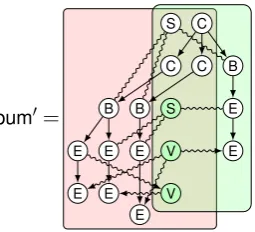
Example 2 (A Refactoring Rule) Figure 2 shows a rule pum0. Blobs painted red and green designate its pattern and replacement, respectively. Together they designate the body, and their overlap defines the interface. An edge belongs only to those blobs that contain it entirely; so the straight arrow connecting the top-mostC-node in the interface to aB-node in the replacement belongs only to the replacement, but not to the pattern (and the interface) ofpum0.
The pattern of pum0 specifies a situation where two subclasses of a class contain obsolete bodies for the same signature. The replacement specifies that one of these bodies is new in the superclass. If the obsolete bodies are semantically equivalent (which cannot be checked automatically, in general, but has to be confirmed by verification), pum0 performs a Pull-up methodrefactoring. However,pum0 only applies if the class has exactly two subclasses, and if the method bodies have the particular shape seen in the pattern.
The general Pull-up Methodrefactoring of Fowler [Fow99], which works for an unbounded number of subclasses and for method bodies of varying shapes, cannot be specified with a simple rule like this, but with schema refinement, seeExample 7below.
Graph rewriting can be used for computing byreduction: a set of rules is applied to some input graph as long as possible. If no rule applies, a graph is a result (called normalform). Reduction is terminating if every sequence of steps leads to a normalform. The normalform for some graph will always be unique if the rewriting relation is confluent.
Rules can also be used to derive sets, orlanguages, of graphs. A simple form of rules, where the pattern is a variable with its attached nodes, is known as context-free (hyperedge) replacement [Hab92]. Here we extend these rules so that their pattern may contain isolated nodes. This increases their generative power considerably.
Definition 3(Derivation) A ruleπ= (P,→B←-R)iscontextualifxis the only edge inPand
RequalsBwithoutx.
For a set Πof contextual rules, we writeG⇒Π H, and say thatΠdirectly derives G to H
Bdy B E Exp . . . . . . E Exp Exp E V Exp Exp E V E Exp Exp S E E Exp . . . . . . E Exp
Figure 3: Contextual rulesMfor method bodies
C V V S B Bdy + ⇒ M C V V S B E E
Figure 4: Deriving a method body
transitive closure of this relation. With somestart graph G0,Πdefines acontextual grammar
(C,Π,G0)over the labelsC, which derives thelanguageof terminal graphs derived fromG0: L(C,Π,G0) ={H|G0⇒+ΠH,XH= /0}.
The patternPof a contextual rulesπis the disjoint union of a starhxiwith a discretecontext
graph, sayC. We callπcontext-freeifCis empty. The (context-free)borrowing ruleπ¯= (hxi,→
B←-R[C])ofπ is obtained by removingCfromP, and distinguishing the subgraphC,→Ras adebtinR. ¯Πis the set ofborrowing rulesforΠ. We write derivations with ¯Π, which we call
endebted, asG⇒+¯
ΠH[D]whereDis thedebt, i.e., the embeddings of the nodes borrowed in the rules used in the derivation.
Derivations always extend the kernels of graphs.
Fact 1. (1) For every contextual ruleπ= (P,→B←-R), P,→R.
(2) For every derivation G⇒πH, it holds that G,→H.
Proof. Letx∈~P. (1) Since P=I by definition, I ,→R. (2) Thus, by definition of ⇒π, K=
G−m(x). ThenK=G, andK,→H impliesK,→H.
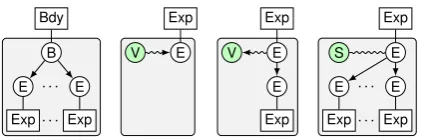
Example3 (Method Bodies) When drawing contextual rules like those inFig. 3, we omit the blob around the pattern, and paint that of the replacement in grey. The variable outside the replacement box designates the star of the pattern, and green filling (appearing grey in B/W print) designates the context nodes.
Figure 3defines the setM of contextual rules that derive method bodies of program graphs, or rather their data flow graphs: A body consists of expressions, which in turn either use the value of a variable,defineit as the value of an expression, or calla method signature with actual parameters. The ellipses “. . . ” in two of the rules abbreviate replicative (context-free) rules that deriven>0copies ofExp-stars. In the rules forExp, the nodes representing variables and signatures are context nodes.
Figure 4shows a derivation of a method body withM. Note that the body can only be derived from a graph that contains appropriate context nodes. For a start graphG0=hxiwith`G0(x) =
Bdy, we have L(C,M,G0) = /0. The grammar for program graphs discussed in [HM10] does derive appropriate context nodes.
3
Schema Refinement with Contextual Meta-Rules
The idea to refine rules with meta-rules before applying them originated in two-level string grammars [CU77] that have been devised for defining the programming language ALGOL-68. The idea has been transferred to graphs – with the aim to derive graph languages – rather early [Hes79,G¨o79]. In [PH96], Detlef Plump and Annegret Habel have used the same idea for graph rewriting. Their definition of asubstitutive ruleis inspired by term rewriting [Ter03]: the pattern and replacement may contain graph variables. Before applying the rule, every variable in the pattern is substituted with some graph; thus the rule maymatcha subgraph of unbounded size and arbitrary shape. If a variable does not occur in the replacement, the rule will justdelete
its substitution; otherwise the rule willreplicateit as many times as the variable occurs in the replacement. In [PH96], a variable may be substituted with any graph. Then rule matching be-comes highly non-deterministic, so that reduction may involve a lot of backtracking. This can be very inefficient. If the substitution of a variable is required to be “shaped”, meaning that it is a graph derived with some set of contextual rules, matching gets feasible, as the rules guide the recursive search for a matching substitution. The context-free rules proposed for this purpose in [Hof01] turned out to be too restrictive in practice: method bodies, for instance, cannot be de-rived with context-free rules so that they could not be used to define the shape of graph variables. (In [DHJ+08], adaptive star rules [DHJM10] have been proposed to derive substitutions. This is powerful enough, but adaptive star rules tend to be complicated.)
The graph rewriting toolGRGEN[BGJ06] supports rules that are even more expressive [Jak08, HJG08]:
• Substitutions of variables may be defined by rules that are contextual, not just context-free. Thus we may substitute variables with graphs that cannot be derived by context-free rules, e.g., with graphs of method bodies as defined inFig. 3.
• A variable may be attached to both, pattern nodes and replacement nodes. Its substitution refines the pattern and the replacement of a rule at the same time. This does not only allow to match, delete, or replicate subgraphs of unbounded size and arbitrary shape: the rules that derive recursive sub-rules thattransformsuch subgraphs in a single rule application.
This way ofrewriting with contextual refinementshall be studied in this paper.
Example4 (Pull-up Method Revisited) In order to generalize the Pull-up method rule ofFig. 2
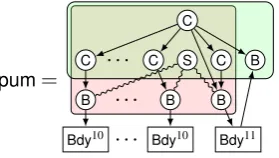
so that it applies to classes with a varying number of subclasses, and method bodies of varying shape, we turn a rule into aschemawith variables. Variables are attached to nodes in the pattern and/or replacement of the schema. Figure 5shows a schema pumfor Pull-up Method. Two variables namedBdy10 and one variable namedBdy11 indicate spots of refinement. Contextual
pum=
C
C . . .CC S C B
B . . . B B
Bdy10 . . . Bdy10 Bdy11
Figure 5: A schema for Pull-up method
Bdy10
B
E
Exp10 . . .
. . . E
Exp10 E
E
Bdy11
B
E
Exp11 . . . E
Exp11 B
E . . .
. . .
E
Exp10
E
V E
E
Exp
Exp11
E
V E
Exp
Figure 6: Meta-rules forBdy10,Bdy11,Exp10, andExp11
The meta-rules for the remaining contextual rules ofMare defined analoguously. (Inpum, the dots between the subgraphs containing the variableBdy10are a shortcut for any number of these subgraphs. These can be generated easily by auxuliary meta-rules.)
Refinement of a schema generates rules, called instances, wherein all variables are gone. Re-fining pum with the meta-rules in Fig. 6 can generate the rule pum0 in Fig. 2 as a particular instance. It may generate instances for any number of subclasses, and for method bodies of any shape. So it implements a general Pull-up method refactoring according to [Fow99].
Contextual meta-rules, like those forExp10andExp11, can only be applied to a schema that contains a node matching its context node (aV-node in this example). This is too restrictive: the context node could also be generated as an “ordinary” refinement of the rule in order to become an interface node that is matched when the instance is applied to a source graph. This can be achieved by using the borrowing version of every “truly” contextual meta-rule. In borrowing meta-rules forExp10 andExp11, theV-nodes would not be context nodes. In rulepum0, three nodes (painted green) have been derived frompumwith borrowing meta-rules forM.
We can now formally define schemata and meta-rules. In that context, variables must be used in a way that is consistent with this distribution: for all variables carrying the same name, corresponding attached nodes must belong to the same part of the schema: to the pattern, to the replacement, or to both.
Definition 4(Schema, Meta-Rule) We assume that the variable namesX come with two func-tionspat,rep: X →Nso thatpat(ξ)6|type(ξ)|and 16rep(ξ)6pat(ξ)for every variable nameξ ∈X. For every variablexnamedξ withattG(x) =v1. . .vkin a graphG, these functions
vrep(ξ). . .vk. 3
A ruleσ= (P,→B←-R)is aschemaifP∪R=Band every variablex∈XB isconsistently
distributed, which means thathx],→Pand[xi,→R.
Ameta-ruleδ= (π,ε)has a contextual ruleπ= (Pπ,→Bπ←-Rπ)as aspine, with a schema ε= (Pε,→Bπ←-Rε), called theembodied schemaofδ.
A match m:Pπ →B is ameta-matchof the spine rule π in the body B ofσ if it maps the contextCπ of
π to the interface ofσ, i.e., ifm(Cπ),→I.
The following properties are direct consequences of this definition.
Proposition 1 Consider a schemaσ = (P,→B←-R), a meta-rule δ = (π,ε) with a meta-match m:Pπ→B so that there is a derivation B⇒
π,mB0.
Then there are unique graphs P0 and R0 so thatσ0= (P0,→B0←-R0) is a schema with P,→
P0←-m(Pε)and R,→R0←-m(Rε).
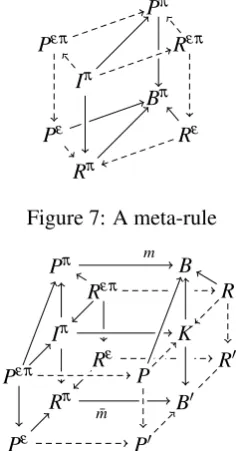
Proof. The morphisms between components of a meta-rule δ in Fig. 7are used to prove the claim. Actually, all of them are inclusions, but we draw them simply as arrows. The solid arrows
Pπ
Iπ
Rε π
Pε
Rπ
Rε
Bπ
Pε π
Figure 7: A meta-rule
Pπ
Pε π
Rε π
Iπ Pε Rπ Rε P B R K P0 B0 R0 ¯ m m
Figure 8: Schema refinement exist by Def. 4. Since Rπ equals Bπ without the single
vari-ablexinPπ, the terminal graphsPε andRε are included inRπ, and(Pε ,→Rπ ←-Rε) is a schema as well. The intersections
Pε π =Pε∩Pπ andRε π =Pπ∩Rε are discrete, as Pπ does not contain terminal edges. LetCπbe the context graph of
π. Then
Pπ =hxi ]Cπ andIπ =hxi ]Cπ. Since variable attachments are consistently distributed, Pε π =hx]∪Cπ, Rε π = [xi ∪Cπ, and (Pε π ,→Pπ ←-Rε π) is a schema as well. As Pπ =Iπ, (Pε π ,→Iπ ←-Rε π) is another schema. This gives the dashed morphisms inFig. 7.
Thus the derivationB⇒π,mB0has the solid morphisms shown
inFig. 8, where ¯m shall denote theembedding Rπ →B0 ofm.
Consistent distribution of variable attachments inBimplies that
m(Pε π),→Pandm(Rε π),→R. SinceKequalsBwithoutm(x), we get inclusions forming the schemaP,→K←-R. NowP0 is the unique subgraph of B0, containing the subgraph P and the subgraph ¯m(Pε);R0is determined likewise. The resulting inclu-sionsσ0= (P0,→B0←-R0)are a schema ifP0∪R0=B0 and all variables inB0are consistently distributed. InRπ andK, all ter-minal edges are in the pattern or replacement subgraphs (or in both), and all variables are consistently distributed. So it is easy to see that so are the terminal edges and variables inB0.
This proposition allows to define the refinement of schemata by meta-rules. Refinement pro-ceeds until all variables have disappeared, and the resulting rule can be used to rewrite a graph.
3Thus the nodesv
rep(ξ). . .vpat(ξ)are in the interface. In figures likeFig. 5andFig. 9, the lines between an attached
Definition 5(Schema Refinement and Rewriting) Consider a schemaσ = (P,→B←-R)and a meta-ruleδ = (π,ε)as above.
For the derivationB⇒π,mB0,Fig. 1allows to extendB0to a unique schemaσ0= (P0→B0←
R0). Then we writeσ⇓δ,mσ0, and say thatδ refinesσ toσ0(atm).
For a contextual meta-rule δ = (π,ε), the borrowing meta-rule is ¯δ = (π¯,ε). Let ∆ be a
finite set of meta-rules so thatδ ∈∆implies ¯δ ∈∆. Then⇓∆ denotes refinement steps with one of its meta-rules, and⇓+∆ denotes repeated refinement, its transitive closure. ∆(σ)denotes the
derivatesof a schemaσ = (P,→B←-R), containing its refinements without variables:
∆(σ) ={ρ|σ⇓+∆ ρ,XBρ =/0}
We writeG⇒∆,σHand say thatσ, refined with∆,rewrites GtoHifG⇒ρHfor some derivate ρ∈∆(σ).
By lifting Proposition 1 to refinement sequences, we see that derivates do indeed refine a schemata.
Fact 2. For derivatesρ∈∆(σ), Pσ ,→Pρ, Bσ ,→Bρ, and Rσ ,→Rρ.
It can be checked whether schemata do have refinements, or not.
Theorem 1 For a schemaσ, it is decidable whether∆(σ) =/0, or not.
Proof. A ruleρis in∆(σ)if and only if its bodyBρis in the language of the contextual grammar (C,Π,Bσ) of spine rules Π={π |(π,ε)∈∆} of∆ that has the body of σ as a start graph. Emptiness of the language is decidable for contextual grammars, by [DHM12, Corollary 1].
Example5 (Encapsulate-Field) Another refactoring operation,Encapsulate Field, shall replace using and defining accesses to an attribute (or field)aof a class by invocations of getter or setter methods, resepctively. Since a program graph may contain an unbounded number of accesses to
a, the operation cannot be specified by a single rule.
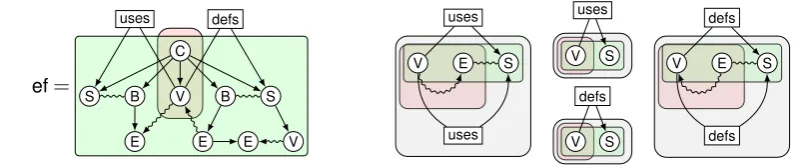
However, it can be defined by a schema with meta-rules. The pattern of the schema ef in
Fig. 9consists of a class node connected to a variable node. To this pattern, the replacement adds graphs representing signatures and bodies of the setter and getter methods. The variablesuses
anddefsindicate points of refinement.
Their meta-rules are context-free, and have a similar structure: One using (defining) access of some expression toa in the pattern is replaced by a call of the getter (setter) method in the replacement, and the meta-rule is called recursively. The other meta-rules terminate this iteration. A single rewriting step with some derivate ofeftransforms an arbitrary number of using and defining accesses to a variable into calls to the getter and setter method, respectively. This cannot be achieved by a plain rewrite rule; it goes even beyond the expressiveness of the substitutive rules that will be considered inSection 4.2further below.
ef=
C
uses defs
S B B S
E V
E E V
uses
uses S V
E EE
uses
S V
defs
S V
defs
defs S V
E EE
Figure 9: A schema forEncapsulate-Fieldwith four meta-rules
Note that the application of a derivateρ∈∆(σ), although it is the result of a compound meta-derivation, is a single rewriting stepG⇒ρH, like a transaction in a data base. Note also that the refinement process is completely rule-based.
Operationally, we cannot construct the derivates of a schemaσ first, and apply one of them later, because ∆(σ) is infinite in general. Rather, we interleave matching and refinement in a goal-oriented algorithm.
Algorithm 1 (Applying a Schema to a Graph) Input: A terminal graph G, a schema σ0 =
(P0,→B0←-R0), and a set∆of meta-rules.
Output: Either a refinement σi ∈∆(σ0)with a matchmi:Pi →G, or the answer “no” if no
derivate in∆(σ0)applies toG.
1. Search for an injective morphismm0:P0→Gof the original schemaσ0, and setito 1.
2. Search for a context-free meta-ruleδi∈∆with a refinement(Pi−1,→Bi−1←-Ri−1)⇓+δ i(P
i,→
Bi←-Ri)such that the morphismmi−1can be extended to a morphismmi:Pi→G. Ifδi is
the borrowing rule of some contextual meta-ruleδ0= (π0,ε0),mmay identify context nodes of the spine ruleπ0with nodes in the interfacePi−1∩Ri−1; otherwise it must be injective. 3. If no such meta-rule can be found, undo refinements to the closest step j<iwhere some
meta-rule exists that has not been inspected forσj previously; if already all meta-rules have
been inspected, for all previous steps, and for all initial matchesm0, answer “no”.
4. Ifσidoes contain further variables, increaseiby one and gotoStep 2.
5. Otherwise,σiis a rule with a morphismmi:Pi→G. Ifmiviolates the gluing condition, goto
Step 3. Otherwise, outputmias a match of the derivateσiinG.
Actually,allmatches forallapplicable derivates can be enumerated, so that potential nonde-terminism in the refinement can be handled by backtracking.
GRGEN rules are executed this way. But, the match of a particular patternPi is determined according to an efficient search plan that is pre-computed, taking into account the shape of the type graph, as well as that of the particular host graphG, and the whole rule is compiled into sequences of low level C# instructions that do graph matching and construction in an efficient way [Gei08].
Definition 6(Pattern Loops in Meta-Rules) A set∆of meta-rulesdoes not loop on patternsif
σ⇓+∆ σ0 impliesPσ Rσ
0
.
Note that the meta-rules inFig. 9ofExample 5do not loop on patterns, nor do those inFig. 10 andFig. 11ofDef. 7, nor those inFig. 6ofExample 7.
Theorem 2 Algorithm 1is correct, and terminates if∆does not loop on patterns.
Proof Sketch. In its course, the algorithm constructs a tree of refinements. This tree is finite: It has finite breadth, asStep 1chooses among finitely many initial morphismsm0inG, andStep 2 chooses among a finite number of morphisms for a finite number of meta-rules. Its depth is finite as well, because everyδi inStep 2 satisfies|Pi−1|6|Pi|, and the length of chains with |Pi−1|=|Pi|is bound by|∆|since∆does not loop on patterns.
For correctness, consider the following arguments: The identification condition in Step 2 makes sure that the morphismmi either is an injective morphism for the borrowing meta-rule
¯
δi, or an injective morphism for the original meta-ruleδi. ThusStep 5 determines an injective
morphism of a derivate ofσ0, and checks whether it is a match. The backtracking inStep 3and
Step 5makes sure that every possible candidate for a derivate with a match is considered.
Corollary 1 For a schemaσand meta-rules∆as above, it is decidable whether some derivate
ρ∈∆(σ)applies to a graph G, or not.
4
Relation to Other Ways of Graph Rewriting
In this section, we compare schemata to other ways of graph rewriting known in the literature: graph rewriting by single pushout, by neighborhood-controlled embedding, and by substitutive rules. In all three cases, a rule can be modeled by a single schema with appropriate meta-rules, whereas they cannot be modeled by a single plain rule.
4.1 Graph Rewriting with Node [Dis-]Connection
We investigate ways of graph rewriting where a single rule may delete and redirect a variable number of edges, respectively. First we define generic meta-rules that allow to model such rules.
Definition 7 ([Dis-]Connecting Meta-Rules) Figure 10shows a disconnecting meta-ruleδd+ that extends a schema by aB-node in its interface, which is connected by an obsoletea-edge to an obsoleteA-node. Adisconnecting configuration d∈C˙×C~× {in,out} ×C˙specifies the la-bels of the refined nodes and the label and direction of the refined edge. Its borrowing meta-rule
¯
δd+is not shown. The (context-free) meta-ruleδd0terminates disconnection. A so refined schema will remove edges that connect nodes in the interface to the obsolete node that is attached to the variabledisconnectd. A set of cooperating disconnecting meta-rules for all possible
δd0=
A C
disconnectd
δd+=
A C
B disconnectd
disconnectd a
Figure 10: Meta-rules for a disconnecting configurationd= (A,a,in,B)
δc0=
A C
connectc
δc+=
A C
B connectc
connectc a
b
Figure 11: Meta-rules for a connecting configu-rationc= (A,a,in,B,b,in,C)
Figure 11shows aconnectingmeta-ruleδc+ that extends a schema by nodes in its interface,
which are connected to an obsolete node and to a new node. Aconnecting configuration c∈
˙
C ×C~× {in,out} ×C˙×C~× {in,out} ×C˙ specifies the labels of the refined nodes and the labels and directions of the refined edges. Again, the borrowing meta-rule ¯δc+is not shown. The
context-free meta-ruleδc0 terminates disconnection. A so refined schema will remove, for the
obsolete node vand the new node v0 attached to the variable, edges connecting v to interface nodes, and insert edges connecting these nodes to v0 instead.4 Again, it is important that the B-nodes are contextual in order to redirect several edges incident with a node.
∆dc shall denote the set of all disconnecting and connecting meta-rules, for all disconnecting and connecting configurations over the label alphabetC.
Graph rewriting defined with single pushouts [L¨ow93] (SPO, for short) is a variation of stan-dard graph rewriting [EEPT06] as inDef. 2. Apart from technical details of their definition, SPO rules have the same form as DPO rules. However, rewriting is defined differently: no dangling condition needs to be checked when matching a rule; the matchm(v)of every obsolete nodevof τ is always deleted, together with all its incident edges, including those outside the matchm(P) that would violate the dangling condition in the standard case.
We define how a plain rule according to Def. 2 is turned into a schema that performs SPO graph rewriting.
Definition 8(Modeling SPO Rewriting with Schema Refinement) For a ruleρ= (P,→B←
-R), construct theSPO schemaσρ= (P,→B←-R)by attaching, to every obsolete nodevinP\R, variablesxnameddisconnectd, for every disconnecting configurationd= (`˙P(v),a,io,A)where
a∈C~,io∈ {in,out}, andA∈C˙.
Fact 3. Consider a ruleρwith an injective morphism m:P→G.
Then the SPO schemaσρhas a derivateρ0∈∆dc(σρ)with a rewriting step G⇒ρ0 H so that all
obsolete nodes ofπare deleted, together with their incident (“dangling”) edges in the subgraph
G\m(P).
Proof Sketch. Considerm:P→G. ThenP,→P0byProposition 1. Now, at every obsolete node
vofρ, the schema can be refined with disconnecting meta-rules so that it covers every “dangling”
4The meta-rules forusesanddefsinExample 5are similar to connecting rules; only the node being disconnected,
edgeeincident in ˙m(v)and its “neighborhood node” – sayv0– that is outsidem(P). As the pre-image ofv0in the schema is in the interface of the refined schema, and the edge is in the obsolete part of the pattern, the dangling edges are removed while the nodes in the neighborhood are preserved. The refined rule satisfies the gluing condition, and does exactly what SPO rewriting does.5
Graph grammars with neighborhood-controlled embedding are “the other notion” of graph rewriting. Their definition is set-theoretic, and their most widely investigated subclass has rules where the pattern consists of a single node [ER97]. Here, we consider the more general case where the pattern is a graph. More precisely, neighborhood-controlled embedding rewriting
(NCE rewriting, for short) is defined as follows.6
Definition 9(NCE Graph Rewriting) AnNCE ruleη= (M,D,I) consists of terminal graphs
M and D, called mother graph and daughter graph respectively, and of a set of connecting instructions
I⊆M˙ ×C~× {in,out} ×C˙×C~× {in,out} ×D˙.
Let ˜I denote the tuples(v,a,io,A)∈M˙ ×C~× {in,out} ×C˙without a connecting instruction
c= (v,a,io,A,b,io0,v0)∈I (for some(b,io0,v0)∈C~× {in,out} ×D˙).
A ruleη as aboveappliesto a graphGif there is an injective morphismm:M→Gso that no edge inG\m(M)is incident with a node inm(M). Then the application ofη atmdeletes the subgraphm(M)fromG, adds a fresh copy of the daughter graphD, and obtains the graphHby executing the connecting instructions as follows:
• Ifc= (v,a,io,A,b,io0,v0)∈I, for allA-nodeszin the subgraphG\m(M)whereGcontains an a-edgeeconnectingzwith ˙m(v)in directionio, ab-edgeeconnectingzwith the nodev0∈D˙ in directionio0is inserted inH.
• For every d = (v,a,io,A)∈I˜, a-edges between v and A-nodes in direction io are deleted fromG.
Example6 (An NCE Rule for Encapsulate-Field) The NCE ruleef0inFig. 12defines a variant of the Encapsulate Fieldoperation efshown inFig. 9. The mother graph is drawn left of the daughter graph. As the nodesc andv of the mother graph are obsolete, we have to add new nodesc0andv0with the same label to the daughter graph. The connecting instructionsIef0 are as
follows:
• All wave-like arrows from the nodevtoE-nodes, which represent direct using accesses tov, are redirected to the getter methodg. (This corresponds to the meta-rules forusesinFig. 9.)
• All wave-like arrows fromE-nodes to the nodev, which represent direct defining accesses tov, are “turned around” and redirected to the setter methods. (This corresponds to the meta-rules fordefsinFig. 9.)
5We have ignored the fact that matches of SPO rules need not be injective. However, we can construct the (finite)
set thequotients Q(ρ)by identifying arbitrary isomorphic subgraphs inP. Then for every non-injective match ofρ,
Q(ρ)contains a quotient with an equivalent injective match.
6The abbreviation “edNCE” used in [ER97] emphasizes the fact that the directed graphs being rewritten have labeled
ef0=
C
c
V
v
C c0
S
g
B B S
s
E V v0
E E V
Ief0 = {(v, ,out,E, ,out,g0)}
∪ {(v, ,in,E, ,out,s0)}
∪
(c,a,d, `,a,c0)
a∈C~,
d∈ {in,out}, `∈C˙
Figure 12: An NCE rule forEncapsulate-Field
• All edges incident with the node care redirected to the nodec0 without changing their label or direction. (These instructions are overhead caused by the fact that the mother graph is completely obsolete.)
Ruleef0 will replace all direct accesses to the variablev– local accesses cannot be preserved in this framework.
Definition 10(Modeling NCE Rewriting with Schema Refinement) An NCE ruleη= (M,D,I) as above can be transformed into a schema ση = (M→B←D) where the underlying rule ση has an empty interface (i.e., B =M]D), and B contains, for every connecting instruc-tion c= (v,a,io,A,b,io0,v0) ∈I, a variable x named connectc0 with attB(x) =vv0 and c0 =
(`˙M(v),a,io,A,b,io0,`˙D(v0)), and for everyd= (v,a,io,A)∈I˜, a variablexnameddisconnectd0
withattB(x) =v, andd0= (`˙M(v),a,io,A).
Fact 4. For an NCE ruleη as above, there exists an NCE graph rewriting step G⇒η H if and only if there is a rewriting step G⇒ρH using some derivateρ∈∆dc(ση)of its schemaση.
Proof Sketch. As in the case of modeling SPO rewriting, a matchm:Mη →Gcan be taken as a basis to refineση so that all connection instructions are “performed”, and all other “dangling” edges are deleted.
There are other derivates that do not satisfy the dangling condition although the NCE rule applies. This is the case when the terminating rules are applied before the recursive meta-rules have been applied exhaustively. If this is done, the NCE rule applies iff the schema applies. Even then, a refinement of the schema may violate the dangling condition. This is the case exactly when the match of the refined pattern contains nodes that are connected by edges outside the match. This, however, violates the application condition for NCE rules as well, where the match must be the induced subgraph of the matched nodes.
4.2 Substitutive Graph Rewriting
We recall the definition of substitutive rules [Hof01], re-phrase it slighty according to our defini-tion of plain rules, and extend it to borrowing substitudefini-tions:
Definition 11(Substitutive Rule) Consider a finite setΠof contextual rules.
(1) all variables inBbelong toPor toR, but not to both, and (2) every variable name occurring inRoccurs inPas well.
Asubstitutionσ is a mapping from variable names to borrowing rules so that, for every vari-able nameξ ∈X,σ(ξ) = (hξi,→B←-R[D])withX(R) =/0.
A ruleρ = (P0,→B0←-R0) is aσ-instanceofγ if its bodyB0 is obtained from the (unique) terminal Graph B∗ with B⇒+
σ B
∗ by identifying the debts of all variables carrying the same
names, and by including them both inP0and inR0. By identifying arbitrary nodes inP∩Rwith the debt, one obtains furtherσ-instances ofγ.
A substitutive rewrite stepG⇒ρHapplies someσ-instanceρ ofγ, for some substitutionσ.
Substitutive rules can be modeled as schemata refined by meta-rules as follows.
Definition 12(Meta-Rules and Schemata for Substitutive Rules) Letγ be a substitutive rule for contextual rulesΠ.
Thenr= (k,m)is areplication instructionof a variable nameξ ∈X if: (a) ξ labels, inγ= (P,→B←-R),kvariables inPandmvariables inR, or
(b) (inductively)Πcontains a rule(P0,→B0←-R0)where the variable nameξ occurs inR0, and the variable nameξ0inPhas a replication instructionr.
We transformγandΠinto a schemaσγand meta-rules∆γ,Πas follows:
1. Whenever a variableξ with type(ξ) =l1. . .ln has a replication instruction r = (k,m), X
shall contain a freshreplication variable nameξrwithtype(ξr) =l1k+m. . .lnk+mandpat(ξr) =
k·pat(ξ),rep(ξr) =m·rep(ξ).
2. We transform every substitutive ruleγ= (P,→B←-R)into a schemaσγ= (P,→B
0←-R)by
replacing all variablesx1, . . . ,xk+mnamedξinB(where we assume thatxiis inPiff 16i6k)
by areplication variable ynamedξrwithattB0(y) =pcat(attB(x1), . . . ,attB(xk+m)).7
3. For every rule π = (P,→B←-R)∈Πwith R=B−x andx named ξ ∈P, and for every replication instructionr = (k,m) ofξ, ∆γ,Π shall contain a context-freereproducing
meta-ruleδπr= (πr,ε)so that
(a) the kernel Bπr of its spine rule consists of k+m disjoint copies B1, . . . ,Bk+m of B so
thatB1, . . . ,Bk are in its embodied pattern Pε and Bk+1, . . . ,Bk+m are in its embodied
replacementRε;
(b) for every variablexnamedξ inB, where we assume that wi is the copy of the attached
node sequenceattB(x)inBi(for 16i6k+m),Bπ r
contains a variableynamedξrwith
attBπr(y) =pcat(w1, . . . ,wk+m).7
Note that the replication rule δπr¯ of the borrowing rule ¯π of a contextual rule π equals the borrowing rule ofδπrso that∆γ,Πdoes also contain all borrowing meta-rules.
Thushyi,→Pπr ifxis the variable inP, and all other variables belong toRπr. InBπr, a copy
Bi belongs toPε if 16i6k, and toRε ifk+1<i6k+m. If
δ is contextual, its contextual nodes belong both toPε and toRε, are shared by all copies, and are contextual nodes in
πr.
7 If, for 16 i6 k, the words w
i = ai,1. . .ai,n have equal length n> 0, their pointwise concatenation is
pum∗=
C
M1
C . . . C S C B
C C
B . . .
. . .
B B
M1 Mn M
M
Figure 13: Pull-up method: substitutive rule
Note that the replications of meta-rules do not loop on patterns if the original meta-rules do not have looping derivationsP⇒+ΠP.
Example 7 (Pull-Up Method) Figure 13shows a substitutive rule pum∗ for Pull-up method. All variables have the shapeBdydefined by the contextual rulesMinFig. 3. The substitutions ofM0, . . . ,Mn,M are obsolete, but the variable namedM is also new so that its substitution is
re-inserted in the replacement.8 The rulepum0 inFig. 2is an instance ofpum∗.
The schema ofpum∗, and the meta-rules forMequal those inFig. 5andFig. 6, respectively.
Fact 5. A ruleρis the instance of a substitutive ruleγif and only if it is a derivate of the schema ρofγ.
5
Existence of Critical Overlaps
In this section, we study whether the existence of critical overlaps, a decidable property for plain rewriting, is decidable for schemata as well.
Definition 13(Critical Overlap) Two rulesρ= (P,→B←-R)andρ0= (P0,→B0←-R0)overlap critically if there exists a graphG with matchesm: P→G and m0: P0→G that intersect in deleted nodes or edges, i.e., ifm(P)∪m0(P0)6,→m(P∩R)∪m0(P0∩R0).
An overlap isminimalif every node and edge ofGis in the image either ofPor ofP0.
It suffices to check whether the finite number of minimal overlaps are parallel independent in the sense of [EEPT06, Def. 5.9] or not. In the case of schema refinement, the more interest-ing question is whether two schemata may have derivates that overlap critically, or not. Since schemata have infinitely many derivates in general, this question is harder to answer. Unfortu-nately, we obtain:
Theorem 3 For rule schemata σ1 and σ2 with meta-rules ∆, it is, in general, undecidable
whether or notσ1andσ2have derivatesρ1∈∆(σ1)andρ2∈∆(σ2)with critical overlaps.
Proof. (By contradiction.) We reduce this problem to deciding whether context-free languages are disjoint, which is known to be undecidable [HU79, Thm. 14.3].
We define a representation of words as string graphs, and context-free rules as context-free rules over string graphs.
(1) Let ˙C ={◦}and let all variable namesξ ∈X have arity arity(ξ) =◦◦, pat(ξ) =2, and
rep(ξ) =0.
(2) A graphGwith nodes ˙G={vo,v1, . . . ,vn}, edges~G={eo,e1, . . . ,en}whereattG(ei) =vi−1vi
for 16i6nis astring graphrepresenting the wordw=~`G∗(e1. . .en)∈C~∗. The string graph
representing a wordwis unique up to isomorphism, and denoted byw•.
(3) Now a proper context-free ruler= (ξ,w)∈X ×C~+can be represented as a meta-ruleδr
with a spine ruleπ= (Pπ→Bπ←-Rπ), whereP=ξ•,R=w•, and, inB,PandRare disjoint up to their start and end nodes. It is shown in [Hab92] that these rules perform context-free derivations on string graphs. In the embodied schemaε= (Pε →Bε ←-Rε)ofδ,Pε =Bπ andRε is empty.
Now consider schemata where the string graphs forξ andξ0 are enclosed in edges labeled with triangles (as start and end markers):
σ1=
ξ
B C σ2=
ξ0
B C
Then derivatesρ1= (P10 →B01←-R01)∈∆(σ1)andρ2= (P20→B02←-R02)∈∆(σ2)have critical
overlaps ifP10∼=P20. By the definition of derivates, and meta-rules, this implies thatP10∼=P20∼=w•
for some wordw∈(C~\X)∗, i.e., ifwis in the context-free string languages derived fromξ and fromξ0, respectively. In other words,σ1 andσ2 have critical overlaps if the languages derived
from ξ andξ0 have an empty intersection. (There is no loss of generality if we assume that the context-free rules are proper, i.e., have non-empty right-hand sides, since every context-free grammar can be transformed into one where only the start symbol has a rule with an empty right-hand side. Then the question is still undecidable for the sublanguages without the empty word.)
This result holds even if the meta-rules are context-free.
6
Conclusions
In this paper we have defined how schemata of plain graph rewriting rules can be refined with contextual meta-rules. This models the outstanding feature ofGRGEN. Until now, we have not considered attributed graphs and subtyping. As they are included in the foundation [EEPT06], we expect that this can be added in a straight-forward way. We also restricted ourselves to unconditional rules. Rules with nested application conditions have been added to the theory in [EHL+10,EGH+12]; recently, Hendrik Radke has studied recursive refinement of such con-ditions [HR10]. We plan to add this concept to our definition in the future.
modeled along the lines of NCE graph rewriting; rules with variables substituted by adaptive star replacement [DHJ+08] can be modeled along the lines of the substitutive rules considered inDef. 11. The rules of [PH96] where variables can be substituted with arbitrary graphs are a special case of the substitutive rules considered here, as the language of all graphs can be defined with contextual replacement [DHM12, Ex. 1].
Even if graph rewriting with refinement is not to far from plain rewriting, some properties get lost since schemata have infinitely many derivates. So it is not decidable whether schemata may have parallelly (in-) dependent derivates, or not. An advanced property like confluence (based on the joinability of critical pairs) can probably only be considered in restricted situations. This will be the major direction of our future work. We want to provide assistance for users ofGRGEN in analyzing the behavior of their specifications.
Acknowledgements: I wish to thank several people: Edgar Jakumeit conceived and imple-mented recursive refinements for rules in the GRGEN rewriting tool, under the supervision of Rubino Geiß. Katharina Saemann and Ruth Sch¨onbacher identified an obvious error inFig. 8, and Giorgio Busatto, Annegret Habel, and Hendrik Radke have lent their ears (and brains) to simplify and consolidate early drafts of this paper. Frank Drewes has carefully reviewed two later versions of the paper.
Bibliography
[BGJ06] J. Blomer, R. Geiß, E. Jakumeit. GRGEN.NET: A Generative System for Graph-Rewriting, User Manual. www.grgen.net, Universit¨at Karlsruhe, 2006. Version V3.6ms1b (2012).
[CU77] C. Cleaveland, R. Uzgalis.Grammars for Programming Languages. Elsevier, New York, 1977.
[DHJ+08] F. Drewes, B. Hoffmann, D. Janssens, M. Minas, N. Van Eetvelde. Shaped Generic Graph Transformation. In Sch¨urr et al. (eds.),Applications of Graph Transformation with Industrial Relevance (AGTIVE’07). Lecture Notes in Computer Science 5088, pp. 201–216. Springer, 2008.
[DHJM10] F. Drewes, B. Hoffmann, D. Janssens, M. Minas. Adaptive Star Grammars and Their Languages.Theoretical Computer Science411:3090–3109, 2010.
[DHM12] F. Drewes, B. Hoffmann, M. Minas. Contextual Hyperedge Replacement. In Sch¨urr et al. (eds.),Applications of Graph Transformation with Industrial Relevance (AG-TIVE’11). Lecture Notes in Computer Science 7233, pp. 182–197. Springer, 2012.
[EGH+12] H. Ehrig, U. Golas, A. Habel, L. Lambers, F. Orejas. Adhesive Transformation Sys-tems with Nested Application Conditions. Part 2: Embedding, Critical Pairs and Local Confluence.Fundam. Inform.118(1-2):35–63, 2012.
[EHL+10] H. Ehrig, A. Habel, L. Lambers, F. Orejas, U. Golas. Local Confluence for Rules with Nested Application Conditions. In Ehrig et al. (eds.),ICGT. Lecture Notes in Computer Science 6372, pp. 330–345. Springer, 2010.
[EPS73] H. Ehrig, M. Pfender, H. Schneider. Graph Grammars: An Algebraic Approach. In
IEEE Conf. on Automata and Switching Theory. Pp. 167–180. Iowa City, 1973.
[ER97] J. Engelfriet, G. Rozenberg. Node Replacement Graph Grammars. In Rozenberg (ed.), Handbook of Graph Grammars and Computing by Graph Transformation. Vol. I: Foundations. Chapter 1, pp. 1–94. World Scientific, Singapore, 1997.
[ERT99] C. Ermel, M. Rudolf, G. Taentzer. The AGGApproach: Language and Environment. In Engels et al. (eds.), Handbook of Graph Grammars and Computing by Graph Transformation, Vol. II: Applications, Languages, and Tools. Chapter 14, pp. 551– 603. World Scientific, Singapore, 1999.
[Fow99] M. Fowler.Refactoring—Improving the Design of Existing Code. Object Technology Series. Addison-Wesley, Reading, MA, 1999.
[Gei08] R. Geiß.Graphersetzung mit Anwendungen im ¨Ubersetzerbau (in German). Disser-tation, Universit¨at Karlsruhe, 2008.
[G¨o79] H. G¨ottler. Semantical Descriptions by Two-Level Gaph-Grammars for Quasi-hierarchical Graphs. In Nagl and Schneider (eds.),Graphs, Data Structures, Algo-rithms (WG’79). Applied Computer Science 13, pp. 207–225. Carl-Hanser Verlag, M¨unchen-Wien, 1979.
[Hab92] A. Habel. Hyperedge Replacement: Grammars and Languages. Lecture Notes in Computer Science 643. Springer, 1992.
[Hes79] W. Hesse. Two-Level Graph Grammars. In Claus et al. (eds.),Graph Grammars and Their Application to Computer Science and Biology. Lecture Notes in Computer Science 73, pp. 255–269. Springer, 1979.
[HJG08] B. Hoffmann, E. Jakumeit, R. Geiß. Graph Rewrite Rules with Structural Recursion. In Mosbah and Habel (eds.),2nd Intl. Workshop on Graph Computational Models (GCM 2008). Pp. 5–16. 2008.
[HM10] B. Hoffmann, M. Minas. Defining Models – Meta Models versus Graph Grammars.
Elect. Comm. of the EASST 29, 2010. Proc. 6th Workshop on Graph Transformation and Visual Modeling Techniques (GT-VMT’10), Paphos, Cyprus.
[HMP01] A. Habel, J. M¨uller, D. Plump. Double-Pushout Graph Transformation Revisited.
[Hof01] B. Hoffmann. Shapely Hierarchical Graph Transformation. InProc. IEEE Symposia on Human-Centric Computing Languages and Environments. Pp. 30–37. IEEE Com-puter Press, 2001.
[HR10] A. Habel, H. Radke. Expressiveness of graph conditions with variables. Elect. Comm. of the EASST 30, 2010. International Colloquium on Graph and Model Transformation (GraMoT’10).
[HU79] J. E. Hopcroft, J. D. Ullman.Introduction to Automata Theory, Languages and Com-putation. Addison-Wesley, Reading, Massachusetts, 1979.
[Jak08] E. Jakumeit. Mit GRGEN zu den Sternen. Diplomarbeit (in German), Universit¨at Karlsruhe, 2008.
[L¨ow93] M. L¨owe. Algebraic Approach to Single-Pushout Graph Transformation.Theoretical Computer Science109:181–224, 1993.
[PH96] D. Plump, A. Habel. Graph Unification and Matching. In Cuny et al. (eds.),Proc. Graph Grammars and Their Application to Computer Science. Lecture Notes in Computer Science 1073, pp. 75–89. Springer, 1996.
[Plu93] D. Plump. Hypergraph Rewriting: Critical Pairs and Undecidability of Confluence. In Sleep et al. (eds.), Term Graph Rewriting, Theory and Practice. Pp. 201–213. Wiley & Sons, Chichester, 1993.
[Ren04] A. Rensink. The GROOVE Simulator: A Tool for State Space Generation. In Nagl et al. (eds.),Applications of Graph Transformation with Industrial Relevance (AG-TIVE’03). Lecture Notes in Computer Science 3062, pp. 479–485. Springer, 2004.
[Ter03] Terese (ed.). Term Rewriting Systems. Cambridge Tracts in Theoretical Computer Science 55. Cambridge University Press, Cambridge, UK, 2003.