Research Article
a
November
2018
Computer Science and Software Engineering
ISSN: 2277-128X (Volume-8, Issue-11)
Design and Implementation of an IoT Based Home
Automation
BoyinbodeO.K.*
Department of Information Technology, Federal University of
Technology Akure, Nigeria
Ibam E.O.
Department of Information Systems, Federal University of
Technology Akure, Nigeria
Akinmutimi O.A.
Department of Computer Science, Federal University of Technology
Akure, Nigeria
Abstract- The automation of any home is possible by controlling the appliances remotely and automatically. This is possible through wireless communication; using Wi-Fi and the internet. The Internet of Things (IoT) refers to the use of intelligently connected devices and systems to use data gathered by embedded sensors to control physical objects from anywhere in the world. Home automation is the process of controlling home appliances automatically using various control system techniques. The electrical and electronic appliances in the home such as fan, lights, outdoor lights, fire alarm, etc., can be controlled using various control techniques. This paper implementsanIoT based home automation using a single electricalappliance FAN that can be controlled either manually or automatically via the internet or Wi-Fi. The automatic control mode takes reading from a temp sensor attached to the board and switchbetween the speed states based on some range of temperature while the manual control takesinstructions from the application software to activate the states.
Keywords- Home Automation, IoT, Wi-Fi, Sensors, Micro Controllers
I. INTRODUCTION
Home automation is the technology that allows home appliances such as lighting point, fan, pumping machine, refrigerators etc. to be controlled by different technologies without human physical contact. Home automation systems use different technologies, which IOT is one of the recent technologies.The term Internet of Things was first coined by Kevin Ashton in 1999 according to Jayavardhana [5]in the context of supply chain management. Although, in the past decade, the definition has takena much inclusive approach covering wide range of applications like healthcare, utilities, transport,etc. Although the definition of ‘Things’ has changed as technology evolved, but the main goal ofmaking a computer sense information without the aid of human intervention remains the same [5].
Internet of things (IoT) is the technology that connects many physical components to each other through the internet, exchanging resources, capable of operating based on a level of intelligence.With the introduction of IoT, the research and implementation of home automation has become more widened and popular [6].
IOT based home automation systems use smartphones to communicate withmicrocontrollers using various wireless communications (GPRS to connect to the internet) with other technologies such as Bluetooth, Wi-Fi, etc. Smartphone applications are used to connect to the network so that the authorized userscan adjust the setting of system on their personal devices without physical contact with theelectronic device. Today home automation also known as smart home has made life easierin developed countries and emerging technology in developing countries [1].
Many researches have been done over the years to improve home automation in terms of flexibility, security, cost of ownership and manageability. This paperimplementsa flexible IoT based home automation using a smart electronic fan that can be controlled locally and remotely.It detects the temperature of its environment using a temperature sensor and automatically adjusts the speed of the fan to manage the room temperature, which reduces human effort and also utilize the intelligence aspect of IOT technology.
II. RELATED WORKS
Boyinbode et al., International Journal of Advanced Research in Computer Science and Software Engineering 8(11) ISSN(E): 2277-128X, ISSN(P): 2277-6451, pp. 46-51 access system parameters over web by logging and setting parameters on forms available on main control page. User submits forms to web server, which performs requested tasks and reports status of system operation. The current operational parameters of the system are measured by microcontroller and displayed on LCD. Using web camera focused on LCD, these parameters are monitored online by client PC.
Chiu-Chiao et al. [2]presented a Bluetooth Based Smart Home using android smart phones without internet connectivity. The devices are physically connected to a Bluetooth sub-controller, which is then accessed and controlled by the smart phone using built-in Bluetooth connectivity.
Carelin and Jacob [4] useGSM and ZigBee based communication and control for home appliances, where the device is connected to a ZigBee Transceiver and it communicates with each node present inside the home. From the mobile phone(GSM), commands can be sent via SMS to the controller, which in turn relay the command and then activates the required ‘switch’ to control the electrical appliance.
Anilkumar B et al. [1]developed Smart Home Automation throughSmart Phone using Wi-Fi Module. The system uses a microcontroller, webserver, Wi-Fi module and smart phone application to function. The Wi-Fi module is connectedthrough port to the microcontroller with embedded html and PHP server scripting. Microcontrolleris triggered by the input sensors and it initiates the action through the actuators. The mobiledevices are connected through a wireless network using the configure IP address of the module.
III. METHODOLOGY
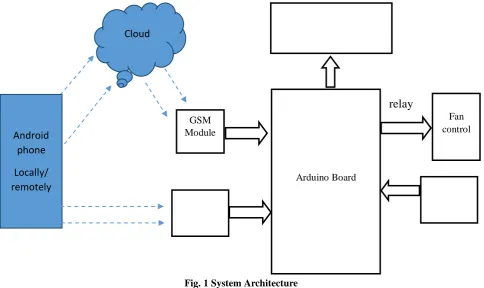
The IoT based Home Automation system implemented in this work usesarduinonano, ESP8266 Wi-Fi module, GSM module, temperature sensor, LCD screen and connecting wires [1]. See figure 1.
Fig. 1 System Architecture
The ArduinoNano board is the micro controller, that connects all other components of the system, C/C++ programs were written to configure the pins of the microcontroller to allow different components to work perfectly on it.
The Wi-Fi Module: ESP8266 WIFI module was considered because of its availability and cost. The Wi-Fi module helps to connectto the system locally via Wi-Fi connection. The Wi-Ficonnection was set up to connect automatically to hotspots and communicate through IP address.
GSM Module:Since the design was meant to be controlled locally and remotely, inclusion of GSM module allows internet connectivity, the module uses a configured network setting.
Temperature Sensor:Sensor takes the temperature reading of the immediate environment and send signal to the micro controller to actuate the device.
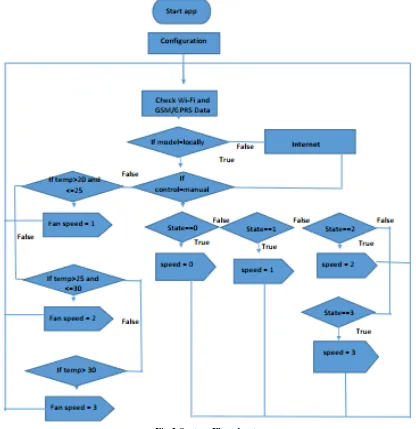
LCD 16X2screen display the speed state of the fan and the temperature reading at every instance of time. Figure 2 shows flow chart of the system operation.
ISSN(E): 2277-128X, ISSN(P): 2277-6451, pp. 46-51
Fig.2 System Flowchart
IV. SYSTEM IMPLEMENTATION
A. Hardware Implementation
The different hardware components are connected first on a bread board based on the design and tested to confirm the connection and later moved to Vero board. Componentsare added one after the other after a successful test of already connected components.Connection of components on bread board includes temperature sensor, LCD screen, Wi-Fi module, GSM module. See Wi-Figure 3.
Boyinbode et al., International Journal of Advanced Research in Computer Science and Software Engineering 8(11) ISSN(E): 2277-128X, ISSN(P): 2277-6451, pp. 46-51 All the components are moved to Vero board and a power adaptor is added to the micro controller pack to tap current from the fan and make supplies to the entire board. Another wire is connected to the live of the relay, while the remaining three wires connects for each of the speed, the relay digitally switch between the speed base on the voltage supplied 180volts, 200volts and 220volts.
B. Software Implementation
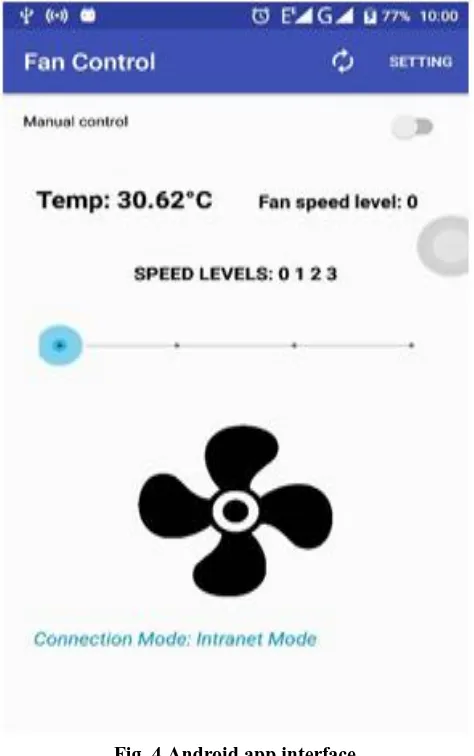
The software was designed using java android studio, the application (app) was designed to allow manual and automatic control over Wi-Fi and internet. Manual and automatic control to allow update of fan state based on the temperature generated by the temperature sensor. Once launched, the app will automatically create a hotspot connection to allow the Wi-Fi module to connect to the arduino board using an Internet protocol (IP), the application has a setting menu where the IP address will be inputted. This allows the app to send data to the board to update the fan.The manual control allows user to change the speed of the fan from 0 state (off) to 3 which is the highest speed. See figure 4.
Fig. 4 Android app interface
The instruction is received and given by the server scripting written in PHP, the PHP code get the state of the fan, if manually controlled and also update the state if automatically controlled i.e based on the sensor temperature reading.
The arduino code written in C++ was used to set all the pins and configure the attached component (LCD, sensor, GSM module and Wi-Fi module). Also the arduino also handles instruction from the application software and the internet based on manual or automatic control.
C. Testing:
ISSN(E): 2277-128X, ISSN(P): 2277-6451, pp. 46-51
Fig. 5 Connected Components on FAN
The response time also varied with internet strength.See Table 1. The users’ views about the flexibility of the system were measured using 0-10 rating and the results are listed in table 1.
Table 1 Table Showing the Responses of the System on Different Android Devices USER CONNECTIVITY TIME RESPONSE TIME FLEXIBILITY
Locally Remotely Locally Remotely
User 1 10sec 15sec 0.5sec 41sec 8
User 2 11sec 16sec 0.6sec 39sec 9
User 3 10sec 22sec 0.9sec 45sec 7
User 4 10sec 20sec 0.5sec 32sec 9
User 5 9sec 18sec 0.6sec 29sec 9
User 6 10sec 15sec 0.8sec 40sec 7
User 7 10sec 16sec 0.5sec 36sec 8
User 8 11sec 18sec 0.6sec 38sec 8
User 9 11sec 22sec 0.7sec 38sec 7
User 10 10sec 21sec 0.6sec 35sec 9
Comparing user 1 and user 5, the overall processing time varied based on the type of devices in use.
V. CONCLUSION
All electrical appliances in the house, offices and factories can be controlled from anywhere in the world and they can be made to act smartly based on a level of intelligence.
This work focused on home automation using internet of things (IoT) technology to aid flexibility and to improve user experience. Based on different android devices deployed, processing time was minimal and the user interface was friendly enough to use.
REFERENCES
[1] Anilkumar B, Lakshmidevi N, PraneethChoudary Home Automation through Smart Phone Using Esp8266
Boyinbode et al., International Journal of Advanced Research in Computer Science and Software Engineering 8(11) ISSN(E): 2277-128X, ISSN(P): 2277-6451, pp. 46-51 [2] Chung, C.C., Huang, C.Y., Wang, S.C. and Lin, C.M., 2011, December. Bluetooth-based Android interactive applications for smart living.In Innovations in Bio-inspired Computing and Applications (IBICA), 2011 Second International Conference on (pp. 309-312).IEEE.
[3] Colak I, Demirbas S, Sefa I, Irmak E, Kahraman HT. Remote controlling and monitoring of HVAC system over
Internet. Journal of science and industries research vol 67, September 2008, pp.680-684
[4] Felix, C. and Raglend, I.J., 2011, July. Home automation using GSM.In Signal Processing, Communication, Computing and Networking Technologies (ICSCCN), 2011 International Conference on (pp. 15-19).IEEE.
[5] Gubbi J, Buyya R, Marusic S, Palaniswami M. Internet of Things (IoT): A vision, architectural elements, and
future directions. Future generation computer systems. 2013 Sep 1;29(7):1645-60.
[6] Liu Y. Study on Smart Home System Based on Internet of Things Technology, In Informatics and Management