Available online throug
ISSN 2229 – 5046
SIMULTANEOUS EFECTS OF HALL CURRENT THERMAL DIFFUSION AND CHEMICAL
REACTION ON MHD CONVECTION FLOW PAST A VERTICAL PLATE
M. ANIL KUMAR
1*, N. VENKATESH
11
Department of Mathematics,
Anurag Group of Institutions, Venkatapur, Ghatkesar, RR District, Telangana, India.
(Received On: 23-08-16; Revised & Accepted On: 12-09-16)
ABSTRACT
T
he objective of this paper is to investigate the combined effects of Hall current, thermal diffusion and chemical reaction effects on MHD free convective flow past a vertical porous plate with heat and mass transfer. Here we considered Darcy resistance into account and constant permeability of the medium numerically and neglecting induced magnetic field in comparison to applied magnetic field. The momentum, energy, and concentration equations derived as coupled second-order, ordinary differential equations and are solved numerically using a highly accurate and thoroughly tested finite element method (FEM). The velocity, temperature and concentration profiles are presented graphicallyKeywords: MHD flow, porous medium, Thermal diffusion, Finite element method.
INTRODUCTION
Free convection flows past a vertical surface or plate were studied extensively in the literature due to its applications in engineering and environmental processes. The heating of rooms and buildings by the use of radiators is a familiar example of heat transfer by free convection. Heat losses from hot pipes, ovens etc surrounded by cooler air, are at least in part, due to free convection. The problem of heat transfer in a vertical channel has been studied in recent years as a model for the re-entry problem. This is due to the significant role of thermal radiation in surface heat transfer when convection heat transfer is similar, particularly in free convection problems involving absorbing emitting fluids. In view of these applications many researchers have studied MHD free convective heat and mass transfer flow in a porous medium, some of them are Raptis and Kafoussias [1].
The Hall effect is the making of a the conductor and an electromagnetic field is perpendicular to the current. It is found by development of magnetohydrodynamics application is toward a strong magnetic field and toward a low density of the gas. Under this condition, the Hall current becomes important. That importance studied by many researchers. Recently Srinivasa raju et al. [2] analyzed the influence of hall current, thermal diffusion and diffusion thermo on magnetohydrodynamic fluid flow past an infinite moving vertical plate using finite element method.
Ming-chun et al. [3] took an account of the thermal diffusion and diffusion-thermo effects, to study the properties of the heat and mass transfer in a strongly endothermic chemical reaction system for a porous medium. Gaikwad et al. [4] investigated the onset of double diffusive convection in a two component couple of stress fluid layer with Soret and Dufour effects using both linear and non-linear stability analysis. Osalusi et al. [5] investigated thermo-diffusion and diffusion-thermo effects on combined heat and mass transfer of a steady hydromagnetic convective and slip flow due to a rotating disk in the presence of viscous dissipation and Ohmic heating. Shateyi [6] investigated thermal radiation and buoyancy effects on heat and mass transfer over a semi-infinite stretching surface with suction and blowing.
Corresponding Author: M. Anil Kumar
1*, 1Department of Mathematics,
In recent years, progress has been considerably made in the study of heat and mass transfer in MHD flows due to its application in many devices, like the MHD power generators and Hall accelerators. Magnetohydrodynamic free convection finds applications in fluid engineering problems such as MHD pumps, accelerators and flow meters, plasma studies, nuclear reactors, geothermal energy extraction, etc. et.al [7] discussed the Analytical and Numerical study of unsteady MHD free convection flow over an exponentially moving vertical plate with Heat Absorption. Pal and Talukdar [8] analyzed the combined effect of mixed convection with thermal radiation and chemical reaction on MHD flow of viscous and electrically conducting fluid past a vertical permeable surface embedded in a porous medium is analyzed.
The objective of the present paper is to study the thermal diffusion and chemical reaction effects on unsteady magneto hydro dynamic flow of stratified viscous fluid.
Formulation of the problem
The study of Heat and Mass Transfer Thermal Diffusion Effect on MHD Free Convection Flow of Stratified Viscous Fluid with assumptions of temperature of plate is constant. Viscous and Darcy’s resistance terms are taken into account with constant permeability of the medium. The suction velocity normal to the plate is constant.
(
V
′
= -u0) (Boussinesq approximation is valid)We considered a system of rectangular co-ordinates O(
x
′
,
y
′
,
z
′
) where asy
′
=
0
on the plate and leading edge isz
′
axis. The density variation with temperature is considered while of all fluid properties remain constant. Due to the influence of density variation in the terms of the momentum and the energy equation and the variation of the expansion coefficient with temperature is neglected.Continuity equation:
0
=
′
∂
′
∂
y
V
(1) Momentum equation: 2 2 1 *2
(
)
(
)
2(1
)
O
B
u
u
u
V
g
T
T
g
C
C
u
t
y
y
m
K
σ
ν
ν
β
β
ρ
∞ ∞′
′
′
∂
′
∂
∂
′
′
′
′
+
=
+
−
+
−
−
+
′
′
′
′
∂
∂
∂
+
(2)Energy Equation: 2 2
y
T
c
k
y
T
V
t
T
p
∂
′
′
∂
=
′
∂
′
∂
′
+
′
∂
′
∂
µ
ν
(3) Diffusion equation:)
(
* 2 2 1 2 2 ∞′
−
′
−
′
∂
′
∂
+
′
∂
′
∂
=
′
∂
′
∂
′
+
′
∂
′
∂
C
C
Kr
y
C
D
y
C
D
y
C
V
t
C
(4)Where
C
p-specific heat at constant pressure,g
-Gravity due to Acceleration, k-Thermal conductivity,T
′
-Temperature of the fluid at the plate,T
∞′
-temperature of the fluid at infinity, m is the hall current parameter.u
′
,v
′
are the Velocity components,ρ
- Density of the fluid,ν
-Kinematic viscosity,β
andβ
*-the thermal and concentration expansion coefficient respectively, B0-magnetic induction, D is the concentration diffusivity,K
′
-the permeability of the porous medium,C
′
-is the dimensional concentration,C
∞′
-is the concentration of free stream,µ
-coefficient of viscosity, D1-the thermal diffusivity.Kr*-chemical reaction factor and m is the hall current parameter.The boundary conditions for the velocity, temperature and concentration fields are:
0
=
′
u
,T
′
=
T
w′
,C
′
=
C
′
w aty
′
=
0
∞∞
′
′
→
′
→
′
→
′
T
T
C
C
In order to write the governing equations and boundary condition in dimension less form the following non dimensional quantities are introduced.
u= o
u
u
′
, V= 0u
V
′
, t=ν
2 ou
t
′
, y=ν
0u
y
′
,
θ
=∞ ∞
′
−
′
′
−
′
T
T
T
T
w , ∞ ∞′
−
′
′
−
′
=
C
C
C
C
C
w, Gr =
3 0
)
(
u
T
T
g
β
w′
−
∞′
ν
, K= 2 2 0ν
K
u
′
, Pr =
k
c
pµ
, M = 2 0 2 2 0)
1
(
m
u
B
+
ρ
ν
σ
, Sc =
D
ν
Kr = 2 0 *
u
K
rν
, A=
ν
)
(
)
(
1 ∞ ∞′
−
′
−
C
C
T
T
D
w wNo =
)
(
)
(
* ∞ ∞′
−
′
′
−
′
T
T
C
C
w wβ
β
(6)where Pr is the Prandtl number, Gr is the Grashof number, No is the buoyancy ratio, Sc is the Schmidt number, M is
the magnetic parameter, K is the permeability parameter,A is the Thermal Diffusion parameter, Kr is the chemical reaction parameter.
In view of (6), the equations (2), (3), (4) reduced to the following dimensionless form
2 2
1
,
O
u
u
u
Gr
N C
M
u
t
y
θ
y
K
∂
−
∂
=
+
+
∂
−
+
∂
∂
∂
(7)2 2
Pr
1
y
y
t
∂
∂
=
∂
∂
−
∂
∂
θ
θ
θ
(8) 2 2 2 2
1
y
A
KrC
y
C
Sc
y
C
t
C
∂
∂
+
−
∂
∂
=
∂
∂
−
∂
∂
θ
(9)And these corresponding boundary conditions are
t > 0: u=0, θ=1, C=1 at y=0,
u
→
0
,
T
→
0
,
C
→
0
as y→
∞
(10)NUMERICALSOLUTIONUSINGFINITEELEMENTMETHOD
Finite element technique is used to solving the non-dimensional momentum and energy equations (7) (8) and (9) along with the imposed boundary conditions (10).
The Galerkin expression for the differential equation (7) becomes
0
) ( ) ( ) ( 2 ) ( 2=
+
−
∂
∂
+
∂
∂
−
∂
∂
∫
Ru
P
dy
y
u
t
u
y
u
N
e e e e T y y k jWhere
[
]
=
=
k j T k j TN
N
N
N
N
, R=M+K
1
, P =
(
G
r)
T
+
(
G
r)
N
oC
;Let the linear piecewise approximation solution
k k j j k k j j e
u
N
u
N
t
u
y
N
t
u
y
N
u
( )=
(
)
(
)
+
(
)
(
)
=
+
The element equation is given by
' ' ' ' ' '
' ' ' ' ' '
k k k
j j j
y y y
j j j k j j j j k j j j k j
j
y j k k k k y j k k k y j k k k k
k
N N
N N
u
N N
N N
u
N N
N N
u
dy
dy
dy
u
u
N N
N N
N N
N N
N N
N N
u
• •
+
−
∫
∫
∫
+ R k j yj j j k j
y j k k k k
N N
N N
u
dy
u
N N
N N
∫
= Pdy
N
N
k j y y k j
∫
Where prime and dot denotes differentiation w.r.t. ‘y’ and ‘t’ respectively Simplifying we get
2 ( )
( )
1
1
2
1
1 1
2
1
1
1
1
1
1
1
6
1
2
2
1 1
6
1
2
2
1
j
j j j
e e
k k k
k
u
u
u
R
u
P
l
u
u
u
l
u
• •
−
−
+
−
+
=
−
−
where
l
y
ky
jh
e)
=
−
=
In order to get the differential equation at the knot xi, we write the element equations for the elements yi-1 ≤ y ≤ yi and
yi ≤ y ≤ yi+1 assemble two element equations, we obtain
2
1
1 1 1
( ) ( )
1 1 1
1
1
1
0
2 1 0
1
1
0
2 1 0
1
1
1
(1)
1
2
1
1 4 1
1
0
1
1 4 1
2
6
2
6
2
0
1
1
0 1 2
0
1 1
0 1 2
1
i
i i i
i
i e i i
e
i i i
i
u
u
u
u
R
P
u
u
u
u
l
l
u
u
u
u
• − − • − − • + + + +
−
−
−
−
+
−
−
+
=
−
−
We put the row equation corresponding to the knot ‘i’, is
[
]
[
u
u
]
R
[
u
u
u
]
P
l
u
u
u
u
u
u
l
e i i i i ii i i i i i
e
−
−
+
+
+
+
=
+
+
+
−
+
−
+ − + − + • • − • +−1 1 1 1 ( ) 1 1 1 1
)
(
2
6
4
)
1
(
4
6
1
2
1
2Applying Crank-Nicholson method to the above equation then we get
Pk
u
A
u
A
u
A
u
A
u
A
u
A
inn i n i n i n i n
i 4 1 5 6 1
24
1 1 3 1 2 1 1
1
+
+
=
−+
+
++
+ + +
+
−
Where A1 = 2 + (3*r*h)+ (R*k) – (6*r); A2 = (4*R*k) + (12*r) + 8; A3 = 2 + (R*k) – (6r) – (3*h*r);
A4 = 2 – (R*k) –(3*r*h) + (6*r); A5 = 8 – (4*R*k) – (12*r); A6 = 2 – (R*k) + (3*r*h) +( 6*r); (11)
P
=
(
G
r)
T
ij+
(
G
r)
N
oC
ij;Applying similar procedure to equation (8), we get
1 1 1
1 1 2 3 1 4 1 5 6 1
n n n n n n
i i i i i i
B T
−++
B T
++
B T
++=
B T
−+
B T
+
B T
+ (12)B1= (2*Pr)+(3*(Pr)*r*h)-(6*r); B2=(8*Pr)+(12*r); B3=(2*Pr)-(3*(Pr)*r*h)-(6*r);
B4= (2*Pr)-(3*(Pr)*r*h)+(6*r); B5=(8*Pr)-(12*r); B6=(2*Pr)+(3*(Pr)*r*h)+(6*r);
Applying similar procedure to equation (9), we get
1 1 1
1 1 2 3 1 4 1 5 6 1
n n n n n n
i i i i i i
J C
−++
J C
++
J C
++=
J C
−+
J C
+
J C
+ (13)J1=(2*Sc)+(3*Sc*r*h)-(6*r)+(Kr*Sc*k); J2=(8*Sc)+(12r)+(4*Kr*Sc*k); J3=(2*Sc)-(3*Sc*r*h)-(6*r)+(Kr*Sc*k);
J4=(2*Sc)-(3*Sc*r*h)+(6*r)-(Kr*Sc*k); J5=(8*Sc)-(12r)-(4*Kr*Sc*k); J6=(2*Sc)+(3*Sc*r*h)+(6*r)-(Kr*Sc*k);
Where Here r = 2
h
k
and k, h are mesh sizes along y- direction and time-direction respectively index ‘i’ refers to
space and ‘j’ refers to time .The mesh system consists of h=0.1 and k=0.001.
In the equations (11), (12), and (13), taking i = 1(1) n and using boundary conditions (10), then we get the following system of equations are obtained:
Ai
X
i=
B
i for i=1(1)nWhere Ai’s are matrices of order n and Xi, Bi’s are column matrices having n-components. The solutions of above
RESULTS AND DISCUSSION
Figure 1: Velocity Profiles for different values of Sc when Gr=2, K=100, M=0.02, Pr=0.71, Kr=1.0, A=0.2, No=1.5.
Figure 2: Velocity Profiles for different values of Pr when Gr=2, K=100, M=0.02, Sc=0.22, Kr=1.0, A=0.2, No=1.5.
Figure 4: Velocity Profiles for different values of A when Pr=0.71, K=100, M=0.02, Sc=0.22, Kr=1.0, Gr=0.2 No=1.5
Figure 5: Velocity Profiles for different values of Kr when Pr=0.71, K=100, M=0.02, Sc=0.22, A=0.2, No=1.5
Figure 7: Temperature Profiles for different values of Kr when Gr=2.0, K=100, M=0.02, Sc=0.22, Pr=0.71, A=0.2, No=1.5
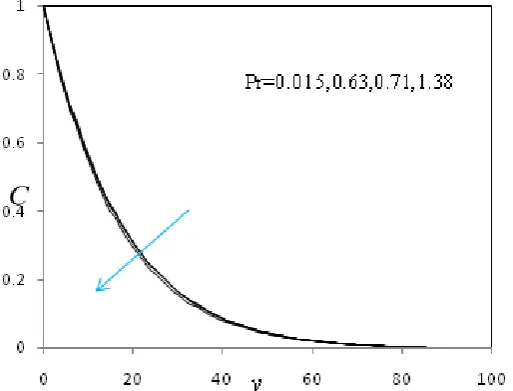
Figure 8: Concentration Profiles for different values of Sc when Gr=2.0, K=100, M=0.02, Kr=1.0, A=0.2, No=1.5
Figure 10: Velocity Profiles for different values of A when Pr=0.71, K=100, M=0.02, Sc=0.22, Kr=1.0, Gr=0.2 No=1.5
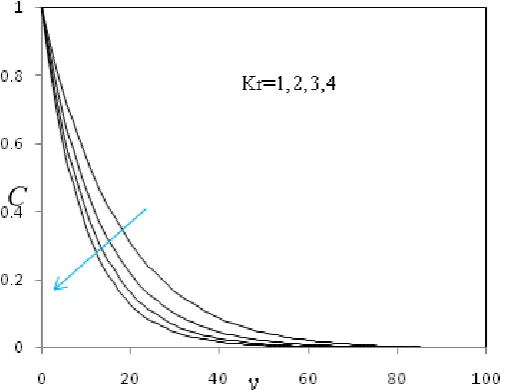
Figure 11: Concentration Profiles for different values of Kr when Gr=2.0, Sc=0.22, K=100, M=0.02, Pr=0.71 A=0.2, No=1.5.
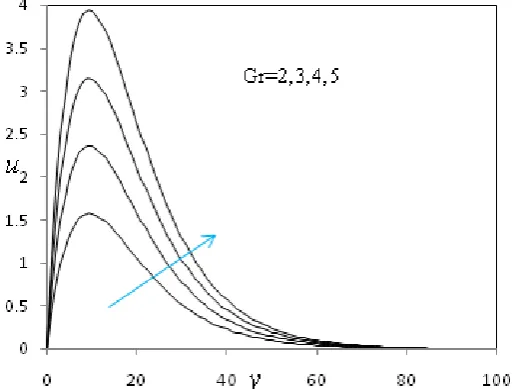
Velocity distribution of fluid flow is plotted from Figure1 to 5.
From Figure 1 It is clearly observed that Velocity decreases with an increase of Schmidt number. The following values of Schmidt number Sc=0.22 (Helium), 0.66 (Ammonia and Water Vapour), 0.83(oxygen), 1(carbon dioxide) are considered to plot the Figure 1.
The velocity profile for different values of Prandtl number (Mercury (0.015), oxygen (0.63), Air (0.71, ammonia (1.38)) is plotted in Figure 2 and it is found that velocity decreases with an increase of Prandtl number.
From the Figures 3 to 5It is also observed that velocity increases with the increase in Gr, &Thermal diffusion parameter A, velocity decreases with an increase in chemical reaction parameter Kr.
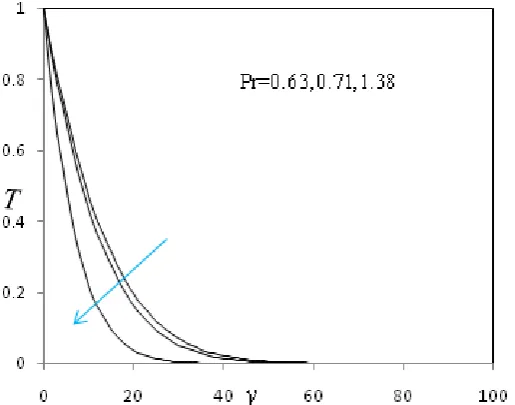
Temperature distribution of fluid flow is plotted in Figure 6 and 7.we observed that the temperature does not fluctuate with change in Gr(Grashof number) and A (Thermal Diffusion parameter) and Sc(Schmidt number). Temperature decreases with an increase in Prandtl number (Pr) and Chemical Reaction parameter (Kr).
CONCLUSION
In this paper we have studied the Thermal diffusion and chemical reaction effects on MHD Free convective flow of stratified viscous fluid with heat and mass transfer. From present numerical study the following conclusions can be drawn
1) The velocity increases with the increase of Gr.
2) The velocity and concentration decreases with an increase in Schmidt number.
3) The velocity and concentration increases with an increase in the thermal diffusion parameter. 4) Increasing the prandtl number substantially decreases the velocity and the temperature profiles. 5) The velocity as well as concentration decreases with an increase in the chemical reaction parameter.
REFERENCES
1. A. Raptis N.G Kafoussias, Magneto hydrodynamic free convection flow and mass transfer through porous medium bounded by an infinite vertical porous plate with constant heat flux, Can. J. Phys, 60(12), pp.1725-1729, 1982.
2. K. Sudhakar, R. Srinivasa Raju, M. Rangamma, Chemical reaction effect on an unsteady MHD free convection flow past an infinite vertical accelerated plate with constant heat flux, thermal diffusion and diffusion thermo, International Journal of Modern Engineering Research, Vol. 2, Issue 5, pp. 3329 – 3339, 2012.
3. Ming-chun, LI., Yan-Wen, T., and Yu-Chun, Z., (2006). Soret and Dufour effects in strongly endothermic chemical reaction system of a porous medium. Trans. Nonferrous Met. Soc. China, 16, 1200-1204.
4. Gaikwad, S.N., Malashetty, M.S., and Prasad, K.R., (2007). An analytical study of linear and nonlinear investigated double diffusive convection with Soret and Dufour effects in coupled stress fluid. International journal of nonlinear mechanics, 42, 903-913.
5. Osalusi, E., Side. and Harris R., (2008). Thermal-diffusion and diffusion-thermo effects on combined heat and mass transfer of steady MHD convective and slip flow due to a rotating disk with viscous dissipation and Ohmic heating. International Communications in Heat and Mass Transfer, 35, 908-915.
6. Shateyi, S., (2008). Thermal radiation and buoyancy effects on heat and mass transfer over a semi-infinite stretching surface with suction and blowing. Journal of Applied Mathematics, doi:10.1155/2008/414830.
7.
Analytical and Numerical study of unsteady MHD free convection flow over an exponentially moving vertical plate with Heat Absorption
8. Pal, D., and Talukdar, B., (2009) Buoyancy and chemical reaction effects on MHD mixed convection heat mass transfer in a porous medium with thermal radiation and ohmic heating. Comm. Nonlinear Sci Numer Simulat., doi:10.1016/j.cnsns.2009.10.029.
9. N .Pandya and A,K, Shukla, soret Dufour and radiation effects on unsteady MHD flow past an impulsively started inclined porous plate with variable temperature and Mass diffusion. Int. J. of Mathematics and Scientific Computing. (ISSN:2231-5330) Vol 3, No2, 2013.
Source of support: Nil, Conflict of interest: None Declared